We have a brand new updated website! Click here to check it out!

Beat summer heat safely during the holiday weekend

KDWPT

PRATT – The July fourth holiday usually means three things for Kansans: fireworks, BBQ, and of course, open water. Make this holiday everything it should be, including safe, by keeping the following things in mind while on and around water.

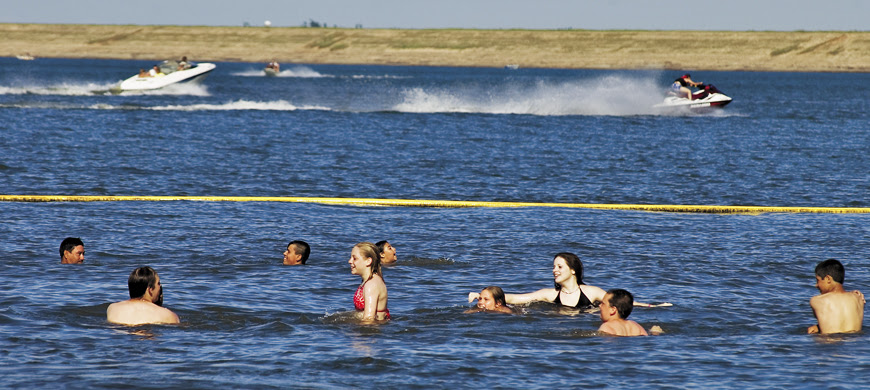
  • -State park beaches do not have lifeguards. Parents should keep a close eye on youngsters and it’s a good idea to strap little ones into properly-fitting life jackets. A toddler can disappear in an instant on a crowded beach. Older kids love to play on inflatable water toys but care must be exercised under windy conditions. A stiff Kansas wind blowing out from the beach can sweep floaters away from shore surprisingly fast.
  • -Over the holiday weekend, reservoirs will be busy and Kansas Department of Wildlife, Parks and Tourism (KDWPT) boating officers will be out keeping waters safe. Familiarize yourself with boating regulations and safety requirements, especially those concerning life jackets, ahead of time. Children age 12 and younger must wear a properly-fitting life jacket while on the boat, and there must be a serviceable life jacket readily accessible for everyone older than 12 onboard. KDWPT strongly encourages everyone on the boat to wear life jackets at all times while on the water.
  • While boating accidents aren’t common on Kansas waters, they do have a common theme: alcohol. Sun, waves and heat exacerbate the effects of alcohol on judgment and coordination. Anyone planning on driving a boat should know that boating under the influence (BUI) is against the law.
  • Weather conditions can change quickly as summer thunderstorms build and bring high winds. Know the forecast, watch the sky, and check weather updates periodically while at the lake to prevent being caught by surprise miles from a boat ramp.

Water recreation at Kansas state parks is safe and getting safer, but there is always some risk. However, if you make just a few precautions routine, you can ensure that your family has fun and stays safe this holiday and summer season.

Bullfrog season opens July 1

KDWPT

PRATT – Bullfrogs: big, green, bellowing creatures of the pond. They’re a common sight in Kansas, and more so a common sound at night. A bullfrog’s call seems to say “summer is here,”

and what better way to celebrate the season than to catch these water-loving acrobats with friends and family. The Kansas bullfrog season will be open from July 1-October 31. The daily limit of bullfrogs is eight and the possession limit is 24.

Frogging is a great way to cool off after a hot summer day, but first you need to locate a good waterhole. You can do this by listening for bullfrog croaks during the evenings. The more you hear, the better it will be. Next, you’ll need some simple gear. A burlap sack or fish basket to hold your frogs, old tennis shoes for wading, a quick pair of hands, and a flashlight or headlamp. Lastly, you’ll need a fishing license, unless exempt by law. That’s it, you’re ready to catch frogs. You can stick to using your hands (it’s the most fun), or you can opt for other legal methods such as hook and line, dip net, gig, or bow and crossbow (a line must attach the bow to the arrow and the arrow must have a barbed head).

While frogs can be caught during the day, most frogging is done at night. Stealth is required because whichever method you select, you must get close. Frogs’ eyes shine in a flashlight beam and the light seems to freeze them in place. However, your approach still needs to be slow and careful. Heavy footfalls on shore or ripples in the water will send the frog hopping, light or no light.

The ultimate challenge is to catch the frog by hand, which requires a low, quiet approach from behind, then a lightning snatch. Aim to grab the frog mid-body, just in front of the rear legs. It’s good fun, especially for kids; staying up past bedtime, wading in the shallows and getting really muddy on a warm summer night – it’s a 12-year-old’s dream!

Apart from providing some summertime fun, frog legs are wonderful table fare. Try yours dipped in batter and fried. After all, eating them is the next best thing to catching them.

Woman formerly in Kansas foster care selected for Congressional internship

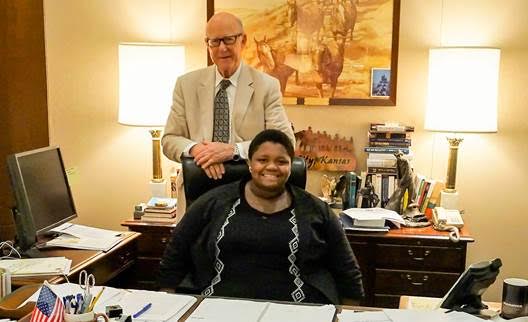
Alexandria Ware with U.S. Senator Pat Roberts, Washington, D.C.

DCF

TOPEKA –A young women, formerly in Kansas foster care, was recently selected for an internship with the Congressional Coalition on Adoption Institute (CCAI). Alexandria Ware, 24, was one of 12 young professionals selected to participate in the CCAI’s Foster Youth Internship Program. Through the program, Ware gained a summer internship with the U.S. House Committee on Ways and Means.

Prior to acquiring this congressional internship, Ware was a successful participant in the Kansas Department for Children and Families’ (DCF) Independent Living program in the Wichita Region. During that time, she was also an active member in the Kansas Youth Advisory Council (KYAC) and the Regional Youth Advisory Council (RYAC).

Ware graduated in May 2016, with a bachelor’s degree in Family Studies and Human Services, with a minor in Conflict Analysis and Trauma Studies from Kansas State University, while utilizing DCF’s Independent Living services. She also received a certificate in Conflict Analysis and Trauma Studies, as well as a certificate in Non-violent studies. Ware is currently a graduate student at Oklahoma State University-Tulsa, pursuing a master’s degree in Human Development and Family Science.

“Alexandria is setting a wonderful example for Kansas youth from foster care,” DCF Secretary Phyllis Gilmore said. “She is demonstrating how perseverance, hard work and dedication are the keys to success, no matter the trauma one experiences early in life.”

She co-founded Fostering Success, a program that seeks to provide college students in or exiting from the foster care system with resources and skills, along with connections to mentors.

Her goal is to advocate for those in foster care with the hope of establishing a center where youth in foster care will have access to tutoring, mentoring and assistance for future college admissions.

CCAI is a non-profit organization that “works to raise awareness about the needs of children without families and to remove policy barriers that hinder children from knowing the love and support a family provides.”

Currently, there are nearly 7,000 children in foster care in Kansas. DCF serves as the State social service agency, providing oversight for the well-being of children and their families. In May, DCF released a new Foster Care Recruitment Campaign designed to recruit foster families, provide support to current foster families and increase the public’s awareness about the need for temporary, stable homes for children coming into care in Kansas. If you would like to learn more about this campaign, visit fosterkskids.org.

Learn more about services available to youth aging out of Kansas foster care at Independent Living. You can also read more about Ware and the CCAI at https://ccainstituteblog.org/.

Boating Under The Influence is serious offense and deadly

KDWPT

PRATT – You know “your limits,” you’ve never been in an alcohol-related accident before, and you could handle your boat with a blindfold on. You figure it’s summertime, the weekend, and time to relax and knock back a few. But that good time that you’re after can quickly turn tragic no matter how well you think you can hold your liquor. This summer season, don’t put yourself, those onboard, and other boaters in harms way by boating under the influence – it’s not worth the risk.

Alcohol use is still the leading known contributing factor in fatal boating accidents. And there’s a difference between drinking on land and drinking in a boat. Sun, wind, noise, vibration, and motion – “stressors” common to the boating environment – intensify the side effects of alcohol, drugs, and some medications.

According to the National Association of State Boating Law Administrators, July recorded the highest number of recreational boater accidents and deaths nationwide in 2016, with the second highest in June. Don’t become a part of those statistics. Kansas Department of Wildlife, Parks and Tourism boating law enforcement officers will be on patrol during the July 4 holiday weekend as part of Operation Dry Water, a nationwide campaign to raise awareness of boating under the influence. Officers will administer breathalyzer blood alcohol tests, and if you blow a blood alcohol content of .08 percent or more, you will be given a boating under the influence citation and lose your boating privileges.

If you suspect someone is boating under the influence, contact 911 immediately and provide the operator with the location, the suspect’s boat registration numbers, and a complete description of the operator and passengers.

For information on boating in Kansas, including regulations and registration information, visit ksoutdoors.com/Boating.

Keep kids safe from summer fire safety hazards

KANSAS FIRE MARSHAL

TOPEKA – Grilling on the barbecue and campfires are great ways to spend quality time outdoors in the summertime. Summer is also a season when kids spend a great deal of time home alone and need to be taught the importance of fire safety.

It’s important to remember any fire can cause serious injuries to children. In fact, summer is the season when there is an increase in visits to the emergency room due to fire and burn injury. Safe Kids Kansas and the Office of the State Fire Marshal (OSFM) remind families to take simple precautions which will prevent “What I Did This Summer” stories from including trips to the emergency room.

Preventing “Home Alone” Disasters

Bored kids at home alone over the summer can injure themselves or cause severe fire damage to their homes by playing with fire or even when cooking their meals on the stove. Parents need to talk to their kids about fire dangers and create and practice an escape plan, which includes two ways out of every room.

Kids should be taught to crawl low to the ground and be able to evacuate the home within two minutes, then call 911 from outside the home with a cell phone or at a neighbor’s house.

To prevent fires from occurring in the first place, parents should hide all matches and lighters and teach their children to practice kitchen safety. It is safest for parents to prepare meals for their children or teach them to prepare their food that does not require the use of a stove. Kids that parents deem responsible enough to cook their meals should be taught cooking safety, such as staying in the kitchen and remaining attentive to any items on the stove, using a timer to prevent food from burning, and knowing how to use a lid to smother a flaming skillet.

Safe Grilling
Grilling food outdoors is a national summer pastime. But before lighting up the grill, know the facts and keep safety in mind. Grill fires at home are estimated to cause an average of 10 deaths, 100 injuries, and $37 million in property loss each year in the U.S.

Follow these grilling safety tips:
 Gas and charcoal grills should only be used outdoors.
 The grill should be placed away from the home, deck railings and out from under eaves and overhanging branches.
 Keep children and pets away from the grill area
 Keep your grill clean by removing grease or fat buildup from the grills and in trays below the grill to prevent flare ups.
 Never leave your grill unattended.

Fun and Safe Camp Fires
Many families enjoy camping during the summer months and making s‘mores around the campfire is often part of that tradition. Be fire smart when you head for the great outdoors, and be prepared to take extra precautions when you may be far from a water source.

Follow these campfire safety tips:
 Supervise children and keep them away from the fire.
 Teach kids how to stop, drop and roll if their clothing catches fire.
 Keep plenty of water nearby and have a shovel for throwing sand or dirt on the fire if it gets out of control.
 Never leave a campfire unattended.

When extinguishing the fire, drown it with water. If you do not have water, use dirt. Continue adding and stirring until all material is cooled. However, do not bury coals, as they can smolder and start to burn again.

For more information about fire safety, visit www.safekids.org or www.firemarshal.ks.gov/firesafety.

Sen. Moran’s VA Accountability legislation signed into law

U.S. Sen. Jerry Moran, R-KS

OFFICE OF SEN. MORAN

WASHINGTON – U.S. Senator Jerry Moran (R-Kan.) today applauded the signing of the Department of Veterans Affairs Accountability and Whistleblower Protection Act into law. This spring, Sen. Moran joined U.S. Senators Johnny Isakson (R-Ga.), Marco Rubio (R-Fla.), Jon Tester (D-Mont.) and John McCain (R-Ariz.) to introduce this legislation, which passed the Senate and House of Representatives this month. Sen. Moran released the following statement after the bill signing:

“Since the disturbing reports of veterans being neglected and mistreated across the country and in Kansas, I have been committed to developing legislation that gives the VA authorities to hold bad actors accountable while protecting veterans and VA whistleblowers who are trying to do what is in the best interest of our nation’s heroes. I am pleased the President signed this bipartisan legislation that I spearheaded to ensure the VA supports hardworking employees who care deeply about our veterans, and removes those few bad actors who fail to perform their duties in service to veterans.

“Many Kansans are familiar with the alarming case at the Leavenworth VA where a VA employee who stands accused of abusing the veterans he was supposed to serve and was allowed to retire and can now collect benefits from the VA. We must make certain this kind of injustice never happens again, which is why I added a provision in this bill with strong consequences for VA employees and their benefits when they are convicted of a felony against veterans or related to their employment. This law is a step forward for our veterans and one of many changes the VA must make if they are going to earn back the trust of veterans and provide them with the care they have earned and deserve.”

Background on the Department of Veterans Affairs Accountability and Whistleblower Protection Act:
The Department of Veterans Affairs Accountability and Whistleblower Protection Act increases the VA’s authority to remove employees at all levels of the department, shortens the removal process and ensures an individual removed from the VA is not kept on the VA’s payroll while appealing that decision. It will also make it easier for the VA to remove poorly performing senior executives and replace them with qualified candidates. Additionally, any appeals by senior VA executives would no longer be brought before the Merit Systems Protection Board, but instead would be handled directly by the VA secretary under an expedited timeline.

The Department of Veterans Affairs Accountability and Whistleblower Protection Act will establish in law the newly created Office of Accountability and Whistleblower Protection within the VA.

The bill is widely supported by key veterans stakeholders including the VA and U.S. House of Representatives Veterans Affairs’ committee leadership. It has also won the support of numerous advocacy groups that represent millions of veterans in the United States and key government accountability groups. Read more about the legislation’s support here.

The legislation also includes a number of other provisions to hold employees accountable, including:

  • Requiring the VA to evaluate supervisors based on the protection of whistleblowers;
  • Incentivizing managers to address poor performance and misconduct among employees by requiring the VA secretary to include this as part of the annual performance plan;
  • Prohibiting bonuses for employees who have been found guilty of wrongdoing;
  • Prohibiting relocation expenses to employees who abuse the system.

Click on VA Accountability for a one-page summary of the legislation.


Administration, processes to change with insurance, securities departments’ realignment

KDI

TOPEKA — Ken Selzer, CPA, Kansas Commissioner of Insurance, is announcing administrative changes and joint working priorities regarding the July 1 transition of the Kansas Securities Commissioner’s office into a division of the Kansas Insurance Department (KID).

John Wine

Commissioner Selzer has named John Wine, current insurance department Assistant Commissioner, to be Securities Commissioner, subject to Kansas Senate confirmation. Wine, an attorney, has been with KID for eight years, serving as General Counsel and Assistant Commissioner.

Prior to working at the insurance department, Wine had been on the Kansas Corporation Commission, serving as chair for six years; had served as the Securities Commissioner in 1995-96; and had been Assistant Secretary of State.

Wine’s appointment as Securities Commissioner by Commissioner Selzer would run through Jan. 17, 2019, as specified in Senate Bill 23 legislation, which realigned the Securities Commissioner’s office with KID, effective at the beginning of the upcoming fiscal year.

“The law allows the Securities Commissioner to function as an independent state official with legislative approval,” Commissioner Selzer said. “This will provide Kansans with additional consumer protections going forward.”

“Thank you to outgoing Securities Commissioner Josh Ney for his service to the agency,” Commissioner Selzer added. “Our team will work with him as he assists with this transition during the next two months.”

Clark Shultz

Replacing Wine as Assistant Commissioner at KID is Clark Shultz, currently Deputy Commissioner. Shultz has served KID as Deputy Commissioner since 2015, after serving as a Kansas State Representative and Senator. His legislative duties included chairing the House of Representatives Insurance Committee and the Rules Committee.

“The professionalism and guidance of John and Clark will be invaluable as we move forward with streamlining and improving the processes of our combined agencies,” said Commissioner Selzer.

The insurance department has approximately 105 employees, while the securities office employs approximately 30. For the immediate future, both agencies will continue to be housed in their current Topeka offices.

With the restructuring of the agencies comes increased emphasis on finding ways to consolidate functions. Initial steps will be taken in the areas of consumer education, licensing and investigations, Commissioner Selzer said.

“Those three functions are integral to both agencies,” Commissioner Selzer said, “and we believe that we can begin the consolidation process by focusing on how we can find commonalities and cost savings in each area. In doing so, we can better protect the public, reduce costs and be more productive.”

Anti-fraud investigations to be enhanced with realignment of 2 state agencies

TOPEKA — On a national level, if insurance fraud was a business, it would be a Fortune 500 company, according to national reports. It is, by all accounts, the second largest economic crime in the United States; only tax evasion exceeds it.

“Statistics from the Coalition Against Insurance Fraud show that insurance fraud costs upwards of $80-120 billion annually across all lines of insurance,” said Ken Selzer, CPA, Kansas Commissioner of Insurance. “Most importantly, it can add hundreds of dollars to annual insurance premiums, because companies include that cost of doing business in the premiums you pay.”

This type of fraud concerns the intentional misrepresentation of facts and circumstances to an insurance company in order to obtain payment that would not otherwise be made. According to the Coalition, the illegal activity accounts for 5-10 percent of claims costs for United States and Canadian insurers.

Current schemes are identity theft, hacking, employee-agent activity, and claims. The reasons for committing fraud are as numerous as the people who commit it — the need for money for some legitimate (in their minds) or illegitimate activity, or maybe just plain greed.

But whatever the motivation, when the anti-fraud division of the Kansas Insurance Department (KID) receives a report of suspected fraud, the department investigators first make a determination about the alleged activity in terms of who should actually do the investigation, Commissioner Selzer said.

Some reports are clearly not insurance fraud and are placed with an appropriate outside investigative agency. Others are not insurance fraud but are consumer issues or market conduct issues that other divisions in KID could investigate.

Information from consumers is often forwarded to an insurance company’s special investigative unit, and some cases that are clearly violations of federal law are referred to a federal investigative agency, such as the FBI.

If the anti-fraud investigators determine that suspected fraud falls within the insurance law in Kansas Statutes, then the investigators interview witnesses, take statements and collect and analyze evidence, Commissioner Selzer said. Once everything is complete, they make a decision on the merit of the case by asking two simple questions: Was it really insurance fraud? Did the facts warrant a prosecution?

If the answers are Yes, then the investigators review the case with the KID In-House Special Assistant Attorney General to determine who prosecutes the case and where the case will be filed. This process involves the KID Legal Division and the Attorney General’s office.

“This process will be enhanced beginning July 1, when the Kansas Securities Commissioner’s office will realign as part of the Kansas Insurance Department,” said Commissioner Selzer. “The passage of the legislation to make that effective includes increased prosecutorial powers for the Attorney General and a collaboration of the combined agencies for more efficient anti-fraud investigations.”

Readers who suspect any type of fraudulent Kansas insurance activity should contact the KID Anti-Fraud Division by calling 1-800-432-2484.

First Artist INC workshop to be held in Salina

KCAIC

TOPEKA–After a successful pilot in Lawrence, the Kansas Creative Arts Industries Commission, through its partnership with the Mid-America Arts Alliance, is announcing additional Artist INC “What Works” workshops in communities throughout Kansas.

Artist INC is a regional cutting edge training program that empowers individual artists in all disciplines to take control of their careers by connecting them to the tools, resources, and opportunities necessary to develop their entrepreneurial skills and strengthen their artistic practice.

To learn more, go to the website Artist INC.

Artists, just like traditional small business owners, have to wear many hats—creator, fabricator, accountant, marketer, technologist, and more. And, just like traditional small business owners, artists can find this to be a daunting task. How do some artists make the leap to sustainable and profitable artistic practices? Through their work with over 500 artists (from musicians, to writers, to painters, to filmmakers), the Artist INC program has identified the common behaviors of successful artist entrepreneurs.

In their free What Works/What Doesn’t? Workshop, Artist INC presenters (all successful working artists) will share those behaviors and leave participating artists ready to apply them to their own art practice. The workshop includes a discussion of portfolio careers; goal setting and planning, communications strategy; financial planning. The last 30 minutes of the workshop is dedicated to audience needs.

Hosted by local arts organizations, the Artist INC What Works workshop will be available to artists in the following communities and surrounding areas in June:

Salina
5:30-7:30 p.m./Wednesday, June 28, 2017
Salina Art Center Warehouse, 149 S. 4th St.
Host: Salina Arts & Humanities
To register by June 27: What Works Salina

Wichita
6-7:30 p.m./Thursday, June 29, 2017
Harvester Arts, 215 N. Washington St.
Host: Harvester Arts

In addition to the above workshops, Artist INC programs include the Artist INC Live eight-week seminar that focuses on professional development and business training for emerging and mid-career artists. Gathering for one night a week for eight weeks, participants learn business skills specific to their art practice and how to apply those skills cooperatively with their peers. Using a ground breaking class design, artists learn and grow together through artist facilitator mentoring, small group application activities, as well as large group discussion and multi-media lecture.

Hosted by the Lawrence Arts Center in Lawrence, KS, artists in Douglas and Shawnee counties have recently completed their second year of Artist Inc Live.

To learn more: Artist INC Live Lawrence

If you have any questions about an individual program, please feel free to contact the host organizations directly.

KCAIC will schedule two additional workshops throughout the summer. To check on additional offerings as they are added: Artist INC Kansas.

Originally launched in 2007 as KCArtistLink, in partnership with ArtsKC, Charlotte Street Foundation, and the UMKC Innovation Center, Artist INC has expanded since 2013 through a collaborative partnership with Mid-America Arts Alliance to communities throughout the Midwest including Argenta and Springdale, Arkansas; Austin and Houston, Texas; Oklahoma City and Tulsa, Oklahoma; Omaha, Nebraska, and Lawrence, Kansas.

New Fatherhood Initiative launched by state agency

DCF

TOPEKA – The Kansas Department for Children and Families (DCF) recognizes the important role that fathers play in the lives of their children. Research shows that children with healthy, involved fathers are more likely to experience positive physical, social, emotional, behavioral and academic outcomes. In an effort support this important role, DCF is proud to launch a new Fatherhood Initiative.

DCF is now partnering with the National Fatherhood Initiative to conduct a Fatherhood Friendly Check-up Assessment across the agency. Staff members from a variety of programs, including contract staff, have been selected to participate in this check-up. The assessment will allow the agency to ensure that all DCF programs and services promote the active participation and inclusion of healthy fathers in the lives of their children. The check-up will give the agency a baseline of where we are excelling in healthy fatherhood engagement and where we still have some work to do.

This agency-wide effort will be led by fatherhood expert George Williams, who works within DCF’s Faith-based and Community Initiatives division.

“The Kansas Department for Children and Families has as one of its objectives strengthening families, and the agency sees the role of the father as an essential component of strong families, and the research literature supports this” Williams said. “DCF is trying to be more effective and intentional in engaging fathers.”

Another effort to encourage staff members to involve both parents consists of new training for social workers.

“One of the classes is “Why Bring Dads into the Picture,” William said. “I’ll be traveling across the state providing classes for social workers on the importance of the role of the dads but also providing some strategies on how they can engage fathers.”

On June 8, DCF participated in the 19th Annual International Fatherhood Conference. The National Partnership for Community Leadership hosted the conference. At the three-day event, fathers, practitioners, policy makers, government employees and faith-based and community organization staff from more than 35 different states gathered in Kansas City, Mo., to focus on informed policy issues regarding healthy father involvement.

Jeffery Johnson, President and Chief Executive Officer for the National Partnership for Community Leadership, addressed the purpose of the conference.

“We not only want to work with moms and dads, we want to help them be the best parents they can be under their circumstances, which translates into the success of children,” Johnson said. “This [event] is all about helping children reach their highest human potential.”

DCF Child Support Services Director Trisha Thomas was among the speakers at the conference.

Since 2013, DCF has provided grants targeted at non-custodial parents, to give them the tools they need to be successful in life and involved with their families.

“Right now, DCF has quite a few things we are doing to engage fathers,” Thomas said. “We have community grants to have classes for fathers to really work on their employment skills, how they interact with their children, domestic violence awareness and prevention and other relationship skills.”

The Fatherhood Initiative grants serve non-custodial fathers who want to reconnect and provide for their children. The program works with fathers to increase skills, overcome barriers and become engaged, responsible fathers. Child Support Services also offers debt-forgiveness programs to non-custodial parents who complete the class, obtain education degrees or contribute to 529 college savings accounts for their children.

Kansas Monarch conservation plan to focus on habitat

KDWPT

PRATT ­– Monarch butterfly populations are on the decline and in just two short years, these winged wonders could be listed as a threatened or endangered species by the U.S. Fish and Wildlife Service (USFWS). In an effort to help bolster monarch habitat, and subsequently monarch numbers, agencies and organizations across the state came together June 7-8 for a two-day summit in Topeka to formulate a plan.

The Kansas Monarch Conservation Plan will be the collaborative effort of many agencies and organizations around the state, including the Kansas Department of Wildlife, Parks and Tourism; Kansas Department of Agriculture, Kansas Department of Transportation, Midwest Association of Fish and Wildlife Agencies, and many other agricultural and conservation-based organizations. The plan is expected to largely address critical monarch habitat – both areas that have been lost or need improvement, as well as areas that could serve as new habitat.

Once a statewide plan is agreed upon, those ideas will then be incorporated into a larger plan derived from as many as 16 other states in the Midwest region. The resulting comprehensive plan will then be presented to the USFWS.

On the state level, one such approach currently under consideration is the possibility of incorporating milkweed – a plant necessary for monarch production – into the seed mixes used by the Kansas Department of Transportation along roadways.

For information on how to get involved, visit www.fws.gov/savethemonarch/, www.monarchwatch.org/, or monarchjointventure.org/.

KU prof: 1 to 2% of adults involved in hoarding behavior

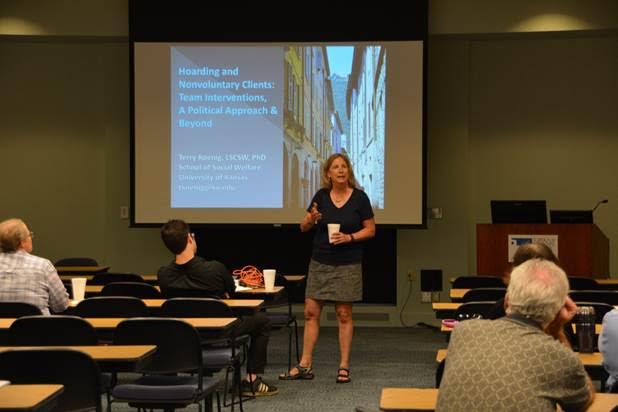
Dr. Terry L. Koenig, Associate Professor at the Kansas University School of Social Welfare, addresses the Adult Abuse Awareness event at the Topeka & Shawnee County Public Library.

DCF

TOPEKA – Abuse of adults may take on numerous forms, including physical, emotional or sexual abuse, self-neglect or neglect by a caregiver and financial exploitation. Community providers, State agency representatives and Dr. Terry L. Koenig, Associate Professor at the Kansas University School of Social Welfare, collaborated in a panel on Thursday afternoon, in Topeka, to discuss hoarding. Hoarding is an issue that affects many vulnerable adults and can have serious consequences.

Gathered at the Topeka & Shawnee County Public Library, Dr. Koenig, presented on Hoarding and Nonvoluntary Clients: Team interventions, a Political Approach and Beyond. Koenig was joined by Valeo Behavior Health Outpatient Psychotherapy Service Manager Donna Park, Adult Protective Services Social Worker Rose Roberts, Owner of Jen’s House Cleaning Service Jen Hopper and Property Maintenance Manager Mike Haugen to bring light to the issue, as well as to the State’s efforts to combat it.

Adult Protective Services Program Manager Leslie Hale provided an overview of how the Kansas Department for Children and Families (DCF) addresses reports of adult abuse.

“When we get a report that an adult has been abused, neglected or exploited, we have a social worker go out and visit with the adult in their home, assess the situation and make sure they are safe see what’s going on and whether they are being abused,” Hale said. “If so, we come up with some sort of plan or intervention to make sure that person is safe from further harm.”

Adult abuse affects individuals 18 and older who are unable to protect themselves. This includes older adults and persons with disabilities.

Governor Sam Brownback declared June Adult Abuse Awareness Month, and DCF asked its staff and participants of the event to wear purple as a show of solidarity behind vulnerable adults.

During the current fiscal year, the DCF Adult Protective Services (APS) hotline has received approximately 16,000 calls regarding abuse and neglect of this vulnerable population. The agency helps protect older adults from being taken advantage of, as well as to ensure they are taking care of themselves.

The state of Kansas takes seriously this issue. Since FY2011, DCF has added Adult Protective Specialist positions to the Adult Protective Services program. It has increased training and outreach efforts and is now better equipped to serve vulnerable adults.

Since 2011, DCF and other state agencies, community providers and advocates have played an active role in positive change by serving on the APS Advisory Committee. They provided direction on a strategic plan to combat adult abuse. The plan includes six goals, including improving services, increasing staff knowledge, improving tracking and monitoring through data sharing and more.

Koenig said that hoarding is a relevant topic because a significant amount of adults suffer from it and it remains largely untreated.

“Surprisingly enough, about 1 to 2 percent of adults are involved in some sort of hoarding behavior,” said Dr. Koenig. “It is often viewed as a hidden problem and sensationalized, when in reality, lots of people struggle with this issue, so this is something that has just gone unnoticed and unacknowledged as something worth treating. In caring about people we ought to care about that issue also.”

Kansans can report abuse by calling the DCF Kansas Protection Report Center, which is available 24 hours per day, seven days a week, at 800-922-5330. Another option would to submit a report online at www.dcf.ks.gov/services/pps/Pages/KIPS/KIPSWebintake.aspx.

Governor’s Exporter and Excellence Award recipients named

KDC

TOPEKA–The Kansas Department of Commerce is pleased to announce that the recipient of the 2017 Governor’s Exporter of the Year Award is Lee Aerospace, Wichita, and the recipient of the Governor’s Award of Excellence is Cereal Ingredients, Inc., Leavenworth. The winners were announced on International Trade Day during Business Appreciation Month.

The Governor’s Exporter of the Year award proudly celebrates the successes of Kansas companies that excel in exporting and growing their communities. It encourages the growth of the state’s international commerce by showcasing successful exporters as role models to the Kansas business community. The recipients are prime examples of how exporting is a significant catalyst for company growth and diversification. Twelve Kansas companies were nominated for the 2017 Exporter of the Year award.

The 2017 Governor’s Award of Excellence companies can be nominated in one of four categories, including manufacturing/distribution, service, retail and hospital/non-profit. There were 19 regional winners and 44 merit winners for the Governor’s Award of Excellence.

Lee Aerospace started as a small production company in 1989, manufacturing aircraft cabin windows for Boeing, and quickly grew to include multiple aircraft manufacturers. Today, Lee Aerospace is one of the world’s largest manufacturers of aircraft windows for business aircraft. Expanding beyond just aircraft transparencies, Lee Aerospace now has over 250 Kansas employees.

Cereal Ingredients, Inc. is a privately held, employee-owned specialty ingredients manufacturer that was established in 1990 by Robert Hatch to research, develop and market unique, new food ingredients. The company holds multiple worldwide product and process patents.

Copyright Eagle Radio | FCC Public Files | EEO Public File