MANHATTAN — The Kansas Department of Agriculture’s agricultural advocacy, marketing and outreach team is seeking talented Kansans to serve on the Marketing Advisory Board.
The mission of the KDA marketing division is to serve all Kansans through innovative programming and deliver solutions designed to create an environment that facilitates growth and expansion in agriculture while increasing pride in and awareness of the state’s largest industry — agriculture.
The Marketing Advisory Board will advise the program team on a variety of topics through the following sub-programs: agricultural business development, international agricultural development/trade, From the Land of Kansas, local foods and affiliated programs, agricultural workforce development and agricultural education.
Current board members include Bob Atkisson, retired farmer/rancher in Stockton.
If you are interested in applying to serve as a Marketing Advisory Board member, please submit a resume, statement of interest/cover letter and tax clearance confirmation PDF via email to Kerry Wefald, director of marketing, at [email protected]. For more details about the board and about the application process, go to agriculture.ks.gov/marketing-advisory-board. All questions can be directed to Kerry Wefald via email or by phone at 785-564-6758.
Applications are due by August 1, 2019, with the first organized board meeting of the fiscal year scheduled for Thursday, September 12, in Hutchinson at the Kansas State Fair.
TOPEKA – Kansas State Treasurer Jake LaTurner set a new Kansas record for the amount of money returned to taxpayers from the Unclaimed Property division of the State Treasury. At the close of business June 30th, the end of FY2019, the State Treasurer’s Office returned $27.1 million in unclaimed property to Kansans, up from last year’s $26.5-million record also set by LaTurner.
“After setting a record high amount of returns last year, we wanted to make sure we set our sights on an even higher goal this year,” said LaTurner. “I am so delighted we were able to not only reach our goal, but exceed it. Thousands of Kansans have money back in their wallets because of the hard work of our staff and the help of the many media outlets that allowed us to help Kansans far and wide get connected with their unclaimed property.”
Throughout the year, LaTurner and his team set up events statewide to help residents across Kansas search for their unclaimed property. In addition to those outreach efforts, the Treasurer’s Office held two live television events in FY2019 hosted by WIBW of Topeka and KWCH of Wichita to raise awareness of the millions in unclaimed property waiting to be claimed. LaTurner has also made it a focus since becoming Treasurer in 2017 to improve the claims process with new technology, including adding direct deposit as an option for Kansans to receive their money faster.
“Giving Kansans back their unclaimed cash is such a rewarding part of what we do at the Treasurer’s Office. It is a major endeavor to give back $27.1 million, and we still have over $350 million waiting to be claimed. We encourage all Kansans to check back regularly for themselves, their family members, and friends,” said LaTurner.
TOPEKA – Governor Laura Kelly today announced the appointment of Audé Amelia Negrete of Overland Park as executive director of the Hispanic and Latino American Affairs Commission.
The Kansas Hispanic and Latino American Affairs Commission serves as a liaison for the Kansas Hispanic and Latino community and the Office of the Governor, with the goal of serving needs of Hispanic and Latino residents in areas of culture, education, employment, health, housing, welfare, and recreation.
“Audé’s own life experience and desire to address challenges faced by Hispanic and Latino residents of our state made her an ideal choice to lead this commission,” Governor Kelly said. “She’ll be a valuable contributor, just as she’s been over the years in her successful efforts surrounding social justice and civic engagement.”
Born in Mexico City, Negrete was 14 when her family left Mexico for to the United States and Kansas. During her career, she’s been involved in numerous initiatives designed to provide educational, social and economic services for Hispanic and Latino families in Kansas.
The seven-member Hispanic and Latino American Affairs Commission includes four members representing each of the state’s congressional districts, and three at-large members.
Negrete will fill the executive director position previously held by Richard Martinez.
The pursuit of higher education can be intimidating, not just for students, but for parents as well. It is a massive monetary investment and many can become overwhelmed by the costs. Expenses and fear often keep individuals from pursuing their dreams and education goals. The State Treasurer’s office is in the business of incentivizing parents to begin saving for their child’s educational success. One of our most unique savings incentives is a matching grant program called Kansas Investments Developing Scholars (K.I.D.S) and since my time as State Treasurer I’ve made spreading the word about this amazing program one of my top priorities.
With the growing price of tuition every year, combined with annual expenses, the dream of college is hard to make a reality.
But with the Kansas K.I.D.S. Matching Grant program individuals in specific income brackets can get an extra boost from the state to save for their children’s education. With a minimum investment of $100 a year into a Learning Quest 529 account, qualified individuals can receive a grant from the state of Kansas matching every dollar you place in your account up to $600 per year. Over the course of 18 years of eligibility a single K.I.D.S. account could potentially be funded with up to $10,800 of state grant dollars. It is a 100% return on investment designed to equip and support families to send their children to college with minimum debt.
The matching grants program has 1200 spots available annually with a budget of $720,000 to match investments.
Chelsea Sexton graduated from Kansas University with help from a K.I.D.S. account.
Cindy Sexton and her daughter Chelsea were one of many who took advantage of this amazing opportunity. Chelsea’s father passed away when she was three years old, leaving Cindy to shoulder the burden of providing for their little family and saving for Chelsea’s future. Cindy set aside $25 from each paycheck for 14 years into a Learning Quest 529 account, and also qualified three times for $600/year in grants through the K.I.D.S. Matching Grant Program. Because of this extra help, Cindy was able to send her daughter to college with minimal debt.
“Thanks to the K.I.D.S. Matching Grant Program, our dream came true,” Cindy says. “It was a no-brainer to take advantage of a program that matches money for saving for college” Cindy says, “I’m so thankful we found out about it.”
For Kansas families concerned about the affordability of higher education a K.I.D.S. account is an amazing opportunity to fund your child’s education. Certain lower-income qualifications are required, but it is important to note that more than 40% of households with children are eligible for this program. With no risk and only reward, it does not even cost a penny to open an account.
A K.I.D.S matching grant can change the course of a child’s future and that is why we are so excited and passionate about this program. Because of Cindy’s hard work, she was able to watch her daughter break the cycle in her family and a college education was a huge part of it. Not only did Chelsea’s degree earn her an amazing job, she was able to pay back her student loans almost immediately, which she only had to take out for her last year of school.
You found it! Click on the Golden Egg for a chance to win FREE Wild West Festival VIP tickets!
“It makes me emotional to see her living this fairy tale life that I always wanted for her,” says Cindy. “No one deserves it more … she’s a wonderful daughter and has my whole heart.”
For more information on how to open a Learning Quest 529 account or find out if you are eligible for the K.I.D.S. Matching Grant, please visit www.LearningQuest.com or contact our office at 785-296-3171.
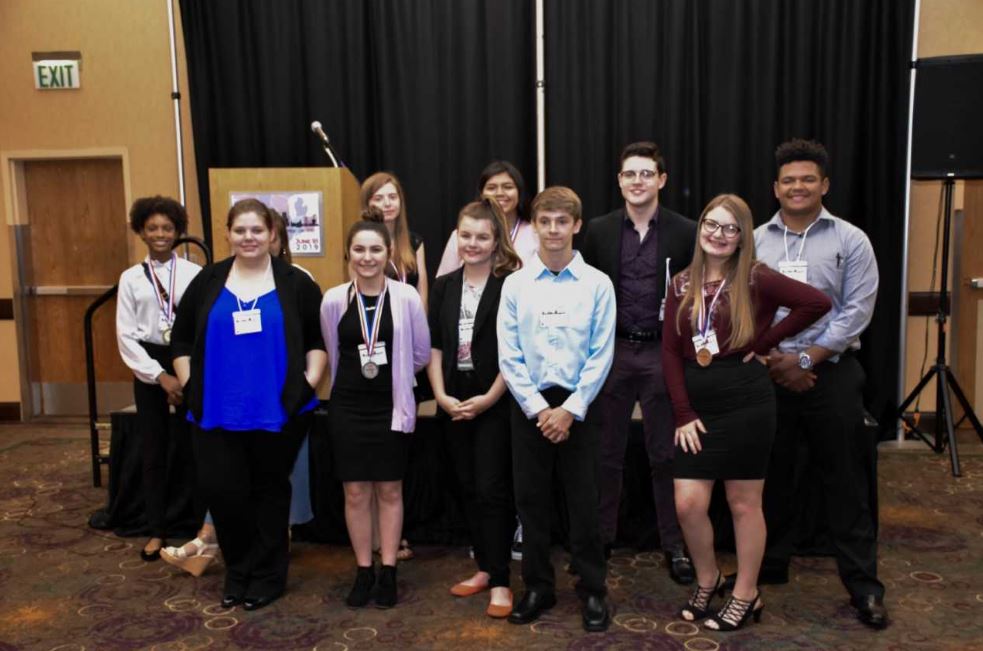
KANSAS CITY– In a first-of-its-kind event, three Jobs for America’s Graduates (JAG) State Affiliates partnered to hold a Midwest Regional Career Development Conference on June 18, 2019, which was organized similar to the State Career Development Conference (CDC).
Each state brought their national qualifying students who were determined earlier this year. During the conference, the 42 students heard
from Dan Meers, KC Wolf, and Kenneth Smith, JAG President and CEO.
The JAG-K national qualifiers competed in four events: project-based learning, mathematics, public speaking, and employability skills.
The Midwest CDC acted as a preliminary event to the National Student Leadership Academy (NSLA) in Washington, D.C. this fall. NSLA is an all-expense paid experience where students will compete against JAG programs from across the country.
At the conclusion of the conference, students were awarded medals for placing in the top three of each event.
JAG-K Awards
Public Speaking: Chrishayla Adams, Topeka HS, 1st place
Employability Skills: Katelyn Laxton, Turner HS, 3rd place
Project Based Learning: Vianca Esquival, Garden City HS, 1st place; Brooklyn Fondaw, BasehorLinwood HS, 2nd place; Lacey Winter, Pratt HS, 3rd place
JAG-K is a multi-year, in-school program for students in grades seven through 12, that offers tools to successfully transition students into post-secondary school, the military, or directly into the workforce with marketable skills. Participants in the program face multiple barriers to success that their JAG-K Career Specialist helps them overcome through a nationally accredited evidence-based model. In 2018, students in JAG-K achieved a 98 percent graduation rate state-wide.
The 501(c) 3 not-for-profit organization is one of 35 state affiliate organizations of Jobs for America’s graduates. Brought to Kansas in 2013, JAG-K is primarily funded through the Temporary Assistance for Needy Families (TANF) block grant to the State of Kansas administered by the Kansas Department for Children and Families (DCF). In addition to school districts and DCF, JAG-K partners with the Kansas Department of Education. Other JAG-K funding sources include AT&T, AT&T Kansas, John Deere Coffeyville Works, and Taco Bell.
To learn more about JAG-K visit, www.jagkansas.org on Facebook, ‘Jobs for America’s GraduatesKansas’, and on Twitter, @JAG_Kansas. To learn more about poverty prevention programs funded by DCF, visit www.dcf.ks.gov.
WASHINGTON–The U.S. Small Business Administration announced Tuesday that the federal government exceeded its small business federal contracting goal for the sixth consecutive year, awarding 25.05 percent in federal contract dollars to small businesses totaling $120.8 billion, an increase from the previous fiscal year of nearly $15 billion. The Fiscal Year 2018 Small Business Federal Procurement Scorecard marks the first time more than $120 billion in prime contracts has been awarded to small businesses. Overall, the federal government earned an “A” on this year’s government-wide scorecard.
“I’m happy to report that for the first time in history the federal government has awarded more than $120 billion in federal contracts and marked the sixth year in a row exceeding our target milestones for small businesses,” said Acting Administrator Chris Pilkerton. “Through these businesses, we strengthen the economy, and support the American workforce in the process. For example, the federal prime and subcontract awarded to small businesses in FY18 equate to more than one million jobs created. Every contract that gets in the hands of a small business is a win-win for our nation, the entrepreneurs, their employees and the communities they support all across the country.”
FY2018 Small Business Federal Procurement Scorecard:
The individual agency scorecards released today by the SBA, as well as a detailed explanation of the methodology, is available online.
In FY18, the federal government exceeded the service-disabled veteran-owned small business and small disadvantaged business goals and the prime contract dollar awards in all small business categories increased from previous years.
The federal government also exceeded its subcontract goals for awards to small businesses and women-owned small businesses, and awarded more than $79 billion in subcontracts to all small businesses.
SBA continues to collaborate with federal agencies to expand small business opportunities for small business contractors to compete and win federal contracts. The FY2018 scorecard analyzed the prime contracting and subcontracting performance, and other contributing factors which resulted in an overall “A” grade for the federal government. Eight agencies received A+, 12 received a grade of “A”, three received a “B” grade and one received a “C” grade.
Small Business Federal Procurement Scorecard Overview:
The annual Procurement Scorecard is an assessment tool to: (1) measure how well federal agencies reach their small business and socio-economic prime contracting and subcontracting goals; (2) provide accurate and transparent contracting data and (3) report agency-specific progress. The prime and subcontracting component goals include goals for small businesses, small businesses owned by women, small disadvantaged businesses, service-disabled veteran-owned small businesses, and small businesses located in Historically Underutilized Business Zones (HUBZones).
Every year, the SBA works with each agency to set their prime and subcontracting goals and their performance is based on the agreed upon goals. Each federal agency has a different small business contracting goal, determined annually in consultation with the SBA. The SBA ensures that the sum total of all of the goals exceed the 23 percent target for the federal government as well as the socio-economic goals established by law.
While each federal agency is responsible for ensuring the quality of its own contracting data, SBA conducts additional analyses to help agencies identify potential data anomalies. As part of its ongoing data quality efforts, the SBA works with federal agency procurement staff to provide analysis and tools to facilitate review of data, implement improvements to procurement systems and conduct training to improve accuracy.
About the U.S. Small Business Administration
The U.S. Small Business Administration makes the American dream of business ownership a reality. As the only go-to resource and voice for small businesses backed by the strength of the federal government, the SBA empowers entrepreneurs and small business owners with the resources and support they need to start, grow or expand their businesses, or recover from a declared disaster. It delivers services through an extensive network of SBA field offices and partnerships with public and private organizations. To learn more, visit www.sba.gov.
TOPEKA – In a move to help Kansans find work and stay employed, Governor Laura Kelly today announced a new Kansas Department for Children and Families (DCF) initiative that will expand access to child care assistance for Kansas families.
“Having access to quality child care is essential for parents to maintain employment,” Kelly said. “Those with lower incomes often struggle to afford quality child care. By expanding access to the program, more Kansas families can sustain employment or participate in meaningful training programs.”
DCF is making several policy changes to the program that will go into effect July 1. They include:
· Reducing the minimum work hours per week to be eligible from 28 to 20, which will expand child-care access to more working parents.
· Expanding the program to participants of the GOALS employment and training program allowing families to access child-care assistance for job search activities. GOALS is specifically for parents who participate in the state’s food assistance program.
· Using Child Care Development Funds (CCDF) to pay child-care costs for foster children. This new program will provide foster parents the added convenience of using an EBT card to pay for child care.
“We know that child-care costs can be an obstacle to employment for many of our low-income families,” DCF Secretary Laura Howard said. “In Topeka for example, affordable child care is 21 percent of a family’s income for those at the top of the eligibility threshold (185% of federal poverty level). Our expectation is that families will actually be able to increase their earnings while having peace of mind knowing their children are being cared for in healthy environments.”
DCF estimates more than 3,000 Kansas children will benefit from these policy changes. The agency estimates spending more than $9 million in FY 2020 and nearly $14 million in FY 2021 based on current caseload data.
“Helping our fellow Kansans find work, stay employed and receive a quality education are universal values,” Kelly said. “This is a first step in repairing the safety net that was pulled from vulnerable Kansans during the previous eight years.”
Stephen Durrell, acting executive director of the Kansas Lottery, and John’s Food Center owner, John Benson, holding the first dollar from the vending machine.
KS LOTTERY
TOPEKA – The Kansas Lottery is launching four self-service vending machine pilot program sites at select retailers around Topeka.
In 2018, the Kansas legislature passed HB 2194 allowing the Kansas Lottery to sell traditional style lottery tickets through self-service vending machines.
“The Kansas Lottery is excited to join the majority of other states offering the convenience of selling lottery products through self-service vending machines,” said Stephen Durrell, the acting executive director of the Kansas Lottery. “We look forward to the opportunity of increasing our sales and our transfer to the state. We feel the machines will also provide easier access for our players to find their favorite games.”
The first pilot site, John’s Food Center, was installed on Wednesday and already had its first customer.
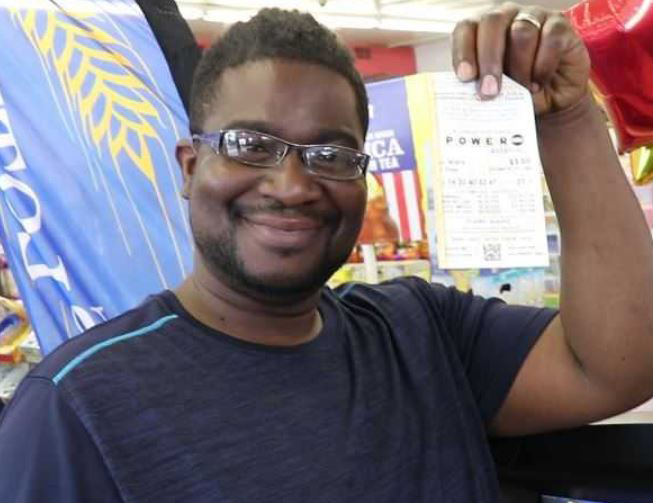
Malik El-amin with the Powerball ticket he purchased from a vending machine.
Malik El-amin of Topeka was the first Kansas Lottery player in the state to purchase a Kansas Lottery ticket using the vending machine. El-amin bought a Powerball ticket and even added the Power Play option.
“It was an exciting experience,” El-amin said. “I like how simple it is you don’t have to wait in line to buy a ticket. It was awesome.”
The three other pilot program sites will be operational next week.
The pilot program locations are:
· Gage Center Bowl, 4200 SW Huntoon Street, Topeka.
· John’s Food Center, 5812 SW Topeka Blvd, Topeka.
· Kansas Lottery Headquarters, 128 N. Kansas Ave, Topeka.
· West Ridge Lanes, 1935 SW Westport Drive, Topeka.
The Kansas Lottery plans to roll out a total of 272 machines to select retailers across the state beginning in July 2019.
Up to $8 million of the net profit from the machines will go to mental health programs throughout the Sunflower state.
Attached to the email is a picture of Malik El-amin with the Powerball ticket he purchased and a picture of Stephen Durrell, the Acting Executive Director of the Kansas Lottery, and John’s Food Center owner, John Benson, holding the first dollar from the vending machine.
Frances Gorman Graves (Courtesy photo)OFFICE OF GOV.
TOPEKA – Governor Laura Kelly Wednesday announced the appointment of Frances Gorman Graves to the Supreme Court Nominating Commission.
“Frances’ leadership experience and years of involvement in communications, along with her rural Kansas perspective, will be valuable as the Supreme Court Nominating Commission does its work,” Kelly said. “We appreciate her willingness to serve and be part of this important process.”
The nine-member Supreme Court Nominating Commission is responsible for recommending qualified individuals for appointment to the Kansas Supreme Court and Kansas Court of Appeals. Four of the members are non-attorneys appointed by the governor. The four appointees selected by the sitting governor each represent one congressional district in the state. Four others are attorneys selected by fellow attorneys in each of the congressional districts, with the chair of the commission an attorney elected by attorneys statewide.
Graves was appointed to a four-year term as one of the board’s four non-attorney members, and will serve starting on June 30. She’s currently the Assistant to the Director of Parsons Area Community Foundation. Previously, Graves was the Senior Media Researcher for Synoptos from 2012 to 2015, Adjunct Instructor at Labette Community College in Parsons from 2009 to 2012, Communications Coordinator at KU’s School of Business from 2008 to 2009, and Director of Strategic Communications for the Kansas Attorney General’s Office from 2007 to 2008.
She and her family are farmers and ranchers in southeast Kansas.
Graves will assume the commission seat currently held by 2nd Congressional District non-attorney member Felita Kahrs of Topeka, who was appointed by Governor Sam Brownback.
Kirk McClure, KU Professor, Urban Planning, School of Public Affairs and Administration
KU NEWS SERVICE
LAWRENCE — For decades, the federal government has used housing vouchers as part of a strategy to help low-income Americans obtain affordable housing as a way out of poverty. Part of that strategy was to help individuals and families settle closer to employment opportunities, but new research shows that proximity to jobs may not be as crucial as previously thought.
Kirk McClure, professor of urban planning in the University of Kansas School of Public Affairs & Administration, has co-written a study examining a national dataset of households receiving support from the Housing Choice Voucher Program from the U.S. Department of Housing and Urban Development. The analysis showed that recipients tended not to locate in neighborhoods that are closer to areas with high job availability compared to their previous neighborhoods and that when they do move to such areas, it does not result in higher earned income.
“We have assumed for a long time that if a household locates in a neighborhood with a lot of jobs, or at least not as much competition for jobs, that’s good,” McClure said. “Congress has not wanted this program to be a form of welfare but a way to move out of poverty and into gainful employment.”
McClure co-wrote the study with Michael Lens of the University of California Los Angeles and Brent Mast of the U.S. Department of Housing and Urban Development, Office of Policy Development and Research. It was published in the journal Cityscape. The authors set out to determine if very low-income renter households using the program, known as HCV households, move closer jobs, and if they do, whether the moves are associated with higher income. McClure and co-authors analyzed data from HUD, which included about 2 million households. Of those, approximately half were included in the study, as they were adults in the workforce, and the other half were not in the workforce due to age or disability. The data showed no association between proximity to jobs and HCV households or an increase in earnings for those who relocated closer to jobs.
“The data says people who move don’t necessarily have higher employment or earnings,” McClure said. “That suggests we may have been using this program in not the absolute best way for 25 years, and it says to me of the linkage between place of residence and place of employment is not as important as we thought.”
Other factors are almost certainly at play, the authors point out. Available transportation for HCV households was not accounted for in the study, and HCV households with vehicle ownership are more likely able to commute farther distances to jobs and services without the necessity to move. Access to public transportation also plays a role, and if a recipient moves closer to jobs, but public transit is lacking, that can be reflected in an inability to reliably get to work, get kids to school and access other basic services.
Proximity to good schools and other neighborhood characteristics play a role as well. The authors point out that many recipients likely look at those characteristics before job proximity when deciding where to move. Families show a tendency to move to neighborhoods in good school districts that are more suburban by nature and not as close to high job-density areas. Landlord resistance is another common obstacle in HCV household relocation. Landlords are under no obligation to rent to voucher recipients and can legally choose not to rent their property to voucher recipients.
McClure said the results make several points clear. First, researchers and policymakers must rethink the “geography of opportunity.” That is the driving idea behind such programs that seek to help low-income families move to new neighborhoods. Moving away from high crime areas is one factor, but what makes a desirable neighborhood is less clear. If proximity to jobs is not as important as once thought, factors such as access to transportation must be more closely studied.
“We need to rethink what it means to be a high opportunity neighborhood,” McClure said.
Second, annual report cards that are provided to the more than 2,700 housing authorities across the country that take part in HCV programs need rethinking as well. HUD has long graded housing authorities on the quality of the neighborhoods where HCV households locate. Proximity to jobs is likely overvalued in those rankings, again in respect to other factors such as access to transportation. In addition, landlord outreach needs to be strengthened. As landlords are not under an obligation to rent to voucher recipients, housing authorities should be able to offer incentives to landlords such as guaranteeing rent and guaranteeing occupation of set numbers of available units, among others, McClure said.
While policy has long focused on the proximity to jobs for housing choice vouchers, McClure and co-authors argue that the absence of data to support a benefit does not mean the programs are not working. Instead, policy should take into account other factors.
“Ultimately, we think that the rational policy response to these findings should be to keep the importance of job proximity in perspective. Evidence of the importance of job proximity for HCV households is simply not sufficient to warrant that it be as high a priority as are safe neighborhoods and access to high-quality schools,” the authors wrote. “HCV households are a diverse group, however, and for households in the workforce and without access to reliable transportation, proximity to jobs is worth paying attention to without allowing it to override concerns that evidence suggests may be more important.”
PRATT – Kansas Wildlife and Parks Magazine, a bimonthly publication of the Kansas Department of Wildlife, Parks and Tourism (KDWPT), will be managed by a female editor for the first time in the magazine’s 76-year history.
Current KDWPT employee Nadia Reimer, who was promoted to chief of information production in April, will serve as the magazine’s executive editor. Reimer previously served as the magazine’s associate editor from 2013-2015, and managing editor from 2015-2019. She follows in the footsteps of long-time executive editor, Mike Miller, who now serves as KDWPT’s assistant secretary of wildlife, fisheries and boating in Pratt.
“Nadia brings a wealth of talent, ideas and energy to her new role. As an avid angler and hunter, she also lives the outdoors lifestyle,” said Ron Kaufman, Director of Information Services at KDWPT. “We look forward to her leadership in continuing the fine tradition of the department’s flagship outdoor recreation magazine.”
Kansas Wildlife and Parks Magazine had humble beginnings in 1938 as a seven-page, typed pamphlet. Today, the award-winning 48-page, full-color publication has made it as far as 47 of the 50 states and three countries.
“Kansas Wildlife and Parks Magazine is the voice of our agency, and carrying on its legacy is a responsibility I feel privileged to take on,” said Reimer. “KDWPT employees are some of the most knowledgeable and passionate people you’ll meet, and when you combine their expertise with the experiences of our constituents, you get an incredible publication at the end of the day.”
Each issue of Kansas Wildlife and Parks Magazine features work from some of the state’s top freelance outdoor photographers and writers who, alongside department staff, cover wildlife, hunting, fishing, state parks, camping, conservation, recipes, tips and tricks, and more.
A single issue costs $3.75, a year subscription (six issues) is $13, a two-year subscription (12 issues) is $22, and a three-year subscription (18 issues) is $32. Interested readers can sign up to receive the magazine by calling the KDWPT Pratt Operations Office at (620) 672-5911, or by visiting ksoutdoors.com/Services/Publications/Magazine.
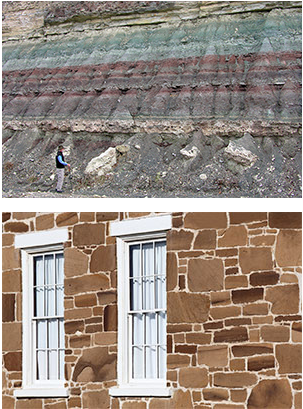
A Kansas roadcut reveals geological history through rock layers. (Photos by Kansas Geological Survey)
KU NEWS SERVICE
LAWRENCE – Sunflower. Meadowlark. Ad astra per aspera. Most Kansans are familiar with the state’s official symbols and motto. But as the summer road trip season kicks into high gear, a new resource from the Kansas Geological Survey invites travelers to dig deeper.
The mobile-friendly “Highways & Byways to Kansas Geology” website leads users on a geological tour of the state’s roadways with a scrolling format known as a story map. It explores what natural features like rock formations, wetlands and colorfully layered roadcuts reveal about the evolution of the ground beneath our feet and the cultural history of the people who settled and passed through the state.
“We were looking for a visual way to showcase the state’s wide-ranging geology and natural resources,” said Cathy Evans, KGS communications coordinator. “By creating a story map, we were able to roll colorful images, maps and narrative text into one dynamic presentation that has the added bonus of being free to anyone with computer access.”
Many travelers have only experienced Kansas as a 75-mph blur while zipping down Interstate 70. What they might not realize is that as they cross the 424-mile route from the state’s eastern to western border, they are traveling forward in time. Rocks that contain 300 million-year-old marine fossils steadily give way to younger layers, ending near a high plains archaeological site where fossils of 13,000-year-old mammoths, camels and bison have been discovered near the surface.
Top photo: Limestone and shale exposed in a Geary County roadcut formed from sediment deposited in shallow seas during the Permian Period about 250 million years ago. Bottom photo: The buildings at Fort Larned National Historical Site on Kansas Highway 156 in west-central Kansas were constructed with Dakota Sandstone quarried nearby. The sandstone layers formed from beach sand and sediment carried by rivers into a sea during the Cretaceous Period.
“In between are the limestone and shale layers in the Flint Hills that developed from sediment deposited in intermittent seas about 250 million years ago,” Evans said, “and sandstone in the Smoky Hills formed from sand dumped by rivers draining into a later sea about 66 million years ago.”
Highways & Byways provides images, illustrations and mile marker references to help travelers identify these features.
For those who venture beyond I-70, more unusual sights await – like the Red Hills that flank U.S. Highway 160 in south-central Kansas. The region’s distinctive, rust-colored mesas, buttes and canyons are more commonly seen in the American Southwest.
Fort Larned National Historic Site on Kansas Highway 156 in west-central Kansas and Point of Rocks – accessible by an unpaved road off Highway 27 in extreme southwest Kansas – are 180 miles apart but linked together by Santa Fe Trail history.
“All the buildings at the fort – which served as an outpost on the Santa Fe Trail – are built from local sandstone, and the view of the surrounding plains is still unobstructed,” Evans said. “Point of Rocks – now appreciated for the expansive view it provides – was once a life-saving landmark towering over the Cimarron River and nearby springs. It signaled the first water source that trail travelers would encounter in more than 100 miles on their 15-mile-per-day journey.”
Undergirding the Highways & Byways website is the geospatial data collection, mapping and visualization expertise of specialists in KGS’s Geographic Information Systems (GIS) section. GIS staff host the Kansas Data Access and Support Center, the state’s official clearinghouse for geospatial data ranging from geologic to environmental to demographic.
Funneling that technical expertise into authoritative maps and infographics and combining those with text, images and video for presentations like Highways & Byways is just one way that KGS fulfills its state-mandated mission to foster a better understanding of the geology and natural resources of Kansas.
“Although collection and dissemination methods have changed drastically since the KGS was established in 1889, we continue to produce a wide variety of publications and maps – both technical and educational – for the scientific community, natural resource decision-makers, businesses and the public,” said Rolfe Mandel, director of the KGS. “Story maps are an innovative means of bringing attention to the state’s sights and natural resources.”
Highways & Byways complements two other KGS online resources designed for exploration and education:
GeoKansas, a website that provides more detailed information about the places featured in Highways & Byways and additional locations.
The KGS Photo Library, an image collection that users can search by county and keyword to see what they can expect to find while exploring the state.
Evans hopes Highways & Byways will spark curiosity and inspire travelers to experience Kansas in new ways.
“I always find scenic surprises driving backroads or even just by pulling off the interstate,” she said. “Photos I took at the Deep Creek exit on I-70 gave me a whole new perspective of a roadcut I’d driven by hundreds of times – and I actually saw the creek, not just its name on a sign.”
The Kansas Geological Survey is a research and service division of the University of Kansas. Its main headquarters is in Lawrence, and its Wichita office houses the KGS Well Sample Library.
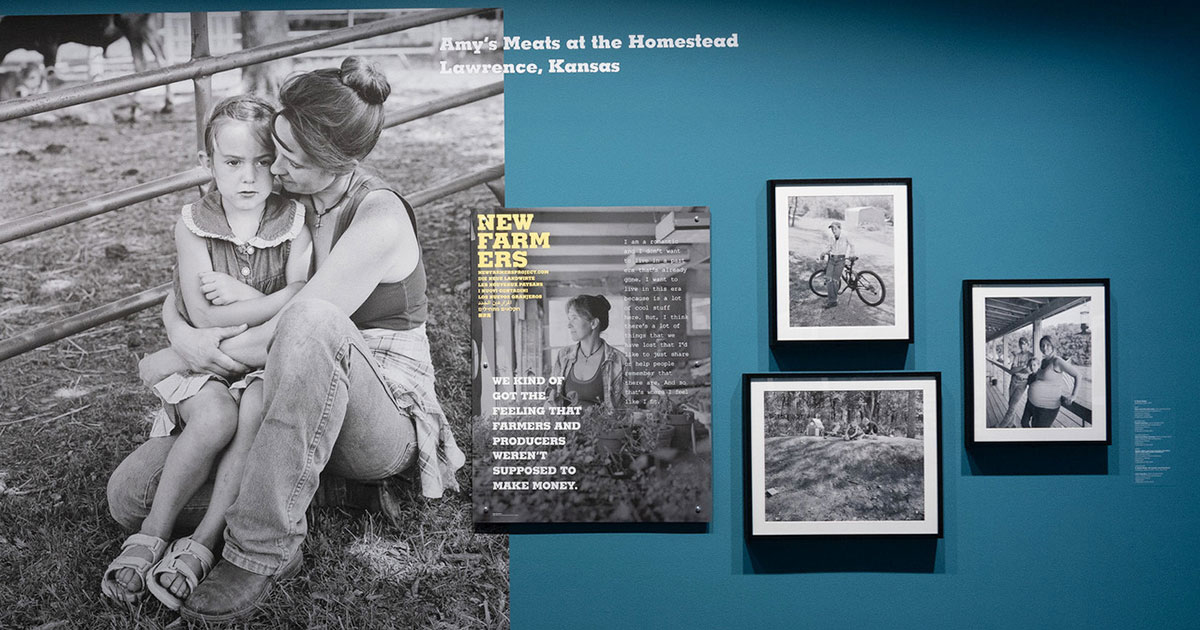
A panel from the Wichita Art Museum’s 2018 “New Farmers” exhibition featuring photographs by Bryon Darby, text by Paul V. Stock and design by Tim Hossler. (Credit: Kirk Eck)
KU NEWS SERVICE
LAWRENCE – Growing up on a farm and carrying on a family tradition is one thing. Taking on the trials of farming from scratch? That’s quite another.
The environmental and societal concerns that drive some 21st-century farm families away from cities and even divide them from their conventional-farming neighbors are the focus of the new book “New Farmers 2014/2018” (P&T Committee, 2019) created by a cross-disciplinary team of University of Kansas scholars.
The project had its genesis when Paul Stock, associate professor in the Department of Sociology and the Environmental Studies Program, met Bryon Darby, former KU assistant professor of photo media and now a lecturer in photography at Utah State University, a couple of years ago at a teaching seminar organized by KU’s Center for Sustainability.
Along the way, they were joined by Tim Hossler, associate professor of design, as designer.
Stock had just come to KU after spending years in New Zealand, studying how that South Pacific nation “went from being primarily a sheep-farming country to becoming the world’s largest dairy exporter.”
“I was working on a global scale, and I wanted to do something a little different, having just moved to Kansas and back to the Midwest,” Stock said. “I was interested in studying people that were getting into farming. Farming is hard. It’s hard to stay in; it’s hard to make money. Everything about it is hard. So what is going on with these people that are actively trying to get into it?”
Stock recalled Darby saying, “I’m really interested in photographing these new farmers, people who are at the farmers’ market. And I thought: That’s what I want to do.”
They launched the project that resulted first in gallery exhibitions and ultimately in “New Farmers 2014/2018.”
Darby and Stock set out first to interview and photograph Amy Saunders of Amy’s Meats north of Lawrence.
Stock credits Darby’s method of working for helping the subjects to open up about their feelings.
“Bryon set most of these up, and he’s like, ‘Can I come photograph you? And Paul’s going to come along, and we’re going to have a talk.’ He’s using this old-style view camera, with the cloth hood over his head and the whole deal. But the real gift of it to doing research is that it takes time. People have to stay real still … which lends itself really well to interviewing. With this way of shooting, they had to relax and be vulnerable.”
Stock and Darby branched out from there to other farmers’ market purveyors and beyond across eastern Kansas.
“It wasn’t just young farmers, and it wasn’t just brand new, because some of the people that were depicted in the book started farming 30 years ago, but they’re still mentoring people,” Stock said. “We asked them about their story of becoming a farmer. What was it that brought about that change in their identity?”
More than one farm family, Stock said, had come to agriculture from teaching.
“It’s not that radical a shift when you hear them talk about it, because it’s all about care and giving,” Stock said.
“New Farmers” is sort of a misnomer, Stock said, in that these farmers, even if not all are certified organic, are at least engaged in less technologically intense methods of raising food than a typical Midwestern row-crop farm with thousands of acres.
“They’re doing stuff that people around the world have been doing for thousands upon thousands of years,” Stock said. “The people we’ve spoken to are asking, ‘How do I live a good life? How do I live my best life with my family, with friends involved, with the community I care about?’ It’s hard. And we’re not going to make much money. But we’re going to be pretty happy and fulfilled.”
The “New Farmers” are not out trying to convert the world to their ways of thinking, living or agriculture, Stock writes in the book. They just want to be left alone to do things their own way. In this age of disputes over carcinogenic pesticides and right-to-repair-equipment laws, that may be harder than it seems at first blush.
Hossler said the combination of text and images he chose for the book “reflects a design history most notable from the Great Depression era, including photographers Dorothea Lange and Walker Evans, who worked closely with their writing collaborators. They are key examples of the book’s inspiration because of the specific combinations of text and imagery as well as the portrayal of farmers. The look of the book reflects those interests and the collaborative spirit of the project.”
Stock and Hossler said The Commons, a partnership among KU’s Biodiversity Institute, Hall Center for the Humanities and Spencer Museum of Art, and its director, Emily Ryan, played important roles in the evolution of the “New Farmers” project, including early research funding, gallery space and support for the book.
Hossler said many of the design choices reflected in the book were made when “New Farmers” started as a gallery exhibition. It returns to its exhibition form July 9-Aug. 11 for a display at the Lenexa City Hall Art Gallery.
“New Farmers 2014/2018” was recently named among the 50 best books and 50 best book covers of the year by Design Observer and AIGA, the professional association for design.
 KDA
KDA