ELLSWORTH COUNTY – A woman from Osborne was injured in an accident just before 10p.m. on Sunday in Ellsworth County.
The Kansas Highway Patrol reported a 2012 Chevy Impala driven by Dorlyn M. Workman, 72, was westbound on Interstate 70 just east of the Kansas 156 Junction in a construction zone.
The vehicle exited the construction zone. The driver was confused. The vehicle entered the median, struck a drainage mound and the vehicle rolled multiple times.
Workman was transported to Salina Regional Medical Center. She was properly restrained at the time of the accident, according to the KHP.
Bull frog season opened July 1 in Kansas and that stirs up lots of fond memories.
It seems bull frogs and frog hunting were a part of my summer for many years. When I was in grade school, there was a big drainage ditch across the road from the neighbor kids’ house.
The three of them had a BB gun and there was never a shortage of frogs in the ditch. When we weren’t shooting at frogs in the ditch, we were behind the barn shooting their big boar hog in the butt (and elsewhere.) Anyway, each time we finally managed to kill a frog, we’d cut the thing open with our pocket knives and retrieve the BB’s.(how’s that for recycling?)
After we moved away from there, lots of my friends were city kids so my outdoor adventures consisted of me shooting blackbirds out of trees along the creek with mom’s old fold-up .410, catching crawdads under the bridge using forked sticks as spears and learning how to trap muskrats.
We moved one more time before I graduated from high school, and there all my buddies were country kids once again that trapped and hunted rabbits, deer and bull frogs. There was a farm a few miles away with two ponds, one on each side of the road, and they both teemed with bull frogs.
Back then, the hot humid summer nights didn’t bother me at all, and that was the best frog hunting weather. By then, we were all in high school and one of us always had some beater of a car, so we’d don warn-out jeans and old sneakers (which was our usual attire anyway,) fill the trunk with flashlights, feed sacks and frog spears and head for the ponds after dark. I can only figure the farmer only let our motley crew on his property hoping we’d all drown in the pond and never bother him again.
Anyway, we would split up to cover both ponds at once, slowly wading around the edge knee-deep in the water until a frog was spotted ahead. Putting the flashlight beam in its eyes dazzled the frog until we could spear it and add it to the feed sack hanging around our waist.
I remember vividly returning home after one particular frog hunt at those ponds. The night was hot and steamy and the four of us went to work butchering frogs in our driveway under the security light by the barn, using an empty hay wagon for a table. Sacks were emptied and squirming bull frogs went everywhere. I also vividly remember mom hollering out her upstairs bedroom window for us to be quiet; I don’t know what her problem was, it was only 2 in the morning!
Frog meat is white and sweet, and half the fun of frog hunting is watching the legs twitch and quiver as they fry in the oil. One night one of the guy’s girl friend was there as we fried up a mess of legs. The experience was all new to her, so while she was out of the room, we propped up a big pair of the legs on the edge of the skillet as if they had climbed out. As I recall that was the last time she ever hung-out with us.
Just a few years ago, I took my dad, who was then nearly 80 frog hunting. We went just out of town to some of the McPherson Valley Wetland ponds. It was a slow night for harvesting frogs, but we got enough to have a “small mess” to fry. The legs still twitched and quivered as they fried, and they still tasted just as sweet as I remembered them. Thankfully, some things never change! Continue to Explore Kansas Outdoors.
Steve Gilliland, Inman, can be contacted by email at [email protected].
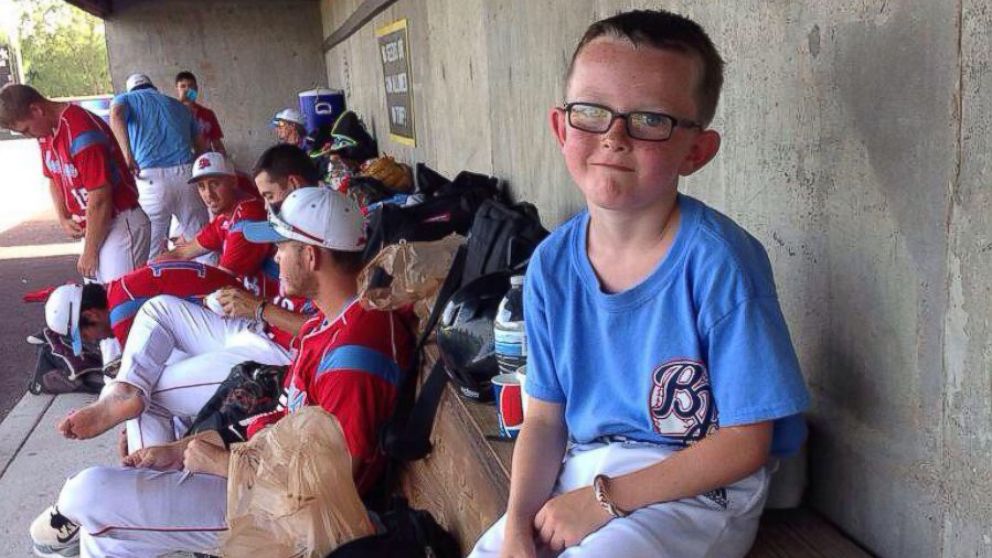
9-year old Liberal bat boy Kaiser Carlile in the Bee Jays dugout at Larks Park in mid July. (Courtesy Liberal Bee Jays)
WICHITA, Kan. (AP) – A 9-year-old bat boy has died after he was accidentally hit in the head during a National Baseball Congress World Series game in Kansas.
The general manager of the Liberal Bee Jays team, Mike Carlile, confirmed late on Sunday the death of Kaiser Carlile.
The boy was struck by a follow-through swing near the on-deck circle on Saturday afternoon. A spokesman for the National Baseball Congress says the child was wearing a helmet, which is mandatory.
Home-plate umpire Mark Goldfeder, who is a longtime paramedic, treated the boy until an ambulance arrived. The team played a game on Sunday, winning 8-0.
——————
WICHITA, Kan. (AP) — A 9-year-old bat boy is hospitalized after being hit in the head during a National Baseball Congress World Series game.
The Wichita Eagle reports that the boy was struck by a follow-through swing near the on-deck circle on Saturday afternoon. A spokesman for the National Baseball Congress says the child was wearing a helmet, which is mandatory.
Home-plate umpire Mark Goldfeder, who is a longtime paramedic, treated the boy until an ambulance arrived. The boy was taken to a local hospital and was in critical condition as of Sunday afternoon.
The boy was a bat boy for the Liberal Bee Jays. The team’s general manager Mike Carlile identified the boy as Kaiser Carlile.
Anthony Imperato presenting Robin & Grayson Sutton with a check for $40,000 in Sedan, KS -courtesy photo
WICHITA, Mo. (AP) — A man is donating the proceeds from 100 .22 rifles to raise money for a southeastern Kansas girl with pulmonary hypertension.
The Wichita Eagle reports a New Jersey gun manufacturer so far has raised more than $52,000 for 4-year-old Grayson Sutton.
The Sedan girl faces thousands of dollars in medical bills and expenses to travel for treatment in a Colorado children’s hospital every three months.
Gun manufacturer Anthony Imperato heard about Sutton through a friend of the family. He says the guns cost about $30,000 to produce. A sunflower and the phrase “Get well Grayson” are etched on each rifle.
Pulmonary hypertension is a genetic condition that causes high blood pressure and can lead to heart failure.
TOPEKA, Kan. (AP) — A Kansas agency doesn’t yet have to release results of its internal investigation into the death of a 4-year-old northeast Kansas boy.
The Topeka Capital-Journal reports that a federal judge’s order for the Department for Children and Families to release an investigative report and other documents regarding the 2013 death is on hold.
U.S. Magistrate Judge Kenneth Gale stayed his earlier order following objections by the agency.
Naomi Boone had sued the department following the death of her son, 4-year-old Mekhi Boone. The child died in 2013 at the hands of his father, Lee Davis, who’s serving nearly 20 years for second-degree murder. Boone contends the child shouldn’t have been placed with his father.
The agency says the order to require the documents’ release wasn’t supported by case law.
TOPEKA, Kan. (AP) — Kansas Gov. Sam Brownback’s latest efforts to prevent a state budget deficit were assisted by a well-timed decision on health care funding from federal officials and better-than-expected news about teacher pensions.
The Republican governor’s administration outlined $63 million in budget adjustments last week. The changes capture savings from lower-than-anticipated spending, book favorable revisions in cost estimates, shift fee dollars into the state’s main bank account and tap additional federal dollars.
Brownback told The Associated Press that he sought to bolster the budget in ways that Kansas residents wouldn’t much notice. However, he’s facing some skepticism from a leading advocate of children’s programs and supporters of highway projects.
A look at the changes imposed by Brownback in the $15.4 billion budget for the fiscal year that began last month.
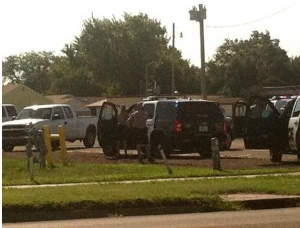
Police on the scene of Sunday’s standoff in Hutchinson
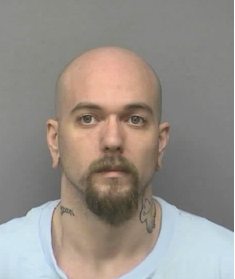
HUTCHINSON– Law enforcement officials were involved in a 6-hour long stand off with a troubled subject Sunday.
According to officer Troy Hoover Hutchinson police were called just after 9:30 a.m. to the report of a disturbance in the 2800 Block of Durango Drive
A shot had reportedly been fired into the air. A short time later police spotted the suspect and attempted to pull him over.
The suspect pulled into the parking lot of the Rusty Needle at 1808 North Plum Street and produced a weapon threatening to take his own life.
Eventually the subject took off running towards some houses east of the area where he was quickly surrounded.
The suspect up with out incident and was not armed at the time of his capture.
He has been taken to Hutchinson Regional Medical Center. Police closed off Plum between 17th and 23rd Avenues and closed off several area of the fair grounds to restrict traffic in the area.
There were no injuries or shots fired at anytime. The suspect’s name has not been released.
————–
HUTCHINSON– Law enforcement authorities are working a standoff with an individual outside a bar and grill in the 1800 Block of North Plum in Hutchinson.
The incident began Sunday morning and the city blocked Plum Street with barricades from 23rd south to 17th Street in an effort to keep on lookers out of the area. An ambulance and fire truck are on stand by near the Kwik Shop at 17th & Plum.
Authorities report the individual is armed and police are working to get him to surrender. He may be suicidal according to Reno County Sheriff Randy Henderson.
The situation is more difficult for law enforcement because of some events going on at the state fairgrounds, right across the street from the standoff.
Check Hays Post for more information as it becomes available.
TORONTO (AP) — Chris Colabello hit a two-run home run, R.A. Dickey threw seven shutout innings and the Toronto Blue Jays beat the Kansas City Royals 5-2 in testy matchup Sunday, taking three of four from the AL’s top team.
Both benches and bullpens emptied after Toronto reliever Aaron Sanchez was ejected for throwing at Kansas City’s Alcides Escobar in the eighth. It was the climax of a game-long spat that began when Royals starter Edinson Volquez hit Josh Donaldson on the left arm in the first.
Donaldson and Volquez traded stares and words as the Blue Jays slugger took a slow walk to first base. Home plate umpire Jim Wolf warned both dugouts.
When Donaldson batted again in the third, Volquez missed high and inside with a pitch that sailed to the backstop. Blue Jays manager John Gibbons came out to argue but Volquez was not ejected.
Ben Zobrist hit a two-run homer to pull the Royals within a run in the eight, but Toronto took advantage of three walks from reliever Kelvin Herrera to score twice in the bottom of the inning.
KANSAS CITY, Kan. (AP) — The future of The Woodlands racing complex in eastern Kansas remains up in the air even after a billionaire businessman bought the property.
The Kansas City Star reports Las Vegas casino owner Phil Ruffin paid an undisclosed amount for the facility that once was one of Wyandotte County’s main attractions.
Competition from Missouri casinos and a lagging interest in dog racing became a drag on the complex before it closed in August 2008.
Some hoped slot machines lawmakers approved in 2007 could fix the facility’s financial woes, but Woodlands supporters said the state wanted too much in taxes from the slots.
Ruffin also owns two other tracks in Kansas and says he would like to open them all again if the state changes the tax structure on racinos.
MARK SCOLFORO, Associated Press
JEFFREY COLLINS, Associated Press
HANOVER, Pa. (AP) — Many Americans assumed the Confederate flag was retired for good after governors in South Carolina and Alabama removed it from their statehouses this summer and presidential candidates from both parties declared it too divisive for official display.
But people still fly it, and not just in the South, despite announcements by leading flag-makers and retailers that they will no longer sell products showing the secessionist battle flag. Some who display it are motivated by pride in their ancestry or enthusiasm for Southern history. Others see it as a symbol of their right to challenge to authority in general, and the federal government in particular.
And some have hoisted Confederate flags in recent weeks precisely because it’s generating controversy again.
UTICA, Mo. – Two teens were injured in an accident just after 2a.m. on Sunday in Livingston County.
The Missouri State Highway Patrol reported a 2005 Ford Ranger driven by Brianna M. Cairns, 16, Chillicothe, Mo., was eastbound on U.S. 36 one mile east of Utica. The vehicle traveled off the north side of the road into the median and overturned.
Cairns and a passenger Kaitlyn D. Plumb, 16, Eudora, Kan., were transported to Hedrick Medical Center. Life-flight then transferred Cairns to Liberty Hospital.
They were properly restrained at the time of the accident, according to the MSHP.
TOPEKA–The Kansas Historical Society announced that a segment of the Smoky Hill Trail and Butterfield Overland Despatch and four historic districts are among the newest Kansas listings added to the National Register of Historic Places. The Keeper of the National Register of Historic Places entered eight Kansas listings into the Register on July 7. The Keeper also removed three demolished properties from the register. This action brings the total number of Kansas listings in the National Register to 1,400.
The National Register of Historic Places is the country’s official list of historically significant properties. Authorized by the National Historic Preservation Act of 1966, the National Park Service’s National Register of Historic Places is part of a national program to coordinate and support public and private efforts to identify, evaluate, and protect America’s historic and archeological resources.
Eligible properties must be significant for one or more of the four criteria for evaluation. Properties can be eligible if they are associated with events that have made a significant contribution to the broad patterns of our history. They can be eligible if they are associated with the lives of persons significant in our past. Distinctive construction can qualify properties for the National Register if they embody the characteristic of a type, period, or method of construction, or represent the work of a master, or possess high artistic values, or represent a significant and distinguishable entity whose components may lack individual distinction. Lastly, properties may be eligible for the National Register if they have yielded or may be likely to yield information important in prehistory or history. The National Register recognizes properties of local, statewide, and national significance.
Below is a summary of the listings and removals:
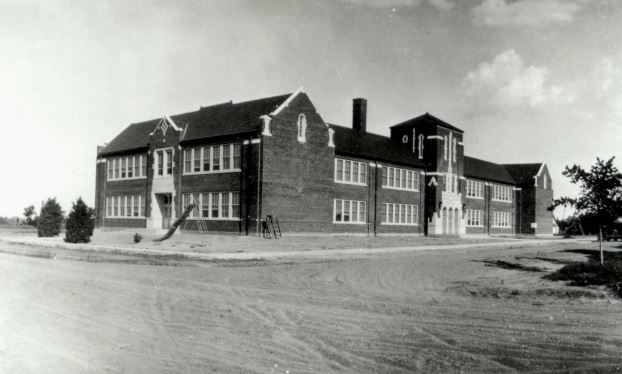
Grant School in Goodland circa 1927 shortly after it was built.
Grant School – 520 W. 12th Street, Goodland, Sherman County
Grant School was built in 1926 to relieve overcrowding at other public schools in Goodland. It served the community as an elementary school from 1926 to 1969 and then as a junior high school until 2015.
The opening of Grant School coincided with the addition of Kindergarten to the district’s curriculum, resulting in the district’s first purpose-built Kindergarten classroom.
Grant School today
The school, which exhibits the Late Gothic Revival style, was designed by Hutchinson-based architects Mann and Company, a firm known for its designs of schools. The school reflects traditional elements of the Gothic Revival style with its variegated red brick exterior, stone detailing, multiple gable roofs and dormers, stone quoining, and central tower. The building reflects Progressive-era tenets of school design with a combined auditorium and gymnasium space and specialized classrooms. It is nominated as part of the Historic Public Schools of Kansas multiple property nomination for its local significance in the areas of education and architecture.
Baldwin City School and Gymnasium/Auditorium – 704 Chapel Street, Baldwin City, Douglas County
Kansas City-based architect Charles A. Smith designed the Baldwin City School, which opened in January 1923. The building embodies Progressive-era tenets particularly involving specialized classrooms. It hosted both elementary and high school classes until a new high school was built in 1969. Topeka-based architect Thomas W. Williamson designed a detached auditorium and gymnasium that was completed in 1942 as part of the Work Projects Administration program. Both buildings functioned as a part of the local public school system until 2011. The property is nominated as part of the Historic Public Schools of Kansas and New Deal-era Resources of Kansas multiple property nominations.
South Kansas Avenue Commercial Historic District – Topeka, Shawnee County
Topeka’s South Kansas Avenue Commercial Historic District includes ten city blocks between 6th Avenue on the north and 10th Avenue on the south. The blocks flanking South Kansas Avenue form the primary historic commercial thoroughfare in the central business district of Topeka. The district incorporates all of the commercial, social, and civic functions necessary for the development of a successful urban center, with evidence of specific building booms and the influence of policy changes, such as urban renewal, present in the variety of building types and styles. The patterns of growth and density of the commercial core paralleled the development of the city as it grew mainly south and west from the original town site. Revitalization efforts in the 1960s and 1970s encouraged larger-scale development, and many businesses relocated away from the traditional commercial center. South Kansas Avenue was left with a concentration of banks, restaurants, and offices for government, utilities, and private companies. The nominated area represents the plethora of architectural styles popular during the course of Topeka’s history. Buildings vary in scale from one to sixteen stories high and from a narrow city lot to an entire city block in width. It is nominated for its local significance in the areas of commerce and architecture.
Mill Block Historic District – 101-129 N. Kansas Avenue, Topeka, Shawnee County
The Mill Block Historic District is a five-building, light industrial district along Topeka’s main commercial street, Kansas Avenue, just north of the central business district, between 1st Avenue and NW Crane Street. The buildings reflect the light industrial and commercial warehouse development that occurred along the river at the north end of the downtown commercial core once the presence of railroads was firmly established in Topeka. Constructed between 1904 and 1930 as wholesale warehouse and distribution facilities, the buildings communicate the evolution of this industry from rail to road transportation. The resources continue to function as warehouses. The district is nominated for its local commercial significance.
Church of the Assumption Historic District – 204 and 212 SW 8th Avenue / 735 SW Jackson Street, Topeka, Shawnee County
The Church of the Assumption (1924) and Assumption Rectory (1929) were listed in the National Register of Historic Places in 2008. The buildings, along with an associated garage, were nominated for their architectural significance as examples of the Mission Revival and Renaissance Revival styles. This new nomination expands the boundaries to include the two associated schools, the former Hayden High School (1939) and Assumption School (1954), and adds an argument for the property’s educational significance. The Church of the Assumption established the first Catholic elementary school and high school in Topeka. For much of the period of significance, Hayden High School served all of the city’s Catholic parishes. The construction of Assumption School in 1954 during the baby boom illustrates the rapid expansion of growth of Catholic education after World War II.
Westheight Apartments Historic District – 1601-1637 Washington Boulevard, Kansas City, Wyandotte County
The Westheight Apartments Historic District on the 1600 block of Washington Boulevard in Kansas City, Wyandotte County, includes four multi‐family apartment buildings constructed between 1947 and 1952. It is a locally rare collection of simple, yet distinctly Modern Movement apartment buildings. In their design, the Westheight Apartments embraced basic tenets of the Modern Movement aesthetic, which were more commonly applied to commercial buildings or later, large apartment buildings. By contrast, nearly all contemporary Wyandotte County apartment projects featured buildings that enlarged and adapted the single‐family dwelling form and traditional historically‐derived architectural idioms to fit a multi‐family purpose. The buildings have flat roofs, rectangular massing emphasized by projecting entrance and stair towers, and wide expanses of windows. The district distinctly embodies national design trends from the mid‐20th century when the Federal Housing Administration (FHA) heavily influenced the design of multi‐family housing that was constructed using agency‐backed mortgages. It is nominated for its local significance in the area of architecture.
Barnes, Oscar D. & Ida, House – 901 N. Broadway Avenue, Wichita, Sedgwick County
The Oscar and Ida Barnes House is located in Wichita’s Midtown neighborhood and was completed in 1911. It is an excellent example of the Italian Renaissance style exhibited on a foursquare, a common house form of the early 20th century that allowed for considerable variation and experimentation in style. The Italian Renaissance style was most popular in Wichita between 1900 and 1920. In residential architecture, it is typically characterized by a low, hipped roof with ceramic tiles, wide eaves with brackets, a symmetrical facade, stucco or masonry walls, and Classical columns and details. The Barnes House also exhibits the Craftsman style in its built-in cabinetry, geometric window designs, and interior floorplan. The architect is unknown, although it may have been Charles Terry, who worked with Oscar Barnes on the design of several commercial buildings. It is nominated to the National Register as part of the Residential Resources of Wichita multiple property nomination for its local significance in the area of architecture.
Smoky Hill Trail and Butterfield Overland Despatch Segment – 522 Golf Course Road, Chapman, Dickinson County
This nominated segment of the Smoky Hill Trail and Butterfield Overland Despatch is located adjacent to Indian Hill Cemetery on the west side of Chapman in Dickinson County. This portion of the road began as a military route connecting Fort Riley with the Santa Fe Trail south of Ellsworth. By the late 1850s, the Smoky Hill Trail developed through Kansas between Leavenworth and Pike’s Peak, Colorado, and functioned briefly as the Butterfield Overland Despatch in the 1860s. The six-acre property is nominated as part of the Historic Resources of the Santa Fe Trail multiple property nomination, as a tertiary route, meaning it was not created solely for Santa Fe trade but was occasionally used as a supporting road. The period of significance encompasses the duration of use for long-distance travel, beginning in 1853 with its use as a military road and ending with the last stage coach service over this segment in 1870.
McClinton Market – 1205 E. 12th Street, Wichita, Sedgwick County
The McClinton Grocery was listed in the National Register of Historic Places on June 28, 2011 for its local significance in the area of commerce and its association with community leader and state representative Curtis McClinton, Sr. It was nominated as part of the African American Resources of Wichita multiple property nomination. The building was demolished in early January 2015.
Hitschmann Double Arch Bridge – Barton County
Hitschmann Cattle Underpass – Barton County
Two 1930s-era bridges near Hitschman were listed in the National Register of Historic Places on April 16, 2008 for their local significance in the areas of social history, government, and architecture. They were nominated as part of the New Deal-era Resources of Kansas and Masonry Arch Bridges of Kansas multiple property nominations. The bridges were demolished in October 2014, and the Kansas State Historic Preservation Office requested they be removed from the National Register.