TOPEKA, Kan. (AP) — The state mistakenly notified thousands of Kansans this week that their Medicaid coverage had been canceled.
The Kansas Department of Children and Families said a computer glitch caused the incorrect letters to be sent out.
DCF spokeswoman Theresa Freed says the error happened as the department switches to a new computer system that manages Medicaid eligibility applications. She says the new system replaces a computer system in use since the early 1980s.
Freed says some of the cancellation letters mailed out in July were legitimate. Those letters were mailed in envelopes that have a DCF logo on them. The incorrect letters did not have the logo.
The Lawrence Journal-World reports everyone who received the letter will be sent a new, accurate letter within a week.
WICHITA, Kan. (AP) — Wichita police are searching for a 4-month-old boy who was last seen three weeks ago with his father.
Police say the boy’s mother reported him missing Thursday. She told police the boy and a 2-year-old child were with their father for visitation beginning June 5. She said the father did not return the children and took them to Texas before returning to Wichita.
Police Capt. Jeff Weible says younger boy, Vincent Moore, was last seen July 11 when the father left their home with him, carrying a blue floral-print diaper bag.
The father was arrested Wednesday on unrelated warrants. The 2-year-old was with him but Vincent was not. Weible says police have been told different stories about the child’s whereabouts and they have all been false.
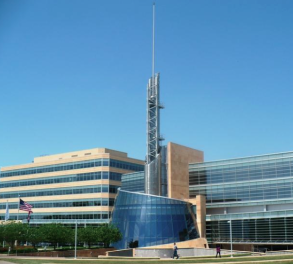
Cerner’s headquarters in North Kansas City. photo by ELANA GORDON KCUR
By DAN MARGOLIES
Cerner Corp. on Wednesday landed what’s thought to be one of the biggest health information technology contracts ever awarded.
The Washington Post reported that the 10-year contract for the U.S. Defense Department’s Military Health System was worth $4.3 billion. Bloomberg Business said the contract was valued at as much as $9 billion through 2033.
Cerner beat out archrival Epic Systems for the contract, which calls for Cerner and its partners to upgrade health records for 9.5 million people at more than 50 hospitals and hundreds of clinics in the United States and abroad.
A spokeswoman for Cerner, Angela Vogen, said in an email that it would be “inappropriate” for the company to discuss specifics of the contract. She said that the Cerner team “stands ready to lean forward with the DoD to implement a world class electronic health records system.”
Cerner teamed up with Leidos, Accenture Federal Services and Intermountain Healthcare on the bid. The Cerner team was one of six teams that originally submitted proposals. Earlier this year, the Defense Department narrowed the list down to three.
Cerner has about 16,000 employees worldwide and is the fastest growing company in Kansas City. The company posted sales of $3.4 billion last year.
An article on the Department of Defense’s website said Cerner and its partners will begin fielding the system at eight Pacific Northwest locations late next year. Ultimately, it said, it will be fielded at more than 1,000 locations worldwide.
The cost over 18 years was originally pegged at $11 billion, but Undersecretary of Defense for Acquisition, Technology and Logistics Frank Kendall said in the article that new estimates put it at below $9 billion.
Dan Margoiles is an editor for Heartland Health Monitor, a news collaboration focusing on health issues and their impact in Missouri and Kansas.
HUTCHINSON– A Kansas man and woman were in court Friday facing drug distribution charges.
They were arrested Thursday at a residence in the 200 block of East 5th Street in Hutchinson.
Thirty-eight-year-old Brian Keith Schoening and 27-year-old Chelsey Aileen Peterson, both of Hutchinson, are in custody on suspicion of distributing methamphetamine, possession of a drug paraphernalia with intent to distribute, possession of marijuana and possession of personal use drug paraphernalia.
Peterson is also charged with interference with law enforcement.
Police say Schoening was driving a vehicle belonging to another individual and a Hutchinson Police officer check of the tag showed the owner had an outstanding warrant in another state.
The officer followed the vehicle to the home on East 5th. He knocked on the door and no one answered. There is another residence behind that home and he knocked on that door. Peterson answered and said she was alone. Police then asked permission to step inside and look for themselves and she agreed. They allegedly found Schoening hiding in the bathroom.
The officer also saw drugs and obtained a search warrant leading to the two arrest.
Peterson is alleged to have given a false name leading to the interference charge against her.
Schoening is on community corrections for another case in Geary County where he was convicted of being in possession of drugs and driving under the influence.
He is being supervised by corrections in Reno County.
The two were taken to jail with different bonds. Schoening has a bond of $15,500 and Peterson with a bond of $17,000. Both appeared in court Friday and are due back in court next week.
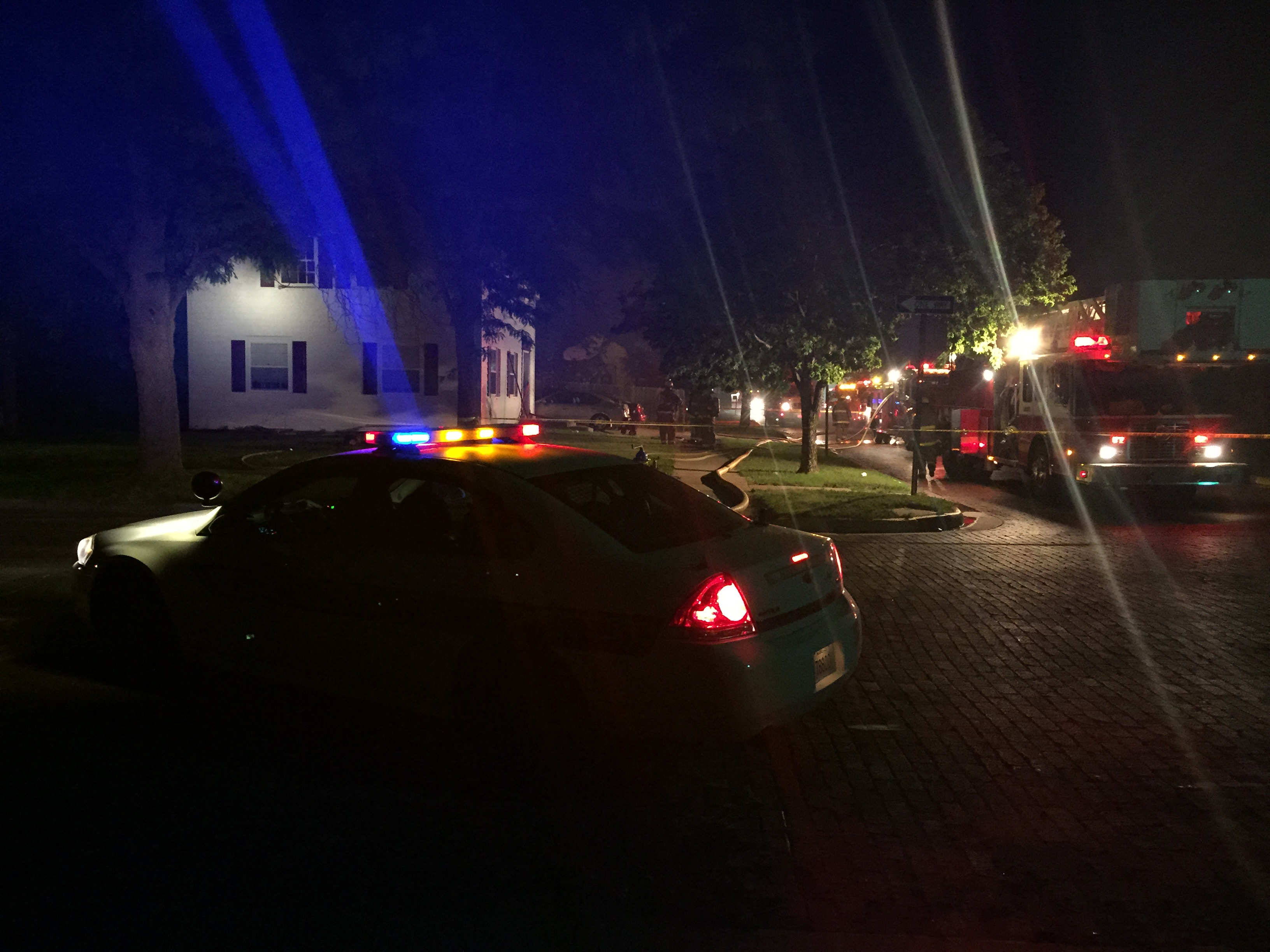
At 2:45 a.m. Saturday, the Hays Fire Department, Hays Police Department and Ellis County EMS were dispatched to a structure fire at 701 Walnut.
Upon arrival, fire crews found heavy smoke conditions on the second floor of the home. Fire crews had to break out windows on the second floor and apply water on the fire from the outside before making entry to completely extinguish the fire. One extra engine was dispatched from Ellis County Rural Fire Department for mutual aid.
Fire crews stayed on scene to check for fire extension and remove any carbon monoxide in the home. The home was turned back over to the tenants. The last fire unit left the scene at approximately 4:45 am.
A total of 22 fire fighters responded, staffing six fire trucks and support vehicles. No injuries were reported.
ELLIS — An Ellis daycare provider and her husband have asked to speak at Monday’s Ellis City Council meeting regarding what the couple believe are “dangerous dogs” in their neighborhood.
Kimberly Andries wrote on her Facebook page July 29 that she, her three children, her daycare children, neighborhood kids and others have been “chased” and “attacked” by the dogs “countless times.”
Bret Andries is scheduled to discuss the issue during public comments. The couple is asking other concerned Ellis residents to join them at the city meeting.
Other agenda items include discussion of the Street Improvement Project by Buck Driggs of Driggs Design Group. Council members will also review bid procedures in the city’s purchasing policy and take another look at the 2016 budget proposal.
The meeting starts at 7:30 p.m. Monday, Aug.3, in Ellis City Hall. The complete agenda follows.
AGENDA August 3, 2015
REGULAR MEETING OF THE CITY COUNCIL OF ELLIS
City Hall – Council Meeting Room
BILLS ORDINANCE REVIEW WORK SESSION BEGINS AT 7:00 P.M.
ROLL CALL AND MEETING CALL TO ORDER AT 7:30 P.M.
PLEDGE OF ALLEGIANCE
AMENDMENTS TO AGENDA (if needed)
PUBLIC HEARING – ENVIRONMENTAL AND CODE VIOLATION NOTICES
1) CONSENT AGENDA
a) Minutes from Regular Meeting on July 20, 2015
b) Bills Ordinance #1978
(Council will review for approval under one motion under the consent agenda. By majority vote of the governing body, any item may be removed from the consent agenda and considered separately)
PUBLIC COMMENTS
(Each speaker will be limited to five minutes. If several people from the group wish to speak on same subject, the group must appoint a spokesperson. ALL comments from public on agenda items must be during Public Comment. Once council begins their business meeting, no more comments from public will be allowed.)
2) PRESENTATIONS OF AWARDS, PROCLAMATIONS, REQUESTS & PETITIONS (HEARINGS)
3) SPECIAL ORDER
a) Discussion on Street Improvement Project – Buck Driggs, Driggs Design Group
b) Discussion on Dangerous Dogs – Bret Andries
c) Discussion on Courthouse Restoration and Ellis County Anniversary – Guy Windholz
d) Fire Department Update – Fire Chief Denis Vine
4) UNFINISHED BUSINESS
a) Consider Memorandum of Understanding – Ellis Fire Department
b) Consider Ordinance Annexing Tract of Land
c) Discuss Cost-Sharing of Infrastructure of Annexed Property
d) Consider Pre-Purchase of Materials – Wastewater Treatment Plant Improvement Project
e) Consider Ordinance Amending Code Section 15-502 Water Conservation Definitions
f) Consider Ordinance Providing for a Permit to Water Newly Seeded Lawns
g) Consider Ratification of Fork Lift Repairs
5) NEW BUSINESS
a) Consider Public Property Permit Application and Event Request for Traffic Control – Ellis Chamber of Commerce
b) Consider Public Property Permit Application – P.E.O., Chapter FO
c) Review Bid Procedures in Purchasing Policy
6) REPORTS FROM CITY OFFICIALS
a) Administrative
1) Public Works
(1) Consider Approval of Hiring Department Employee
(2) Department Update
2) Police
(1) July Monthly Activity Report
(2) August Staff Calendar
(3) National Night Out Against Crime – August 4th
(4) Department Update
3) City Clerk
(1) 2016 Budget Document
(2) Department Update
4) Attorney
5) Mayor/Council
(1) Update on Ellis City Lake
(2) Update on Hays R9 Ranch Project
EXECUTIVE SESSIONS
7) ADJOURNMENT
ELLIS–Kansas Hunter Education Class 2015, sponsored by the Ellis Recreation Commission, will be taught in Ellis Thursday, Aug. 27 and Saturday, Aug. 29 at the Ellis Public Library Community Room.
Online registration deadline is Wednesday, Aug. 12. Cost is $20–a refundable deposit to be returned at the end of the session on the last day of class.
Students must be age 11 or older as of August 29, 2015, in order to receive their Hunter Education Card.
Classes will be taught by volunteer Kansas Dept. of Wildlife, Parks and Tourism instructors from 6 to 9 p.m. August 27 and 8 a.m. to 5 p.m. Aug. 29.
Students are required to attend both sessions. Parents are welcome to attend the classes with their child.
Kansas Hunter Education teaches new hunters to be ethical, safe and knowledgeable.
The course consists of subjects covering hunter responsibility, ethics, fair chase, history of firearms, firearms basics, ammunition, basic gun safety, field safety, bow hunting, conservation and wildlife management, wildlife of Kansas, outdoor emergencies, Kansas hunting regulations and boating safety for hunters.
A warm weekend is in store for the area. Mostly sunny day today with winds increasing as the day progresses. Highs will top out in the low 90s with winds becoming southerly at 15-20 mph with a slight chance for hit and miss thunderstorms tonight.
Warm and dry weather is expected on Sunday. High temperatures should top out in the mid 90s and lows should be in the upper 60s.
Today: Patchy fog before 8am. Otherwise, sunny, with a high near 93. Light southwest wind becoming south 9 to 14 mph in the morning.
Tonight: Partly cloudy, with a low around 68. South wind 7 to 13 mph.
Sunday: Mostly sunny, with a high near 95. South southwest wind 7 to 9 mph.
Sunday Night: Partly cloudy, with a low around 69. Southeast wind 6 to 9 mph.
Monday: Mostly sunny, with a high near 95. South wind 6 to 14 mph.
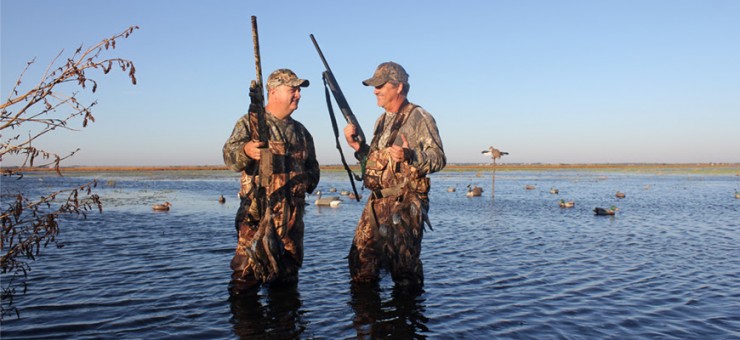
PRATT–According the U.S. Fish and Wildlife Service’s (USFWS) 2015 Trends in Duck Breeding Populations survey, overall duck numbers remain strong as we enter the 2015-2016 hunting seasons. The USFWS stated that total populations were estimated at 49.5 million breeding ducks in the traditional survey area, which is 43 percent above the 1955-2014 long-term average and the highest count on record. Last year’s estimate was 49.2 million birds.
According to the report, current species estimates are as follows:
Blue-winged teal: 8.5 million, 73 percent above the long-term average.
Green-winged teal: 4.1 million, 98 percent above the long-term average.
Northern shoveler: 4.4 million, 75 percent above the long-term average.
Northern pintail: 3.0 million, 24 percent below the long-term average.
Mallard: 11.6 million, 51 percent above the long-term average.
Gadwall: 3.8 million, 100 percent above the long-term average.
American wigeon: 3.0 million, 17 percent above the long-term average.
Redhead: 1.2 million, 71 percent above the long-term average.
Canvasback: 0.76 million, 30 percent above the long-term average.
Scaup: 4.4 million, 13 percent below the long-term average.
Waterfowl hunting seasons in Kansas will begin with the teal season in the Low Plains Zones Sept. 12-27, followed by the High Plains Zone Sept. 19-27, 2015.
Regular duck and goose seasons will be approved by the Kansas Wildlife, Parks and Tourism Commission at the public hearing portion of its Thursday, August 20 meeting, which will be held at the Kansas Wetlands Education Center, 592 NE K-156 Highway, Great Bend. The public hearing will begin at 6:30 p.m.
Waterfowl hunters are required to possess a Kansas HIP permit, state waterfowl permit, federal waterfowl stamp, and Kansas hunting license, unless exempt.
For more information on Kansas waterfowl seasons, visit ksoutdoors.com.
HARVEY COUNTY- A Kansas woman was injured in an accident just after 11p.m. on Friday in Harvey County.
The Kansas Highway Patrol reported a 2011 Toyota Corolla driven by Angela R. Stucky, 38, Moundridge, was eastbound on U.S. 50 near the Harvey-Reno County line behind a box truck.
The Toyota pulled out to pass the truck and struck a semi head on in the westbound lanes.
Stucky was transported to Wesley Medical Center.
The semi driver Billy F. Brizendine, 39, Hutchinson, was not injured. Both drivers were properly restrained at the time of the accident, according to the KHP.
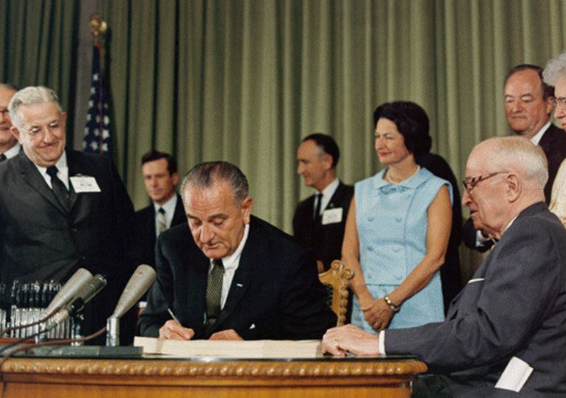
President Lyndon B. Johnson signing the Medicare bill at the Harry S. Truman Library in Independence, Missouri. Former President Harry S. Truman is seated at the table with Johnson. In the background (from left to right) are Sen. Edward V. Long, an unidentified man, Sen. Mike Mansfield, Lady Bird Johnson, Vice President Hubert Humphrey and Bess Truman. CREDIT EXECUTIVE OFFICE OF THE PRESIDENT OF THE UNITED STATES
By MIKE SHERRY
Advocates of government-sponsored health care gathered Thursday at the Harry S. Truman Library and Museum in Independence, Missouri, to mark the anniversary of legislation that’s both a local story and a milestone for medical care in the United States.
Fifty years ago, on the same stage where speakers sat, President Lyndon Johnson signed the law establishing Medicare and Medicaid, vastly expanding insurance protections for the elderly and for low-income Americans.
Medicare and Medicaid stand as “shining examples” of the very reason his grandfather entered politics, said Clifton Truman Daniel, a grandson of President Truman. “He wanted to make things better for people.”
Johnson chose the Truman Library for the signing ceremony as a tribute to Truman, who had championed national health insurance, urging Congress to adopt his vision. His pleas went unanswered.
Today, Medicare covers the elderly and disabled while Medicaid assists the poor, including children and pregnant women. The two programs combined cover about 125 million people, or nearly one out of every three Americans.
Johnson issued the first two Medicare cards to Truman and his wife, Bess.
At the signing ceremony, Johnson expressed pride that Medicare and Medicaid were enacted during his administration, but said: “It was really Harry Truman of Missouri who planted the seeds of compassion and duty which today flowered into care for the sick, and serenity for the fearful.”
Addressing Truman, Johnson said, “And just think, Mr. President, because of this document – and the long years of struggle which so many have put into creating it – in this town, and a thousand other towns like it, there are men and women in pain who will now find ease.”
Thursday’s speakers invoked Johnson’s comments, declaring that the two programs have proven worthy of his rhetorical flourishes.
“Simply put,” said Nanette Foster Reilly, regional administrator of the agency that oversees the programs, “Medicare and Medicaid save lives.”
The path
Medical histories often trace the concept of government-provided health care to Germany in the late 19th century. By the start of the 20th century, the U.S. lagged behind many of its peer countries in providing medical care for its citizens.
But the idea of a national health insurance program failed to take hold even during the vast expansion of social programs enacted as part of President Franklin D. Roosevelt’s New Deal legislation.
Johnson and others credited Truman with laying the groundwork for Medicare and Medicaid in the mid-1940s. Truman, they said, was the first president to stick out his neck, take on the fierce opposition of the organized medical community, including the American Medical Association, and put the full force of his office behind the idea of national health insurance.
“Many men can make proposals. Many men can draft many laws,” Johnson said. “But few have the piercing and humane eye which can see beyond the words to the people that they touch … And fewer still have the courage to stake reputation, and position, and the effort of a lifetime upon such a cause when there are so few that share it.”
In his own remarks at the signing ceremony, Truman suggested that his push for a government health insurance program had a significant national security angle.
He said that Medicare was an important benefit for “those of our citizens who have completed their tour of duty and have moved to the sidelines.”
Truman’s message to Congress on Nov. 19, 1945, considered to be his first call for national health insurance, noted the alarming frequency with which people were being declared medically unfit to serve in the military.
As of April of that year, nearly a third of all draftees between the ages of 18 and 37 had failed their physicals, he noted.
“These men and women who were rejected for military service are not necessarily incapable of civilian work,” Truman said in his congressional message. “It is plain, however, that they have illnesses and defects that handicap them, reduce their working capacity, or shorten their lives.”
Three years later, in remarks to the National Health Assembly, a body convened to outline a 10-year health strategy for the nation, Truman said he first recognized the link between population health and national defense during his service in World War I.
Truman organized a field artillery regiment in 1917 and was shocked by how many men were too medically fragile to serve.
“That was a National Guard volunteer regiment,” he said, “and when a man got turned down because he was physically unfit, that was not only tragic to him, but it was tragic to us who wanted him to serve with us.”
(Echoes of those comments were heard again just this month, when a group of retired generals and admirals concluded that nearly one of every three Americans age 17 to 24 is too obese to qualify for military service.)
As speakers on Thursday noted, Truman’s rationale for enacting a national health insurance program sounded remarkably similar to the arguments advanced by proponents of the Affordable Care Act, also known as Obamacare.
Truman argued that a healthier populace would translate into a more productive workforce and encouraged people to get preventive care rather than wait until their condition worsened before seeking medical assistance.
In a special message to Congress in 1949, reminding lawmakers of the plan he had put forth four years earlier, Truman said the real cost of inadequate medical care was not measured merely in hospital and doctor bills.
“The real cost to society,” he wrote, “is unnecessary human suffering and the yearly loss of hundreds of millions of productive working days.”
Truman promoted his vision through the waning days of his presidency.
On Jan. 9, 1953, less than two weeks before the inauguration of his successor, Dwight D. Eisenhower, Truman transmitted to Congress the first volume of a report by the President’s Commission on the Health Needs of the Nation, a panel he had established.
But as early as 1950, one of his key health aides, Oscar R. Ewing, said he had become convinced that the nation was not ready for the type of broad national program envisioned by Truman.
Ewing recounted his thoughts in a 1969 oral history on file at the Truman Library.
He said that, partly because of a cocktail party conversation he had with newspaper publisher William Randolph Hearst Jr., he had begun to think about taking a smaller bite of the apple by proposing to cover a smaller segment of the population.
The interviewer asked Ewing how Truman reacted to the idea of a plan solely for seniors.
“Well, at first he didn’t like the idea because he didn’t like to give up,” Ewing said. “I think the president rather thought it would be better to lose everything at that time and that future events would later force the adoption of some form of national health insurance. But he finally said, as I recall, that he’d follow my recommendations if I really thought it was the wise thing to do.”
Mike Sherry is a reporter for Heartland Health Monitor, a news collaboration focusing on health issues and their impact in Missouri and Kansas.