RENO COUNTY— A Kansas man who waived his preliminary hearing in the fatal stabbing of a Hutchinson man was sentenced Friday to 7-years and six months in prison.
Kevin Wayne Ginn Jr., 34, was convicted in the stabbing death of 24-year-old Deshamus Diron Luckey during a large disturbance just after 2 a.m. New Years Day in the area of 8th and Madison Street in Hutchinson.
He was originally charged with voluntary manslaughter, but in March, the state amended the complaint to second-degree murder and added counts of voluntary manslaughter and aggravated battery.
Ginn entered a plea to one count of involuntary manslaughter with the other charges dropped as part of the agreement.
The Hays Police Department responded to 5 animal calls and 9 traffic stops Thu., July 28, 2016, according to the HPD Activity Log.
Warrant Service (Fail to Appear)–500 block E 7th St, Hays; 1:55 AM
Driving Under the Influence–500 block W 7th St, Hays; 2:08 AM
Animal At Large–1300 block Western Plains Dr, Hays; 8:13 AM
Lost Animals ONLY–4000 block Covenant Dr, Hays; 9 AM
MV Accident-City Street/Alley–1100 block E 15th St, Hays; 7/26 11 AM
Animal At Large–1700 block Douglas Dr, Hays; 10:24 AM
Theft (general)–400 block W 5th St, Hays; 10:48 AM
MV Accident-City Street/Alley–2500 block Donald Dr, Hays; 10:48 AM
Drug Offenses–1000 block Vine St, Hays; 11 AM; 11:40 AM
Search Warrant–500 block W 16th St, Hays; 2:11 PM
Animal Call–1300 block Western Plains Dr, Hays; 7:10 PM
Suicidal Subject–2700 block Epworth St, Hays; 7:28 PM; 8:18 PM
Suspicious Activity–3000 block E 14th St, Hays; 7:33 PM
Drug Offenses–800 block Ash St, Hays; 11:15 PM; 11:22 PM
Parents and students in Hays will benefit from a national backpack giveaway campaign Saturday.
A Wireless, the nation’s second-largest Verizon Premium Retailer, announced today they are partnering with Culture of Good to donate 100,000 backpacks full of school supplies to children through the annual School Rocks Backpack Giveaway. Since 2013, Culture of Good has donated more than 360,000 backpacks filled with supplies to ensure children are well prepared for the start of the school year.
More than 760 participating A Wireless stores across the U.S. are inviting local families and their children to visit these select locations on Saturday between noon and 3 p.m. to pick up a backpack filled with various school supplies; including pencils, paper, a pencil box, folders and glue. One backpack per child present will be given away on a first-come, first served basis while the supplies last.
The participating A Wireless store in Hays are located at 4325 Vine, Ste. 20. Each participating A Wireless store will donate 125 backpacks. Any leftover backpacks will be donated to local schools. A Wireless hopes that this program will help alleviate the average cost of $97.74 on school supplies that the average person with children spends each school year on these supplies. With over 16 million children in the U.S. living in poverty, A Wireless hopes to help give some relief to some of these families.
“When given the opportunity, doing good is important, and taking such opportunities to help, lift up, and encourage others is a privilege,” said Bryan Bevin, president and CEO of A Wireless. “At A Wireless we don’t just want to be doers of good, we want to inspire a Culture of Good.”
More information about the School Rocks Backpack Giveaway initiative is available on YouTube. Supporters of the School Rocks Backpack Giveaway are encouraged to use hashtag #cultureofgood on Instagram and Twitter to help spread the word.
To learn more about A Wireless, visit www.awireless.com. Customers can also connect with the company at facebook.com/awireless and www.twitter.com/myawireless.
SALINE COUNTY – Two people were injured in an accident just before 1:30 p.m. on Friday in Saline County.
Law enforcement officers at the scene reported a GMC Tahoe driven by Kaila Vlahopoulos, 21, a student in McPherson from Texas, was northbound on Interstate 135 just north of Magnolia Road.
The vehicle traveled into the median and rolled.
Vlahopoulos was transported to Salina Regional Health Center with non-life threatening injuries, according to authorities.
A passenger in the vehicle also suffered minor injuries.
TOPEKA, Kan. (AP) — A federal inmate has been charged with killing a man connected to the 2014 shooting death of a Kansas bride.
The Topeka Capital-Journal reports that 27-year-old Cortez Tyrell Timley was charged Wednesday with premeditated first-degree murder in the June 2014 shooting death of 26-year-old Jermel Robbins Sr. He doesn’t yet have an attorney.
Three weeks earlier, 42-year-old Tiffany Davenport-Ray was killed as she headed to her wedding reception when shots were fired from a sport utility vehicle in which three men were riding. Two men were convicted previously, and Robbins name surfaced as the third SUV occupant during their trials.
Timley pleaded guilty last year to a federal charge of possessing a firearm in furtherance of a drug-trafficking crime. The offense occurred the same day Robbins was killed.
The Centers for Disease Control and Prevention recently awarded Kansas more than $350,000 to support efforts to protect Kansans from Zika virus, a mosquito-borne disease. The money also will go toward eliminating adverse health outcomes that can result from Zika infection, including severe birth defects.
Mosquito season went into full swing when early rains and warm temperatures started the population with a bang this spring. But with rising concerns of Zika virus in the United States, the itchy welts that come from mosquito bites are no longer just annoying. They’re scary.
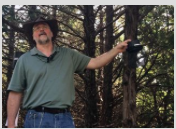
Photo by Abigail Wilson/KMUW Christopher Rogers, with the Kansas Biological Survey, demonstrates one method of trapping mosquitoes for monitoring.
Trapping mosquitoes
In an effort to lessen fears and keep track of the prevalence of the tiny flying bugs, the Kansas Department of Health and Environment, along with specialists from the University of Kansas, conduct mosquito surveillance each year. Researchers trap and count the insects and identify them by species.
Christopher Rogers, with the Kansas Biological Survey, is one of the researchers tasked with mosquito monitoring in Kansas.
Just off the sidewalk at Chisholm Creek Park in Wichita near the Great Plains Nature Center, Rogers stands next to an interesting contraption. It looks a little like black paint bucket with a long, skinny bird feeder hanging from it. And while seemingly simple, this mosquito trap is a key piece of the puzzle for Kansans hoping to avoid mosquito-borne illnesses.
Of the 50 species of mosquitoes in the state, Rogers said only about half bite.
“And of those species that do bite, only the female bites, and she only bites when she needs to lay eggs,” he said.
In order to find someone or something to bite, the female mosquitoes look for our breath — or, more specifically, the carbon dioxide that we breathe out. Rogers’ trap simulates that using a bucket filled with dry ice, which puts off the gas as it melts.
The hanging contraption also has a small light near the top, which serves the same purpose that a lighthouse does for ships at sea. As the mosquitoes fly toward the carbon dioxide, they see the light and think it’s body heat. That’s how they identify their next meal, which, thankfully, this time, is not a person.
“They fly in,” Rogers said, pointing at the trap. “And inside of here is a fan, which sucks the mosquitoes down into the sleeve cage.”
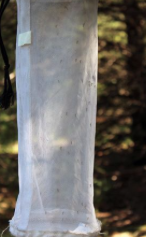
The sleeve cage is exactly what it sounds like: a sheath of tightly woven netting that traps the mosquitoes. Rogers said it can hold anywhere from a few dozen to 7,000 mosquitoes, which he then puts on dry ice to knock them out so he can get to work identifying the insects down to a species level.
He says different varieties are distinguishable by the arrangement of veins in their fragile wings or the patterns found in scales, spines and hairs on their tiny bodies. The species he’s looking for are varieties of the Aedes mosquito: Aedes aegypti, which is native to Africa, and Aedes albopictus, which comes from Asia.
“These are the two that we’re most concerned about because they have the potential to carry the Zika virus,” Rogers said. “These are the two species that are carrying Zika virus in Central and South America, Puerto Rico, the Caribbean and whatnot.”
If either Aedes variety is found in one of Rogers’ traps, its body is sent to a KDHE laboratory.
“We look for the DNA of the virus in the mosquitoes. That way we can tell if the mosquitoes are actually transmitting the disease,” he said.
Photo by Abigail Wilson/KMUW The net-like traps that Christopher Rogers uses can hold thousands of mosquitoes. –
Eight cases in Kansas
The state of Kansas has been doing this kind of work — trapping, counting and identifying mosquitoes — for years in order to keep tabs on other mosquito-borne diseases like West Nile virus, which first showed up in the state in 2002. Rogers’ work helps state agencies like the KDHE determine where certain species of the insect are found and how dense the population is.
“By knowing what species of mosquitoes are coming into the traps, we can direct Sedgwick County in their efforts to control the mosquito larvae, and they know where to go look for habitat where the larvae may be coming from,” he said.
So, that begs the question everyone seems to be asking: Is it just a matter of time before Zika virus does show up in Kansas?
“Zika virus has shown up in Kansas in people who went to other places, got the virus and came here,” Rogers said. “Because there are people here who have Zika — and there’s very few — these mosquitoes, all they have to do is go and bite that person and now they’ve got the virus. So far, these people are doing everything in their power not to get bitten by these mosquitoes.”
Eight cases of Zika have been confirmed in Kansas, and none of those originated in the United States. In fact, according to the KDHE, there have been no local transmissions of the virus in the continental United States.
Rogers said the countries that have been inundated with cases of Zika virus tend to be tropical places where mosquitoes are out year-round. One thing in Kansas’ favor is the colder winter weather.
“As soon as winter comes, they’re all dead,” he said. “All that’s left behind is their eggs. Now, as far as we know, so far all the data shows that the mosquitoes are not passing the virus to their eggs.”
So that’s a good thing. But, Rogers said, next year, it will start over again.
“If Zika virus does show up in the mosquitoes in Kansas, it’s going to reset every single year,” he said. “And it’s probably not going to be as huge a problem as we’re seeing in more tropical areas. We don’t know. We honestly don’t know what we’re up against yet.”
But there are ways to reduce the chances of getting Zika virus, like using DEET, staying covered and avoiding places where mosquitoes are likely to be in large numbers, and especially where they breed.
Rogers said that doesn’t only mean roadside ditches and stagnant ponds. The species of mosquito that can carry Zika, Aedes aegypti and Aedes albopictus, actually nest in trees with rotten hollows or pockets between limbs that can hold water.
Aedes aegypti has mainly been found along the Kansas-Missouri border and as far west of that as Topeka, he said. Aedes albopictus has been found in Sedgwick County for quite some time. But according to the KDHE, the precise range of both species is unknown, and just because the mosquitoes are here, that doesn’t mean they’re transmitting Zika to Kansans.
“I’m running traps all across the state to figure out where it lives, why it’s there, how did it get there,” Rogers said.
And with that data, the KDHE should be able to assess potential threat levels should Zika virus ever show up in mosquitoes in Kansas.
SALINE COUNTY – Law enforcement authorities in Saline County are investigating a suspect for alleged car theft.
Just after 10:30 p.m. on Thursday, police stopped a 2007 Buick Lacrosse, driven by Roderick Payton, 32, Galveston, TX, in the 1600 block of South Ohio, according to Salina Police Captain Mike Sweeney.
Payton got out of the car and fled on foot. He was taken into custody in the 900 block of East Cloud a short time later.
The Buick was stolen from a 24-year-old woman from Texas City, Texas, according to Sweeney.
Payton was booked into the Saline County Jail on requested charges of possession of stolen property, fleeing and eluding law enforcement, and interference with a law enforcement officer.
TOPEKA, Kan. (AP) — The Kansas Supreme Court has ruled that state law allows Gov. Sam Brownback to decide when he will fill a vacant district magistrate position.
Three 26th District judges asked the court in July to require Brownback to appoint a judge in that district within 90 days of learning of the vacancy. They argued state law requires five magistrate judges to serve the six-county district.
Brownback wants to wait until after the August election to appoint a replacement for Judge Tommy Webb of Haskell County, who retired in February.
The justices ruled unanimously Friday that wording of state law gives the governor discretion to exceed the 90-day deadline.
Justices Dan Biles and Caleb Stegall were not part of the decision. They were replaced by Senior Judges Michael Malone and David Stutzman.
Jacob Wood, Hays Asst. Mngr., reports on the aftermath of the July 13 storm in Hays.
By BECKY KISER Hays Post
Two weeks and one day after that severe wind storm went through Hays, downing many trees and a few power lines, and causing some structural damage, the city has completed its cleanup of broken trees and limbs.
Assistant City Manager Jacob Wood reported to city commissioners Thursday evening the crews has finished up earlier in the day.
“By 7 a.m., we had 95 city employees out moving the storm debris.,” Wood said. “The crews worked to clear the streets, respond to different service calls, and repair traffic signals. By 9 o’clock, most of the streets were cleared and we started to handle other debris.”
Workers then went to Lincoln Draw. Forecasts from the National Weather Service called for more rain the next night. “We got Lincoln Draw cleaned out so that wouldn’t cause any future flooding problems.”
Wood also noted that during the initial response, the Hays McDonald’s restaurants provided free breakfast to the city crews.
Curbside tree limb pick up started Friday, July 15, giving property owners a couple of days to get the debris moved.
“We had crews from the parks department, public works department and utilities, and they moved close to 700 loads of limbs to the Ellis County Landfill,” Wood said.
The city provided personnel at the landfill to help direct the incoming loads from city and private vehicles.
City Manager Toby Dougherty said he’s not yet seen a compilation of costs. “We did have to rent some trailers, and there’ll be some labor costs.”
Wood told commissioners the city received a number of compliments on how the situation was handled.
“The guys did a great job on this,” Wood said. “They spent a lot of time out there picking up limbs.”
Longtime resident Mayor Eber Phelps, and Commissioner Henry Schwaller, who has lived in Hays all his life, made remarks last week about the storm’s ferocity.
“I’ve never seen anything like this,” Phelps said.
KANSAS CITY, Mo. (AP) — A Kansas man has been charged with killing a woman in a Missouri apartment where officers found three children hiding under a blanket.
Thirty-one-year-old Derrick Williams, of Kansas City, Kansas, is charged in Jackson County Circuit Court with second-degree murder in the death of 32-year-old Denise Gayle. He’s also charged with three counts each of armed criminal action and endangering the welfare of a child. No attorney is listed for him in online court records.
Court records say officers responding to a report of gunfire and screams found a naked Williams outside the apartment. The records say that Williams told police they would find a dead woman inside the building and that he killed her.
One of the children found hiding in the apartment told police, “He killed my mom.”
DETROIT (AP) — Combi USA is recalling more than 39,000 car seats because they can transmit too much force to a child’s chest in a crash.
The recall covers certain Coccoro Convertible Child Restraints with a model number of 8220. They were manufactured from Jan. 1, 2009 to June 29, 2016.
Government documents say the problem happens when the seats are installed in a forward-facing position and secured only with a vehicle lap belt.
The problem was discovered in government tests. Combi says in the documents that there is little to no risk in real-world crashes. It has no reports of injuries.
Combi will notify owners and send them a cover for the bottom of the seat that reduces the force on children’s chests. Distribution of the covers started on July 11.