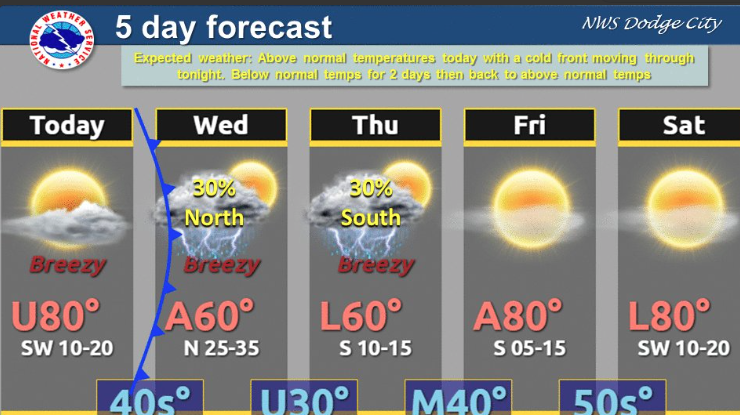
Today Mostly sunny, with a high near 84. South wind 7 to 9 mph becoming east southeast in the afternoon.
Tonight A 30 percent chance of showers and thunderstorms, mainly after 1am. Mostly cloudy, with a low around 48. Breezy, with a southeast wind 6 to 11 mph becoming north 17 to 22 mph after midnight.
WednesdayA 20 percent chance of showers before 1pm. Cloudy, then gradually becoming mostly sunny, with a high near 58. Windy, with a north wind 21 to 26 mph decreasing to 15 to 20 mph in the afternoon. Winds could gust as high as 36 mph.
Wednesday NightPatchy frost after 5am. Otherwise, mostly clear, with a low around 36. Northeast wind 9 to 14 mph becoming light east northeast.
ThursdayPatchy frost before 8am. Otherwise, partly sunny, with a high near 61. South southeast wind 5 to 13 mph.
Thursday NightPartly cloudy, with a low around 44.
BRENHAM, Texas (AP) — Blue Bell Creameries is recalling all of its ice cream products that contain cookie dough from an Iowa-based supplier.
The move announced Monday night comes after Aspen Hills recalled cookie dough supplied to ice cream makers after finding potential listeria bacteria contamination.
The Blue Bell recall involves half-gallons and pints of Blue Bell Chocolate Chip Cookie Dough and Blue Bell Cookie Two Step sold to retailers and three-gallon packages of Blue Bell Blue Monster, Blue Bell Chocolate Chip Cookie and Blue Bell Krazy Kookie Dough sold to food-service clients. They were produced between Feb. 2 and Sept. 7 and distributed in Kansas and 15 other states.
Listeria can cause serious, sometimes fatal infections in young children, frail or elderly people and those with weakened immune systems. In 2015, company products were linked to 10 listeria illnesses in four states, including three deaths in Kansas.
SALINA -Friends and family are searching for a missing Salina teenager.
Leslie Rush, 15, was reportedly last seen at about 3:45 a.m. Monday. It is believed that she is the company of an adult male.
Rush is 4’11” tall, 122 lbs., with light brown and blonde hair and blue eyes.
Her ears are pierced and she has cutting scars on her wrists.
When last seen, the teenager was wearing a black and green hooded sweatshirt, a blue or black t-shirt, a black jogging suit with stripes down the sides, and she may be carrying a blue backpack.
Anyone with information regarding Leslie Rush’s disappearance or knows of her whereabouts, is asked to call the Salina Police Department at 785-826-7210.
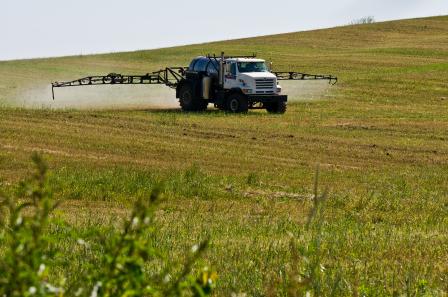
MANHATTAN — The Kansas secretary of agriculture and attorney general have asked the Environmental Protection Agency not to regulate the herbicide atrazine to the point it becomes ineffective or uneconomical for Kansas farmers.
In comments filed with EPA in connection with that agency’s proposed new regulation for atrazine and related herbicides, Secretary Jackie McClaskey and Attorney General Derek Schmidt urged the agency not to adopt a regulation that would render atrazine effectively unavailable for Kansas farmers.
“Any decision by EPA to restrict or eliminate the availability of the subject herbicides, particularly the availability of atrazine, would directly and negatively affect thousands of Kansas farmers by increasing the costs of production, reducing yield, and harming profitability while producing no meaningful environmental benefit,” the two wrote. “Please carefully consider a broader perspective and long-term approach when handling this issue. The proposal is inconsistent with EPA’s previous stated environmental concerns, is in conflict with proven evidence, and is detrimental to agriculture conservation practices.”
McClaskey and Schmidt pointed out that new regulations that result in atrazine being ineffective or unavailable would undermine efforts to promote soil conservation through reduced tillage practices.
SALINE COUNTY – Law enforcement authorities in Saline County are investigating a Publisher’s Clearinghouse scam.
A man in his 70’s, received multiple calls between October 3rd and October 6th to notify him he had won a Publisher’s Clearinghouse sweepstakes, according to Salina
Police Captain Mike Sweeney.
The victim was instructed that he would have to pay taxes and fees in order to receive it. He told the caller that he did not have the money to pay the fees and instructed the caller to donate his winnings to charity.
On October 4th, the man received a second call and was asked to provide credit card information that would assist the caller in helping him pay the fees and taxes. The caller stated that $1,800 would be placed in the account and at that time, the man would need to get a cash advance for $300 and wire $299 of that to cover the fees.
Sweeney said the man received a third call on October 5th informing him that he needed to pay additional fees to release his winnings. The caller again requested credit card information, stating that $4,900 would be placed on his account and he was again to get a cash advance and send $279 via MoneyGram to cover the fees.
Despite the man sending the payments, the $1,800 and $4,900 deposits were never made.
Sweeney indicated the caller also requested the man provide his date of birth and social security number so that a checking account could be opened that was required to assist with payment as well. An account was later opened in the man’s name at Bank of the West with an initial deposit of $34,000.
That deposit never cleared.
After realizing he had been scammed, the man contacted police.
Total loss in the case to date has been estimated at $578, according to Sweeney.
WICHITA, Kan. (AP) — A tax exemption enabling business owners to pay no state tax on business income is a boon to many Kansas lawmakers.
The Wichita Eagle reports nearly 70 percent of lawmakers or their spouses own a business or property that allows them to benefit from the exemption.
Gov. Sam Brownback and his wife, Mary, also stand to benefit from the law, which was passed in 2012 at the governor’s urging. Brownback would not discuss his family’s taxes when asked at the Capitol last month.
The law exempts the owners of limited liability companies, S-corporations, limited partnerships, family farms and sole proprietorships from paying state income tax on their non-wage business income. The law also extends to other sources of pass-through income, such as rents, royalties and trusts.
Click below to listen to Tiger Talk with “Voice of the Tigers” Gerard Wellbrock and Fort Hays State head football coach Chris Brown as they review Saturday’s win at Pittsburg State and take a look ahead at this Saturday’s game in Topeka against Washburn.
Tiger Talk airs on Monday evening at 6 p.m. on Tiger Radio Mix-103.
MANHATTAN — A corn disease that is new to the heartland is infecting Kansas crops. Bacterial leaf streak is so new to the United States that it is unclear whether it will pose a threat to this year’s yields, according to Kansas State University plant pathologist Doug Jardine.
The U.S. Department of Agriculture-Animal and Plant Health Inspection Service confirmed the presence of the new disease Aug. 26. In Kansas, it has been positively identified in 12 counties from Pratt County to Edwards County.
The disease is thought to have occurred on corn in South Africa, but it has been most notably associated with gumming disease of sugarcane. At this time, it is not known how it made its way to the United States or how long it has been here.
Following its initial confirmation, APHIS, working with state departments of agriculture and extension plant pathologists, began a survey of corn fields across the western Corn Belt. Bacterial leaf streak disease has now been identified in nine states including Nebraska, Kansas, Colorado, Iowa, Illinois, Minnesota, South Dakota, Texas and Oklahoma, Jardine said.
“Three additional counties have had corn with symptoms of the disease, but samples have not yet been confirmed definitively by DNA analysis.”
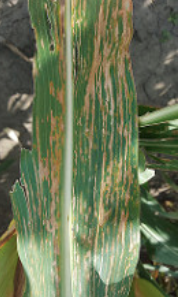
Infected corn leaves exhibit narrow tan to brown streaks that range from less than an inch to several inches long.
It is not currently known how the disease has spread to so many states, Jardine said, but a current hypothesis is that it is seed transmitted. Movement within a field or from field to field may be by the bacteria blowing in the wind created by thunderstorms. Unlike Goss’s blight, it does not appear that it needs a wound to aid it in getting into the plant.
“Under what conditions is it likely to occur? By far the single largest scenario associated with the disease is corn being produced in a continuous, no-till, sprinkler-irrigated production system,” Jardine said. “This is likely the reason that most positive counties in Kansas are in the western part of the state. That being said, the disease has also been found in furrow irrigated fields, as well as dryland fields in a strict corn-soybean rotation.”
No research has been conducted to date to determine if there will be any impact on yield, the K-State plant pathologist said. Disease management options are currently limited. Since it is a bacterial disease, fungicides are not effective. Because of the highly erodible nature of most Kansas soils, residue management will not likely be an option except perhaps in southeast Kansas.
“We do not know how long the bacteria can reside in old crop debris, but observationally, it can survive through the rotational year to soybeans,” Jardine said. “Observations in hybrid demonstration trials in Nebraska indicate that there are differences in hybrid response to the disease with some being much more susceptible than others. Long term, hybrid selection, as with Goss’s blight, will be the primary means of management.”
As with any crop disease, he added, samples can be submitted to the K-State Plant Disease Diagnostic clinic through any county or district extension office or directly to the clinic. Information on sample submission can be found at tinyurl.com/hm9eale.
Upland game hunters remain positive about a good season this fall in Kansas. Talk with landowners in the western half of Kansas and they will tell you rainfall this summer has resulted in more birds for the upcoming fall season. This year promises to be as good as 2015 and maybe better as hunters scour the countryside in search of pheasants, quail, ducks and other species of wildlife.
It goes without saying that Kansas farms and ranches have always been a handy, ready-to-use outlet for many urban dwellers who travel outside their city homes in search of recreational hunting. On opening day of the upland game season, the interstate and U.S. highways will be a steady stream of pickups, SUVs and cars headed for central and western Kansas.
If you’re one of these hunters who plan to hunt on private land, remember one key word when your thoughts turn toward hunting. This word is consideration. Translated, this word means thoughtful and sympathetic regard.
In this country, wildlife belongs to the people, but landowners have the right to say who goes on their land. If you are interested in hunting, make arrangements before you hunt.
Don’t wait until the day you plan to hunt someone’s land and then pound on their door at 6 a.m. Once you’ve secured permission, here are some suggestions to follow to ensure a lasting relationship between you and the landowner.
Agree on who, and how many, will hunt on the land. Specify number and furnish names. Talk about specific times and dates you plan to hunt.
Phone each and every time before you plan to hunt, and let the landowner know your intentions. The landowner may have forgotten about your original conversation. It’s just common courtesy to say hello before hunting and ask again for the opportunity – or privilege to hunt on someone’s property.
Determine exactly where on the land you have permission to hunt. Some areas may be off-limits because of livestock or crops.
Always, and I can’t stress this enough, leave gates the way you find them. If they are open, leave them that way. If they are closed, shut them after you pass through.
If you ever leave a gate open and a farmer’s cow herd gets out of the pasture, “Katie bar the door.” You’ll never be invited back to hunt.
Once you’ve enjoyed a successful hunt, stop by to thank the landowner for his generosity. Offer to share the game you bag.
After the season ends, write a note expressing your appreciation for the opportunity to hunt. You may also find out what the landowner and his/her family enjoys eating or drinking and drop by later with a gift.
Leasing of land by the hunter from the landowner is becoming more
popular in Kansas. Such agreements allow hunters a guaranteed hunting site. It
also provides the landowner income to recoup some of the investment he needs to leave habitat suitable for wildlife to survive and prosper.
If you enter into such a lease, make sure it is written and includes all provisions both parties deem necessary. This should include a clause for the landowner and his or her family to hunt on the land.
Remember that the hunter and landowner should always discuss the terms of the hunt before hunting begins. This is extremely important. And hunters, never forget you are a guest and it is a privilege to hunt on the owner’s land.
John Schlageck, a Hoxie native, is a leading commentator on agriculture and rural Kansas.
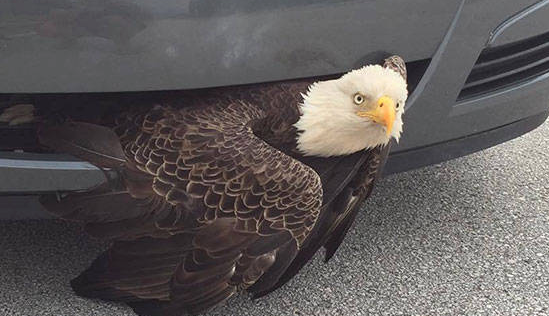
A bald eagle flew in front of became lodged in the grill of the vehicle-photos Clay County, FL., Sheriff
GREEN COVE SPRINGS, Fla. (AP) — A bald eagle that somehow managed to get wedged in the front grill of a car was freed unharmed after a passing motorist noticed the bird.
The Clay County Sheriff’s Office says a resident of the Fleming Island area south of Jacksonville noticed the bird peering out of a passing car Saturday as the area recovered from Hurricane Matthew. The resident urged the motorist to pull over and rescue crews were called.
The sheriff’s department says rescue personnel and deputies were able to work the bird free from the car. It was taken to a wildlife sanctuary in Jacksonville but authorities say the eagle appears to be unharmed. Photos posted of the eagle on the sheriff’s office Facebook page show it standing on two feet in a cage.
Tthe Hays USD 489 Board of Education will discuss the HVAC proposal request for Hays High School during tonight’s board meeting and work session at 6:30 p.m. in the Toepfer Board Room, 323 W. 12th.
The board will be reviewing the proposal request that is to be drawn up by the Integrated Consulting Engineers, Inc.
At last month’s board Meeting it was discussed how HHS is in need of a “massive job” done on its HVAC system and that it would be the next big project handled by the district.
The board and administration will also discuss using a construction management at-risk firm to oversee the construction/renovation projects of a potential bond issue.
Last month sophomore Isabelle Braun and freshman Emma Buchholz took a trip up to South Dakota to experience something that the average high school student does not get to.
“My mom’s a vet so we travel to a few places a year to do spay and neuter clinics,” Braun said. This pulls Braun away from school often. “We’ve probably been up there 11 times, and I’ve been all but once,” Braun said.
Though South Dakota doesn’t seem to be too far away, the places that the Braun family travels to aren’t always so close to home.
“I haven’t been to nearly as many places as my parents for this,” Braun said. “They’ve been to South Dakota, Mississippi, Belize, Suriname, Turks and Caicos, and the British Virgin Islands. I’ve been to three of those places – S.D., Belize, and Suriname.”
Sometimes, one of the family’s friends goes along with them to lend a hand. On this trip, that friend would be Buchholz. “We met Emma when we were really little because her mom was my mom’s vet tech,” Braun said.
Braun’s mother was not the only vet that attended the clinic. “There were three vets and a bunch of people from South Dakota who always volunteer,” Braun said.
Emma Buchholz giving gas to a dog during surgery.
Even with three vets, everyone had plenty to do. During the two day clinic, approximately 120 surgeries were preformed. With this many surgeries being done, it is vital that all hands are on deck. “I washed the instruments and helped out Dr. Braun,” Buchholz said.
After going on so many trips, Braun is considering becoming a vet, and following in her mothers footsteps. “When I was little, I always wanted to be a vet, then I stopped, but these trips do make me want to be one,” Braun said. “However, if I did become a vet and didn’t make it as far as I mom has, I would feel that it was for nothing.”















 By GARRETT SAGER

