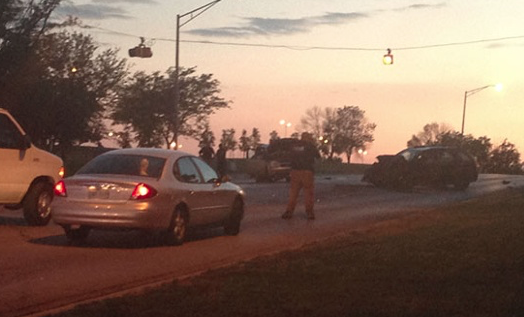
KANSAS CITY, Kan. (AP) — Police say a woman has died after a rear-end collision outside a Kansas City, Kansas, hospital.
Police said in a news release Wednesday that the victim of Monday night’s crash outside Providence Medical Center was 74-year-old Sotera Sebastian.
The crash happened when a sport utility vehicle struck another SUV that was stopped while waiting to turn into the hospital. After the crash, the driver of the striking SUV fled on foot before he was located about a block away and taken to a hospital to be treated for his injuries.
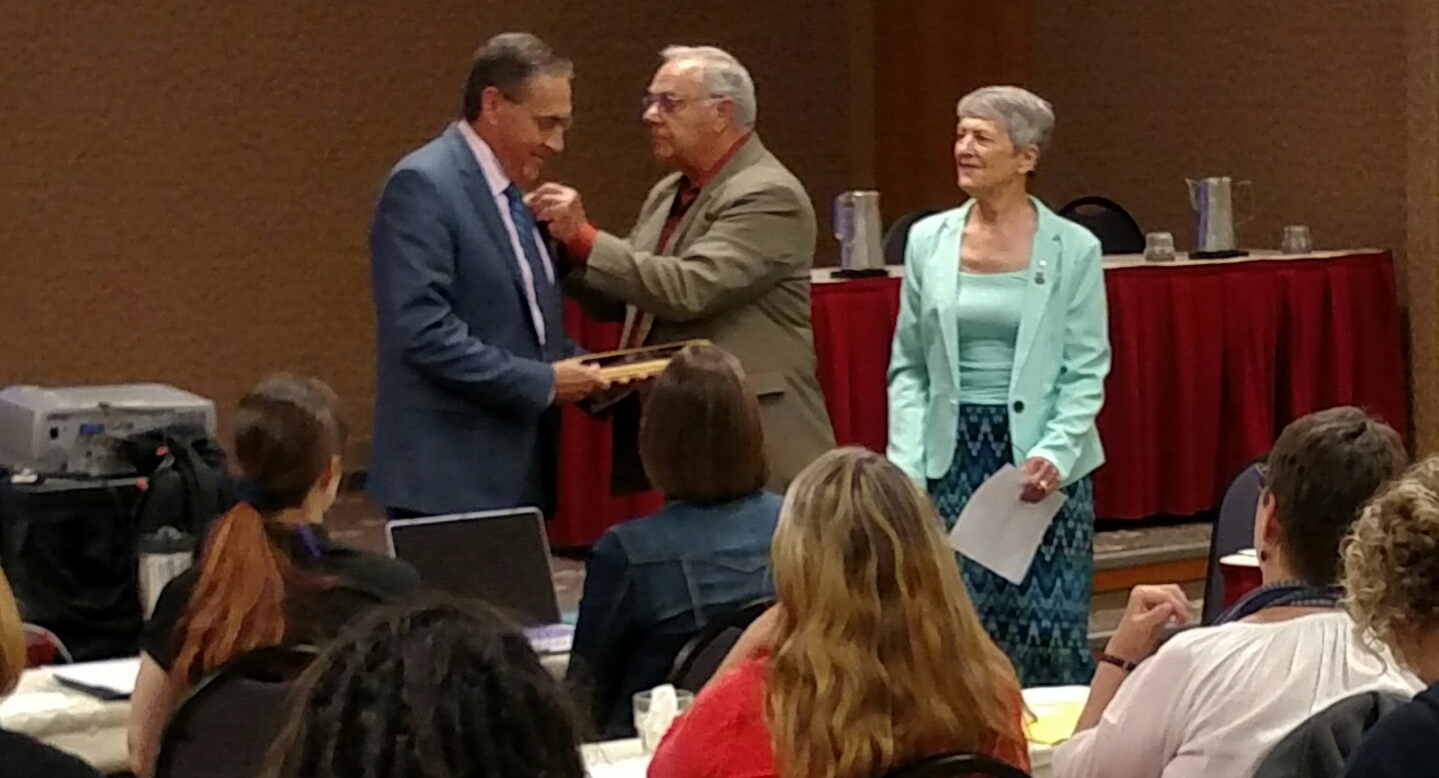
From left: Dr. Kendall Krug, PID Gene Vogel and Lion Sylvia Reinhard.
By Dr. ANNE NIELSEN Kansas State School for the Blind Field Services
TOPEKA — Dr. Kendall Krug was awarded the Claude M. DeVorss award for his outstanding work with the Kansas Lions Statewide Low Vision Program (KanLovKids), by PID Gene Vogel and Lion Sylvia Reinhardt at a recent training in Topeka for the Kansas Teachers of the Blind and Visually Impaired.
KanLovKids is a program administered through the Kansas State School for the Blind to provide vision evaluations to students who have low vision from birth to 21 years of age.
This is the 10th year that the Kansas Lions Sight Foundation has donated $10,000 per year to subsidize the cost of low vision evaluations. The KLSF has given the KC Blind All Stars to date, $100,000 since 2006. One hundred fifty students are evaluated in this program every year.
Submitted by Jim Huenergarde, Hays Lions
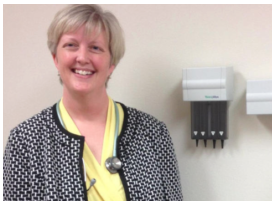
Jen Brull, a physician at Post Rock Family Medicine in Plainville, says her practice is among those that will use a cardiovascular risk calculator as part of a federal project to prevent 1 million heart attacks, strokes and heart disease deaths by 2017.
By MEGAN HART KHI News Service
Nine Kansas medical practices and collaborative groups will participate in an experiment to find out if doctors could do a better job preventing heart attacks and strokes.
The project is part of the Million Hearts federal initiative, which is trying to prevent 1 million heart attacks, strokes and heart disease deaths by 2017. Some of the participating practices will use a risk calculator adopted by the American Heart Association to try to pinpoint their patients’ risk of cardiovascular disease.
Jen Brull, a physician at Post Rock Family Medicine in Plainville, says her practice is among those that will try the risk calculator. She says Post Rock and other participating practices will get new “tools” beyond the current standard of care to reduce patients’ risk of a heart attack or stroke over five years.
“Hopefully at the end they’ll have lower cardiovascular risk,” she says.
Post Rock already uses electronic health records, Brull says, so she expects to incorporate existing information about patients to determine their risk of a heart attack or stroke. New methods to engage patients in reducing their risks should help Post Rock improve patient health outcomes, she says.
“Post Rock has a history of doing clinical improvement,” she says. “Those are things we’re trying to do here.”
Other Kansas practices will be part of a control group that will follow current guidelines for preventing heart disease. The Department of Health and Human Services chose 516 providers in 47 states and the District of Columbia to participate, with about half making changes and the others acting as a control group.
If patients in the treatment group have fewer heart attacks and strokes, the federal government could push more health care practices to start using the risk calculations — particularly if the financial savings outweigh the cost of any treatment used to prevent heart attacks.
Formal protocols
The risk calculator tries to determine a person’s risk of having a heart attack or stroke within the next 10 years. Risk factors include age, race, cholesterol levels and blood pressure, plus whether the patient smokes, has diabetes or takes medications for cholesterol or blood pressure.
Providers typically focus on blood pressure, cholesterol, smoking and possibly family history, says Robert Moser, executive director of the Kansas Heart and Stroke Collaborative. The collaborative, a grant-funded program of the University of Kansas Hospital, works with more than a dozen rural hospitals that will be part of the control group. Moser says those Kansas hospitals will continue with other efforts to improve cardiovascular care, such as helping patients keep up with their visits and medications.
The risk calculator will provide protocols for when a patient would benefit from a treatment, such as blood pressure medication, Moser says. The protocols also will address risk factors that not every doctor may consider, such as whether the person has diabetes, he says.
“This is really setting up a formal way of looking at those things,” he says.
The risk calculator can’t predict whether a patient actually will have a heart attack, but it can suggest that similar patients have in the past. For example, if a patient’s risk score is 10 percent, it would predict that 10 out of every 100 people with the same risk factors will have a heart attack or stroke in the next decade.
Not a miracle cure
Some studies have raised concerns that the risk calculators, developed by the American Heart Association and the American College of Cardiologists, overstate people’s odds of a heart attack. It isn’t entirely clear why that might be, but it does raise concerns that some patients might be exposed to unnecessary side effects from medication.
Elizabeth Jackson, an associate professor in the division of cardiovascular medicine at University of Michigan Health System, says she thinks the risk calculator would provide an adequate gauge of a patient’s odds of developing cardiovascular disease.
“We clearly need to do a better job of identifying people who are at increased risk,” she says.
Still, the risk calculator isn’t a miracle cure, because some people don’t have insurance or a primary care doctor to help them reduce their risk, Jackson says. Other people can’t easily make healthy changes like exercising or eating better, and some only begin worrying after unhealthy behaviors have started to cause problems, she says.
“A lot of people who are young or adolescent don’t know the risks of an unhealthy lifestyle or smoking,” she says.
Cardiovascular disease caused about 23 percent of U.S. deaths in 2014 and was the leading cause of death for both genders and most ethnic groups, according to the Centers for Disease Control and Prevention. But death rates have fallen substantially for heart disease in the previous 60 years.
Americans were about half as likely to die of heart disease in 2014 as they were in 1950, and the results are even more impressive when taking into account the aging of the population as a whole — which would place more people in the demographic spot where heart trouble is more likely to develop.
HHS estimates that heart disease still costs the health care system about $300 billion annually, however, and says the disease is a significant cause of disability for people who survive a heart attack or stroke.
Building knowledge
Some of the Kansas practices participating in Million Hearts says they hope to build the body of knowledge about how to prevent cardiovascular disease.
Andrea Hargett, office manager at Bluestem Medical in Quinter, says staff members there still are learning exactly how they will screen patients and come up with individual plans to reduce their risks of cardiovascular disease. But she says Bluestem Medical looks forward to treating patients more proactively.
“We have a large Medicare, older population, so we thought this was an opportunity to kind of wrap our arms around these patients before anything does happen” to their hearts, she says.
Janel Chilson, administrator at Sunflower Medical Group in Mission, says the practice is part of the control group. Patients will get the normal standard of cardiac care and Sunflower Medical Group will report its results. Even though the patients won’t receive any new interventions, they will benefit if Million Hearts discovers better ways to prevent heart attacks and strokes, she says.
“They’ll compare us with the intervention group to see if their intervention is working,” she says. “We’re always looking for opportunities to try to help with population health.”
Megan Hart is a reporter for KHI News Service in Topeka, a partner in the Heartland Health Monitor team. You can reach her on Twitter @meganhartMC
Dr. Paul Adams, dean of the College of Education at Fort Hays State University, was invited to make a presentation to the American Association of Physics Teachers in Sacramento, Calif., this summer.
“Twenty Plus Years of Physics Teacher Professional Development in Rural Kansas” focused on the efforts FHSU has made in developing physics teachers in high-needs schools.
“While our efforts have been successful, it required meeting the challenge of place- and time-bound teachers, under-funded school districts, shortage of STEM teachers, and leveraging resources of time, talent and treasure,” Adams said.
“The experiences — both successes and failures — at FHSU provide insight for other institutions looking for ideas to provide sustained ongoing professional development to assure high-quality physics teaching for all students.”
Adams also recently attended training to become an examiner for the Council for Accreditation of Educator Preparation.
Ron Wilson is director of the Huck Boyd National Institute for Rural Development at Kansas State University.
By RON WILSON Huck Boyd National Institute for Rural Development
Go west of Alma a few miles and one will find a gem – not a literal jewel, but a beautiful place. It is a historic farmstead with fabulous buildings which have been painstakingly restored and repurposed, and now are open to the public for lodging and events.
Verne and Marilyn Claussen are owners of a newly opened facility called Mill Creek Lodge at Volland Point. This is on a ranch which belonged to Verne’s parents. Verne went to K-State and then Houston College of Optometry, becoming an eye doctor. After a fellowship at Yale, he came back to Kansas and bought another place near Alma. He served as an optometrist in the region for 43 years before retiring.
Meanwhile, he was puzzling over what to do with his parents’ farm. This place has a rich history. J.R. Fix and his wife Rebecca homesteaded the place in 1865 after Fix had served in the Civil War. The couple had one son who died in infancy. Then they had a daughter – and then another daughter – and then another and another. All told, there were eight daughters born to the Fix family.
This meant they needed a spacious place to live. They also needed a large barn to house the workhorses needed for the farming, plus a place for the farmhands to live. The Fix family expanded the buildings through the years.
The place remains a working ranch, now known as the Claussen Ranch. But what about the buildings on the farmstead? By 2013, the barn was no longer suitable for everyday farm use, for example.
“I wanted to make it into something where people could come out and enjoy the rural lifestyle,” Verne said. He took on a wonderful restoration of the house and buildings so as to create a place for lodging, meetings, and special events. That was the beginning of Mill Creek Lodge at Volland Point. The grouping of buildings has been designated a historic district by the National Register of Historic Places.
Since J.R. Fix and his wife had all those daughters, each daughter needed a bedroom so the Fix family built a majestic three-story Italianate home. “The house was in real good shape,” Verne said.
In 2015, Verne restored the house with heating, air conditioning, and modern plumbing and electricity. He also brought in period chandeliers and antique furniture. Verne named each one of the guest rooms for the daughter who lived there. So, guests can stay in the Pearl bedroom or the Mabel bedroom, for example. There is no doubt about which room is which – those two daughters actually carved their names into the wood floor.
The nearby tenant house for the farmhands was restored and expanded also. Then came the barn, which received a total makeover. The exterior look was largely preserved, but windows, heat and air conditioning, water and bathrooms were installed.
“The barn had been built in two phases,” Verne said. “The first part was to hold the horses, hay and wagons, and the second part was a corn crib to the west.” Verne remembers putting hay in this barn as a kid. Now the barn has been converted into a thoroughly modern but rustic-looking meeting area with multiple restrooms. The hayloft area can hold up to 250 people and the horse stall area can hold another 100. The north side of the old corn crib is now a receiving kitchen for caterers, and the south side is a bunkhouse. A spring-fed, hand-dug well is inside a cave nearby.
Mill Creek Lodge at Volland Point is now host to weddings, meetings, family reunions, and hunting in season. Up to 29 people can stay there overnight. The lodge is located 7 ½ miles west of the rural community of Alma, population 785 people. Now, that’s rural. More information can be found at www.millcreeklodgevollandpoint.com.
Go west of Alma a few miles and one will find a gem – not a literal jewel, but a beautiful place. We salute Verne and Marilyn Claussen for making a difference by restoring and repurposing these historic buildings in rural Kansas. I think it is a treasure.
Rescue crews on the scene of Tuesday drowning-photo courtesy KSHB
SHAWNEE, Kan. (AP) — Authorities say a juvenile has died while swimming and paddle boarding with friends at a neighborhood lake in suburban Kansas City.
Shawnee police said in a news release that officers were called Tuesday to Lakeview Estates after the victim went missing. The release said the victim’s friends weren’t sure if he left or if he was still in the water because they didn’t see him go under.
A search began, and a dive team found the boy’s body. His name wasn’t immediately released, pending notification of his extended family. An autopsy is scheduled for Wednesday.
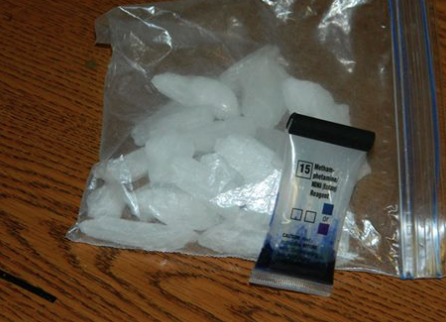
A bag containing what appears to be ice cubes. This is actually how methamphetamine became to be called “ICE”. The pouch lying on the bag containing the methamphetamine is called a field test kit. These kits allow officers to test the substance prior to sending it into a laboratory such as the Kansas Bureau of Investigation.-photo Pawnee County Sheriff
PAWNEE COUNTY – Law enforcement authorities in Pawnee County are investigating several suspects on drug charges.
On August 12, a deputy made contact with a subject traveling through the county from Nebraska to Oklahoma, according to a social media report.
During the investigation it was determined the subject was driving on a suspended driver’s license.
The driver was initially arrested for driving while suspended.
During the tow inventory of the vehicle, 117 grams of methamphetamine was discovered hidden inside the vehicle.
The Deputy also found a digital scale.
The subject was finally arrested for possession of methamphetamine with intent to distribute, felony drug paraphernalia, and driving while suspended and transported to the Pawnee County Sheriff’s Office.
This case is currently being looked at by the Drug Enforcement Agency (DEA) for possible Federal Charges.
Just after 8 p.m. on Sunday, the Pawnee County Sheriff’s Office initiated a drug sting within the City of Larned.
A cooperating individual was able to purchase a large amount of methamphetamine from a subject in Larned.
After the “controlled buy” a search warrant was obtained for a residence in Larned. The search warrant was served without incident, with one individual arrested. Officers from the Pawnee County Sheriff’s Office were able to locate nearly 50 grams of methamphetamine with packaging and 90 grams of marijuana with packaging inside the residence.
One subject is currently in custody for possession of methamphetamine with intent to distribute, possession of marijuana with intent to distribute, using a communication device to facilitate a drug transaction, felony drug paraphernalia, and misdemeanor drug paraphernalia.
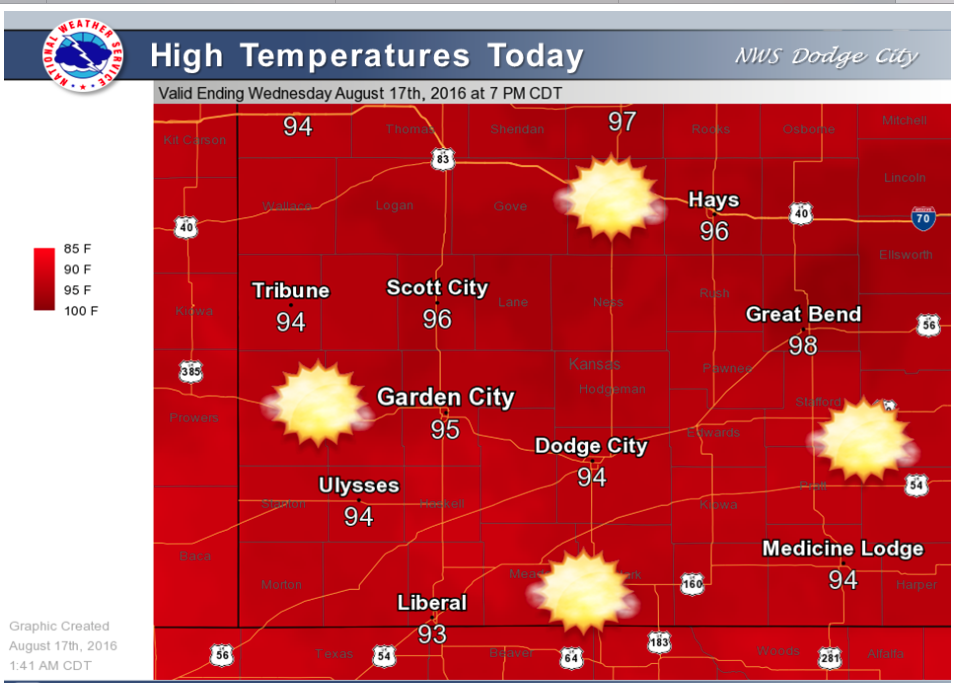
Today Sunny, with a high near 96. South wind 6 to 13 mph.
Tonight Partly cloudy, with a low around 66. South wind 8 to 14 mph.
ThursdaySunny, with a high near 92. South wind 7 to 15 mph.
Thursday NightMostly clear, with a low around 68. South southeast wind 9 to 14 mph.
FridayA 30 percent chance of showers and thunderstorms, mainly after noon. Partly sunny, with a high near 91. South wind 8 to 13 mph becoming west southwest in the afternoon.
Friday NightShowers and thunderstorms likely, mainly after 8pm. Mostly cloudy, with a low around 61. Chance of precipitation is 60%. New rainfall amounts between a quarter and half of an inch possible.
SaturdayShowers and thunderstorms likely, mainly before 8am. Mostly cloudy, with a high near 75. Chance of precipitation is 60%. New rainfall amounts of less than a tenth of an inch, except higher amounts possible in thunderstorms.
Saturday NightA 20 percent chance of showers and thunderstorms. Mostly cloudy, with a low around 54.
DETROIT (AP) — Danny Duffy allowed one run in 7 2/3 innings and the Kansas City Royals hit four homers in a 6-1 victory over the Detroit Tigers on Tuesday night.
Raul Mondesi, Alex Gordon and Eric Hosmer all homered off Justin Verlander (12-7), while Kendrys Morales went deep off Mark Lowe.
Jarrod Saltalamacchia homered for Detroit’s only run. The Tigers have lost seven of nine.
Duffy (10-1) allowed three hits and two walks, striking out five.
Verlander gave up five runs — three earned — four hits and a walk in seven-plus innings. He struck out six.
Verlander retired the first eight batters he faced, but Mondesi gave the Royals a 1-0 lead by driving a hanging slider just inside the right-field foul pole for his first career homer.
Kansas City’s second hit came in the fifth inning, when Gordon hit another slider into nearly the same spot as Mondesi. Gordon came into the game with a .205 career average against the Tigers ace.
Duffy only needed 41 pitches over the first four innings, but Saltalamacchia put the Tigers on the board with a fifth-inning homer into the shrubs above the centerfield fence.
Hosmer restored Kansas City’s two-run lead with a seventh-inning homer to center field that was estimated at 443 feet. It was the fifth hit of the game — four solo homers and a double by Detroit’s J.D. Martinez.
Victor Martinez got the game’s first single when Gordon missed a diving catch of his sinking liner to left in the seventh. J.D. Martinez hit into a force at second, but moved to third on a wild pitch and a fly ball.
Duffy, though, struck out James McCann to end the inning.
Detroit’s defense fell apart at the start of the eighth. Gordon hit a routine grounder to third, but ended up on second when Saltalamacchia missed Casey McGehee’s throw. Alcides Escobar singled to left with Gordon taking third, then moved to second when Justin Upton lobbed the ball into the infield.
Verlander walked Mondesi on his 112th and final pitch, loading the bases. Bruce Rondon came in from the bullpen and struck out Paolo Orlando, but Cheslor Cuthbert hit a blooper to shallow center that Ian Kinsler got under, but dropped.
Kinsler recovered in time to force Escobar at third, but Gordon scored to make to it 4-1. Lorenzo Cain doubled to give the Royals a four-run lead.
TRAINER’S ROOM
Royals: Three pitchers with long-term injuries are scheduled to make rehab performances this week. Kris Medlen, out since May with a rotator cuff problem, started Tuesday night for Surprise in the Arizona League, while Jason Vargas (Tommy John surgery) is scheduled to start for Double-A Northwest Arizona on Wednesday. Mike Minor (shoulder) is supposed to pitch for Triple-A Omaha on Friday. Vargas and Minor have both missed the entire season.
Tigers: 1B Miguel Cabrera was out of the starting lineup Tuesday with a strained left biceps. The injury, sustained in Monday’s loss to the Royals, is not considered serious. Tigers manager Brad Ausmus said he expects Cabrera to miss no more than 2 or 3 games. … Jordan Zimmermann (neck) threw a 20-pitch bullpen session on Tuesday, and is scheduled to throw another on Thursday.
TIGERS TRADE
The Tigers announced shortly before the first pitch that they had traded utilityman Mike Aviles and minor-league catcher Kade Scivicque to Atlanta for infielder Erick Aybar. General manager Al Avila said the move was designed to give the Tigers more offense off the bench. Aybar is hitting .242 this season as opposed to Aviles’ .210.
UP NEXT
The teams finish their three-game series on Wednesday evening, with Kansas City’s Yordano Ventura (8-9, 4.60) facing Anibal Sanchez (6-12, 6.31). Sanchez has allowed 23 homers in 19 starts and only lasted four innings in his last outing.
BUTLER COUNTY – Law enforcement authorities in Butler County are investigating a reported driveway paving scam.
The potential victim provided deputies with photographs, vehicle tag information and names of those involved with the scam, according to the Butler County Sheriff’s Office
Information received linked the individual to a group that the Kansas Attorney General’s office has on a watch list.
The sheriff’s office asked the public to keep these guidelines in mind before having any pavement sealing done on your property.
One of the biggest scams in asphalt contracting is the “I have extra material” line.
Any reputable sealing contractor will have very little sealer left after a job is complete.
Also sealer does not go bad as long as it does not freeze.
Any contractor that knocks on your door should only tell you one thing; that he left his shop with nothing to do that day and is now out trying to drum up some work.
Beware of anyone who does not have their truck lettered.
If a deal sounds too good to be true, it is.
Ask for references, exact addresses, tell them to come back after you have had a chance to go look at them… and do go look. ·
If a contractor says that a price is for “today only,” or “working in your area this week only” that usually means that he is what’s called a “Traveler.” Traveler’s or more commonly called “Gypsies” move from state to state and town to town. After they have worn out their welcome, they move to a different state or town. These people usually have out of state license plates, fancy trucks, and a reason you need to do the work right now.
Always just take a moment to see if they are in the phone book, if they say they are new, call directory assistance.
If the contractor you hire will only accept cash or wants the check made out to cash, BEWARE. Never make a check out to “cash” and if they insist on using their personal name ask for a valid driver’s license and copy all their information.
A reputable contractor will always ask for a check made out in the name of the business.
If in any doubt, ask for their contractor’s license number, to see their driver’s license, or certificates of insurance. If they just give you information verbally tell them to return the next business day after you have had a chance to verify their information.
While not every contractor who makes “cold calls” is disreputable many are, often others are brand new, inexperienced, and desperate for work.
If you have information about the scammers or if you yourself have been scammed, please contact the Sheriff’s Office at 316-322-4254 or 800-794-0190.










 Tonight Partly cloudy, with a low around 66. South wind 8 to 14 mph.