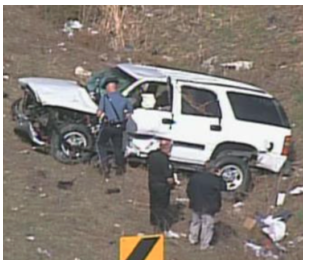
After the high-speed chase with a 19-month-old child in their car, and firing at police officers who were chasing them.-photo courtesy KCTV5
KANSAS CITY. – A Kansas woman pleaded guilty Monday to federal charges that she took part in an armed robbery at a Stillwell bank before the robbers led police on a high speed chase with a child in the car, according to Acting U.S. Attorney Tom Beall.
Danille Morris, 26, Kansas City, Kan., pleaded guilty to one count of bank robbery, one count of brandishing a firearm during a robbery and one count of unlawful possession of a firearm following a felony conviction. She admitted she cased the bank, provided the getaway car and was in the car when the robbers fled the bank.
Two co-defendants already have entered pleas. Gary Jordan, 39, Kansas City, Kan., pleaded guilty to one count of bank robbery, one count of brandishing a firearm during a robbery and one count of unlawful possession of a firearm following a felony conviction. Co-defendant Jacob L. Smith, 18, Kansas City, Kan., pleaded guilty to one count of bank robbery and one count of brandishing a firearm during a robbery.
In their pleas, Jordan and Smith admitted they were armed with handguns when they entered the First National Bank at 7460 W. 199th Street in Stilwell, Kan. They held tellers at gunpoint before fleeing with cash stuffed in a backpack. Jordan took the wheel of the getaway car.
During the next 25 minutes, the robbers were pursued by the Kansas Highway Patrol, the Leawood Police Department and other law enforcement agencies as they fled across the Kansas/Missouri state line. During the chase, Smith fired at officers six times from the car. After the car overturned on a sharp turn, the defendants were arrested. Throughout the chase, co-defendant Morris and her 19-month-old child were in the car. She was seated in the front passenger seat at the time the vehicle crashed. The child was fastened in a car seat in the back seat.
Morris is set for sentencing Dec. 20. The crimes carry the following penalties: Up to 25 years in federal prison and a fine up to $250,000 for robbery, not less than 10 years and a fine up to $250,000 for discharging firearms in a robbery, and up to 10 years and a fine up to $250,000 for unlawful possession a firearm by a felon.
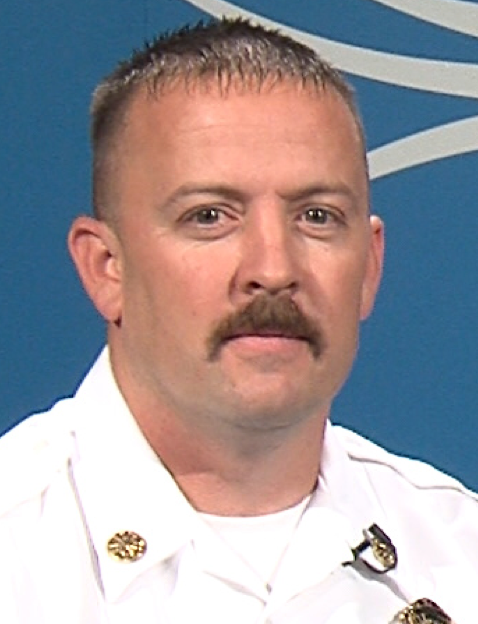
ELLIS COUNTY – The Ellis County Commission has officially named Darin Myers as the head of the county’s emergency management department.
In June, the commission approved consolidation of the Rural Fire and Emergency Management Departments and created the new position of Director of Fire and Emergency Management. The changes were among several that, according to County Administrator Phillip Smith-Hanes, are expected to save the county nearly $100,000 in 2017.
At Monday’s meeting, the commission approved a resolution naming Myers to the new position as the person who “heads the agency responsible for providing (disaster) services.”
Myers replaces the previous Emergency Manager Bill Ring, who was appointed Public Works Director in June.
“Bill Ring was very well-respected in the Emergency Management field in the state,” Myers said. “I’m glad he’s not leaving because I’ve already called him quite a bit and asked him a lot of questions, and I’m sure there will be a lot more in the future.”
Public Works Director Bill Ring
Myers said his No. 1 priority will be to finish the emergency operations center in the basement of the Emergency Services building. He said workers are installing desks and cabinets this week. The operations center is used for training and serves as the command center in the event of a disaster.
They are also working to upgrade the radio system in the EMS building. Emergency radios do not currently work in the basement of the building, and they will install a booster to improve coverage.
Myers said they will also be working to upgrade the communications center. The county has been working to upgrade 911 dispatch consoles, and Myers said he will spend a lot of time examining dispatch operations and studying what equipment will best fit the county’s needs.
He said he plans to talk with organizations within the county to determine what they expect from the emergency management department.
Myers will have to earn his additional certification as a Kansas Certified Emergency Manager.
In other business, the commission:
• Discussed and approved the hiring of a person to fill an open position in the County Attorney’s office. Ellis County Attorney Tom Drees said the position is open after a person on his staff accepted a position in the private sector.
• Agreed to support a legislative request drafted by Ellis County Appraiser Lisa Ree.
• Oversaw the canvass of the results from the Aug. 2 primary election. Voter turnout in Ellis County was 24.28-percent, according to County Clerk and Election Officer Donna Maskus.
• Met in executive session for 15 minutes to discuss attorney-client privilege. No action was taken.
BARTON COUNTY – Law enforcement authorities in Barton County are investigating a suspect who was arrested following a standoff on Monday evening.
On Monday afternoon a Barton County Sheriff’s officer received information regarding the location of a wanted suspect, according to a media release.
Deputies put a residence under surveillance and observed the individual leaving in a vehicle. Officers followed the vehicle and a felony traffic stop was conducted in the 100 block of Southeast 20 Road.
The driver, a white female was ordered from the vehicle and complied. The passenger, who was known to be Robert Scheuerman, 35, Larned, refused to exit the vehicle and brandished a weapon.
Scheuerman then threatened to shoot himself. Scheuerman was wanted for a parole violation warrant from Pawnee County.
Deputies were able to block the vehicle as to prevent the suspect from escaping the scene. After about one hour and 40 minutes we were able to convince Scheuerman to lay down the 9 mm handgun and exit the vehicle. Scheuerman was arrested and taken into custody.
Scheuerman was found to be in possession of more than 100 grams of suspected methamphetamine valued at about $5,000 as well as in excess of $3,000 cash.
Scheuerman was arrested for the parole violation warrant from Pawnee County, possession of methamphetamine with intent to distribute, felon in possession of a firearm, no drug tax stamp and resisting arrest. He was transported and booked at the Barton County jail without incident.
The female driver was released, charges may be filed against her at a later date.
The Barton County Sheriff’s Office was assisted at the scene by a deputy from the Pawnee County Sheriff’s Office and an Enforcement Officer from Kansas Department of Wildlife and Parks who happened to be in the area.
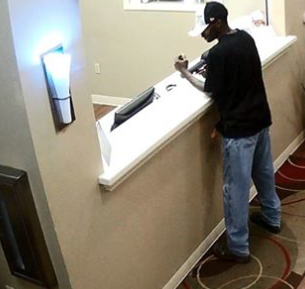
Security camera image of hotel robbery courtesy Wichita Police
SEDGWICK COUNTY – Law enforcement authorities in Sedgwick County are investigating an armed robbery and asking for help to identify the suspect.
Just after 9 p.m. on July 31, Hotel at Waterwalk, 711 South Main was robbed at gunpoint, according to a social media report.
On Tuesday, police released a security camera photo of the suspect.
If you have any information about this case or know the identity of this individual please call Wichita Police Department Detectives at 268-4407 or Crime Stoppers at 267-2111.
During Monday’s meeting, the Hays USD 489 Board of Education reviewed the proposed 2017 budget, hearing that despite the continued downward trend in state aid per pupil, the percent of funding to be used for instruction has increased.
“We have increased our budget for the money that goes into instruction,” said Tracy Kaiser, executive director of finance and support services.
“Sixty-six percent of all of our budget is going to instruction,” she said, noting the amount used for instruction is up 18 percent from last year.
Superintendent John Thissen said the percentage of the budget USD 489 spends on instruction is in line with other districts.
“Comparative-wise, one of the complaints we heard from the Legislature this year was that there was not enough money spent on instruction,” said Paul Adams, board member, asking what percentage is desired by the Legislature.
“My memory is that they’ve usually identified two-thirds,” Thissen said.
Adams then asked if there was any budget area where USD 489 is significantly different that other districts.
“Definitely, there’s one thing that’s very, very strange on this chart. It’s the zero. Most districts don’t have that,” Thissen said about the district’s debt payments.
“For us, I don’t know how many years you can go back, but its a number of years that there haven’t been payments for that,” he said. “I can tell you right off that zero is definitely out of ordinary for the majority of districts in the state.”
“By debt, you mean bond?” asked Sarah Rankin, board member.
“Exactly,” Thissen said.
Generally, however, the budget review found no major changes over last year, in part due to block grant funding from the state that remained the same, but state revenue was up slightly for the district.
However, state aid per pupil continued its downward decline.
“Our state revenues are up this year, that does include an increase in KPERS payments. Our federal revenue is up slightly, and our local revenue is down a little bit also,” Kaiser said. “The main thing is we have $283 per student less revenue than we did last year.”
In a brief history of state aid per pupil, Kaiser told the board it has been dropping since 2009.
“In 2008, our base state aid per pupil was $4,483 and that is oftentimes the number you hear when they’re talking about ‘Is the state adequately funding education?’ ” she said.
Starting in 2009, there have been four cuts to state aid per pupil, along with a 2 percent reduction in special aid, she further told the board, and again cut twice in 2011.
The Legislature increased that amount by $58 in 2013 and $14 in 2014, but other changes caused a reduction in funding.
“When they excluded virtual and new facilities weighting that year, USD 489 actually lost $99,000,” Kaiser said. “The total of all of those changes since 2008 is over $2.7 million that have affected USD 489 each and every year. So our total losses in the last eight years are over $20 million.”
During the meeting, Thissen explained to the board money in the contingency fund that has been another point of contention in the state Legislature is well in line with previous state recommendations.
“I want to make sure that everybody here is well aware that that contingency fund number of $331,000. There are a lot of people that can look numbers and say that’s a lot of money,” Thissen said. “I want people to understand that there was a time not so many years ago that the state ended up recommending 6 percent of your general fund would end up being contingency. Then they changed it to 10 percent, and now in the last couple of years there has been great criticism by legislators saying there is way too much money in there, although that was the direction that was given by the state for years.”
Having money in the reserve in case of a catastrophe is good fiscal policy he said, noting the size of the fund for the Hays district is “quite low.”
The budget also contained a raise for district staff members, which must be separately approved by the board.
“The budget does include a wage increase for all staff that are not covered under the SEIU or the HNEA-negotiated agreements,” Kaiser said. “This is really kind of a raise for those staff that we really wanted to happen last year, to go along with the HNEA-negotiated agreement.”
A public hearing on the budget will occur at the next board meeting, at 6:30 p.m. Monday, Aug. 22, at the Rockwell Administration Center, 323 W. 12th.
POTWIN, Kan. (AP) — A couple who rented a Kansas farmhouse is suing a company over an internet glitch that brought them numerous legal problems.
The glitch put the coordinates for the center of the U.S. in the front yard of James and Theresa Arnold near Potwin. The farmhouse became the default location for any website owner that didn’t have a specific IP address.
The Arnolds allege in a lawsuit filed Monday that glitch meant more than 600 million IP addresses became associated with the farmhouse. That led to them being accused over the years of internet-based crimes such as computer fraud and tax fraud, as well as making pornographic films.
The Wichita Eagle reports the couple is suing MaxMind, which they say is responsible.
Dr. Craig Smith (center, in yellow) demonstrates the use of drones in agriculture with the Leadership Kansas class of 2016 and takes a picture of the class using the drone.FHSU University Relations
Fort Hays State University was well represented at the recent Leadership Kansas session at the Kansas State University Agricultural Research Center in Hays.
Dr. Craig Smith, assistant professor of agriculture, was a panelist for the discussion on the future of agriculture. Smith spoke on the use of drones in agriculture and demonstrated how to fly drones.
The Leadership Kansas class of 2016 includes Dr. Joy Hatch, vice president for technology and professor of informatics.
FHSU alumni and local farmer Matt Grabbe was also on the panel, focusing on the cost of farming. Grabbe explained his choice to be an agriculture producer and stay in Kansas after graduating.
Dr. Brittany Howell, associate professor of agriculture, organized and moderated the panel. Henry Schwaller, instructor of management, served as session leader.
Donald Anthony James Herl, age 69, of rural Ogallah, Kansas passed away Saturday, August 6, 2016 at the Good Samaritan Society, Ellis. He was born November 20, 1946 at Saint Anthony’s Hospital in Hays, Kansas to Alvin Sr. and Dorothy (Karlin) Herl.
He worked diligently on the family farm. He was a member of St. Mary’s Catholic Church in Ellis and attended school at St. Mary’s, Ogallah Elementary and Trego Community High School. Years ago he worked at Trego County Hospital. He enjoyed archery and designed his own personal bows and arrows, he enjoyed nature walks where he would often collect unique small artifacts. He was a self taught artist creating western scenes, comics, animals and nature themed landscapes. He enjoyed music and played the guitar, harmonica and attempted the banjo. Don enjoyed reading history, geographical and relegious books. He could recite lengthy poems that he had learned as a young man. He loved his family and enjoyed visits with them and friends.
He is survived by his identical twin brother, Ronald (Karen) Herl, another brother, Alvin (Amy) Herl all of Ogallah, Kansas; three sisters, Jeannette (Charles) Augustine of Ellis, Kansas, Joyce (Kenneth) Kinderknecht of Collyer, Kansas and Jean (Donovan) Neufeldt of Moundridge, Kansas; nieces and nephews, Michael (Jennifer) Augustine and children,Samantha, Emily and Nathaniel all of Topeka, Kansas, Tony R. (Christy) Knouf and son Hunter all of Conway and a daughter, Khloe Knouf of Peyton, Colorado,Michelle (Craig) Goldsberry and children, Cale and Tenley all of Springfield, Missouri, Jessica (Jason) Augustine-Stegman of Manhattan, Kansas, Aaron Herl and Fiance, Shelby Gottschalk of Hays, Kansas, Jared, Katelyn and Ryan herl of Ogallah, John Kinderknecht of Colorado and Nicole Neufeldt of Moundridge, Kansas.
He was preceded in death by his parents, Alvin and Dorothy Herl.
Funeral services will be 10 AM Thursday, August 11, 2016 at St. Mary’s Catholic Church in Ellis with burial to follow in the church cemetery.
Visitation will be Wednesday 6 PM – 8 PM with a combined rosary and vigil service at 7 PM and Thursday 9 AM – 9:30 AM all at Keithley Funeral Chapel 400 E 17th Ellis, KS 67637.
Memorials are suggested to the organization of your choice.
Condolences may be left by guestbook at www.keithleyfuneralchapels.com or emailed to [email protected].
One of the key tenets of the American Dream is the promise that if you work hard, you can get ahead. This dream doesn’t discriminate – regardless of the circumstances you’re born into, hard work will lead you to success. Generations of Americans have lived, worked and raised families believing in that idea.
Despite honest living and persistence, millions in our country still struggle to get ahead financially. This is especially true in rural communities where the challenges of poverty differ significantly from urban areas. When access to higher education, health care, affordable housing, social and financial services, and job opportunities is limited, the path toward upward mobility is challenging.
As someone who grew up in small-town Kansas, the issue of rural poverty hits close to home. While representing Kansans in Congress, I have made it a priority to highlight this often overlooked struggle and have proposed policy solutions to help drive Americans, both urban and rural, up the economic ladder. For example, I’m working to make certain all Kansans can access high-speed internet and get care from their local Critical Access Hospital, as well as ensure our veterans receive the benefits they’ve earned in a timely fashion.
Many rural, low-income families lack both affordable housing and access to credit: two major factors in determining one’s mobility. And unfortunately, as the cost of compliance with new government rules and regulations grows, community banks and local lenders are increasingly being squeezed out of their local economies. As a member of the Senate Banking Committee, I’ve proposed legislative solutions to relieve this burden, but it is clear solving this issue will require a series of policy and regulatory changes coupled with broader economic growth.
In Kansas, much of that economic growth depends on the health of the agriculture industry – a major pillar of our economy – which determines the financial well-being of nearly 250,000 Kansans. As the chairman of the Senate Agriculture Appropriations Subcommittee, I’m tasked with drafting annual legislation to prioritize funding for the Department of Agriculture and the Food and Drug Administration – agencies whose work impacts growth and mobility in rural America. My bill (S. 2956) includes critical improvements to rural infrastructure such as water and waste systems and upgrades to electric and telephone services. It also strengthens the farm safety net to keep family farms viable in tough economic conditions, which in turn helps keep Main Street businesses that rely on agriculture afloat. These policies improve the economic viability of small town America.
Rural economic interests, while often overlooked, must be represented in all policy debates on Capitol Hill – agricultural or otherwise. With that in mind, I cofounded the bipartisan Senate Economic Mobility Caucus in 2012 to bring together policymakers to examine mobility challenges and develop ways to overcome them. Since the caucus’ inception, we have conceived numerous bipartisan policies, including some that are now law. Most recently, the caucus hosted an event to convene experts from various backgrounds focused specifically on economic mobility through a rural lens. To see such strong interest in the topic was encouraging and I will continue to stress the importance of rural-specific considerations during policy debates.
While each of these steps represents progress, much work remains to enable all Americans to become economically mobile and financially secure. I will continue to do all I can during my time in the United States Senate to help restore the confidence that every man, woman and child has a real opportunity to achieve their own American Dream.
LAWRENCE, Kan. (AP) — The University of Kansas is asking a judge to dismiss a lawsuit related to two alleged sexual assaults.
Two former female rowers contend they were raped in university housing by the same man. The two women and their parents claim in the lawsuit that the university misled the public by saying campus housing was safe.
The alleged assailant, a former football player, was expelled last spring.
The Lawrence Journal-World reports that during a hearing Monday in Douglas County, university attorney Brian Fries argued the lawsuit didn’t identify specific injuries caused by the university’s actions, which makes their lawsuit unwarranted. He said the former students could be consumers at the university but their parents are not.
District Court Judge Kay Huff took the motion under advisement.
Self-absorbed. It’s all about me. I am the center of the universe.
All of these words come to mind when today’s endless stream of motorists talk, tweet and Face-book while speeding down the boulevard. This recent phenomenon has become epidemic and it’s spreading.
Harsh words?
Certainly, but there are also harsh consequences in lives lost, maimed and injured permanently in traffic accidents caused by those who place their own need to continually talk or text on the phone before focusing on the task at hand – driving safely and consciously.
In 2014, 3,179 people were killed and an estimated 431,000 more were injured in motor vehicle crashes involving distracted drivers, according to the National Highway Traffic Safety Association. Ten percent of all drivers 15-19 years of age involved in fatal crashes were reported as distracted at the time of the crashes.
At any given moment across America, approximately 660,000 drivers use cell phones or manipulate electronic devices while driving. Those who aren’t calling or texting are distracted while driving by something else in one or both of their mitts. You know a mascara brush, a hamburger, a liter of water or a tablet while they steer with their knees.
Recent research at Virginia Tech revealed an almost 3-fold increase in the odds of crashing or nearly crashing when dialing a hand-held phone while driving. Risk associated with text messaging may be much higher based on a new study of truck drivers. The main finding here was a 23-fold increase in the odds of crashing, nearly crashing or drifting from a travel lane among truckers who texted while driving.
This list continues.
Whatever happened to the conscientious and courteous driver of yesteryear?
How many motorists today continually scan the road and sidewalks in front of them for kids biking or walking down the sidewalk? How about a watchful eye for the elderly couple out for an early morning stroll? Or someone else walking his or her dog?
Such conduct while driving today has become the exception rather than the rule. Did I mention before that driving today is all about me getting where I need to go?
What we need on our streets and highways today are motorists with the intelligence to understand that driving a car, pickup, motorcycle, bus, van, SUV or anything you crawl behind the wheel and drive requires your undivided attention.
With the ever-growing number of people on roads today, driving must be tuned in to the business of driving. This means no phone calls, no meals, no makeup. Just drive.
There’s seldom a phone in my car. When I carry one, I never call or answer it when I’m behind the wheel. I conduct calls when I leave the car after I arrive alive.
I have no desire to talk on the phone while I drive. If I had my druthers, I wouldn’t carry a phone in my vehicle. My car functions the way it was intended without one. Anyway, I prefer to be ever vigilant looking out for all those motorists who are doing everything else in their cars but driving.
Used to be one of the last bastions of individual freedom was cruising in your car with the windows down, the radio playing your favorite song and the wind whistling through your hair. Every so often, you’d raise your index finger to signal, “Hey” to an upcoming motorist who’d reply in kind.
Doesn’t happen much today. More than likely the only finger you’ll see in 2016 is the middle one and it ain’t raised to say hello.
Still I can dream, but not behind the wheel – that’s where I drive.
John Schlageck, a Hoxie native, is a leading commentator on agriculture and rural Kansas.