
 Listen to Mike Cooper interviewing Bryan Noone, Director of the Sleep and Neurodiagnostic Institute at HaysMed, with the topic of “Sleep Health” by clicking the link above and then clicking the play button
Year: 2016
Police: Search continues for Kansas armed robbery suspect

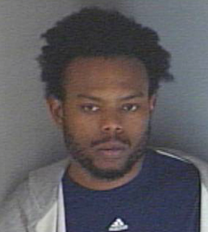
SHAWNEE COUNTY – Law enforcement authorities in Northeast Kansas are investigating an armed robbery and searching for a most wanted suspect.
Just before12:30 p.m. on Friday hours, officers responded to 101 SW 37th in Topeka to investigate an Armed Robbery that had just occurred, according to a media release.
The suspect, who was armed with a firearm, robbed not only the business, but stole a silver 2011 Nissan Sentra and fled the scene in the vehicle.
Just after 12:41 p.m., the vehicle was located in the 1000 Block Southeast Vine and had been set on fire.
A person of interest has been identified as Orlando Collins.
He is currently listed as Northeast Kansas Most Wanted and is being sought by the Shawnee County Sheriff’s Office on the following charges: Attempted Aggravated Robbery 2 counts of Criminal Discharge of a Weapon at an Occupied Dwelling or Vehicle. Any information related to this investigation please forward to DET Lance Green ([email protected]) 785-368-9569 or Crime Stoppers at 234-0007.
Ellis County featured real estate, open houses

CLICK FOR MOBILE INTERACTIVE MAP
Listings with star symbol have weekend open houses.
Getting ‘SLAPP’d’ for getting involved — new protections considered


Have you ever been SLAPP’d?
SLAPP stands for “Strategic Lawsuit Against Public Participation,” and it’s a technique as old as lawsuits to stifle competition brought by the rapacious moguls of the early Industrial Age, and as modern as lawsuits against online critics.
A section of the Communications Decency Act shields online sites from defamation suits and other kinds of civil actions over content posted by third parties — but not the people who post the material. Nearly one-half of states provide some protection against SLAPP lawsuits — some limited only to communication with the government — but a new U.S. House proposal, HR 2304, would add to those defenses, proponents say.
Rep. Blake Farenthold, R-Texas, introduced the “Speak Free Act” last June, co-sponsored by Rep. Anna G. Eshoo, D-Calif. In an interview Tuesday, Farenthold said the legislation is needed to protect people “who don’t have $50,000” to spend on legal fees to, for example, defend against a lawsuit over a negative review posted on social media.
The “Speak Free” proposal tentatively is set for a hearing in the House Judiciary subcommittee in late May.
In response to a threat of legal action, many people simply take down the negative review or comment — which Farenthold sees as counter to the point of free speech. A broadcaster who also has worked in the computer field, Farenthold said he supports the First Amendment concept that “a review is, by definition, an opinion and there’s no defamation in opinion.”
Farenthold and others see increased concern over SLAPP actions — which, while expanding in recent years, still represent a small number within the total number of lawsuits annually — as reflective of the rise of “peer-to-peer” sites where people looking for specific services can find reviews and comments.
The proposed law would allow defendants to transfer lawsuits from state to federal courts, particularly valuable in 22 states that do not have an anti-SLAPP law or in those with weak protection. Farenthold said the law also will provide a means in federal court to quickly resolve a SLAPP lawsuit “before the legal fees run up.”
The combination of breadth and speed has appeal on both Democratic and Republican sides of the aisle, and to conservatives seeking “tort reform” to reduce lawsuits and liberals aiming to protect civic activists. Farenthold said he has not seen significant push-back from companies, which might have been expected to oppose the act. “Overall, I think more people in business have the view that you don’t need to worry … if you are providing good service.”
Bipartisan support encourages Evan Mascagni, policy director for the Public Participation Project, a nonprofit group supporting such legislation — who noted two earlier Congressional attempts failed to gain such backing. In an interview, Mascagni said, “The First Amendment is not a partisan issue. Americans understand the importance of free speech and petition activity in our society.”
Another possible factor in increased attention to the bill is the attention paid this year to lawsuits and counterlitigation actions by GOP presidential front-runner Donald Trump, who also has called for weakening protections in existing defamation law that limit retaliatory lawsuits by public figures.
Anti-SLAPP supporters also note that the range of SLAPP actions is wide: From a lawsuit brought by a California nursing home lawsuit against two women involving an email sent to a legal aid lawyer, to actions against consumers complaining about a tax advice service, to news outlets for reporting unflattering personal details about a public figure. And some warn that even the potential for a lawsuit, despite speedy resolution, will deter some private citizens from even contacting government officials about a complaint.
Retaliatory lawsuits that seek mainly to punish are a misuse of legal remedies intended to repair the reputations of those wrongly damaged, produce truthful information or spur government response — not to be a tactic to punish public participation.
A longstanding thesis about the First Amendment is that “the antidote to speech you don’t like is more speech, not less.” Nary a mention of legal threats, expensive fees and drawn-out court battles in the 45 words that define our core freedoms.
Gene Policinski is chief operating officer of the Newseum Institute and senior vice president of the Institute’s First Amendment Center. [email protected]
ECTV Forum: Lance Russell; Recently traveled on an Ag Trade Mission to China

BEECH: How to raise a saver


As parents, we naturally want what’s best for our kids. We want them to be happy, healthy, curious and respectful. And we hope that someday, they will grow into successful adults with independent, fulfilling lives.
How best to accomplish this? Well, along with teaching the ABCs, 123s, and right from wrong, teaching your child the basics of financial literacy can help you raise a saver and lay the foundation for your child’s secure financial future. Here are some great tips from 360 Degrees of Financial Literacy from the American Institute of CPAs:
The early years, 3 to 7
Children this age may think that money magically appears from special machines whenever Mom or Dad pushes a few buttons, but there is one money concept they can understand. They know people need money to buy things–chances are they’ve tagged along with you to the grocery store a few times and watched you fill up your cart. Young children often model the behavior of their parents, so on these shopping trips, when you think your child is receptive, you might say things like “I can’t buy this right now, I have to save more money and buy it another time” or “These apples are a really good price today–I can buy a few more.” These types of comments will get your child thinking about money and spending.
Once children can identify coins and dollar bills, give them a piggy bank or clear plastic jar to keep any money they earn or receive as gifts. Tell them they can buy something they want once they save a certain amount (make sure the item/price is appropriate and within short-term financial reach). Taping a picture of the item on the bank can provide a visual goal. Of course, children need a way to earn some money. Consider giving your child a weekly allowance and/or payment for small jobs around the house. Some parents tie an allowance to chores; others expect certain duties as part of everyday family life, but pay more for extra work. The overall goal is to get your child excited about earning money and seeing the coins and bills pile up.
The middle years, 8 to 12
These years are the prime time to lay a solid financial foundation. Children this age are more financially and materially aware–they have a general idea of what things cost (at least the things they want), they see (and desire) the possessions their friends have, they’re bombarded by advertising, they get asked what they’d like for their birthday, and they often have a say in the new clothes and school supplies they get every year. And they aren’t shy about pointing out all the other items they want–electronics, sports equipment, room decor. It’s enough to make any parent cringe.
The first thing to do? Explain the difference between “needs” and “wants.” Continue to give your child an allowance, and encourage a 50-25-25 rule (or some variation) that earmarks 50% for immediate spending needs, 25% for the purchase of big-ticket items, and 25% for long-term savings. Consider matching a portion of that last 25% so your child is more motivated to save. Help your child open a bank savings account for long-term savings, and explain how interest and compounding works.
Help your child set financial goals, both short-term (a skateboard or sweatshirt) and long-term (a car or laptop). When it comes to spending, explain–and model–the concepts of delayed gratification, prioritizing purchases, and making tradeoffs. Help your child learn to get the most value for his or her money by selecting quality merchandise, comparison shopping, waiting for sales, and discouraging impulse buying. Let your child see that you, too, can’t buy everything you want all the time.
Introduce the concept of budgeting by explaining how your family’s budget works. Without going into detailed numbers, explain how income you receive from your job must be used to pay for needs like food, housing, utilities, and clothing, and how any money left over is set aside for emergency savings, long-term savings, and for “wants” like trips to the movies, restaurants, and new toys and gadgets.
The teen years
Children this age often seem to be ever-growing financial sinkholes–$10 here, $20 there, a laptop, sports equipment, an instrument, school trips, gas for the car, not to mention looming college expenses. Build on the saving, goal-setting, and budgeting lessons from earlier years. Be more specific about what things cost in your family’s budget, and explain that in addition to paying day-to-day expenses and saving for college, you’re also saving for your own retirement.When your child is old enough, encourage him or her to get a job to help pay for some typical high-school expenses and to increase savings. Teach your child how to use an ATM/debit card, balance and reconcile a checking/debit account, use online banking features, if available, and live on a budget–skills they’ll need in college.
These two helpful websites have more information on teaching children about money: https://www.360financialliteracy.org and https://kansassaves.org. The Ellis County Extension Office offers the group program “Money on the Bookshelf” to help parents use children’s books to teach financial concepts to kids.
Contact me at 785-628-9430 to schedule a program for your group.
Linda K. Beech is Ellis County Extension Agent for Family and Consumer Sciences.
Recent rains postpone Arbor Day tree plantings in Kiwanis Park


By BECKY KISER
Hays Post
The crowd let out a collective groan at Thursday’s Arbor Day observance in the Hays Kiwanis Park, especially the Wilson School second graders, when they found out there would be no tree planting that day.
Although they were disappointed, it was for what might be the best reason possible–rainwater still pooled from last week’s spring storms.
“Fortunately, it rained really good this last weekend,” said Jeff Boyle, director of parks. “Unfortunately, it’s really muddy where we want to plant the trees. The first part of next week the city Parks Department crew will come out here and plant these trees.”
Three Accolade Elms will be planted behind the new restroom facility. A nearby tree that is dying will also be removed, according to department employees. The trees, still in plastic tubs, were placed in view of the students just outside the shelter where the Arbor Day ceremony was held.
 Boyle credited the Hays Kiwanis Club for helping the city create the park at 17th and Harvest Road in the 1990s.
“All the trees you see in this park were planted several years ago, most of the in the early 1990s. That’s when the Kiwanis Club came to the city and said ‘we’d like to build a park out there and make it right.’ Look what we have now,” Boyle said with a sweep of his arm pointing to the park’s many features.
“So by planting these new trees we’re adding to the future of this park and for future generations to have nice park areas.”

Last year the Hays Kiwanis Club contributed $40,000 for the new restroom and new play unit. Club member Michael Drees told the crowd “more is coming.”
“This was just phase one,” Drees said, as he thanked Boyle for guiding the club through what was needed and the type of playground equipment to purchase. “Hopefully, you kids will have more equipment here soon.”

The highlight of the event, other than playing on the equipment and eating picnic lunches in the shelter, was recognition of the Smokey Bear Poster Contest winners by Prairie Garden Club. member Brenda Slaughter.
- First Place–Taylor Tutak
- Second Place–Brett Stieben
- Third Place–Makayla Ward



All three winners are second grade students at Wilson Elementary School. Their posters will be displayed at Tri-Central Office Supply, 1101 Main, next Friday, April 29, as part of the Hays Arts Council Spring Gallery Art Walk.
Warm, breezy Saturday
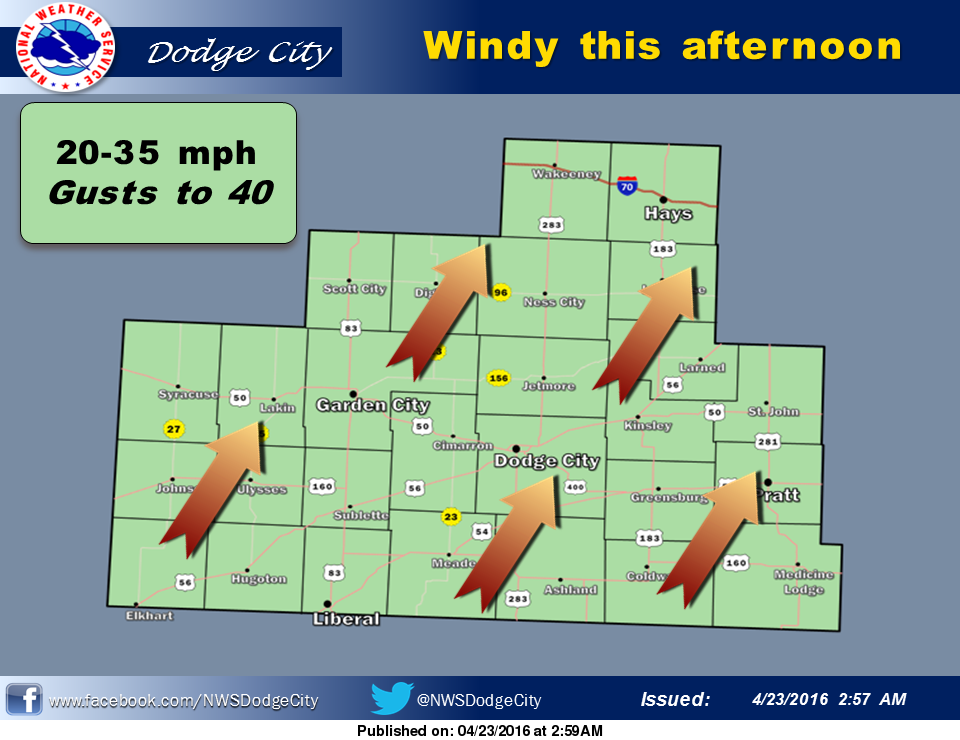
 Today will be warm and breezy. Highs will reach the 80s across the area with south winds of 20 to 30 mph gusting to around 40 mph at times. There is a slight chance for thunderstorms tonight. A few of the storms could be strong with small hail and gusty winds. Sunday will be a bit cooler, but still mild and not as windy.
Today: Sunny, with a high near 83. Windy, with a south wind 11 to 16 mph increasing to 24 to 29 mph in the afternoon.
Tonight: A 30 percent chance of showers and thunderstorms, mainly between 10pm and 2am. Mostly cloudy, with a low around 57. Windy, with a south wind 21 to 26 mph, with gusts as high as 36 mph.
Sunday: Mostly sunny, with a high near 80. West southwest wind 11 to 16 mph.
Sunday Night: Mostly clear, with a low around 48. West southwest wind 10 to 14 mph becoming north northwest after midnight.
Monday: Sunny, with a high near 73. North northwest wind around 11 mph becoming northeast in the afternoon.
Registry Aims To Link Kansas Medicaid Patients, Personal Care Workers

By MEGAN HART

CREDIT COURTESY BILL STOVALL
A statewide registry is in the works to make it easier for Medicaid patients to find qualified, reliable personal care workers.
That’s good news for Bill Stovall of Topeka and others like him who help direct care for their family members.
Stovall has a long list of complaints against personal care workers who have cared for his sister in recent years, including punctuality problems and a lack of training.
Stovall has directed care services under Medicaid for his sister Carol Miller, 58, for about 10 years. Miller has needed 24-hour care since she had a brain hemorrhage in August 2013, he said, and he has struggled to find people who are willing and able to provide the level of care she needs.
For example, some haven’t arrived on time to relieve the person caring for Miller on the previous shift, and one came with alcohol on her breath, Stovall said. Another care worker apparently didn’t know much about wheelchairs and called him to ask how fast his sister’s non-motorized chair could go, he said.
“I said, ‘It goes as fast as you want to push it,’” he said.
Several Kansas nonprofits are working on the central registry for personal care workers. The Arc of Douglas County, the Kansas Lifespan Respite Coalition and Rewarding Work, a nonprofit based in Massachusetts, hope the website will go live within a year, said Gina Ervay, chair of the Kansas Lifespan Respite Coalition.
Rewarding Work operates similar registries in seven states. People who are looking for work or Medicaid patients who need to hire a personal care worker can create profiles and search for matches.
The system will send regular reminders to workers on the registry to update their information, Ervay said. Those who do will appear at the top when Medicaid patients search for workers, she said, and those who don’t will be removed from the list after a year of inactivity.
A working relationship
According to the Kansas Department of Labor, about 18,190 people were employed in 2014 as personal care workers who care for the elderly and people with disabilities in Kansas.
Their median annual wages ranged from a high of $23,068 in Atchison County to a low of $17,711 in Labette County — meaning median hourly wages would range from about $8.50 to $11 if the person works full-time.
Mike Oxford, director of the Topeka Independent Living Resource Center, said the average hourly wage statewide for personal care services under Medicaid is $9.60, which makes it difficult to find people willing to do the work.
“We’re asking people to do some pretty icky things for about the same amount as delivering pizzas,” he said.
Groups like the Topeka Independent Living Resource Center have lists of people who report they are interested in providing home care services, but the groups don’t have the resources to regularly update them, Oxford said. The result is that a Medicaid patient may have to call quite a few numbers before finding someone who still is available and interested in doing the work, he said.
The statewide registry will better match workers and patients based on services offered, training the employee has or even whether they smoke or have similar interests, Oxford said.
“There’s a lot of social interaction between personal care attendants and people who direct their own care. It’s a relationship,” he said.
Assessed for services
Medicaid, which in Kansas is a privatized program known as KanCare, pays for home and community-based services through various waiver programs that serve people with specific types of disabilities. The three managed care organizations that administer KanCare spent a combined $188 million on home and community-based services in 2013, but their reports don’t specify how much of that spending goes toward personal care services.
For Kansans with disabilities who might need personal care services, the Kansas Department for Aging and Disability Services first assesses their needs, then the Kansas Department of Health and Environment determines if they meet income qualifications, KDADS spokeswoman Angela de Rocha said.
The MCO then assigns a caseworker to work on a plan spelling out what services the patient is eligible for and how many hours a month he or she will receive, she said.
The patient can choose to have a local home health agency make the arrangements or can self-direct care, de Rocha said. When a patient self-directs, the person receiving the services or his or her representative decides whom to hire and is responsible for making sure the worker performs the right tasks within the authorized hours, she said. A financial management services provider handles background checks and tax withholding.
Ervay said the groups behind the registry anticipate about $55,000 in costs to build and market the website, plus $60,000 in annual maintenance costs. They hope that the MCOs will agree to contribute toward the maintenance costs in the future if they can show improved outcomes from quickly matching patients with workers, she said.
“We’re hoping that families are going to more readily find the workers they need to help them continue living in the community,” she said. “If they can’t find the people, that can be a barrier to them living independently.”
Megan Hart is a reporter for KHI News Service in Topeka, a partner in the Heartland Health Monitor team. You can reach her on Twitter @meganhartMC
KDWPT: Hunting in Kansas is safer than playing golf

 KDWPT
KDWPT
PRATT – The Kansas Spring Turkey Season opened April 12 and is in full swing through May 31. Reports from the field indicate that birds are plentiful and responding to hunters’ calls. However, the tradition of spring turkey hunting, where the hunter hides in full camouflage while imitating the call of a hen, requires special safety consideration.
Turkey hunting can be excellent on state wildlife areas, as well as the nearly 250,000 acres of private land enrolled in the Spring Walk-In Hunting Access Program. Hunters on public land must always assume other hunters are there, too. Although hunting in Kansas is safer than playing golf, when you consider injuries per 100,000 participants, one tragic hunting-related accident is too many. A few simple precautions can help ensure you or another hunter don’t become a statistic.
First, never wear the colors black, blue or red, the colors prominent on a tom turkey as it displays for a hen. Set up to call with a good view in front and a tree wider than your shoulders at your back. A shoulder-width tree to lean against will protect you if another hunter stalks in from behind. If you see another hunter, whistle or call out; never wave or move, which could draw fire. Always assume a sound you hear is another hunter, and act accordingly. Many hunters will wear a fluorescent orange hat or vest when they walk out after hunting, or if they are successful, they may wrap an orange vest around their bird as they carry it out. Hunting-related accidents during the spring turkey season are rare, but let’s keep it that way.
Another kind of hunter in the woods this time of year is hunting morel mushrooms, and reports from the field indicate that hunters are finding them now. It is legal to pick morels on state and federal public hunting land as long as they are kept for personal consumption. Mushrooms collected on state and federal lands may not be sold commercially. Spring Walk-In Hunting Access land is leased for hunting access only. Morels found incidentally by turkey hunters on WIHA lands may be collected for personal use. Mushroom hunters should assume they will encounter turkey hunters on public lands, but potential conflict can be minimized by hunting mushrooms mid-day. Most turkey hunters prefer to be in the woods at daybreak and are often calling it a day by mid-morning.
KNOLL: Nope, my head hasn’t stopped spinning


The race for the White House is mindboggling.
There’s such a huge difference in how our U.S. government is supposed to be run when one looks at Democrat candidates versus Republicans. That is, if the latter party carries through on their campaign promises. Our Republican controlled Congress hasn’t and I will get to the reason why.
On the Republican GOP side Kansas got it right with Ted Cruz. Nobody can say with absolute certainty what Cruz will do about our country but I’m in his corner optimistically. I might not be as enthusiastic if Trump is the nominee, but I will support either one. What choice do we have?
The answer to that last question is mindboggling and makes one’s head spin!
Many of us on the conservative side feel we need a complete change in direction for this country!
Front runner Democrat Hillary claims she will follow in the footsteps of Obama and Bernie will too for the most part. Call them the establishment although Bernie wants an even bigger socialist government than we already have.
But here’s the kicker. There are many influential Republicans that would just as soon maintain the status quo. They don’t want change. They’re sitting pretty in Washington, D.C. or wherever, even without control of the White House. To them it’s “why rock the boat” with all the changes Trump and Cruz are proposing? There’s talk all over the place that many Republicans might cross over and vote Democrat rather than vote for the two just mentioned.
And, that’s mindboggling! Did readers see what our former First Lady said? Laura Bush said she would rather vote for Hillary than Trump if he becomes the nominee. What more proof is needed that the Democrat and Republican establishment in many ways are one?
Don’t forget voters – Hillary has a disastrous past – oodles of negatives. Donald may say some things that may be off the wall, but has yet to show what he will do about changing the direction of this country. Hillary won’t change anything.
To think there are Republicans in name only (called RINOS) who would vote against a Trump or Cruz blows the mind but then again that’s why Trump and Cruz are popular. They’re not part of the establishment and have support from millions of dissatisfied voters not seen in our politics for decades.
God help us if a Democrat again becomes president and if it is a Republican, we pray the new guy in the Oval Office doesn’t cave to the establishment on either side of the aisle.
Les Knoll lives in Victoria and Gilbert, Ariz.
Young has 10 Ks, Moustakas hits HR as Royals beat Orioles


KANSAS CITY, Mo. (AP) — Chris Young struck out 10 in six innings, Mike Moustakas homered, doubled twice and drove in three runs, and the Kansas City Royals beat the Baltimore Orioles 4-2 Friday night.
Young (1-3), who came in with a 7.90 ERA and had allowed 20 hits in 13 2/3 innings, baffled the Orioles. Young recorded his sixth-career double-figure strikeout game and his first since April 24, 2008, when he struck out 10 against San Francisco while with San Diego.
Young gave up two runs and four hits, including a sixth inning leadoff home run to Manny Machado, who extended his hitting streak to a career-high 15 games.
Wade Davis pitched a spotless ninth to log his seventh save in as many chances.
Moustakas hit his sixth home run on Yovani Gallardo’s second pitch with Alcides Escobar aboard. Moustakas had a two-out, RBI double in the second off Gallardo (1-1).
FHSU baseball drops series opener at Missouri Southern

JOPLIN, Mo. – Missouri Southern scored four runs in the eighth inning and rally past Fort Hays State 5-2 in the opening game of their three-game series at Warren Turner Field. The Tigers (17-24, 11-19 MIAA) have dropped seven straight while the Lions improved to 27-14 overall and 17-13 in the MIAA.
Missouri Southern scored in the bottom of the second inning but the Tigers evened the score in the third. With two outs, Nick Hammeke worked a full count and drew a walk. He then stole second and came around to score on an error.
FHSU took a 2-1 lead in the seventh. With one out, Connor Ross tripled to right center. Hammeke, who saw his team-best 14-game hit streak come to and end, plated Ross on a fielder’s choice.
The Lions had five hits off reliever Austin Unrein in the eighth inning, four of which were doubles. The Tigers had two runners reach base in the ninth, but weren’t able to score.
Starter Kyle Vogt pitched seven innings but did not receive a decision. He allowed one run on four hits with a walk and three strikeouts. Unrein took the loss in his inning of relief.
Payton Walker of Missouri Southern picked up the win, tossing eight innings with just one earned run allowed on seven hits and four walks. He struck out four. Kyle McCulloch picked up the save, throwing the ninth inning with a hit allowed an two strikeouts.