Washington, D.C. – U.S. Senator Pat Roberts on Friday called for better coordination among agencies handling the spread of the Zika virus to ensure “the best science-based solutions are available” to prevent the spread of the mosquitoes carrying the disease. Roberts questioned witness Dr. Anne Schuchat of the Centers for Disease Control and Prevention (CDC) at a Senate health committee hearing on the growing public health threat of the Zika virus.
“I believe it’s important that we are ensuring a variety of tools are available to states, towns, and countries,” Roberts said. “The president’s request proposes giving CDC the money to handle vector control and mosquito surveillance programs, but I have concerns about the agency’s expertise and access to the chemicals.”
Roberts continued, “I understand that we have engaged with the World Health Organization to ensure availability of insect repellants to address mosquitos carrying the Zika virus. How is the CDC working with EPA and others to ensure that pesticide products are registered and available for use as tools in addressing this public health situation?”
Roberts also mentioned the use of a genetically-engineered mosquito, which has been tested in Brazil and asked if the United States is considering this technology.
Roberts spoke earlier this week with researchers at Kansas State University Biosecurity Research Institute who are researching Japanese encephalitis, a similar mosquito-borne virus, saying “they impressed upon me how much we simply don’t know about the virus at this time.”
EMPORIA, Kan. (AP) — Fire officials say they are investigating several fires in Lyon County as possible arsons.
The Lyon County Sheriff’s Office said in a news release it found 14 starting points to a fire Saturday night. The blaze started just north of Interstate 35 and stretched along the Interstate 35 corridor to the Coffey County line.
Authorities are looking for an early 1990s Chevrolet or GMC single or extended cab truck that was dark blue or black. It reportedly was driven by two white males in their mid-30s with full beards.
The Lyon County Sheriff’s Office, Emporia Fire Department and Reading Fire Department responded to the fires.
WICHITA, Kan. (AP) — A long-running school finance case is proving costly for the state of Kansas and four school districts.
State Republican leaders argue money spent on the case could be used instead in classrooms. But an attorney for the Wichita school district argues the legal fees are small compared with the money on the line for the districts, which contend the state is not adequately funding schools.
The Wichita Eagle reports the state has spent $1.4 million on outside counsel, and that doesn’t include pay for eight attorneys in the attorney general’s office who have worked on the case since 2010.
The Wichita district has spent more than $1.6 million since 2010. The Kansas City, Kansas, Dodge City and Hutchinson districts also have spent thousands of dollars.
KANSAS CITY, Kan. (AP) — A competency hearing is being sought for a Kansas City, Kansas, woman who was running for public office when she was accused of hitting four high-schoolers with her car and killing one of them.
The Kansas City Star reports that Tamika Pledger is charged in Wyandotte County with involuntary manslaughter in the death of 17-year-old Tierra Smith. The teen died about a week after the January 2015 crash.
At the time, Pledger was running for the board that governs the Unified Government of Wyandotte County and Kansas City, Kansas.
Court documents say Pledger sped to the area after receiving a call from her daughter about a fight that was about to occur. The charges don’t allege that she intentionally hit the group, but that she was driving recklessly.
State Rep. Ken Rahjes, R-Agra, 110th Dist., will host several town hall meetings in northwest Kansas this week.
Monday, Feb. 29, Rahjes will be in Hill City at Red’s Family Restaurant from 11 a.m until 12 p.m.
Tuesday, March 1, he will be at the Rooks County Health Center, Plainville, from 1-2 p.m., and then in Agra from 3-4 p.m. in the Agra City Building/Library.
TOPEKA – Gov. Sam Brownback has signed into law a bill that would allow underage drinkers to seek or receive emergency medical treatment without legal repercussions.
SB 133, commonly known as the Lifeline 911 bill, became law after two and half years of work by supporters both inside and outside the Capitol. College students and lawmakers collaborated to make the new law a reality.
“I am thrilled for the students,” Sen. Tom Hawk, D-Manhattan, said. Hawk, along with numerous senators, worked with student proponents to help kick-start the bill and see it through the legislature.
“I am very proud to see the bill be signed in to law,” said Reagan Kays, former Kansas State (K-State) student body president, who was a key player in drafting the legislation.
The bill began as a student initiative at K-State and was designed to mirror similar laws in other states.
“I guess you could say (the initiative) started out as an idea I borrowed from a fellow intern the summer before my senior year of college,” Kays said.
After being elected student body president in 2014, Kays spoke with his newly elected vice president, Cody Kennedy, and they decided to run with the idea.
“We spent a lot of time explaining it to people who had never heard of anything like this legislation,” Kays said.
Before their explanations, few people were familiar with the concept of immunity from criminal prosecution for minors seeking medical assistance from alcohol, but they were very open to hearing how such a measure could affect college campuses around Kansas.
“My goal was to use the position of student body president, a role recognized by many, as a way to leverage stakeholders to get behind the bill,” Kays said.
Kays and Kennedy began speaking to legislators from the Manhattan area to see if they had any interest in the idea – and they did.
“After speaking with Kays about his initial idea, I told him, ‘Let’s get together in Topeka!’” Hawk said.
Hawk helped direct Kays and other advocates to different lawmakers around the Capitol. After drafting of the bill, Kays encouraged others to promote it.
“We organized students from K-State to go to the Capitol every two weeks to advocate for the bill,” Kays said.
Momentum to support Lifeline 911 eventually grew to include campus leaders around the state. Even as recently as early February, Jessie Pringle, University of Kansas (KU) student body president, came to the Capitol’s annual “Higher Education Day,” to urge legislators to help pass the bill.
Hawk said credit for the success of the bill goes to the students.
“It’s all about the constituents pushing for the piece of legislation,” Hawk said.
Nearly three years after the journey to implement Lifeline 911 in Kansas began, students and supporters believe the new law will benefit students across the state.
“Every once in a while you hear of tragic drinking accidents at your college or one near you,” said Anna Frame, a junior at the University of Kansas. “I think legislation like this will encourage people to help each other and not fear for their legal safety.”
Hawk strongly agrees with Frame. He believes that students have previously been nervous about the consequences they would have to face if they called for medical attention for an underage drinker, especially if they were underage themselves. This bill would protect students who drink too much and those who seek help for them.
“With the way society is, people are paranoid with getting in trouble,” said Hawk.
Kays said the ultimate objective of Lifeline 911 is to serve as an incentive to help young people pick up the phone and ask for help.
“If one of your friends or acquaintances has a little too much to drink, this bill can help them get the medical attention they need,” Kays said.
Hawk agrees.
“This bill isn’t students wanting to get out of legal responsibility. . . . This is a mature move made to help people,” Hawk said.
More than 20 states have 911 lifeline legislation in place, reports Aware, Awake, Alive, an education and advocacy group in Texas. The group reports that from 1999 to 2005, 83 deaths among college students nationwide were due to underage drinking.
LENEXA—The U.S. Environmental Protection Agency is seeking grant proposals from eligible applicants for the 2016 round of funding from the agency’s Environmental Education Grants program. These grants will support local environmental education projects that promote environmental awareness and stewardship and help provide people with the skills to take responsible actions to protect the environment.
EPA’s Environmental Education Grants program provides financial support for projects that design, demonstrate, and/or disseminate environmental education practices, methods, or techniques. EPA expects to award up to three grants from each of the EPA’s 10 regional offices, for a total of approximately 30 grants nationwide. The award amount for each of these grants will be approximately, but no more than, $91,000. Since 1992, EPA has distributed between $2 and $3.5 million in grant funding per year through the EE Grants Program, supporting more than 3,600 grants.
Applicants must represent one of the following types of organizations to be eligible: a state education or environmental agency, a college or university, a non-profit organization as described in section 501(c)(3) of the Internal Revenue Code, or a tribal education agency (which includes schools and community colleges controlled by an Indian tribe, band, or nation).
Applicant organizations must be located in the United States or territories and the majority of the educational activities must take place in the United States; or in the United States and Canada or Mexico; or in the U.S. Territories.
LENEXA–The U.S. Environmental Protection Agency (EPA) has announced the availability of up to $1.5 million in funding for clean diesel projects in Iowa, Kansas, Missouri and Nebraska under the Diesel Emissions Reduction program (DERA). Nationally, $26 million in grant funding will be available to establish clean diesel projects aimed at reducing emissions from the nation’s existing fleet of diesel engines.
Region 7 – including Iowa, Kansas, Missouri, and Nebraska – will request proposals that include funding for at least $300,000 and not exceed $1.5 million. Past funding in the region has included clean diesel projects for school district buses, municipal vehicles and river push boats and tugs.
Diesel-powered engines move approximately 90 percent of the nation’s freight tonnage, and today nearly all highway freight trucks, locomotives, and commercial marine vessels are powered by diesel engines.
EPA is soliciting proposals nationwide for projects that significantly reduce diesel emissions and exposure, especially from fleets operating in areas designated as having poor air quality. Priority for funding will be given to projects that engage and benefit local communities and applicants that demonstrate their ability to promote and continue efforts to reduce emissions after the project has ended.
Eligible applicants include regional, state, local or tribal agencies, or port authorities with jurisdiction over transportation or air quality. Nonprofit organizations may apply if they provide pollution reduction or educational services to diesel fleet owners or have, as their principal purpose, the promotion of transportation or air quality. The applicants may apply until Tuesday, April 26, 2016. EPA Region 7’s contact for application questions is Greg Crable, (913) 551-739 or [email protected]
Under this competition, EPA anticipates awarding between 10 and 40 awards nationwide.
Tribes are welcome to apply under this Request for Proposals although EPA anticipates releasing a separate Request for Proposals for Tribal applicants during March.
Since the first year of the DERA program in 2008, EPA has awarded nearly 700 grants across the U.S. Many of these projects fund cleaner diesel engines that operate in economically disadvantaged communities whose residents suffer from higher-than-average instances of asthma, heart and lung disease.
ELLSWORTH COUNTY -What if a significant crime took place in a large public setting? What if there were dozens of eyewitnesses or people that might be able to shed some light on the incident?
You would think having multiple witnesses or sources of information would be a positive thing. What do think the chances are that each individual has the same story?
Ellsworth County Sheriff Tracy Ploutz says he is in a similar situation trying to get to the bottom of an investigation involving an alleged sexual assault on a Great Bend High School activities bus.
“If you’ve ever played the game where they stand two lines together, tell the first person the story and share it to the person behind them and by the time you reach person in back of the line the story isn’t close to what started,” said Ploutz.
“That’s not what I’m dealing with here but you just have to weed it out,”
Ploutz said he chose to interview everyone that was on the bus including the bus driver, two coaches, and most of the swim team members.
Ploutz mentioned the parents of two students choose that their children not speak to investigators.
The process of scheduling interviews and traveling back and forth from Great Bend to Ellsworth County has caused the case to take longer than most people expected.
Ploutz says he now projects the investigation will be turned over to the Ellsworth County Attorney’s Office soon.
While Ploutz is dealing with the case that allegedly happened in Ellsworth County, the Saline County Sheriff’s Office has turned over a separate sexual assault claim from a 15-year old Great Bend High School swimmer to the Barton County Sheriff’s Office.
The boy and a parent went to Salina last weekend to report a sexual assault on the swim team bus on February 3. After an investigation, Saline County determined the incident occurred in Barton County and handed over the investigation to the Barton County Sheriff’s Office.
At 3:47 p.m. on Saturday, the City of Hays Fire Department, assisted by the Hays Police Department and Ellis County EMS, was dispatched to a building fire at 4602 Hoover Drive. The Ellis County Rural Fire Chief was first on scene and found a fire at the rear of the building.
A neighbor had observed smoke coming from the building, called 911 and alerted the occupant. Using a garden hose, they had the fire under control when firefighters arrived. The fire had started in outside ground litter, extended to the wooden stairs and burned through the outside wall into the structure. Firefighters had to open up the wall to extinguish smoldering fire. Firefighters then covered the opening to prevent further damage until repairs can be made.
The fire was most probably caused by improperly discarded smoking materials. The fire grew rapidly in the windy conditions present at that time.
Five fire trucks and 16 firefighters responded. The last firefighters left the scene at 4:45 p.m.
OLATHE, Kan. (AP) — A Lenexa man has admitted he stabbed two men to death during a burglary at their home.
Alex Brune pleaded guilty Friday to two counts of first-degree murder in the July 2014 deaths of 47-year-old Brian Baskind and his stepfather, 79-year-old Clifford Preston at the men’s home in Lenexa. Brune was scheduled to go to trial on Monday.
The Kansas City Star reports each count carries a sentence of life in prison with no chance of parole for 25 years. Prosecutors said they will ask that the sentences run consecutively when Brune is sentenced May 18.
One of the victims shot Brune during the altercation. Brune told police he had been kidnapped by a stranger and driven to the house, where he stabbed the men while trying to escape.
EDMOND, Okla. – Fort Hays State had their second worst shooting game of the season as they lose 67-54 to Central Oklahoma in their regular season finale Saturday afternoon at Hamilton Field House. The Tigers (19-9, 13-9 MIAA), who missed their first 10 shot attempts, were held to 35-percent shooting and see their four-game win streak snapped.
Mark Johnson Postgame Interview
Game Highlights
The Tigers trailed by as many as 10 in the first half and were down 21 with just over six minutes to play.
Rob Davis led FHSU with 15 points. Jake Stoppel added 12.
Trai Jordon led Central Oklahoma (15-13, 11-11 MIAA) with 10 points and 14 rebounds.
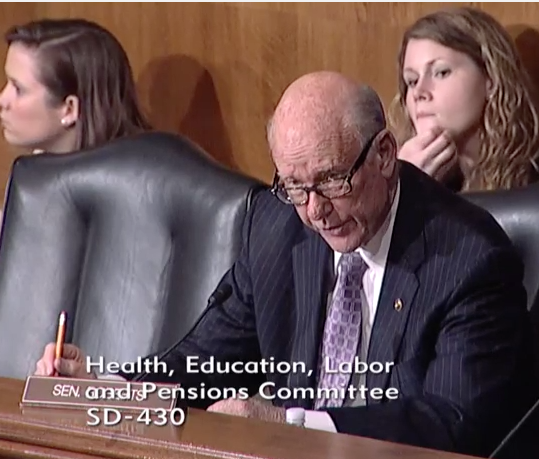
 Washington, D.C. – U.S. Senator Pat Roberts on Friday called for better coordination among agencies handling the spread of the Zika virus to ensure “the best science-based solutions are available” to prevent the spread of the mosquitoes carrying the disease. Roberts questioned witness Dr. Anne Schuchat of the Centers for Disease Control and Prevention (CDC) at a Senate health committee hearing on the growing public health threat of the Zika virus.