We have a brand new updated website! Click here to check it out!

NTSB: Plane in air 26 seconds before Kansas crash

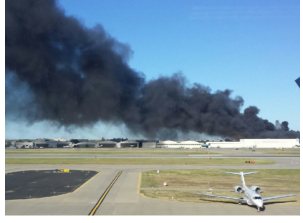
2014 crash in Wichita

WICHITA, Kan. (AP) — The National Transportation Safety Board says an airplane that crashed at a Wichita airport in 2014 was in the air for only 26 seconds and 120 feet.

The Beechcraft King Air B200 crashed into a FlightSafety building at the Eisenhower National Airport, killing four people.

The Wichita Eagle report the NTSB released its factual report on the crash Friday. The report precedes a ruling on what caused the crash.

The report says pilot Mark Goldstein, one of those who died, radioed that his left engine was malfunctioning before the impact.

The report said investigators found no maintenance record discrepancies that would have affected the plane’s performance. The airplane’s last major scheduled maintenance was completed nine days before the crash.

Wichita State routs Illinois State for 5th-straight win

WICHITA, Kan. (AP) — Fred VanVleet and Anton Grady scored 16 points apiece and Wichita State routed Illinois State 74-58 on Saturday for its fifth-straight win.

The Shockers (23-7, 16-2 Missouri Valley) entered having already clinched their third-consecutive conference title, and snapped a two-game skid against Illinois State (18-13, 12-6).

DeVaughn Akoon-Purcell had 15 points and MiKyle McIntosh 14 to lead the Redbirds, who end their regular season tied with Evansville for second in the conference standings. The tie will be broken using Jim Sukup’s RPI Report on Sunday. The team with the better RPI will be the No. 2 seed into the conference tournament.

It was tied at 20-all midway through the first half before Wichita State pulled away on a 26-8 run to close the period and build a 46-28 halftime lead. The Shockers stretched it to 25 points with 7:31 remaining and cruised from there.

No. 9 Tiger women come up short at Central Oklahoma

By GERARD WELLBROCK
Hays Post

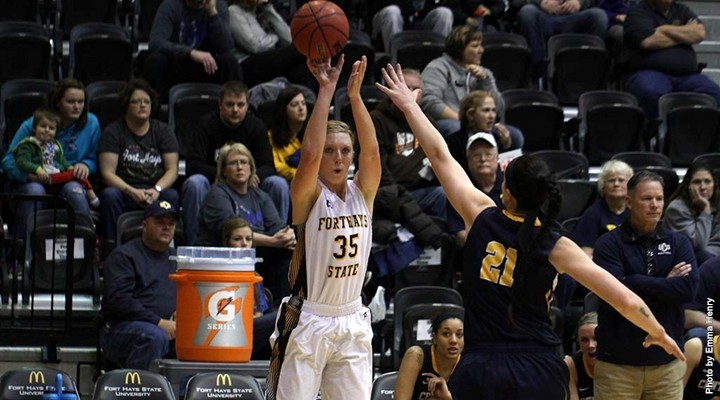
EDMOND, Okla. – Fort Hays State couldn’t overcome an early double-figure deficit and lose 81-73 to Central Oklahoma Saturday afternoon at Hamilton Field House. With the loss, the Tigers (24-4, 18-4 MIAA) tie for second in the MIAA with Pittsburg State and will have the No. 3 seed in the conference tournament and play at noon on Thursday.

The Broncos (18-10, 12-10 MIAA) used an early 14-2 run to build an 11-point first quarter lead and would never trail the rest of the day. The Tigers trailed  by 19 with 2:05 to play in the third quarter, then put together a 17-2 run over the next four minutes to close the gap to four which would be the closest they would get.

Tony Hobson Postgame Interview


Game Highlights


The Tigers shot 27-percent in the first half and finished at 37-percent for the game but were 7-of-29 from beyond the arc. UCO knocked down 8-of-15 from 3-point range while shooting 55-percent. They were 27-of-32 from the free throw line where they outscored the Tigers by 11.

Paige Lunsford led three Tigers in double-figures with 16 points. Nikola Kacperska added 14 and Beth Bohuslavsky 13.

Nature Conservancy gets gift for Kansas waterways

Screen Shot 2016-02-27 at 11.33.28 AMTOPEKA, Kan. (AP) — The Nature Conservancy of Kansas plans to use a $2 million gift to improve stream conservation in the state.

The gift from the David T. Beals III Charitable Trust is the largest gift the organization has ever received. Nature Conservancy officials said Wednesday the money will be used to establish a statewide stream conservation program.

The Topeka Capital-Journal reports (https://bit.ly/1QgRSTt ) the Nature Conservancy owns 46,000 acres in Kansas. It also leads conservation efforts in the Flint Hills, Red Hills and Cheyenne Bottoms.

The organization plans to work with private landowners on techniques that limit livestock and crop runoff into streams. That work will start occur mostly in rural areas once the agency finds a stream that needs rehabilitation. A program manager is expected to be hired by this spring.

Kan. woman charged after newborn found dead in trash can

court jailOLATHE, Kan. (AP) — An Olathe woman will stand trial in the death of her newborn daughter, whose body was found in a trash can.

Twenty-year-old Marissa Carol Fields is charged with first-degree felony murder and aggravated abandonment of a child. After a preliminary hearing Friday, Fields’ attorney entered not guilty pleas for her.

Prosecutors say Fields gave birth at home in December 2014 after not telling anyone she was pregnant.

The Kansas City Star reports (https://bit.ly/21zo3Va ) she told police the child was born blue and was cold to the touch. She said she put her in plastic bags and in the trash can because she was in shock.

Medical testimony Friday indicated the baby was born alive and took at least one breath. The baby was full term and had no injuries.

No. 2 Jayhawks beat Texas Tech for Big 12 title share

By AMIE JUST
Associated Press

LAWRENCE, Kan. (AP) — Svi Mykhailiuk came off the bench to score 17 points, Frank Mason III added 16 and No. 2 Kansas beat Texas Tech 67-58 on Saturday to secure at least a share of its 12th straight Big 12 title.

Mykhailiuk hit five 3-pointers and didn’t miss a shot until the final minute, helping the Jayhawks (25-4, 13-3) extend one of the most remarkable streaks in major college basketball.

The only school to win more consecutive conference championships was UCLA, which won 13 in a row during the 1960s and ’70s. The Jayhawks can win their eighth outright title during their streak with a win Monday night at No. 25 Texas or in their regular-season finale against No. 17 Iowa State.

Toddrick Gotcher hit five 3s and led the Red Raiders (18-10, 8-8) with 20 points.

Precision ag technology program offered to growers

precision agEllis Co. Extension

Trying to stay up-to-date on precision agriculture and the potential efficiencies they present can be challenging for growers.

In an effort to keep farmers informed a precision agriculture technology program will be conducted in Hays on Friday, March 4th. Registration is at 8:00 a.m. The program starts at 8:30 a.m. and concludes at 12 noon in the Ellis County Extension Office back meeting room, 601 Main Street, Hays.

K-State Speakers and topics:
• GPS Overview & Economics of Swath Control, Lucas Haag, Extension Agronomist
• Precision Planting Technology – A.J. Sharda, Agricultural Engineer
• Big Data Implications for Farmers – Terry Griffin, Agricultural Economist
• Small Unmanned Aircraft Systems (UAS) and Applications in Agriculture, Brian McCornack, Field Crop Entomologist
• Industry session

The cost is a $5.00 fee for lunch. RSVPs are requested by Monday, February 29. There must be a minimum of 12 people pre-registered to have the program. Call (785) 628-9430 any time and a leave message at Ext. 1 or email Theresa at [email protected].

Man sentenced for theft, Kansas hunting violations

Screen Shot 2016-02-24 at 11.22.14 AMKANSAS CITY – A Missouri man was sentenced Tuesday to two years on federal probation during which he is banned from hunting for stealing a tractor and hunting in Kansas in violation of the federal Lacy Act, according to U.S. Attorney Barry Grissom. In addition, he was ordered to pay a $5,000 fine, and $6,894 in restitution.

Thomas Morgan, 31, Blue Springs, Mo., pleaded guilty to one count of transporting a stolen vehicle across state lines and one count of violating the Lacy Act, which prohibits interstate transportation of wildlife that was illegally taken.

In his plea, Morgan admitted a Rice County deputy stopped him in November 2013 after Morgan had been hunting deer in Stafford County without a license or deer permits.

Morgan had been illegally hunting in the dark. Investigators found deer heads in his car. A search warrant at his home turned up heads, antlers, skulls and capes of deer.

During the investigation, agents of the U.S. Fish and Wildlife Service learned Morgan was involved in the theft of a Kubota tractor in Miami County. The tractor was found at Morgan’s residence.

Grissom commended the U.S. Fish and Wildlife Service, the Kansas Department of Wildlife, Parks and Tourism, the Rice County Sheriff’s Department, the Miami County Sheriff’s Department and Assistant U.S. Attorney Chris Oakley for their work on the case.

HINEMAN: Are KPERS retirement accounts at risk?

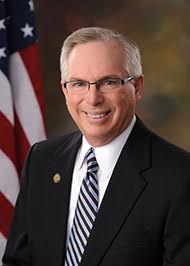
Rep. Don Hineman, R-Dighton, 118th Dist.

Controversy over the state of Kansas’ KPERS retirement system seems to be a perennial part of the legislative process.  Each year seems to bring new legislative proposals which cause anxiety among KPERS participants… both current employees who are paying into the system and retirees who are now receiving benefits.

The problem started years ago when the Kansas legislature began to shirk its statutory responsibility for funding KPERS.  While employees were required to contribute the entire percentage of their pay they had originally agreed to, the legislature shorted KPERS by making a smaller employer contribution than the state had agreed to.  That contribution rate had been calculated back then as the amount necessary to keep KPERS solvent.

Over time the legislature’s underfunding created a huge problem for KPERS and the result was a retirement system which was billions of dollars away from being actuarially sound.  That posed a real threat to the future retirement benefits of thousands of state and local government employees.    Fortunately the legislature in 2012 recognized that something had to be done and a law was passed that increased contribution rates for both employers and employees.  It was designed to eventually return KPERS to fiscal health, and that will happen if this and future legislatures live up to their commitment.  I was pleased to vote for the bill back then, and I consider it the most significant piece of good government legislation to come out of that session.

The budget which passed the legislature last week gives Governor Brownback the flexibility to delay the fourth quarter payment into KPERS (due by the end of the fiscal year on June 30) until later in the new fiscal year.  But if he does that (and I believe the dire fiscal circumstances of the state will force him to do so) then the delayed payment must be made into KPERS, with 8% annual interest, no later than September 30.

This is not the same thing as borrowing from KPERS, which implies that the state would be withdrawing past contributions to KPERS and using them for other purposes.  That has not happened and will never happen.  The IRS has very strict rules governing retirement plans such as KPERS, and withdrawing previous contributions would be a clear violation of those rules.  It would put the entire system in jeopardy.  From the perspective of the IRS, that is a much more serious event than diverting contributions before they go into KPERS.

The truth is KPERS is the only absolutely secure lockbox in Topeka.  The IRS regulations make it impossible for any legislature or governor to start using KPERS as a piggy bank.  If contributions are delayed or reduced, that means it will take longer for KPERS to reach fiscal soundness but it does not put anyone’s retirement at risk in the foreseeable future.  Unfortunately that is exactly what is currently happening.  In fiscal year 2014 Governor Brownback reduced the state’s contribution to KPERS.  And the budget passed just last week continues that practice for FY 2016 and 2017.  By doing so the state is delaying the date at which KPERS becomes solvent.  That fact alone was reason enough for me to vote no on the budget.

However there is another reason to be concerned about delaying or reducing state contributions.  Doing so is a huge red flag regarding the fiscal situation the state is currently in.  If we can’t afford to make four quarterly KPERS payments this fiscal year, what are the odds we will be able to make five payments plus interest on one of them in the next fiscal year?  The fact that this move is even being contemplated is a manifestation of a serious fiscal crisis within state government.

Aside from the fiscal red flag there is another troubling aspect to this practice.  Agreed-to KPERS contribution rates constitute an agreement between employer and employee.  For the state of Kansas to shirk its responsibility and reduce its current or future contribution rates while employees and other government employers are making their full contribution represents a serious breach of ethics and may in fact be illegal.  We ought not to do that.

State Representative Don Hineman, 118th District
[email protected]
785-296-7636    

FHSU institutes offer science, math summer camps to young students

fhsu limestone entrance signFHSU University Relations and Marketing

Registration for math, science and engineering summer camps offered by two Fort Hays State University entities is open to students who will enter the second through 10th grade in fall 2016.

KAMS Camps

The Kansas Academy of Mathematics and Science offers five different four-day camps to high school underclassmen. Students can sign up for a maximum of two camps. Each camp costs $100 for Kansas residents and $400 for non-residents. Tuition includes camp supplies, a T-shirt, and room and board. Registration priority date is April 1.

Computer Animation, June 6-9
Students will learn to use Alice, a freeware, object-based educational programming language with an integrated development environment. Through hands-on experiments, students will create computer animations using 3D models and produce their own short animated movie.

Becoming an Everyday Mathematician, June 13-16
Students will learn to use Excel and statistical programs and go on field trips to understand mathematical concepts that affect daily life. Students will learn how to use mathematics to explain questions such as: How does the weather forecaster make predictions? What makes water taste the way it does? And, can you accurately predict the score of a big game?

Chemistry of Cooking, June 13-16
Students will work with Ph.D. professors to learn chemistry through a fusion of culinary skills and scientific exploration of spices and herbs and cooking techniques like searing steaks, roasting vegetables and baking.

Google Cardboard Virtual Reality Boot Camp, June 20-23
Students will use Google Virtual Reality to create their own world and then step into it. Using Google Cardboard, students will construct low-cost, 3D virtual reality viewers. Also, students will create a 3D virtual reality game and collaborate in small groups to create a 360-degree video.

Capturing the Storm: Learning the Basics of Meteorology and Storm Photography, June 27-30
Students will learn the science of weather forecasting. Students will use digital SLR cameras and tripods to capture storm structures and lightning photos. Students will also get a basic understanding of meteorology, photography, radar software and storm forecasting.

SMEI Camps

The Science and Mathematics Education Institute is offering day-time summer camps to students in second through eighth grades. Each summer camp lasts four days and costs $50 per participant. Space is limited in each camp to the first 24 who sign up before the May 18 deadline.

Robotics Adventure for Girls and Robot-O-Rama (co-ed) are two separate camps that will teach students to build, program and test LEGO robots using LEGO EV3 software. Offered from 9 a.m. to noon and from 1 to 4 p.m. from June 6-9, and available to students grades sixth to eighth.

Mathematical Fitness will give students the chance to explore the behind-the-scenes mathematics at a health and fitness center. Students will use their brain and body to become mathematically fit. Offered 9 a.m. to noon from June 13-16, and available to students in grades fifth to seventh.

Camp North Star involves team projects and experiments with engineering, nanotechnology and rockets. Offered from 12:30 to 4:30 p.m. from June 13-16, and available to students in grades fifth to seventh.

Super Science Heroes Save the World! will teach students about the different aspects of engineering while focusing on the mechanical, electrical, civil and aerospace fields. Students will build robots, mechanical hands and flashlights, and design towers, bridges, arches, cars and planes. Two sessions will be offered, from 9 a.m. to noon and from 1 to 4 p.m. from June 20-23, and available to students in grades second to fifth.

The Science of Aerodynamics camp will teach students about many facets of flight through hands-on experiments. Students will make their own flying craft, take the distance challenge and see the forces of flight in action. Two sessions will be offered from 9 a.m. to noon and from 1 p.m. to 4 p.m. from June 27-30. Available to students in grades second to fifth.

To register for the KAMS summer academy camps, navigate to https://www.fhsu.edu/kams/ and select “Summer Camps.”

Additional information and camp registration for the SMEI camps can be found at www.fhsu.edu/smei under “summer camps.”
SCHROCK: Standards Wars

John Richard Schrock is a professor at Emporia State University.

Anti-Common Core sentiment in the Kansas Legislature has resulted in another bill that would direct Kansas schools to develop new standards—yet again.  This action appears driven by a general antipathy for the federal government’s 15 years of meddling in state education policy.

Education has always been and remains a “state’s right.” President Bush extorted policy compliance by tying it to federal Title money. While Common Core was developed by the chief school officers—state commissioners and superintendents across the country—it became a federal curriculum when it was tied to federal education money under the Race to the Top competition. Despite renaming No Child Left Behind as the Every Student Succeeds Act, the NCLB policies and curricula have become embedded in state education regulations in 43 states. That includes Kansas where the College and Career Ready Standards are Common Core-inspired.

After hearing a Common Core opponent from Wisconsin testify, the Kansas House Education Committee took the anti-Common Core HB 2676 and moved it into Substitute House Bill 2292. This bill also requires that Advanced Placement and International Baccalaureate programs be aligned with the newly-required Kansas standards.

While this anti-fed action is simple-minded knee-jerk politics, the opposition’s sky-is-falling response is hardly more credible. Both sides are under the illusion that changing paperwork dramatically changes teaching practices in the classroom. Both sides are wrong.

In 1987, the State Board of Education was one of the first states to mandate sex and AIDS education. In 2005, the KSBE removed this state mandate. Those teachers who had previously included sex education before 1987 taught it competently before, during and after the mandate. Those who were not well-trained in sex education adopted anemic Sex Respect programs and dropped the topic as soon as the mandate ended. Policies changed. Classroom practices did not.

In 1999-2000, I was on the Science Standards Committee that rewrote the second revision. That was the time the State Board removed the evolution section and made national news. Two years later, after another Board election, evolution was returned. When Kansas biology teachers met for their annual meetings, it was obvious that removing evolution from the standards had increased, not decreased, the extent evolution was taught in biology classes. With the highest belief in evolution of any state surveyed, Kansas biology teachers integrated evolution into every lesson they taught. The late Professor John Moore of UC-Riverside told me to expect the Board action to cause an increase in evolution teaching. He was correct.

It is difficult for folks in high positions to realize that in a profession, practice is not determined by directives from above, but by the education of the professionals. Education schools also appear gullible to this “better education through paperwork” myth. But even if you legislate that we teach that the earth is flat, evolution is wrong, and global warming does not exist, the competent professional teacher is not going to comply. What teachers teach in the classroom is dependent on their professional training. Simply, a science education has more power than legislators or state board members.

There is only one worldwide universal science. It is the same chart of chemical elements that hangs in classrooms worldwide. And gravity does not work differently in Russia. The Advanced Placement curriculum was developed long before state standards and the International Baccalaureate  curriculum is a product of Europe.

I have no love of the educationist Next Generation Science Standards that omit animals, plants, microbes and human anatomy and physiology. But good biology teachers go ahead and teach this content anyway. Professional teachers can ignore the NGSS and they can ignore any new Kansas standards as well.

Kansas does not need to waste $9 million and two years of professionals’ time writing more standards. Indeed, issues such as this are the jurisdiction of the State Board of Education. They are none of the Kansas Legislature’s business.

Copyright Eagle Radio | FCC Public Files | EEO Public File