TREGO COUNTY – Law enforcement authorities are investigating a fatal accident that occurred before 11p.m. on Saturday in Trego County and continue to look for a vehicle involved.
The Kansas Highway Patrol reported a semi was westbound on Interstate 70 just west of Riga Road when it lost part of the load.
The driver returned to the location and parked the semi on the right-hand shoulder of the Interstate.
The passenger identified as Lisa A. Longo, 47, Fort Smith, Arkansas, exited the vehicle into the left side shoulder to pick up debris.
An unknown semi driving in the passing lane traveled left of center and hit her.
Longo was pronounced dead at the scene and transported to Wasinger- Keithly Funeral Home.
Authorities are looking for a dark-colored semi with a light-colored box trailer that is traveling in tandem with another semi. The patrol says the semi that struck Longo may have damage to the driver’s side.
ELLIS–Following a rainy weekend mixed with snow, it’s time to think about July 4 fireworks in Ellis.
Ellis city council members will hear requests during their May 1 meeting for fireworks permit applications from Ellis Softball/Baseball Association and Ellis Baptist Youth.
Several agenda items are related to the municipal swimming pool which has problems with water leaks. An update on the fundraising for a new pool slide will be presented by Pauleen Edmonds of the Ellis Community Foundation.
The complete agenda for tonight’s meeting follows.
AGENDA
May 1, 2017
REGULAR MEETING OF THE CITY COUNCIL OF ELLIS
City Hall – Council Meeting Room
BILLS ORDINANCE REVIEW WORK SESSION BEGINS AT 7:00 P.M.
ROLL CALL AND MEETING CALL TO ORDER AT 7:30 P.M.
PLEDGE OF ALLEGIANCE
AMENDMENTS TO AGENDA (if needed)
1) CONSENT AGENDA
a) Minutes from Regular Meeting on April 17, 2017
b) Bills Ordinance #2020
c) Manual Journal Entries for November 2016
(Council will review for approval under one motion under the consent agenda. By majority vote of the governing body, any item may be removed from the consent agenda and considered separately)
PUBLIC COMMENTS
(Each speaker will be limited to five minutes. If several people from the group wish to speak on same subject, the group must appoint a spokesperson. ALL comments from public on agenda items must be during Public Comment. Once council begins their business meeting, no more comments from public will be allowed.)
2) PRESENTATIONS OF AWARDS, PROCLAMATIONS, REQUESTS & PETITIONS (HEARINGS)
3) SPECIAL ORDER
a) Presentation by Fort Hays State University Leadership 310 Team on Pool Research Project
b) Update on Pool Slide Fundraising Event – Pauleen Edmonds, Ellis Community Foundation
4) UNFINISHED BUSINESS
a) Consider Approval of Fireworks Permit Applications – Ellis Softball/Baseball Association and Ellis Baptist Youth
5) NEW BUSINESS
a) Consider Ratification of Change Order #2 for Street Improvement Project
b) Consider Approval of Application for License to Sell Cereal Malt Beverages – Ellis Chamber of Commerce
c) Consider Authorization to Sign Consultant of Record Agreement
d) Discuss Rededication of Cottonwood Avenue
e) Consider Approval of City Attorney Contract Renewal
6) REPORTS FROM CITY OFFICIALS
a) Administrative
1) Public Works
(1) Comparative Water Reports
(2) Repair Documentation from Natare Corporation
(3) Department Update
2) Police
(1) Monthly Activity Report for April
(2) May Staff Calendar
(3) Department Update
3) City Clerk
(1) Financial Reports for November 2016
(2) Draft Minutes from City Committees
(3) Department Update
4) Attorney
(1) Update on Status of Code Violation Cases
5) Mayor Update and Announcements
(1) Update from 2017 Leadership Summit and Kansas Mayor’s Conference
(2) Report on Citizen’s Complaint
EXECUTIVE SESSIONS
7) ADJOURNMENT
Leary J. Johnson, 82, of WaKeeney, passed away Sunday, April 30, 2017, at Trego County-Lemke Memorial Hospital. Schmitt Funeral Home, WaKeeney, is handling arrangements.
TOPEKA, Kan. (AP) — Kansas legislators are returning from their annual spring break to fix the state budget and are waiting to hear whether tax collections met expectations in April.
The Senate was reconvening Monday morning and the House planned to gavel in Monday afternoon.
The state Department of Revenue is releasing a report Monday on tax collections in April. It comes less than two weeks after state officials revised revenue projections to make them a little more optimistic.
Kansas faces projected budget shortfalls totaling $889 million through June 2019. The state’s budget woes developed after GOP lawmakers slashed personal income taxes in 2012 and 2013 at Republican Gov. Sam Brownback’s urging.
Legislators have been focused on rolling back those past income tax cuts despite Brownback’s resistance. He vetoed a tax bill in February.
Hays-based Eagle Communications, Inc. announces the election of Travis Kohlrus to the company’s board of directors.
Kohlrus has been General Manager of Eagle’s Broadband division since January 2012 and has worked in the telecommunications and customer service industry for over 20 years.
“Travis’ considerable experience combined with his knowledge of the broadband industry will benefit the board greatly as we continue the growth and expansion of our employee-owned company,” said Eagle Communications president Gary Shorman. “We are excited to have him further involved in our corporate governance.”
Prior to joining Eagle Communications in 2003, Kohlrus spent seven years working for Sykes Enterprises Inc. as a Senior Client Services Manager. He directed customer service and support for many Fortune 500 companies, managed over $10 million in annual revenue, and over 300 customer service agents.
Kohlrus is the current president of the Ellis Alliance and the Ellis Industrial Development Corporation boards. He is a graduate of both Leadership Hays and Leadership Kansas. He has served as chair of the Hays Area Chamber of Commerce and is a founding advisory council member of the Hays Area Young Professionals.
Kohlrus volunteered time as a big brother for the local Big Brother and Big Sisters chapter for 11 years. He previously served as former Campaign Chair and President of the United Way of Ellis County and is also active in Gideon’s International.
He currently serves on the board of the Nebraska Cable Communications Association.
Travis and his wife Susie have two children Tanner, 12 and MaKenzie, 9.
In addition to Kohlrus, the board elected Ken Braun elected as Director Emeritus and Eagle Communications President Gary Shorman was appointed Vice Chairman.
KHAZ is giving you the chance to win a pair of tickets for the 7:30 pm show on Saturday, May 6, 2017. Register by calling 785-628-2995 when you hear Theresa Trapp or Amy B. play a Garth Brooks or Trisha Yearwood song Wednesday, April 26 – Friday, April 28, 2017. Only one entry per person. No age requirement to register.
Winners contacted Friday, April 28, 2017. Winners will need to pick up their tickets at the KHAZ Studio, 2300 Hall, Hays, KS.
By MICHAEL AUSTIN Kansas Department of Revenue economist
I must admit, I never truly understood the value of “why” until I became a parent of a toddler. While being the target of his incessant questions, I admire his quest to understand why a certain event exists, and if there is a problem, where do we start in fixing it. The Kansas economy is no exception. Agriculture and oil are vital to the state, and yet in recent years, they’ve been dragging its growth.
The importance of these two industries cannot be overstated. These two sectors take a larger slice of the Kansas economy than at the national level. In fact, it was because of agriculture and oil that Kansas weathered and recovered from the Great Recession better than the nation as a whole. So, it’s disappointing to see that since 2014, slow growth in agriculture and oil is impacting growth for Kansas. I can hear my son now, “but why?”
Imagine if your earnings dropped by more than 10 percent every year for the last three years. That’s been the case for Kansas workers in oil or agriculture. In 2015 average net farm income was $4,568, a 96 percent drop from $128,731 in 2014. It’s getting harder for these Kansas families to make ends meet. But this doesn’t just touch our rural communities. Underperforming agriculture and oil in Kansas are like throwing stones in a pond; it creates ripples. Falling income for farmers means less income for crop delivery workers, translating to lower income for food processors, and even lower income for restaurant owners and their employees.
If these industries performed well, then the entire Kansas economy would benefit. Whether tied to the agriculture and oil markets directly or indirectly, Kansans’ wages would even grow at faster levels.
By referring back to our “toddler learning” and asking “why” we can understand that strong growth in the farm and oil sectors help all Kansans. And with that knowledge, we become more aware of what types of policies can develop and foster that income growth, and what types of policies can stymie or reverse it.
Beans and legumes are nutritional wonders disguised in lowly form. Dried beans and peas, collectively known as pulses or legumes, are storehouses of concentrated nutrients, especially protein and dietary fiber.
Their nutritional endowment has to do with the fact that legumes are seeds; they contain all that is needed to reproduce themselves, along with enough nutrients to sustain the new plant until it can draw its own nutrients from the soil.
Legumes are unique because, nutritionally, they belong to both the protein and vegetable food groups. They have no cholesterol, are high in fiber, and are naturally low in fat. They are also good sources of a variety of minerals and antioxidants. When included in the diet, legumes can help reduce the risk of heart disease and some cancers. They are a good choice for people who must control blood sugar, and a good option for a meatless meal. They are so healthful, in fact, that Walk Kansas team members are challenged this week to make three recipes with beans for the “Bean Power Mini-Challenge.”
The protein in legumes, like most vegetable products, is “incomplete,” lacking in one or more essential amino acids. However, this deficiency can easily be overcome by serving beans with grains, nuts, or a small amount of lean meat. These foods provide the missing amino acids to complete the protein.
In addition to protein, legumes are well-stocked with complex carbohydrates, B vitamins, and minerals such as zinc, potassium, magnesium, calcium and iron. In fact, a cup of cooked beans supplies about 25 percent of the daily value for iron for women, 40 percent for men. Eating foods rich in vitamin C along with beans helps to increase the absorbability of the type of iron in beans.
Legumes are second only to wheat bran as the best plant source of dietary fiber. Both types of fiber, soluble and insoluble, are present. Soluble fiber has been shown to help lower blood cholesterol levels and control blood sugar; insoluble fiber increases bulk, alleviates some digestive disorders, and may help to prevent colon cancer.
Beans and legumes come in a few different shapes and a rainbow of colors. Archaeological evidence shows that they are among the oldest agricultural crops, dating back perhaps ten thousand years. They have been found in Egyptian tombs and are frequently referred to in the Bible.
With their rich nutritional value and long history, beans and legumes are a wise food buy– the cheapest protein source of all with no waste. They are easy to cook, tremendously versatile, and they keep well.
There are many ways to add legumes to your diet. At the salad bar, add garbanzo and kidney beans; add lentils to spaghetti sauce; include beans and lentils when making soup, stew, or a casserole. Enjoy hummus as a snack with vegetable dippers and whole-grain pita bread or crackers, and spread on a sandwich or wrap. Prepare legumes as a side dish, and explore how other cultures feature beans by trying an ethnic recipe. You’ll find other ideas in the 33-page booklet “Cooking With Beans and Legumes” on our website at www.ellis.ksu.edu under Health & Nutrition.
If you kitchen bean vocabulary is limited to chili and bean dip for chips, then it’s time to learn more about the powerful punch packed by this humble food.
Linda K. Beech is Ellis County Extension Agent for Family and Consumer Sciences.
Native Kansan Karen Madorin is a local writer and retired teacher who loves sharing stories about places, people, critters, plants, food, and history of the High Plains.
I’ve heard some folks refer to cattle as hamburger on the hoof. With this reference in mind, the past few weeks have had me salivating as I think of all the luscious jellies out there still on the bush. Yes, each of those fragrant bee-attracting blooms is a bit of jelly still on the plant, and I can’t wait to harvest the fruits and heat up the kitchen.
In the past few weeks, this year’s currant bushes sported lovely, fragrant yellow blooms that promise tasty currant jellies, while hundreds of chokecherry bushes blossomed out hinting of savory, rose-red bliss. Unfortunately, the sand hill plums flowered early enough that a frost damaged many of their blooms. Despite the damage, I hope to harvest some fruits for the jelly pot.
I’ve kept an eye on the wild grape vines nearby, but I can’t tell whether to develop a hankering for wild grape jelly or not. Grapes are difficult to predict because the plant can set little clusters, but dry conditions can shrivel them before they become raisins or you have to beat wild creatures to them. Birds love the little purple fruits, so it’s a contest to see whether I can pluck these from the vine before my feathered neighbors eat them first.
I did have currants last year, but I also had free range chickens that quickly dashed any hopes of beating them to the harvest. I’d eyeball the deepening color of the round fruits each day, and by the time they reached picking perfection, my 30 some walking egg factories had gobbled them. I felt lucky to find a handful to toss in my salads by the time the chickens finished their feasts. This year I am down to three chickens, so perhaps I’ll get a bowl full of currants for jelly making.
Because a combination of early blooms, and late frosts, and droughts have wiped out all hopes of summer jelly making in recent summers, I’m watched this year’s plants with an eagle eye. Barring insect or hail damage, I’m hoping this year’s jelly making prospects look good.
Currently, no pun intended, scores of empty jelly jars occupy my pantry. Each container is a silent testament to my failure to harvest a single chokecherry or sand hill plum in recent years. If there were wild grapes, I didn’t find enough to amount to a pot of simmering purple brew.
My goal this summer is to harvest bowls of currants, buckets of chokecherries and hopefully grapes, with a pan of sand hill plums added as each fruit ripens at the right time. I intend to create a little magic with some simple ingredients such as Sure Gel and sugar added to my boiling fruit juices. At exactly the right time, I ‘ll pour the resulting ambrosia into empty fruit vessels, seal them, and let them jell. Then I ‘ll stack the results in front of my kitchen window to let the sun shine through until it looks like a cathedral window instead of my normal glass.
After enjoying the visual effects, I’ll share the goodies with family and friends all through the winter to savor summer’s flavors on our toast and biscuits.
Native Kansan Karen Madorin is a local writer and retired teacher who loves sharing stories about places, people, critters, plants, food, and history of the High Plains.
John Richard Schrock is a professor at Emporia State University.
Combining the Greek words for “knowledge” and “rule,” epistocracy is “government by the knowledgeable.” Philosopher David Estlund from Brown University introduced the term “epistocracy” in his 2008 book “Democratic Authority.”
Imposing an intelligence requirement in order to vote may seem heresy to Americans. But throughout history, voting has been restricted, just as we still limit voting to age 18 and above. We recognize that a minimal amount of intellectual maturity is required to cast an intelligent vote, although there is evidence that youngsters do not make judgements independent of their parents until their early 20s.
Of course, the U.S. is a republic or representative democracy, but not a pure democracy where individual voters decide every policy and regulation.
In ancient Greek city states, those pure democracies excluded women and slaves.
In “The Case Against Democracy,” author Caleb Crain points out how “…Plato thought to entrust power to carefully educated guardians.” And he notes that John Stewart Mill provided a “more practical suggestion…give extra votes to citizens with university degrees or intellectually demanding jobs.”
Few writers reflect on the fact that at the founding of the United States, voting was effectively restricted to the educated elite. Voters were mostly landed gentry who could afford to educate their sons, the future voters. Women and slaves were excluded.
Crain reminds us: “In the United States, elites who feared the ignorance of poor immigrants tried to restrict ballots. …in the next half century the tests spread to almost all parts of the country. They helped racists in the South circumvent the Fifteenth Amendment and disenfranchise blacks, and even in immigrant-rich New York a 1921 law required new voters to take a test if they couldn’t prove that they had an eighth-grade education. About fifteen per cent flunked. Voter literacy tests weren’t permanently outlawed by Congress until 1975….”
The idea of limiting voting to those with a specified level of education opens questions that the average American never ponders. But following the U.K. Brexit vote and then the U.S. Presidential election, a flurry of columnists rediscovered Estlund’s epistocracy concept.
Philosophical ethicist Jason Brennan examined the Brexit decision last June: “Political scientists have been studying voter knowledge for the past 60 years. The results are uniformly depressing. Most voters in most countries are systematically ignorant of even the most basic political facts….”
Brennan asks: “Should we be ruled by the few or the many? What this amounts to is the choice between being ruled by the smart but selfish or dumb but nice…. If a king holds all the power, his decisions matter. He will likely use that power in a smart way, but smart for himself, rather than smart for everybody. Suppose instead we give everyone power. In doing so, we largely remove the incentive and ability for people to use power in self-serving ways at the expense of everyone else. But, at the same time, we remove the incentive for people to use power wisely. Since individual votes count for so little, individual voters have no incentive to become well-informed or to process information with any degree of care. Democracy incentivizes voters to be dumb.” Brennan is a professor at Georgetown University and discusses much more in his new book “Against Democracy.”
While our elections have stimulated discussions of the shortcomings of our form of representative democracy, none of these discussions examined Singapore where the level of education is the highest in the world and their elected leaders have all been highly educated intellectuals.
Many of my overseas colleagues in Asian countries are thinking twice about our U.S. democracy where gridlock and government shutdowns have been recent realities that would be devastating in Asia.
Economist Joseph Schumpeter characterized our representative democracy as where “electorates normally do not control their political leaders in any way except by refusing to re-elect them.”
This flurry of critical discussions should challenge the superficial political education we provide most students. It is time for our teachers to help students discuss and explore both the strengths and weaknesses of our system.
Since it is not right to impose an intelligence test in order to vote, our only recourse is to promote “government by the knowledgeable” through more education, both before and after graduation.
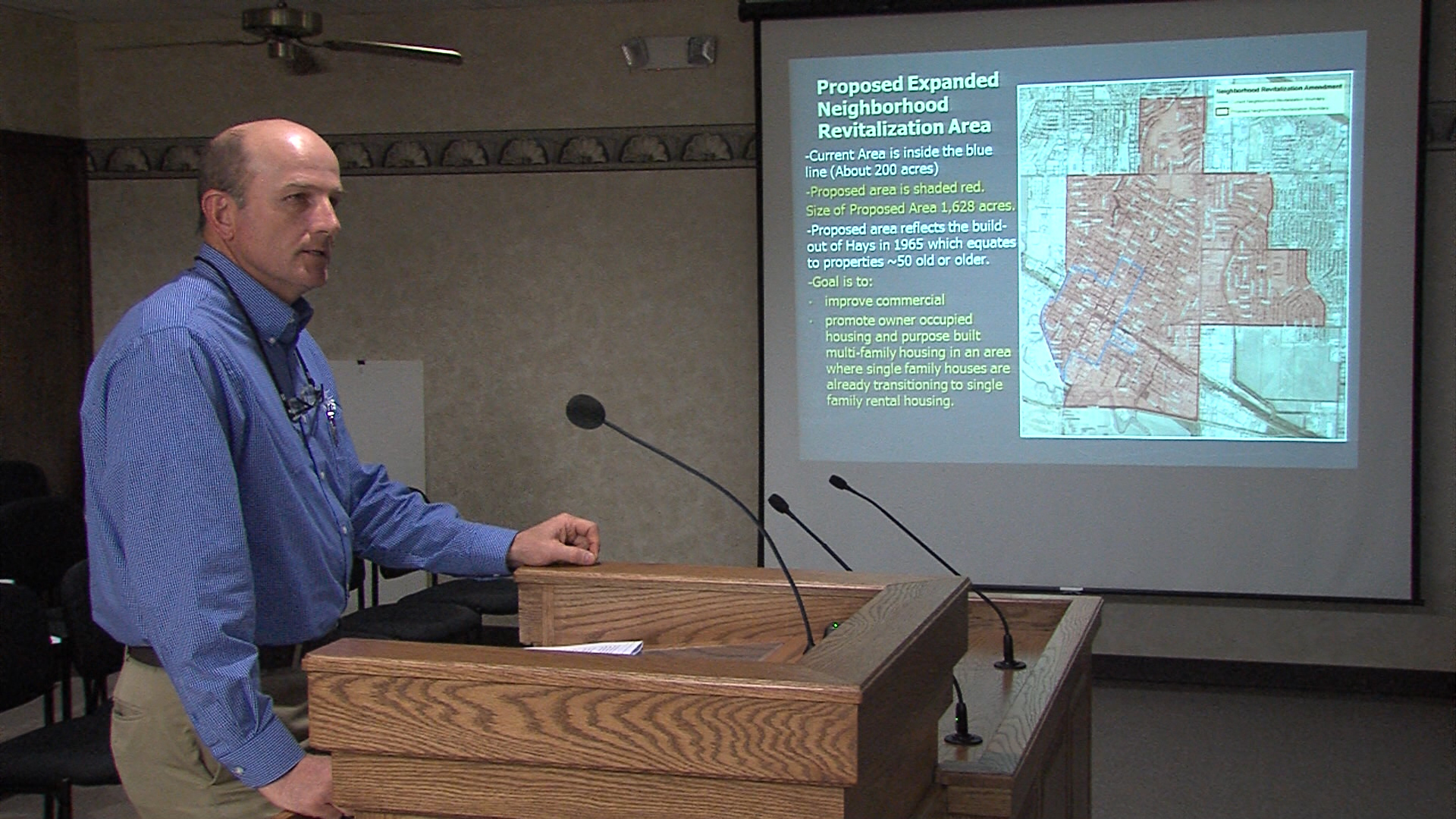
John Braun, Asst. Public Works Dir., shows rehabbed properties in the existing Neighborhood Revitalization District.
By BECKY KISER Hays Post
There was just one question asked during last Thursday’s public hearing regarding a proposed update of the Hays Neighborhood Revitalization District Program (NRP) which would considerably increase the area of the NRP.
“It’s very clear the benefits of this. What are the negatives?,” asked John Thissen, a Hays resident and USD 489 Superintendent. Not much, he discovered.
“The down side is if improvements take place without the program they are subject to increased property taxes because presumably the value of the property will go up,” explained longtime city commissioner Henry Schwaller.
The commission voted 4-1 to approve the change which features a 65 percent rebate of increased taxes (based on assessed value after improvements) paid in the first year after completion of construction paid each year for 10 years. Commissioner Lance Jones voted against the measure, preferring a larger rebate of 95 percent.
The current NRP, 209 acres in the downtown area, was created in 2002 and according to Schwaller, it actually spurred development in areas that probably would not have seen rehabilitation. More than 45 properties have benefited from the current NRP. The January 1, 2016 value of those properties was about $4 million.
“We were able to take buildings that were being used for storage and convert them to higher use, thus actually raising the value of them permanently and generating more (property tax) revenue,” Schwaller said.”
The new NRP would cover 1,628 acres, encompassing most of the commercial and residential buildings in Hays more than 50 years old.
“We hope to see that happen here as well,” Schwaller continued, “because it takes neighborhoods that might otherwise be likely not to grow and actually spurs development in them–infill.
(Click to enlarge)
“Our concern is that as neighborhoods age, we tend to see them convert to uses that we don’t find desirable. Single family homes become 5-plexes. And the problem is that the other people in the neighborhood decide they don’t want to live next to a duplex and then we have flight from that neighborhood.
“We really do want to keep single-family home neighborhoods intact,” Schwaller stressed, “because the cost of creating new housing developments north and west of town is so incredibly high. Rehabbing an infill is much more desirable.”
“While we lose that incremental gain in valuation, we still receive the original property tax amount and we capture taxes in other ways.”
Another key change to the NRP is to increase and standardize minimum investment from $5,000 for a residential project and $15,000 for a commercial project to $25,000 and $50,000 respectively.
Both the Ellis County Commission and the USD 489 school board must also support resolutions to amend the NRP before it would become effective.
Eagle Communications is teaming with six area golf courses to offer the inaugural I-70 Golf Card.
The card allows one free round at each of the six courses — Indian Hill Golf Course, Stagg Hill Golf Club, Rolling Meadows Golf Course, and GreatLife Golf/Fitness locations in Salina, Junction City and Abilene.
In addition, each of the courses will be featured on a new series on Eagle Cable Ch. 2 and also available at eaglecomtv.net.
Cards are just $50 for six rounds of golf. Call (785) 200-6030 or email [email protected] to place your order today. Quantities are LIMITED.

 TREGO COUNTY – Law enforcement authorities are investigating a fatal accident that occurred before 11p.m. on Saturday in Trego County and continue to look for a vehicle involved.