Gaylord resident Hazel B. Brown, age 97, passed away Sunday, July 9, 2017 in the Smith County Memorial Hospital Long Term Care, Smith Center.
She was born September 9, 1919 in Beaver County, OK the daughter of Charlie & Bertha (Purdy) Atherton.
Hazel was united in marriage to Clarence O. Brown on November 16, 1939 in Smith Center, KS. He preceded her in death on February 21, 1988.
Survivors include 2 daughters, Georgia Bottorf & husband, Ron of Springfield, MO and Lawana Shellito & husband, Paul of Gaylord, KS; 5 grandchildren; 8 great grandchildren; 3 step-great grandchildren; 2 great great grandchildren; and her sister, Frieda Fix of El Cajon, CA.
Cremation was planned. Memorial services will be held at 2:00 p.m. Saturday, July 15, 2017 in the Olliff-Boeve Memorial Chapel, Phillipsburg, with Pastor Randy Hill officiating. Private inurnment will be in the Fairview Cemetery, Phillipsburg.
Friends may sign the book from 9 a.m. to 9 p.m. Friday at the Olliff-Boeve Memorial Chapel, 1115 2nd Street, Phillipsburg, KS 67661. Memorial contributions may be made to the Smith County Memorial Hospital Long Term Care. Online condolences: www.ollliffboeve.com.
HARPER COUNTY – An earthquake shook portions of Kansas Tuesday afternoon. The quake at 12:22 p.m. measured a magnitude 3.3 and was centered approximately 6 miles southeast of Harper, according to the U.S. Geological Survey.
This is the second earthquake reported in Kansas this month A quake just after midnight Saturday measured a magnitude 2.4 and was centered approximately a mile northeast of the unincorporated Harper County community of Crystal Springs.
The USGS reported 18 Kansas earthquakes in June, 9 in May, a dozen in April, 7 in March and 6 in February.
There are no reports of damage or injury from Tuesday’s quake, according to the Harper County Sheriff’s Department.
What had been a $10 fine–among the lowest in the nation–will soon triple to $30, thanks to a new state law.
Effective July 1, the law established a new Seat Belt Safety Fund which will be funded by requiring cities to pay $20 into the newly created fund for each local seat belt fine.
City Attorney John Bird told city commissioners last week the city’s 2016 Standard Traffic Ordinance needs to be amended to provide for the change in fine.
The League of Municipalities will incorporate the change in the next version of the Standard Traffic Ordinance, which will be issued in late 2017. The ordinance to be presented this week to commissioners is considered a “stop-gap measure” until the Standard Ordinance is passed later this year.
The new Seat Belt Safety Fund is administered by the Kansas Secretary of Transportation and will fund an expansion of the student-driven Seatbelts Are For Everyone (SAFE) program, making it available to every high school in Kansas.
Hays High School has participated in SAFE for several years. It started in 2009 in Crawford County to address low occupant restraint use among young drivers.
In 2016 in Kansas, 435 people died in motor vehicle crashes according to the Kansas Highway Patrol, making it one of the top ten causes of unintentional death in Kansas and the number one killer of teens. According to the Kansas Department of Transportation (KDOT), 71 percent of all people killed or seriously injured in Kansas traffic crashes are unrestrained.
Commissioners will also be asked to consider a recommendation to increase court costs.
According to research by Police Chief Don Scheibler, the current court costs of $80 per case in Hays Municipal Court are significantly less than the costs in other comparable municipal courts, and in the Ellis County District Court. Ellis County District Court currently charges between $103 and $148 per case.
Scheibler and city staff are recommending an ordinance to increase costs per case in Hays Municipal Court from $80 to $100 to better reflect the actual costs of cases filed in Municipal Court and other administrative costs.
Other agenda items for the July 13 Hays city commission meeting include a recommended nuisance property abatement of the former Ambassador Hotel, 3603 Vine Street.
The complete agenda may be seen here. The meeting starts at 6:30 p.m. Thursday in Hays City Hall, 1507 Main.
Diana Elizabeth Sanders, 73, died unexpectedly July 8, 2017, at her rural Great Bend residence. She was born Aug. 29, 1943, at Great Bend, the daughter of George Joseph and Luella Pauline (Burhenn) Schwager. She married Robert LeRoy Sanders July 7, 1962, at Great Bend. A lifetime Great Bend resident, Mrs. Sanders was a homemaker, property manager and sales professional. She currently was employed by Great Bend Appliance and Furniture.
Mrs. Sanders was a member of Prince of Peace Parish at St. Patrick Catholic Church, Altar Society, and Social Circle Club. She was a former Cub Scout, Girl Scout, and Campfire Girls Troop leader. She was a PBB, who gathered monthly. Her proudest accomplishments were centered around her family, both immediate and extended, always being there to offer her support in whatever endeavor they would try. She also loved hosting family and friends at home and was an exceptional cook and an avid reader, always trying new recipes or making up her own.
Survivors include her husband, Robert LeRoy Sanders, of the home; three sons, Robert E. Sanders and his wife Cindy of Enid, Okla., Kenneth G. Sanders and his wife Misty of St. Petersburg, Fla., and Matthew J. Sanders and his wife Stacy of Great Bend; one daughter: Gwendolyn S. Maris and her husband Brett of Trenton, Neb.; four brothers, Raymond Schwager and his wife Donita of Hays, Roger Schwager of Great Bend, Ricky Schwager of Great Bend, and Ronald Schwager and his wife Michelle of Hoisington; two sisters, Jeanette Soper of Great Bend, and Shirley Headley of Albert; 12 grandchildren, Rebecca Smith, Christina Deason, Julian Shuey, Jordin Scott, Lexi Maris, Dalton Shuey, Christian Zamora, Sebastian Zamora, Ivan Zamora, Cole Sanders, Paige Sanders and Dayna Sanders; 10 great-grandchildren, Leslie Sanders, Jadyn Smith, Aidyn Sanders, Shelbie Deason, Aaron Deason, Breckyn Scott, Greyson Scott, Averi Robinson, Viktoria Shuey and Leviathan Shuey; and a host of nieces, nephews and cousins. She was preceded in death by one brother, Robert George Schwager; one great-grandson, Nicholas Smith; one nephew, Jerry Emerson; one niece, Lisa Woods, and one sister-in-law, Margaret Smith.
Altar Society Rosary will be at 4 p.m. and Vigil Service will be at 7 p.m., Wednesday, July 12, 2017, at Bryant Funeral Home. Mass of Christian Burial will be at 10:30 a.m., Thursday, July 13, 2017, at St. Patrick Catholic Church in Great Bend with Father Ted Stoecklein celebrating. Burial will be in Great Bend Cemetery. Friends may call from 9 a.m. to 9 p.m., Wednesday, July 12, 2017, at Bryant Funeral Home. Memorials have been established with Boy Scout Troop 184, in care of Bryant Funeral Home.
SIDNEY, Neb. (AP) — Cabela’s shareholders have approved selling the outdoor outfitter to rival Bass Pro Shops for roughly $4 billion.
The Nebraska-based chain said Tuesday that shareholders had voted for the deal that will pay them $61.50 per share.
Cabela’s CEO Tommy Millner says the shareholder vote is an encouraging milestone for the deal that was announced last October.
Company officials have said they expect the deal to close later this year, but banking regulators have yet to approve the sale of Cabela’s credit card unit that is part of the transaction.
After the merger, the company will be based in Bass Pro’s hometown of Springfield, Mo. It’s not yet clear how many of the roughly 2,000 jobs in Cabela’s headquarters of Sidney, Nebraska will remain after the deal.
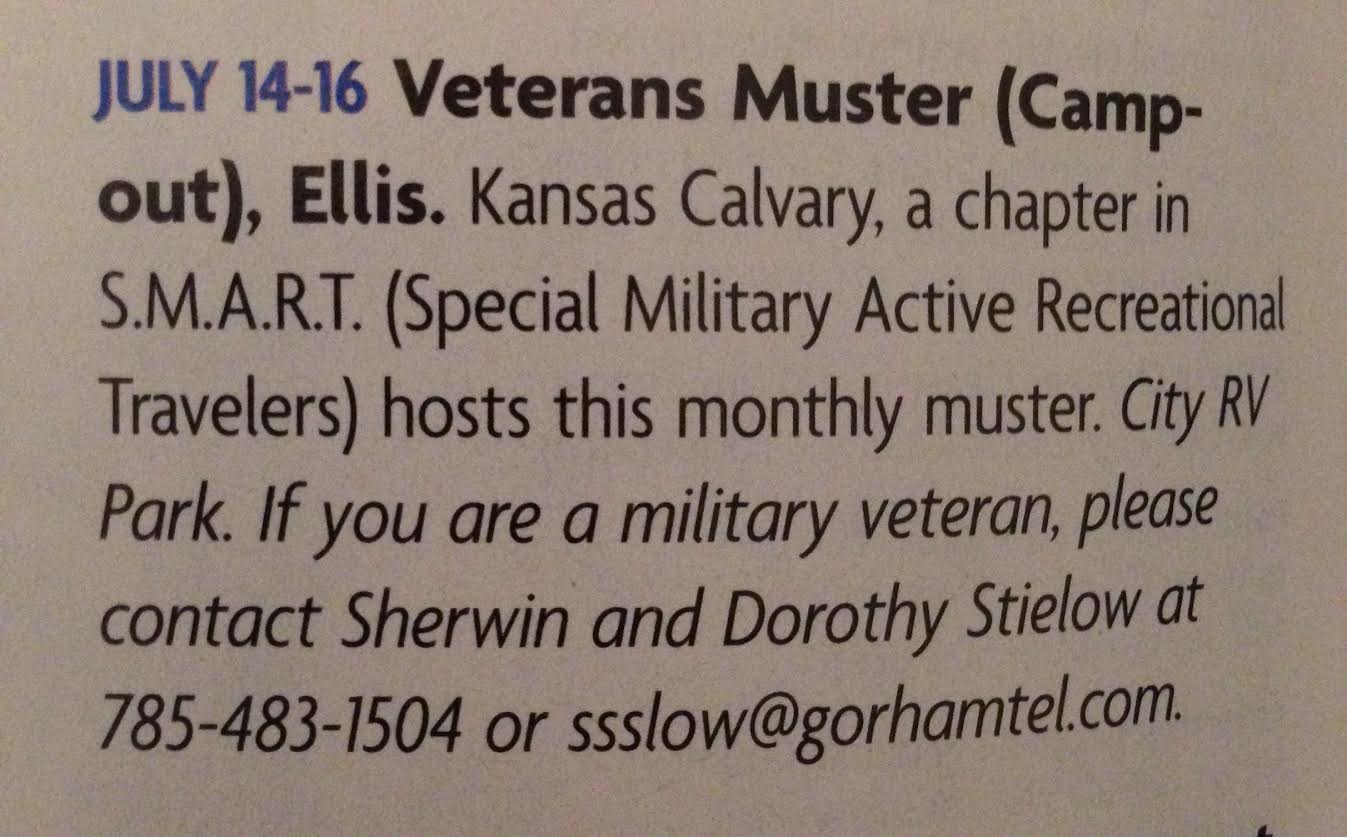
ELLIS–Ellis will be the host city for the Veterans Muster (camp-out) S.M.A.R.T.-Special Military Active Recreational Travelers will be staying in our campgrounds this weekend, July 14-16, and will use Ellis as their home away from home.
They have invited all first responders to a picnic on Friday, July 14, at 5:30 p.m. All that is asked is that you bring a side dish and the family and enjoy yourselves.
Ellis Lakeside Campground is nestled along the south bank of Big Creek just two blocks off Washington Street on East 8th.
TOPEKA – The Kansas attorney general’s office received more than 5,100 new applications for concealed carry licenses in the recently ended 2017 fiscal year, Kansas Attorney General Derek Schmidt said Tuesday in a media release.
Between July 1, 2016, and June 30, 2017, the Concealed Carry Licensing Unit received 5,119 new applications. This was the lowest number of applications received in a fiscal year since the licensing program began in 2006. A legislative change in 2015 allows eligible Kansans to carry concealed without a license.
While the number of new applications has waned, most Kansans who already have permits are choosing to keep their licenses active. The Concealed Carry Licensing Unit received more than 21,000 renewal applications during the 2017 fiscal year.
Licenses are still required in most states, and Kansas licenses are currently recognized in 38 states.
“Many Kansans continue to recognize the benefits of obtaining a license, including our reciprocity agreements with other states,” Schmidt said. “We continue to work with other states to ensure Kansas licenses are recognized.”
Schmidt also encouraged all Kansans who intend to carry firearms to pursue training opportunities. He reminded all Kansans who choose to carry firearms to comply with properly posted signage.
Currently, more than 83,000 Kansans have active concealed carry licenses. More information on the concealed carry licensing program is available on the attorney general’s website
Ellis County is set to move forward with a 2018 budget that does not raise the general fund mill levy.
Following more than four months of work, Ellis County Administrator Phillip Smith-Hanes presented the county commission with the 2018 budget at Monday’s commission meeting. The budget contains $23.6 million in general fund expenditures — about $100,000 more than 2017 — but the mill levy will remain at 36.7.
Smith-Hanes told the commission that revenues are “growing faster than expenditures.”
General fund revenues are expected to increase by about $668,000, while expenditures will increase by about $115,000, according to Smith-Hanes.
Commissioner Barb Wasinger said the increase in revenue offsets the increase in county employee health insurance costs.
“We were able to keep the mill levy down despite the huge increase in health insurance,” Wasinger said.
Previously, Smith-Hanes said the increase in insurance is expected to be between 9.5 percent and 10.5 percent next year.
The only area that will see an increase in the levy is Fire District No. 1, which will see an increase of less than one-half of one mill. Rural Fire is its own taxing entity for the unincorporated areas of the county. For 2017, the Fire District mill levy was 3.314.
Smith-Hanes described Fire District No. 1 as everything west of Walker outside of the three largest cities in the county — Hays, Ellis and Victoria.
During his budget presentation, Director of Fire and Emergency Management Darin Myers told the commission last year was the busiest year the department have ever had and this year is already on pace to surpass that.
Myers said an increase in the fire district mill levy will help to offset the increase in services.
The commissioners commended Smith-Hanes and the department heads for the work they have done on the budget.
“They did a wonderful job as always,” said Commissioner Dean Haselhorst. “Being able to keep our budget where it is and no increase in the mill levy, that was just pretty nice to see.”
The commission will hold a public hearing on the budget Aug. 7.
In other business, the commission agreed to halve fees for constriction/demolition solid waste at the landfill for crews cleaning up the Ellis House Inn on behalf of the Ellis Industrial Development Corporation.
EIDC President Travis Kohlrus told the commission the nonprofit acquired the property and will have M&D Excavating demolish the building in an effort to sell the property.
Kohlrus said the group estimates there will be between 200 and 400 tons of construction waste that will need to be taken to the landfill. They are working to recycle the concrete and asphalt.
Public Works Director Bill Ring said the landfill charges $32 per ton for construction/demolition waste.
The commission agreed, as a way to help the nonprofit group, to charge $16 per ton to dispose of the waste at the landfill.
The commission also approved a funding request by the Ellis County Historical Society to spend a portion of the $5,000 set aside for sesquicentennial promotion. The Historical Society plans to use the money to purchase three portable systems that will allow them to set up photo and text exhibits.
The Management Development Center at Fort Hays State University will offer the final two workshops in its summer series this July.
“Intro and Intermediate Microsoft Excel” will be Wednesday, July 19, at FHSU in McCartney Hall, room 116. The introductory session will be from 8:30 a.m. to noon, while the intermediate training will be from 1 to 4:30 p.m.
“Time Management” will be from 8:30 a.m. to noon on Tuesday, July 25, in the Memorial Union Stouffer Lounge.
Dr. Cole Engel, assistant professor of economics, finance and accounting, will facilitate “Intro and Intermediate Microsoft Excel.” The introductory course will teach participants to navigate basic Excel spreadsheets, build basic formulas, utilize basic functions, and build a table and simple charts and graphs.
The intermediate course will instruct attendees to create what-if analyses, use logical statements, sort and filter data, create PivotTables and PivotCharts, and utilize descriptive statistics.
Dr. Justin Greenleaf, assistant professor of leadership studies, will facilitate “Time Management.” The training will assist participants in using time effectively and productively.
It will teach planning and control for how to spend the hours in the day to accomplish goals and tasks.
The facilitator will review several components including dealing with work interruptions, how to create and maintain strong scheduling abilities, the seven keys for time management, and creating organizational and personal goals.
Each person who completes a workshop will receive a completion certificate.
The cost for the Excel workshop is $119 per session or $200 to attend both the introductory and intermediate sessions. The cost for “Time Management” is $119.
The Management Development Center at Fort Hays State University is recognized by the Society for Human Resource Management (SHRM) to offer professional development credits for SHRM Certified Professionals or SHRM Senior Certified Professionals.
These programs are valid for PDCs for the CP or SCP credentials. For more information about certification or recertification, visit shrmcertification.org.
Registration is available online at www.fhsu.edu/mdc. To learn more about the workshop or upcoming training, contact Sabrina William, Management Development Center director, at 785-628-4124 or at [email protected].
The Gannon v. Kansas lawsuit is in its seventh year. In that time, the case has led to repeated rulings against the state for underfunding schools and responses by lawmakers in the form of appropriations bills.
What’s it all about? Here are five issues central to the battle.
Significant numbers of Kansas children lack basic math and reading skills.
Oral arguments are scheduled for July 18 at the Kansas Supreme Court in the Gannon v. Kansas school funding lawsuit, which is now in its seventh year. FILE PHOTO / KPR
This is particularly true for students from socioeconomic groups that are historically disadvantaged, including children from low-income families and children from racial and ethnic minorities.When the Kansas Supreme Court struck down existing funding levels as unconstitutional in March, the justices emphasized the state’s responsibility to help fix student achievement. Standardized test results show that about one-quarter of Kansas students are struggling with math and reading, the justices noted. That includes half of the state’s African-American students, one-third of Hispanic students and one-third of students from low-income families.
The concern that the state needs to provide more resources to support achievement for specific student groups isn’t new. It played a key role in another school finance lawsuit in the early to mid-2000s, Montoy v. Kansas. That case led in part to funding increases that target students with disabilities, from low-income families or learning English as a second language.
School resources available to children vary based on where they live.
That’s because local tax wealth varies. In the context of the state’s school finance formula, there are wealthier districts and poorer districts, meaning districts with more taxable property and those with less.
An example: Kaw Valley and Royal Valley, neighboring rural school districts north of Topeka that serve about 1,200 and 800 students respectively. Kaw Valley has one of the strongest tax bases in the state relative to the number of students it serves — a coal power plant falls within its boundaries. Royal Valley, which covers a few small towns, farmland and the Potawatomi Nation Reservation, has one of the weakest. A single mill of property tax generates more than $300,000 in Royal Valley but only a tenth as much in Royal Valley.
The state tries to even the playing field through extra state aid to districts with weaker local tax bases. The Gannon lawsuit partly revolves around the extent to which the state needs to do that.
Things were OK — as far as the courts were concerned — then the recession hit.
Montoy v. Kansas pushed the state to ratchet up school funding by more than $750 million through a three-year plan that won court approval and finally put an end to that case, which, much like Gannon, had lasted several years.
Then the recession hit. Gov. Kathleen Sebelius and her successor Mark Parkinson cut hundreds of millions of dollars from K-12 schools in 2009 and 2010. That made the state vulnerable to a fresh legal challenge from school districts whose concerns had been resolved by Montoy. In 2010 the Gannon lawsuit began.
Many educators became more frustrated after Gov. Sam Brownback took office in 2011 and pursued, together with the Legislature, deep cuts to income taxes instead of restoring the school finance plan that had been approved in the Montoy case.
With each passing year, operating schools costs more money.
School expenses and student enrollment continued to grow in Kansas, even though the Montoy plan fell by the wayside in 2009 and the state cut school funding.
Lawyers for the Gannon plaintiffs argue Kansas’ school funding has fallen hundreds of millions of dollars behind inflation. That’s a key sticking point between the state and school districts.
In June the Legislature voted to increase annual funding by nearly $300 million within two years. The state’s lawyers argue that’s enough to end the lawsuit, but the plaintiffs’ lawyers say it’s at the most just one-third of what is needed.
Inflation within those two years will eat up more than half of the nearly $300 million, they say, and another chunk will likely go toward raising stagnant teacher salaries, leaving little to bolster academic programs for struggling students.
The state’s lawyers reject those arguments. They point to a statistical analysis conducted for the Legislature this year that aimed to identify successful school districts based on academic measures, and then to check the districts’ spending levels. The state argues the $300 million plan is in line with spending practices at the 41 districts.
The state has constitutional obligations to the children of Kansas.
The provision of the state constitution that frequently pops up in the school finance argument reads: “The legislature shall make suitable provision for finance of the educational interests of the state.”
The state has argued in the past that the Legislature nevertheless has the power to decide how much to spend on schools — without judicial interference.
The courts disagree and have issued repeated rulings on school finance stretching as far back as the 1970s. Those rulings tend to home in on themes mentioned above: that educational opportunities should be adequate, that a child’s ZIP code shouldn’t determine access to quality schools and that local taxpayers in less wealthy districts shouldn’t face unreasonable tax burdens to try to offer adequate resources.
Celia Llopis-Jepsen is a reporter for the Kansas News Service, a collaboration of kcur.org, Kansas Public Radio and KMUW covering health, education and politics. You can reach her on Twitter @Celia_LJ.
By RANDY GONZALES FHSU University Relations and Marketing
The students for the High Plains Music Camp checked in Sunday morning and were rehearsing by Sunday evening. It’s a busy schedule at the camp, in its 70th year on the campus of Fort Hays State University.
FHSU provides the only camp in the state for vocal, strings and band, said Dr. Ivalah Allen, associate professor of music at FHSU who is in her sixth year as camp director.
There are about 230 students at this summer’s camp, ranging in age from those entering sixth grade in the fall to others who have just graduated from high school. They will be instructed by faculty from Fort Hays State as well as instructors from other points on the compass, everywhere from Lakin, Pratt and Kansas City to as far away as Tennessee, Ohio and California.
“We’ve got a great group,” Allen said of the faculty. “Our primary goal is musical training and experiences. But there’s so much more that goes beyond that.”
Campers form lasting friendships, Allen said. There are teary goodbyes at the end of the week and happy reunions the next summer. Students can request roommates and they will often contact friends made at previous camps so they can be roomies.
Allen enjoys watching the students improve in their craft from the beginning of the week to the end.
“For me, it really is the students,” Allen said. “It is 100 percent the students, and watching them grow. It’s just great to see them blooming in front of your eyes.”
Many of those students, after a positive experience at the camp, end up enrolling at FHSU. They are not just music majors coming to enjoy all Fort Hays State has to offer.
“We have a large number of our campers who do come to Fort Hays State,” Allen said. “Some major in music, but many will not. It’s because they become acquainted with the campus and they like the campus. They will major in nursing, in agriculture, leadership studies — any number of majors.”
Just because a Fort Hays State student is not a music major does not mean he or she can’t still be involved.
“They might still be performing in the band and the choir and the orchestra,” Allen said. “You don’t have to be a music major to perform in these ensembles on campus.”
There are free concerts on campus each night of the camp. Faculty and staff recitals are scheduled for 7 p.m. Monday and Tuesday at Beach/Schmidt Performing Arts Center. A student honor recital is scheduled for 7 p.m. Wednesday at Beach/Schmidt, which will also host a 7 p.m. faculty/band concert on Thursday.
Concerts are scheduled for both Beach/Schmidt and Felten-Start Theatre in Malloy Hall on Friday, starting at 6 p.m. At Felten-Start it starts with scenes from the musical “South Pacific” followed by a faculty chamber strings concert at 7 p.m. and a student celtic strings concert at 8 p.m.
At Beach/Schmidt, it starts with a middle school jazz band concert at 6 p.m. A high school jazz band will perform at 6:20 p.m., followed by the high school honor jazz band at 6:50 p.m. The faculty jazz band will perform at 7:30 p.m. Guest clinician Wycliffe Gordon will solo with the faculty concert. Gordon, an internationally renowned musician, has received many awards for playing the trombone.
On Saturday, campers will perform in concert at both Felten-Start and Beach/Schmidt starting at 9 a.m., with the last performance at 3 p.m.
The concert schedule and biographies on Gordon and other guest faculty can be found online at www.fhsu.edu/musiccamp.
“We really encourage the public to come to these concerts,” Allen said.
Hays city commissioners look at the first draft of the 2018 city budget.
By BECKY KISER Hays Post
A proposed 10 percent cut in the city of Hays 2018 draft budget for funding to the Ellis County Coalition for Economic Development (ECCED) and Fort Hays State University scholarships, may go a little deeper and even wider.
Also proposed is moving the remaining half of city funding for the Downtown Hays Development Corporation (DHDC) to the Convention and Visitors Bureau (CVB) budget which is funded by the Transient Guest tax.
City commissioners heard their first overview of the budget by City Manager Toby Dougherty during their work session last week.
The 25.000 mill levy would be maintained for 2018 even as sales tax revenues for the General Fund are projected to be flat.
“Knowing that we’re projecting $78,000 less in sales tax revenues for 2018 than we budgeted for 2017, I challenged city staff to find money for raises. So that means we had to get our operating expenditures down as much as possible,” explained Dougherty.
And they did.
City Manager Toby Dougherty says the draft 2018 budget includes a pay increase for all city employees.
Total operating expenditures for 2018 will be $11,719,457, which includes a four percent raise for all current employees. It’s also $155,000 lower than the 2017 operating expenditures of $11,874,395.
“A concerted effort was made to reduce expenditures without impacting operations or capital maintenance, and yet find money for a raise for all employees,” said Dougherty. “Everybody did a good job. In some places it was cuts, in some places we tightened the tolerances, in some places we made adjustments as we needed to.”
The commission then discussed the proposed funding levels for outside agencies.
Commissioner Lance Jones doesn’t like CVB funds supporting the DHDC. “I don’t think the CVB fund needs to be looked at as an endless resource–forever. If we cut the DHDC money by 10 percent, there’s $5,000 we can put towards an app for self-guided tours of downtown Hays,” he said.
“The same cut we made to economic development and FHSU, we should make to DHDC–10 percent,” Jones said, noting he has made his decision known to the DHDC board and employees. Mayor Shaun Musil was not in favor of any cuts to their funding, saying “DHDC is one area of our community that’s seems to be continually growing the sales tax base.”
The $10,000 cut in the FHSU city scholarships program was not favored by Commissioner Sandy Jacob.
“I think we’re trying to build a partnership with the university and the community, particularly from the downtown standpoint the past few years,” she said. “If we need it to take care of our employee raises then I absolutely am in favor of it. If we don’t need it for the raises, then I would not vote for cutting FHSU. I think it’s just a bad message.” Mayor Musil agreed.
Vice-Mayor James Meier was concerned about a different message to city employees and said he was “fine with the cuts.”
“We’ve asked staff members to look at their budgets and what they’re spending money on, and then to push things back and rearrange things, all so they can get a raise. There’s certainly nothing wrong with asking them to do that, but I think it sends the wrong message to our employees to ask them to do that and not also ask outside agencies to take a cut.”
Musil then brought up the Coalition. “I’m extremely confused on how we handle that because every year it’s a different way.” He continued as Commissioner Henry Schwaller nodded his head in agreement.
“I firmly think we should cut them,” declared Musil. “We’ve kind of talked about if we like their outcomes, then we fund them. I don’t agree that we haven’t given them a clear direction. There are a lot of people on the board who care about our community but it really hasn’t changed since I’ve been on the city commission, since 2013. Either we do fund them or we don’t, and move on,” Musil advocated.
“I don’t think we should fund them this year,” Meier said, “and just be done with it.” Meier is the city’s representative on the ECCED board. “I’ve come to the conclusion I’m not pleased with the outcomes and I agree with Mayor Musil there’s no point in funding half now and maybe half later.”
Musil was quick to point out he’s always said “we have to have economic development, but it’s just not working, what we’re doing.”
“Regarding outcomes, when’s the last time the Coalition recruited a new business? How many jobs did they add?” Commissioner Schwaller asked. “When’s the last time they helped a startup or two actually launch? When was the last time they actually did something for housing other than help someone flip a home? It just keeps staying right where it is,” he said.
Schwaller said he was not speaking about the Coalition board, although the city and county commissions during a joint meeting in April agreed the board membership is too big to be effective and should be reduced. The Ellis County draft 2018 budget includes a recommended 50 percent cut in funding to the ECCED. The city of Hays and Ellis County are the biggest revenue contributors to the Coalition budget.
“The Coalition is able to fund its operations, not its programs, with our money. As long as that salary is guaranteed, that’s what you’re gonna get,” Schwaller said. “I support any cut in the city’s funding from 10 percent to 100 percent.
“Unfortunately though, the same is true for DHDC. They were told in the very beginning they’d have to sustain cuts in the future. Our money doesn’t really go to projects because the criteria for the DHDC events is that they must pay for themselves or make money. Otherwise, they don’t do them. So that means we’re paying the salary of the DHDC director, which is fine, but that’s not what we do, other than for the Coalition. We don’t pay the FHSU president’s salary. I agree with Commissioner Jones–we’re subsidizing something,” Schwaller said.
“I don’t mind giving money to the DHDC, but I’d rather have the city sponsor individual events,” Schwaller suggested, “sponsoring the things that actually bring tourists in. All the non-alcoholic things that bring in people, we should be the sponsors of that.
“DHDC and the Coalition are the only two agencies that we just write a check to, and basically pay for their operations. Everything else has been programmatic.”
The budget proposal, along with more about city funding to outside agencies, will be discussed again at the next commission work session, July 20 and then reviewed during the regular July 27 commission meeting.
No cuts were recommended for the CARE Council funding, which is again asking for $164,000 for the following social services agencies:
American Red Cross-Ellis Co. Chapter
Big Brothers Big Sisters
Cancer Council
CASA of the High Plains
First Call For Help
Options
Hays Senior Center
DSNWK Access Transportation
“You have to come to a consensus,” advised Dougherty the city commissioners, “but you have plenty of time.” Staff is recommending the budget public hearing be conducted Aug. 10.