A suspect wanted for several robberies died following a Nov. 2016 officer-involved shooting in Kansas City -photo courtesy KCTV5
KANSAS CITY, Mo. (AP) — The U.S. Attorney based in Kansas City says he will hire a new assistant U.S. attorney to help combat violent crime in the Kansas City area.
The office announced Friday that the new position is part of a federal program to hire 40 assistant U.S. attorneys in 27 districts to reduce violent crime.
The Western District of Missouri has been designated as a Public Safety Partnership Diagnostic Site to work with local law enforcement on public safety and violence reduction. Eight districts nationwide received the designation.
The partnership allows cities to consult with and receive training, technical assistance and resources from the Justice Department to improve local violence reduction efforts.
Two Fort Hays State University Kansas Academy of Mathematics and Science students recently received a Level 1 national rocketry certification. The certificate was awarded in Argonia at a KLOUDBusters event.
KLOUDBusters is a Kansas rocketry club founded in the early 1990s by two rocket enthusiasts from Goessel. The organization became a prefecture of the Tripoli Rocketry Association in 1991 and shortly thereafter found a home in Argonia.
“According to the Tripoli Rocketry Association, Level 1 certification allows flyers to fly high-power rockets,” said Abby Anderson, KAMS coordinator for marketing and recruitment.
The students who have been working over the fall 2017 semester to build their rockets are listed in alphabetical order by last name.
Seth Colson, Hoisington, is a KAMS senior from Hoisington High School.
Christian Ermann, Liberal, is a KAMS senior from Liberal High School.
Katie Weisenborn, Hays, is a KAMS senior from Hays High School.
Jed Werner, Codell, is a KAMS senior from Plainville High School.
Ermann and Werner successfully achieved level one certification, and the others will travel back to Argonia in January to test again.
“Several test flights were conducted in Hays to perfect each rocket’s functions before testing them with KLOUDBusters,” said Anderson.
“The students were tested on their ability to examine, load, create a sustainable motor and properly launch their own rocket,” she said. “They were also responsible for the recovery and repair of the rocket after launch.”
Dr. Paul Adams, dean of the College of Education, advised and sponsored the students throughout the process.
Due to the observance of the Christmas holiday, Monday, December 25th, and Tuesday, December 26th, refuse/recycling route collection schedules will be altered as follows:
Although collections may not occur on your normal day, collections will be completed by the end of the week. Crews anticipate that the collection routes will be as followed:
o Monday, December 25th, and Tuesday, December 26th, refuse and recycling collections will be on Wednesday, December 27th.
o Wednesday, December 27th, and Thursday, December 28th, refuse and recycling collections will be on Thursday, December 28th.
o There are no anticipated changes to Friday, December 29th, collection schedule.
It is anticipated that heavy volumes of refuse/recyclables will be encountered around the holidays. Please be sure to have your refuse/recycling out by 7:00 AM on the specified collection day, and keep in mind the trucks have no set time schedule.
City of Hays customers who may have any questions regarding this notice should contact the Solid Waste Division of the Public Works Department at 785-628-7357.
You sometimes suspect that you’re not as well-informed as you should be. When you read about that study that found that middle school kids were unable to distinguish paid advertisements from news stories, you shook your head sadly — then secretly wondered if you would do much better. You’ve heard that most people are so entrenched in their own beliefs that even indisputable facts can’t change their minds, and would really like to believe you’re different from most people. (But doesn’t everyone think that?) You have, on at least a couple of occasions, pretended that you were familiar with a subject you actually barely understood.
You are, in other words, a person living in the world. According to the Pew Research Center, 64 percent of Americans say that fabricated news stories have caused them a great deal of confusion about the basic facts of current issues and events. A survey conducted by the Annenberg Public Policy Center found that the majority of Americans are poorly informed about the basic structures of their own government. And this year’s “State of the First Amendment” survey revealed that the majority of Americans prefer news that aligns with their own point of view, demonstrating their firm commitment to their own filter bubbles. Unsurprisingly, none of this is good for democracy. As Thomas Jefferson said, “An educated citizenry is a vital requisite for our survival as a free people.”
But enough hand wringing! You don’t want to let the ghost of Thomas Jefferson down. You want to be media literate and fair-minded and well-informed. You want to be the kind of person who knows how many congressmen there are and can explain what the electoral college is. You want to be a good citizen. It’s on your list of New Year’s resolutions, somewhere between “exercise get more” and “floss regularly.”
It’s not that you’re lazy. It’s just that you have a job, and loved ones, and a very limited amount of free time.
Or maybe you are just lazy. That’s okay too.
Regardless — what are you to do? Let’s be realistic: You don’t need a list of best practices for media literacy and civic engagement. You need a list of good-enough practices. You need the equivalent of those individual floss picks. (To any dentists reading this: I am aware that floss picks are not a perfect substitute for regular dental flossing. But they are a vast improvement over the nothing I was doing before I started using them.)
Get (re)acquainted with civics.
Most of us either took civics a long time ago, or didn’t take it at all. If you no longer remember what the branches of the government are, know that you’re not alone and that you need not waste time wallowing in shame. There are resources out there for fully-fledged adults! “Civics 101” is a great podcast if you like listening to things. Khan Academy has an “American Civics” YouTube series if you’d rather watch something. But if you want a crash course in the least amount of time possible, I’d recommend spending a little time skimming the review sheets intended for immigrants studying for their American citizenship exams.
Think about where your news comes from.
You probably have your own way of staying up to date with current events, whether it’s a newspaper, a TV show, a favorite podcast, or your Twitter feed. There’s no shortage of information in today’s world. The challenge is being able to separate the real from the fake, the facts from the opinions, and the Facebook posts from your crazy uncle from the Facebook posts paid for by the Russian government. As a lazy person, you may balk at the idea of analyzing and fact-checking every story that comes up in your Facebook feed. But becoming a better news consumer can be as simple as asking yourself two questions: Who wrote the thing you just read, and why did they write it? If you read a story about the amazing anti-aging properties of grapefruit, and then you learn it was written by a spokesman for the National Council on Grapefruits and sponsored by the Grapefruit Farmers of America…well, that should give you pause. It doesn’t necessarily mean the story is false, but it does mean you should probably look for a second opinion before buying stock in grapefruits.
Form your own opinions.
You don’t have to have an opinion on everything, but you will probably want to have an opinion on issues that directly impact you or your loved ones, or on matters that you find interesting. The path of least resistance is to adopt someone else’s opinion — to echo what your political party endorses, what your friends think, or what your favorite writers and TV pundits put forth.
We all do this, often without even being aware that we’re doing it. But if it’s an issue you really care about, you owe it to yourself to delve a little deeper and come to your own conclusions.
Here’s a good “recipe” for forming opinions from writer Kinsey Bluestein:
At least one “liberal” news source
At least one “conservative” news source
At least one international news source (because these tend to write about news from a nonpartisan viewpoint)
Combine and let rest until you have a viewpoint you can defend objectively.
You don’t have to have an opinion about everything.
Forming your own opinions takes a good amount of your time and mental energy. The only way a lazy person can manage it is by being generally informed about current events, but selective about the things they really stand for.
Otherwise, you’ll have no choice but to adopt other peoples’ opinions, which is the kind of thing that eventually leads us to take hard, intractable stances on issues we never gave much thought to in the first place.
It’s alright to say you don’t know enough about a subject to weigh in on it. It’s better than alright — in a world where people are constantly pretending to be more knowledgeable than they actually are, it’s downright heroic.
If you reach a point where you must form an opinion on something — there’s an election coming up, or your friends are asking you to join a movement or protest — see my previous point.
Stop sharing links to news stories you haven’t read.
According to a 2016 study by computer scientists at Columbia University and the French National Institute, 59 percent of links shared on social media are never actually clicked.
Resist the urge.
If you’re too lazy to read it, then please be too lazy to share it.
Lata Nott is executive director of the First Amendment Center of the Newseum Institute. Contact her via email at [email protected], or follow her on Twitter at @LataNott.
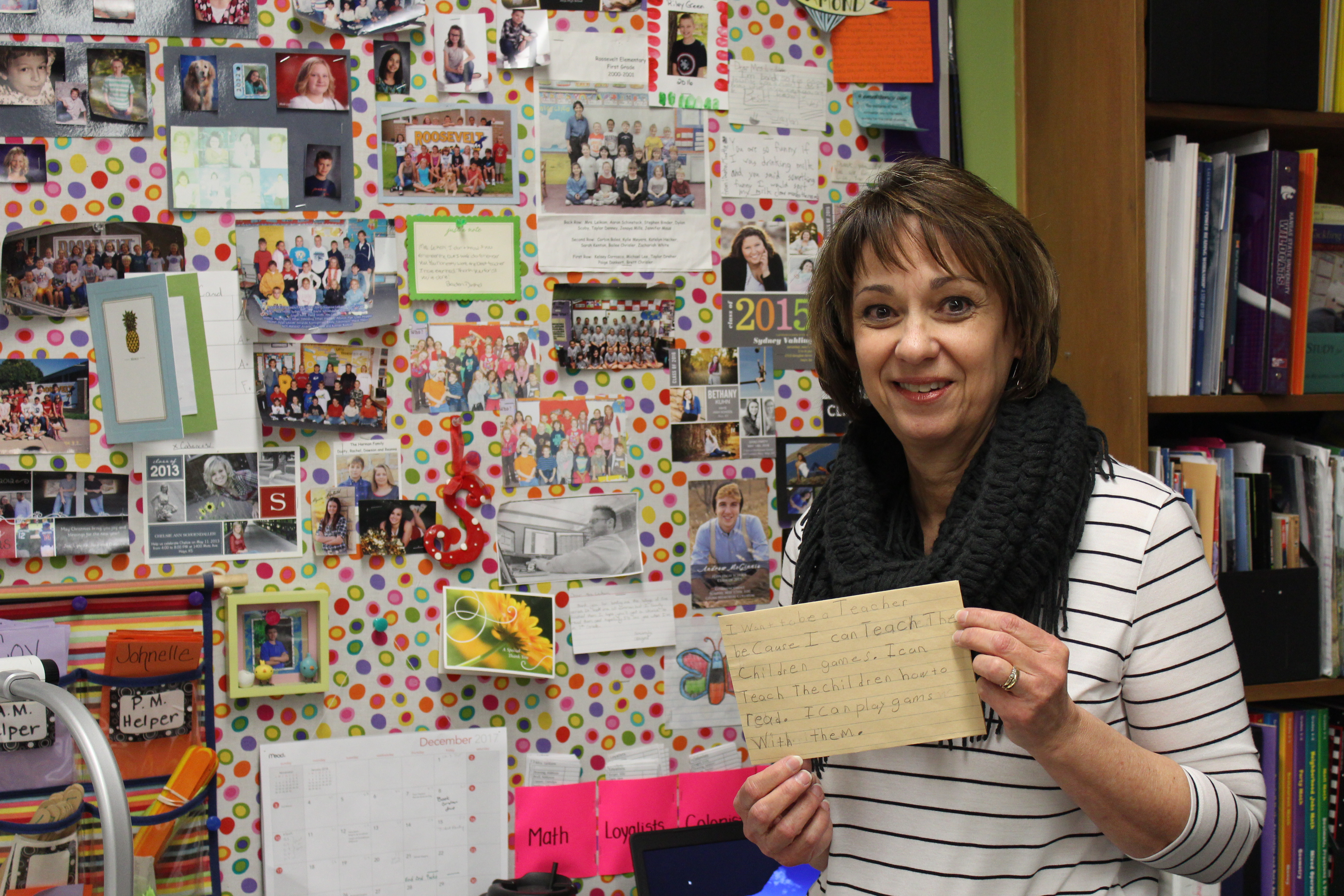
Suzanne Leikam, fifth-grade teacher at Roosevelt Elementary School, holds up a note she wrote in the second grade about wanting to be a teacher. She stands in front of a billboard featuring pictures of her former students.
By CRISTINA JANNEY Hays Post
Suzanne Leikam is always looking for that spark in her students’ eyes — that moment when she knows they finally grasp a concept.
It is her mission and what has driven her for the last 23 years as a teacher, 20 of which have been at Roosevelt Elementary School.
Leikam was selected as the December Hays Post Teacher of the Month.
“There are many wonderful aspects of teaching,” she said, “But one of my favorite is what I call the ‘ah-ha’ moment. It’s the time when a student has worked really hard to understand a concept, and they finally get it. There is a great satisfaction seeing the confidence they gain at that moment when their hard work has paid off and they feel that sense of accomplishment.”
She explained that moment.
“It is like a light bulb going off, and you know it. Their eyes light up, and sometimes they go, ‘Ah-ha, I got it!’ You can see they brighten up. I feel great for them because they have worked so hard to figure it out. They went through each strategy and tried to work it out. Then when they finally find something that works for them, they say, ‘Ah-ha!’ and it makes you feel great. Look, see what happened. You worked hard, you were persistent and you figured it out, and you did that on your own.”
Leikam’s path to becoming a teacher was similar to her students’ struggles with math problems and history. Leikam, 57, knew she wanted to be a teacher from an early age. She has a piece of yellowed Big Chief paper stuck to one of her file cabinets that she wrote when she was in second grade.
In large printed letters it says, “I want to be a Teacher beCause I can Teach The Children games. I can Teach The children how to read. I can play gams With them.”
She said she had mentors along the way who helped her realize she was a good student.
Suzanne Leikam, fifth-grade teacher at Roosevelt Elementary School, wrote a note in the second grade about wanting to be a teacher.
“Because there were times that I felt that I wasn’t the smartest one in the class,” she said, “and then you have those teachers who nurture you and build up your confidence and they make you realize, ‘Oh, yeah, I can do this.’ That’s the kind of teacher I want to be as well.”
Mr. Zwink in seventh and eighth grade showed her she was capable as a student, and Roger Ruder, her high school history teacher at Marian High School, sparked her interest in history.
“(Mr. Ruder) was the one who lit the spark for me,” she said. “It was the way he taught. He would attach little stories to information we needed to know. That helped me remember the information.”
However, life intervened. Leikam got married and had a family. She went to work for Roosevelt, but as a secretary. Finally, the “ah-ha” moment struck her. She was in her 30s, and she was teaching second-grade religion courses for St. Mary’s Immaculate Heart of Mary. She enjoyed the experience so much she enrolled in the education program at Fort Hays State University.
Going back to school was difficult, but Leikam said she appreciated school more as an older student.
“It was bittersweet,” she said of going back to school,” she said. “When I went back to school in my 30s and saw these 18-year-olds and they were in a place where I was just getting to in my 30s, I said, ‘Wow, I have wasted so much of my time, but it took me a while to figure out what I wanted to do. … Once I got my mind set on something, I got really focused on what I wanted to do.”
Leikam has worked with every level of elementary student and said she each grade has its pros and cons.
She loves kindergarteners’ innocence and honesty.
“If I wore something that didn’t look good on me, I had a little girl who would say that didn’t look very good on you,” she said. “They would work very hard for me.”
Fifth-graders, which she teaches now, are more independent.
“The reason I chose to work with elementary students is their infectious love of learning,” she said. “At this age, students are still idealistic and every day is a new day of wonder and excitement about something they have learned.”
Leikam seeks to prepare her students for what they will learn later in school.
“I make the comparison between elementary school and the foundation of a house,” she said. “You need a solid foundation to support the rest of the house and that is how I view teaching elementary students. What we teach the students at this age is the foundation of their education to be built upon each year. As elementary teachers, we are also very aware that we set the tone for how our students view school and their attitude toward learning.”
Leikam not only tries to help prepare her students academically, but socially and emotionally as well. She said it is the most challenging aspect of being a teacher.
At one time, only a few of her students came from homes with divorced parents, and now it’s at least half. During her years of teaching, she has had to deal with children in poverty and who have been homeless and many other situations Leikam said children should not have to deal with.
“We have to be good listeners,” she said. “When they come in and they just need someone to talk to and it is a release for them, I am here to listen and they know that is as far as it goes — that they don’t have to worry about me going here or there and talking about it with anyone else. Sometimes they just need to express what is going on, and if there is something that I can’t help them with, I refer them to the counselor. …
“That is probably the hardest part is when you see them at such a young age dealing with stressful situations that I myself personally have never had to deal with and yet here they are 10-years-old and they are pushing through it.”
Teachers routinely help students with basic needs, such as coats or a pair of shoes to replace one with holes in the them.
“You just try to be there to be a good listener for them and to reassure them that, yes, it is a rough path now, but things do get better,” she said.
Leikam said she hopes to leave her students with a sense that she cares for them as individuals.
“I hope to instill in them some values,” she said. “We talk a lot about respect. Being respectful to each other and yourself and especially to the staff. I try to build on that respect, and I hope that has an effect on how they treat others.”
At the beginning of each school year, she does a study of the same book, “A Hundred Dresses,” which is about bullying.
“I tell them every year that you come to school here to learn, and I want you to be safe here,” she said. “I don’t want you to worry as soon as mom or dad drops you off here someone is going to be saying mean things to you or pinching you where a teacher doesn’t see it.”
She has the children raise their hands if they have been bullied, and Leikam raises her hand. She went to a small school and played football with the boys. One of the boys pushed her down regularly. She remembers vividly one day he hit her in the chest with his knee and she lay gasping on the ground for breath.
The act of raising her own hand helps open up the discussion and allows her to talk to the children about helping others during bullying situations.
“When they ask me about me bullying, I say I am too ashamed to talk about that,” she said. “That is something I don’t even want to talk about. That was a time in my life that wasn’t very good, but I want them to understand. I ask them, ‘Why?’ and a lot of it is that they were bullied.”
Katelyn Hecker, teacher at Lincoln Elementary School, nominated Leikam for Teacher of the Month. Leikam was Hecker’s teacher when she was in elementary school and was her mentor when Hecker was a student teacher. She said Leikam is the reason she became a teacher.
“She is supportive, always welcoming, and extremely compassionate,” Hecker said. “I am so fortunate to be able to say that I started my primary education with her and completed my college education with her!”
Hecker remembered dictating a parent newsletter to Leikam for her mother. Leikam did this for every student and parent weekly. Hecker also remembered feeling special when she got to take the class fish home for the summer.
Hecker said Leikam always gave the students individual attention and she was more like a mom than a teacher to her students.
Leikam said, “Special times for me as a teacher are when I have former students come up to me and say ‘Hi’ and let me know how they are doing. As a fifth-grade teacher, there are times when I see former students who are now young adults, are taller than me, and they … drive! It’s also special when these students share a memory they have of something that we did when I had them in class. However, the most rewarding part of teaching, is when these former students tell me they have decided to become teachers themselves.
“When I think about Katelyn Hecker, my former student who nominated me, I feel my whole career in teaching has been validated.”
TOPEKA — The Kansas Supreme Court announced today that it will require attorneys to begin electronically filing documents in all state courts effective June 25, 2018, and that it is taking public comment on rule amendments that advance the efiling requirement.
The requirement applies to all Kansas-licensed attorneys who are permitted to practice law under Rule 208(a), and it applies to all case types processed by Kansas courts. Self-represented parties will continue to file paper documents.
“Electronic filing has been required in the appellate courts since November 2015, and many judicial districts have mandated efiling as well,” said Chief Justice Lawton Nuss. “This statewide mandate is an important step in our move toward centralized case management, which is part of our Kansas eCourt initiative, and the standardization that will come with it.”
Proposed amended rules open for comment
To advance the efiling requirement, the Supreme Court is proposing amendments to two rules for district courts:
Supreme Court Rule 119: Fax Filing and Service. Proposed amendments would no longer allow document filing by fax from Kansas-licensed attorneys who are subject to the efiling requirement in Rule 122.
Supreme Court Rule 122: Electronic Filing and Transmission of District Court Documents. Proposed amendments include the requirement for electronic filing by Kansas-licensed attorneys who are permitted to practice law under Rule 208(a). Other amendments address electronic service, certificates of service, and filings made untimely if an efiling system is unavailable.
Proposed amended rules are available on the Kansas judicial branch website at www.kscourts.org under What’s New.
The court is accepting comment on the rule amendments until 5 p.m. Monday, January 22, 2018. Comments will be accepted by email to [email protected] with either Rule 119 or Rule 122 in the subject line. Commenters must address each proposed amended rule individually rather than combine comments for both rules in a single email.
Attorneys who have yet to start filing electronically are encouraged to visit the Kansas Courts Electronic Filing web page on the judicial branch website to register to efile, access training videos and enroll in webinars.
Since electronic filing’s inception in Kansas courts in 2013, more than 4.4 million documents have been efiled in district and appellate courts. Currently, 24 judicial districts representing 79 counties require attorneys to efile in some or all case types. The remaining seven judicial districts representing 26 counties accept documents filed electronically but do not require it.
Of the 11,700 Kansas-licensed attorneys who are registered as active, more than 6,000 have registered to efile. Some attorneys may never efile if the positions they hold do not involve litigation in state courts.
Mandatory efiling important step toward centralized case management
Mandatory electronic filing is an important step toward centralized case management, which will allow all district and appellate case data to reside on a single web-based platform and transform the way the state court system serves the people of Kansas.
The primary goals of centralized case management are to:
Improve case processing in the district and appellate courts.
Increase the efficiency of information delivery to district and appellate court judges.
Increase operational efficiency and effectiveness through automating certain activities and streamlining other operations.
Improve data quality and integrity.
Improve performance measurement, analysis, and reporting through enhanced information collection, storage, retrieval, and analysis.
Enable work sharing between district courts, primarily among clerks and court services
Maintain and improve data sharing between various governmental and public entities.
Maintain and improve the ability to process electronic payments.
Enable web-based sharing of public information.
The 2014 Legislature established the Electronic Filing and Case Management Fund with deposits from docket fees dedicated to finalizing the efiling project and implementing centralized case management under the Supreme Court’s eCourt plan.
The conversion to the centralized case management system is expected to take three to four years. Once the system is designed and completed, it will be launched in pilot courts before a statewide rollout.
Originally published in the New York Sun, Sept. 21, 1897. Written by Frances Pharcellus Church
DEAR EDITOR: I am 8 years old. Some of my little friends say there is no Santa Claus. Papa says, “If you see it in THE SUN it’s so.” Please tell me the truth; is there a Santa Claus?
VIRGINIA O’HANLON. 115 WEST NINETY-FIFTH STREET
VIRGINIA, your little friends are wrong. They have been affected by the skepticism of a skeptical age. They do not believe except [what] they see. They think that nothing can be which is not comprehensible by their little minds. All minds, Virginia, whether they be men’s or children’s, are little. In this great universe of ours man is a mere insect, an ant, in his intellect, as compared with the boundless world about him, as measured by the intelligence capable of grasping the whole of truth and knowledge.
Yes, Virginia, there is a Santa Claus. He exists as certainly as love and generosity and devotion exist, and you know that they abound and give to your life its highest beauty and joy. Alas! how dreary would be the world if there were no Santa Claus. It would be as dreary as if there were no Virginias. There would be no childlike faith then, no poetry, no romance to make tolerable this existence. We should have no enjoyment, except in sense and sight. The eternal light with which childhood fills the world would be extinguished.
Not believe in Santa Claus! You might as well not believe in fairies! You might get your papa to hire men to watch in all the chimneys on Christmas Eve to catch Santa Claus, but even if they did not see Santa Claus coming down, what would that prove? Nobody sees Santa Claus, but that is no sign that there is no Santa Claus. The most real things in the world are those that neither children nor men can see. Did you ever see fairies dancing on the lawn? Of course not, but that’s no proof that they are not there. Nobody can conceive or imagine all the wonders there are unseen and unseeable in the world.
You may tear apart the baby’s rattle and see what makes the noise inside, but there is a veil covering the unseen world which not the strongest man, nor even the united strength of all the strongest men that ever lived, could tear apart. Only faith, fancy, poetry, love, romance, can push aside that curtain and view and picture the supernal beauty and glory beyond. Is it all real? Ah, Virginia, in all this world there is nothing else real and abiding.
No Santa Claus! Thank God! He lives, and he lives forever. A thousand years from now, Virginia, nay, ten times ten thousand years from now, he will continue to make glad the heart of childhood.
TranSystems announced the promotion of Todd Herman of the firm’s Kansas City, Missouri, office to associate and assistant vice president.
Herman has 24 years of experience in bridge plan preparation, planning, project and client management of transportation structures, with an emphasis over the last 15 years on railroad structures for the Class I railroads.
As a nominee for associate, he was measured on client relationships and sales, management and operations ability, and subject matter expertise.
Herman’s promotion is part of an annual process determined by the firm’s partner performance and development committee, a committee formed in 2003 to refine the company’s leadership development standards by identifying a process for selecting future leaders and owners.
Herman holds a Bachelor of Science in Industrial Technology from Fort Hays State University in Hays, Kansas. He is actively involved with the American Railway Engineering & Maintenance of Way Association.
An article written by three Fort Hays State University faculty members was recently selected for publication in an upcoming issue of the Journal of Health and Human Services Administration.
“Challenges of Increased Diabetes Prevalence: Implications of Cardio and Renal Comorbidities for Hispanic and White Middle Aged Nursing Home Residents Diagnosed with Diabetes in Texas, 1999 and 2009,” analyzes data from the federal Minimum Data Set and draws comparisons based on ethnicity and gender to identify trends and disparities.
The article was written by Dr. Leland Coxe, assistant professor of political science, Kathie Lennertz, instructor of mathematics, and Dr. Roberta Martine, instructor of sociology.
Federal officials have recertified a 60-bed acute care unit at Osawatomie State Hospital, one of two state-run inpatient treatment facilities for Kansans with severe mental illness. FILE PHOTO / KANSAS NEWS SERVICE
Osawatomie State Hospital is again eligible for millions of dollars in federal Medicare payments after the Centers for Medicare and Medicaid Services recertified its acute care center.
The Kansas Department for Aging and Disability Services, which oversees the state’s psychiatric hospitals, has been working to decrease staff vacancy levels at Osawatomie and Larned state hospitals in recent years. Osawatomie now has a 16.7 percent staff vacancy rate, down from as high as 32 percent.
“This is a big leap for us from where we started, and it’s really good news for all the hard work folks at Osawatomie did,” KDADS secretary Tim Keck said Tuesday.
Recertification of the Adair Acute Care Center, a 60-bed section of the hospital that serves patients who need a more intensive level of care, allows Osawatomie to bill for care provided to patients covered by Medicare. Those federal payments had averaged about $1 million per month.
“I’m incredibly pleased that the work to restore Osawatomie Hospital’s participation in the Medicare program has paid off so clearly,” Gov. Sam Brownback said in a Tuesday news release about the hospital’s recertification. “The determination and effort the staff put toward successful recertification shows the commitment level the State of Kansas has to vulnerable people who need help.”
GARDEN CITY, Kan. (AP) — A Kansas appeals court has overturned the child-endangerment conviction of a man found guilty of locking his two toddlers in a room for 14 hours with their clothing and bedding soaked in their bodily waste.
The Kansas Court of Appeals on Friday ordered a new trial for Samuel Mich White of Garden City, citing an improper instruction to the jury from the judge.
The case began when a Garden City police officer and a probation officer conducted a surprise inspection at White’s home. Police say the children, ages 2 and 3, were inside a room chain-locked from the outside.
A jury acquitted White of child abuse, but found him guilty of two counts of child endangerment.
In 2013 White was convicted of sexual exploitation of a child, according to the Kansas Department of Corrections.
Saturday morning house fire in Shawnee-photo courtesy KCTV
SHAWNEE, Kan. (AP) — Two people are OK after escaping an early-morning fire in a Kansas suburb of Kansas City, thanks to the fast actions of a person passing by.
The fire broke out early Saturday at a home in Shawnee. Fire officials say a person passing by saw the fire and alerted the residents.
Fire crews rescued a cat but were unable to save the family dog.
Fire officials believe a wood burning stove in the garage caused the fire.