ELLIS COUNTY— One person was injured in an accident just before 11:30a.m. Friday in Ellis County.
The Kansas Highway Patrol reported a 2008 Nissan passenger car driven by Catherine E. Pezeley, 82, Norristown, PA., was westbound on Interstate 70 three miles east of Toulon.
The vehicle entered the median. The driver overcorrected and lost control of the vehicle. It
entered the north ditch and rolled.
Pezely was transported to the hospital Hays.
A passenger Stanley J. Pezely Jr., Norristown, PA., was not wearing a seat belt, according to the KHP.
KANSAS CITY, Mo. – The United Soccer Coaches announced its NCAA Division II Scholar All-Region selections for the 2017 season. The organization selected Fort Hays State senior goalkeeper Michael Yantz to its All-West Region Team. The United Soccer Coaches recognizes four regions of the United States for this award. FHSU is part of the West Region for this award.
Yantz is the only goalkeeper named to this prestigious list for the entire West Region, which includes all states west of a line that splits the east borders of North Dakota, South Dakota, Nebraska, Kansas, Oklahoma, and Texas.
Yantz, a three-time All-MIAA selection at goalkeeper, is majoring in International Business and Marketing at Fort Hays State. The Warsaw, Indiana native holds a cumulative GPA of 3.78.
To be eligible for selection to the Scholar All-Region Team, the student athlete must be nominated by their head coach and meet the following criteria:
Have at least a 3.30 cumulative grade point average (on a 4.0 scale) throughout his or her career
Start more than 50 percent of all games and be an elite player as supported by playing honors (i.e., all-conference) or contributions to the success of his/her team.
Plays for a current United Soccer Coaches College Services member institution
Senior College:
Be a junior or above in academic standing at the current institution.
Be in his or her second year at the current institution if a transfer student.
TOPEKA, Kan. (AP) — Local officials say new limits on the ability to raise property tax revenues from one year to the next are hamstringing Kansas cities and counties as they attempt to cover rising health insurance costs for their employees.
The Lawrence Journal-World reports that officials representing local governments voiced their concerns about the new law to an interim legislative committee Thursday. The law is commonly known as a property tax lid because it generally caps how much of an increase in property tax revenue cities and counties can levy from year to year at the rate of inflation, unless they get voter approval.
Opponents say cities throughout Kansas are facing increased costs for things like employee health insurance, and that the tax lid prevents them from keeping up with such costs.
Fake movie money that appeared in Central Kansas in May of 2016-
HASKELL COUNTY—Law enforcement authorities are warning about the increased use of counterfeit money in the region, according to a media release.
The money indicates it is for use in movies and not legal currency, according to the sheriff’s department. They reminded residents that use of counterfeit money is a felony and encouraged residents who receive or have information on the fake bills to contact the sheriff’s department.
According to a news release issued Friday by the Ellis County Attorney’s office, no charges will be filed in a Nov. 8, 2016, officer-involved shooting north of Hays.
“Following an investigation by Ellis County Coroner Dr. Lyle Noordhoek, the Kansas Bureau of Investigation, the Ellis County Sheriff’s Office and the Hays Police Department, it has been determined that the deputy acted in self-defense — that he reasonably believed shooting the suspect was necessary to prevent his own death or great bodily harm,” the release said. “Therefore, no crime occurred and no charges will be filed.”
While the release did not name the victim, he was identified by the Lincoln Journal-Star as 18-year-old Kenton Kobza, David City, Neb. The Ellis County Sheriff’s deputy involved in the shooting also was not identified.
“The names of the suspect and the officer involved will not be released as disclosure would constitute a clearly unwarranted invasion of personal privacy,” the news release said.
Check Hays Post for more as details become available.
TEXT of the Dec. 8, 2017, news release:
(Summary) On November 8, 2016, at approximately 3:00 a.m., a motorist was stopped by Hays Police Officers in the 1800 Block of Vine Street for driving left of center (northbound in a southbound lane of travel). The driver initially complied with traffic stop then fled northbound in his vehicle at speeds in excess of 70 mph. The vehicle was being driven erratically and at a high rate of speed as it left Hays northbound on Highway 183. The vehicle was pursued by an Ellis County Sheriff’s Deputy (officer). The vehicle traveled in excess of 100 mph throughout the pursuit. The vehicle continued to be driven erratically, at one point entering the west ditch and returning to the roadway. As the vehicle attempted to pass a northbound vehicle, the driver lost control of the vehicle and entered the west ditch. The vehicle came to rest in a field approximately 1/3 of a mile south of the Ellis County/Rooks County line. The driver/suspect got out of the vehicle and approached the officer. The suspect initially complied with the officer’s command to lie on the ground. However, the suspect then stood up, confronted the officer and attacked the officer. During the struggle, the suspect was tased twice by the officer but continued the attack. The suspect knocked the officer to the ground. The suspect took the officer’s taser from him. The officer pulled his service firearm and ordered the suspect to get back. The suspect again attacked the officer and attempted to take the officer’s gun from the officer. The physical confrontation continued on the ground. The officer fired multiple shots striking the suspect. The suspect died at the scene. The officer was treated at Hays Medical Center for injuries he received during the altercation.
Following an investigation by Ellis County Coroner Dr. Lyle Noordhoek, the Kansas Bureau of Investigation, the Ellis County Sheriff’s Office, and the Hays Police Department, it has been determined that the deputy acted in self-defense – that he reasonably believed shooting the suspect was necessary to prevent his own death or great bodily harm. Therefore, no crime occurred and no charges will be filed.
—————–
(Full Text) On November 8, 2016, at approximately 3:00 a.m. Hays Police Officers observed a vehicle traveling in the 1200 Block of Vine Street in Hays, Ellis County, Kansas. The vehicle was traveling northbound in a southbound lane of travel. The vehicle was swerving within the lane. The Hays Police officers made a traffic stop in the 1800 Block of Vine Street. The driver of the vehicle was acting erratic, striking the outside door of his vehicle with his hands. Backup officers were requested. The driver failed to follow the officers’ commands to stay in his vehicle and started to approach the officers. The driver then returned to his vehicle. He was told to remain in the vehicle. The driver then drove away and fled northbound through the City of Hays at a high rate of speed, in excess of 70 mph in the 3300 Block of Vine Street and reached 107 mph at the I-70 overpass on the north edge of Hays. A Deputy (officer) with the Ellis County Sheriff’s Office took over the pursuit at that point.
The pursuit on Highway 183 northbound continued for approximately ten minutes. The vehicle
was driven erratically and at speeds in excess of 100 mph, failing to maintain a single lane of travel. At one point the vehicle left the roadway, entered the west ditch (left of center) then returning back onto the roadway and continued northbound. The suspect vehicle attempted to pass an additional northbound vehicle on the right side in a passing lane. As the passing lane was nearing its completion, the suspect vehicle (in the right hand lane) turned sharply left, crossed all lanes of travel and entered into the west ditch approximately 1/3 of a mile south of the Ellis County/Rooks County line.
The driver/suspect walked out of the ditch and towards the Sheriff’s Deputy (Officer). The officer observed the suspect “growling and panting, making noises like an animal.” The officer ordered the suspect to the ground. The suspect did not immediately comply. The officer pulled his taser and ordered the suspect to the ground. The suspect then complied and laid on the ground. The officer waited for backup officers to arrive before attempting to handcuff the suspect. As the suspect lay on the ground, he started to get up and the officer again ordered him to lay on the ground. The suspect then got up off the ground and approached the officer. The officer fired his taser striking the suspect. The taser appeared to have little to no effect on the suspect. The suspect pursued the officer in a circular motion on the roadway and attempted to grab the officer. The officer performed a drive stun taser into the chest of the suspect. Again, the taser had little to no effect on the suspect. The suspect was able to wrestle the taser away from the officer and knocked the officer to the ground. The officer pulled his service firearm and ordered the suspect to get back, warning the suspect he would be shot if he approached the officer. The suspect continued to approach the officer. The suspect straddled the officer standing above him and reached for the officer’s firearm. The suspect grabbed the officer’s firearm with his right hand and struggled with the officer attempting to take the officer’s firearm. The officer pulled back his firearm and ordered “don’t grab my gun”. The suspect continued to grab for the firearm and the officer fired shots at the suspect. The suspect continued growling and continued to try to take the officer’s firearm from him. The officer fired additional shots. The suspect then loosened his grip on the firearm and the officer was able to pull his firearm back. The suspect collapsed on top of the officer. The officer pushed the suspect off of himself and the officer was able to get off the ground.
Hays Police Department backup officers arrived within 30 seconds of the shots fired. A Hays Police Department officer immediately began CPR but the suspect had died.
Dr. Lyle Noordhoek, coroner, performed the autopsy. Three gunshots struck the suspect. The gunshot wounds were close contact or close range shots. The significant different angles in which the bullets struck the suspect is consistent with the suspect and the officer struggling for the gun. The gunshot wounds caused the death of the suspect.
The legal issue involves answering the question – was the officer met with what he reasonably believed to be deadly force, thereby justifying the officer’s use of deadly force?
Kansas Statute Annotated 21-5227(a) states as follows:
“a law enforcement officer . . . need not retreat or desist from efforts to make a lawful arrest because of resistance or threatened resistance to the arrest. Such officer is justified in the use of any force which such officer reasonably believes to be necessary to affect the arrest and the use of any force which such officer reasonably believes to be necessary to defend the officer’s self or another from bodily harm while making the arrest. However, such officer is justified in using deadly force only when such officer reasonably believes that such force is necessary to prevent death or great bodily harm to such officer or another person . . .”
Having evaluated what the officer knew and observed, the officer did act in self-defense. When the suspect got off the ground and approached the officer, the officer first attempted to use a non-lethal force, tasing, which had no effect on the suspect. The probe taser and the drive-stun taser had no effect on the suspect. The suspect continued to pursue the officer, grabbed the taser from the officer and knocked the officer to the ground. The suspect then straddled the officer, while holding the officer’s taser, and proceeded to wrestle with the officer. The officer pulled his service firearm in self-defense and ordered the suspect away. The suspect continued to pursue the officer and struggled with the officer. The suspect grabbed the officer’s gun and was warned not to. As the suspect tried to wrestle the gun from the officer, the officer shot the suspect. The suspect continued to attempt to remove the officer’s firearm from the officer and was shot additional times. The officer reasonably believed he was being threatened with deadly force and the officer was justified in using deadly force in his self-defense. Therefore, no criminal charges will be filed stemming from this officer involved shooting.
The names of the suspect and the officer involved will not be released as disclosure would constitute a clearly unwarranted invasion of personal privacy. [K.S.A. 45-221(a)(30)].
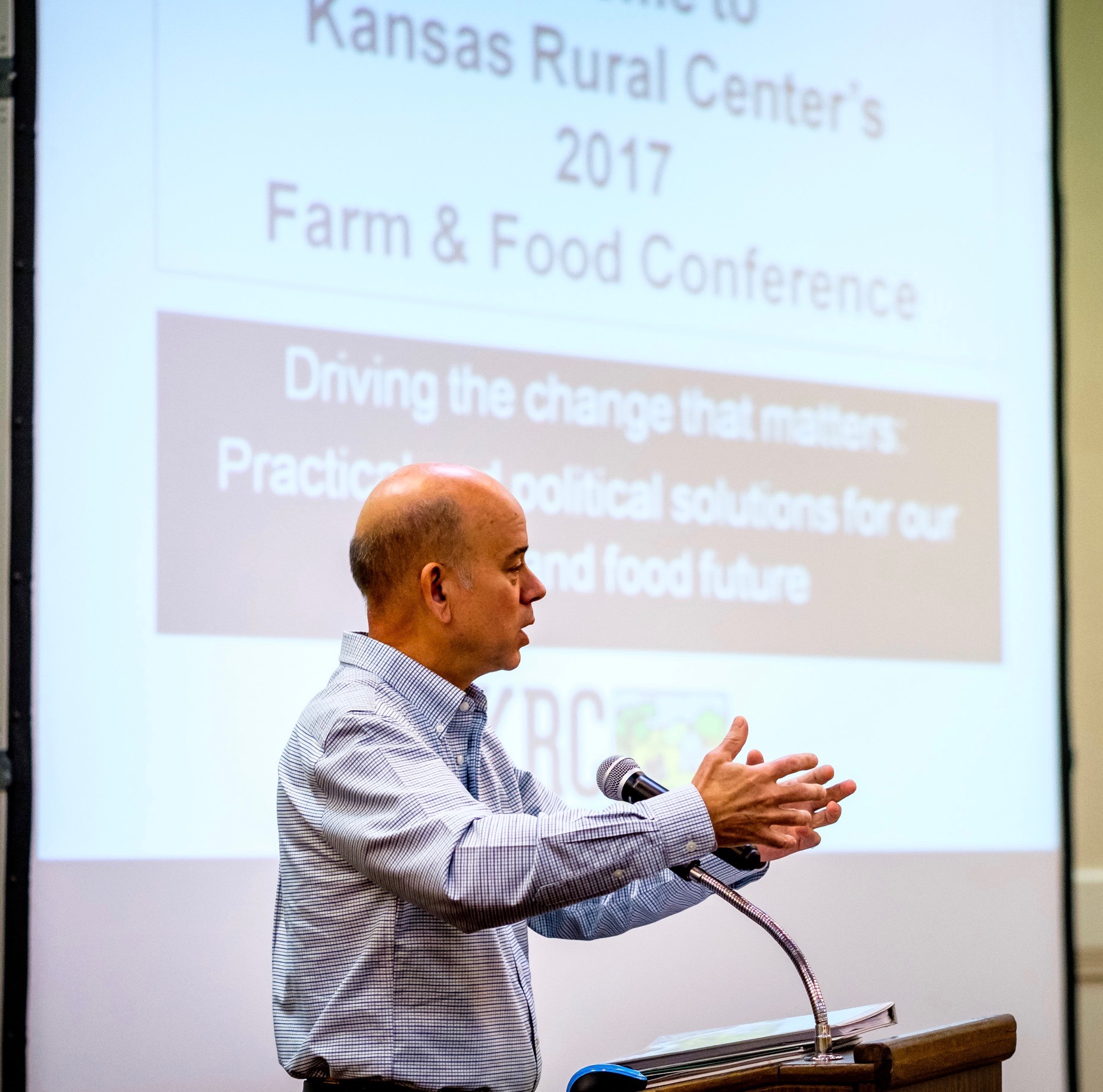
Ferd Hoefner, Senior Strategic Advisor for the National Coalition for Sustainable Agriculture (NSAC), spoke to the November Kansas Rural Center Food and Farm conference on the past, present and future of sustainable agriculture policy.
Looking back on four decades of advocating for sustainable agricultural issues and policies, most of it on the federal level, Ferd Hoefner, Senior Strategic Advisor for the National Sustainable Agriculture Coalition (NSAC), has seen his share of gains, losses and missed opportunities. For every notable success, such as the implementation of the Sustainable Agriculture Research and Education program (SARE) in 1988, there was a notable loss.
But it is important to remember, Hoefner stated, that great advances have been made, and that despite continued obstacles to achieving good food and farm policies, a celebration is in order. “This is not the time to abandon the mission of reforming public policy at all levels,” he said, “but rather a time to remain engaged, with even more passion than before.”
Hoefner was a keynote speaker for “Driving the change that matters: Practical and political solutions for our farm and food future,” the Kansas Rural Center’s 2017 Farm and Food Conference, held Nov. 17-18 in Manhattan, Kansas. Nearly 200 farmers, local food advocates, conservationists, and consumers gathered for two days of speakers and workshops, ranging from practical farming and marketing how-to’s to policy analysis and organizing tips, and exhibitors focused on topics ranging from beekeeping to soil health and voting rights.
Hoefner addressed the crowd on the “past, present and future of sustainable agriculture”, having spent the last 40 years addressing federal policies supporting long-term economic and environmental sustainability of agriculture, natural resources and rural communities. Hoefner started on this path in 1977 as a congressional intern working on the Farmer to Consumer Direct Marketing Act and the Urban Gardening Program.
It was a heady time to be working on farm issues. New innovations were being introduced and a new movement was emerging. Even Congress seemed ready to consider the “why”of the farm bill rather than simply tinkering with support programs. Title 1 was not the commodity title as it is now, but the family farm title, specifically stating that federal laws and programs should foster the family farm system of agriculture and that no policies or programs should be enacted or administered in a manner that would place the family farm operation at an unfair economic disadvantage. It also put commodity program payment limits front and center, rather than buried at the end of the commodity title.
Though it proved imperfect in practice, Hoefner said, the bill’s payment limit provision at least attempted to target commodity benefits to moderate-scale agriculture, reducing coverage at the high end to tamp down over-expansion and consolidation.
Following the passage of the 1977 farm bill, the USDA undertook the Structure of Agriculture project and the Organic Farming project, both of which led to two highly important USDA reports, Hoefner said. “A Time to Choose” profiled the federal policy changes needed to save and grow an agriculture backed by mid-size family farms, while the “Report and Recommendations on Organic Agriculture” profiled the potential for widespread adoption of organic farming – a first for a USDA publication.
Ferd Hoefner, Senior Strategic Advisor for the National Coalition for Sustainable Agriculture (NSAC), spoke to the November Kansas Rural Center Food and Farm conference on the past, present and future of sustainable agriculture policy.
The euphoria was short-lived. Immediately following the 1980 election and the installation of the new administration, both reports were pulled, publication ceased, and the recommendations left on the cutting room floor.
During and following the farm crisis of the mid-1980’s, many farmers started looking for alternatives to the “get big or get out” concept. They were looking at ways to reduce input costs and rely more on management and on-farm resources, as well as looking for ways to find increased value in the marketplace. Sustainable agricultural societies and grassroots organizations across the Midwest formed to change the direction of federal policy toward a more sustainable vision of agriculture. One of them, the Kansas Rural Center, was a vital contributor to those early organizing efforts, Hoefner said. Another was the Sustainable Agriculture Coalition, now known as the National Sustainable Agriculture Coalition (NSAC), which formed in the late 1980s.
The organization’s goals were simple. “We argued for a seat at the table,” he said. “We warned policymakers to not put all their eggs in one basket. We pleaded that they allow an alternative to have a chance. We argued for a fair share and a fair shake.”
Winning congressional appropriations for the SARE program after it had been shelved for almost a decade was their first mission, and getting it off the ground was their first big win in 1988. Two years later the organization won the full-scale authorization of SARE into the 1990 Farm Bill. Other initiatives followed, including the Organic Agriculture Research and Extension Initiative, the Beginning Farmer and Rancher Development Program, and the Small and Medium-Size Farm Viability Program.
“It was no coincidence that SARE and NSAC got started in the same year,” he said. “The impact of our work to create and fund SARE has been hugely important to the movement. It’s difficult to imagine where we would be in sustainable agriculture both now and in the future were it not for the combined $75 million a year we are pumping into the four programs.”
Support for new and beginning farmers has been a central tenet of the NSAC policy agenda from the 1990 farm bill to the present. “We have consistently kept the issue of the aging of American agriculture in front of Congress and the USDA,” Hoefner said.
Also, with the newfound interest in soil health and cover crops really beginning to take off, Hoefner said, NSAC has been overwhelmed by the interest in a topic they have championed for decades in their conservation policy work. “We are trying to harness that broader support to gain stronger policy and better funding for working lands conservation, and also to better integrate conservation and soil health with the federal crop insurance program.”
During the past decade, marketing issues have accelerated. Legislative wins included the Value-Added Producer Grant Program, the Farmers Market and Local Food Promotion Program, the National Organic Certification Cost Share Program, and others that were combined into the Know Your Farmer, Know Your Food Initiative passed during the Obama Administration.
All of these programs required hard work and dedication to develop, launch and campaign for, Hoefner said. But when it came to tackling the Big Ag programs, whether commodity programs, crop insurance, tax shelters, CAFO regulations, or anti-trust and fair competition policy, the going got a lot tougher.
“Farm policy overall is stacked against diversification and farming in concert with the environment,” he said. “Switching from the production system side of the equation to the structure of agriculture side, we have had nothing if not an agonizing time trying to get Congress and USDA to enact and implement real subsidy payment limitation reform to reduce incentives to over expansion and subsidized farm consolidation. We repeatedly seem to make progress, passing real reform measures on one side of Congress but not the other, or winning small reforms from Congress only to watch USDA undo them in the implementation phase.”
Positive change will come only when we are able to construct a wider coalition of farmers, workers, and consumers who will stand up and fight for a better food policy, building a stronger power base to make fundamental change, he said.
NSAC and its member organizations are now focusing on the 2018 Farm Bill, but Hoefner expects it to be a difficult struggle. “Support for beginning farmers and new farming opportunities in Congress and even among agricultural interest groups is a mile wide and an inch deep,” he said. “But for the sake of the future of a sustainable agriculture based on family farms, we really need to confront the barriers in a more systemic way and try to get support levels to a mile wide and a mile deep. The future of a more sustainable agriculture depends on it.”
Policy, he said, is not the be all and end all, but it can help to move us in the right direction. It’s also important to recognize that legislative successes happened from the grassroots up. “We know that the future of sustainable food systems at home and abroad hinge on how we respond to the challenges of today and prepare for the challenges of tomorrow, which are coming at us fast and furious.
“Sustainable farming tomorrow will not be exactly like that of today. The principles and values may remain constant, but the challenges and opportunities will continue to evolve, and in many respects intensify. That makes fighting the fight for more research dollars in general, and more dollars for sustainability, regeneration and resilience research in particular, more important than ever.”
Hoefner’s and other conference presentations are available on the KRC website at www.kansasruralcenter.org.
Tom Parker is a freelance writer from Blue Rapids, Kansas, who prepared this article for the Kansas Rural Center.
LYON COUNTY — Law enforcement authorities and officials with USD 253 Emporia are investigating after two William Allen White Elementary students were approached by a stranger as they walked home from school Thursday afternoon, according to Superintendent Kevin Case.
The report came in around 4pm on Thursday afternoon. The man approached the students near East 9th Avenue and Cottonwood Street at the south edge of the school campus and reportedly yelled at two students to come home with him, according to Emporia Police.
A review of surveillance video in the area showed a person of interest. The video shows this man in the area at the time of the report.
The man appears to be Caucasian, wearing sunglasses, a hooded jacket or coat and light colored jeans or sweatpants.
They students back to the school to report the incident to a staff member. School officials immediately notified Emporia Police, and they came by the school to get a report.
“Both students were unharmed and we are especially proud of their smart and quick reaction,” according to Case.
He urged parents to take time to remind children to be watchful and to not interact with strangers near the playground or along the route to and from schools. “Teachers will emphasize the message at all of our schools as well, and our staff will be vigilant to watch for individuals who have no reason to be around the schools.”
Anyone with information about the identity of this man is asked to call the Emporia Police Department at 620 343-4200 or Lyon County Crime Stoppers at 620 342-2273.
RILEY COUNTY – Law enforcement authorities in Manhattan are investigating another alleged rape and have arrested a suspect
Just after 10p.m. Thursday, police arrested Marcus U. Martin, 37, Manhattan, at a residence in the 3000 Block of Kimball Avenue in Manhattan, according to the Riley County Police Department arrest report.
In 2001, Martin was convicted for indecent liberties with a victim under the age of 16, according to the Kansas Department of Corrections. He was released from prison in 2007.
In July Riley County authorities reported the number of rapes reported in Manhattan and surrounding areas had doubled during the first quarter of 2017 compared with the same time last year.
A total of 40 rapes were reported in Manhattan in 2016.
Douglas Alan Sandoval, age 48, of Hays, passed away Tuesday, December 5, 2017 in Hays. He was born July 20, 1969 in Wichita, Kansas to JoAnn Dreiling and Timothy Daniel Sandoval Jr.
He had worked as a chef and enjoyed working out, song writing, watching old tv movies and computer work.
He is survived by his mother, JoAnn Sandoval of Hays, his father Timothy Sandoval and wife Eunice of Wichita; a son, Doug Lynn of Wichita; a brother, Jason Eric Sandoval of Wichita and his step brothers and sisters, Steve, Jeff and Jeni.
Memorial services will be held at 11:00 A.M., Saturday, December 9, 2017 at Brock’s-Keithley Funeral Chapel and Crematory 2509 Vine Hays, KS 67601. Inurnment will follow in the St. Joseph’s Cemetery, Hays.
A Memorial visitation will be held from 10:00 A.M., until service time on Saturday at the Funeral Chapel.
Memorial contributions are suggested to the family.
Condolences may be left by guest book at www.keithleyfuneralchapels.com or by email at [email protected]
Kansas Farm Management Association economist gives tips
MANHATTAN — With the new year straight ahead, there’s no better time for farmers and ranchers to take stock of where they are financially in order to put them in the best tax situation possible, according to agricultural economist Mark Dikeman.
Dikeman, associate director of the Kansas Farm Management Association at Kansas State University, said some farmers arrive at the end of the year without a good understanding of where they are financially. Spending time now to determine where your operation is can benefit a farmer in the long run.
“In the last 10 years, we’ve looked at tax planning from the perspective of keeping income down and staying in a certain tax bracket,” Dikeman said, but with lower commodity prices the last couple of years, some farmers may be on the brink of showing a net operating loss, which has its own pitfalls, tax-wise.
In addition to obvious reasons to avoid such a loss, a net operating loss means a farmer will not be able to utilize personal exemptions, capital loss carryovers, or all of their standard deduction.
“That’s lost to you. Avoiding a net operating loss is always a good idea. For a married couple with two children, that is up to $28,900 in lost deductions in 2017,” Dikeman said.
He provided year-end tips:
• Get your records in order. Having an accurate set of records is critical for a tax preparer to work with. That doesn’t mean a shoebox with a bunch of receipts. A computer program or ledger sheet — something that’s reconciled back to a bank statement — is best. If you don’t have that set up, consider that your New Year’s resolution so you’ll be better prepared next year.
• Don’t wait until the last minute to get your records in order. Waiting until December to start your bookkeeping for the year means guessing about checks written in January and that doesn’t lead to accurate records.
• Meet with your tax preparer before the end of the year to discuss your current financial situation and what tax bracket you’re likely to be in. Allow enough time to bring in additional income if facing a net operating loss or to make additional purchases if your income is too high.
• If a farm loss is inevitable, think outside the box to bring in additional income. Extra IRA distributions, traditional IRA to Roth IRA conversions, or non-farm capital asset sales (like stocks) can potentially offset negative farm income and avoid a net operating loss.
• Remember the option to sell grain using a deferred contract. In that case, you can sell grain before the end of the year, but not be paid until after the first of the next year. You then have flexibility to decide, after the fact, if you need additional income in the year that the crop was sold. Make sure you sell in several small contracts rather than one large contract to provide more flexibility for when to show income.
• Make sure you tell your tax preparer about all equipment purchases. If equipment is dealer- or manufacturer-financed, it won’t show up in your bank accounts. That can be $300,000 or $400,000 that your tax preparer doesn’t know about it unless you tell him or her.
For farmers, part of tax planning involves understanding your options regarding when you file your return and pay taxes. The most popular, Dikeman said, is to not make any estimated tax payments, but in that case, you must file your return and pay all tax due by March 1. The downside is that if you have investments in stocks or mutual funds through brokerage accounts, some of those firms don’t mail 1099 forms until mid to late February which may not allow enough time to file by the deadline.
Other options are to make quarterly estimated tax payments, although this is the least popular. In that case, the tax return must be filed by April 15. This option may be required if less than two-thirds of your gross income comes from farming.
Some farmers make one annual estimated payment which must be paid by Jan. 15, though the tax return itself must be filed by April 15. In that case, the smaller of 100 percent of last year’s tax liability or two-thirds of this year’s tax liability is the estimated payment amount with any shortfall due when the return is filed.
A final option for farmers when it comes to filing deadlines is to not pay any estimated tax and file by April 15. If a farmer owes tax, this would likely result in penalties and interest, Dikeman said, but usually not as much as interest paid if they had to borrow the funds to pay taxes.
“More and more are doing that because cash is tight and operating loan balances are high. Depending on the situation, it might make sense to do that,” he added.
The Kansas Farm Management Association has 26 agricultural economists located in 11 offices across the state. They provide farmer members with production and financial information to make farm business decisions. Each KFMA member receives record keeping assistance, an annual accrual farm analysis, year-end tax planning and more. For more information go to www.agmanager.info/kfma
When her young son developed an ear infection, his mother took him to
the pediatrician. The mother was very impressed with the way the doctor
directed his comments and questions directly to the boy.
At one point the doctor asked her son, “Is there anything you are
allergic to?” The boy nodded and whispered in the doctor’s ear.
Smiling, the pediatrician wrote out a prescription and handed it to the
mother. Without looking at it, she tucked it into her purse.
Later, the pharmacist filled the order, remarking on the unusual
food-drug interaction her son must have.
When he saw the mother’s puzzled expression, he showed her the label on
the bottle.
As per the doctor’s instructions, it read: “Do not take with broccoli.”
College Bowl season is right around the corner, and you have a chance to win $500 in Hays Chamber Cheques! All you have to do is enter here and join the 2017 Landmark Realty Bowl Mania Contest.