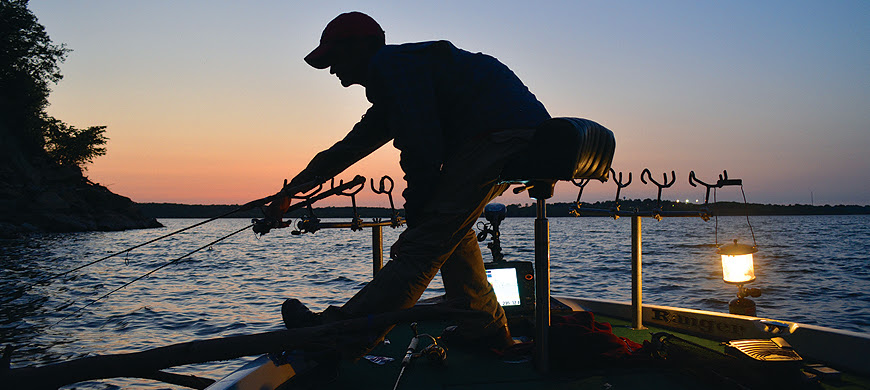
PRATT – You don’t have to quit fishing just because it’s hot. You just have to adjust your schedule to fish at night rather than during the day. Oh yeah – and leave a light on.
July and August are perfect months to catch white bass, crappie and wipers under lights. Young-of-the-year gizzard shad, the primary forage in Kansas reservoirs, are just getting to “bite size” and sport fish are busy filling their bellies.
To catch fish under the lights at night, you first need to anchor your boat in a strategic location just before dark. Your best bets are over a deep brush pile or cube cluster, creek channel ledge or mudflat. Once the sun sets, set out lanterns, floating lights or submersible halogen lights, and wait.
What happens is a natural but amazing phenomenon of the aquatic food chain. The light will attract microscopic zooplankton, which in turn will attract minnows and shad. When the lights have congregated a large school of shad – which will often swim in circles around the light as if disoriented – the predators will show up below. You’ll see the shad under the lights, and if you watch your sonar, you’ll know when the predators show up beneath the shad school. Drop a jig or minnow down and you’re in business.
It may take a trip or two to become accustomed to fishing at night, and there are safety considerations to keep in mind. Once the sun sets, your boat needs to have navigation lights on. Motor boats less than 40 feet long should have a white light at the stern, visible all around, and a light at the bow, showing red on the port side and green on the starboard side. A white light should be visible when the boat is at anchor. Wear your lifejacket and become familiar with the area before it gets dark. Go slow and use a hand-held spotlight to locate shorelines or obstacles while under power. If your sonar has GPS, use the map page with the trackback function on so you’ll have a safe route back to the ramp in the dark.
For some great tips on catching crappie under the lights, check out the July/August 2018 issue of Kansas Wildlife and Parks Magazine (ksoutdoors.com/Services/Publications/Magazine). Expert angler and guide, Joe Bragg, shares his night fishing know-how in a feature article authored by Brent Frazee.
TOPEKA, Kan. (AP) — A Kansas Republican candidate for Congress is denying claims from three Democratic officials that he considered running as a Democrat and expressed socially liberal views before announcing as a GOP candidate last year.
Steve Watkins courtesy photo
Steve Watkins, an Army veteran seeking the GOP nomination in Kansas’ 2nd District, met with the Democrats at the Shawnee Democratic Party headquarters in Topeka in August 2017 when he was considering launching a campaign.
Ty Dragoo, the Democratic vice chairman for the 2nd District, said Watkins was trying to determine if the party would support him and expressed liberal social views during the meeting, including supporting labor unions, sensible gun laws and LGBT rights.
“He sounded like a Kansas Democratic Party member,” Dragoo said. “His social views were liberal.”
Watkins disputed Dragoo’s characterization of the meeting.
“I was not at any point looking to run as a Democrat, nor was I ever approached about running as a Democrat,” Watkins said. “I was taking some meetings with political types . and an associate advised me to reach out to Ty. At some point, I realized he had arranged the meeting to take place at the Democratic HQ. I didn’t back down from that. I’ve met with insurgents and warlords.”
Watkins, 41, said he didn’t participate when the Democrats expanded the discussion to include more liberal policies.
He announced his campaign as a Republican in November, four months after the meeting took place.
The Star reported it could find no evidence that Watkins ever voted or registered to vote before he voted last year in a local Topeka election, shortly before he announced his candidacy. Watkins said he couldn’t recall if he ever registered but he was well known of his conservative views as a graduate student at Harvard University after he left the Army in 2004.
He agreed to the meeting because he wanted to learn about transportation policy after being told by an adviser Dragoo was a transportation lobbyist, Watkins said.
Dragoo is the state legislative director for the Kansas chapter of SMART, a union that represents transportation workers. He called The Star about the 2017 meeting after seeing Watkins support a Supreme Court ruling that limits the ability of public sector unions to collect fees. Watkins said he didn’t know Dragoo was a union representative until being told by the newspaper Thursday.
Luke Domme, a Shawnee Democratic Party’s vice chairman and a business representative for the Bakery, Confectionery, Tobacco Workers and Grain Millers’ union, was at the meeting and supported Dragoo’s contention that Watkins was trying to decide whether to run as a Democrat or Republican.
Sarah Coats, a Democratic candidate for the Kansas Legislature, also attended the meeting and said Watkins expressed fiscal conservatism but more liberal views on social issues.
“He said that he thought he was too much of a moderate, so he was really interested in being in the Democratic Party,” she said.
Watkins said he was surprised that Coats was at the meeting. He also denied that Domme attended but the three Democrats said Domme set up the meeting and was there.
“The politics were middle of the road to me,” Domme said of Watkins. “I didn’t expect him to immediately swing to the Republicans.”
Watkins said the Democrats are bringing up the meeting now because they “want to damage me because they know I stand the best chance of beating Democratic front runner Paul Davis in the general election.
Listen to Mike Cooper interviewing Dr. Wally Walstrom; from from Hays Orthopedic Institute at HaysMed, by clicking the link above and then clicking the play button
OSBORNE—Girl Scouts of Kansas Heartland honors new Girl Scout Gold Award recipient, Ashton Baxa of Osborne for creating a new literacy program in her community.
Earning the Gold Award is one of the most challenging, exciting and rewarding experiences a Girl Scout can have and one of the most prestigious recognitions she’ll accomplish. The Girl Scout Gold Award stands as the highest achievement a Girl Scout can earn, comparable to the Eagle Scout rank in Boy Scouts.
The award recognizes girls in grades 9 through 12 who demonstrate extraordinary leadership through Take Action projects that have a sustainable impact in their communities and beyond. Girl Scout Gold Award recipients who join the armed forces enter one rank higher than other recruits, and they qualify for exclusive scholarships.
“Earning the Girl Scout Gold Award is truly a remarkable achievement, and the young women who earn this award exemplify leadership in all of its forms,” said Liz Workman, chief executive officer of Girl Scouts of Kansas Heartland. “They saw a need in their communities and around the world, and took action. Their extraordinary dedication, perseverance and leadership is making the world a better place.”
Baxa focused her efforts on the reading ability of youth in her community with “Buddies and Books.” The project created a mentorship program with volunteers in her local community spending time with youth, listening to them read and helping them along the way.
The goal was to establish an initiative to improve reading abilities, a life skill that will stay with them forever. “Buddies and Books” was developed with the intention of volunteers sustaining the program long after Baxa leaves for college through Facebook pages and a partnership with the Osborne Public Library.
On earning her Gold Award, Baxa said her leadership skills “became even stronger as I handled the children and learned how much they actually do look up to you. From this program, I learned that I love working with kids and I am going to school to study pharmacy, but I learned that I would like to take that career and work in a children’s hospital.”
Neal Allen is an Associate Professor of Political Science at Wichita State University.
Life tenure for Supreme Court Justices, combined with increasing partisan polarization, is a toxic combination that is poisoning our democracy.
It is time to find a better way that preserves judicial independence while reducing the level of conflict over nominations. A move to a non-renewable 18-year term is a one way to reduce the stakes of confirmation battles, while preserving judicial independence.
Soon after Associate Justice Anthony Kennedy announced his resignation, President Donald Trump said “We have to pick a great one, we have to pick one that’s going to be there for 40 years, 45 years.”
While this statement will likely be a talking point for Democrats who oppose Judge Brett Kavanaugh, Trump’s 53-year-old nominee for Kennedy’s seat, it also accurately describes the way Supreme Court nominees are currently chosen.
Supreme Court nominations have become a way to preserve a party’s policy positions even after those policies cannot command a majority of voters in national elections. This practice is good for the party that has the Presidency when a vacancy occurs, and wonderful for relatively young lower-court judges who have a record that predicts ideological purity on the Court.
But it is bad for our democracy in general. It creates incentives for Senate leaders to use all means available to block nominees from the President of the other party, and to then push through the most conservative (or liberal) nominee possible. The norms of democracy and civility have not withstood such pressure, as shown by the unwillingness of Senate Republicans to grant President Obama’s nomination of Merrick Garland a vote.
One way to lower the temperature in Washington would be to lower the stakes of Supreme Court nominations. Judicial independence does not require a Justice serve as long as they live (or decide to retire after decades of service), but only that they are not susceptible to removal by a President or Congress.
Eighteen years is not the only number that would work, but it would have the advantage of ensuring that every President would get at least one appointment during their term. Thus we would avoid situations like in Democrat Jimmy Carter’s only term or Republican President George W. Bush’s first term, where a democratically-elected President had no appointments. A long, but defined term would also increase the likelihood that qualified potential appointees in their 60s would be considered.
The extreme partisanship of our current nomination politics makes such a proposal highly unlikely to even get a vote in either house of Congress, let alone enough support to begin the necessary process of constitutional amendment. But de-escalation must start somewhere, and ideally with the actions of a President or Senator.
Kansas Senators Pat Roberts and Jerry Moran, while loyal Republican partisans throughout their careers in elected office, are ideal candidates to start a conversation on reform of the Supreme Court nomination process. Neither one is in electoral danger, with Moran overwhelmingly reelected in 2016 and Roberts serving what is likely his last term. They could both withstand the pressure that would surely come from questioning the wisdom of the current nomination process when their party is on the verge of locking in their desired policy positions for a generation or more.
If either Kansas Senator would use their leverage in the current 50 Republican/49 Democrat Senate, they could at least secure a pledge from Majority Leader McConnell to schedule debate after the November elections on nomination reform. It is in their long-term interest, and the interest of Kansans in general, to reduce the level of partisanship on judicial nominations.
The Democratic Senators that are excluded from the nomination process will be less likely to collaborate with Senator Roberts on agriculture issues. When Senator Moran continues his fight to preserve rural Post Offices, he will need the help of Democratic Senators who also represent states with large rural populations.
Scorched-earth politics on nominations will not be contained to just Supreme Court nominations, but will continue the degradation of the personal relationships that are crucial to good-faith negotiation across party lines.
Senators Roberts and Moran would be wise to consider how to preserve the Senate as a broadly-representative governing institution, instead of continuing the destruction of bipartisan norms.
Neal Allen is an Associate Professor of Political Science at Wichita State University.
ASH FLAT, Ark. (AP) — The last of three inmates who escaped from an Arkansas jail has been apprehended in Kansas.
Sledge- photo Sharp Co.
Sharp County Sheriff Mark Counts said that Randall Paul Sledge was arrested Friday by troopers with Kansas Highway Patrol. Counts did not provide details on the arrest.
Sledge, Chris Frey and Robert Pollard escaped early Wednesday from the Sharp County jail. The other two were apprehended later in the day.
Sledge prior to his escape was being held on various charges that included fleeing on foot.
Frey -photo Sharp Co.Pollard -photo Sharp Co.
Counts says the men unscrewed the deadbolt from a jail door and lifted the bottom of a fence to escape. He says two jailers also failed to do a head count that could have revealed the escape earlier.
WICHITA — Wichita State University has announced the names of more than 2,750 students who were on the WSU dean’s honor roll for spring 2018.
To be included on the dean’s honor roll, a student must be enrolled full time (at least 12 credit hours) and earn at least a 3.5 grade point average on a 4.0 scale.
The following northwest Kansas students were included:
The Fort Hays State University Alumni Association will host a golf tournament Friday, Aug. 3, at Meadow Lake Golf Club, 1085 East Golf Club Dr in Colby. Golf enthusiasts are invited for a relaxing day on the greens while raising funds in support of Fort Hays State University student scholarships.
The tournament begins with registration at 8 a.m. followed by tee time at 9 a.m. Registration fees are $90 per golfer or $300 for a team of four.
Special guest FHSU Athletic Director Curtis Hammeke will offer an update on Tiger athletics and the university after the tournament. Non-golfers are invited to stop by the golf course at approximately 1:30 p.m. to hear the latest in FHSU news.
For more information and to register for this event, visit www.goforthaysstate.com/events, email [email protected] or call 785-628-4430 or toll free 1-888-351-3591.
Kansas water use is declining, according to a new report from the U.S. Geological survey.
Kansans decreased their water usage by 25 percent over the past 25 years — which is great. But conservation experts say there’s still a lot more work to be done.
“What we’re doing is great, it’s just not enough of it,” said Kansas Water Office Director Tracy Streeter.
He’s particularly concerned about areas of western Kansas where farmers draw from the diminishing Ogallala aquifer.
“Overall, we’ve got to see more widespread adoption of conservation efforts,” he said.
The top three water consuming counties are Stevens, Finney and Seward — all located in southwestern Kansas.
Linn County, in eastern Kansas, withdraws the most water per day of any county. The culprit is the LaCygne coal-fired power plant, which withdraws 610 million gallons per day. But the plant puts almost all the water it withdraws back into the lake it comes from, consuming just 1 percent of it.
Mandy Stone is a hydrologist at the USGS in Kansas. She said the data is a good tool to show policymakers, and Kansans, where their water comes from and where it goes.
“This water use data is important, ultimately because all of us in the economy depend on water every day,” she said.
Brian Grimmett, based at KMUW in Wichita, is a reporter focusing on the environment and energy for the Kansas News Service, a collaboration of KMUW, Kansas Public Radio, KCUR and High Plains Public Radio covering health, education and politics. Follow him on Twitter @briangrimmett.
Employees from the Cosmosphere space museum in Hutchinson are helping to recreate one of the biggest moments in our nation’s space history: the mission control room used during the first moon landing.
Specifically, the team at SpaceWorks, a division of the Cosmosphere, are updating the famous control room consoles piece by piece.
The SpaceWorks facility west of downtown Hutchinson includes a restoration warehouse and workshops for metal fabrication, machining, woodworking and paint.
“For the most part, we try to be self-sustaining as possible,” says Jack Graber, project manager and Cosmosphere vice president of exhibits and technology. “I would say less than 10 percent of the parts are done outside of our shop.”
SpaceWorks manager Dale Capps is working on metal brackets that he created in the fabrication shop. They will hold the monitor in place on a console. Original replacements are not available. CREDIT LARISSA LAWRIE / KMUW
SpaceWorks manager Dale Capps is smoothing the edges inside a small rectangular metal bracket in the metal fabrication workshop. The part, a faceplate, will hold a monitor in a console that was used during the historic Apollo space missions nearly 50 years ago.
A replacement is not available, so Capps used one of the originals to create a mold to manufacture brackets in-house.
Graber says finding original equipment is the hardest part of doing historically accurate restoration work.
“The actual components that would have been around in the Apollo-era are obviously past their prime so we’ve had to replicate some things that we may not have anticipated just because they are not available anymore,” he says.
Flight controllers celebrate the successful conclusion of the Apollo 11 lunar landing mission on July 24, 1969, at NASA’s Mission Control Center in Houston. CREDIT NASA
Graber and his team are restoring and preserving nearly two dozen mission control consoles from the Johnson Space Center in Houston. NASA flight controllers used these consoles during missions that put astronauts on the moon and space shuttles into orbit.
The consoles were retired and shut down after the Discovery space shuttle flight in 1992.
“The tours would come into there and they would just see the consoles dead; just turned off. The room was very empty in a sense,” Graber says.
The SpaceWorks team is working to bring the consoles back to life.
“So they will not function or communicate with anything. They will just look like they would have in a snapshot in time with lights, data on the screens, information that way,” Graber says.
Two rows of the green metal consoles are currently in the SpaceWorks restoration facility. The team works on one console at a time. They clean and fix the wiring, identify which parts can stay, and which parts need to be replaced or replicated. The cabinets will be restored to their Apollo-era appearance with working displays and backlit push-button panels.
Work on this first set of consoles will be completed in September, and then they will be returned to Johnson Space Center. CREDIT LARISSA LAWRIE / KMUW
“We have a layout for each console, and we match that layout per console. Then we will research through pictures to try and match buttons as far as what was lit at a certain time,” Graber says.
The craftsmen are also relying on a manual for the configuration for the consoles. The team often uses reverse engineering and a bit of creativity when it comes to recreating these important pieces of space history. Photographs rarely show the mission control consoles head-on.
“You have a lot of pictures of the room from corners. Sometimes we might find a picture of a certain pattern that might have been on one console and try to replicate it on another. So it’s been a lot of research, been a lot of fun and we’re still digging into that part of it,” Graber says.
Technician Don Aich is retrofitting the display mounting for one of the consoles by adding those metal brackets created in-house. He is replacing the old tube monitors with modern flat screen LEDs. He says no one will notice the upgrade because the front looks identical to the original console display.
Technician Don Aich shows how an upgraded monitor plate looks identical to an original. CREDIT LARISSA LAWRIE / KMUW
“Other people think it looks good and they can’t tell the difference. And we’ve had astronauts who couldn’t tell the difference from some of the things we’ve created,” Aich says.
Because the mission operations control room was designated a National Historic Landmark in 1985, every piece of every console is considered an artifact and is documented. Graber says any parts that are not used in a refurbished console will be archived.
“All of the pieces that we take out that are not historically accurate or that are not going to used anymore, we catalogue, we preserve and then we store for future generations to be able to reference,” Graber says.
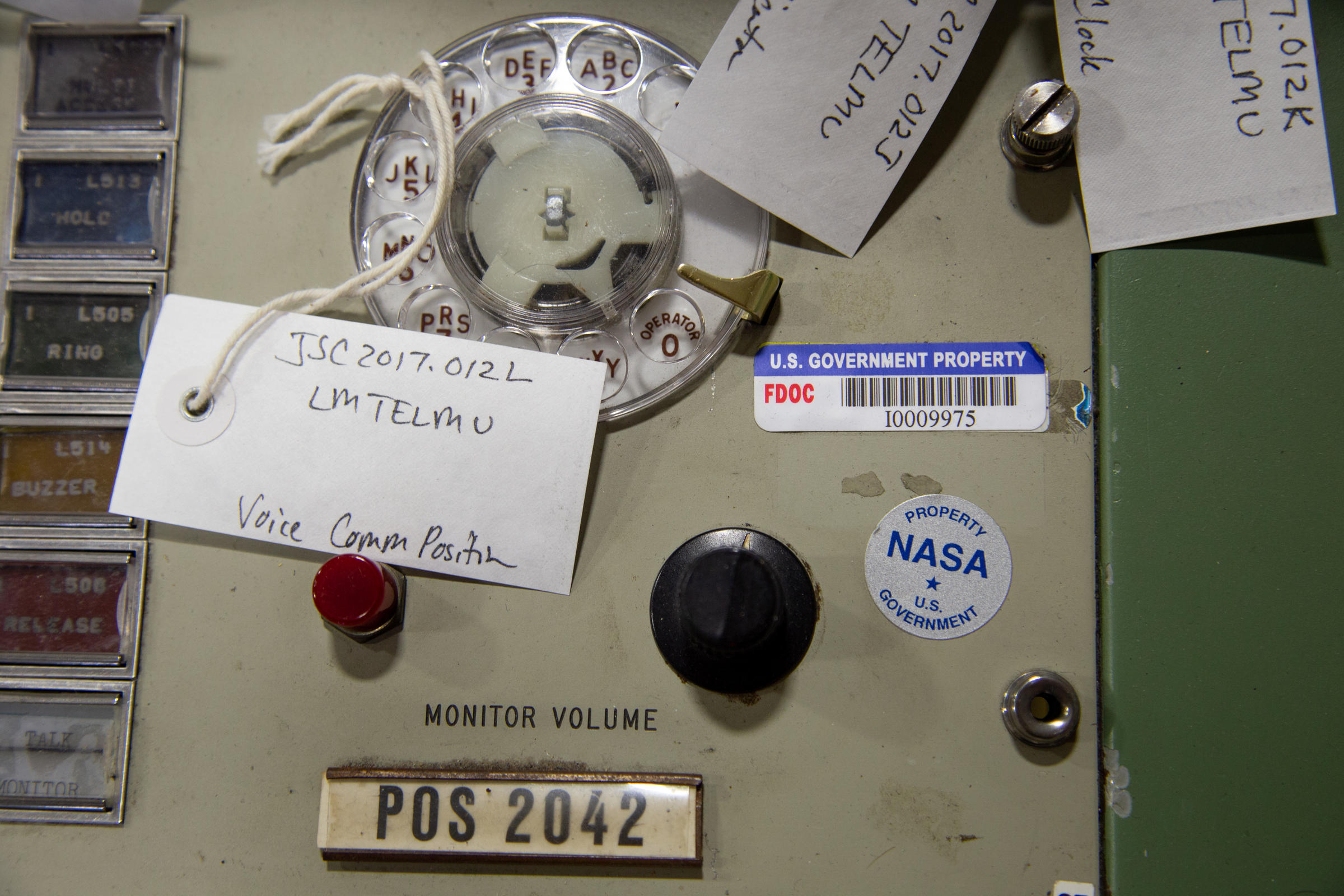
The console restoration is part of a bigger Johnson Space Center project to return the entire flight control room and visitor viewing room to their Apollo-era configurations. All of the furnishings in those rooms including carpet, wallpaper and chairs are being cleaned or replaced to match their 1969 appearance. That’s why Graber and his team are making sure every component in the consoles is accurate and functioning.
Jack Graber, vice president of exhibits and technology at the Cosmosphere, uses a color-coded tagging system on the consoles to identify historically accurate parts and parts that need to be replaced or replicated. CREDIT LARISSA LAWRIE / KMUW
“So when people come on tours and they walk in there, it looks like it did on that day with coats and jackets and cigarette ashtrays, and books and manuals and that’s why the consoles will be lighted as well,” he says.
The SpaceWorks team will finish renovating these consoles in September. Then they will take them back to Houston, and pick up the remaining consoles.
The restoration project is expected to be completed next summer in time for the 50th anniversary of the first moon landing.
Golf enthusiasts are invited for a relaxing day on the greens while raising funds in support of Fort Hays State University student scholarships.
The FHSU Alumni Association is hosting golf tournaments Friday, July 27, at Buffalo Dunes Golf Course, 5685 US-83 in Garden City and Saturday, July 28, at the Liberal Country Club, 1900 North Kansas Ave. in Liberal.
Both tournaments begin with registration at 8 a.m., followed by a 9 a.m. tee time. Registration fees are $90 per golfer or $300 for a team of four.
Head football Coach Chris Brown, coming off an 11-0 regular season and the 2017 MIAA Championship – a first in FHSU history – will be the special guest at the Garden City and Liberal tournaments. He will be joined by FHSU Sports Information Director Ryan Prickett after tournament play in Garden City to discuss the upcoming season of Tiger Athletics as well as an update on the university.
Non-golfers are welcome to stop by either golf course at approximately 1:30 p.m. to hear the latest in FHSU news.
 KDWPT
KDWPT



 Listen to Mike Cooper interviewing Dr. Wally Walstrom; from from Hays Orthopedic Institute at HaysMed, by clicking the link above and then clicking the play button











 Today
Today