SEDGWICK COUNTY — Law enforcement authorities are investigating a suspect for alleged child sex crimes.
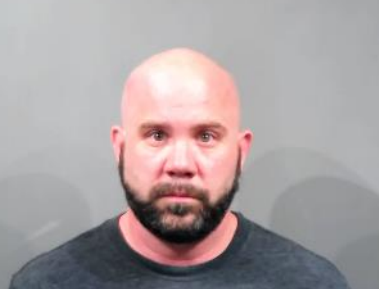
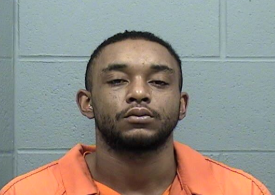
David J. Smith photo Sedgwick County
On Thursday, police arrested David Justin Smith, 38, on a warrant, according to officer Kevin Wheeler. He is jailed on a bond of $150,000 on requested charges that include four counts of criminal sodomy and three counts of sexual exploitation of a child, according to the online Sedgwick County jail records.
The charges allegedly involved the sexual relationship between a 16-year-old minor and Smith, according to Wheeler.
Police will present the case to the Sedgwick County District Attorney.
WASHINGTON (AP) — President Donald Trump on Saturday delayed a nationwide immigration sweep to deport people living the United States illegally, including families, saying he would give lawmakers two weeks to work out solutions for the southern border.
The move came after House Speaker Nancy Pelosi called Trump on Friday asking him to call off the raids. But three administration officials said scrapping the operation was not just about politics. They said Immigration and Customs Enforcement leaders had expressed serious concerns that officers’ safety would be in jeopardy because too many details about the raids had been made public.
The officials spoke on condition of anonymity to speak about private discussions.
“At the request of Democrats, I have delayed the Illegal Immigration Removal Process (Deportation) for two weeks to see if the Democrats and Republicans can get together and work out a solution to the Asylum and Loophole problems at the Southern Border,” Trump wrote on Twitter. “If not, Deportations start!”
The operation, which sparked outrage and concern among immigrant advocates, had been expected to begin Sunday and would target people with final orders of removal, including families whose immigration cases had been fast-tracked by judges.
The cancellation was another sign of the Trump administration’s difficulty managing the border crisis. The number of people crossing the U.S.-Mexico border has risen dramatically under Trump, despite his tough rhetoric and hard-line policies. Balancing a White House eager to push major operational changes with the reality on the ground is a constant challenge for the Department of Homeland Security.
Trump gave the first public word of the planned sweep earlier this week, saying in a tweet that an operation was coming up and the agency would begin to remove “millions” of people who were in the United States illegally. Later, leaks to the media included sensitive law enforcement details, such as the day it was to begin, Sunday, plus specific cities and other operational details.
On Saturday, ICE spokeswoman Carol Danko criticized the leaks in context of their potential impact on ICE personnel, saying in a statement that “any leaks telegraphing sensitive law enforcement operations is egregious and puts our officers’ safety in danger.”
Pelosi called Trump on Friday night and the two spoke for about 12 minutes, according to a person familiar with the situation and not authorized to discuss it publicly. She asked him to call off the raids and he said he would consider the request, the person said.
It’s unclear what else was said during the call. But in a statement Saturday before the president’s decision was announced, Pelosi appealed to the same compassion Trump expressed in declining to strike Iran because of the potential for lost lives.
“The President spoke about the importance of avoiding the collateral damage of 150 lives in Iran. I would hope he would apply that same value to avoiding the collateral damage to tens of thousands of children who are frightened by his actions,” she said.
She called the raids “heartless.”
Pelosi responded to Trump’s announcement with her own tweet, saying: “Mr. President, delay is welcome. Time is needed for comprehensive immigration reform. Families belong together.”
Halting the flow of illegal immigration has been Trump’s signature campaign issue, but Congress has been unable to push his proposals into law with resistance from both Democrats and Republicans. Bipartisan talks over the immigration system have started and stalled but are again underway among some in the Senate.
Lawmakers are considering whether to give $4.6 billion in emergency funding to help border agencies struggling to manage a growing number of migrants crossing the border. The measure passed a Senate committee on a 30-1 vote. But the House is considering its own measure. Funding is running out and Congress is trying to approve legislation before the House and Senate recess next week.
Earlier Saturday, Trump hinted the operation was still on, saying the people ICE was looking for “have already been ordered to be deported.”
“This means that they have run from the law and run from the courts,” Trump said.
Coordinated enforcement operations take months to plan . Surprise is also an important element. ICE officers don’t have a search warrant and are working from files with addresses and must go to people’s home and ask to be let inside. Immigrants are not required to open their doors, and increasingly they don’t. Officers generally capture about 30% to 40% of targets.
The planned operation was heavily criticized by Democratic lawmakers as cruel, and many local mayors said they would refuse to cooperate with ICE. Immigrant advocates stepped up know-your-rights campaigns.
Another complication is that ICE needs travel paperwork from a home country to deport someone, so immigrants often end up detained at least temporarily waiting for a flight. ICE was reserving hotel rooms for families in the event the operation went off as planned Sunday.
The adult population of detainees was 53,141 as of June 8, though the agency is only budgeted for 45,000. There were 1,662 in family detention, also at capacity, and one of the family detention centers is currently housing single adults.
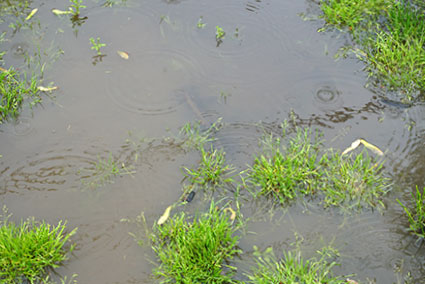
KANSAS CITY, Kan. (AP) — Residents of a Kansas City, Kansas neighborhood have filed a federal lawsuit over flooding during the summer of 2017 that accuses businesses and local officials of negligence.
The lawsuit filed earlier this month by five residents in the U.S. District Court for Kansas accuses the companies of leaving debris in a drainage creek west of the Argentine neighborhood. It also names the Unified Government of Wyandotte County and Kansas City, Kansas, as a defendant.
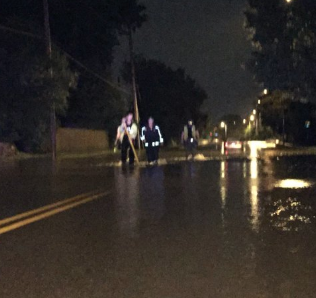
OPFD helping numerous people out of high water. Please don’t drive into water over the roadway! pic.twitter.com/mC68U7nkyZ
The lawsuit claims the debris clogged the creek, resulted in significant flooding and property damage and wasn’t cleared away until residents complained.
The Unified Government declined to comment. One of the companies being sued is the BNSF Railway and it said it was not responsible for the flooding.
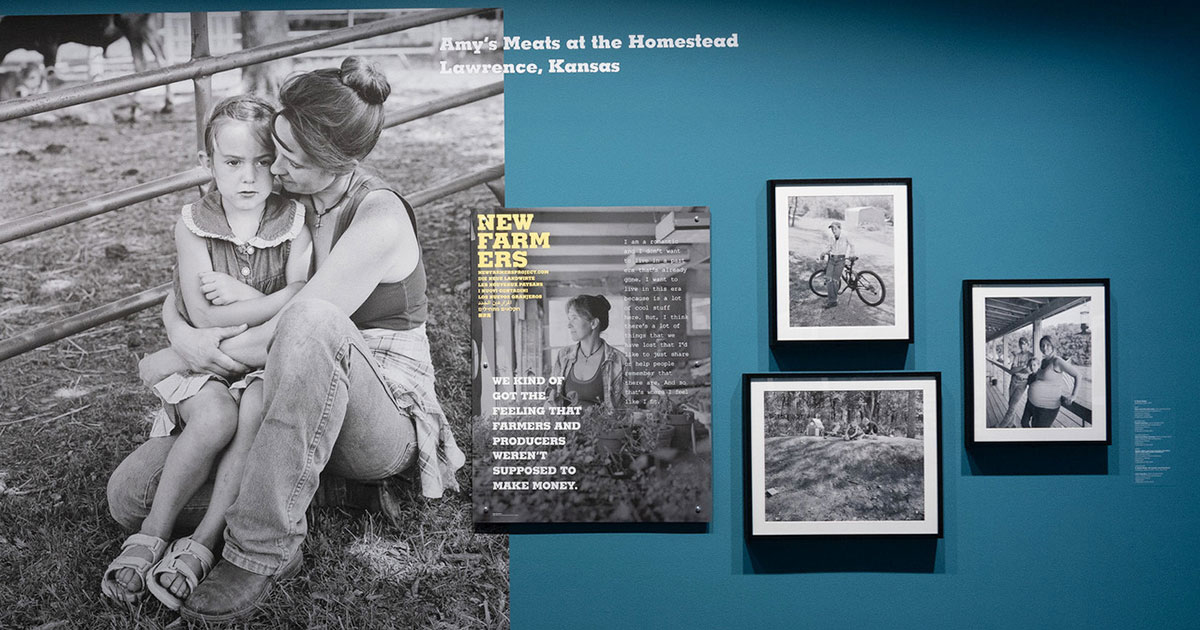
A panel from the Wichita Art Museum’s 2018 “New Farmers” exhibition featuring photographs by Bryon Darby, text by Paul V. Stock and design by Tim Hossler. (Credit: Kirk Eck)
KU NEWS SERVICE
LAWRENCE – Growing up on a farm and carrying on a family tradition is one thing. Taking on the trials of farming from scratch? That’s quite another.
The environmental and societal concerns that drive some 21st-century farm families away from cities and even divide them from their conventional-farming neighbors are the focus of the new book “New Farmers 2014/2018” (P&T Committee, 2019) created by a cross-disciplinary team of University of Kansas scholars.
The project had its genesis when Paul Stock, associate professor in the Department of Sociology and the Environmental Studies Program, met Bryon Darby, former KU assistant professor of photo media and now a lecturer in photography at Utah State University, a couple of years ago at a teaching seminar organized by KU’s Center for Sustainability.
Along the way, they were joined by Tim Hossler, associate professor of design, as designer.
Stock had just come to KU after spending years in New Zealand, studying how that South Pacific nation “went from being primarily a sheep-farming country to becoming the world’s largest dairy exporter.”
“I was working on a global scale, and I wanted to do something a little different, having just moved to Kansas and back to the Midwest,” Stock said. “I was interested in studying people that were getting into farming. Farming is hard. It’s hard to stay in; it’s hard to make money. Everything about it is hard. So what is going on with these people that are actively trying to get into it?”
Stock recalled Darby saying, “I’m really interested in photographing these new farmers, people who are at the farmers’ market. And I thought: That’s what I want to do.”
They launched the project that resulted first in gallery exhibitions and ultimately in “New Farmers 2014/2018.”
Darby and Stock set out first to interview and photograph Amy Saunders of Amy’s Meats north of Lawrence.
Stock credits Darby’s method of working for helping the subjects to open up about their feelings.
“Bryon set most of these up, and he’s like, ‘Can I come photograph you? And Paul’s going to come along, and we’re going to have a talk.’ He’s using this old-style view camera, with the cloth hood over his head and the whole deal. But the real gift of it to doing research is that it takes time. People have to stay real still … which lends itself really well to interviewing. With this way of shooting, they had to relax and be vulnerable.”
Stock and Darby branched out from there to other farmers’ market purveyors and beyond across eastern Kansas.
“It wasn’t just young farmers, and it wasn’t just brand new, because some of the people that were depicted in the book started farming 30 years ago, but they’re still mentoring people,” Stock said. “We asked them about their story of becoming a farmer. What was it that brought about that change in their identity?”
More than one farm family, Stock said, had come to agriculture from teaching.
“It’s not that radical a shift when you hear them talk about it, because it’s all about care and giving,” Stock said.
“New Farmers” is sort of a misnomer, Stock said, in that these farmers, even if not all are certified organic, are at least engaged in less technologically intense methods of raising food than a typical Midwestern row-crop farm with thousands of acres.
“They’re doing stuff that people around the world have been doing for thousands upon thousands of years,” Stock said. “The people we’ve spoken to are asking, ‘How do I live a good life? How do I live my best life with my family, with friends involved, with the community I care about?’ It’s hard. And we’re not going to make much money. But we’re going to be pretty happy and fulfilled.”
The “New Farmers” are not out trying to convert the world to their ways of thinking, living or agriculture, Stock writes in the book. They just want to be left alone to do things their own way. In this age of disputes over carcinogenic pesticides and right-to-repair-equipment laws, that may be harder than it seems at first blush.
Hossler said the combination of text and images he chose for the book “reflects a design history most notable from the Great Depression era, including photographers Dorothea Lange and Walker Evans, who worked closely with their writing collaborators. They are key examples of the book’s inspiration because of the specific combinations of text and imagery as well as the portrayal of farmers. The look of the book reflects those interests and the collaborative spirit of the project.”
Stock and Hossler said The Commons, a partnership among KU’s Biodiversity Institute, Hall Center for the Humanities and Spencer Museum of Art, and its director, Emily Ryan, played important roles in the evolution of the “New Farmers” project, including early research funding, gallery space and support for the book.
Hossler said many of the design choices reflected in the book were made when “New Farmers” started as a gallery exhibition. It returns to its exhibition form July 9-Aug. 11 for a display at the Lenexa City Hall Art Gallery.
“New Farmers 2014/2018” was recently named among the 50 best books and 50 best book covers of the year by Design Observer and AIGA, the professional association for design.
Register of Deeds Tonya Buckingham proposed offering the cards through her office as a way to combat people who falsely claim to be veterans.
The Sedgwick County Commission approved the plan on Wednesday. The cards will be free to veterans and Buckingham’s office will pay the costs. She expects to begin issuing the cards in about two weeks.
Buckingham says she got the idea from the Cook County deeds office in Chicago.
Sedgwick will be the first Kansas county to issue veteran ID cards.
McPherson – The Hays Eagle Senior American Legion went 1-1 in the first day of the Hooper Showcase in McPherson on Friday.
In the first game of the day the Eagles scored in all but one inning on their way to an 8-0 win over Pratt in fiving innings.
Hays got the scoring started in their half of the first inning when Cody Petersen drove in a pair of runs on a fielder’s choice putting the Eagles up 2-0.
They added single runs in both the second and third innings before blowing the game open with a four-run fifth for the 8-0 win.
Petersen drove in three and also earned the win on the mound. He allowed just three hits and struck out five in five shutout innings.
In game two Liberal jumped out to a 4-0 lead in the first inning with all four runs unearned.
The Eagles bats were held at bay until the sixth inning when Trey Riggs and Cody Petersen drove in a pair of runs on back-to-back doubles to cut the Liberal lead to 4-2.
Hays added their third run of the game in the seventh inning on a wild pitch but stranded a pair of runnners in scoring position as they fell 4-3.
William Sennett was the tough luck loser for Hays. He allow four unearned runs over six and two-thirds innings.
The Eagles are 14-5 and are scheduled to play two games on Saturday in McPherson.
WICHITA– A Kansas man pleaded guilty Wednesday to four commercial robberies, according to U.S. Attorney Stephen McAllister.
Kenneth W. Cade, 29, Wichita, Kan., pleaded guilty to four counts of robbery and one count of carrying a firearm during a robbery. In his plea, he admitted committing the following robberies:
Dollar General Store, 915 S. Glendale in Wichita, Nov. 22, 2017. Cade admitted pointing a gun at an employee and demanding money. C-Store, 837 S. Oliver in Wichita, Feb. 7, 2018. Cade admitted serving as a lookout while a co-defendant pointed a gun at an employee and demanded money. Arby’s, 4308 E. Harry in Wichita, Feb. 14, 2018. Cade admitted pointing a firearm at an employee and demanding money. Circle K Store, 515 N. Seneca in Wichita, Feb. 14, 2018. Cade admitted grabbing cash from a register after a co-defendant pointed a gun at an employee and demanded money.
Savannah Cole photo Butler Co.
Co-defendant Savannah Cole, 21, Wichita, is scheduled for a change of plea hearing June 24, 2019.
Cade is set for sentencing Sept. 6. Both parties have agreed to recommend Cade receive a sentence in a range from 144 months to 170 months in federal prison.
In the time I have spent in public service, I have been privileged to be a part of some important legislative changes and met some incredible people in the process.
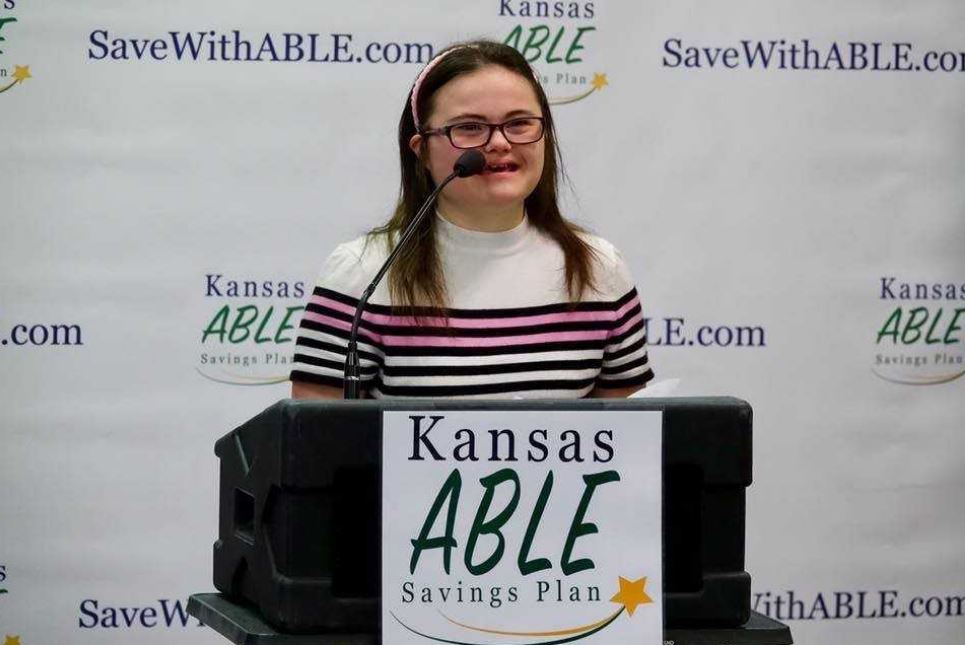
One of my favorite experiences that brings together both of these things happened in 2017 when I got to meet Rachel Mast. Rachel is a vibrant young woman who just finished her first semester of college, loves to be active in her community, and spreads her contagious enthusiasm for life to everyone she meets. She was also born with Down syndrome.
Rachel has the distinct honor of being the first individual to open a Kansas ABLE savings account, which became available just a few short years ago when my fellow legislators and I passed the ABLE Act through the Kansas Legislature.
ABLE accounts are new to Kansas and created specifically for people living with a disability. Those within the disabled community and the family members tied to the community often face the hardship of higher medical costs, along with other disability-related expenses. Prior to the ABLE Act’s passage, saving money was often a tricky issue for the disabled community. Saving more than $2,000 in one’s name could jeopardize that individual’s eligibility for necessary benefits such as SSI and Medicaid. ABLE accounts were designed to alleviate that savings restriction, and in turn give individuals living with a disability and their families the freedom to plan ahead and save for a more secure future without the worry of losing much needed public assistance.
Rachel Mast
An ABLE account for Rachel has allowed her to experience things in life that were previously financially out of reach. Rachel now attends college and is using the saved funds within the account to pay for parts of her higher education. Rachel now has a job where a portion of her earnings go into her ABLE account and her desire to work and earn an income is not limited by a $2,000 savings cap. Rachel now has an achievable dream where she can save a sizable amount of money in order to make a down payment on the pink house she’d like to own one day.
It has been very heart-warming from my vantage point now in the Kansas State Treasurer’s office, where we administer ABLE accounts, to see these accounts being opened and the disabled community feeling the relief of being able to save for the future. As awareness of ABLE accounts grows it is my hope that more and more families caring for a disabled family member will consider this path of saving.
For Rachel, ABLE has been a key to opening new doors that will assist her in living an independent and fulfilling life. We at the Treasurer’s office are excited to continue assisting more Kansans with opening ABLE accounts that we hope will allow them to live their best life as well.
For more information on how to get started with an ABLE account for yourself or a family member, please give our office a call at 785-296-7950.
PRATT – Kansas Wildlife, Parks and Tourism (KWPT) Commissioners met on June 13 at the Rolling Hills Zoo in Salina to conduct their 5th public meeting of the year. There, Commissioners voted on and approved deer season dates for select military installations, and the statewide antelope season.
Passing 7-0, Commissioners approved deer season dates for the following military installations:
Fort Riley
Youth and hunters with disabilities – Oct. 12-14, 2019
Firearm – Nov. 29-Dec. 1, 2019 and Dec. 14-22, 2019
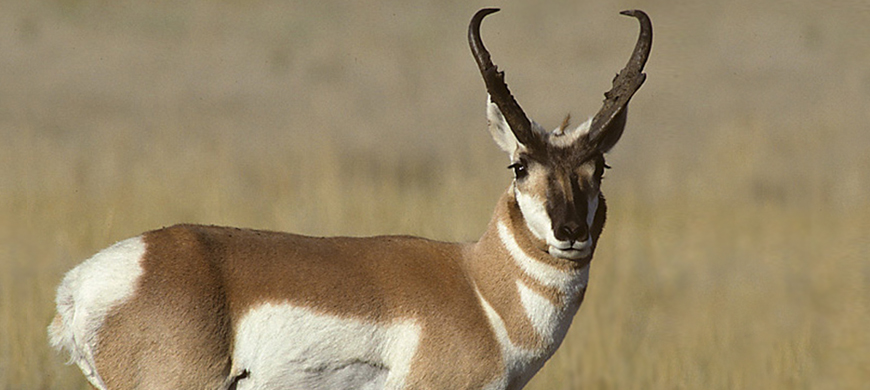
Commissioners also approved 2019 statewide antelope seasons as follows:
Archery – Sept. 21-29, 2019 and Oct. 12-31, 2019
Firearm – Oct. 4-7, 2019
Muzzleloader-only – Sept. 30-Oct. 7, 2019
The next KWPT Commission meeting is scheduled for Thursday, August 15, 2019 at the University of Kansas Edwards Campus – Best Conference Center, 12600 Quivira Road in Overland Park.
USD 489 was hosted its second-annual EdCamp Kansas in Hays on June 4 at Hays High School.
Area educators were given the ability to choose a variety of topics that piqued their interest throughout the course of the day.
Sessions included topics such as: flexible seating, elementary writer’s workshop, early childhood Seasaw, Google applications, PLC breakout groups, kindergarten readiness skills, student motivation, teacher organization, teacher self-care, various subject-based sessions, and several others.
Marie Henderson, instructional technology specialist, coordinated the event.
MANHATTAN — Farmers who planted cover crops on prevented plant acres will be permitted to hay, graze or chop those fields earlier than November this year, the U.S. Department of Agriculture (USDA) announced June 20.
USDA’s Risk Management Agency (RMA) adjusted the 2019 final haying and grazing date from November 1 to September 1 to help farmers who were prevented from planting because of flooding and excess rainfall this spring.
“I thank USDA for recognizing the impact the flooding and excess rainfall have had on farmers this spring,” said Kansas Secretary of Agriculture Mike Beam. “This adjustment will provide a new opportunity for some producers who are seeking alternatives in response to prevented planting because of excess moisture.”
RMA has also determined that silage, haylage and baleage should be treated in the same manner as haying and grazing this year. Producers can hay, graze or cut cover crops for silage, haylage or baleage on prevented plant acres on or after September 1 and still maintain eligibility for their full 2019 prevented planting indemnity.
“We made this one-year adjustment to help farmers with the tough decisions they are facing this year,” said Under Secretary for Farm Production and Conservation Bill Northey. “This change will make good stewardship of the land easier to accomplish while also providing an opportunity to ensure quality forage is available for livestock this fall.”
Other USDA Programs Other USDA agencies are also assisting producers with delayed or prevented planting. USDA’s Farm Service Agency (FSA) is extending the deadline to report prevented plant acres in select counties, and USDA’s Natural Resources Conservation Service (NRCS) is holding special sign-ups for the Environmental Quality Incentives Program in certain states to help with planting cover crops on impacted lands. Contact your local FSA and NRCS offices to learn more.
Grow Hays invites the public to attend TriSpective on Monday BriefSpace, 219 W. 10th.
Similar to TED Talks, the speakers will each focus on a topic. Dallas Haselhorst, owner of Treetop Security, will address entrepreneurship. Kieran Windholz, Equity Bank Lender will discuss moving home and Gina Riedel, owner of Gina Riedel Results, will talk on succession planning.
Doors will open at 5:30 p.m. with the event starting at 6 p.m.
TriSpective is a part of the Robert E. Schmidt Entrepreneurship Series sponsored by Robert E. and Patricia A. Schmidt Foundation.
For questions or more information contact Grow Hays at 785.628.3102 or [email protected].