We have a brand new updated website! Click here to check it out!

FIRST FIVE: Losing our core freedoms by not knowing we have them

Gene Policinski

Ignorance may well have been bliss to 18th-century English poet Thomas Gray, but in 2019, widespread ignorance of our core freedoms and how our government functions is just plain dangerous.

A just-released Survey of Civic Literacy, conducted by the American Bar Association (ABA) and released May 1 to mark national Law Day, finds many of us do not know much about either subject.

The survey’s theme and the ABA’s Law Day focus was on “Free Speech, Free Press, Free Society.” The survey findings are generally in line with the Freedom Forum Institute’s annual State of the First Amendment survey, conducted since 1997: Many — sometimes a majority — of us get our rights “wrong.” History tells us that if we are not aware of our freedoms, it is that much easier to lose them.

There is some good news in the results, particularly in strong support for free speech: More than eight of 10 respondents of the 1,000-person sampling said we should be able to publicly criticize a president or any other government leader and that we should have the right to ask for government records and information. Three of four agree the government should not be able to restrain the press in reporting on political protest.

Then there are these findings:

  • 18 percent don’t know freedom of the press or the freedom of assembly are elements of the First Amendment;
  • 30 percent of respondents believe freedom of speech applies only to U.S. citizens rather than correctly to all in this nation;
  • 23 percent said Ruth Bader Ginsburg is chief justice of the U.S. Supreme Court; just 49 percent correctly said it’s John Roberts;
  • 18 percent thought the first 10 amendments to the U.S. Constitution are called the Declaration of Independence; 75 percent correctly identified them as the Bill of Rights.

It is reassuring that 88 percent of respondents know that the government does not have the “right to review what journalists write before it is published,” but that means more than 10 percent wrongly believe government does have a right to censor.

Again, it is good that a strong majority sees no problem in openly criticizing public officials. But nearly 20 percent are opposed or unsure whether or not we should have that right, which is more than unsettling — it’s sizeable doubt about a core principle of what it means to be an American.

Sometimes the ignorance shown in the survey concerns current law: 54 percent said there is no free speech right under the First Amendment to burn a U.S. flag in political protest. In fact, in a 1989 decision, Texas v. Johnson, the U.S. Supreme Court said just the opposite, setting up flag burning as a demonstration to the world of our commitment to freedom of expression.

The ABA’s survey is just the latest demonstration of the need for a new national campaign by schools and civic and professional groups to educate our citizens about the meaning and importance of the role and purpose of First Amendment freedoms and, beyond that, how our government works — and why it works.

Without that effort, the warning signs are in – thanks to the ABA’s survey and others – that we could lose our basic freedoms, our representative form of self-government and undermine the basic rule of law for simply the sorrowful, sad, embarrassing reason that many of us simply will not know, or perhaps even care, that they are gone.

[The ABA Survey of Civic Literacy 2019 is available at: https://www.americanbar.org/news/reporter_resources/civic-knowledge-survey/]

Gene Policinski is president and chief operating officer of the Freedom Forum Institute and an introductory speaker at the May 1 release of the ABA’s Survey on “Free Press, Free Speech, Free Society.” He can be reached at [email protected], or follow him on Twitter at @genefac.
NORLIN: Justice … more than just us

David Norlin, Salina.

Pity the poor public servant.

Legislators, Commissioners, and agency managers must sort facts and opinions to make the best decisions for the public good.  It is critical to hear from the public — and then sort through those comments carefully, thoughtfully, and compassionately.

They’ll get advice.  Some good, thoughtful, constructive.  And some mean-spirited, resentful, and cringe-worthy.  The latter often emanates from people claiming the mantle of stern adult responsibility, bent on teaching what, for them, pass as Christian values.

Consider two citizen commenters at a Saline County hearing on a possible new Salina jail.  One cited the Bible encouraging use of “the rod of discipline.” For him, jail seems “too comfortable.”  Three meals a day, warm in winter, cool in summer free medical, no work required, TV—all were seen as coddling.   So, to make jails really rehabilitate, we’ll just shut down air conditioning in 100+ degree temps.

“Known murderers” (disregarding recent examples of false convictions) should be executed “in a timely manner.”  God’s word in Genesis so decrees, said he.  His solution?  Teach his version of religion in schools.

Another cited excess alcohol use and drug abuse as choices, not diseases.  Despite all evidence to the contrary, including the US’ No. 1 standing as incarcerator-in-chief,  he cited the “social experiment of the past 60 years’ as ’soft on criminals’” and “the biggest failure this country has ever seen.”  Again, air conditioning, heat and three meals a day became soft, coddling measures to be dispensed with.

Where does one begin responding to such illogic and incitement to riot? First impulse is to shrug off these sentiments as aberrations and dismiss them.  But these attitudes constitute a canary in our coal mine.

Though not as extreme, other similarly dismissive, jarring attitudes are impacting public policy as we speak. Sadly, they come from public servants themselves, not the testifying public.

And here, pity for public servants comes to a screeching halt.

Case in point: the KS ledge’s last days.  As Kansas Interfaith Action so clearly spells out, “Medicaid Expansion ……[is] a clear moral imperative, and its failure to pass is not just a disappointment, it’s an injustice. . . . . The failure to hold hearings, the refusal to allow a vote in the Senate, are nothing less than moral failures, and blame for them rests solely at the feet of House and Senate leadership.”

On top of that, another large tax cut was passed, replacing the one vetoed by the Governor.  Says KIFA, “The fact that a big tax cut that will largely benefit multinational corporations and the wealthiest Kansans can pass, but a policy that will help working people, and is supported by 70% of Kansans, by a majority of the legislature and by the governor, cannot, shows how twisted the priorities of legislative leadership were this session.”

Now, 150,000 Kansans are denied access to health insurance, and approximately 627 Kansans may die this year in the absence of expansion. “Justice delayed is {not just] justice denied,” says KIFA, “[it] is life denied.”

KIFA’s life-affirming, compassionate, faith-tradition-taught values stand in stark contrast to the pious, judgmental, punitive attitudes displayed in the latest legislative last-minute games.  Adhering to the best of our religious values means revering and supporting all our fellow creatures.

Attitudes to the contrary must be called out at their root, in public meetings, on-air or in-print, in social media, in private conversations, and at the ballot box.

Those adopting such attitudes should not be allowed in positions where their rhetoric becomes reality.

Allowing that to happen is immoral and, well … un-Christian.

David Norlin is past Chairman of the Salina Planning Commission, former President of Salina Access TV, and an occasional Salina Journal columnist. He is a retired College English Department Chair and Director of Broadcasting. He has twice run for the Kansas Legislature.

4 jailed for attempted robbery at Kan. State Fairgrounds RV park expected in court

RENO COUNTY – Law enforcement authorities are investigating an attempted robbery and the four suspects allegedly involved are expected to be in court this week.

Kerrah Shulze, Blaine White, Kaleb Beard and Richard Fenters photos Reno Co. Sheriff

Just after 4:30p.m. Friday police were dispatched to the Kansas State Fairgrounds for an active shooter with a “machine gun.”

Armando Castillo Jr, of Mineral Wells, Texas reported being confronted by four individuals while inside his 5th wheel camper. He was battered but was able to grab a firearm he had hidden in the camper. Castillo fired several shots to try and get the neighbors to call 911.

Everyone involved was still on scene when officers arrived. No injuries were reported due to gunfire. During the investigation, it was discovered that the suspects came to Castillo’s camper to get cash.

Police arrested four suspects identified as 22-year-old Kaleb Schyler Beard, 23-year-old Kerrah Schulze, 20-year-old Richard Fenters and 22-year-old Blaine White all of Wichita. They were jailed on requested charges of attempted aggravated robbery, according to the release. Three had bonded out of jail. Fenters was still in custody, according to online jail records.

Hays schools see spike in vaping; USD 489 board clarifies nicotine policy

By CRISTINA JANNEY
Hays Post

As the school year nears a close, administrators at Hays High School and Hays Middle School both said they have seen a spike this year in vaping referrals at the schools.

Neither HMS Principal Tom Albers nor HHS Assistant Principal John Linn had exact number of referrals they have received as a result of vaping, but both agreed the number of students using nicotine products at school has increased.

The 2017 Kansas Youth Risk Factors Survey shows one in three (or 34.8 percent) Kansas high school students have tried e-cigarettes and one in 10 (or 10.6 percent) were current users.

In light of the jump the Kansas State Board of Education will receive a presentation on vaping during its regular May meeting on Tuesday.

HHS is seeing very few referrals for traditional tobacco products, such as cigarettes or chewing tobacco, Linn said.

A Juul electronic cigarette / Wikipedia Commons

Easy to conceal

Linn said the most common devices he finds students using are Juuls, which is specific brand of vape device. The Juuls tend to be small, easy to conceal and sometimes resemble flash drives.

“I will be honest with you. I didn’t even know Juuls existed until the last couple of years,” he said, “and these things have just blown up.”

Albers said the vaping devices are easier for students to conceal than traditional tobacco.

“The one thing about cigarettes is that you can’t really do that without people seeing and smelling,” he said. … “Vape ends up being something that is easy to hide. It doesn’t produce smoke. It just produces a vape. It is really hard to see or find.”

Education lacking

Both administrators said despite information sent out to district patrons earlier this year about vaping as well as education in health classes, many students and parents are still not aware of the dangers of vaping.

“When I talk to our kids, it is more about trying to fit in,” Linn said. “I get very little about ‘I am trying to quit smoking so this is the best alternative to do that.’ You try to tell them no its not because it has the same amount of nicotine in those substances as a pack of cigarettes.”

Linn said he didn’t think students think about the addictive nature of nicotine when they vape.

“I think they think it is a safer alternative than smoking,” he said. “There has been multiple times this year that I have talked to students about vaping and these issues and asked them specifically, ‘Do you even know what you are sucking into your lungs? Do you even know what it is?’ You would be amazed about how many of them tell me no. They don’t know what it is. It just tastes good.”

Albers said companies are marketing to kids with sweet flavors. They also manipulate the amount of nicotine in vape pods. One pod can have the same amount of nicotine as three and half packs of cigarettes.

“Kids become addicted whether they realize it or not,” he said.

Most parents Linn said he has talked to are aware their children have tried vaping, but may not be aware they have a vaping device and are vaping on a regular basis.

“Again it comes back to education and letting them know it is the same issue as any type of tobacco product,”‘ Linn said. “It has nicotine, and that’s addictive. It is not good for students of this age whose brains are developing like they should.”

Health dangers of vaping

Dr. Michelle Pope, Hays pediatrician, spoke to TMP students last spring about the dangers of vaping.

Not only is the nicotine you can consume through vaping dangerous, but so are other chemicals and heavy metals you take into your lungs when you vape, she said.

Vaping liquids are loosely regulated by the federal government and 95 percent of the juices are made in China.

Vaping in teens can permanently stunt lung development. Nicotine, specifically, can cause cancer, is addictive and damaging, especially to the adolescent brain. It can also cause heart attack and stroke, Pope said.

School nicotine policy includes vaping

The Hays USD 489 school board passed revisions to its tobacco policy at its April 29 meeting. Superintendent John Thissen said the changes clarify what nicotine products are banned at the school.

This includes “any device that can be used to deliver nicotine or nicotine salts to the person inhaling from the device. Such definition shall include, but may not be limited to, any electronic cigarette, cigar, cigarillo, pipe or personal vaporizer.”

Vaping is banned not only in schools during school hours, but in any district facility; in school vehicles; at school-sponsored activities, programs, or events; and on school owned or operated property. The policy is the same for both school employees and students.

The consequences of vaping at school

For students, the policy goes on to discuss the consequences for students caught with nicotine or tobacco products.

According to the policy, “Student violations may result in parent/guardian notification, participating in tobacco education program, suspension and/or expulsion from school and/or extracurricular activities, community service, and/or notification of law enforcement.”

Linn said standard discipline at HHS for students caught with vaping devices or tobacco products is an automatic two-day in-school suspension. If the student is younger than 18, the police are contacted. If students are caught subsequent times, the disciplinary action can be heightened, Linn said.

“This is really frustrating, because the devices have changed so much. They are so difficult to detect,”Linn said. “I can search bags and all that kind of stuff, but if they hide it on themselves, it is very difficult to find sometimes. The companies have made it really easy for the students to use them and hide it.

“We do take it very seriously, and hopefully, we can get some kids to think before they do something like that.”

Irvin wins impressive debut as Phillies beat Royals

KANSAS CITY, Mo. (AP) – Cole Irvin was outstanding in his major league debut and the Philadelphia Phillies scored six times in the fifth inning to beat the Kansas City Royals 6-1 on Sunday in the rubber match of their three-game series.

J.T. Realmuto hit a two-run double and Odubel Herrera followed with a two-run single for Philadelphia.

Irvin (1-0) threw seven innings of one-run ball, allowing five hits with one walk and five strikeouts. Seranthony Dominguez and Juan Nicasio each tossed a scoreless inning to close it out for the 25-year-old lefty.

Kansas City has lost 12 consecutive rubber games, a streak that stretches back to May 30 last year, when the Royals took two of three against Minnesota.

Irvin’s strong start continued an impressive run by Philadelphia’s rotation. Over their last 15 games, Phillies starters have a 2.36 ERA – second-best in the majors during that span.

Royals starter Jakob Junis (3-4) cruised through four innings but fell apart in the fifth. After Nick Williams reached on an error with one out, Junis walked three of the next four batters, the last one chasing him from the game.

Realmuto greeted Richard Lovelady with a first-pitch double down the right field line and Herrera hit his two-run single two pitches later. Herrera and Jean Segura each had two hits for the Phillies, and Andrew McCutchen was on base four times via three walks and a single.

Despite allowing just three hits, Junis was tagged for five runs due primarily to five walks. Free passes were an issue all weekend for Royals pitchers, who walked 18 batters during the three-game set.

Alex Gordon brought home the Royals’ only run with an RBI single in the third. After the umpires initially ruled Billy Hamilton was thrown out at third base before Cam Gallagher crossed the plate, a replay review showed Hamilton beat the throw. Hamilton and Gordon had two hits apiece for Kansas City.

ROSTER MOVES

Before the game, the Phillies called up Irvin optioned LHP Austin Davis to Triple-A Lehigh Valley. Davis had been recalled on Saturday.

UP NEXT

Phillies: RHP Aaron Nola (3-0, 4.57 ERA) starts Monday night against Milwaukee in the opener of a seven-game homestand. Nola has given up just one run in each of his last three outings.

Royals: LHP Danny Duffy (1-1, 3.06 ERA) makes his fourth start of the year Tuesday night against Texas. Duffy held Houston to two runs over six innings in his last outing to earn his first win of the season.

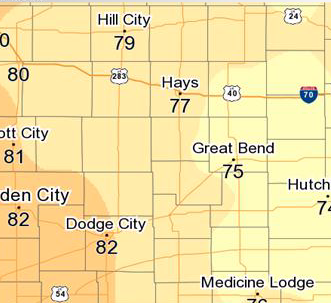
Sunny, mild Monday

Monday Sunny, with a high near 77. South southeast wind 5 to 13 mph.

Monday Night Partly cloudy, with a low around 53. South southeast wind 6 to 11 mph.

Tuesday Sunny, with a high near 86. South southeast wind 5 to 7 mph.

Tuesday NightPartly cloudy, with a low around 56. South southeast wind around 7 mph becoming east after midnight.

WednesdaySunny, with a high near 85.

Wednesday NightPartly cloudy, with a low around 60.

ThursdaySunny, with a high near 86.

Update: Several weekend earthquakes reported in Rooks County

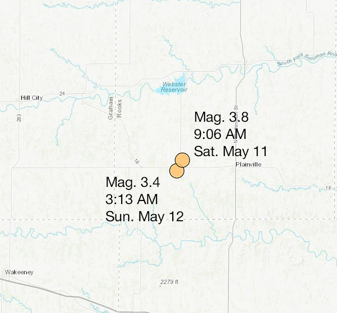
ROOKS COUNTY—Several earthquakes shook Rooks County over the weekend.

According to the Kansas Geological Survey, the two largest were magnitude 3.8 at 9:06a.m. Saturday and a magnitude 3.4 at 3:13a.m. Sunday. The United State’s Geological  Survey also reported a 2.6 magnitude quake centered 8 miles northwest of Plainville on Sunday.

These are among the first reported quakes in Kansas since a 2.6 magnitude quake in Saline County on March 21.

The Rooks County Sheriff’s office reported they received no calls about the weekend quakes and there were no other calls of damage or injury.

———–

ROOKS COUNTY — A small earthquake shook northwest Kansas Sunday. The quake just after 3 a.m. measured a magnitude 2.6 and was centered approximately 8 miles northwest of Plainville, according to the U.S. Geological Survey.

These are among the first reported quake in Kansas since a 2.6 magnitude quake in Saline County on March 21.

There are no reports of any damage or injury from Sunday’s quake.

Kan. man pretended to be FBI agent to get out of traffic ticket

WICHITA, KAN. – A Kansas man pleaded guilty to trying to get out of a traffic ticket by pretending to be an FBI agent, according to U.S. Attorney Stephen McAllister.

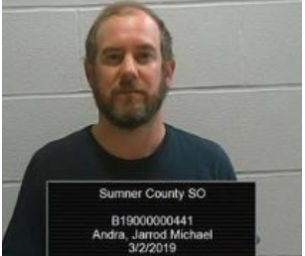
Andra photo Sumner Co.

Jarrod M. Andra, 36, Milan, Kan., pleaded guilty to one count of impersonating an agent. In his plea, he admitted that on Nov. 30, 2018, he was stopped for speeding in Sumner County by a Sumner County Sheriff’s Deputy. Andra claimed he was a special agent for the FBI and presented what appeared to be an FBI identification card with his photo.

Sentencing is set for July 31. Both parties are expected to recommend a sentence of probation and a $1,000 fine.

Man accused of killing cats he found on Craigslist

ST. PETERS, Mo. (AP) — A man is charged with felony animal abuse after authorities say he killed and dismembered cats he found in online want ads.

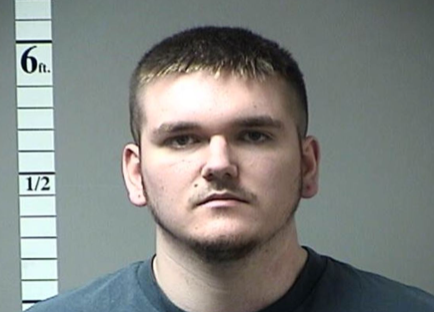
Louzader photo St. Charles Co.

20-year-old Kaine Louzader was charged Friday. Prosecutors say more charges are expected.

Court documents say dead cats have been turning up on or near Louzader’s street outside St. Peters since January. Police contacted Louzader after someone reported seeing him dump a dead cat near his house.

St. Charles County police Sgt. Jeff Ochs says Louzader told police he would scour Craigslist ads for free cats, then would take them home and stomp or strangle them. Police say he dismembered some cats before dumping their remains.

Louzader is being held on $50,000 bond and could not be reached Saturday for comment. No lawyer is listed for him in online court documents.

Nonprofit names Kansas boy ‘hero’ after road rage shooting

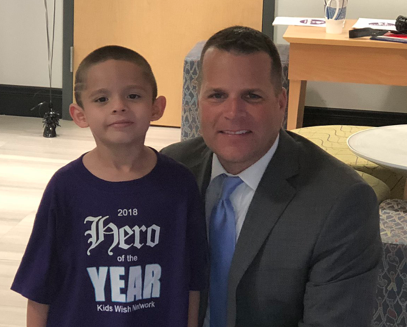
WICHITA, Kan. (AP) — A Wichita boy who was wounded in a road rage shooting last fall has been named the hero of the year at the children’s hospital where he recovered from a stray bullet that shattered his hip bone and lacerated his liver and kidney.Wesley Children’s Hospital held a ceremony Tuesday that honored Andres Arambula as Kids Wish Network’s hero of the year.

“A very special hero, (Andres) is a courageous little boy who has been through the fight of his life,” said Josh Santiago, marketing manager of Kids Wish Network. The national nonprofit serves children with exceptional medical circumstances.

Police said Andres was among six children inside a sports utility vehicle that was shot at twice by 19-year-old Tylin Atkinson in downtown Wichita on October 17. Investigators determined that the shooting stemmed from a road rage incident.

Atkinson and Ramonyka Smith, 21, have been charged with criminal discharge of a firearm in the shooting. Atkinson also faces an aggravated assault charge. They both remain in Sedgwick County Jail.

Andres, who was 4 at the time, was taken to the hospital in critical condition and had to undergo surgery to remove the bullet and repair his diaphragm and organs. He also went through pain management and physical therapy to help him walk again.

“Andres is not just a hero, but (also) a miracle, because he survived this and dealt with this pain,” said his mother, Lucero Arambula.

The Kids Wish Network gave Andres gifts and a $5,000 check. The organization also donated a pallet of toys worth $20,000 in his name to the Kansas Children’s Foundation.

MCALLISTER: A debt of gratitude to 3 Kansas law enforcement officers who died

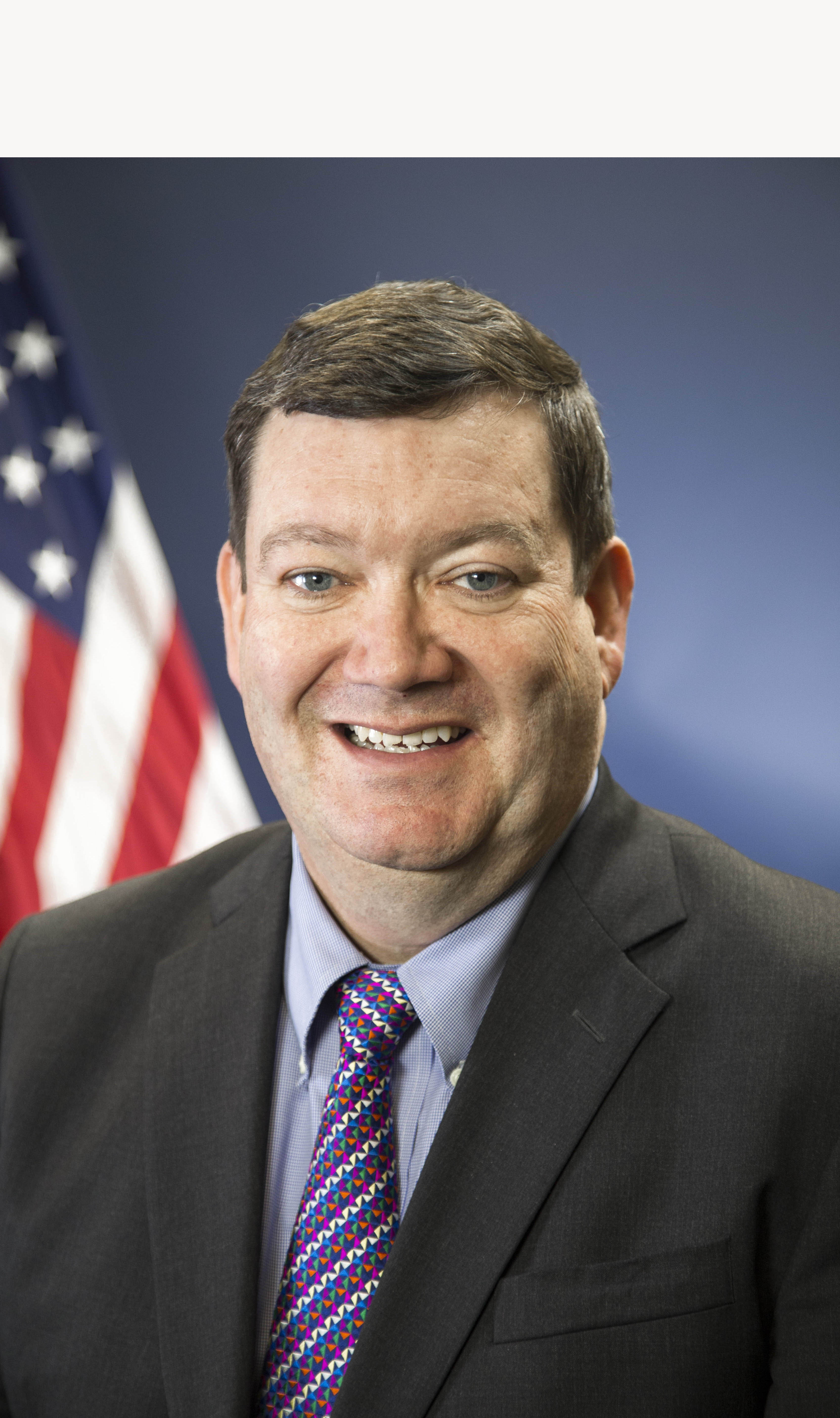
Stephen McAllister, U.S. Attorney for Kansas

We all owe a debt of gratitude to three Kansas law enforcement officers who sacrificed their lives for the safety and protection of others.

National Police Week is May 12 to May 18.

The names of Sedgwick County Sheriff’s Deputy Robert Kunze and Wyandotte County Sheriff’s Deputies Theresa King and Patrick Rohrer will be added to the National Law Enforcement Officers Memorial in Washington, D.C., during a ceremony May 13.

“We must never forget these brave officers,” McAllister said. “We will strive to be worthy of the sacrifices they made for us and to carry on their dedication to law enforcement. I invite the public to join our office in showing support for their families and their fellow officers.”

King and Rohrer were shot to death June 15, 2018, in Kansas City, Kan., while transporting prisoners between jail and court. Kunze was shot to death Sept. 16, 2018, during an arrest in western Sedgwick County.

According to the FBI, 55 law enforcement officers died in 2018 from injuries received during felonious incidents

Victim officer profile:

  • Average age: 37 years old
  • Average length of service: 10 year
  • Gender: 52 male, 3 female

For more information, see of the FBI report Law Enforcement Officers Killed and Assaulted, 2018 at https://ucr.fbi.gov/leoka/2018/.

Stephen McAllister is the U.S. Attorney for Kansas.


5th farmer pleads guilty in massive organic grain fraud case

CEDAR RAPIDS, Iowa (AP) — A fifth farmer has pleaded guilty to his role in an organic grain fraud scheme that involved at least $140 million in sales of grain.

John Burton, of Clarksdale, Missouri, pleaded guilty Friday to one count of conspiracy to commit wire fraud, as part of a plea agreement with federal prosecutors.

Burton, 52, admitted that grain grown on his non-organic fields was marketed and sold as organic and that unapproved substances were used on fields certified as organic. Federal prosecutors are seeking to require that he forfeit $2.2 million that was traced to the scheme.

Burton’s plea comes months after one of his associates, 61-year-old Randy Constant of Chillicothe, Missouri, pleaded guilty to charges alleging he masterminded the scheme.

Constant made many of the fraudulent sales through an Iowa grain brokerage that he owned. Three other Nebraska farmers have also pleaded guilty in the case.

More ‘heartbeat’ abortion bans advancing in South, Midwest

By RUSS BYNUM Associated Press

If a new Mississippi law survives a court challenge, it will be nearly impossible for most pregnant women to get an abortion there.

Or, potentially, in neighboring Louisiana. Or Alabama. Or Georgia.

The Louisiana legislature is halfway toward passing a law — like the ones enacted in Mississippiand Georgia— that will ban abortions after a fetal heartbeat is detected, about six weeks into a pregnancy and before many women know they’re pregnant. Alabamais on the cusp of approving an even more restrictive bill.

State governments are on a course to virtually eliminate abortion access in large chunks of the Deep South and Midwest. Ohio and Kentucky also have passed heartbeat laws; Missouri’s Republican-controlled legislature is considering one.

Their hope is that a more conservative U.S. Supreme Court will approve, spelling the end of the constitutional right to abortion.

“For pro-life folks, these are huge victories,” said Sue Liebel, state director for the Susan B. Anthony List, an anti-abortion advocacy group. “And I think they’re indicative of the momentum and excitement and the hope that’s happening with changes in the Supreme Court and having such a pro-life president.”

For abortion rights supporters, meanwhile, the trend is ominous. Said Diane Derzis, owner of Mississippi’s sole abortion clinic, the Jackson Women’s Health Organization: “I think it’s certainly more dire than it ever has been. They smell blood and that’s why they’re doing this.”

Already, Mississippi mandates a 24-hour wait between an in-person consultation. That means women must make at least two trips to her clinic, often traveling long distances.

Other states have passed similar, incremental laws restricting abortion in recent years, and aside from Mississippi, five states have just one clinic — Kentucky, Missouri, North and South Dakota, and West Virginia. But the latest efforts to bar the procedure represent the largest assault on abortion rights in decades.

Lawmakers sponsoring the bans have made it clear their goal is to spark court challenges in hopes of ultimately overturning the 1973 Roe v. Wade decision legalizing abortion.

Those challenges have begun. Derzis’ attorneys are scheduled to go before a judge on May 21, seeking to prevent Mississippi’s heartbeat law from taking effect July 1.

A judge in Kentucky blocked enforcement of that state’s heartbeat ban after the American Civil Liberties Union filed suit on behalf of the clinic in Louisville.

Similar legal action is expected before bans can take effect in Ohio and Georgia, where Republican Gov. Brian Kemp signed the latest heartbeat bill into law Tuesday. Kemp said he welcomed the fight, vowing: “We will not back down.”

Georgia’s ban doesn’t take effect until Jan. 1. But the impact was immediate.

An abortion clinic operated by The Women’s Centers in Atlanta began receiving anxious calls from patients soon after Kemp signed the law. Many callers had plans to travel from outside the state for abortions. Georgia’s heartbeat ban would have a wider impact because the state has 17 abortion clinics — more than the combined total in the other four Southern states that have passed or are considering bans.

“On a typical day we will see people from North Carolina, Tennessee, Alabama, South Carolina — all over the region,” said Dr. Lisa Haddad, the Atlanta clinic’s medical director. “And my thought is we’re not going to see those people coming here because they assume it’s already illegal in Georgia.”

Dr. Ernest Marshall, co-founder of Kentucky’s last remaining abortion clinic in Louisville, said in an email that banning abortions before most women know they’re pregnant would “have a disproportionate impact on poor women and communities of color throughout the South.”

Advocates for abortion rights expect judges to halt enforcement of any new bans while lawsuits work their way through the courts. That could take years.

“These laws are blatantly unconstitutional,” said Elisabeth Smith, chief counsel for state policy and advocacy for the Center for Reproductive Rights, which also has filed suit over Mississippi’s ban. “But if they were allowed to go into force, they would have devastating consequences for the residents of all of these states.”

If heartbeat bans are upheld, many women who are poor and have limited means to travel would have few options other than to try to terminate their own pregnancies, Haddad said, possibly using abortion drugs purchased online.

Others would have to drive or fly across multiple states, said Elizabeth Nash, a state policy analyst for the Guttmacher Institute, a research group that supports abortion rights.

“People would go to Florida, people would continue to go to Memphis,” Nash said. “How many states do you have to cross before you can access abortion services? It exacerbates all the issues we’ve already seen around taking time off from work and having the money to travel.”

Proposed heartbeat bans failed to pass this year in several Republican-led states, including Texas. There, GOP lawmakers lost ground to Democrats in the 2018 elections, and some abortion foes were wary after courts struck down prior abortion restrictions in the state. Such efforts also fell short in Florida, South Carolina, Tennessee and West Virginia.

Alabama lawmakers postponed until next week a vote on a proposal that would make performing nearly all abortions a felony. The measure has passed the state House, and the Senate suspended debate Thursday amid a heated dispute over whether exemptions for rape and incest should be stripped from the bill.

“You can’t put a price on unborn life,” Eric Johnston, president of the Alabama Pro-Life Coalition, said Wednesday, as a legislative committee heard testimony on the state’s proposed ban. “What you have to do is protect the people that live in this state and that includes unborn children.”

But Jenna King-Shepherd told Alabama lawmakers she believed the abortion she had at age 17 allowed her to finish college. She said her father, a part-time Baptist preacher furious about her pregnancy, drove her to the abortion clinic because he trusted her to make the right choice.

“I’m not asking you to support access to abortion,” King-Shepherd said. “I’m only asking you to let women, their families, their physicians and their God make this decision on how they want to start their families in private and trust them to do that.”


Copyright Eagle Radio | FCC Public Files | EEO Public File