We have a brand new updated website! Click here to check it out!

FHSU Center for Entrepreneurship to host $10,000 business plan competition

HAYS – The Center for Entrepreneurship at Fort Hays State University will host the Faulkner Challenge on March 30 at the W.R. and Yvonne Robbins College of Business and Entrepreneurship. Fort Hays State students and residents of a 26-county area of northwest Kansas are eligible to compete for $10,000 in prizes.

The event begins at 9 a.m. Saturday, March 30, in McCartney Hall, home of the Robbins College, on the Fort Hays State campus. Admission is free for participants and the public.

The Faulkner Challenge is made possible by the generosity of alumnus, Kevin Faulkner. It is a business plan competition for new, independent proposed ventures in the conceptual, seed or startup stages.

Entries will be accepted until the March 20 deadline. The eight best business plans will be selected as finalists to present on the Fort Hays State campus. Finalists will deliver 10 minute presentations to a panel of judges, and the top three business projects will split the $10,000 in prize money into awards of $6,000, $3,000, and $1,000, to first, second, and third places, respectively.

“It will be an exciting event on our campus to showcase the creativity and entrepreneurial spirit of our students and the Kansans of this region”, said Dr. David Snow, the director of entrepreneurship for FHSU. “This is meant not only to be a fun event for all involved, but a contribution to economic development in northwest Kansas and a boost for those early-stage entrepreneurs.”

The eligibility area comprises the 26 northwest Kansas counties stretching from Cheyenne down to Wallace County, east through the top three tiers of counties and then into the eight-county block from Jewell and Republic down through Ellsworth and Saline.

Plan presentations begin at 9 a.m. and run through 12:15 p.m. A luncheon will go from 12:15 to 12:45 p.m. The judges feedback session will run from 12:45 to 1:15 p.m. Awards presentations begin at 1:15 p.m. and end at 1:30 p.m.

For more information about the Faulkner Challenge, visit https://www.fhsu.edu/cob/faulkner-challenge

For free tickets to watch the event: https://www.eventbrite.com/e/faulkner-challenge-tickets-55640862317?aff=ehomecard

For more information about the FHSU Center for Entrepreneurship, visit https://www.fhsu.edu/cob/entrepreneurship

Police arrest Kansas felon for alleged armed robbery

SHAWNEE COUNTY  – Law enforcement authorities are investigating a robbery and have a suspect in custody.

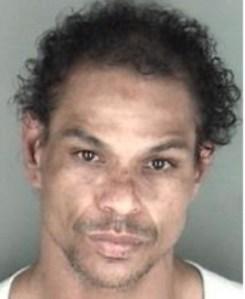
Cowan -photo Shawnee Co.

Just before 3p.m. Sunday, police were dispatched to 904 SW Lincoln in Topeka in reference to an aggravated robbery to an individual, according to Lt. Robbie Simmons.

Officers located someone matching the description of the suspect at 8th and SW Fillmore. This suspect attempted to flee and elude officers but was captured shortly thereafter.

This suspect was identified as 48-year-old Christopher Cowan. He was found to be in possession of a firearm and methamphetamines. Cowan was transported to Shawnee County Department of Corrections of requested  charges of Felon in Possession of a Firearm and Obstruction. The robbery is still under investigation, according to Simmons.

Cowan has seven previous convictions that include possession of burglary tools, unlawful possession of firearms, violation of offender registration, flee and attempt to elude police, DUI and drugs, according to the Kansas Department of Corrections.

This is the 12th case in 2019 with a charge involving a felon in possession of a firearm reported by the Topeka Police Department.


Hays farmers’ market workshop Feb. 22

KDA

MANHATTAN — The Kansas Department of Agriculture, K-State Research and Extension and the Kansas Department of Health and Environment will host a regional workshop in Hays on Friday, Feb. 22, at the K-State Agricultural Research Center. This is one of six regional workshops which are being held this winter to assist farmers’ market vendors and managers.

Kansas farmers’ markets not only provide a fresh food source, but also stimulate the local economy. In 2018, 95 farmers’ markets were registered with KDA’s Central Registration of Farmers’ Markets.

“Farmers’ markets provide growers a wonderful opportunity to have real interaction with consumers, and a chance to tell their farm’s story,” said Londa Nwadike, consumer food safety specialist with K-State Research and Extension and the University of Missouri. “It’s also important for farmers to understand certain legal, safety and financial parameters before choosing to sell at a farmers’ market.”

A keynote presentation will feature tips on marketing and making a profit, and a panel will provide information selling to institutions such as restaurants, groceries and schools. KDA’s weights and measures program will also offer free scale certification for attendees. Workshop topics will include:

• Pest Control Methods, Cover Crops and Soil Health
• Regulations for Selling Meat, Eggs and Poultry
• SNAP Program and Sales Tax for Vendors
• Specialty Crops and Produce Safety
• Kansas Senior Farmers’ Market Nutrition Program Training

The workshop will be held at the K-State Agricultural Research Center, 1232 240th Ave. in Hays. Onsite registration will open at 8:30 a.m. and the workshops will begin at 9:00 a.m. and conclude by 3:00 p.m. Registration for this workshop is now open and is $20 per participant. Registration includes lunch; however, lunch will only be guaranteed to those participants who register by Feb. 14. Registration forms can be found at FromtheLandofKansas.com/FMWorkshop or at local extension offices.

For more information, contact Lexi Wright, KDA’s From the Land of Kansas marketing coordinator, at 785-564-6755 or [email protected]. Workshops were also held in Olathe, Parsons, Dodge City, Wichita and Manhattan.

KDA is committed to providing an environment that enhances and encourages economic growth of the agriculture industry and the Kansas economy. The Kansas Ag Growth Strategy has identified training for small companies via workshops as a key growth outcome for the specialty crop sector, particularly in the western half of the state. The farmers’ market workshops will provide education through partnerships to help make Kansas farmers, ranchers and agribusinesses more successful.

NW Kansas students earn academic honors at Wichita State

WICHITA – Wichita State University has announced the names of more than 3,000 students who were on the WSU dean’s honor roll for fall 2018.

To be included on the dean’s honor roll, a student must be enrolled full time (at least 12 credit hours) and earn at least a 3.5 grade point average on a 4.0 scale.

WSU enrolls over 15,000 students and offers more than 60 undergraduate degree programs in more than 150 areas of study in seven undergraduate colleges.

The following northwest Kansas students earned the honor:

Bird City
Bergan W Bock

Colby
Erik B Mallonee

Goodland
Sara B Amend
Amanda R Coon

Hays
Brianna M Burns
Maci M Gerhard
Bridget M Heimann
Isabella H Lee
Ashlyn M Parrish
Michaela N Spalsbury

Hill City
Taylor Gobin
Kayla M Keith

Hoxie
Billi J Wilson

Kensington
Maira Banuelos Galicia

Oberlin
Kristy M Ostmeyer

Osborne
Emma C Carlin

Phillipsburg
Kinzee L Hoover

Quinter
Brice R Hackler
Rebekah R Kitch

Rexford
Devin J Carter

Russell
Audra D Henne
Christopher V Pummell

Smith Center
Michelle M Palmer
Mitchell D Topel

WaKeeney
Bailey A Mattke
Cade A Papes

Weskan
Charice E Winter

SCHROCK:  School consolidation — China versus the U.S.            

A billboard on a Chinese campus appeals to college students to help tutor rural “left behind” children. With parents gone to work in the city, grandparents often do not have the education level to help their grandchild study the modern curriculum.

A population equal to two-thirds of the United States has moved from rural China to urban China in the last decade. This rapid draw-down in rural communities has resulted in villages of mostly elderly retirees and a shrinkage of rural schools. China’s rapid educational expansion has been a 30-year miracle, dramatically raising the educational level of the younger generations. But this advancement has not been equal between countryside and city. And the shrinkage in rural schools is causing China to consolidate to improve quality.

John Richard Schrock is a professor at Emporia State University.
When I speak to large groups of future biology teachers-in-training at their normal universities, I ask for hands of those who come from the countryside. In spite of more than half of China’s population living in rural areas ten years ago, usually only one-fourth of the students have come from those regions. When I ask how many of them are planning to go back to the countryside to teach, all hands drop. That is their problem.

Rural schools in China face a dramatic shortage of college-educated qualified science teachers–roughly a million nationwide. The term for a countryside person [nóng​mín, ] or “peasant” is a term that has the connotations of poor and uneducated. And poor pay and primitive living conditions is the reason new teachers will not return. Many country schools are staffed by teachers with less than a college education. This decreases the opportunity for students to get a good education and score high on the high school leaving exam or gāo​kǎo[高考]. They do not have an equal chance to advance into college, an inequity that I always press when talking with university party secretaries. So that one-fourth who are in university and raised their hands studied hard to overcome the odds.

Young rural parents who migrate to the industrial opportunities in China’s cities have two options. They can leave their child or children (many rural families have more than one child) with the grandparents, send back money, and return to their rural home during this holiday. These are China’s “left behind” children [
liú​shǒu​’ér​tóng, 留守儿童]. The rural “left behind” numbered roughly 60 million in 2005 but have dropped to under 40 million today.

The other option is to take your child (or children) with you to the suburbs of the industrialized cities. However, residency documents or
hù​kǒu[] prevent these children from attending the regular urban schools.They must attend special migrant schools where again, although located in the city, teacher pay is low and students again have lesser-qualified instructors. These urban students are therefore also “left behind” children and numbered about 17 million in 2005. They now have risen to 23 million. When I again point out the inequity in education, party secretaries tell me that there are plans to rotate the good teachers from the “number one” public schools through the migrant city schools. But regular teachers say “no way!”

There are also about 20 million migrant kids whose families move about, especially in distant rural herding communities. Their numbers have not changed and they pose a separate and difficult problem.

But in China’s rapidly changing educational scene, the governments at national, provincial and local levels can and does work to consolidate these shrinking rural schools. Providing the best teachers possible to restore educational equity remains uppermost on their agenda.

The United States faces a similar problem. Unfortunately, providing qualified teachers for our shrinking, mostly-rural school districts in the United States in order to provide educational equity is not at the top of our American education agenda. Many rural areas in America are also depopulating, although not at the breakneck speed of China. Yet, providing qualified teachers and academic equity for rural students is rarely voiced. Arguments made for school consolidation are usually couched in terms of saving money.

In most states, public schooling makes up the biggest state budget item, often comprising half of state tax dollars. With 50 states and 50 different systems for managing schools, it is difficult to generalize. But in the 1950s and 1960s, a national movement toward school consolidation did occur as one- and two-room schools were replaced by larger modern classrooms, often on a township level for elementary schools and county level for high schools. But many states did not fully consolidate. As our rural areas depopulate, the number of school districts that lack a full array of specialized teachers grows. And it is not just our Great Plains and Midwest regions that face this dilemma. States such as Vermont with 270 districts, New Jersey with 545, Maryland, New Jersey, Maine and Virginia also need consolidation. But the desire to keep our undersized local school for sports, community identity, or other political reasons makes consolidation efforts fail.

Americans may disparage China’s central control. But it is the downside of our local control democracy that results in the United States producing educationally “left behind” children.
John Richard Schrock is a professor at Emporia State University.

Hays man named junior member of American Angus Assoc.

John J Stremel, Hays is a new junior member of the American Angus Association, reports Allen Moczygemba, CEO of the national organization with headquarters in Saint Joseph, Mo.

Junior members of the Association are eligible to register cattle in the American Angus Association, participate in programs conducted by the National Junior Angus Association and take part in Association-sponsored shows and other national and regional events.

The American Angus Association is the largest beef breed association in the world, with more than 25,000 active adult and junior members.

Now That’s Rural: Laura Martin, Sew Loved Quilt Shop

Ron Wilson is director of the Huck Boyd National Institute for Rural Development at Kansas State University.
By RON WILSON
Huck Boyd National Institute for Rural Development

Laura was six years old. There was a big present for her under the Christmas tree. She excitedly opened the package and was delighted to find it was a sewing machine from her grandmother. Her interest in sewing grew, and decades later it became a sort of magic carpet which would bring her and her husband back to Kansas.

Laura and Ronn Martin live at Elkhart. They went off to the big city for their careers but came back to Kansas.

Ronn grew up at Elkhart. Laura grew up on a farm near McCracken, a rural community of 190 people. Now, that’s rural.

The two met at Tabor College in Hillsboro. Ronn earned degrees in computer science, and Laura earned degrees in psychology and counseling. They followed his career to the Dallas-Fort Worth area in Texas where he worked in information technology. They also raised a daughter and son.

When Laura was a little girl, her mother had been a seamstress on the farm. “One of my earliest recollections was sitting on my mom’s lap while she sewed,” Laura said. One Christmas, Laura received the aforementioned sewing machine from her grandmother. With help from her other grandma, she even did a 4-H sewing project. Laura loved sewing, but when her mother encouraged her to try quilting, Laura had no interest at the time.

Years later when family came for a visit in Texas, Laura’s mother-in-law went to a local quilt shop. Laura observed the results. “I saw the entire process, from when she took the fabric out of the bag, handed the receipt to her husband, studied the pattern, and carefully cut out the pieces,” Laura said. Then Laura watched a beautiful quilt come to life.

“I thought to myself, ‘I could do that,’” Laura said – “especially the part about handing the receipt to my husband…”. She tried quilting and was hooked. She even worked part-time at a quilt shop in Texas.

When their children graduated, Laura and Ronn decided to make a change and move back closer to family. Ronn’s computer job enabled him to work from anywhere, as long as he had high-quality internet access which they found in Elkhart. It also meant that Laura could have her own quilt shop.

Laura and Ronn bought and remodeled a historic building in downtown Elkhart. In June 2018, Laura opened her new store. She called it Sew Loved Quilt Shop. In addition to the obvious reference to sewing, she cites as inspiration the Bible verse which says God so loved the world.

“There are a hundred women that quilt in our area,” Laura said. “Some of them can make quilts as beautiful as anything you will see at the international quilt show in Houston,” she said.

Quilters can purchase fabric, notions and other supplies at Laura’s quilt shop. Laura offers classes for all levels of experience.

“We offer kids’ sew day on days when there is no school,” Laura said. “Kids can spend a couple of hours and leave with a finished product.”

That was so popular that it led to a moms’ sewing time, which is scheduled later in the evening after supper. Laura also has a longarm device, which is like a giant, automated sewing machine that can quilt great big pieces of fabric.

“People come to the shop by the carloads,” Laura said. “We serve five states.”

What about the transition from the big city to small-town Kansas? “The people are so wonderful and down-to-earth,” Laura said. “We had forgotten what pretty sunsets looked like,” Ronn said.

For more information, go to the Sew Loved website.

It’s time to leave this quilt shop in Elkhart. We commend Ronn and Laura Martin for making a difference by returning to their Kansas roots. As we go, we observe one final treasure on display: It’s the original sewing machine which Laura received as a present when she was six years old. It’s a reminder that she was so loved.

And there’s more. Remember how Ronn’s job required high-quality internet access? We’ll learn about that next week.

Kansas man dies in 5-vehicle I-70 crash

LEAVENWORTH COUNTY— One person died in a five vehicle accident just after 4p.m. Sunday in Leavenworth County.

First responders on the scene of the accident Sunday evening –photo courtesy WIBW TV

The Kansas Highway Patrol reported a 2017 Ford E45 driven by Michael Weis, 62, Columbia, MT, was westbound on Interstate 70 just east of Tonganoxie.

The vehicle rear-ended a 2014 Chevy Cruz driven by Tristan Kuritz, 21, Lawrence.  The collision pushed the Chevy into a 2017 Dodge Grand Caravan driven by Rachel Jones, 33, Beloit.  The Dodge was pushed into a 2011 Star Bus driven by Roger Rodriguez, 64, Kansas City.

A 2017 Ford F150 driven by Robert Powell, 47, St. Robert, Mo., attempted to avoid the initial collision, swerved from the left lane to the right lane and struck the Dodge Grand Caravan.

Kuritz was pronounced dead at the scene. A passenger in the Chevy Samantha Duckett, 21, Lawrence, was transported to Overland Park Regional Medical Center. Jones was transported to KU Medical Center.

Weis and Rogriguez were not injured. Four passengers on the bus reported only minor injuries. They were not wearing seat belts.

The accident investigation closed the Kansas Turnpike for several hours Sunday.

Sunny, cold Monday

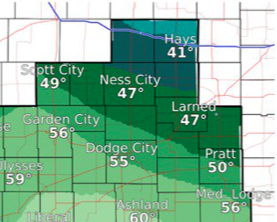
Monday Sunny, with a high near 41. North northwest wind around 10 mph becoming east northeast in the afternoon.

Monday Night Partly cloudy, with a low around 21. East northeast wind 9 to 13 mph.

TuesdayMostly cloudy, with a high near 33. East wind 7 to 10 mph.

Tuesday NightMostly cloudy, with a low around 25. East wind around 8 mph.

WednesdayMostly cloudy, with a high near 36.

Wednesday NightA slight chance of freezing rain before 7pm, then a chance of snow. Mostly cloudy, with a low around 12. Chance of precipitation is 30%.

ThursdayPartly sunny, with a high near 22.

Pentagon sending another 3,750 troops to Southwest border

WASHINGTON (AP) — The Pentagon said Sunday it will send 3,750 more troops to the U.S.-Mexico border to put up another 150 miles of concertina wire and provide other support for Customs and Border Protection.

photo courtesy U.S. Department of Homeland Security

The additions will bring the total number of active-duty troops on the border to 4,350.

The announcement is in line with what Acting Defense Secretary Pat Shanahan had said on Tuesday when he provided estimates for the next phase of a military mission that has grown in size and length. Critics have derided it as a political ploy by the White House as President Donald Trump seeks billions to build a border wall.

Shanahan said on Tuesday that several thousand more troops would be sent mainly to install additional wire barriers and provide a large new system of mobile surveillance and monitoring of the border area. Sunday’s announcement said the mobile surveillance mission would last through Sept. 30.

Members of Congress have question whether the border mission is distracting troops from their main work of fighting extremists abroad and training for combat. The first active-duty troops were sent to the border on about Oct. 30 for a mission that was to end Dec. 15. It has since been extended twice.

“What impact does it have to readiness to send several thousand troops down to the Southern border? It interrupts their training. It interrupts their dwell time,” Rep. Adam Smith, D-Wash., chairman of the House Armed Services Committee said at a hearing on Tuesday.

Vice Adm. Mike Gilday, the director of operations for the Joint Staff, told the panel that he does not believe military readiness has been significantly affected. He said some units have missed training opportunities because of the deployment and others have seen less time at home between deployments than the military likes to provide.

But he said there is an effort to rotate service members in and out of the mission every six to eight weeks in order to minimize any impact.

Jury: Kan. man guilty in shooting death of sleeping victim

HUTCHINSON — A Kansas man has been found guilty in the September 2017 shooting death of a man who was sleeping.

Moore -photo Reno Co.

A Reno County jury on Thursday found 35-year-old Quinton Moore guilty of first degree murder.

Moore shot 42-year-old Clarence D. Allen multiple times in his head and neck while he slept in his bed at a residence at 1701 E. 30th in Hutchinson.

During an interview with a Hutchinson Police Detective, Moore at first denied shooting Allen, but later said he did but blacked out during the shooting.

The gun used in the shooting was found in a poly-cart at the home on East 6th. It was a Smith and Wesson .40 caliber semi-automatic handgun which police believe was the murder weapon.  At the scene, police found six .40 caliber shell casings and 3 bullets.

Moore did not take the stand in his own defense. He is scheduled for sentencing March 15.

Throwback night: Brady, Patriots win Super Bowl the old-fashioned way

ATLANTA (AP) – Graying but still gritty, Tom Brady, Bill Belichick and the Patriots came to the Super Bowl intending to stave off, for at least one more game, the inevitable onslaught of the NFL’s future.

Job well done.

Pro football never looked flatter, older and more stuck in the days of the VCR than it did Sunday.

In a Super Bowl only New England could love, the Patriots won their sixth title by lumbering their way to a 13-3 victory over the Los Angeles Rams – that young, brash, high-flying team with the 33-year-old coach and the 24-year-old quarterback who were, we thought, changing football before our very eyes.

If only we could’ve kept them open.

Among the Super Bowl records set: Fewest points by both teams (16); fewest points by the winning team (13); fewest combined points through three quarters (6); most consecutive drives ending with a punt (8 by the Rams); longest punt (65 yards).

The halftime show with Maroon 5 offered no relief – roundly ripped, including by an Associated Press reviewer who called it “Empty. Boring. Basic. Sleepy.”

He could have said the same about the game. But give credit where it’s due.

The defense designed by Belichick turned Rams quarterback Jared Goff into a jittery mess. He completed 19 of 38 passes for 229 yards, with an assortment of rushed throws, misread coverages and, in the tiny windows in which LA showed any sign of life, a pair of terrible passes.

One, trailing 3-0 in the third quarter, was late and high to wide-open Brandin Cooks in the end zone; the other, trailing 10-3 with 4:17 left in the fourth quarter, was high under pressure for an easy interception by Patriots cornerback Stephon Gilmore that essentially ended the game.

“I know I definitely have a lot to learn from this one,” said Rams coach Sean McVay, who, at 33, is exactly half the age of Belichick.

McVay has been the flavor of the month in the copycat NFL. Other teams have hired away three of his assistant coaches over the last two years, as the rest of the league tries to catch up with his newfangled offense that cracked 30 points in 13 games this season.

On Sunday, it managed one 53-yard field goal from Greg Zuerlein and didn’t take a snap inside the New England 20.

Gilmore’s interception came minutes after Brady engineered the game’s lone touchdown drive.

It was five plays and included four straight completions: 18 yards to Rob Gronkowski, 13 yards to Julian Edelman, seven yards to backup running back Rex Burkhead, then a 29-yard teardrop placed perfectly into the arms of Gronkowski, who was double-covered. Sony Michel ran it in from 2 yards for the touchdown with 7 minutes left.

“We couldn’t get points on the board for one reason or another,” Brady said, “but in the end, it feels a lot better than last year, when we did get some points on the board.”

Last year, the Patriots fell 41-33 to Philly in a back-and-forth thriller that essentially featured one good defensive play: a sack and strip on Brady by Eagles defensive end Brandon Graham with the clock running down.

The year before, the Patriots scored 31 points in the second half and overtime for a riveting 34-28 comeback win over Atlanta and title No. 5.

Then, this.

New England’s road to a sixth Lombardi Trophy – tied with Pittsburgh for the most – was never easy this season. The Patriots lost five times, didn’t have home-field advantage through the playoffs and, after every loss, were beset by questions over whether the 41-year-old Brady and his 66-year-old coach might be winding down.

Through it all, though, they could score. New England averaged 27.2 points a game. And in the run through the playoffs, the offense scored 10 touchdowns and Brady barely got touched, and never got sacked.

They were not clicking like that Sunday at the $1.5 billion Mercedes-Benz Stadium, where 70,081 fans – most of them cheering for New England – watched the game.

Other than Edelman, whose 10 catches for 141 yards won him MVP honors and made him look like a combination of Michael Irvin and Jerry Rice considering everything happening around him, the Patriots were out of sync.

Brady’s first pass got intercepted. He went 21 for 35 for 262 yards and a passer rating of 71.4 – more than 26 points lower than he averaged this season.

New England outgained Los Angeles 195-57 in the first half, but settled for two field goal attempts – one miss and one make – for a 3-0 lead at the break.

It was 3-3 heading into the fourth quarter – the fewest points through the first 45 minutes of any playoff game since a 1980 barnburner between the Bucs and Rams that LA won 9-0.

Maybe the biggest irony of all: The New England dynasty’s five previous Super Bowl victories came by 3, 3, 3, 4 and 6. Two were decided on the last play. The other three came down to the final minutes.

Compared to that, this was a veritable runaway.

On a day when New England held LA running back Todd Gurley to 35 yards, when LA couldn’t muster a drive longer than five plays for nearly three quarters, and when LA’s Johnny Hekker (eight punts, 46.3 yard average) was his team’s most effective player, a 10-point lead at the end felt like a million.

“It’s a beautiful thing, man,” said New England cornerback Jason McCourty.

And a game only the Patriots could love.

Copyright Eagle Radio | FCC Public Files | EEO Public File