Beginning Monday, the 400 block of West 4th Street between Elm and Ash Streets will be closed to traffic. This work is related to the Elm/Ash/4th Street reconstruction project.
Signs will be in place to direct the traveling public. The traveling public should use caution and if possible, avoid this area.
The City of Hays regrets any inconvenience this may cause to the public. If there are any questions, please call the Office of Project Management at 628-7350 or the contractor, Morgan Brothers Construction, at 432-3104 or 394-1777.
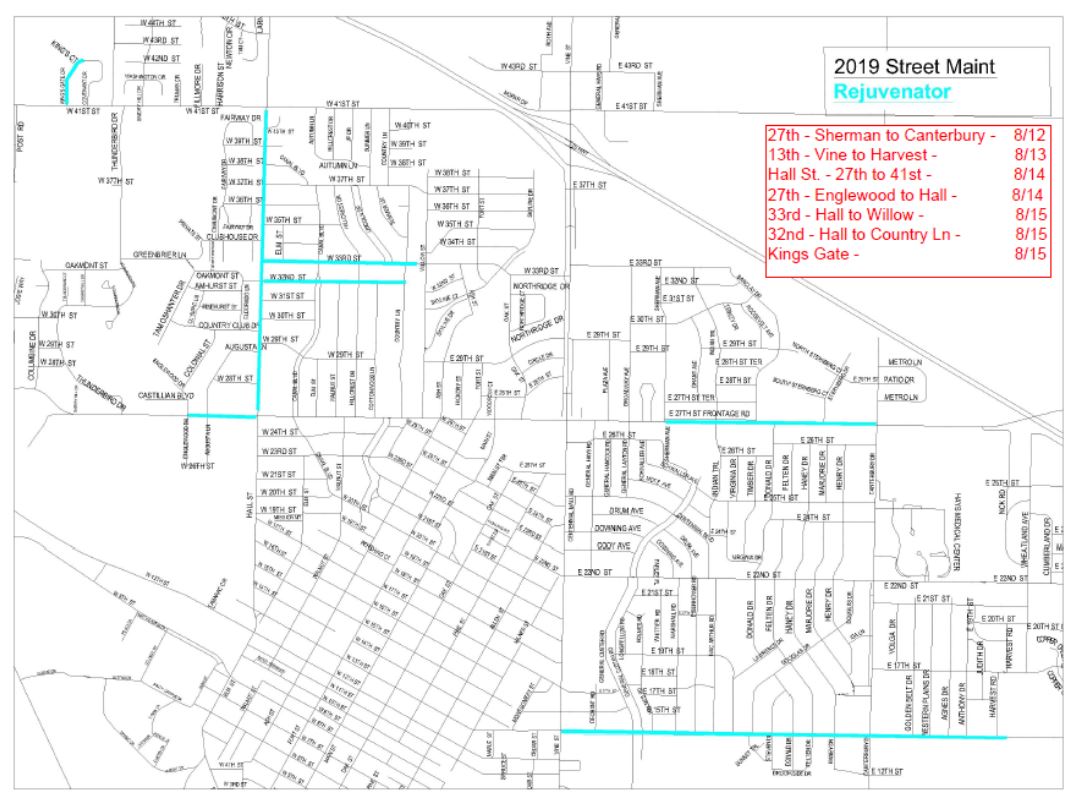
Please be advised that beginning Monday, August 12, 2019, Proseal Inc. will begin application of an asphalt rejuvenator on various street throughout the city of Hays. See map below for street locations and anticipated dates.
The asphalt rejuvenator is a preservative seal that is used on newer asphalt streets that do not yet warrant more advanced treatment.
On the date scheduled for treatment, all cars need to be moved from the street by 8:00 a.m. Streets being sealed will be closed or partially closed for a short duration during the time of the application. Access can be achieved in cases of emergency. Parking on adjacent streets is recommended during the daytime. Parking in driveways is okay if you DO NOT plan on moving the vehicle during the daytime hours.
After application, the surface should not be driven on until the fine overlay of sand is applied. If tracked upon before curing is complete, the product may stain surfaces such as concrete, carpet, or flooring if tracked from construction areas.
Please have all lawn watering devices turned off the evening before the scheduled date. Please help keep the streets clean and dry for a smooth and lasting project.
Traffic control will be set in areas of work being completed and picked up by the end of the work day. This project is scheduled to be completed by August 16 (pending weather conditions).
The city of Hays regrets any inconvenience this may cause to the public. If there are any questions, please call the Office of Project Management at 628-7350 or the contractor, Proseal Inc at (877) 650-9805.
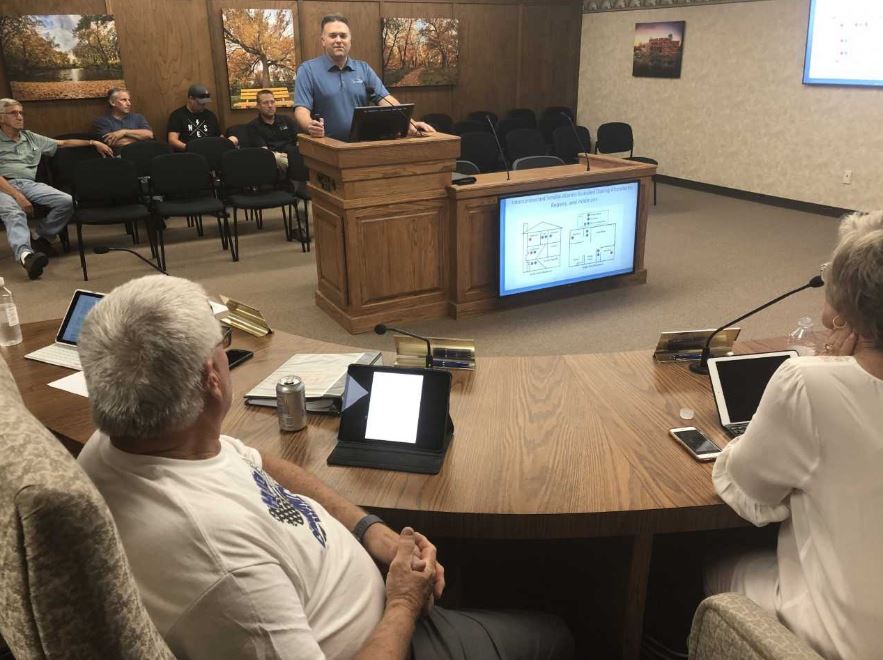
Toby Dougherty, Hays city manager, review highlights of the 2020 budget.
By BECKY KISER Hays Post
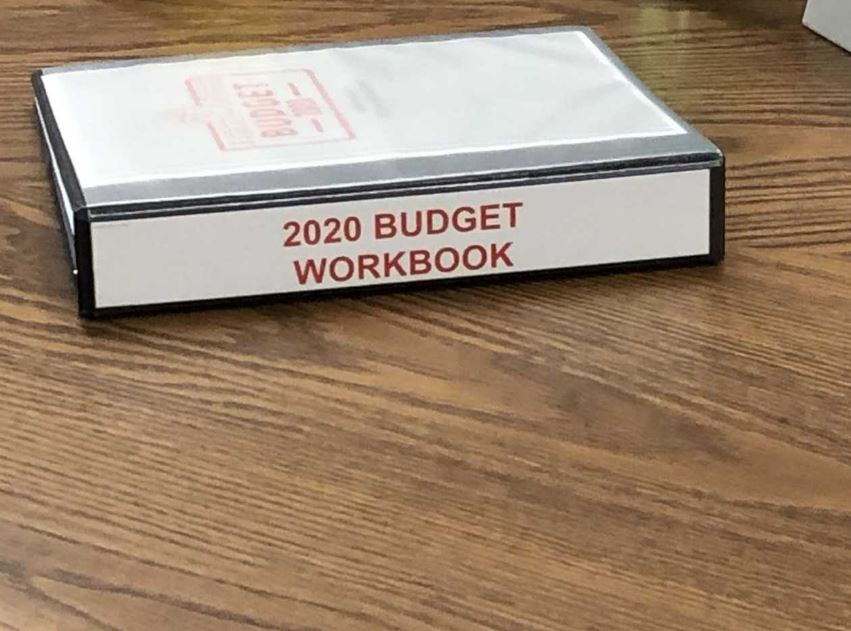
The 2020 budget for the city of Hays includes a projected increase in sales tax revenues, the primary source of funding for the city’s general fund.
Following Thursday night’s public hearing for the budget, City Manager Toby Dougherty reviewed some of the highlights with city commissioners.
“The most notable item in the General Fund is that we are budgeting a sales tax (revenue) increase over the 2019 budget of 2.9%. Been a lot of flat years in sales tax (revenue) and we’ve seen a positive trend as of late, so this is a little bit helpful for us,” Dougherty said.
Within Levy Funds, Dougherty pointed out a reallocation of 0.5 mills to the Hays Regional Airport.
“The airport has subsisted on a 1 mill levy for a lot of years and we are outgrowing that 1 mill with the capital and operational requirements we have.”
The total mill levy for Hays in 2020 is 25.000, the same as it’s been the past 13 of 14 years.
Commissioner Ron Mellick pointed out the mill levy is “actually 18 for the city and 7 pass-through for the library.
“Once again, city staff as well as department heads and all of our workers, it takes all of us pulling together in order for us to be able to to that for 13 of the last 14 years,” Mellick said.
The Hays mill levy is the seventh lowest in Kansas and the lowest levy outside of Johnson County.
Street maintenance projects have a budget of $1.3 million next year.
“I think extending the life of our streets and keeping up on that infrastructure, like with our sewer cleaning, that’s got to be saving us money in the long run,” said Eber Phelps, commissioner.
In 2004 when the city sales tax was voted in, one of the promises was that more money would be spent on street maintenance, recalled Dougherty.
“Beginning in 2006 we went from having very little money – maybe $100,00 a year – to having over a million dollars a year to spend on street maintenance. …Our problem was where do we start because every street needed help. Now as you drive around, our streets are in pretty good condition. There’s always maintenance that needs to be done but it’s not overwhelming. We’re ahead of the curve right now.”
Next year’s budget includes $100,00 for creation of a new stormwater master plan. “The last master plan was completed in the ’90s and we have fulfilled the master plan. We’ve done all the notable things that we were going to do. It’s time to put a new master plan in place, one that marries up dollars with risk.”
A new multi-use path on the east side of Hays will be funded in Special Parks. Phase one will be a 1.25 mile path between the Hays Recreation Commission and the 22nd Street access to the HaysMed walking trail.
Projects in the 2020 Capital Improvement Plan (CIP) include the first year of the North Vine Street Corridor Improvements and a second, redundant waterline crossing under Interstate 70 to the north side of Hays.
Four million dollars is designated in the CIP for design engineering of the R-9 Ranch long-term water supply project “assuming we start moving through the (state) water transfer process in 2021,” Dougherty said.
Lighting will be upgraded for runway 4-22 at the airport and runway 16-34 will be repainted.
The Convention and Visitors Bureau (CVB) budget will reflect a shift from print/billboard to electronic/social media marketing. CVB will also hire an analytics consultant to help quantify the return on investment for various types of travelers and visitors.
In the fleet replacement schedule for several vehicles and pieces of large equipment, two police vehicles will be purchased and the fire department will replace its 1998 rescue pumper.
The city’s approved 2020 budget must be submitted by the director of finance to the Ellis County Clerk by Aug. 23.
Hays city commissioners unanimously approved the 2020 budget Thursday night.
By BECKY KISER Hays Post
Hays city commissioners unanimously approved the city’s 2020 budget during their meeting Thursday night. The budget total is $$41,966,419.
Following the public hearing which had no participants, City Manager Toby Dougherty reviewed the budget goals.
“We want the budget to be balanced. We want to keep the mill levy at 25. We have not added an employee since 2010. And we want to continue paying cash for large projects,” said Dougherty.
The mill levy for Hays is the seventh lowest in Kansas and the lowest levy outside of Johnson County.
The city’s assessed valuation increased by 1.6% since 2019, with the value of 1 mill equal to $226,802. The mill levy for Hays has been at or below 25.000 for 13 of the past 14 years.
Dougherty was quick to give credit to Kim Rupp, city finance director.
“The budget is his baby to put together and get to me in raw form, then meet with department heads and sort of congeal it into something that we feel will be palatable to you guys. Then you guys finish molding it before it’s passed,” explained Dougherty. “Kim does a lot of the heavy lifting.”
Commissioners also thanked city employees.
“Employees now have buy-in to the budget,” said Mayor Henry Schwaller, “whether it’s their healthcare program or finding some savings (in their department).
“Most of this budget is possible because they’re finding savings, particularly in recent years as sales tax dollars have dropped,” Schwaller noted. “So we’re able to carry those savings forward and fund future budgets.”
Most of the city’s general fund monies come from a local sales tax.
The 2020 budget contains a programmed step and cost of living increase for all city employees.
A new pedestrian crosswalk with flashing lights has been installed at Hall and 19th Streets in Hays.
By BECKY KISER Hays Post
As back-to-school traffic picks up later this month in Hays, drivers and pedestrians on Hall Street near Thomas More Prep-Marian school will need to pay extra attention.
A new pedestrian crosswalk with flashing lights has been installed on Hall at the intersection of 19th Street.
A Kansas Department of Transportation Traffic Engineering Assistance Program study was awarded several years ago to the city of Hays. TEAP awards provide engineering services for small areas with things such as access problems or pedestrian issues.
The city looked at Hall Street between O’Loughlin Elementary School at the 14th Street intersection and TMP-M at 19th.
“We have a challenge at certain times of the day with pedestrians, with cars, with overloading access when people are dropping off or picking up their kids at O’Loughlin, and when school is getting out at TMP. There are short-term congestion problems,” City Manager Toby Dougherty said.
One of the suggestions made in the TEAP study was a pedestrian crosswalk.
The city met a while ago with TMP-M administrative staff and both groups agreed to the 19th Street location.
“We think that’s the best option right now. I think they’re very happy with the outcome,” Dougherty added.
TMP-M Principal Chad Meitner is so happy about the crosswalk he went to a Hays City Commission meeting to tell them about it.
“John Braun (Hays project manager) had worked with us and the administration at O’Loughlin … The (TEAP) findings made us look at how we could make the traffic flow there safer for the students, the families, and just for citizens in general going through that area especially in the mornings and afternoons,” said Meitner. “I thank the city for installing the crosswalk. It looks great. We’re excited not only for our students but even the folks who use the campus for walking their dogs or jogging (who) can now cross there.”
The new crosswalk aids pedestrian traffic on the campus of Thomas More Prep-Marian school.
The TMP location was chosen for the crosswalk because O’Loughlin uses a staffed crosswalk when the school day opens and closes.
“The majority of those kids crossing Hall Street are doing so under controlled circumstances,” Dougherty said, “but TMP doesn’t have anybody posted there … so this actually gives them some kind of controlled access.”
The new pedestrian crosswalk is similar to the one further north on Hall Street in front of Cervs convenience store and another on 22nd Street near Roosevelt Elementary School. Each is activated by pedestrians.
“They’re very bright flashing lights that will get the attention of the vehicles so they can slow down and yield to the people in the crosswalk. … Traffic is usually pretty good about stopping for the kids. … But you never know with people on their phones not paying attention. That flasher adds another (safety) measure.”
Dougherty said he believes the city will look at installing a crosswalk at O’Loughlin sometime in the future, “but given the fact that they have no intention of doing away with their crossing guard right now, we feel it’s protected.”
There is no crossing guard station at Roosevelt.
Classes at TMP-Marian start Monday, Aug. 19. Hays USD 489 classes start Wednesday, Aug. 14.
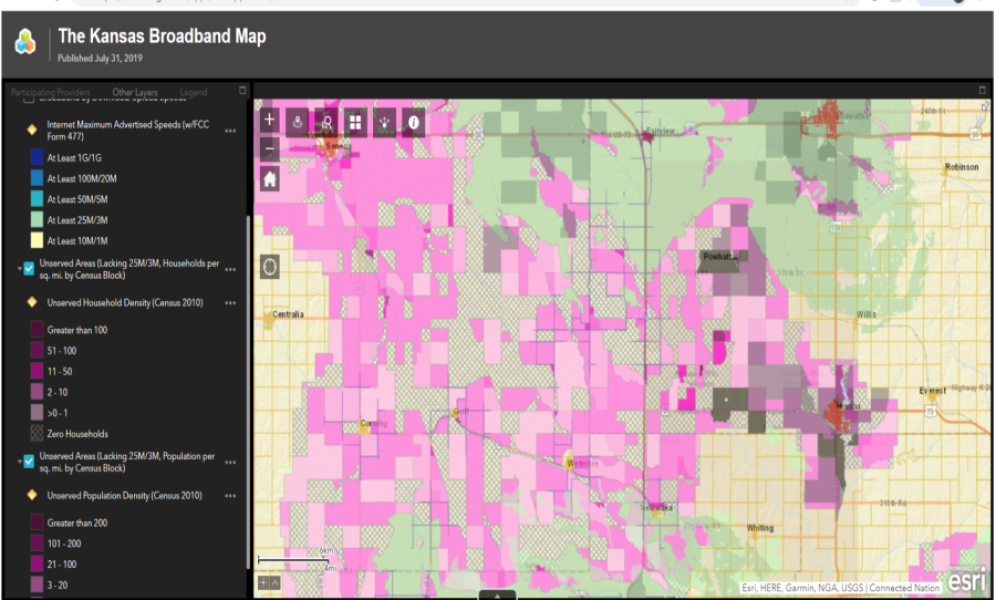
DODGE CITY – Where would we be if we couldn’t stream movies or music? Far-eastern Kansas counties and a broad swath of western Kansas.The newly released statewide broadband map shows in greater detail than ever before where 3.5% of Kansas residents don’t have adequate access to the internet. You can even search by your address … if you have internet, that is.
Telecom experts know it’s expensive to get service out to those areas, but advocates say it’s crucial to make up for the gap that’s been left in the wake of rural hospitals closing.
Kansas is bathed in shades of blue that stretch north to south, east to west. That’s not a reference to politics: It’s what the state looks like on the Federal Communications Commission’s Fixed Broadband Deployment map.
The map shows the approximate number of internet service providers within an area — the lighter blue represents fewer, the darker multiple. Considering the entire state is blue, you’d think internet service is available everywhere.
In reality, internet access has been a problem for Kansas residents, service providers, health care and lawmakers.
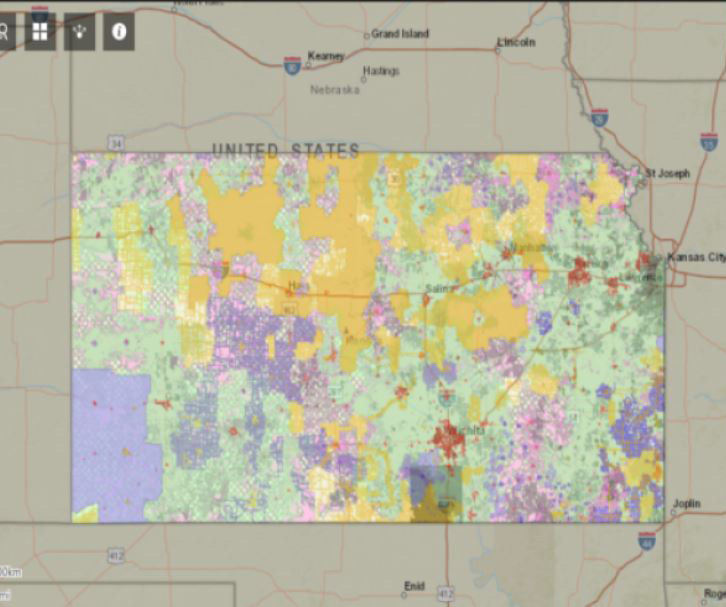
So a new map was created with information supplied by dozens of providers around the state. And the data shows that more than 95,000 people, or about 3.5% of the state’s population, do not have internet access; places like rural eastern Kansas.
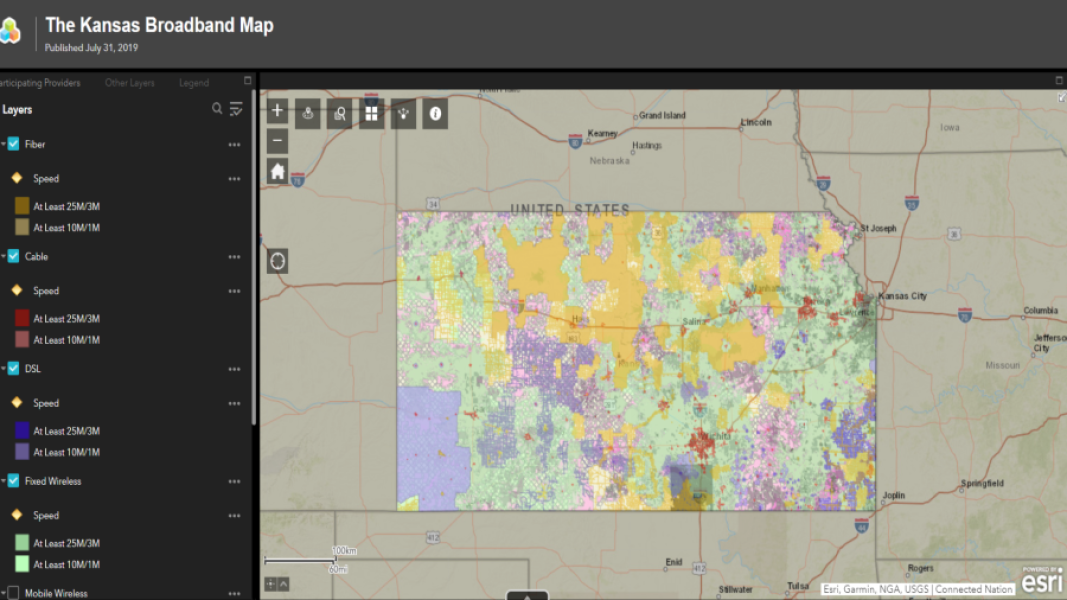
The new Kansas Broadband Map shows speeds, types of service available and features an address search feature. (Credit ArcGIS.com)
“We found, through this mapping exercise, that there actually are pockets of areas where people do live — here in Dodge City and even in the suburbs of Kansas City — that don’t have service, that need it,” said Brent Legg, who’s the vice president of government affairs with Connected Nation, at the State Independent Telephone Association Conference on July 30.
Connected Nation, a nonprofit, created the new map with a $300,000 grant from the Information Network of Kansas. It worked with internet service providers and deployed engineers to verify service providers’ data, so now multiple layers of broadband availability by speed and type are publicly available.
Seventy-two of the state’s 88 internet service providers voluntarily submitted data, and FCC data was used for the companies that declined to respond or participate (Legg said none was available for six providers).
Jason Smith is CEO of Rainbow Telecommunications based in Everest, Kansas. He said the map is “desperately needed.” Laying fiber outside of of Rainbow Telecommunications’ coverage area is expensive.
“When you’re looking at anywhere from $20 to $40,000 a mile to build fiber services, you can’t make a business case on that for a small pocket of 10, 20 customers — it will never pay for itself,” Smith said. “And so you’re going to need types of grant funding.”
But federal grant funding for expanding rural internet service uses FCC census block data, which in rural and remote areas are larger and may even be measured by square miles. The census block data can lead to long and costly application processes for providers like Rainbow Telecommunications.
“So you might consider an area that you could help expand broadband to, but if you base it off those maps … they weren’t accurate,” Smith said. “So you would spend time and effort and money to find out you couldn’t participate in that program.”
What areas lack
Nationally, 19 million people in the U.S. don’t have access to broadband, according to the FCC. That’s about 5.8% of the population. Kansas’ connectivity rate is better than the national rate, but the lack of internet access can deter people from moving to and working remotely from rural areas, where populations are generally declining.
Earlier this year, some Kansans testified before the Statewide Broadband Expansion Planning Task Force about painfully slow internet speeds.
And some rural areas have seen hospitals close, Executive Manager of SITA Colleen Jamison said July 30, noting that broadband could deliver telemedicine to people who live hours away from specialized care.
“Maybe somebody who’s got a high-risk pregnancy in Ulysses, Kansas, and the nearest potential NICU for a birth maybe in Wichita,” Jamison said. “But that monthly or even weekly monitoring of maternal health could be so vitally important to that unborn child.”
And even though it may not be entirely useful for people who already don’t have internet, the new map contains an address search feature. For households without internet, searching online may involve traveling to a public place, but Legg said the new feature will be helpful to service providers that might be be unaware of unserved residents.
“So they may want to build out service into those areas,” Legg said. “It will also help service providers identify places where they could go apply for federal grant dollars to build out via the (U.S. Department of Agriculture) reconnect program, for instance.”
Pinks and purples on the new map indicate areas without internet, and some are found outside of eastern Kansas counties, including Atchison, Brown and Wabaunsee. Clicking on the unserved layers of the map shows where household are and how many don’t have access to internet.
Areas without service are located under the “other layers” tab within the new broadband map. (Credit ArcGIS.com)
Jamison said legislation authorized the creation of a more accurate map allowed it to guide the state’s broadband task force. “The statewide broadband task force said, ‘Let’s look at what we recognize the issues that there are at the federal level.’ So let’s look at what can we do to ensure that Kansas is mapped as accurately as possible,” she said. “So that it guides the state efforts at the task force level and beyond.”
Corinne Boyer covers western Kansas for High Plains Public Radio and the Kansas News Service. You can follow her on Twitter @corinne_boyer or email cboyer (at) hppr (dot) org.
The Kansas News Service is a collaboration of KCUR, Kansas Public Radio, KMUW and High Plains Public Radio focused on the health and well-being of Kansans, their communities and civic life.
Ralph Augustine of Ralph’s Electric alongside Jesse Rohr, public works director for the city of Hays.
By BECKY KISER Hays Post
The Hays city commission knew there would need to be some tweaking of the residential and electrical code updates adopted by the city in July 2017.
Three concerns in relation to upgrades and remodels of existing homes requiring a city permit were brought to their attention during the commission work session last week.
“Almost all rooms except bathrooms and garages now require AFCIs (Arc Fault Circuit Interrupter),” explained Jesse Rohr, public works director. An AFCI protects against electrical- related arcs from an electrical circuit or a device, which commonly lead to fires. If an arc is detected, the AFCI is tripped and kills the power to that individual circuit.
“AFCIs and the wiring are easy to install in new homes. However, in existing houses, that’s where we have an issue.”
AFCI receptacles are much more expensive – $22 to $75 – as compared to $1.20 for a regular non-AFCI receptacle.
Some existing electric panels are not configured to work with AFCI breakers and older wiring methods may not be conducive to new devices and codes.
“Homes that were wired 30 to 80 years ago just weren’t wired the way you would wire homes today,” he added, “making it very difficult to protect an electric circuit with an AFCI.” The labor costs to do so are quite high, according to Rohr, “thousands of dollars extra.”
Similar issues affect placement and interconnection of smoke and carbon monoxide alarms in remodel/addition situations. Current code requires the alarms to be installed throughout the house and to be connected to each other, the same as required for new construction.
“You can see why this is problematic, having to fish wires through walls and ceilings. … the labor is probably $1,500 to $2,000 and that’s probably on the cheap side if you have to do an entire house.”
Local contractors recently brought the concerns to the attention of Rohr who agreed with them.
“We kind of liken this to bringing your 1950 Ford to the mechanic for a fuel pump and the mechanic says you now have to put seatbelts in it. You have to bring it up to current code. Again, this is may be an overstep of bounds that we’re seeing as we’ve started enforcing this code.”
Rohr is proposing amendments to the 2014 National Electric Code (NEC) and 2015 International Residential Code (IRC) which were adopted in an update by the city of Hays in July 2017. The suggested changes remove many AFCI and smoke alarm requirements for remodel projects in existing dwellings.
One proposal is to allow modified or extended electrical circuits in existing dwellings to not be AFCI-protected due to the high cost and impracticability of doing so. Rohr also suggests that changing a receptacle should not require the new receptacle to be an AFCI-type receptacle.
A third suggestion is “a change to the code that would not require a placement of smoke alarms and carbon monoxide alarms unless a sleeping room is remodeled or added.”
Rohr noted that’s how the code has been enforced the past several years.
City commissioners will consider the proposed residential and electrical code amendments at their Aug. 8 meeting.
In other business, commissioners set Aug. 8 as the public hearing date for the proposed 2020 budget.
Speaking via phone, Mayor Henry Schwaller asked the commissioners if the proposed $12,000 in funding to the Ellis County Historical Society (ECHS) should be reconsidered.
The ECHS Board of Trustees announced last week the closure of the gallery and stone church to the public due to mold growth. Offices, photo collections and archive materials are being relocated to to 1111 E. 30th.
“Our funding was originally intended to help them with building maintenance,” Schwaller noted.
Officer Ryan Blecha hands out chips to hungry swimmers at the Hays Aquatic Park during Thursday’s HPD Community Night Out.
BY BECKY KISER Hays Post
As usual, Hays police officer Ryan Blecha was on duty Thursday evening, but this shift did not require a patrol vehicle or even the official uniform.
This duty called for wearing shorts and a special T-shirt as Blecha manned the chip station in the food line for the Hays Police Department’s “Community Night Out” at the Hays Aquatic Park (HAP).
“He’s very important,” laughed Mackenzie Blecha, Ryan’s wife.
Mackenzie and Gentry Blecha
Mackenzie and daughter Gentry, 18 months, were some of the Hays police officers’ family members enjoying the fourth annual event. It included free swimming for everyone and a hot dog or hamburger meal for the first 1,000 people.
Gentry loves swimming, according to Mackenzie. “She’s been a water bug since she was six months old. She just goes and goes and goes, doesn’t care how cold it is.”
The Blecha family goes swimming together every couple of weekends when Ryan is off, but this weekday was a special experience.
“I think it’s important for us to show up also because we’re not only supporting him but were supporting the community and supporting the pool.
“I think it’s good for these guys to be out here and show their softer side,” Mackenzie said with a smile. “They get to communicate with everybody in an informal way.”
No waiting in line for Gentry as her dad hands her chips.
Ryan Blecha has been on the Hays police force for two and half years. “We moved here in March 2017 and then found out two weeks later we were having Gentry,” Mackenzie laughed again. “It’s in the Hays water,” she quipped.
Ryan is originally from Norton and Mackenzie is from Hoxie. She’s a dental assistant at Lifetime Dental Care. Mackenzie will be back at the pool Tuesday at 1 p.m. with her Lifetime Dental team. “We’re going to hand out Popsicles to all the kids just for a little fun summer freebie.”
Prior to joining HPD, Ryan served five years in the Marine Corps as a military police officer.
Mackenzie says the Marine Corps prepped her for the sleepless nights that come with being the wife of a law enforcement official.
“We did a seven month deployment so this was just kind of cake after that.
“Night shift is just a little bit harder. That’s another reason we’re down here today because we want to get every ounce of him that we can. He will start back on night shift in September so we’ll be missing him a little bit. It’ll be more of the single parent life.”
Hays police officers rotate between day and night shifts every four months.
City commissioners Eber Phelps and Shaun Musil
Several city officials also enjoyed Community Night Out, including city commissioners Eber Phelps, Ron Mellick and vice-mayor Shaun Musil.
Phelps joked he was glad the event had not been scheduled for Wednesday when the high temperature in Hays was 107 degrees. Thursday’s high was 92 degrees.
Attendees also got to check out a HPD patrol cars, the SSRT (Special Situation Response Team) van and some of the gear used by the police.
“Community Night Out” is sponsored by the city of Hays, Walmart, Hays Recreation Commission, Pepsi of Hays, Heartland Building Center, Fraternal Order of Police Hays Lodge 48, Phaze 2 and Nex-Tech.
The city of Hays plans to offer an admission discount at the Hays Aquatic Park (HAP) to Ellis residents after the Ellis swimming pool was unexpectedly closed Wednesday morning.
Henry Schwaller, Hays mayor, made the suggestion during Thursday’s city commission work session.
The Ellis municipal pool was losing almost 30,000 gallons of water every 2 to 3 days according to Mayor Dave McDaniel and city officials decided to shut it down ahead of the season closing date.
Ellis is planning to build a new swimming pool and has received $1.3 million in grant funding towards the $1.8 million dollar project.
In the meantime, Hays city commissioners want to show their support of the neighboring town.
“They’ve been very supportive of us in our pursuit of water (from the R-9 Ranch in Edwards County),” Schwaller noted. “They also have water needs and they pump from the Big Creek Aquifer as Hays does.
“Their decision to shut the pool and not waste water, not only benefits them, it benefits us.”
Schwaller, who was participating in the meeting via phone, suggested offering a 50% discount to HAP for Ellis residents showing proof of residence. The expense would come from the city commission contingency fund.
Toby Dougherty, city manager, said he would tell Jeff Boyle, Director of Parks, to contact the Hays Recreation Commission (HRC) and offer the half-price admission to Ellis residents and the people with them. HRC manages the two Hays swimming pools.
Although the commission cannot take action during a work session, Dougherty explained that “with the consensus of all five commissioners, under my spending authority I can approve this.”
Dougherty said the agreement would be on the agenda for next week’s regular meeting “for formal action to authorize it just to cover the bases.”
The Hays Aquatic Park will close for the season Aug. 11.
HPD Lt. Ron Rounkles (Ret.) mans the grill at the 2018 Community Night Out.
By BECKY KISER Hays Post
With Thursday’s forecast calling for a daytime high temperature in the mid-90s in Hays, Police Chief Don Scheibler is expecting a good turnout for tonight’s fourth annual “Community Night Out.”
The event, 5-8 pm. Thursday at the Hays Aquatic Park, includes free admission to the swimming pool for everyone and free hot dogs and hamburgers to the first 1,000 people served up by Hays police officers. Free T-shirts will also be handed out.
It’s a way to show thanks to the community for their support of the police department, says Sgt. Chris Hancock, and it’s just as much fun for the officers as it is for the public.
“They enjoy it a lot. It helps to humanize police officers when you see them out of uniform,” Hancock said.
Attendees will also get to check out HPD patrol cars, the SSRT (Special Situation Response Team) van and some of the gear used by the police.
Many officers will be there with their families.
“Seeing us interact with our families makes it easier to relate to us later on if we have to help you out on a call,” Hancock said.
“Community Night Out” is sponsored by the city of Hays, Walmart, Hays Recreation Commission, Pepsi of Hays, Heartland Building Center, Fraternal Order of Police Hays Lodge 48, Phaze 2 and Nex-Tech.
Hays city commissioners will continue discussion of the proposed 2020 budget during their work session this evening.
At last week’s regular meeting the commission set August 8 for the budget’s public hearing after which the budget will be formally adopted.
“We have to have the budget certified and to the Ellis County Clerk by Aug. 23, which means the city commission needs to get it adopted at the Aug. 8 meeting,” explained Toby Dougherty, city manager.
A public hearing is required by state law.
“The public is welcome to come and comment on the proposed budget. This week will be the city commission’s last opportunity to make significant changes if they want.”
The other agenda item for Aug. 1 is consideration of several amendments to the residential and electrical codes.
The two issues involve smoke alarms and arc-fault interrupted electrical outlets.
“There are a couple of provision that are a little bit punitive and a little bit retroactive in the opinion of public works staff,” Dougherty said. The scenarios were brought to the attention of the city by local electrical contractors.
A Hays couple and the employees of a state office building have been honored with the 2019 Water$mart Landscape Award by the city of Hays.
Since 2016, one residential and one commercial property have been chosen for the recognition.
The goal of the award program is to increase awareness of the importance of water conservation in the landscape and to recognize those in the community who have made great strides towards that effort.
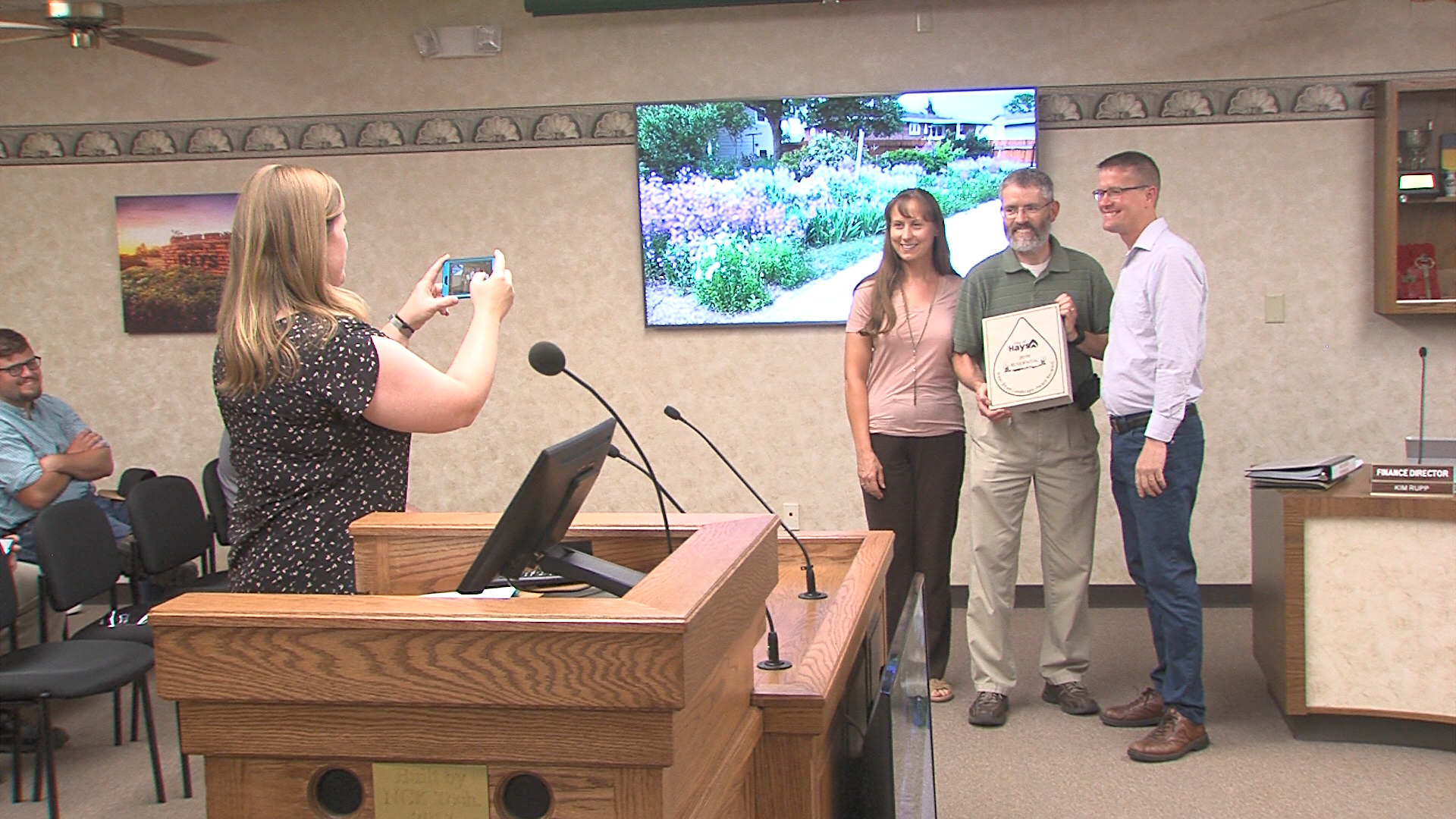
Holly Dickman, water conservation specialist, introduced the winners and showed pictures of their landscaping during Thursday’s Hays city commission meeting.
The Trapp front yard
Winners of the residential award are Theresa and Patrick Trapp.
Their yard on Holmes Road “exemplifies what it means to be water smart,” said Dickman.
The entire yard is landscape plantings of drought-tolerant perennials, including lavender and hens and chicks. They use mulch and and compost from the free sites maintained by the city.
“There’s no turf grass, just a little bit of buffalo grass here and there.”
The front yard is designed to keep as much rainfall as possible on the property without runoff. The couple also uses three rain barrels to capture rain for watering the plants.
The Trapp backyard is a Certified Wildlife Habitat.
The Trapp back yard is also a Certified Wildlife Habitat – a designation by the National Wildlife Federation – which provides water and shelter for animals raising their young.
The commercial award winner is the Kansas Department of Children and Families on East 22nd Street, represented by their director Armando Orozco.
Organic mulch surrounds the plantings, which include ornamental grasses and shrubs along with drought-tolerant perennials, including catmint and Rose of Sharon.
“Even the islands in the parking lot have organic wood-type mulch with plantings,” Dickman pointed out.
The parking lot is also part of the water-conserving design.
“It completely drains into a buffalo grass low spot. The rain is all going into that nice deep-rooted buffalo grass which is what we like to see. It’s not escaping the property.”
The Trapp backyard view from the alley.
“A watersmart landscape is more than just watering those plants correctly,” she explained.
“It’s a combination of several different gardening practices that together create a beautiful, water conserving landscape.”
Those practices include planning and design, soil preparation, right plants in the right places, practical turf areas, efficient irrigation, proper mulch and proper maintenance.
The DCF building in Hays is landscaped with organic mulch and drought-tolerating plants.Rain runs off the DCF parking lot into a lot spot planted with buffalo grass.Holly Dickman, Hays water conservation specialist, takes a picture of residential Water$mart Landscape winners Theresa and Patrick Trapp with Mayor Shaun Musil.Hays DCF director Armando Orozco poses with the commercial Water$mart Landscape Award and Mayor Shaun Musil.
(Editor’s note: Theresa Trapp is an employee of Eagle Communications, the parent company of Hays Post.)