 USD 489
Early Childhood Connections cafeteria received a facelift over the winter break.
Pastor Travis Cassity and members of the Vine Church of Hays helped paint the cafeteria.
The school district thanked the pastor and his crew for the work.

USD 489
Early Childhood Connections cafeteria received a facelift over the winter break.
Pastor Travis Cassity and members of the Vine Church of Hays helped paint the cafeteria.
The school district thanked the pastor and his crew for the work.
By CRISTINA JANNEY
Hays Post
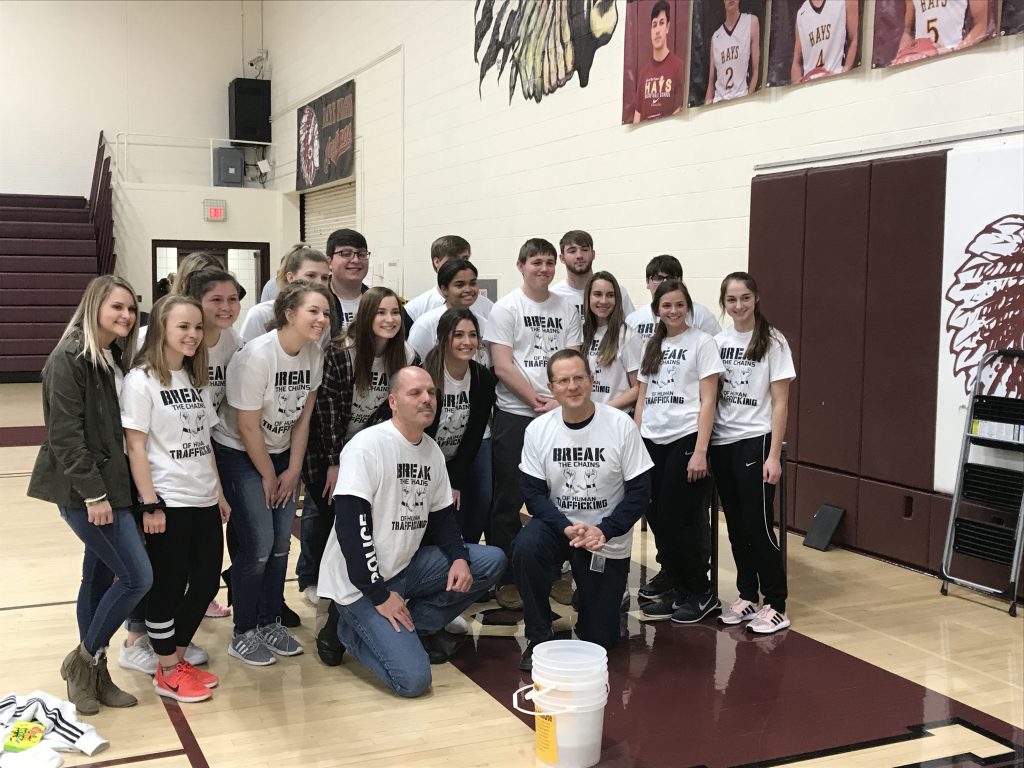
Police Chief Don Scheibler and Hays High School Principal Martin Straub hung out for a good cause on Friday.
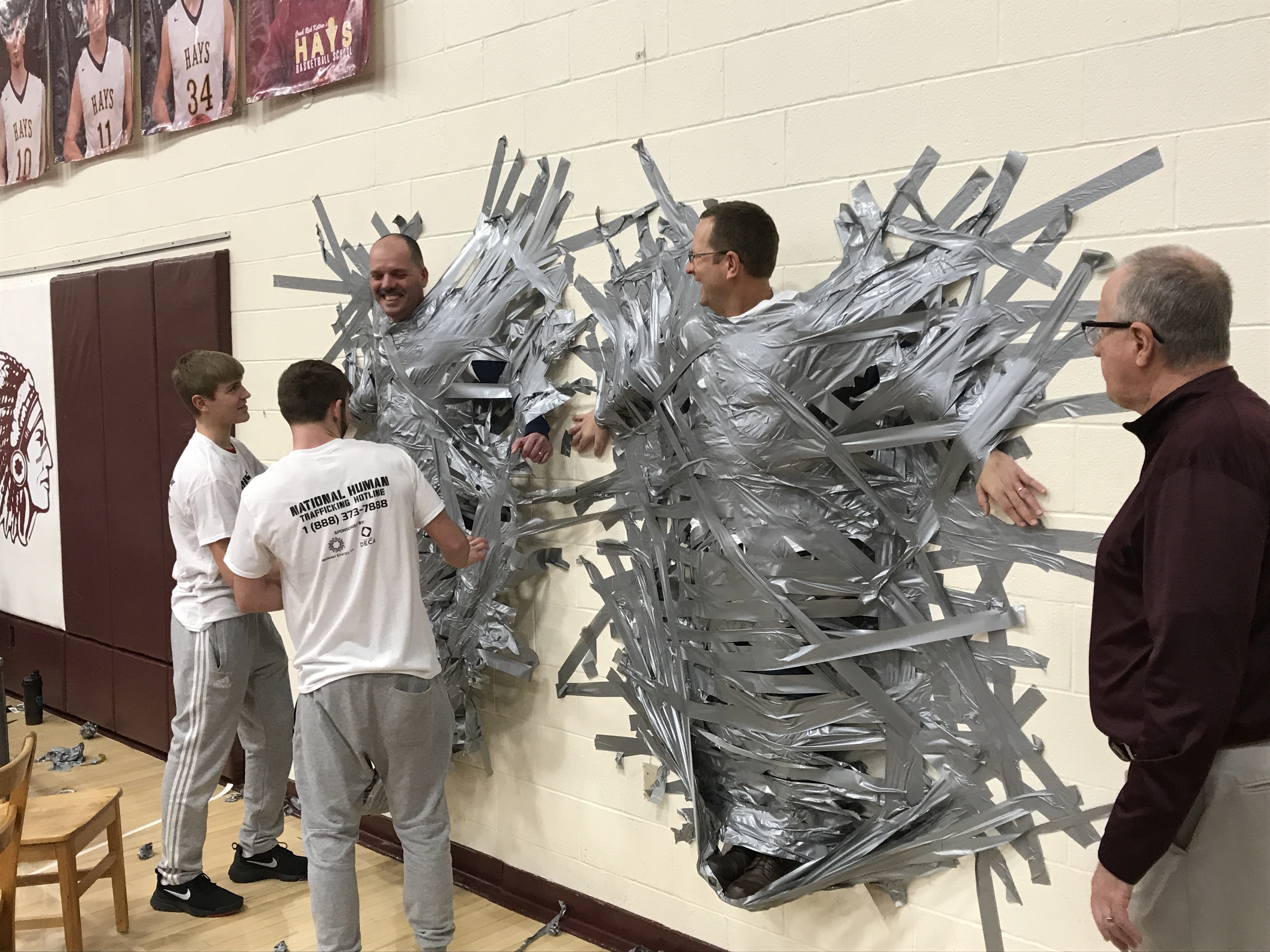
Both of the men agreed to be taped to the wall of the HHS gym with duct tape as a part of a human trafficking prevention fundraiser.
Hays High seniors Kaitlyn Schaben and Lisa Schoenberger with their peers in the HHS DECA club organized a week-long awareness campaign complete with speakers, posters and the fundraiser on Friday.
The students raised $1,500, which will be donated to Options Domestic and Sexual Violence Services in Hays.
The local Kiwanis organization supported Scheibler with a $500 donation and Auto Collision Specialists’ Mary Schoenberger gave $125 with the majority of the rest of the money coming from individual students at the high school.
Schoenberger will be attending college in Lincoln, Neb., in the fall and found through research Lincoln is a top city for human trafficking. This sparked her interest in informing her fellow students about the dangers of human trafficking.
Schaben said, “We have had some very positive feedback, and students said they did not know that went on and how easy it is to be a victim to that.”
Scheibler said the students and the local media have helped spark a discussion in the community about human trafficking.
“Human trafficking is the second largest criminal industry next to only drugs. One reason it is so successful is the high profit and the lack of information and the lack of education,” he told the students Friday. “This group and Hays High has made the city of Hays safer today.”
Straub said he received several emails from parents who said their students came home and talked about the human trafficking issue after attending one of the assemblies at the school this week.
“Whether people think this is a good or bad idea, it has let people talk about the issue,” he said. “Hopefully, it helps keep our kids safe when they leave us and go to communities where it is may more prevalent.”
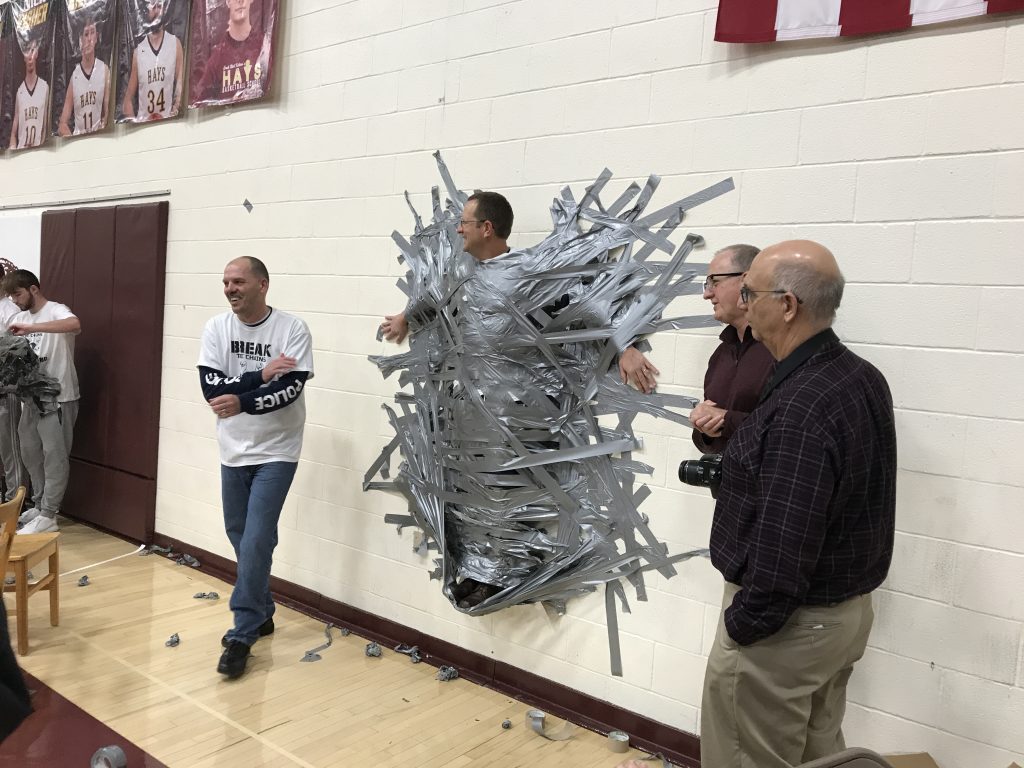
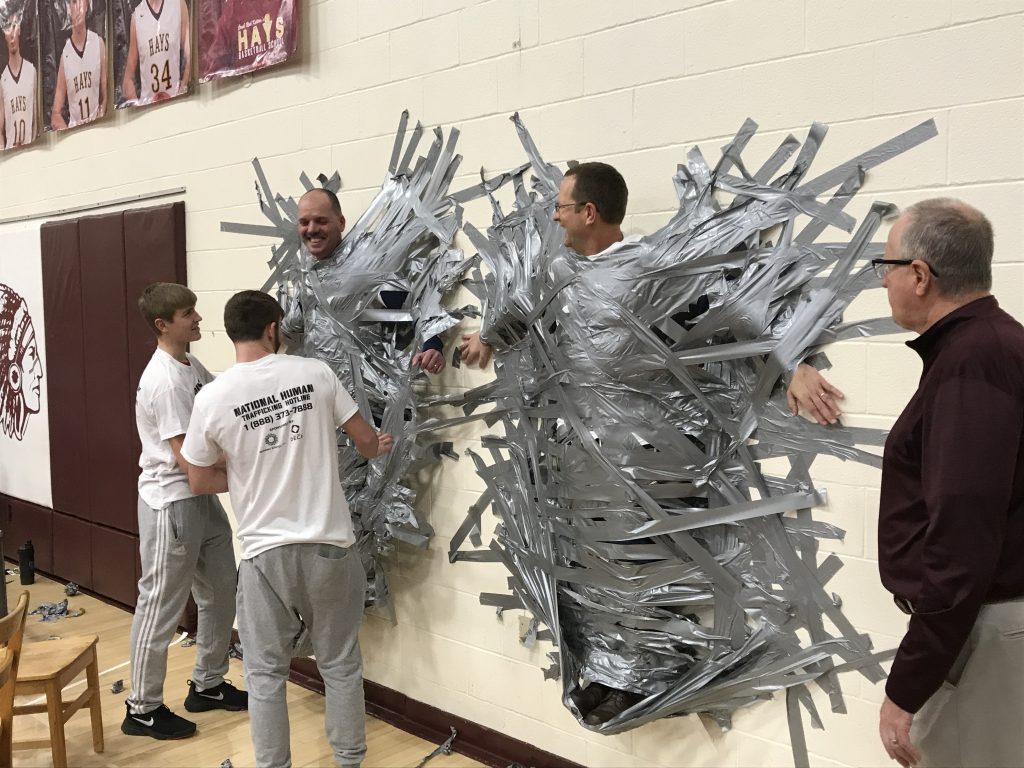


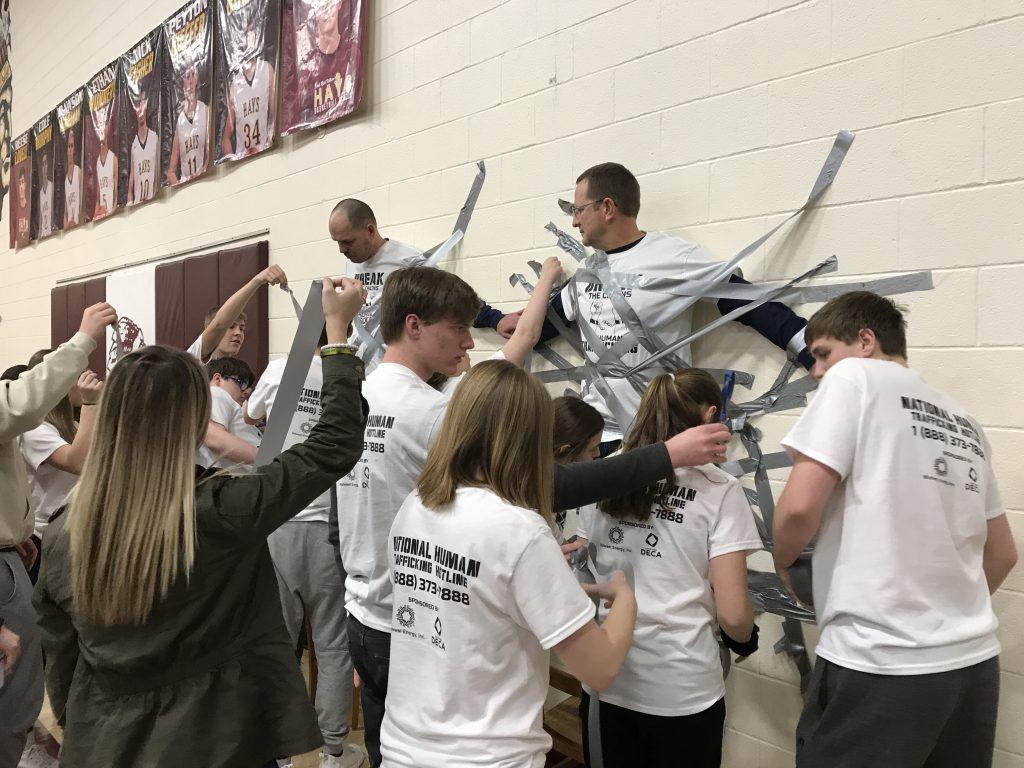
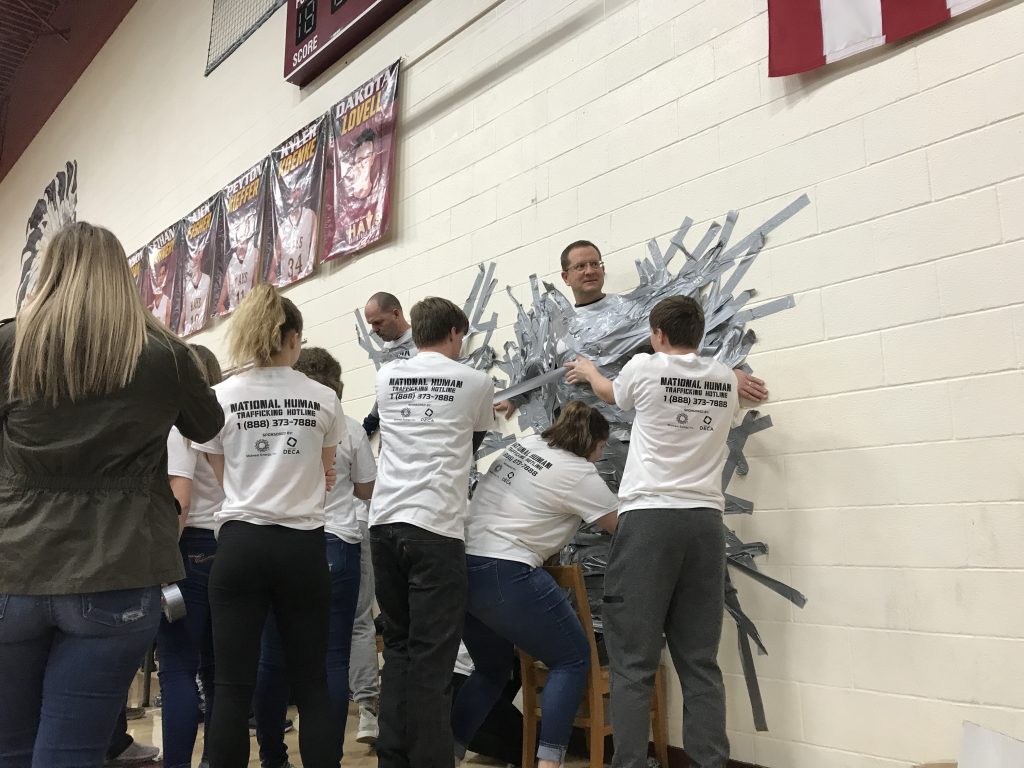

Although Straub said he got rather hot being stuck in the duct tape for a half hour, he wanted to support the students.
“It is really not about me,” Straub said after he came down off the wall. “It is about trying to make a difference. We can humble ourselves and be part of some fun. I don’t think it was a thing of disrespect. I think it was a thing of fun, and sometimes we just have to have fun with the kids.”
Related story: Hays High DECA students raise awareness for human trafficking
Related story: Hays High speaker: Human traffickers usually someone victims know
Related story: Local PD tells students of Hays attempted human trafficking case
By CRISTINA JANNEY
Hays Post
The Hays USD 489 school board will talk about opting out of the PEERA program and ending negotiations with the custodian’s Union at its meeting Monday.
SEIU (Service Employees International Union) covers 28 staff members of the about 500 people employed by the Hays school district. Nineteen of those staff members pay dues and are a part of the union.
Although the city of Hays and Ellis County both voted in December to opt out of PEERA (Public Employer-Employee Relations Act), the addition of the PEERA item to Monday’s school board agenda has nothing to do with the actions of those other governing bodies.
Related story: City commission votes 3-2 to exit PEERA and employee union negotiations
Related story: Ellis County Commission votes to end union negotiations
Superintendent John Thissen said there had been some irritation expressed by certain board members when SEIU took action last year that stalled the district’s move from a state insurance plan administered by Blue Cross Blue Shield to a non-state plan administered by Aetna.
Related story: Unions threaten to sue district over health insurance
Related story: Unions respond on Hays USD 489 insurance issue
The school board hoped the move would save the district money and give it more flexibility in negotiating future insurance contracts.
SEIU had a provision in its contract that specifically required the district to provide the state plan and sent a letter to the district saying if it voted to leave Blue Cross Blue Shield the district could open itself up to future lawsuits. The district was able to negotiate an agreement with SEIU, and the district moved its insurance contract to Aetna.
However, the board asked the administration to revisit the union issue after the first of the year.
The district administration has not made a recommendation on the PEERA issue. Thissen said the issue would be open for discussion Monday and is not expected to be voted on. He noted that three new board members have come onto the board since the insurance issue was discussed last year, including Greg Schwartz, who was appointed in the fall and Sophia Young and Mike Walker, who were elected in November. Monday night will be their first official meeting as board members.
Esau Freeman, SEIU representative, released the following statement Friday: “The custodians of USD 489 value their collective bargaining rights and are hopeful that the school board will remain under PEERA. We appreciate that we were able to come to a fair and equitable agreement this year. We also understand that negotiations can be frustrating at times; however, collective bargaining aids in securing harmony in the workplace and allows employees to focus on their work rather than their grievances.”
Any action the district would take on PEERA would not affect teacher negotiations. The district would still be legally required to negotiate with the Hays NEA.
High school HVAC upgrades
The board is set to vote on a proposal to spend $778,000 on the first phase of improvements to the HVAC system at Hays High School. The whole high school HVAC project is estimated to cost $4 million to $5 million. The district should have enough money in its capital outlay fund to pay for this first phase of the project.
The work will add roof-top units for the main gym, auxiliary gym and wrestling room. The program will also improve controls for other parts of the high school. The district would like to complete construction on the project this summer.
Thissen said these areas were chosen because they are the areas that are most used by the district during the summer.
Related story: Hays USD 489 set to spend $778,000 to improve HHS HVAC
School bond
The board will also continue to discuss a $78.5 million bond issue that failed in November. The bond was the second to fail in the last two years.
Related story: Hays USD 489 school bond fails; another bond likely on the horizon
In other business, the school board will:
• Vote on the audit report
• Hear a special education update
WAKEENEY—WaKeeney First United Methodist Church will join forces with Red Cross Community Blood Bank to help with winter blood shortages by hosting a community blood drive. The blood drive will be from noon to 6 p.m. Thursday, Jan. 18 at the FUMC, 500 Summit Ave., WaKeeney.
The public will have an opportunity to donate blood to help local patients in the hospital during the busy holiday season. All blood donations will go directly to saving patients’ lives.
Every three seconds someone needs blood, and the only way to ensure that those needs are met is to rely on volunteer donors to donate blood. The need for local blood donors is immense. The Red Cross Blood Bank supplies over 550 units of blood each week to people in the various areas. Among those who benefit from donated blood are trauma and burn victims, cancer patients and persons undergoing surgery.
“January is National Blood Donor month and is one of the peak times for blood usage, as well as being one of the most difficult times to keep supplies at healthy levels,” state Blood Bank workers said. “With a consistent need for blood for many types of medical treatments, we are asking for the community’s help by giving blood at this event.”
Donors must be in good general health the day of the donation. Please bring an I.D. It is recommended that a person eat and drink plenty of fluid prior to donating. For more information, log onto www.redcrossblood.org or call Wakeeney First United Methodist Church at 785-743-2040.
By CRISTINA JANNEY
Hays Post
ELLIS—Ellis VFW Post 9139 is sponsoring an effort to build a memorial walkway for service men and women in Memorial Park in Ellis.
The park already features a memorial to those who gave their lives in the service of their country serving in the Army, Marine Corps, Navy, Air Force and Coast Guard.
However, Post Commander Bill Hansen said there are so many more service men and women who served and came home who need to be honored.
The walkway will initially have space for 300 bricks, but could be widened for more bricks at a later date. It will start at the existing memorial and will run east to the sidewalk along Washington Street.
The VFW is trying to have something in place by Memorial Day.
Bricks will cost $30 each. Characters are limited to 12 per row with three rows possible. Forms are circulating in Ellis and the VFW is asking each brick contain the first and last name of the service person, grade/rank and branch of service.
Forms and donations can be mailed to VFW Post 9139, P.O. Box 71, Ellis, KS 67637.
Those with questions can contact Hansen at 785-737-3081.
 By CRISTINA JANNEY
Hays Post
Two investigators from the Hays Police Department talked to students at Hays High School on Wednesday about attempted human trafficking in Ellis County.
The speakers were a part of a weeklong awareness project sponsored by the HHS DECA club.
Related story: Hays High speaker: Human traffickers usually someone victims know
Related story: Hays High DECA students raise awareness for human trafficking
HPD Investigator Jeffery Ridgway told the students about two cases of attempted human trafficking he investigated in 2015.
In April 2015, a 13-year-old girl was contacted through Facebook by a man she did not know. She accepted his friend request. Out of the blue, the man asked her if she wanted to go to Wichita with him.
“I give credit to the 13-year-old. She said, ‘You are a creeper, leave me alone,’ and contacted the police,” Ridgway said.
In June 2015, the police department was contacted by someone who had seen an advertisement on Craig’s List that offered to bring a young girl to Hays for sex. Ridgway said there was a picture with the ad of the alleged girl, who he suspected might be about 13. The person who reported the ad allowed law enforcement to use their account to investigate the case.
Local law enforcement received two more similar complaints by July 2015.
A suspect was identified in Iowa, and another suspect was identified in Ellis County.
On July 2, 2015, law enforcement found the Iowa suspect’s vehicle in the parking lot of a local hotel.
At this point, the investigation learned the suspect thought that two girls — ages 10 and 13 — were being brought from Texas to Hays for the purpose of having sex.
Ultimately, both parties were duped by a third party in another state, and the children never existed.
Ridgway said police could not take a chance there were two children being trafficked into Hays for sex.
Both suspects were charged with crimes — one attempted sex trafficking. Both suspects made plea agreements and will be serving sentences.
“My point is that, yes, we are Hays, America, but we are not immune. It can, and to some degree has, touched our community,” he said. “Are you prepared so that you are not duped into the illusion of what the human traffickers are going to make you think is on the other side? Don’t engage in the risky behavior, please, please.”
Kansas is considered a source state for human trafficking. With its central location and major highways, such as Interstate 70 and I-135, traffickers can use the Internet to target youth, sweep into the state and have a youth out of the state in hours or days.
Ridgway and Investigator Aaron Larson both said they are especially concerned with youth sexting.
Ridgway said he could not give specifics, but knows of two local active sexting cases.
His concern is youth will send pictures to a predator, and they might use those photos as leverage to get the children to do more dangerous or inappropriate things.
“Unfortunately, we have a lot of teenagers who will accept the friendship on the sole basis that it was a friend request,” he said. “It wasn’t someone they actually knew. Yep, click, I agree. It is almost if we are trying to get a tally count and the highest tally wins. But that sets you up for so much risky potential. Do you really know who is on your friend list?”
The person who is requesting the photos might not be the person who he or she says they are. They could be in another state, or they might not be the person in the picture that was sent. Pictures of youth have been used to blackmail victims. Even photos sent to a boyfriend or girlfriend could be used in unintended ways, they warned.
“Those relationships might last for weeks or months, but if you are trading photos, where do those photos go?” Larson said. “They may exchange them with someone else and now they are all over school.”
Ridgway said, “In the child pornography world, these pictures become trading cards — like you would trade Babe Ruth for Eric Hosmer. Don’t stoop yourself to the level that you become trading cards. You are better than that.”
Both officers encouraged the public if they see something suspicious online or in person to report it to police. The case in 2015 was investigated because of the tips.
Principal Martin Straub spoke to online criticism that the high school should focus on other issues, saying that if talking about trafficking keeps students safe, he is all for it. Ridgway noted high school students and even children as young as 12 are the target age for traffickers.
The DECA club is having a fundraiser for ICT SOS, which is an agency in Wichita that assists human trafficking victims. Students can purchase pieces of tape through the end of the week that will be used to tape either Hays Police Chief Don Scheibler or Straub to the gym wall during an assembly Friday. The person with the least money raised will be taped to the wall.
Twila B. Berry, 88, died Monday, Jan. 8, 2018 at Presbyterian Manor in Emporia, Kan.,
She was born May 15, 1929 in Colby, Kan. She was a retired beautician.
She was preceded in death by one grandchild and her husband, Duane, on May 26, 1999.
Survivors include sons Boyd Berry of Madison, Kan., and Randy Berry of Trenton, Kan.; daughters Loretta Bryant of Emporia, Kan., Sheila Jones of Emporia; 10 grandchildren and 12 great-grandchildren.
The funeral service will be at 11 a.m. Monday, Jan. 15, 2018 at Kersenbrock Funeral Chapel in Colby with the Rev. James Mardock officiating.
Visitation will be 3-5 p.m. Sunday, Jan. 14 at Kersenbrock Funeral Chapel in Colby.
Burial will be at Beulah Cemetery in Colby.
Memorials may be made to Pioneer Memorial Library. Donations can be made in care of the funeral chapel
Condolences may be made at kersenbrockfuneralchapel.com.
COLBY—Donna Hess, 83, passed away Friday, Jan. 5, 2018 in Heber Springs, Ark. She was born Nov. 11, 1934.
Survivors include four children Dillon, Tina, Kirk and Mary.
She was preceded in death by her husband, Dale, on July 24, 2003.
Services will be Monday, Jan. 15 at Berean Bible Fellowship Church in Colby.
There will be no visitation as cremation has been chosen.

By CRISTINA JANNEY
Hays Post
The Downtown Hays Development Corporation is banking on the 2018 Brews on the Bricks event April 7 to be bigger and better than ever with more tickets and more brewers.
The event hopes to have 30 brewers and 20 home brewers compared to 20 breweries and 14 home brewers last year, Sara Bloom, executive director of Downtown Hays, said.
“We are expecting a lot more brewers this year, which means a lot more beer and a lot more beer varieties, but the event will be essentially a lot similar to how it has been in the last two years only it will be bigger and better, as it is every year. This year we have expanded the event so people can walk onto 10th Street. They can walk onto the Bricks with their alcohol and enjoy the food trucks. That will help with the crowd, and we are very excited for that.”
After speedy sell outs in its first two years, organizers are increasing the number of tickets available. There will be 250 VIP tickets available, 1,000 general admission tickets available and unlimited designated driver tickets available. VIP tickets will be $75 each, general admission tickets will be $38 and designated driver tickets will be $10.
“We are really excited to bring such a large event to the heart of our downtown,” Bloom said, “and we hope to continue the great tradition we have started with the event.”
VIP ticket holders get a full-size glass beer stein and a sampling glass to use during the event. VIP participants get an invitation to sampling of the home-brew competition, which will be in the new Downtown Pavilion, and entry into the event earlier from 12:30 to 2 p.m.
The VIP tents will have food stations to pair the different beers with. It will not be a sit-down event this year, but Bloom said she hoped this will be a more relaxed atmosphere during which VIPs will have more time to sample beers and paired foods.
General admission participants get a sampling glass and three hours of sampling. General admission is open 2 to 5 p.m. designated driver attendees get a plastic cup, which says ‘Don’t serve me. I’m the DD.’ The DDs can use their cup to get root beer, cream soda and water.
“They can still go and enjoy the event with their friends, and of course not partake in the beer, and make sure their friends are getting home safely,” Bloom said of designated drivers.
The tickets for the event will be sold in several lots to give people more opportunities to get tickets. Last year tickets sold out in 11 minutes.
The first set of tickets (200 general admission tickets and 100 VIP tickets) will go on sale at 8 a.m. Thursday, Feb. 1 at the Downtown Visitor’s Center, 106 W. 12th St. All but 200 of the remaining tickets will go on sale at 9 a.m. online at downtownhays.com.
At 11 a.m. Feb. 1, 100 tickets will go on sale at Gella’s Diner and Lb. Brewing Co. and another 100 tickets will go on sale at 4 p.m. at Defiance Brewing. Ticket purchases are being limited to four at a time.
“We want to make sure as many people as possible get to enjoy this event with us,” Bloom said. “By staggering it out, we are hoping a lot of people will have opportunities to buy those tickets. Plus it gives the brewers and breweries that support this event a little exposure as well.”
The deadline to enter the home-brew competition is 4:30 p.m. Friday, March 23. More information on the contest is available on the Hays Downtown website.
For brewers this year, Downton Hays is offering a free hotel room if they are coming from 150 miles away or more.
Any licensed food vendor has been invited to participate in the event. In the past, the event has featured Slater’s Pizza, Gella’s and Joe’s Redneck Grill. Vendor forms are available on the Downtown website.
“As far as the event goes, it is still going to be a lot of fun, a lot of brewers, live music, lots of great foods, lots of food vendors, and we are excited to bring it back downtown,” Bloom said.
Eagle Communications and 8th Street Liquor are sponsors for the event.
Former Phillipsburg resident, Katie Davis, passed away Nov. 24, 2107 in Wichita at the age of 91. She was born Sept. 3, 1926 in Russell, Kan., the daughter of Frederick and Katherine (Pope) Peil.
Survivors include two daughters, Sandra Harmon of Phillipsburg and Denise Hays of Wichita; three sons, Howard of Dodge City, Joe of Fremont, Calif. and Loren of Pleasanton, Calif.; six grandchildren, 11 great-grandchildren and three great-great-grandchildren.
Cremation was chosen. A memorial service will be at 10:30 a.m. Saturday, Jan. 13 in the Olliff-Boeve Memorial Chapel, Phillipsburg, with Pastor Joel Hiesterman officiating.
Memorials have been established to the Phillipsburg City Library.
Online condolences: www.olliffboeve.com.
Olliff-Boeve Memorial Chapel is in charge of arrangements.

By CRISTINA JANNEY
Hays Post
For many, sex trafficking seems like a far-away problem — something that happens in another country or a big city, but a Kansas advocate for trafficking victims says it happens in Kansas too.
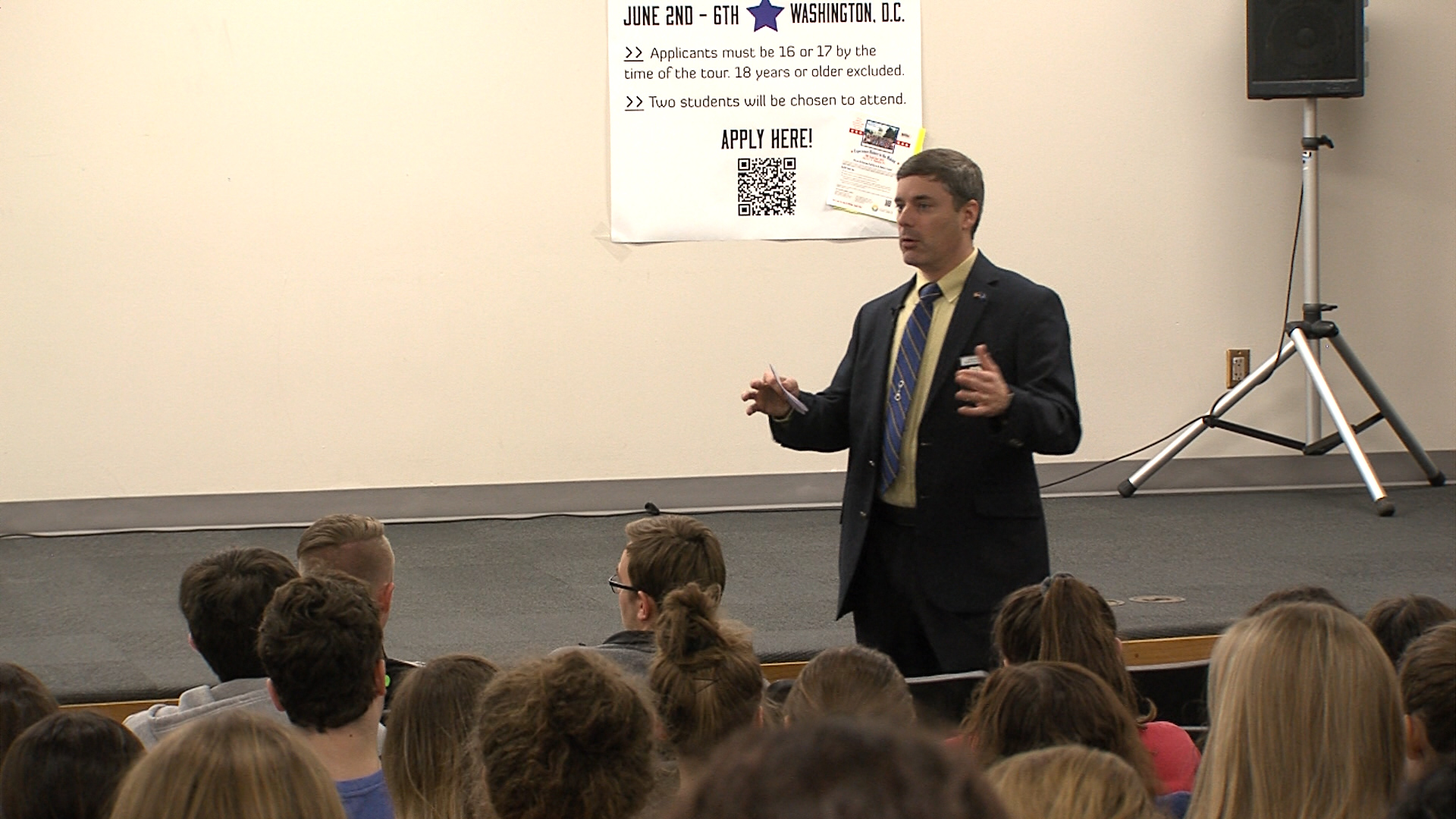
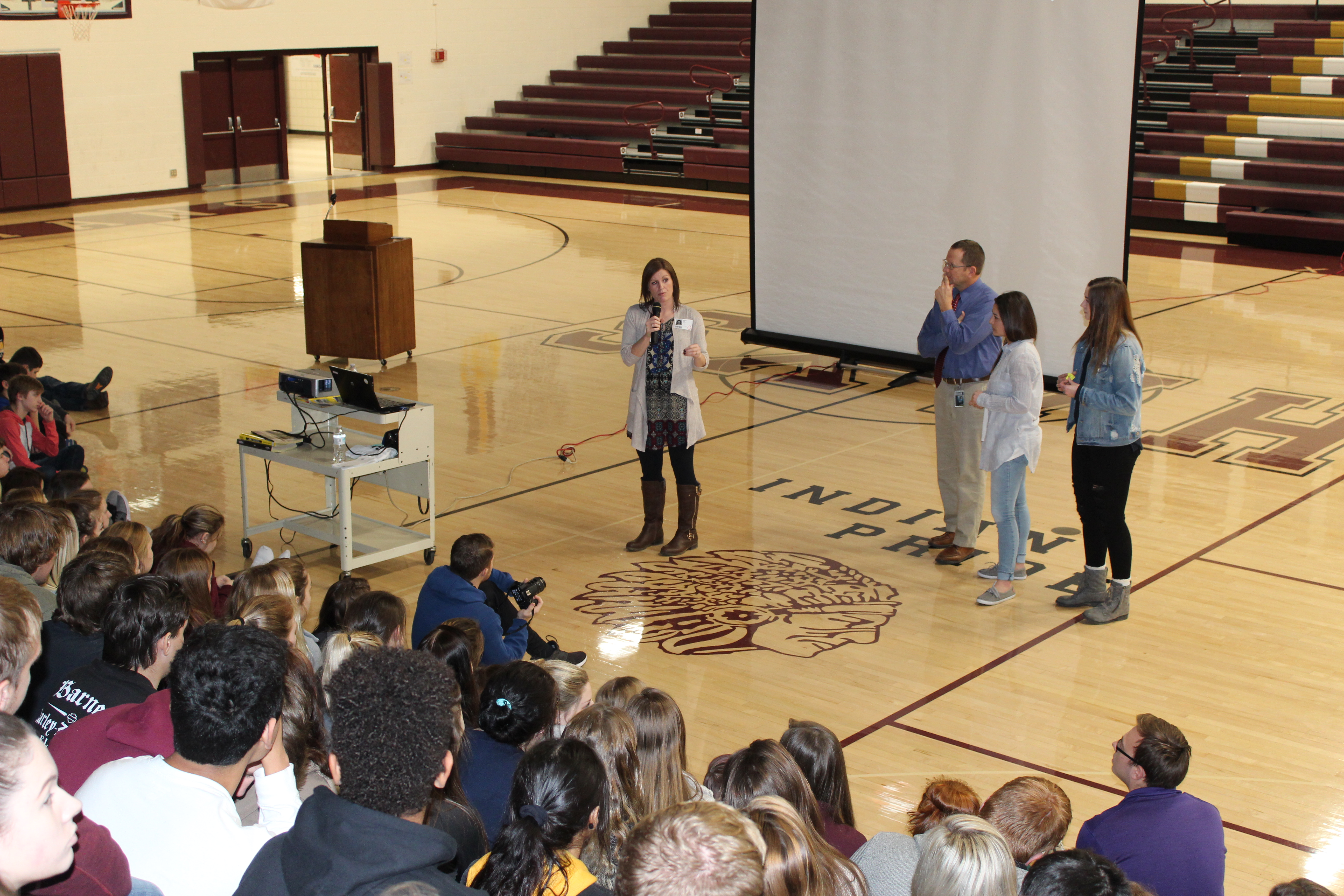
Jennifer White, executive director of ICT SOS, talked to Hays High School students Monday about human trafficking as a part of a weeklong awareness campaign sponsored by the school’s DECA club.
Related story: Hays High DECA students raise awareness for human trafficking
ICT SOS was created in 2011 after two local high-profile sex trafficking cases were covered by local media. Victims in that case were close in age to White’s own daughter, who was 12 at the time.
“Reading that article and realizing that this kind of activity was happening not only in my community, but to kids that were the same age as my kid, was really what gave me what I call a gut-check moment,” she said.
The national average for children becoming victims of human trafficking is 12 to 14 years old. In Wichita, ICT SOS typically sees victims in the 14- to 17-year-old age range. Although most of the victims ICT SOS deals with are girls and women, men and boys are also trafficked. The rate of sexual violence among girls is one in four. For boys, it is one in six.
White said almost none of the cases of human trafficking ICT SOS deals with are kidnapping cases. Most of them involve a friend, boyfriend or family member.
“This is not a stranger-danger crime,” White said. “This is a situation where someone is building a relationship. They are gaining trust. It is a gradual thing. It is manipulating. It is talking someone into taking one step, and then the next step and then the next step.”
Predators often target youth who have difficultly feeling as if they belong. It may be a child who is in foster care or is experiencing abuse at home.
“We all want to belong to something — a sports team or choir or band or whatever that is — our family, our church,” White said. “There are so many people who don’t believe they belong anywhere, and that’s who traffickers prey on. They figure out what that vulnerability is for kids, and they try to be what the kid needs if that is a father figure, if that’s a boyfriend or girlfriend or a friend to listen to them.”
Almost every case ICT SOS now sees involves the internet. It might be recruiting on the front end with social media or advertising on the back end for prostitution.
“As sad and as sick as it is, you can order a person like you can order a pizza,” she said.
She urged the students if they receive a messages through Facebook from people they do not know to block and delete them. Law enforcement subpoenaed the social media records for one human trafficker and found records of 250 women and girls he was talking to on social media.
White said the relationship between a human trafficking victim and their pimp might be similar to a domestic violence situation.
“It’s that same kind of honeymoon phase,” White said. ” ‘Oh, I love you. You are the greatest thing in the world,’ and then it switches to, ‘You are so stupid. No one is ever going to want you. Do you know what you’ve done? No one is ever going to love you. But I love you, I think you are amazing.’ ”
Some youth may fear seeking help, because they are afraid they will be in trouble for what they have done.
In Kansas, minors involved in the sex trade, such as prostitution, stripping, escorting and pornography, are automatically considered victims because it is assumed they do not have the ability to consent, White said.
Kansas is considered a source state for human trafficking. Youth are recruited in places like Wichita, and traffickers use major highways like Interstate 135 or I-70 to move the youth to other states.
Trafficking is highly under-reported, so it is difficult to get solid statistics on its prevalence, White said. The number of cases in Wichita has been steadily increasing — 81 for 2016. These are only victims who are minors, and 2017 figures are not yet available. White said law enforcement believes the incidents of trafficking are not increasing, but awareness is resulting in more victims reporting it and getting help.
“It is a conversation we have to be having because it does happen here, and when we don’t talk about it, it lives in the secrets,” White said. “It is very important that we are talking about it and talking about it accurately.”
ICT SOS works to assist victims of human trafficking, but it also has a prevention effort that seeks to end human trafficking in Wichita and across Kansas.
“As community members, we feel if we can get out in front of it and we can stop it from happening to the kid, that is ultimately what is better,” White said. “It is great to have all those restoration pieces in place and being able to help someone on the back side of this, but if we can keep this from happening in the first place, we feel that is where we can have the greatest impact.”
White listed a number of ways youth and adults can help ICT SOS or help in their own communities.
ICT SOS takes a number of donations for its partner agencies that are used when agencies interact with trafficking victims or youth who are at risk of becoming trafficking victims. These include individually wrapped snack items, hygiene items and warm clothing like hoodies, sweat pants or socks.
“We had a girl come in the (homeless youth) drop-in center a couple of years ago who was about 14 or 15, and she was hanging around with a guy the staff knew to be a pimp in the area. They said, ‘You are a smart kid, why are you running around with this guy?’
“The thing for her that meant he loved her and he was going to take care of her and he was her protector was that he taught her to wash and condition her hair properly. … This girl had not had anyone who had invested enough in her to teach her how to take care of her hair, so those hygiene products coming form a safe place might have made a big difference.”
ICT SOS does Fresh Start Bags with hygiene items and clothing for abuse or neglect victims. White said children who law enforcement see now at 6, 7 or 8 are more likely to be victims of trafficking when they get older.
ICT SOS also has a program to help trafficking victims get tattoos removed or covered up. Often trafficked victims have tattoos of their pimp’s name, a gang name or symbol, or a street name. This can be dangerous for the victim and it is a constant reminder of a life they are trying to leave behind.
Besides donations to programs like ICT SOS, youth and adults can work in their own communities to help prevent human trafficking by serving as a mentor to younger children.
“Whether it is this issue or hunger or poverty or whatever,” White said, “it starts with caring about other people. So whatever that issue is for you, figure out what that is and figure out how you can help.”

By CRISTINA JANNEY
Hays Post
The Kansas Legislature has been charged with increasing school funding by as much as $600 million, but local legislators say that may be a painful process considering the current economic climate in the state.
The 2018 session starts today.
The Kansas Supreme Court ruled in October state funding for schools was inadequate despite the Legislature increasing school funding by $293 million over two years.
The Legislature also increased income taxes during the last session to close a budget gap created by Brownback-backed tax cuts.
Local legislators said this 2017 tax increase plus an upcoming election in November means it is unlikely a tax increase to finance schools would pass.
Rep. Don Hineman, R-Dighton, said raising taxes now would not only be very difficult politically, but harmful to the economy.
Rep. Ken Rahjes, R-Agra, did not vote for the tax increase last session and said he would not support one now.
An interim legislative committee has been meeting to try to address the funding issue.
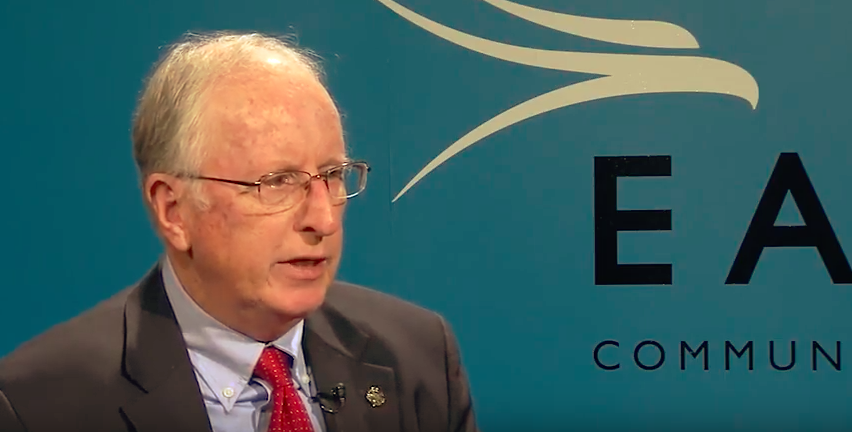
Rep. Eber Phelps, D-Hays, said in an interview for Eagle Communications’s Forum with Gary Shorman, he did not think the committee was making good progress.
“What I think they are really struggling with right now is trying to respond to the court instead of attacking the court,” Phelps said.
“So the court ruled that our formula is unconstitutional. They also questioned the amount of money that is going in for base state aid or the overall budget for education. I think rather than try to work to a solution on that, I think this committee that has been meeting has been spending a lot of time hammering the court. I don’t know if that is going to be productive. I don’t think it is.”
He said the state may be able to draw from increased revenue to fund schools.
The state has seen revenue increases beyond estimates in each reporting period for the last four to five months
Phelps said he hoped the court would allow the district to address school funding in a three-year plan.
“I think we are going to be pretty close to $200 million that we can infuse into education, and it may be more than that. As they have tried to guess, they have been surprised,” Phelps said of the revenue increases. “I think if we can do $200 million each year, that would be $600 million over a three-year period.”
If all of the estimated $600 million had to come from the existing state budget, the state estimates that would equal about an 18 percent across-the board cut to all other state-funded programs. The interim committee heard state agency reports on this scenario.
Hineman said, “The picture that emerged was pretty depressing. I think that it is apparent that no one wants to be responsible for cutting other agencies to that extent.”
If there needed to be cuts to other agencies to fund schools, he said he would prefer to see them done by department rather than across-the board. Hineman said he too supported a phased-in funding increase for schools and also hoped revenue increases would help meet the court’s demands.
However, he said the state can’t rely on increases in revenue alone to deal with the school finance issue. The state’s major industries—oil and gas, agriculture, and aviation—remained depressed.
There has been discussion by the legislators about trying to pass a constitution amendment that would limit the court’s power on school finance. That would require a two-thirds vote by both the Senate and House and a majority vote of the public.
Hineman said he thought it was time to have the discussion. However, he noted it would be an uphill battle to get anything passed.
“The people of Kansas and legislators have a high regard for public schools,” he said. “We want to see our students adequately prepared for their futures, but we have other obligations too. I don’t want to short change other departments by 18 percent. That is really not responsible government. That was not what I was elected to do.”
Rahjes also said he would be willing to discussion a constitutional amendment, but added he would have to review language before he would support it.
“Messing with the constitution is not something to be taken lightly,” he said.
Rahjes said he wanted to see local school districts, especially those rural schools in western Kansas continue to have a voice in the debate.
“The key to a successful economy and state is a strong education system, but we have to make sure the people and the taxpayers are being served well and we are being good stewards of their money,” he said. “We want to continue to engage parents and citizens and school boards and administrators. We all want what is best for students. We may have a different route to get there, but if we continue the conversation, we will get there.”
The Legislature has until April 30 to respond to the Kansas Supreme Court on school funding.
By CRISTINA JANNEY
Hays Post
A simple pat on the shoulder would not bother most people, but for a child who has experienced abuse, it might trigger a feeling of intense fear. They might yell or hit or run away.
The Hays USD 489 school district has formed a committee to make schools better adapted for children who have experienced trauma. Instead of punishing children for acting out, they are trying to respond to children in positive ways and give them coping skills to deal with fear and stress.
Childhood trauma can come in many forms. Some of these include sexual abuse, physical abuse, emotional abuse, neglect—physical and emotional, household dysfunction, domestic violence, a parent or guardian with severe mental illness, domestic violence (especially against a mother), divorce, an incarcerated relative, substance abuse and death of a close family member.
School psychologist Kyle Carlin described what a child who has been traumatized may experience.
“In a child who has experienced trauma, a neutral stimulus now is something that creates this fear response in them that they now act out. With a fear response, you might see that fight, flight or freeze, or they might act out, they might try to run away, they might become more aggressive either verbally or physically or they might completely withdraw within themselves and have trouble interacting within the classroom and with everything else that is happening around them.
“Those triggers can be things that we normally would not think would make someone upset, but it is because it brings back that traumatic experience. They go into this re-experience of it and are trying to cope with this scary situation for them.”
Raj Sharma, director of special education, said children who experience abuse at home might re-enact that behavior at school.
“If they are seeing that abuse over and over in the family, seeing their dad or mom involved in the violence. … Our children model what we do at home. They are going to be modeling that in the school. They might see that as a norm. That might not be a norm in our community or society,” Sharma said.
Trauma-informed education is not only a new effort at USD 489, but it is a movement occurring in school districts across the country and is being studied at major universities, Sharma said.
He said an estimated 5 percent to 10 percent of a school’s student population likely has suffered at least one traumatic event. Statistically, that would be one to two children in each Hays classroom.
Some children might have experienced more than one of these experiences, which not only hinders their ability to perform well at school, but also can affect them into adulthood.
A long-term study of 17,000 people who experienced trauma as children demonstrated the connection between childhood trauma exposure and high-risk behaviors (e.g., smoking, unprotected sex), chronic illness such as heart disease and cancer, and early death, according to the National Childhood Traumatic Stress Network.
“If they have any type of trauma — physical or sexual abuse or neglect — that affects their whole life,” Sharma said.
Instead of punishing children who have experienced trauma for their behaviors, new policies seek to help children deal with the intense emotions they feel.
“They don’t require punishment. They require teaching on how to cope with the stress,” Sharma said. “We know now that brain functioning is impacted and this person needs help with how to cope with the stress level. If we punish them, they are going to have more stress.”
Carlin described several techniques he and others teach kids who are dealing with trauma. The child can draw a square on his or her palm. He or she inhales with the first line of the square and exhales with the second line and repeats for the third and fourth lines. Carlin also might ask a child to focus on a sound in the room, such as the whir of a fan.
He said it helps ground the children so they are not so overwhelmed by their thoughts and their body’s physical response to stress.
Some programs are exploring meditation for children who have experienced trauma — in-school meditation instead of in-school suspension, Sharma said. He said meditation programs have been inked to increased math scores, it is believed because it helps students be calmer, more relaxed and more focused.
Establishing routines and clear expectations help children who have experienced trauma. Carlin said the district began to implement new positive behavior programs last semester for all children known as Foundations on the school level and CHAMPS on the classroom level.
Carlin gave an example of how the system works. Instead of reprimanding a student for running in the hallway and saying, “Don’t run,” the teacher would ask the student to walk. They might also ask the student to return to the other end of the hallway and practice walking.
Sharma said building positive relationship with students is key.
“If you have that relation and you provide that positive environment in the school, that is the only way they can overcome from the situation,” Sharma said.
The district has conducted two trauma-informed schools trainings for teachers and staff. It will continue to not only work with individual students, but also a committee is working on district-wide policies.
The district is using a Trauma Sensitive School Checklist that was developed by the Lesley University Center for Special Education, Massachusetts Advocates for Children and the Legal Services Center for the Harvard School of Law. There are 26 criteria on the checklist, dealing with school-wide policies and practices and classroom strategies as well as how the school interacts with mental health services, families and the community.