The following Hays High School band members were named to the Kansas Music Education Association’s band for the 2017-2018 school year: Myranda Berner—2nd chair flute; Cameron Karlin—2nd chair oboe; Ashley Vilaysing—1st chair clarinet; Abby Kennemer—1st chair trumpet; Cori Isbell—8th chair trombone; Spencer Wittkorn—percussion (no chairs assigned).
Thirty-eight Hays High School students were named to KMEA choir for the 2017-2018 school year. Those students are Eric Adams, Sierra Adkins, Rebecca Anderson, Alisara Arial, Brett Bowles, Eliana Buller, Garrett Cole, Ean Dexter, Katelynn Engel, Brittany Espinosa, Hayden Giebler, Michael Hernandez, Madison Karlin, Adam Klausmeyer, Shelby Knoll, Caitlin Leiker, Nathan Leiker, Lucy Lin, Madison Lisman, Tayler Lobato, Hannah McGuire, Kourtney Muench, Erin Muirhead, Brittani Park, Taya Randle, Emily Ricke, Dawson Rooney, Kari Satomi, Kayla Satomi, Levi Smith, Cade Swayne, Kayson Unsworth, Daylen Vaughn, Alexis White, Ryan Will, Eythun Wyatt, Zac Wyse and Paige Zamecnik.
The Hays High School National Honor Society and Student Council are teaming up for their winter project this year to help families who are struggling financially.
Foreign language, language arts and special education classes will collect hygiene items.
Science, business and music classes will collect items that provide warmth.
Social studies classes will collect school supplies.
Family and consumer science and art classes will collect household supplies.
Technologies will collect paper products and linens.
Math classes will collect miscellaneous items.
Items will be collected from Monday, Nov. 27 through Friday, Dec. 15 and will be distributed to families in need before the holidays.
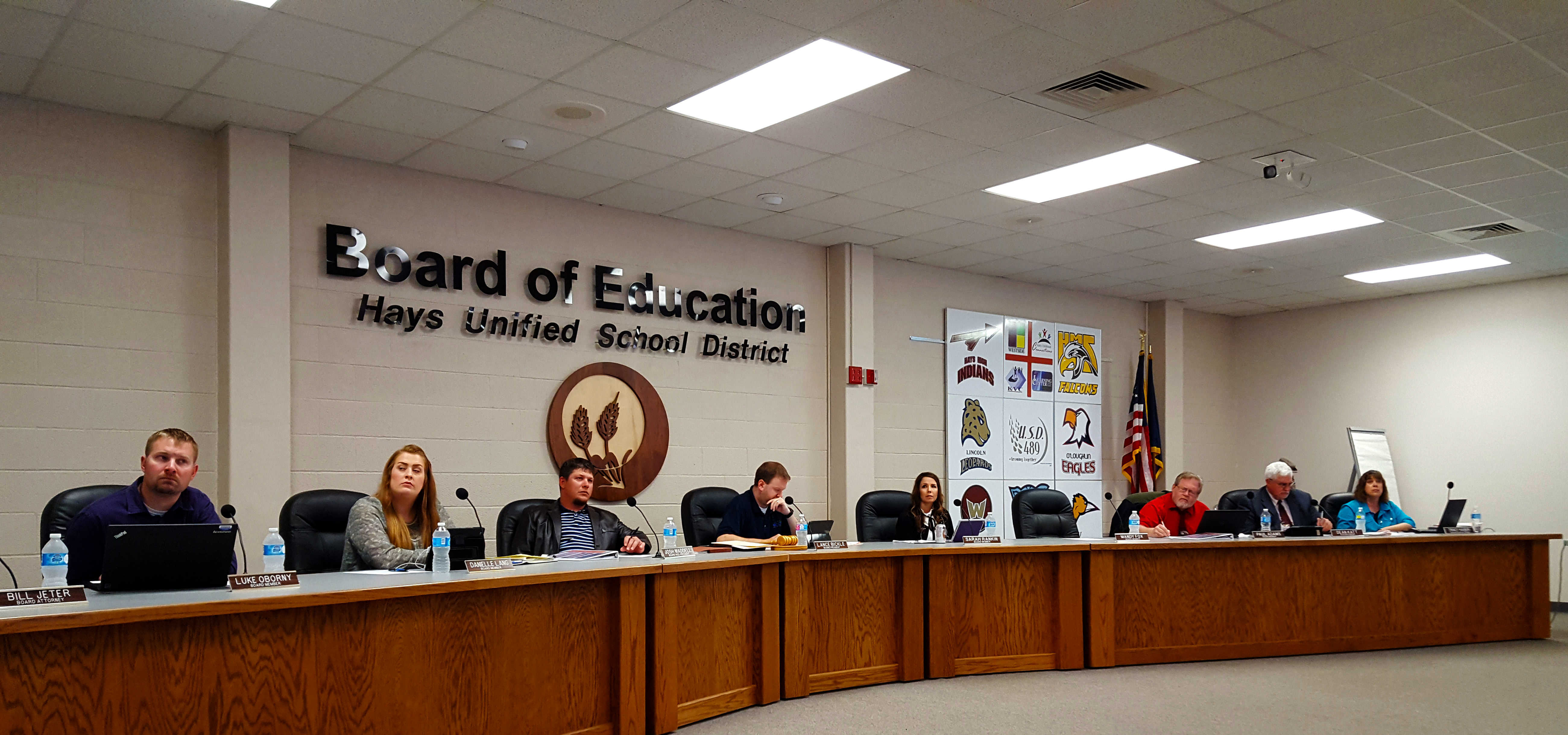
After weeks of discussions, the Hays school board has finally received a copy of an agreement with Fort Hays State University on an assistance program for Ellis County teachers seeking master’s degrees.
The agreement is in the board’s packet for its Monday meeting.
Under the agreement, FHSU would pay $75 per credit hour toward students’ tuition, and USD 489 would pay another $75.
To qualify, teachers must be full-time, approved by the district and seeking a graduate degree through FHSU or up to 18 graduate credit hours in a high needs area, as designated by the district. Teachers must apply and be accepted to the FHSU Graduate School.
Students enrolled in the program are responsible for all fees not paid for through the program and must successfully complete the courses in which they are enrolled.
The program can’t be used in combination with other FHSU scholarship programs.
The agreement has already been signed by FHSU president Andy Tompkins. It will go into effect when it is signed by the school district.
In other business, the board will
• Hear a financial report
• Vote on a request to close the No Fund Warrant account and transfer the $22,400 balance to the Capital Outlay Fund.
Hays has a new service that brings radiology services directly to patients wherever they may be.
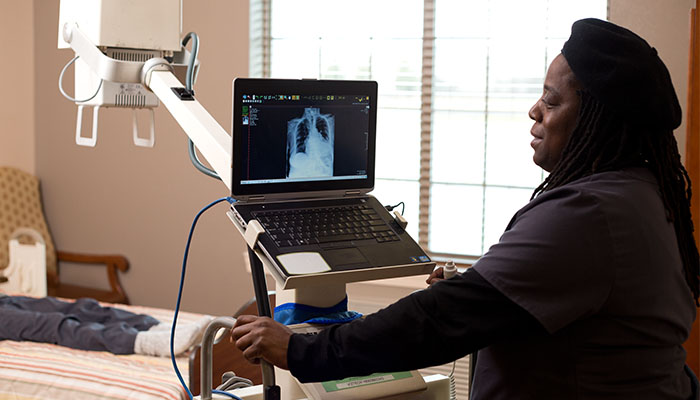
Wichita-based Kansas Mobile Solutions started offering services in Hays and the surrounding area this spring. Patients who can’t be easily moved to a hospital or clinic can have X-rays and EKGs done at their bedsides.
Lachelle Peterson,n director of business development/account services, said the company often works with nursing homes, detention facilities, rehabilitation facilities and even private clients through home health and serve clients within a two-hour radius of Hays. The service is performing 30 to 40 services per month, but hopes to grow that number.
Moving a patient for an exam is often not in the best interest of the patient, Peterson said. If weather is icy or dangerously hot, a patient has dementia or Alzheimer’s or a patient is obese and would be hard to move, allowing the patient to stay where they are can be beneficial.
Tina Brown, director of mobile operations, said, “We are dealing with an elderly population who are in a facility for a reason. There is some reason they are there. They cannot live on their own or it is difficult for their family members to care for them.
“So when we can come in and be able to ease their confusion — their pain whatever it might be and they can stay right there in their bed in the comfort of their own home, it is very less traumatizing on the patient in so many aspects.”
The service can eliminate transportation costs and costly ER visits, allow patients to be treated in their facility and reduce hospital readmission rates. All of this can reduce costs to Medicare.
In Wichita, a five-mile ambulance ride to Wesley can cost $600 one way. Eliminating this transport, saves Medicare at least $400.
ER costs add up quickly. There is the cost of staff to travel with the patient, cost of a doctor seeing the patient in the ER and other tests and treatment that may be done in the ER.
“When we come to the bedside, all they are charged is for the exam and the trip charge,” Peterson said.
The service can be used when a patient falls. Many facilities have to meet certain protocols within set time frames in evaluating a patient who has fallen. The mobile service can often be done more quickly than a service in the ER. It may prevent an unnecessary trip out of the facility if X-ray indicates no injury or result in a faster admission to the hospital if the patient is injured. The X-rays can be burned to a disc and be handed off to hospital staff when the patient arrives at the hospital.
Kansas Mobile Solutions does not seek to replace hospital, emergency rooms or clinics. It is there as an alternative when appropriate, Peterson said.
The company works with physicians and can quickly have X-rays and ultrasounds read through digital technology. The pictures pop on a laptop in the patient’s room and can be seen there. The tech hits send, and the image goes straight to the radiologist.
“Continuity of care is what we strive for,” Brown said. “Being digital and being able to send digital and the turn around time on our reports helps us to make quicker response times to the facility and for the patient so they are not having to wait so long in the ER or in a clinic.”
Kansas Mobile Solutions also is very concerned about quality and has equipment equal to or better than what can be found in a hospital, Peterson said. The technicians are specially trained to work in the field to use what they have available to capture the best images possible. The technicians also have special training working with patients with dementia and Alzheimer’s.
“If our quality was not good, the Wichita Radiological Group would not be standing behind us,” Brown said.
The company’s radiologists own stock in the company.
Kansas Mobile Solutions would like to expand its services in Hays to include ultrasound, but has had trouble finding qualified sonographers.
Sonograms can find blood clots, which can be treated immediately at the patient’s bedside.
The company offers services 7 a.m. to 7 p.m. Mondays through Saturdays. It will do call outs outside of normal hours if a technician is available. The Wichita branch works 24 hours, seven days a week. Hours could be expanded in Hays if demand increases.
The USD 489 Hope Pantry distributed 52 boxes of food to district families in need last week.
The pantry received a $1,000 grant from the Heartland Community Foundation to help purchase food and hygienic supplies over the extended breaks throughout the school year.
Fort Hays State University also hosted their Make a Difference Project to benefit the pantry.
Proceeds from this project, as well as donations received from Alpha Delta Kappa and individuals from the community have allowed the pantry to expand the program from 35 boxes last year to the 52 requested this year.
ADK, an international honorary organization for women educators, donated $300 to the USD 489 Hope Pantry. The $300 donation was used to purchase hygiene products, clothing and food for families in need throughout the district.
“ADK has supported the USD 489 Hope Pantry since it began in 2015 and has made a great difference in the lives of many of the district’s students and their families,” a news release said.
The pantry will continue to strive to meet the needs of families who request assistance.
A total of 58 boxes were requested for families this year. The Hays High School and Hays Middle School pantries were able to assist in making care packages for the remaining six families.
The boxes were distributed to the schools on Nov. 17.
DiRae Boyd looks at her class of middle school students and sees only possibilities.
Boyd works with disabled sixth- through eighth-grade students in the interrelated functional class at Hays Middle School, a job she has enthusiastically held since 1996. Boyd works with students who have severe physical limitations and developmental delays. Some are not verbal, and others have autism.
Boyd has been selected as the Hays Post Teacher of the Month.
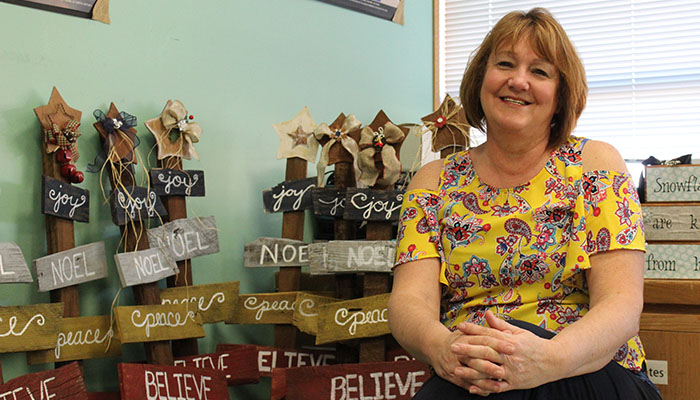
DiRae Boyd, Hays Middle School special education teacher, sits next to crafts her students made for Christmas. Boyd was selected as the November Hays Post Teacher of the Month.
“When I see my students and they enroll and come each year, I see their ability and not their disability,” she said. “And then I try to pack their suitcase with as many strategies, so they can be as independent and successful as possible as an adult.”
For each student, that path looks different. Some students are able to hold down full-time jobs after graduation. Some can only work a few hours, and others their support team has to find other ways for them to have an outlet.
Boyd came to teaching later in life. She went to back to school to become a teacher when she was 33.
The average burnout rate for a teacher like Boyd is three to five years. However, Boyd can’t imagine herself doing anything else. Boyd, who lives in Speed, Kan., loves her job so much she drives 60 miles to work every day so she can work with in a special education functional classroom. Her husband questions her why she doesn’t take a job closer to home.
“It’s my love,” she said. “I love to help them cook. I love to show them how to read and how to do technology, how to do the laundry, how to respond when you go to a dance and someone asks you to dance and you don’t want to dance. Those are the skills we work on — those life skills that other kids just gradually get.”
Working with students with autism, who really need a lot of help building social and communication skills, can be her most challenging work, but also the most rewarding.
“When I see the social and communication growth that they make within my program, it’s exciting because that is lifelong for them,” she said.
Boyd said she tries to put herself in her students’ worlds. She had a boy in her class who was wheelchair-bound, blind and nonverbal. He had to be laid on a mat every day during class so an aide could stretch him. When he did this, he cried out. She knew they were not hurting him, but something about that experience frightened him.
Boyd tried to put herself in his shoes. She laid down on the floor and closed her eyes. She said he must have felt very vulnerable, thinking he was laid out in the middle of the floor so someone might step on him. She and the aides moved his mat to one side of the classroom and gathered some pillows to lay around him so he would not feel so exposed.
Boyd has been selected by her peers twice as a master teacher for the middle school.
Ann Schmidt nominated Boyd for the Teacher of the month saying, “DiRae goes above and beyond every day for not only her students, but any student in need. She always goes the extra mile. For example, a student forgets their sack lunch for a field trip, you will find her in her classroom kitchen putting a lunch together. Not only is she there for students, she always is the go-to person for staff too, whether it be covering a class or sewing on a missing button. She is one of the most caring and compassionate people I know.”
Boyd focuses on behavior in her classroom. Students may cognitively learn on the first-grade level or fifth-grade level, but her students know what is expected of them inside and outside of the classroom.
“When you stand in line at the grocery store, do not be impatient,” she said. “Sometimes my paras say that our students act way better than those people in line at Walmart. I always have high expectations of my students across the board, whether it is academics or social skills.
“I think our lunch ladies would tell you when our students go through the line, they are always the most polite. I always tell them when they pick up their lunch trays, they need to say thank you to those lunch ladies. They have provided you a meal, and you need to say thank you.”
Boyd tries to involve her students with projects at school and in the community. Her students set up for football games. It helps them feel a sense of accomplishment, they are exercising and they use math. The class has also helps make repairs to uniforms. If a student can only push the power pedal of the sewing machine or guide fabric, that is what they do.
Early in her career, she went to the drama teacher and asked that a couple of her students be allowed to be in Mark Massagalia’s drama class. He questioned how that would work since the students were non-verbal.
He wrote a play called “Look Me in the Eye.” Peers recorded the students’ lines, and the students performed on stage through mimes and by pushing buttons to activate the recordings of their lines. She said that play was one of the highlights of her career, and it went a long way to change the perception of her students within the school.
Seeing children’s growth keeps Boyd coming back year after year.
“When you see a young man walk across the stage to receive a seventh-grade award or go across the stage to get their eighth-grade recognition, that is heartwarming. That is fulfillment,” she said. “When I see a young man who came to me with 17 percent compliance behavior for a day and three and half years later he has 99 percent compliance in behavior, we are doing something right. We are meeting the needs of that young man.”
Boyd and her husband were foster parents for more than 20 years, taking in 35 boys and two girls.
Whether it is her foster boys at home, kids in her detention after school, students in home room or her special needs students, she encourages her students to own their mistakes and then move on.
“Every day regardless of how today ended, tomorrow is a new day, and I think that has helped my one young man in the improvements in his behaviors,” she said. “He may know today is the toughest day, but when he walks in the door tomorrow at 7:55, let’s go, it is a new day. Every day should be a fresh start and a new day for everyone.”
It takes a special heart to work with special needs students and it takes a team, which everyone at the school is a part of.
“You do it because you want to make a difference in their lives and, by doing that, they have made a huge impact on mine,” she said.
Boyd, 58, said she would eventually like to retire and be a full-time grandma, but she said she would miss working with the kids in her classroom. She said maybe she would retire and become a para, which would allow her to still work with kids without worrying about all the paperwork.
She said it is hard to let her students go.
Boyd usually spends four years with her students, because most of the students repeat the seventh-grade. She has them six to seven class periods per day five days a week. Sending them off to the high school, she said, “can almost emotionally wreck me.”
“Emotionally it is like sending your child off to college,” she said. “It always seems like if I lose that really, really special student, the next year I get one of those really, really special students that just has that special place in your heart.”
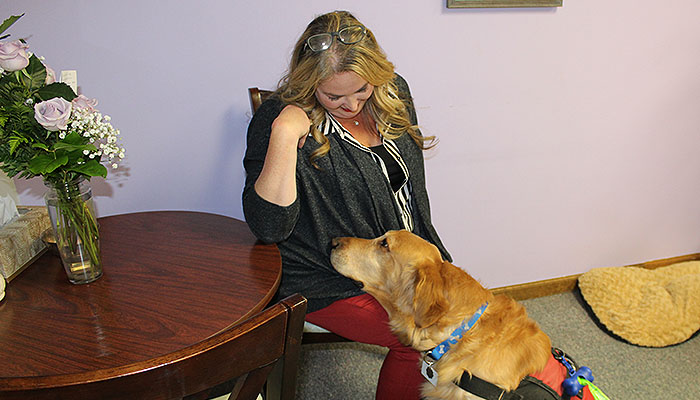
There is a new staff member at Options Domestic and Sexual Violence Services. He has four paws, a silky golden coat and his name is Sunny.
Sunny, 9, is a registered therapy dog with the U.S. Animal Registry and works with Options clients.
About two years ago, Options’ staff starting talking about obtaining a therapy dog due to emerging research on the benefits to trauma victims. They discovered buying a therapy dog would be cost-prohibitive for the agency.
Sunny was Options Executive Director Jennifer Hecker’s dog. Hecker’s son was terrified of dogs when he was young because of traumatic experience when he was little. The family had a chow/German shepherd mix that helped him get over that fear. As that dog aged, the family looked for another easy-going pet to keep their older dog company. Sunny, a full-blood golden retriever, was a gift from family friends.
His innate loving, easy-going temperament led Hecker to think Sunny could be more than just a family pet.
“Golden retrievers want to give you love, and they want to get love, and that is pretty much all they want,” she said. “They are happy and calm and very social dogs.”
Therapy dogs are considered pets. They do not fall under the same protections as service animals or emotional support dogs. Those two categories of dogs are considered workers and serve a single person, whereas a therapy dog is a personal pet that has the disposition to bring comfort to others.
Sunny’s training started at home where he had to learn to get used to being around more people and the door bell ringing. The Options door has a doorbell.
In January, Sunny started coming into work and training there. Hecker stayed after to work to train Sunny. When the doorbell rang, Sunny would bark. If he didn’t bark, he would get a treat. Slowly, he became acclimated to the noises and people to the point he could be used with clients.
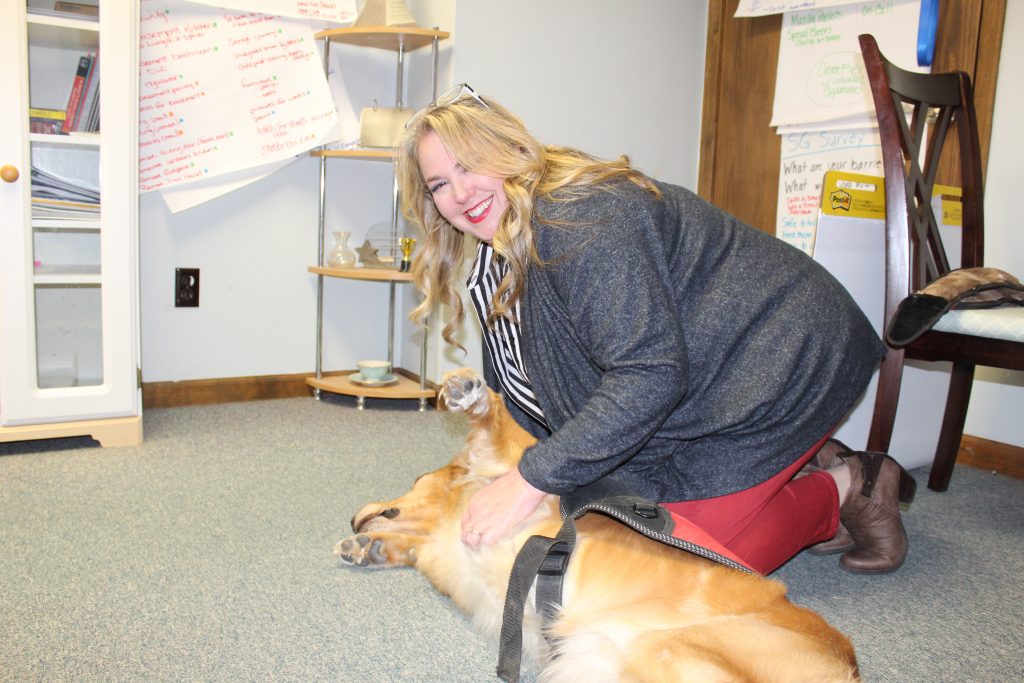
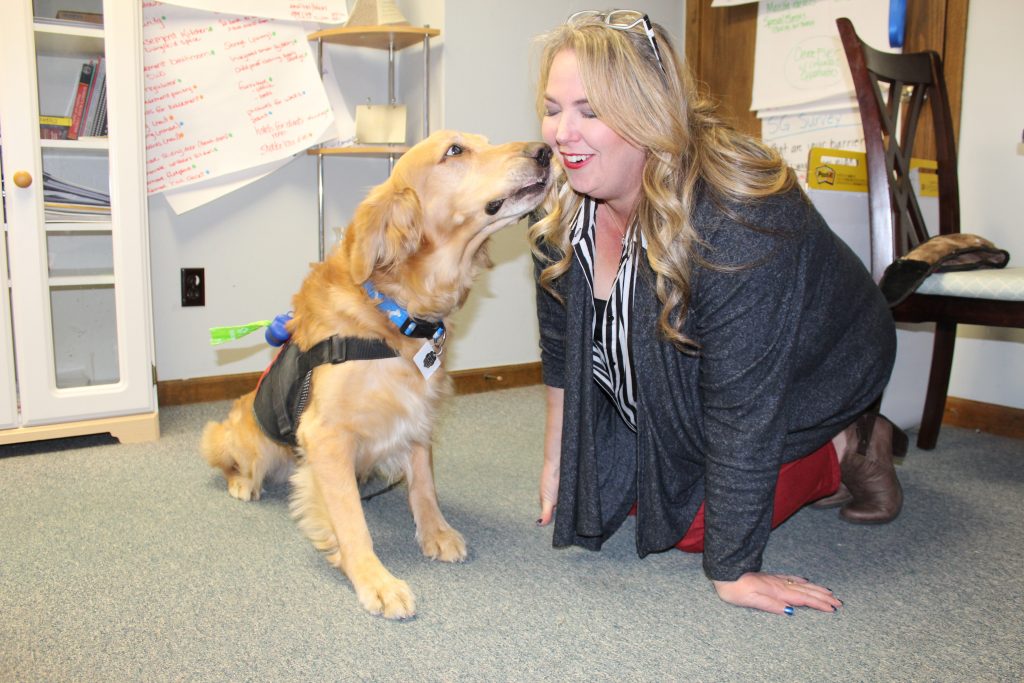
Sunny lays his head on Options Executive Director Jennifer Hecker’s lap just as he does with domestic violence and sexual assault survivors.
Hecker said the difference she has seen in survivors has been amazing.
“It is hard to talk about trauma you are experiencing. It is very personal information. It is embarrassing. It is shameful for some people. It is very triggering,” she said. “Even just recounting a traumatic experience actually engages the brain back into the trauma cycle, and so you physically experience a lot of the trauma responses you did when you originally experienced it for the first time, and it makes it very heard to talk about.”
Shortly after Sunny came to the office, Hecker met a survivor and when she would talk to Hecker, she would physically shake, you could hear her voice crack, she had a hard time recalling details and was tense.
The third time the two met, Hecker introduced her to Sunny.
“She was completely different. She could look me in the eye. She could talk to me without her voice cracking. The physical signs of trauma were gone,” Hecker said. “Of course, it was still difficult to talk about it. She still had those same emotions, but being able to channel that energy. … She just stroked the dog for an hour. He just patiently sat there, loving every minute of it — an hour of complete undivided petting.”
Hecker said that was when she really saw for herself what Sunny could do.
“Until you see it happen, you have no idea the power that a therapy animal can bring,” she said.
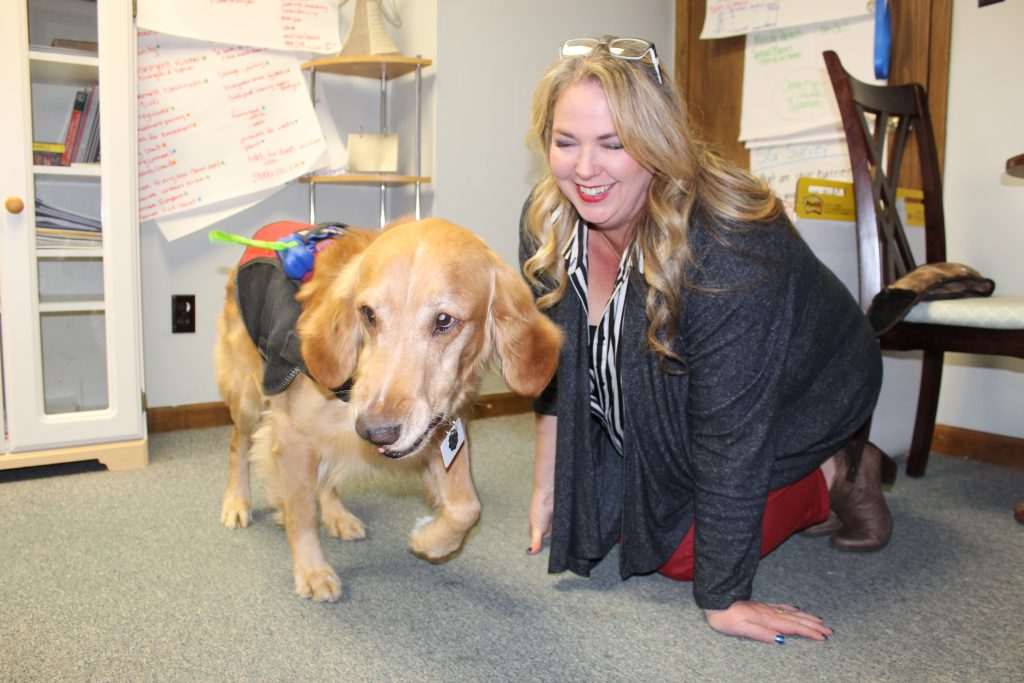
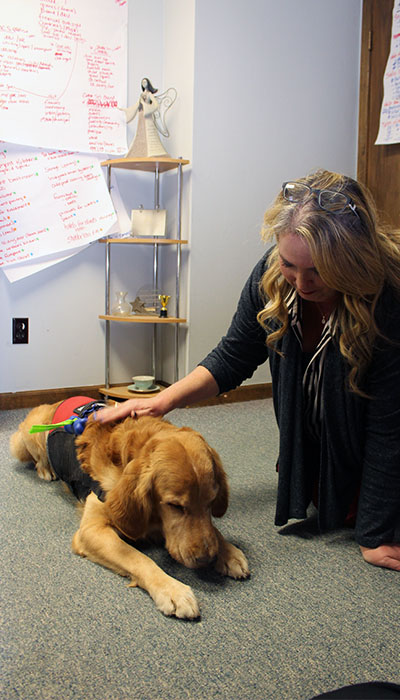
Jennifer Hecker, Options executive director and Sunny’s owner, takes a moment to get down on the floor and pet Sunny.
Sunny has a very natural way of approaching anyone in the office. He comes up to them and places his head in their lap and waits to be petted. He was never trained to do this. In fact, he did had to be trained to disengage, which is achieved by crossing your arms.
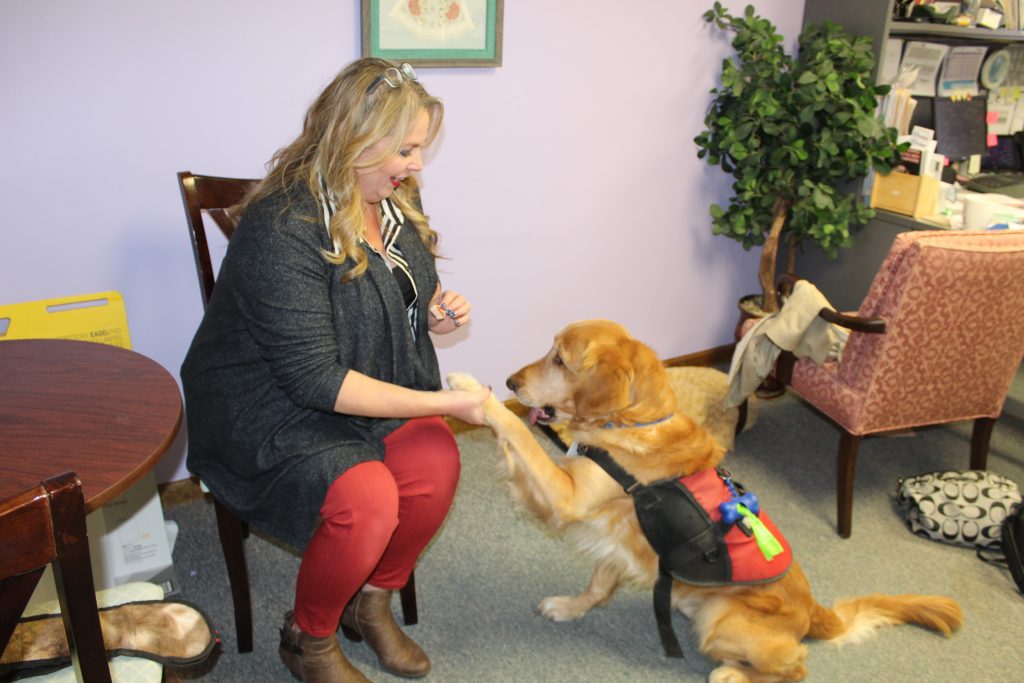
Sunny has a leash on hand, so if an advocate is working with a child, they can take Sunny for a walk. Hecker said it is a great way to break the ice with kids who may be a little nervous. Sunny can do a few tricks. He can shake hands, give you a high-five and lay down, which can be a fun way to introduce Sunny to kids.
Options tries to be sensitive to people who may have allergies or feel uncomfortable around dogs. Sunny has a bed and a comfy spot where he likes to lay in Hecker’s office, out of the way when he is not needed.
Sunny makes regular trips to the Options shelter. He takes on a comforting role and can aid to people who had to leave their pets behind when they left their abusive situations.
“They want an animal to bring them love and comfort or an animal to give love and comfort to,” Hecker said.
Sunny is just a regular fixture of the office now, and his presence has had a happy side effect. Sunny eases tensions in office and is happy to comfort Options employees and be petted when they have bad days.
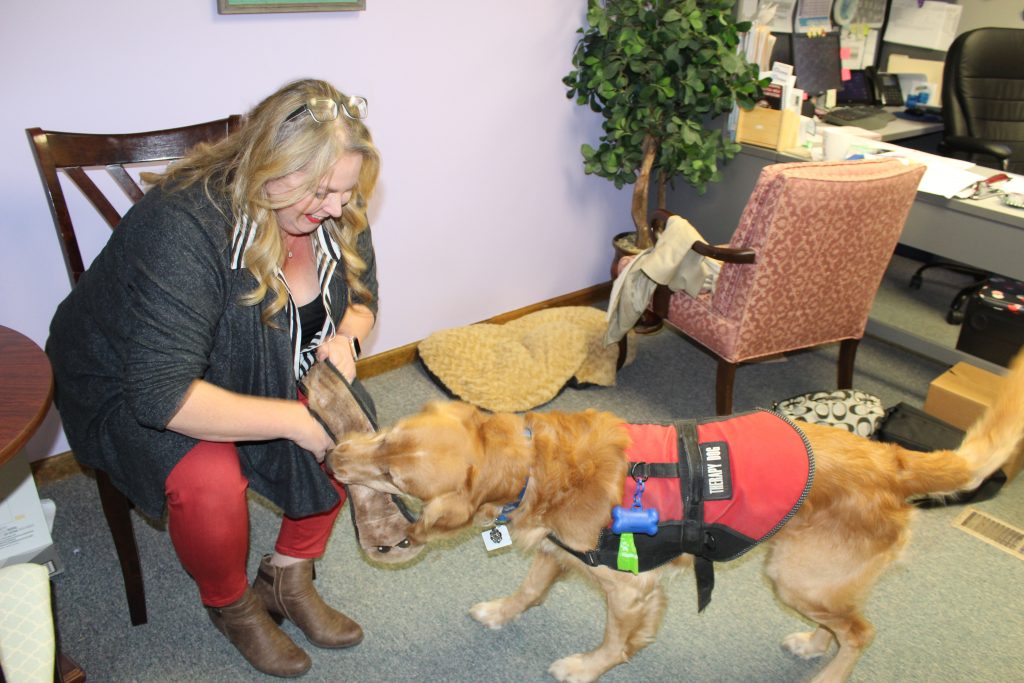
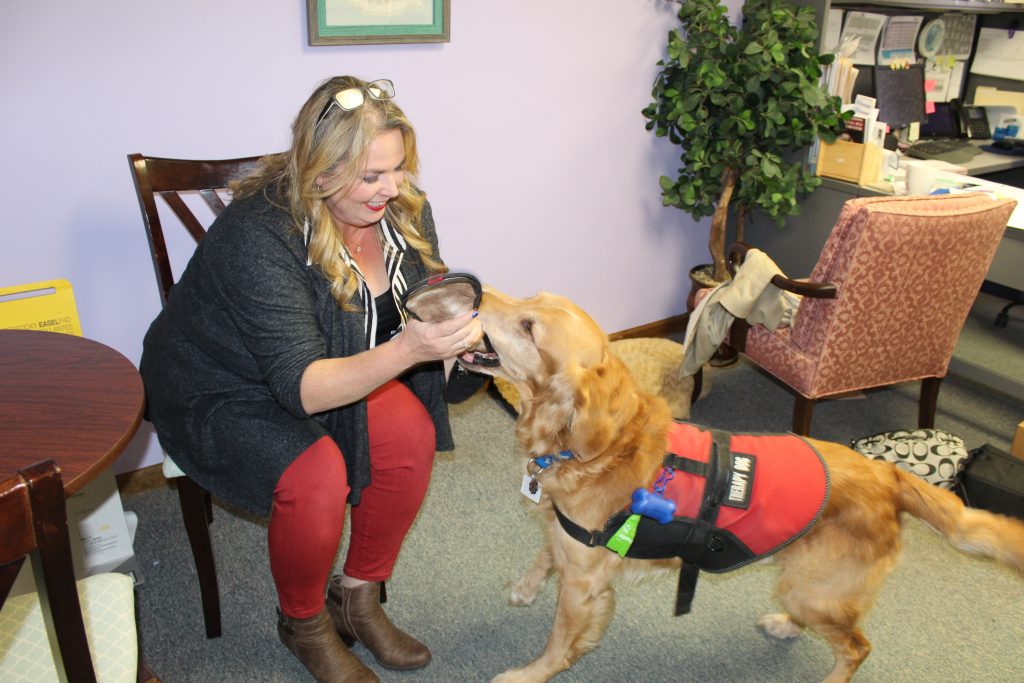
Sunny greets a few staff members each morning with a toy. He cries until they take the toy and pet him.
“It’s hard to be grumpy when there is a dog who wants to give you a high-five or shake your hand,” Hecker said.
To seek help from Options call, 785-625-4202, or its 24-hour help line at 1-800-794-4624. Options’ Hays office is located at 2716 Plaza Ave., Hays, Ks 67601. Find more information on its website at https://help4abuse.org/.
All Options services are free, confidential and voluntary.
Heartland Community Foundation awarded a $5,269 grant to USD 489 for PREPaRE Crisis Training.
Julie Zollinger, USD 489 psychologist, and Theresa Clark, Holy Family/TMP-Marian psychologist, will attend a week-long training conducted by the writers of the original PREPaRE curriculum.
The money for this grant was awarded from the Dane G. Hansen Community Fund.
The school psychologists will learn how to better organize the district and/or school crisis teams, the roles of mental health professionals during a crisis and how to address trauma and recovery from a traumatic event.
After learning this curriculum, Zollinger and Clark will attend the training the trainers workshops, which will provide them with curriculum materials to bring back to their respective schools to train their peers on improving school safety and crisis preparation techniques.
USD 489 piloted the original PREPaRE curriculum 17 years ago and has not had a refresher in crisis preparedness since that time. The PREPaRE curriculum was revised in 2011 after reviewing several schools’ responses during crisis situations.
Midwest Energy grants
Additional USD 489 Midwest Energy grant recipients have been named.
The following Hays High School staff members received grant funding from Midwest Energy:
• Lisa Schoenberger and Katilyn Schaben wrote a $1,000 grant for the “Human Trafficking” project that DECA will be in charge of January 8-12.
• Michelle Thacker and Jolene Windholz wrote a $1,000 grant to help fund the Helping Hands “Prom for Everyone” project. Helping Hands will be collecting formal attire for students to wear who may not normally be able to afford the appropriate dress attire for prom this year.
• Michelle Thacker wrote a $500 grant to purchase aging kits that will be used to provide students with a hands-on view of what it is like to get older.
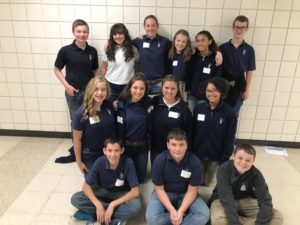
Thomas More Prep-Marian Future Business Leaders of America members are selling Krispy Kreme doughnuts to help pay for their state competition in Topeka.
If you are interested in buying donuts or coffee, contact an FBLA member or Sharris Coomes, adviser, at [email protected] or 785-737-6094.
The school has 29 members this year, and they are listed below for your convenience.
Options Domestic and Sexual Violence Services is offering four nights of child care in November and December to allow parents time to go Christmas shopping.
The event is titled Holly Jolly Nights of Shopping. The shopping nights will be 6 to 8 p.m. Nov. 30, Dec. 7, Dec. 14 and Dec. 21 at Trinity Lutheran Church in Hays. The organization will take children six months and older. Registration will be limited to 15 children each night.
All families are welcome to register their children for the event. Registration is required by 5 p.m the Monday before the shopping night. That can be done by calling Ashley Hecker at 625-4202. There will be games and snacks offered.
Cost of participation in the event will be one donation per child of an unwrapped gift for one of Options’ clients or their children. This will include families in the Options’ shelter. Those not participating in Holly Jolly Nights of Shopping can also bring donations to Options at 2716 Plaza Ave., Hays, KS 67601.
Options will be working with Toys for Tots for gifts for young children, but could use help with donations for parents and teens. Hecker said gift cards can be good gifts for teens.
Other items that can be donated include wrapping paper, gift bags, bows/ribbons, children’s toys, nail polish, new make-up, sporting goods, bath and body items, candles, new blankets, sleep wear in men’s, women’s and children’s sizes, sweets, candy and popcorn, new board/card games, jewelry, home decor, dishes, cookware.
Monetary donations will also be accepted.
For families that have been shattered by domestic violence, the Christmas gifts can be very special, Jennifer Hecker, Options executive director, said.
“It is really healing for the parents,” Hecker said. “How do you say to your child that Santa is not coming this year. You add that with the stress on not being in your own home, or having no job or just getting a job and not knowing how you are going to get gifts for your children.”
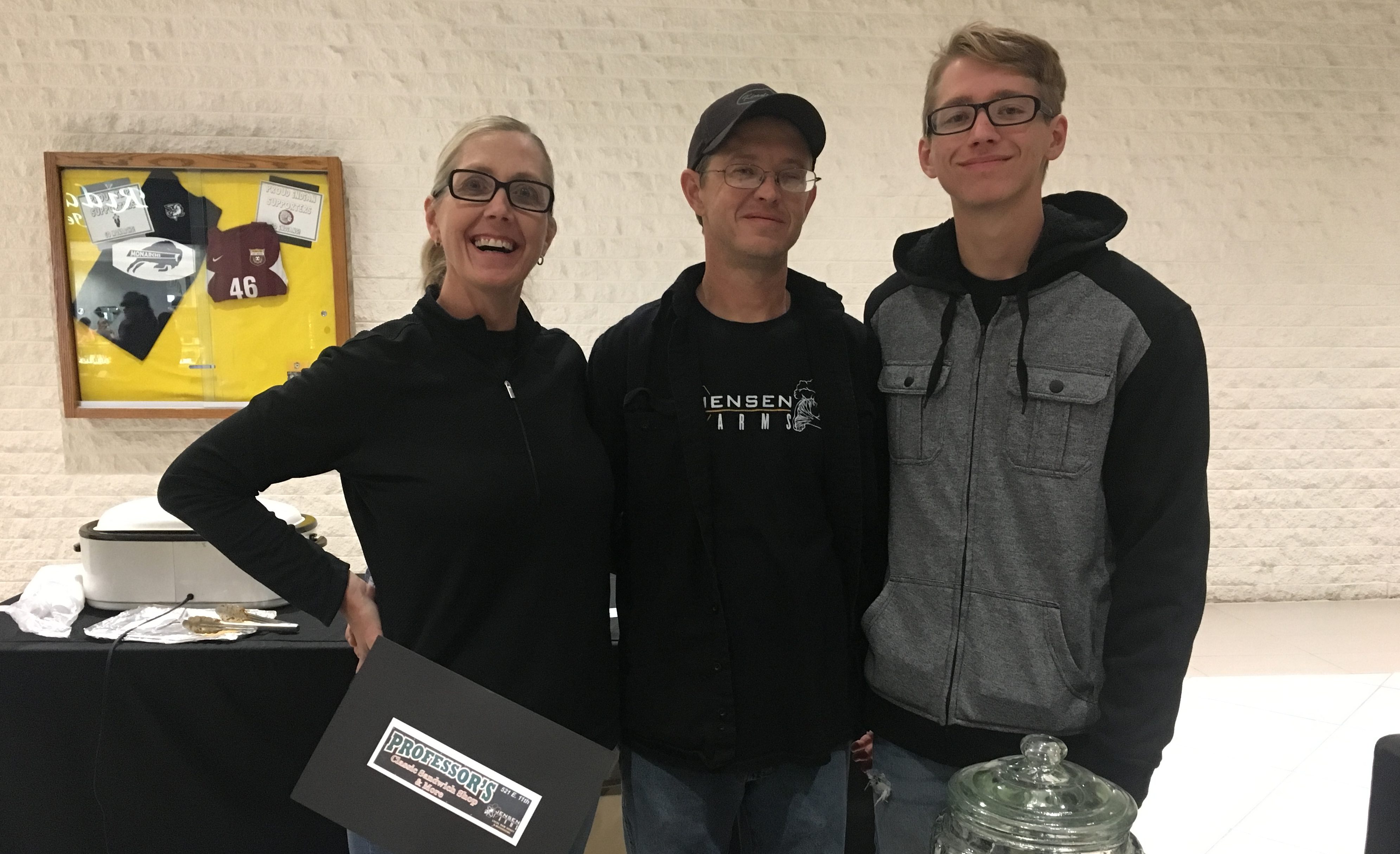
Habitat for Humanity raised $2,200 at its Vine and Dine fundraiser at Big Creek Crossing Nov. 12.
Ten percent will be sent to Habitat for Humanity International’s “Hammer Back” that helps rebuild and repair homes around the United States for recent victims of natural disasters.
Habitat had 17 participating restaurants and 18 local businesses contributing raffles at its Vine and Dine event.
With food samples ranging from mushroom soup, eel sushi to cheesecake, the organization had quite the variety.
Habitat is planning on making this an annual event and hope to see more diners next year.
“We are so appreciative of the support from the community and area businesses that we received,” Habitat said in a news release.
Habitat is currently working on a house in Ellis and has a home available at 901 11th St. in Victoria. Applications must meet income guidelines.
Those interested can print off an application on our website at www.hfhec.org or call 785-623-4200.
Habitat is also seeking applicants for its Critical Home Repair and A Brush With Kindness program for low-income homeowners. Applications are taken for this program year round and work is done as weather permits. Volunteers are always needed for these projects.
Critical Home Repair addresses health and safety concerns in several areas of the home. ABWK projects may include exterior painting, landscaping, weather stripping, door/window replacement or handicap accessibility. Those interested may print an application at www.hfhec.org or call 785-623-4200.
Habitat for Humanity envisions a world where everyone has a decent place to live. Habitat for Humanity of Ellis County seeks to eliminate substandard housing in Ellis County by bringing people together to build, rehabilitate, and repair homes and communities, and create hope.