The Ellis County Ministerial Alliance will host its 10th annual Thanksgiving Feast from noon to 1:30 p.m. Thanksgiving Day at the Rose Garden Banquet Hall, 2350 E. Eighth St.
All are welcome to attend the free traditional Thanksgiving meal. The meal is supported by the United Way of Ellis County, local businesses, non-profits and private donors.
A free-will donations will be accepted. You also may send your tax-deductible donations to ECMA, P.O. Box 173, Hays, KS 67601. Anything raised above the cost of the meal benefits the Ministerial Alliance’s 2nd Mile Fund, which supports First Call for Help and other sheltering agencies.
Rides are available by calling Access Transportation at 785-628-1052. Reservations must be made by noon on Wednesday. Dinners also will be delivered to shut-ins. Make arrangements for delivery by calling First Call for Help at 623-2800 by noon on Wednesday.
Linda Mills, director of First Call for Help, said 600 to 700 people will likely be served at the dinner.
More than 100 volunteers will be needed for the event to serve, bus tables, seat guests and perform other duties. To volunteer, also call First Call for Help at 623-2800.
“Everyone is invited. We have a good time and good food,” Mills said.
The Parents as Teachers program through Hays USD 489 Early Childhood Connections was awarded the Blue Ribbon Affiliate award.
The program met or exceeded all 17 essential requirements in the 2016-2017 program year and also met at least 75 percent of the additional Parents as Teachers quality standards in the self-study
The USD 489 Parents as Teachers program will be honored at the 2018 Parents as Teachers Conference.
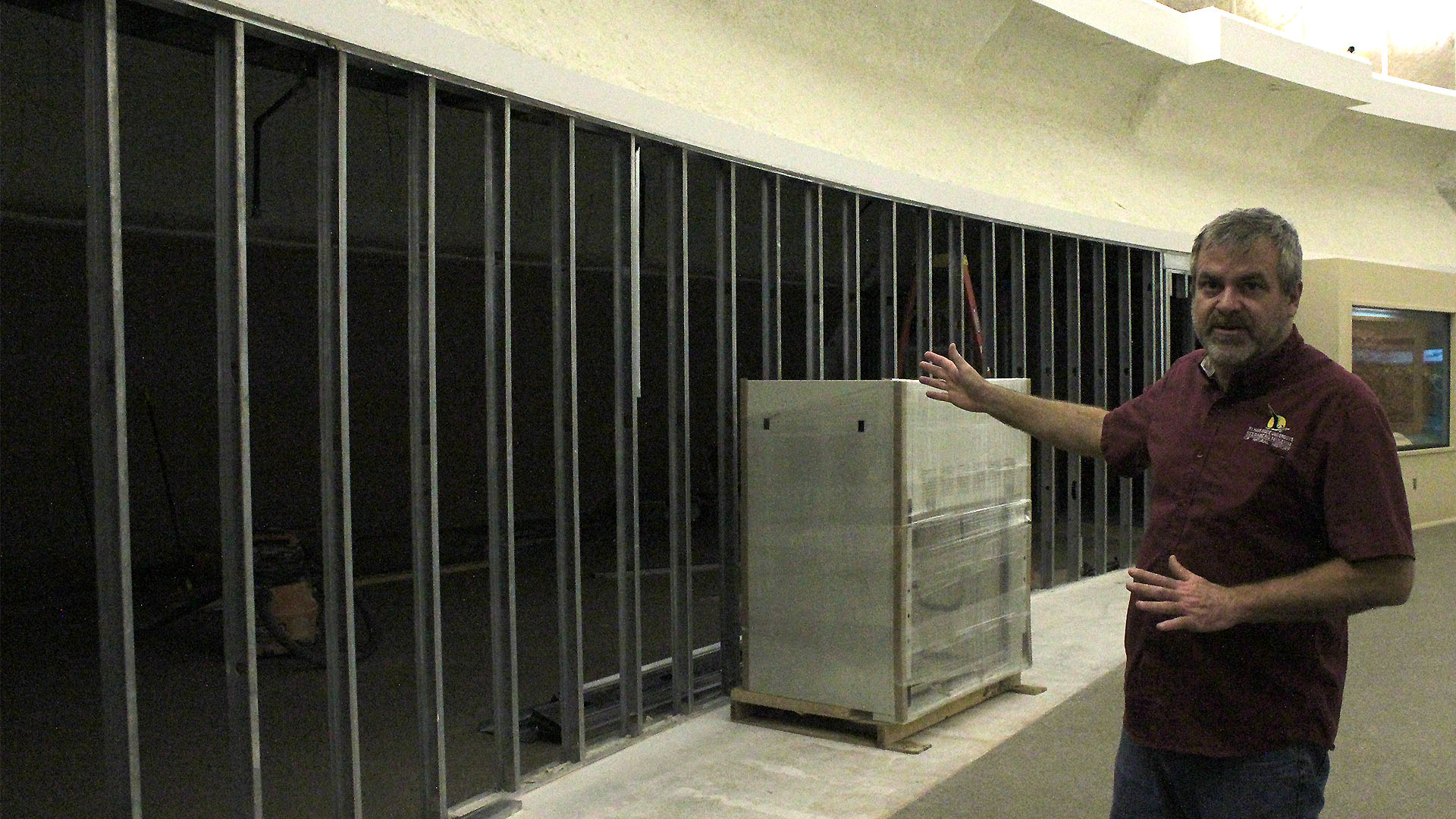
Reese Barrick, Sternberg Museum director, shows off the space where a new paleontology prep lab will be located.
By CRISTINA JANNEY Hays Post
Visitors to the Sternberg Museum of Natural History will soon have the opportunity to watch and interact with scientists as they process fossils.
The museum received $160,000 from Dane G. Hansen Foundation, Mike and Pam Everhart and many other individuals to construct a 750-square-foot paleontology prep lab. The lab will include a 12-foot sliding window that will open and allow visitors to interact with scientists as they prepare fossils.
“This is a chance to really upgrade and renovate our ability to interact with the public, show off what we do in getting things from the field to the research collection to the exhibits. You’ll really get to see what happens at the museum,” museum director Reese Barrick said.
Barrick said this interaction will help both the students and the public. The public will learn more about the animals, and the students working in the lab will get hands-on experience speaking and interacting with museum guests.
The new lab also significantly expands the museum’s research space, which will give the museum opportunities to train students and volunteers in fossil preparation and move fossils more quickly from the field to the museum’s collection.
The additional space will allow the museum to add equipment and small separate research lab. This will facilitate Dr. Laura Wilson, museum curator, in her study of fossil histology. Wilson slices bones into very small pieces and evaluates them under a microscope, research that helps determine how an animal grew.
Some animals grow slowly over their whole lives, Barrick said. While other animals, such as mammals, grow quickly in their early years and then stop growing. Some animals’ bones resemble the growth rings of trees and can be used to determine age or even gender.
The information gleaned from histology studies can also be used to extrapolate ancient animals’ ecologies.
“We know as mammals we have a pretty high metabolisms and we eat a lot,” he said. “You can figure out how many grocery stores in a town it is going to take to feed people. You can run that with animals. If you have an elephant, how many acres is it going to take to live in and feed it? Whereas if you have an elephant-sized thing that has the metabolism of a lizard, it doesn’t take nearly as much space.
“We have things like our big mosasaur over here and our plesiosaur over there. If we can look at how fast those things grew, we can get an idea of how much those things had to eat. You can work back and figure out how much food was in the ocean period. How many fish did there have to be to feed all these giant monsters and how many smaller fish did there have to be to feed these bigger fish all the way down to these single-cell organisms?”
The lab should be completed by Christmas and all the equipment in place by mid-January.
The lab construction has set in motion a major reconstruction in several other areas of the museum.
Barrick shows the area in the Earth Sciences Gallery where the Rocks of Western Kansas exhibit will be moved.
To make way for the lab in the Fossil Gallery, the Rocks of Western Kansas exhibit had to be taken down. That is being moved to the Exploring Earth Sciences Gallery. Five cases in the Earth Sciences Gallery that were dedicated to an exhibit titled Fossils Through Time have been take off of exhibit and the fossils returned the museum collection.
Rocks of Western Kansas should be in its new home by Christmas, as well.
The rest of the Exploring Earth Sciences Gallery will also change very drastically. A new exhibit will eventually be added that will explore the invertebrates of the Kansas seaway, such as clams and ammonites.
The museum will receive a donation next week of a private mineral collection worth an estimated $100,000 to expand its minerals exhibit.
Next week, the museum will pick up a new $100,000 collection of minerals that is being donated by a private collector. It will be added where the fluorescent minerals display is now.
The rest of the Earth Sciences Gallery will be dedicated to explain the evolution of the grasslands in Kansas over the last 50 million years, which will encompass the Paleocene through Miocene eras.
Finally, visitors to the museum will walk into the ice age exhibit, which includes skeletons of large mammals of the time period, including a mammoth. This exhibit will largely remain the same.
Barrick said the museum has considered for some time restructuring its exhibits to show the evolution of the Kansas landscape from an inland sea, to a closed canopy forest to the grasslands we see today.
“I think we want to give them a more comprehensive idea of the changes in life and ecology through the Cretaceous of Western Kansas in a more inviting, exciting and appealing way, so they will spend more time, be more enthused about what they are seeing and come back and learn a lot more about what Kansas is like — what the Cretaceous was like and learn a lot more about the value of rocks and minerals,” Barrick said.
Other areas of the museum will be renovated to depict the transition of Kansas from an inland sea to a modern grassland.
He said many people see minerals as shiny, bright items, but they may not understand the full economic values of minerals and how they are used in industry and how they end up in household goods.
When the museum received the funding for the paleontology lab, it jump-started renovations of the rest museum. The funds for the paleontology lab have already been secured. However, the museum will still need to raise money for the further renovations of the invertebrate, mineral and Paleocene through Miocene exhibits.
It will likely be three to four years before all the renovations and new exhibits are complete, depending on fundraising. The museum will need about $50,000 to $60,000 to finish the exhibits. Barrick said he did not anticipate any museum closures associated with the renovations.
Donors can give by visiting the Sternberg website and clicking on the Donate button at the bottom of the homepage. This will take you to the Fort Hays State University Foundation page. You will need to indicate on this page that you want the money to go to the Sternberg.
The museum will continue to feature traveling exhibits In its rotating exhibit space. This summer, the museum will have a traveling exhibit titled “World of Giant Insects” that will feature animatronics insects.
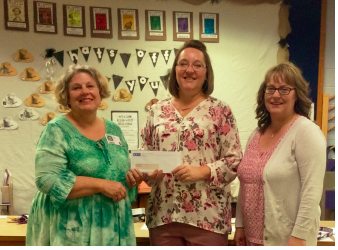
Lynette Armstrong, Wilson Elementary School librarian, successfully wrote a $5,000 grant for the Wilson library.
The Central Kansas Library System and the Dane G. Hansen Foundation awarded the check to Armstrong on Oct. 23. Money received from this grant will go toward purchasing books and materials that support the readers and writers workshop curriculum.
Midwest Energy announced grant awards to the following district staff:
• Tessa Brandenburg—Lincoln Elementary– Interrelated resource teacher: $487 to purchase low-leveled high interest books and storage crates for the special education classroom. This will allow students to find books they enjoy at their reading levels.
• Gay Flax—Lincoln Elementary—Physical education teacher: $1,000 to purchase golf equipment for physical education classes
• Brad Moritz—Hays Middle School—Exploratory/industrial technology teacher: $771 to purchase two EV3 LEGO robotic kits for the Hays Middle School Robotics Club
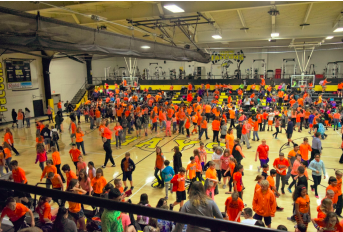
Hays Middle School celebrated Unity Day and anti-bullying month with an assembly planned by its Leadership Team.
Students played mix-it-up bingo to start the day.
They were placed in groups and each student had a bingo card. They had to find a student who fit the description on the card — a person who has braces, a person who lives on a farm, a person who rides his/her bike to school. Door prizes were given to students entered in the drawing who had completed their bingo cards.
The HMS Leadership Team created its own anti-bullying videos that were shown to the student body.
Students and staff wearing orange met for a group picture. The goal of Unity Day and Mix It Up day is to include others, be open to form new friendships and stand together against bullying.
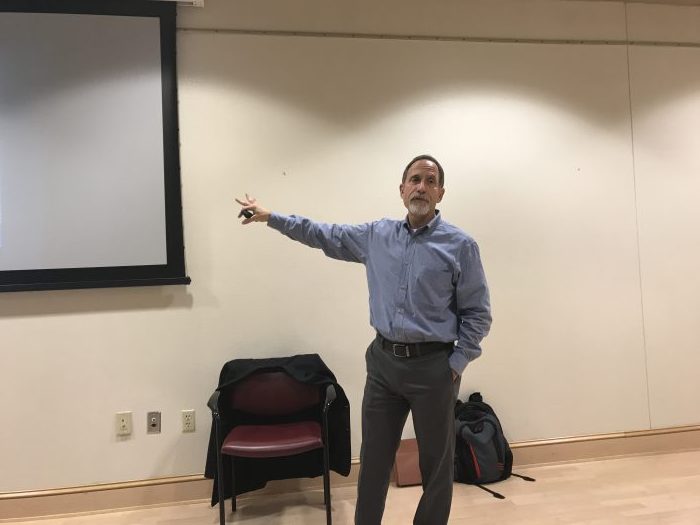
Sheldon Weiagrau, director of the Health Reform Resource Project, talks to a group in Hays about Medicare expansion.
By CRISTINA JANNEY Hays Post
A health educator told a group of Hays-area residents Tuesday that Medicaid expansion would not only be revenue positive to the Kansas budget, but boost the state’s economy.
Sheldon Weisgrau, director of the Health Reform Resource Project, a foundation-funded initiative to provide education and technical assistance in the implementation of health reform and the Affordable Care Act, was invited to speak at the Hays Public Library by Women for Kansas.
Women for Kansas is a non-partisan group that aims to promote election of moderate candidates who support moderate policies.
There are several groups who qualify for Medicaid (known as KanCare in Kansas) under the current system including low-income residents with disabilities, low-income pregnant women, low-income elderly and low-income children.
Those making a certain amount of money and who are not covered by health care insurance at their jobs can qualify for plans under the Affordable Care Act. About 90 percent of those people qualify for subsidies.
About 150,000 people in Kansas make too little to qualify for the Affordable Care Act, but do not qualify for Medicaid, Weisgrau said.
She said expansion of Medicaid under the Affordable Care Act was supposed to cover these people in the gap, but Kansas has refused to expand Medicaid, 100 percent of which would have been funded by the federal government in the first three years (2014 to 2016).
Kansas has lost more than $2.2 billion in tax revenue in the last three years by not expanding Medicaid and that number increases by more than $1.9 million every day. This is money that is going to the other 33 states that enacted Medicaid expansion.
“Everyone in this room is a federal taxpayer. The federal government is saying, ‘Here, take some of it back,’ and we are saying ‘No thank you,’ which means your federal tax dollars are going to California and Colorado and Massachusetts and all the other states that have accepted this program and it is not coming back to the state of Kansas,” Weisgrau said.
Now the federal government is paying 95 percent of the cost of Medicaid expansion, which will eventually go down to 90 percent.
The Kansas Legislature passed a measure to expand Medicare in Kansas during the last session. However, it was vetoed by Gov. Brownback, and the Legislature was just shy of enough votes to override the veto.
Brownback and other opponents of the Medicaid expansion have argued the expansion would be too costly to the state’s budget. Weisgrau disagreed.
Kansas pays 45 percent of the care for Kansas residents who are currently on Medicaid. If the state would move some people who qualify for Medicaid to the federal Medicaid expansion, there would be cost saving, because the cost to the state would shift from 45 percent to 10 percent.
Weisgrau gave the example of a low-income woman. If that woman becomes pregnant, they qualify for Medicaid for the duration of her pregnancy then they fall off the Medicaid rolls. If she was continuously enrolled in Medicaid under Medicaid expansion, the state would only pay 10 percent of her care during pregnancy and delivery instead of 45 percent.
There are people with disabilities that could also be covered under Medicaid expansion for similar savings.
“If you look at the budget, which we have done very carefully, not only will this not cost Kansas money, but we will save enough money to completely pay for this,” Weisgrau said.
In addition, the three managed care companies that provide insurance to KanCare recipients each pay a privilege fee to the state for each person they cover. Covering another 150,000 would increase privilege fee revenue for the state.
Most of the states that have implemented Medicaid expansion have seen a 1 percent growth in GDP. In Kansas expansion of Medicaid would create an estimated 3,800 jobs. Based on population, Ellis County could expect $4.3 million in new health care spending and addition of 27 new jobs. Because Hays draws patients from smaller outlying communities, those figures are likely conservative.
The millions in revenue Medicaid expansion would bring the health care industry could be especially critical to small, rural hospitals. Thirty rural hospitals in Kansas are classified as financially vulnerable.
A big hit in these hospitals’ bottom lines is uncompensated care. Federal law dictates if someone comes to the emergency room, they have to be evaluated and treated for acute conditions, including women in active labor. Hospitals rarely are able to collect payment from uninsured patients.
Medical debt is the No. 1 reason for bankruptcy in the United States. When uninsured patients can’t pay, it ruins their credit and inhibits their ability to land a good job, get a loan for a car or qualify for a mortgage.
Weisgrau said we need to dispel the myth of the “Welfare Queen.” There are people who take advantage of the system, but that is not true in most cases.
“This is a real way out of poverty,” Weisgrau said. “Most of the people who fall in the gap work or are sick. … Medicare helps people get jobs and creates a path out of poverty and a way to economic security.”
Weisgrau said people who support Medicaid expansion in the state should contact their local state representatives and senators. Rep. Eber Phelps, D-Hays, and Sen. Rick Billinger, R-Goodland, both voted in favor of Medicaid expansion during the last session. Rep. Ken Rahjes, R-Agra, voted against.
In surveys, 70 to 82 percent of Kansans support Medicaid expansion. Sixty-six percent of Republican voters support it.
“This is not a controversial issue,” he said. “It is not a partisan issue. There are some legislators who are honestly not representing their communities.”
To join the Alliance for a Healthy Kansas in support of Medicaid expansion or find other material supporting Medicaid expansion, visit www.ExpandKanCare.com.
Also like the group on Facebook @ExpandKanCare or follow them on Twitter at /ExpandKanCare.
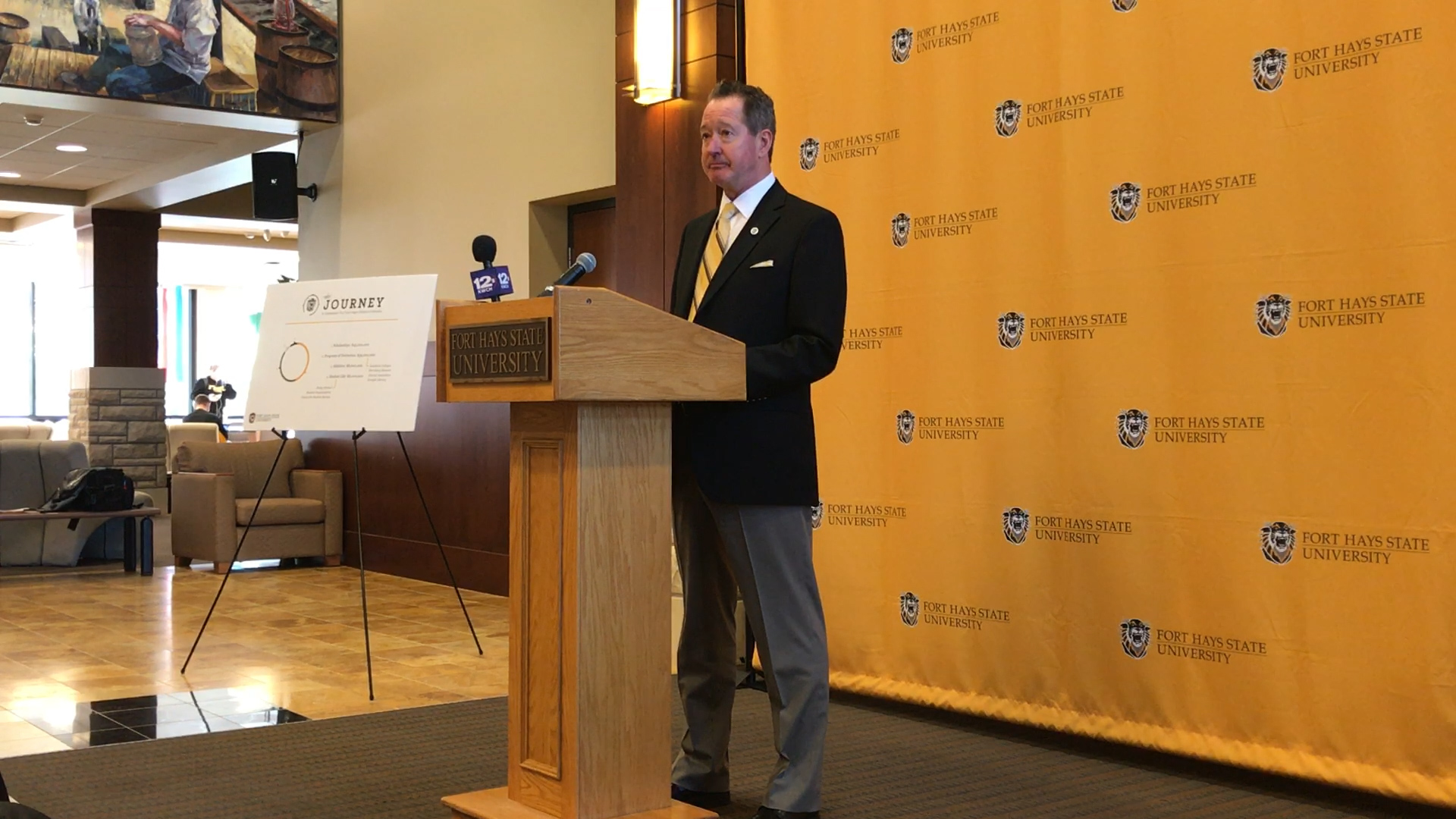
Curtis Longpine speaks at a press conference Thursday, announcing a $100,000 gift to Fort Hays State University.
By CRISTINA JANNEY Hays Post
The Fort Hays State University Foundation announced Thursday a $100,000 gift from Curtis and Renee Longpine to benefit the University’s Journey Campaign.
The gift brings the Journey Campaign total to $56 million of its $100 million goal.
About $60,000 of the Longpines’ gift will go toward the Geology Field Camp program, $20,000 will go to the President’s Venture Campaign and $20,000 will be an unrestricted gift to the FHSU Foundation. Curtis Longpine will serve as the next president of the foundation board.
Ken Neuhauser, professor of geology and co-director of the Geology Field Camp, discussed how the donation will benefit FHSU students.
Neuhauser said the Geology Field Camp, a six-credit course, is an essential part of geology students’ study. They use all of the skills and book learning they have accumulated in their time at the university and apply it in the field.
“You get to see things that were in textbooks or on YouTube. It is not the same,” he said. “You gotta be out in the dirt and the mud and the bugs and the cold and all those things that they have to deal with daily. We guide them through that. It is something that is going to be a great experience to them. It is something they will never forget for the rest of their lives.”
The cost of sending one student through field camp is about $2,000. This includes tuition, camping fees and equipment, such as tents, sleeping bags and geology tools. Over the years, more of the burden of this cost has been borne by the students. This gift will help defray some of that cost.
Curtis Longpine of Damar Resources of Hays studied geology at FHSU and said he and his wife are very fortunate to be able to indulge in philanthropy.
“My interests in charity are to stay local when possible, to help those who can’t help themselves and to help those intent on improving themselves,” Longpine said. “Obviously when a student comes to Fort Hays, they are making an investment in their life, and I want to help them with that investment.”
He said Geology Field Camp allowed him to use the range of his education all at one time, all in one place.
Longpine said when he attended field camp, the school paid for all of the field camp expenses, but today much of the expense falls on students. The Longpines’ gift will create a an endowed scholarship fund to ease the burden of the cost of field camp on students.
The funds that are going to the President’s Venture Fund will help incoming FHSU President Tisa Mason lead the college into the future, Longpine said.
Longpine urged members to consider donations to the foundation.
“Why? Because they do great work. They truly do. Why? Because it is good for the community and it is good for our future. Why? Because it is just a great time to be a Tiger, and you all want to be a part of that,” he said.
Interim FHSU President Andy Tompkins said when he went to college, the community supported a lot more of what was happening at the college.
“You know that has flipped over the years, and it has become more important to see the importance of a greater good, and giving back and giving to things we know make a difference in other people’s lives,” he said. “We are grateful for not only the gift, but for the givers and the message that you give us about giving, so I want to say thanks for that too.”
ELLIS — The Ellis Food Box program is seeking applicants and donations for its annual Christmas gift and food give away program.
This is the 15th year for the Food Box program. It began with only five boxes, and last year served 130 families in Ellis USD 388.
Applications will be taken through Dec. 9. No proof of income is required. Simply call Leonard Schoenberger, program director, at 785-726-4917. Leave a message.
Please include your name, address, phone number and age and gender of the children in your family. Please also note if you are 65 years old or older.
Those wishing to donate may give food, a toy for either a child 12 and younger or 12 through 18 or monetary donations.
Monetary donations or unwrapped toys can be taken to Golden Belt Bank, 901 Washington St., Ellis, or Emprise Bank.
Checks can also be made out to Ellis Food Boxes and mailed to 808 Monroe, Ellis, KS 67637.
Food can be dropped off at the grocery store or donations can be made through participating local churches.
Food donations that are needed most are canned fruits and vegetables, soups and dry commodities. Please no flour or sugar.
Donations will be taken through Dec. 20 for delivery this year.
Ellis Food Boxes is affiliated with the Ellis Community Foundation, and donations are tax deductible.
For more information, contact Schoenberger. He can also be reached on his cell phone at 785-726-1278.
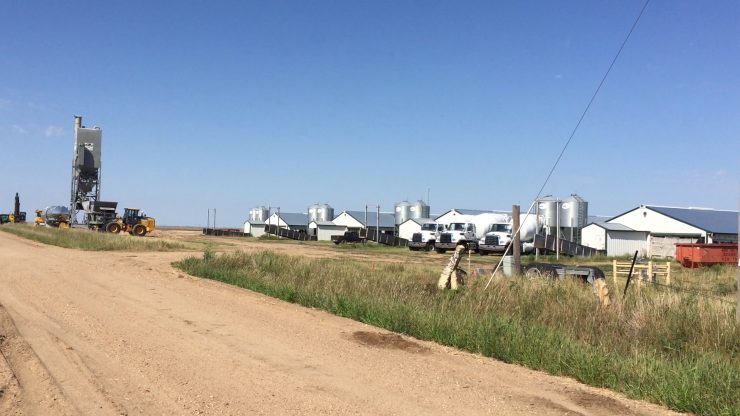
Residents in Rush County voted in Nov. 7’s general election to allow the expansion of a hog farm two miles southwest of Pfeifer near the Rush County and Ellis County line.
The vote total, finalized after the canvass on Monday, was 568 voting to allow the expansion of the hog farm and 496 voting against.
The expansion by Bison Rush Genetics, LLC, would increase the permitted number of animals from 3,840 to 24,408.
Those who live close to the hog farm were concerned about potential contamination of water wells. The Smoky Hill River is 1.5 miles away from the site and the source for drinking water, private wells and agricultural wells in the area. The Pfeifer well field on the Smoky Hill River is the primary source of water for the city of Russell. Most of the water wells for the city of Hays are also located along the Smoky Hill River.
Concerns were raised at the August meeting about dead swine being buried less than the required 5,000 feet from a home.
Waymaster said he addressed the issues that were brought to him during the August meeting to Agriculture Secretary Jackie McClaskey. McCalskey assured Waymaster in August that all of the environmental and regulatory concerns surrounding the swine farm had been addressed.
The problem with the pig carcasses being buried outside of the required setbacks occurred under the last owners of the pig farm, Waymaster said.
“I can understand why they may still have some concerns about that,” Waymaster said. “You might think, even though they are separate owners, that history might repeat itself. Because of the size of the hog farm that is moving in compared to one that was there previously, Sec. McClaskey assured me that they are going to be regulated probably more.”
He said he had been assured by the department of agriculture and the department of water that they are going to be monitoring the hog farm and its effects on the water table.
The current applicant is listed as Bison Rush Genetics LLC, with a post office box address in Carthage, Ill. That address is associated with Professional Swine Management. The application includes a facility address of rural Bison in Rush County.
A call to Professional Swine Management was not returned Tuesday.
Ellis County Public Works Director Bill Ring also attended the meeting in August and expressed concerns the hog farm will increase heavy truck traffic on Ellis County roads without any tax benefit from the farm. Waymaster forwarded this concern to the Kansas Secretary of Transportation, but Waymaster said he had not heard if any progress had been made on this issue.
Ring is at a conference this week and was unable to be reached.
Waymaster drew parallels between the expansion of the hog farm and Russell County’s attempt to bring a Tyson plant to the area. The proposal also met with opposition for many of the same reasons.
“I look at it as an economic development as the farm is ag commerce,” he said. “One thing is that in our area of the state, it will be creating jobs, which is something that we definitely need. It may not be the most ideal jobs coming into the economy, but it will still be individuals who are employed and hopefully living in our local communities, spending in our local stores and businesses, increasing sales tax revenue and also property tax.
“You can look at it from many different perspectives, but I do understand the concerns citizens had.”
Had Rush County residents voted against the hog farm expansion, the county would have had the right to contest the KDHE finding.
A Sept. 25 letter confirming approval of the water pollution control permit application by Bison Rush Genetics LLC was mailed to participants in the July 25 public hearing convened in Lacrosse by the Kansas Dept. of Health and Environment.
The second paragraph of the 11 page letter reads “The Kansas Department of Health and Environment (KDHE) has reviewed the information, comments and questions; particularly in relation to meeting the applicable statutory and regulatory requirements for a water pollution control permit for a confined feeding facility. The evaluation has determined the permit application, design plans, nutrient management plan and supporting documentation demonstrate the capability of the facility to adequately protect waters of the State and public health. Therefore, KDHE has issued the permit to the facility.”
The letter is signed by Tara Mahin, Chief of the Livestock Waste Management Section, Bureau of Water.
The district spent $12,272 for educational materials, mailings and general supplies.
Placing the special question on the ballot cost the district $1,689. Had the district had a special election to pose the bond question, the cost to the district would have been $18,000-$20,000, according to Tracy Kaiser, the district’s director of finance. $278 was spent on legal notices.
The district hired an architectural firm, DLR, to guide discussion and assist in developing the bond question. The firm also helped promote the bond, but passage of the bond was a condition of payment for its services.
A pro-bond group also raised private money to help promote the bond.
The bond would have built two new elementary schools to replace Lincoln and Wilson schools. Renovations would have been done to Roosevelt Elementary School, the middle school and high school, including the addition of a new auditorium at HHS.
O’Loughlin Elementary School would have been renovated to accommodate the Westside program, Early Childhood Connections and the Learning Center.
Secured entrances, storm shelters and right-sized classrooms were also part of the bond proposal.
It has been more than 25 years since Hays passed its last bond issue.
Superintendent John Thissen said the district still has many facility needs that need to be addressed, and another bond attempt is likely. He said he thought the district should not wait to begin the process to create another bond.
The district’s next step will be to conduct surveys and review why those who voted no did so.
The Hays USD 489 school board heard an overview of new state accreditation standards for Kansas school districts at its meeting Monday.
The new standards move away from scores on achievement tests to five main focus areas: social and emotional growth, kindergarten readiness, individual plans of study, increased graduation rates, and post-secondary success. This is the first year for the new accreditation process.
Although the main objectives for the accreditation, which the Kansas Department of Education has dubbed Kansans Can, are the same for all districts, the means to achieve those goals will be different for each district.
Research has indicated more than 70 percent of Kansas jobs will need a college degree or some type of post-secondary certification by 2020.
Kansans Can seeks to have high school graduates academically prepared, cognitively prepared, have the technical skills, employment skills and civic engagement that will prepare them to be successful in post-secondary education or attainment of an industry certification without remediation.
The state has launched a school redesign program around these principles that will include seven schools. The program is titled after the Mercury 7 space missions.
The schools included in that redesign include Stockton, Olathe, Twin Valley, Liberal, Wellington, McPherson and Coffeyville. Each district has agreed to include an elementary and secondary school in the program.
Twenty-one more schools are part of the second phase of the redesign project that has been dubbed the Gemini Project. Hays schools are not a part of this project.
Kansas Education Commissioner Randy Watson in a video he made to roll out the program said the redesign is aimed at making schools more student centered. He sees learning being focused around students learning styles and needs and not around set class periods, age groups or grade levels.
Board member Paul Adams said one of the pilot schools has added a firefighting program. By the time the students graduate, they will be able to serve as volunteer firefighters.
He said career planning needs to start in kindergarten.
Shanna Dinkel, assistant superintendent, said children as early as kindergarten can begin to explore different interests that will ultimately help them choose a career when they are older.
Dinkel said the district already has identified the need to add an elementary counselor to meet the needs of students and the new accreditation system.
To learn more about the Kansans Can initiative, visit the KSDE website. Videos and fact sheets are available.
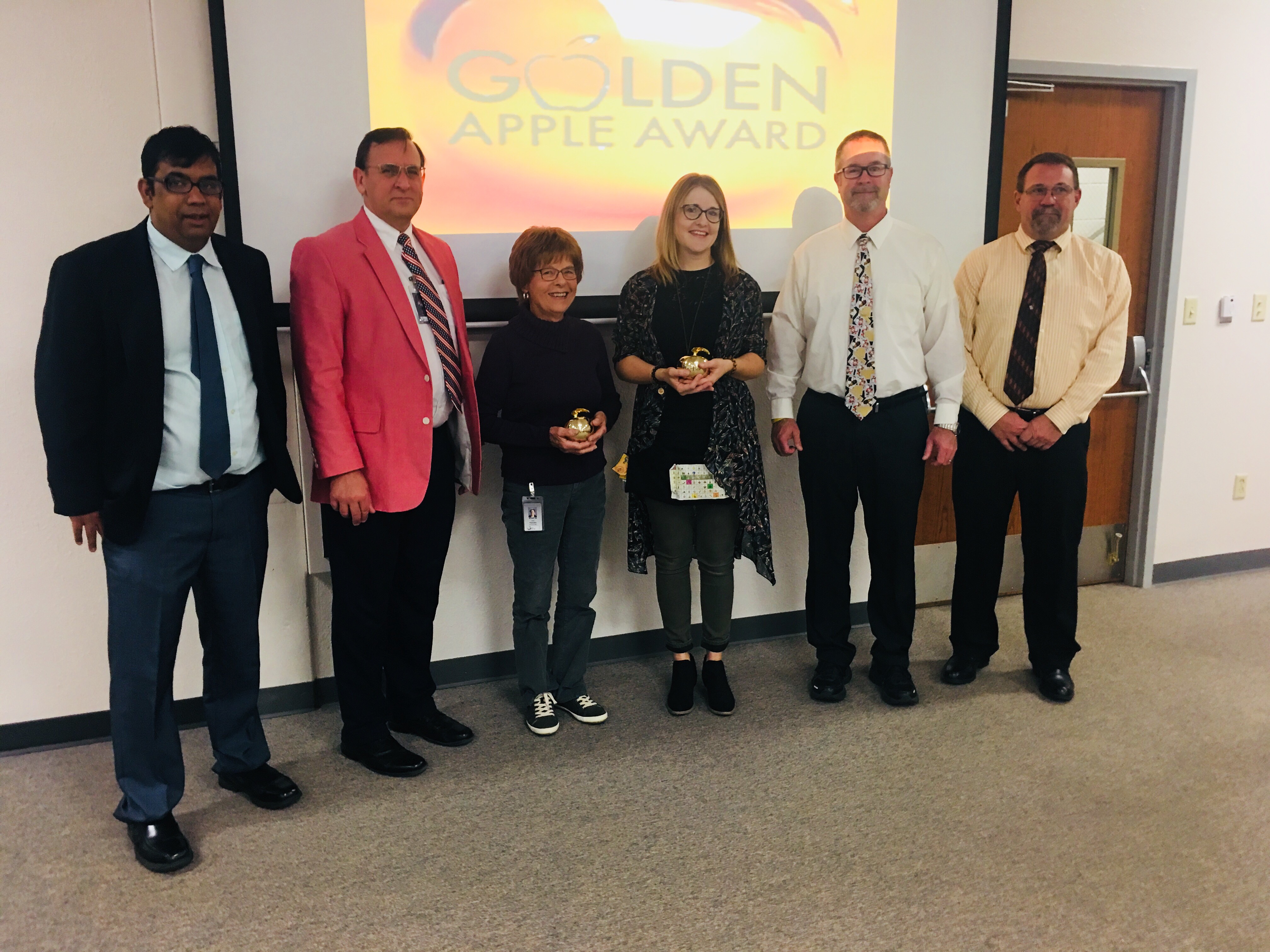
Left to Right: Raj Sharma, special education director, HWCKSEC; John Thissen, superintendent of USD 489; Mavis Pianalto; paraeducator at Roosevelt Elementary; Melinda McDaniel, special educator at Roosevelt Elementary; David Ottley, superintendent, USD 432; and Robert Young, superintendent, USD 388.
USD 489
The Special Education Cooperative Golden Apple Award winner received honors based on the cooperative’s Goal 1 criteria, which means they contribute to the development and/or improvement of programs, services or curriculum, and foster staff growth, effectiveness or professional development.
Melinda McDaniel
Special education instructor Melinda McDaniel of Roosevelt Elementary School is the recipient of the quarterly Golden Apple award.
She was nominated by Tasha Lang and the STAR staff.
According to Lang, “Melinda McDaniel has been in this district for just over a year. Since that time she has helped the district grow in understanding what is best for all students and staff. She is currently a regional trainer of trainers, teachers, and administrators in working together and doing what is best for their staff.
She is also co-coordinator on the district’s Autism Team, the Assistive Technology Team,and SAFE Team. While helping lead the district, McDaniel provides on-the-job training to her STAR staff and others. She also continues to help her families grow by providing visual supports and other resources outside of the school day. McDaniel has helped the STAR program grow in the district, state and nation.
When asked something of her, McDaniel has always gone above and beyond to help improve programs and services and foster staff growth, effectiveness and professional development.”
Mavis Pinalto
Special education paraeducator Mavis Pinalto of Roosevelt Elementary School is the recipient of the quarterly Golden Apple award. She was also nominated by Tasha Lang.
Lang describes Pinalto as a great advocate for our students.
Lang said, “Pinalto is on her ninth year of being a paraeducator. In those nine years, she’s advocated for all students who cross her path.
This past year we celebrated her 75th birthday. To us that is just a number because Pinalto can outwork any of us young kids on any given day. Last year one of my paras snapped a picture of Pinalto and another student in our sensory tent (which is not big) reading stories to help calm him down. She is also found pulling students on scooters, pushing them on swings, and a lot of other physical work to help with their sensory needs.
While being Pinalto’s supervisor she has never complained about her job, she comes in smiling knowing she is going to give it her all. Each student has their own connection with her and you can see how much she cares for all students. She is fully dedicated to her job and obviously not for the money, but because she loves what she does.”
Here are a few things other staff in the past have said.
School principal: “I appreciate that Pinalto always is smiling, positive and encouraging with all students, not just the students with whom she is assigned to work. She is a valuable asset to our entire building, not just the special education department.
Kindergarten teacher: “Pinalto is always so caring and patient will all the students. She never stops going, helping where ever there is a need!”
Third-grade teacher: “Very nice, friendly and supportive to teachers. Friendly face to see at school!”
Fourth-grade teacher: “I think the thing that sticks out to me about Pinalto is how she always gives 100 percent to whatever she is doing in the school and how warmly and respectfully she treats all students. She really has such compassion for working with students with special needs that is so evident.”
Fifth-grade teacher: “Whenever I see her in the hallway with a student, she is so kind and patient! She is a role model for all of us when it comes to how to build a loving relationship with students. I want to be her when I grow up!!!”
Resource teacher: “She is AWESOME!!”
Gifted teacher: “She is so humble and doesn’t even realize how awesome she is!!!”
OT: “I think that she is perfect for Golden Apple. She has so much patience with the kids. Awesome lady!”
PT: “Mavis has patience beyond what I can imagine with all the students she assists each day. She never tires of helping them get to the locations they need to go, will repeat directions as many times as they need and will help them do the work they are assigned no matter how much repetition or assistance they need. She truly celebrates in their gains as well.”
Music teacher: “She is patient and kind and always willing to go beyond the call of duty. She is always cheerful too!”
Art teacher: “Pinalto is so patient, kind, joyful, positive, calm and wise. She is such an asset to our school. She treats every student with respect and love. Mrs. P is amazing!”
The Hays USD 489 school board discussed the replacement program for the district’s tablets.
The districts several years ago went to a one-to-one program for all students and staff. Every student has access to a computer.
Technology Director Scott Summers brought a replacement plan to the board at its meeting Monday night.
This shows the high school computers being replaced after four years and then the middle school, then elementary school replacement being split into two years with fifth through third grade being replaced in one year and the Kindergarten through second grade being replaced the next year. Replacement of staff computers would also be staggered.
The computer replacement plan would cost an estimated $310,800 in 2018-19, which would include the sale of old computers. The program would cost $206,000 in 2019-20, $203,320 in 2020-21 and $227,430 in 2021-2022.
Board member Greg Schwartz asked why the high school computers were being replaced before the projected six-year lifespan that was suggested when the computers were purchased.
Superintendent John Thissen said creating the replacement plan would allow the district to budget for the replacement instead of being hit with a large expense all at once. Further it would avoid the chaos of introducing so many new pieces of technology at once.
Summers said the district only receives a discount on packs of 10 computers, so buying all the computers for the district at one time would not reap a significant savings.
Board member Josh Waddell said he would like to see better measures of how the technology is improving the education experience for students. He questioned the expense of the one-to-one technology policy, especially in light of the district’s recent $78.5 million bond issue failure. He said funds may need to be diverted to other capital needs.
Schwartz also said he thought the district needed to equate the increase in technology with some type of objective measure such as test scores.
“Is it a toy or a tool?” Schwartz said.
Waddell also said he would like the district to look at a bring-your-own-device policy for staff.
Board member Paul Adams brought up a study that indicated the use of technology in the classroom did increase student performance on his computer during the discussion and forwarded to all the board members and asked them to at some point look at it.
He added that the district needs to look at the use and access to technology and consider how it will be used to reach the new district accreditation standards.
Thissen said the replacement policy has not been finalized and can still be revised by the district’s Technology Committee.
New website
Summers also discussed a proposal to contract for a new website. The estimated prorated cost for the site would be $7,600 for a site going live in February. Ongoing maintenance of the site would cost $11,000 annually. The company would create an updated design, help create consistency within the district’s webpages and help teachers and staff manage content on the site.
The plan also includes a notification system, which would save the district $5,600 annually through elimination of its current notification system. The contract would also give the district the option of a branded App.
The district’s site is not ADA compliant. It should create text when a cursor hovers over pictures. The district could be forced to update the site if someone makes an ADA complaint.
Board member Lance Bickle said WordPress, which the district currently uses, can be used to make the site ADA complaint.
Board members questioned the cost and a move away from WordPress and into a proprietary software system.
Summers said the district would encumber no cost until the website would go live. He said he would bring back some designs at a later board meeting.