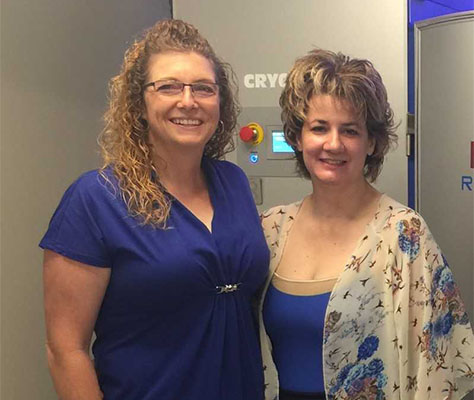
From left Shayne Whisman and Ceena Owens, co-owners of H20.
By CRISTINA JANNEY Hays Post
Imagine floating in a tank of salt water with no light and no sound — just you and the sensation of warm water against your body. Relaxed?
A new business, H2O, is bringing floatation tanks, as described above, and cryo therapy, along with some varied massage practices to Hays this fall.
The flotation tanks and cryo chambers will be a first for the region. The next closest float tanks are in Lawrence and Kansas City.
H2O is a cooperation between Shayne Whisman of Heavenly Soles and Ceena Owens. The co-owners both have their own massage practices in Hays and will be closing those in lieu of opening H2O
An example of a float tank.
The float tanks, also known as sensory deprivation chambers, contain about 18 inches of a combination of water and Epson salt.
The idea is to slow the mind, so that all you can hear and sense is the sound of your breath and your heart beating. Some people relax so fully they fall asleep, Owens said.
Owens suffers from an autoimmune disease and has had her thyroid removed.
“I am like a computer with 15 tabs open at the same time,” Owens said, adding the floating helps to calm her mind.
For people with autism who can be easily over stimulated, the floats can be relaxing. The tanks are also often used by people with anxiety, ADD, PTSD, insomnia or who are seeking a way to deal with stress.
“It cuts off all your external stimuli,” Owens said. “We are stimulated by our cell phones and TVs and fluorescent lighting in the rooms and external noise and radios. You can’t take your cell phone in water, so you disconnect.”
Floating also helps with water retention and may help pregnant woman or others with edema.
A cryo chamber.
The flotation tanks have four-way filters, and Owens said they intend to be very careful with hygiene and cleanliness.
The center will also be offering cryo ice baths. The units are vertical, you step into them and your body is surrounded by liquid nitrogen for three minutes. The cold helps treat inflammation and can be helpful for people with arthritis and those who are recovering from injury.
Some people use the process for weight loss, as it burns about 800 calories.
Both co-owners will be certified by the companies who manufactured the float chamber and cryo unit to use the equipment.
H2O will also offer a salt sauna and hydro therapy tub. For the hydro therapy room the business is brining in Indonesia body treatments from Bali. The women will do Curry scrubs and a yogurt splash. The enzymes in the yogurt help soften the skin. Then you get in the tub with floating flowers and jasmine frangipani oil. You finish with a massage with the jasmine frangipani oil highlighted with a bowl of flowers below you in the face cradle.
Owens said they are modeling their offerings after bath houses in Budapest, where saunas are used to boost the immune system and circulation.
Massage will continue to be an important facet of Owens’ and Whisman’s work.
Some of the massage techniques they will offer include: hot stone, fire cupping and Chinese cupping.
Owens said the owners are looking to offer a holistic approach to the care of the mind, body and spirit.
The center will be decorated in hand-painted murals and house a life coach, relaxation lounge and water bar.
Owens teaches massage at Fort Hays State University and she hopes the center at 1011 W. 27th St., Building F4, (Eagle Business Plaza) can be used for classes starting this fall. They are planning a soft opening in August with a full opening in October when the center gets its float tanks and cryo chamber.
Owens is a nurse and she has worked with local physicians to be complimentary to traditional medical treatment.
For example, physicians often refer her lymphedema patients. Patients, who have blocked lymph nodes or have had lymph nodes removed because of cancer can have problems with build up of fluids, and the massage helps drain these fluid.
Owens and her partner hope to keep their services accessible, with costs starting at $40. They will be open 8 a.m. to 8 p.m. Mondays through Saturdays and 3 to 8 p.m. Sundays.
Enrollment for Thomas More Prep-Marian and Holy Family Elementary School is fast approaching.
Students at Holy Family will enroll 7:30 a.m. to 2 p.m. Thursday. Aug. 3 in the school’s cafeteria. TMP students will enroll Tuesday Aug. 8 and Wednesday Aug. 9 in the TMP-Marian dining hall. Times and grades are below.
The names of two men involved in an accident in Ellis County Wednesday have been released.
Jack Garner, 19, of Trego County was critically injured when the Chevy S10 pickup he was driving collided with a semi driven by Galen Whisman, 23, of Ellis County at 210th and Noose Road at 10:28 a.m. Wednesday.
The jaws of life had to be used to extricate Garner from the pickup. Garner was taken to HaysMed and was then sent via air ambulance to Wichita. Whisman reported minor injuries.
No further updates were available on Garner’s condition as of Thursday morning, according to Scott Brown of the Ellis County Sheriff’s Office.
Ellis County Sheriff Ed Harbin said Wednesday the semi had a stop sign, but the accident was still being investigated and no citations had been issued.
Sheriff’s personnel, a Kansas Highway Patrol trooper, Ellis County EMS and Rural Fire all responded to the accident. In addition, an off-duty Hays firefighter came upon the accident and helped at the scene until EMS arrived.
A Trego County man was critically injured when the Chevy S10 pickup he was driving collided with a semi at 210th and Noose Road at 10:28 a.m. Wednesday.
The jaws of life had to be used to extricate the man from the pickup. The man was taken to HaysMed and was set to be sent via air ambulance to Wichita. The driver of the semi reported minor injuries.
Ellis County Sheriff Ed Harbin said the semi had a stop sign, but the accident is still being investigated and no citations have been issued.
No names have been released pending the notification of family members.
Sheriff’s personnel, a Kansas Highway Patrol trooper, Ellis County EMS and Rural Fire all responded to the accident. In addition, an off-duty Hays firefighter came upon the accident and helped at the scene until EMS arrived.
Carolyn Fuller, former Hays Middle School teacher, stands in the Schmidt Gallery at the Hays Public Library with her Mr. Potato Head collection.
One off-hand comment ended up in a collection of over 90 Mr. Potato Heads for Carolyn Fuller.
Fuller taught math at Hays Middle School for more than 30 years. She was always encouraging here students to participate in class.
“I opened my smart mouth and said, ‘You should participate more than a potato would,’ ” she said.
Her daughter found out about the comment and purchased Fuller her first Mr. Potato Head as a joke.
Fuller brought the Potato Head to class, and the kids thought it was funny.
From there, the Mr. Potato Head collection was born.
Fuller retired from teaching a couple of years ago, but this summer she unboxed her more than 90 Mr. Potato Heads and is displaying some of them at the Hays Public Library in the Schmidt Gallery.
Fuller never intended to collect Potato Heads, but people kept bringing them to her as gifts. They have come in all shapes in sizes and designs.
The original Mr. Potato Head was created by George Lerner of New York City in 1949. It was modeled after an earlier toy, “make a face,” which was a collection of facial parts that you stuck into a real potato. Although Fuller nor her daughters ever had Mr. Potato Heads as children, she said she did remember her cousins have the original “make a face” toy.
“Can you imagine giving that to a child now with the sharp points?” she said.
Parents complained about the rotting fruit and vegetables and the government banned sharp parts in children’s toys, so the head was replaced with a plastic potato in 1964.
The pieces were at one time distributed as prizes in cereal boxes, but the toy was picked up by what is now Hasbro in 1951.
Lerner’s Mr. Potato Head was the first toy to be marketed on network television.
“Toy Story,” which was released in 1995, lead to a resurgence in Mr. Potato Head’s popularity and diversification of his personas as evidenced in Fuller’s collection.
Fuller’s Potato Heads include Spud Trooper and Darth Tater from “Star Wars,” Albert Einspud, Santa Clause, a pirate, an Indiana Jones and Superman spud. The Three Stooges are portrayed as the vegetable toy as well as the characters from the “Wizard of Oz.”
The Loony Tunes are also represented, including Donal Duck and Bugs Bunny.
Fuller has a young Elvis, old Elvis and Blue Hawaii Elvis. Hasbro has also made other toys that portray the character like a piggy bank, key chains and toys similar to a View Masters.
She has several Mr. Potato Heads that represent sports teams. The last Potato Head she received was a Pittsburg Steeler Mr. Potato Head, which mysteriously appeared on her on her last day at school. Fuller never discovered who gifted her the Potato Head.
Fuller said she has never met anyone else who collects Mr. Potato Head, but she is sure they are out there.
“It was fun,” she said of collecting the toys. “The kids at school liked it. I had a former student who told me she really liked my Mr. Potato Heads. She said no matter what was happening in class, there was always something to look at in my room. I am not sure that was a compliment, but it amused me.”
Fuller said she doesn’t know what the future of the Mr. Potato Head collection will be. Most of the toys were gifts, and they have meaning because of the people who gave them to her.
“It was just fun, and it just got out of control,” she said.
The collection will be on display at the library until Aug. 5.
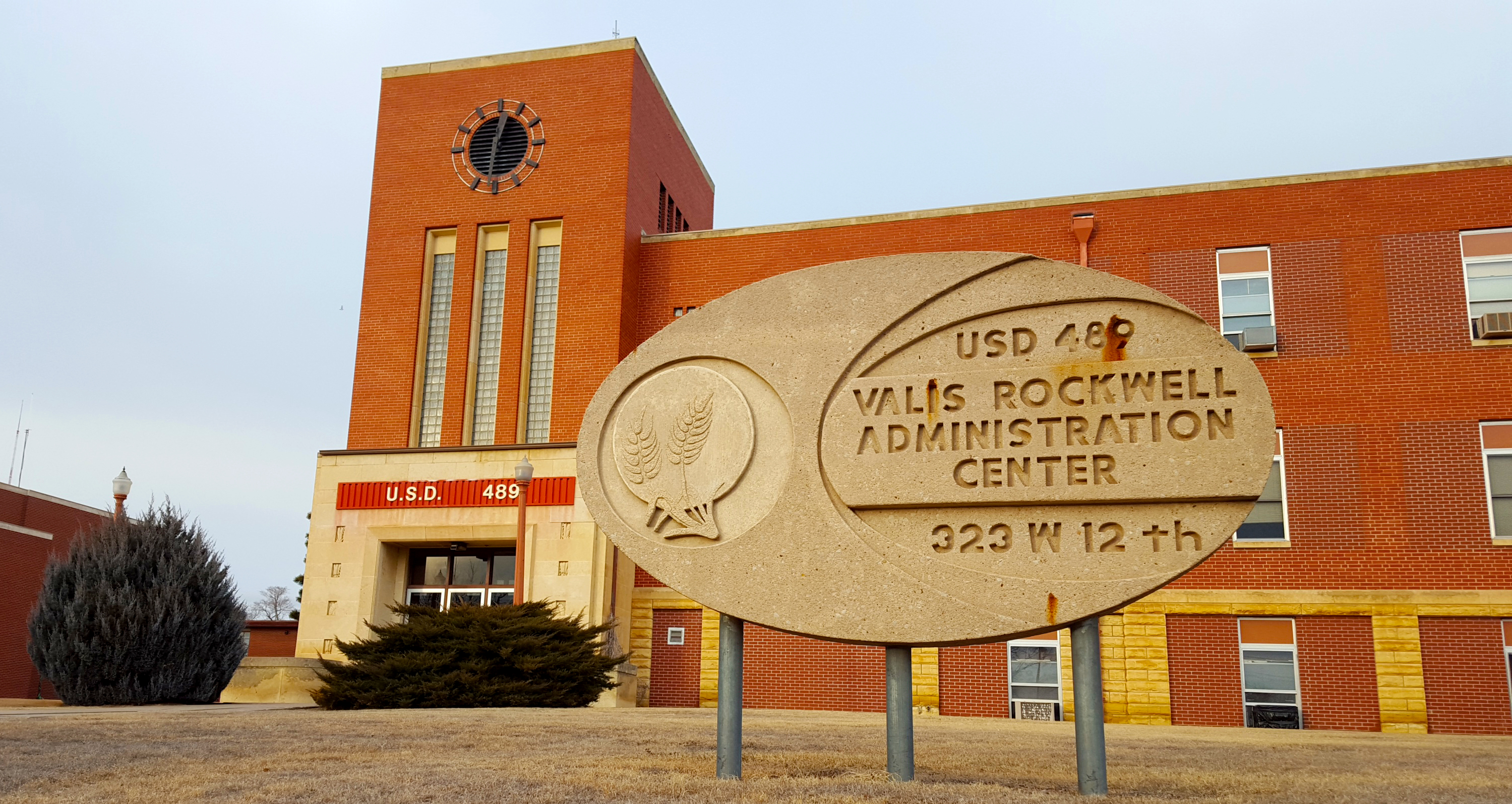
The Hays school district is offering a one-stop shop for in-person enrollment this school year.
In-person enrollment will be offered 7 a.m. to 5:30 p.m. Tuesday, 10 a.m. to 7 p.m. Wednesday and 7 a.m. to 5:30 p.m. Thursday at the Hays High School cafeteria.
Returning students can enroll and pay fees online with a credit card. The enrollment link will be posted on the district website on Monday. For those who wish to pay with some other form of payment, they can enroll online and join a speedy checkout line during in-person enrollment for payment only.
School supply lists, student handbooks, forms and school calendars are also available on the website.
Shanna Dinkel, assistant superintendent, said she hoped consolidating enrollment in one location will help make enrollment more convenient for parents.
Principals and support staff will be on site to answer questions.
Spanish translators will be available all three days of enrollment, and enrollment information is available online in Spanish. Mandarin Chinese translators will be available 7 to 8:30 a.m. Tuesday and Thursday and 5:30 to 7:30 p.m. Wednesday.
The Hays school district seeks to use a portion of an estimated $1.9 million increase in state funding to raise wages for faculty and staff for the coming school year.
In a preliminary budget report presented to the school board at its meeting Monday, the district had set aside $743,275 for salary increases.
How that money will be distributed has yet to be determined as negotiations with the teacher’s union and custodial and maintenance staff union are still ongoing.
Tracy Kaiser, USD 489 executive director of finance, said teachers are paid on a step grid based on education and experience. The teachers will likely request a move upward on the step scale. Teachers last received a raise for the 2015-16 school year, but have gone several other years recently without raises.
Classified staff are usually given a percentage wage, and the district tries to keep it in line with teacher raises. Four years ago, Fort Hays State University conducted a wage survey for the district. USD 489 wages were far below those in the private sector, Kaiser said.
Kaiser said the district hopes to move the wages at least a third closer to the district’s private peers.
The district hopes to wrap up negotiations within the next couple of weeks.
Superintendent John Thissen said the negotiation process was moving forward. However, he noted the entire budget process has been delayed for all districts in the state because the Legislature approved its school funding formula later than usual.
The district will see savings for 2017-18 of about $435,835 from a decrease in insurance premiums, staff attrition, reduced sick leave payout and decreased Internet costs for a total revenue increase of $2,356,515.
Although the district is anticipating an increase in state aid and some savings in other areas, it is also forecasting a decrease in other funding and increases in other expenses.
The district is facing a drop of $150,000 in federal funding, a $241,650 decrease because of enrollment decline and an $80,000 loss in Medicaid funding in 2019.
Excluding the increase in salaries, the district expects a $1,139,265 increase in expenses for the coming fiscal year. Almost $400,000 of that increase is in health insurance premiums. About $582,000 will go back into classrooms in the form of new certified positions, classroom aids, bilingual support and curriculum support.
The district also voted to decrease the material/workbook fee for all students at its meeting Monday. This, coupled with a required elimination of kindergarten fees, which are going to be supplemented by state aid, means a $121,000 decrease in district revenue for the coming year. All this means negatives to the bottom line equal to $2,354,190.
Kaiser said ultimately the district is hoping for a balanced budget with a net of $2,325.
However, the district’s budget is far from set in stone at this time.
A lawsuit is pending in front of the Kansas Supreme Court that alleges the state’s funding level for schools is inadequate. Although the Kansas Legislature passed legislation that would increase funding by $293 million during the next two years, the plaintiffs in the lawsuit still assert the Legislature has not provided enough funding to the state’s schools. The Kansas Board of Education requested a $900 million funding increase for the current fiscal year.
The Supreme Court heard oral arguments in the case on July 18. The court has allowed the Legislature’s funding plan to become law, but has yet to issue a ruling on the adequacy of the funding formula.
The school board approved two special meetings Monday to deal with the budget. The board will meet at 7 a.m. Aug. 10 for its budget hearing and 5:30 p.m. Aug. 24 to approve the budget.
The Hays school board voted Monday night to reduce workbook/material fees for all students for the upcoming school year by $45.
The fee will drop from $135 to $90.
The drop in fees will cost the district about $90,000, but this will be offset by an increase in state aid.
The new base state aid per pupil will be raised to $4,006 for the 2017-2018 school year, which is estimated to bring an additional $1.9 million to the district this year.
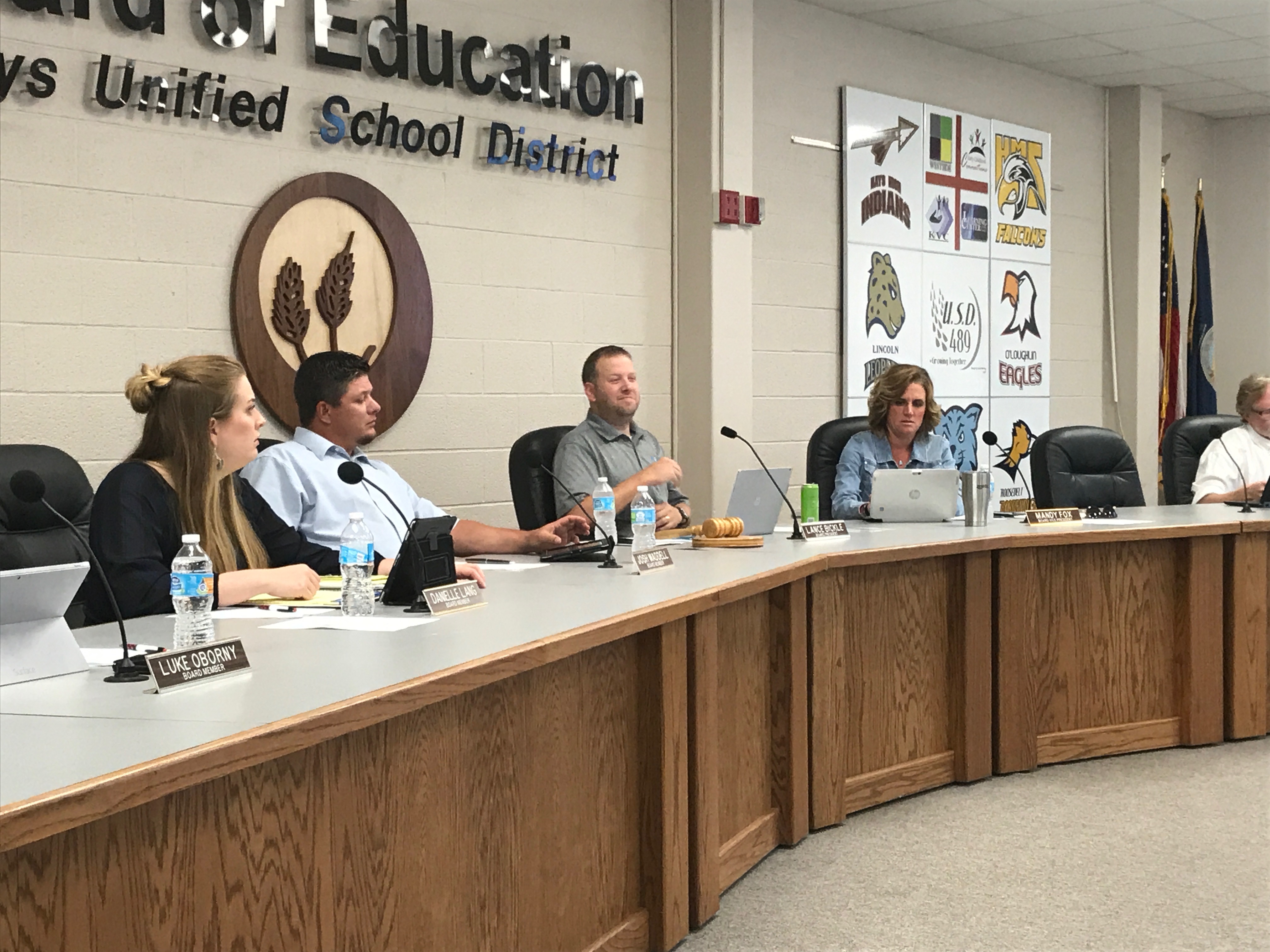
Board member Luke Oborny said, “This has been a goal, and this has been one of the things that we have worked toward, and I am happy to vote for this.”
Board president Lance Bickle also said he supported the reduction in fees and looked forward to chipping away further at the fees in the future.
In other business, the board:
• Approved the milk bid from Hiland Dairy for the 2017-2018 school year
• Approved a copier paper bid from Contract Paper Group for $21,627.60.
• Approved a Title VI-B budget for special education
• Approved special meetings for 7 a.m. Aug. 10 for the annual budget hearing and 5:30 p.m. Aug. 24 for the budget approval.
Members of the Striders track team work out in preparation of their trip to the Junior Olympics.
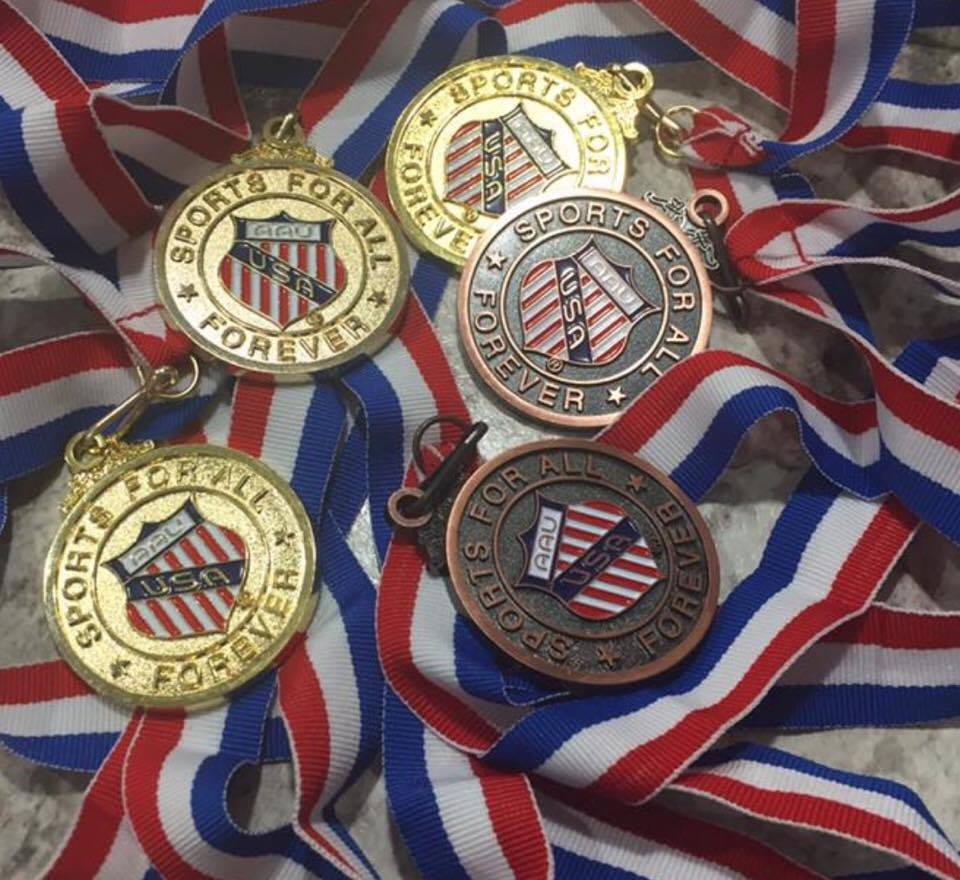
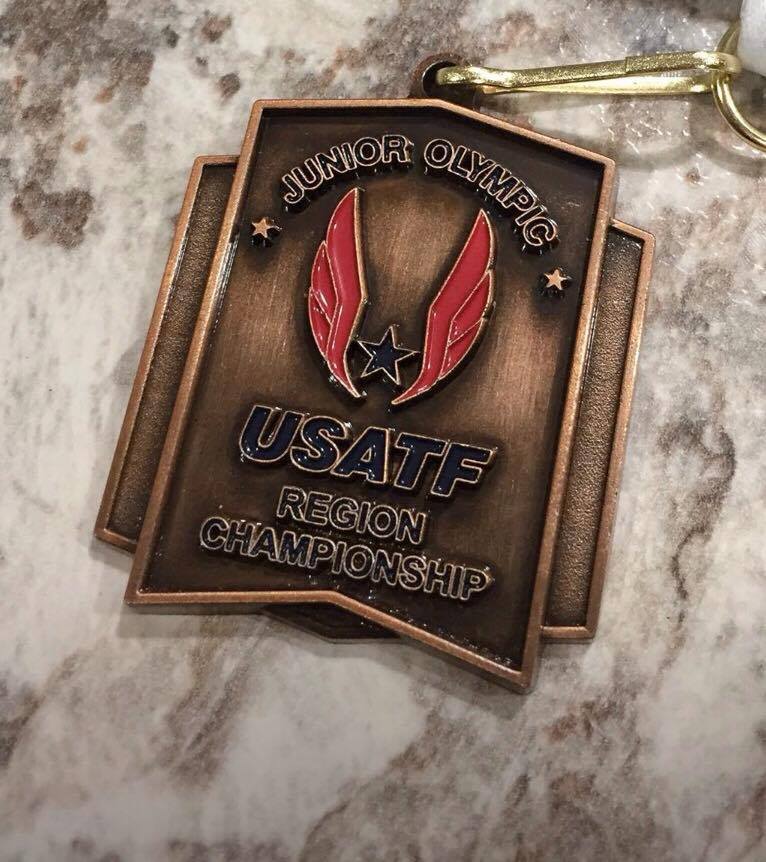
Three members of the Striders Track Club traveled to Lawrence Monday to compete in the USATF Junior Olympic Games, while a fourth will compete in the AAU Junior Olympics in Ypsilanti, Michigan, July 29-Aug. 5.
Youth form 5 to 18 from all over the country will be competing in the event.
Makayla Lewallen, 8, of Hays; Lacy Droegemeier, 11, of Hays and Lyndi Zimmerman, 8, of Hays will all compete in Lawrence. Zane Viegra, 9, LaCrosse and Hays, will compete in Michigan.
Droegemeier will compete in the 80 m hurdles, Makayla Lewallen in the 400 and long jump, and Lyndi Zimmerman in the 1500. Viegra will compete in the 800 and 1500.
Lewallen became interested in running because of her sister. She said she likes the long jump best because it feels like you are flying. She said she likes to push herself to do better. This will be her first trip to the Junior Olympics.
Droegemeier, 11, has been with the Striders for four years. Her mother encouraged her to start track because she couldn’t stop her from running around their home. This is her second year to compete at the Junior Olympics.
“I get to meet all new people from different places,” she said.
She said she would love to compete in the international Olympics some day. Her hero is Usain Bolt.
Zimmerman is in her second year with the Striders. She also is a long jumper and says she loves it when she crashes into the sand and she sprays sand everywhere.
Her father also was a Strider when he was younger, and he helps her with her events.
Viegra has spent five years in the Striders with a personal best of 2.48 in the 800 and 5.51 in the 1500.
“I like to run a lot,” he said. “Every year you get to meet new people. It is fun to run with new people.”
Viegra said his hero is Steve Prefontaine, a middle distance runner who competed in the 1972 Olympics. Prefontaine once held seven distance records, but was killed at the age of 24 in a car accident.
Twenty-six athletes from the Hays Striders Track Club were in competition in two regional meets to qualify for the 2017 AAU and USATF Junior Olympics.
Six athletes competed in the AAU Regional Championships on June 24-25 in Joplin, Missouri. All of them qualified for the AAU Junior Olympics in Ypsilanti.
Lance Lang and Viegra were regional champions in their events.
Lang placed first in the 100 m hurdles and 400 m dash, also qualifying in the 200. Viegra placed first in the 800 and also qualified in the 1500.
Also qualifying were Hunter Molthan (800, 1500, 3000), Grace Molthan (800, 1500), Lyndi Zimmerman (800, 1500, long jump), and Emery Zimmerman (1500).
On July 8-9, 19 Hays Striders competed in a Missouri Valley USATF Qualifying meet, also in Joplin.
Droegemeier also competed in the 200 and long jump, Lewallen in the 200, and Zimmerman in the 800 and long jump.
Other athletes in competition were Tacoma Augustine (pentathlon, 80 m hurdles, 3000, high jump), Hunter Molthan (800, 1500, 3000), Carson Moore (100, 200, long jump), Easton Moore (100, 200, long jump), Anthony Ventura (100, 200), Zane Viegra (400, 800, 1500), Connor Winter (shot put and discus), Morgan Armbruster (400, 800) Kinzie Cox (high jump), Brooklyn Lewallen (100 m hurdles, 200 m hurdles, 400, long jump), Sydney Lewallen (long jump), Grace Molthan (800 and 1500), Olivia Rankin (400, long jump, high jump), Katie Rankin (200, 400, long jump), Abby Rueschhoff (200, 400, long jump, triple jump, and Sasha Wasinger (shot put, discus).
“The competition at the USATF Joplin meet was definitely the best competition I have seen in 20 years,” head coach Dave Haberman said in a news release.”We are proud of all of our Striders. Even though some did not qualify to compete in Lawrence, most had their best performances of the year, despite the oppressive heat and humidity of that part of Missouri.”
Haberman said the Striders not only helps the young people develop as athletes, but it helps them become well-rounded people.
The Hays school board unanimously voted to send a $78.5 million bond issue to voters at its meeting Monday night.
The school board members asked many questions about the bond but ultimately decided to place the issue on the Nov. 7 general election ballot.
The bond issue seeks to build two new elementary schools, and renovate Roosevelt Elementary School, the high school and middle school. O’Loughlin Elementary School would be renovated to accommodate the Westside Program, Learning Center and Early Childhood Connections. A new auditorium would be part of the high school renovation. For a more detailed list of the bond improvements, click here.
The bond would be paid over 30 years, with an owner of a $150,000 home paying $16.43 per month.
Paul Adams, board member, asked if all the space that was being added or renovated was going to be used for education.
Amy Foster, associate for DLR, the district’s architectural firm, said the project would add a gym at the middle school, but the space would be used for PE classes. As many as 130 students are using the current gym at the school. If there is another event in the gym, there is no place to put those students.
A performing arts auditorium will also be built at the high school. Foster said the space could not only be used for performing arts classes, but guest lectures for classes or community events. All the schools will be equipped with accessible storm shelters once the bond is completed, but all those spaces will be used during the school day for other educational purposes.
Adams asked if furniture and technology was included in the bond price. The DLR team said all furnishings and fees for the architectural and engineering firm are included in the $78.5 million.
The district has chosen to hire a construction manager at-risk, Nabholz Construction. Once the project goes out for bid, the school district is given a guaranteed maximum price. If any savings are found during the project, that money goes back to the school district, Ron Ferris of Nabholz explained to the board.
Ferris said if the bond passes, his company would meet with local subcontractors, vendors and suppliers, and the company tires to develop bids that keep as much of the work within the local community as possible.
“The dollars that are spent in Hays keep being spent in Hays over and over,” he said.
Adams praised the teams that worked on the bond issue for their consideration of how the education process has changed. One of the focuses for work at all schools has been to right-size classrooms.
Valerie Wente, parent and community Vision Team member, said elementary teachers want to be able to get down on the floor and work with groups of students on science and social studies projects, but there is no room. Some projects require assistance from paras and parents, but there isn’t enough space to get everyone in the classrooms.
Adams said, “I just returned from a conference in Boston where teachers across the country were learning about how the physical plant affects learning. I wish my children would have been able to benefit from this.”
Board president Lance Bickle said he struggled with his decision on bond issue, but he was willing allow the community to decide on the bond.
“No matter what we do with the bond, how big or small. We are not going to be able to fix everything,” he said. Some will agree with it and some won’t. There is no perfect plan, and there are plenty of items to address. No matter what proposal we have, not all of us are going to agree, not the community, staff or the board.”
Bickle also asked about how many sections would be available for each grade in the elementary schools.
There would be 12 sections for grades second-fifth and 13 sections for kindergarten and first grade. Adding classrooms would move the district closer to smaller class sizes.
However, Josh Waddell, board member, criticized the district for not having a funding plan for additional teachers to staff additional elementary class sections.
Superintendent John Thissen assured Waddell the district would develop a plan to reach that goal. He said staff could be added slowly over time as not to overwhelm the budget.
Foster of DLR noted going from four elementary schools to three is estimated to save the district $300,000 per year for a total savings of $9 million over the life of the bond. Some of that savings could be used for teacher salaries.
The bond financing includes a 2 mill reduction in the capital outlay fund in order to reduce the burden on taxpayers. Bickle asked about how this affects the district’s ability to maintain its buildings.
Thissen said the renovation and construction of new buildings would significantly reduce the list of projects the district has slated to accomplish with its capital outlay funds and further reduce needs going into the future.
Bickle also expressed concerns about the length of the bond.
Dustin Avey of PiperJaffray, which is handling the financial aspects of the bond, said the 30-year bond has some advantages compared to more frequent, smaller bonds. The longer bond would take advantage of low interest rates at this time. The bond could be paid off early, but interest rates could increase if another bond was issued at a later date.
The state has also changed the law on bond debt. A new law passed this spring limits the amount of bond debt that can be issued state-wide in a given year. USD 489 is exempt from this law because it hasn’t passed a bond issue in the last 25 years. Its ability to issue bond debt could be restricted in the future.
Avey also said a 30-year bond spreads the cost of bond to future residents whose children will benefit from the school improvements.
Mandy Fox, board member, wanted to make sure teachers felt they had an opportunity to give input on the bond. A $94 million bond failed to pass in 2016 and Fox said she thought teachers felt they did not get to give input in the development of that bond.
Amy Waginger, O’Loughlin teacher, and Krista Brooks, reading teacher, both said they thought the district-wide in service that was conducted in creating this bond allowed teachers to voice their opinions.
Board members asked John Fuller, chief marketing officer for DLR, if a general election or special election would be better for the bond issue.
Fuller said special elections tend to be most successful for bond issues, but a general election is a close second. He said it might be more advisable to go forward now because interest rates and building costs could go up by the time the district could mount a special election in early 2018. The district will not have to pay to have a bond question on a general election ballot, but it would have to pay for a special election.
The city of Hays and Ellis County celebrated its 150th birthday this weekend with a variety of events.
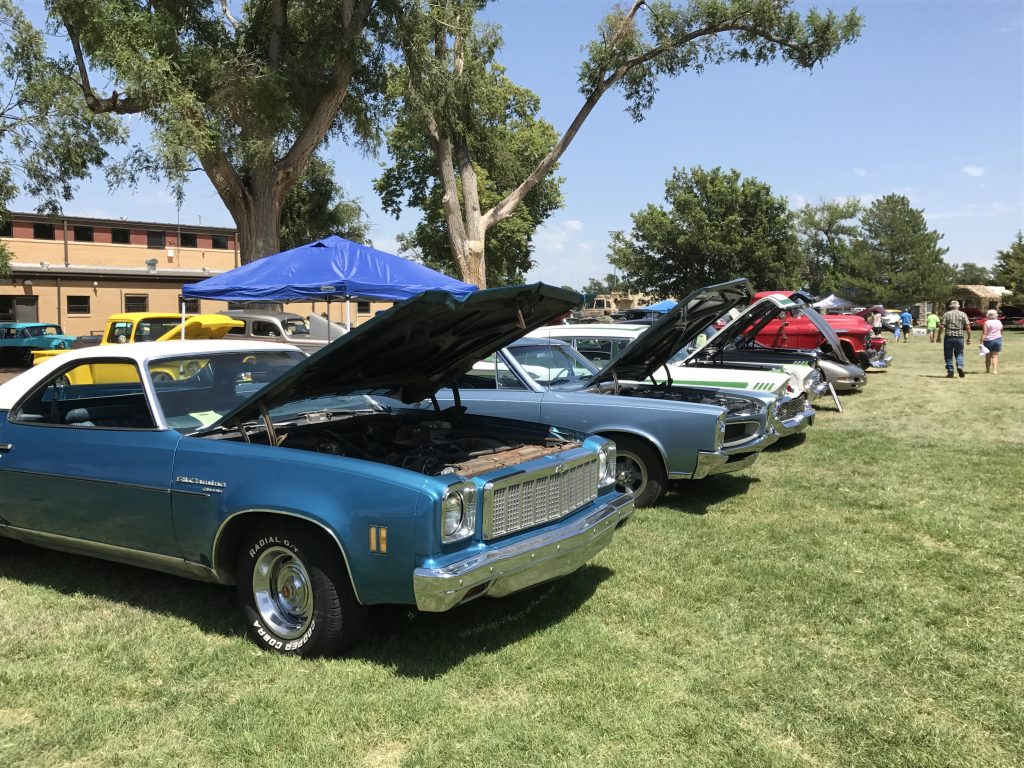
The annual Thunder on The Bricks Car, Truck and Cycle Show recorded more entires than the previous year with 225 vehicles and 50 motorcycles.
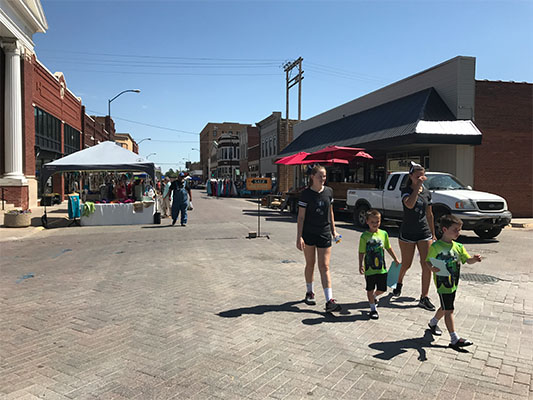
Saturday morning started with the Cancer Council of Ellis County 5K and the Bargains on the Bricks sidewalk sale and Downtown Hays Market.
People crowded Municipal Park Sunday morning for a city-wide church service, which was followed by proclamations being read by city and county officials and presentations being made between representatives of Hays and delegations from Hays’ sister cities, Santa Maria de Fe, Paraguay, and Xinzheng, China.
A free picnic lunch was offered in the park as well as inflatables for children.
The city of Hays, historic Fort Hays and Ellis County were all established in 1867, 150 years ago this year.
Henry Schwaller IV
The community’s sesquicentennial was celebrated this weekend.
For three men living in Hays, that history is not just something to be celebrated once or twice a century. It is not plaques on a wall or disintegrating newspaper clippings. It is their lives and their families.
Henry Schwaller IV, George Philip V and Pete Felten, agreed to sit down with the Hays Post and talk about Hays history and changing face of the city.
Early Hays
Pete Felten
Schwaller’s family history dates back to the 1870s in Hays. His great-great grandfather Clemens immigrated to America with his brothers from Switzerland in the early 1800s. Clemens brought his son, Henry I, to settle in Ellis County on a farm near Walker.
Henry and Clemens worked in a general store in Catherine Astad. In about 1888 or 1890, the family acquired a lumberyard along the railroad tracks in Hays.
George Philip V
“They were a large Swiss German family. They were not Volga Germans, but they integrated into the community well and were very involved,” Henry Schwaller IV said.
Henry I, married, May Farley, the daughter of the local druggist. She was the Ellis County beauty queen and represented the area at the 1904 World’s Fair.
Henry II was the third child of Henry I and May. The family focus was business, but they were also involved in the community. May and her sister volunteered at the Presbyterian Club and were very active in other social circles, including Bridge Club and the Women’s Literay Club, which successfully obtained a grant from Andrew Carnegie to build the Hays Public Library.
Henry I was politically active and was one of the groups that campaigned to pave the Hays streets with brick, which was controversial at the time. Some people said they wanted to stay with their rural roots, and brick streets were too cosmopolitan. Henry I’s brother, Fred, was a charter member of the Hays Rotary Club and started the first golf course in Hays.
The Depression
The 1910s and 1920s were good years for the Schwallers, but the prospects changed even for successful families during the 1930s.
The first set back for local businessmen like the Schwallers was the income tax of World War I.
“Although we were comfortable and we had a business,”Schwaller said, “The 1930s were very, very tough. Our customers couldn’t pay and our customers could not afford. There was no building going on. It was a tough time to be in the lumber business.”
Although the economic conditions were awful as commodity prices were very low, the environmental conditions were perhaps worse, Schwaller said.
The dust storms during the Dust Bowl were so bad that it turned day into night. Schwaller said his grandfather recalled going to a basketball game inside Sheridan Coliseum. It was so dusty they had to call off the game because they could not see inside the building.
“The dust would get in houses. I understand that my great-grandmother would close all the windows as best they could and get all the towels they could and make them wet to seal every crevice, and the dust was still crazy,” Schwaller said.
“Not only were there really tough economic times … they were really horrible … but the environmental conditions were awful because the topsoil was just drifting away. Those are the stories that will stick with me most. If it were not for Franklin Delano Roosevelt and the New Deal, we would not have made it.”
In fact, Roosevelt’s WPA commitment to Hays was what turned the family from Republicans to Democrats and frankly other families too. Schwaller said many families had two pictures hanging in their parlor. One was of Jesus and the other was of Franklin Roosevelt. Roosevelt’s administration helped to revise farming practices, bring electricity to the region, and build the courthouse, municipal park and the pool.
“The list was a huge bounty to Ellis County when people couldn’t find work,” he said.
Philip Hardware
George Philip II came to American in 1873 from Scotland. He and a cousin had a general store in Victoria and George Philip was the postmaster there. In 1894 George started the hardware store in Hays. In 1896, the store was moved into its long-time location at 801 Main St.
The Philip family ran the hardware store until 1996.
George Philip V, 62, who still lives in Hays today, grew up working in his family’s store. He used the hardware to build himself elaborate toys, which his father would eventually disassemble and restock.
Downtown was the shopping hub. It was the social hub, Philip said.
“I remember when 27th and Vine were dirt roads, and now look what is there,” he said.
George grew up in what is now the Mary Elizabeth home. They family kept horses, and George said he remembers ridding along Big Creek and many areas that are now busy streets.
“It was a very small town,” he said. “That is one of the things we took for granted, maybe it was something we shouldn’t have taken it for granted.”
During Hays’s centennial in 1967, George and his family participated in a large pageant that depicted the history of the city. The pageant was staged on the football field and included elaborate costumes and live action with actors on horseback.
As the large chains came into the city, small local businesses like the Philip Hardware Store began to suffer. George V dropped power tools and appliances and focused on items that were harder to find and the big box stores did not carry. Eventually it would not be enough, and George made the decision to close. During this time, other downtown retailers suffered.
“Hays has done a lot downtown, a lot of revitalization. A lot of business is interested. They realize, hey, downtown can be a real vital place to shop … just to visit. There is the Art Walk,” Philip said.
————————————————
Catholic, protestants and the War
Pete Felten, local artists and Hays native, was born in Hays in 1933. Felten’s ancestors came from Germany in the 1700s and settled in Pennsylvania. They farmed their way across the country and finally settled in Hays. His father had a truck line and hauled freight from Kansas City to Colby on Highway 40.
He remembers a division in Hays between the German Catholics and the Protestants. Although the two groups got along fine, they had separate schools.
He remembers playing with the boys from German families. The Catholic schools were strict, according to his Catholic friends. The nuns and priests did not like the boys speaking German or using the term, gella, which was a slang for the affirmative. This is where the name of Gella’s Dinner came from.
The boys’ military school may have been strict, but Felten remembers their huge cheers during football game.
“The were really fiery. They were great,” he said.
Felten he had fond members of Hays growing up and riding the hills of Hays on his bicycle.
Hays never had a boom, but had continual growth. The population of Ellis County never soared, but many of the older farm families moved into the city over the years, Felten said.
Farming had never been lucrative, but oil was discovered in the area in 1920s and that brought some prosperity to the farm families. The oil industry brought new businesses to Hays. The oil industry along with the college, which was established in 1902, both helped bring people from new regions with different backgrounds to the city.
“The general health of the city just got better and better,” he said.
Felted remembers pretending to fight the Nazis during World War II. He remembered scrap drives and the slowing of building in the city.
The USO was located in Hays and young men from the Walker Army Airfield would come into the city to visit the beer gardens. A lot of those soldiers ended up staying in Hays after the war.
Hays had prisoners of war at the experiment station.
“They loved it here,” Felten said. “They did not have to fight. They could speak the language because there were so many Germans out here and good food. They liked it out here in Hays.”
———————————————————————————————————————————-
Building for Boomers
As the cloud of the Depression lifted, the Schwallers knew they needed to diversify the business beyond a lumber yard.
“When he was running the lumberyard, there were 12 other lumber yards in town,” he knew he needed to get ahead,” Henry IV said of his grandfather.
In 1950s, Hays was hit by devastating floods. Henry II built some spec homes in the area of 22nd and Oak, which he called Highland Avenue. People eager to move out of the flood plain moved to the addition.
In 1959, Henry II bought the Winter’s family farm at 22nd and Vine for about $200,000. The property extended to 27th Street to about Indian Trail, about 150 to 200 acres.
At the time, this was thought to be an odd move. Most people in the community at the time assumed the city would grow to the west away from the cemetery. With the government land bordering the city on the south, Henry II saw the potential of city growth to the north and east.
Henry II also knew the state had adopted Vine Street as part of the new Highway 183.
———————————————————————————————————————————-
Not a hip city
Felten served four years in the military and came home to Hays as the hippie movement was beginning. He said the city leaders thought the city had a hippy problem, but Felten said it was exaggerated.
Locals were unsure if Felten, with his beard, was a hippie or an artist.
A group of students from Victoria came to interview him at the time and were shocked that the FHSU president’s daughter was riding around town in an open jeep with a big dog.
Felten just explained she was an artist.
The people in Hays were practical, Felten said, but there was a significant opposition to the war in Vietnam, especially among the young men in the community.
The completion of I-70 to the Colorado border in 1970, brought more motels and restaurants to the city and Felten said the city became more cosmopolitan.
Growing up in Hays in the 1960 and ’70s
Henry Schwaller IV was born in 1966, one year before the community’s centennial.
Schwaller remembers growing up in a much smaller city surrounded by country. He remembers a time before the Dillons was built on 27th and Hall and when everything west of that point was fields and farming.
His grandfather Henry II lived at 22nd and Oak, which at that time was in the country, and the family had a small farm there.
“It is hard to explain,” Schwaller said. “When you are really tiny and you look from your house and there is nothing and it is all fields and all dirt and now there are things there, it is really mind-boggling how the city has grown not only in population, but in density and land mass over the last 50 years.”
When he was born Interstate 70 was not finished and not connected to the rest of the country, and Vine Street did not exist in the form it is today.
He remembered going to the first A&W Drive on Eighth Street and Sandy’s Drive-in where the Hays Welcome Center is now at 2700 Vine.
Henry IV walked and biked to school and was among the first students as a sophomore to attend classes in the new Hays High School on 13th Street east of Canterbury.
“As a little kid all my memories are around parks and food and fun,” he said.
Henry IV spent a lot of time with his father and grandmother, Juliette Schwaller. She was also active in the family business and in the community.
Juliette had a son who would be eventually diagnosed with a mental illness and was referred to Menninger’s Clinic in Topeka. Juliette had the means and time to drive her son back and forth to receive care. However, she thought much about those families who did not have the means to seek care for their loved ones. Juliette helped form High Plains Mental Health and community mental health centers around the state.
She was involved with the Hays Arts Council to a degree and became the first women to run the Democratic Party in Ellis County.
Henry II was also very politically active and served in Kansas Gov. Robert Docking’s administration first on the highway commission, which helped build Vine Street and completed Interstate 70. Then he was Secretary of Administration.
By this time the family had diversified even further, Henry’s grandfather raised cattle and horses and his father helped in the family real estate and rental business as well as ran a liquor store and connivence food store.
More economic hard times
Although the Dust Bowl had been very difficult on many Hays families, it was by no means the only economic downturn the community has faced.
“With the economic collapse again with farming and oil and industry in 1980s that extended all the way to 1994, it was very bleak here,” Schwaller said. … “It was absolutely devastating. It was devastating to our business and our family.”
“There was some who thought we may not survive the 1980s,” he said.
Growing a community
Henry IV said his families involvement in public service and politics in part lead him to be a city commissioner. He entered the commission in 1999. He lost re-election in 2007, and then won election in 2009 and has been on the commission since. His current term expires in 2020.
“This is something we do,” he said. “We are not just here to make a profit. We are here to give back to the community.”
The city started primarily because of three people, Buffalo Bill, who settled Rome; H.P. Wilson of the Union Pacific Railroad who developed Hays as we know the core; and Martin Allen, who named all the streets and told the residents what could and could not grow here.
However, Schwaller said it has really been groups of people who built Hays to what it is today. When Hays wanted a college, a group of residents worked toward that. A group fought for a bigger, better depot.
Since the recession in the 1980s and 1990s, the city has been able to build up reserves and steady its financial status. Many infrastructure repairs have also been completed since the turn of the century.
Henry IV said his biggest concern for the future is economic development. Rural Kansas’ population is in decline, and Hays can’t solely rely on retail for economic stability.
“We need to figure out what our next act is,” he said. “What are we going to do next. I have no doubt we will figure that out, but it is going to be a painful path getting there. It is going to take some time.”
Late in his grandfather’s life in 2013, his grandfather liked to be driven around town looking at construction and new additions. Henry IV took his grandfather up to 55th and Vine to the water tower and the two looked out over the city.
“He was blown away. We had been driving around looking at individual houses and where he used to live and now he could see the whole city. He said, ‘This is incredible. I never imagined this. Hays is a wonderful place. I never thought it would be this big. This is amazing.’”
When Schwaller was asked where Hays might be in 50 years or 100 years, he recalled a quote from Ray Crock, the founder of McDonald’s
“’I don’t know what we will be selling in the year 2000, but we will be selling more than anyone else,’ and I don’t know where we will be in 50 years, but we will be vibrant, we will still be here and we will be a regional center,” he said.
Hope for the future
George Philip also said he is optimistic for the future of Hays.
“Hays is obviously growing,” he said. “There is a lot of residential development going on, obviously commercial development if you only look at the number of restaurant or retail outlets and the various products and services.”
“If I would have been dropped off the face of the earth 50 years ago and suddenly been dropped off again now,” he said, “I don’t think I would have recognized the place. So many landmarks have been torn down, so many new structures have been put up. It is rather remarkable.”
Hays residents and four members of a delegation from Santa Maria de Fe gathered at the Hays Public Library Saturday afternoon for a presentation and dedication of an art installation “World Apart, Cities Together” honoring Hays’ sister city.
Milciades Ramon Mancuello, tourism coordinator, Erma Elizabetk Del Puerto de Ramirez, director of Institute of Technology, Isabelino Victor Martinez Galiano, manager of Jesuit’s Museum and Derlis Hernan Maidana Zarza, governor of Misiones, are visiting the city in honor of the city of Hays’ 150th birthday.
The group attended many events during the sesquicentennial this week, including the Hays City Commission meeting Thursday night.
Hays and Santa Maria became sister cities in 1976. Although there had been exchanges back and forth since that time, the sister city organization began working in earnest to renew the partnership between the two cities in 2001, culminating with the four dignitaries’ visit to Hays this weekend.
Del Puerto de Ramirez gave a presentation to a group gathered at the library about her home city.
Santa Maria has about 10,000 residents in the surrounding area with an economy that is based on agriculture, meat production, industry and fine arts.
Erma Elizabetk Del Puerto de Ramirez, Director of Institute of Technology, gives a presentation Saturday at the Hays Public Library on her hometown of Santa Maria, Paraguay.
The community has 25 elementary schools, seven middle school/high schools and one technological institute, which Del Puerto de Ramirez is the director.
Max Maximov, Sister Cities board member, has traveled to Santa Maria and said in introductions of the Hays group has tried to help the schools in Santa Maria.
The Santa Maria school district has about 925 students, but only 45 computers, and those are from the 1990s. The Hays Sister Cities group tried unsuccessfully to obtain a grant to buy new computers for the schools.
Students in Santa Maria are studying English, which allows them to take tests that would allow them to study in the United States or the United Kingdom. About 90 students have passed the British Cambridge test, and 178 students are studying English at various level at this time.
Santa Maria hopes to soon have a branch of the state university, Del Puerto de Ramirez said through Maximov, who was interpreting. Transportation proves to be a large barrier for students to reach university branches in other communities.
The technical institute is privately funded. A British journalist traveled to the community and fell in love with the city and its people. She helped set up a charity in Britain that helps fund the institute, which offers classes to its students for free.
The technological institute’s two-year program focuses on food production and packaging. The students are working with the municipal meat packing plant on quality control.
The institute also has worked with local residents to identify and cultivate medicinal plants and vegetables and improve nutrition.
Paraguay produces some herbs that are shipped all other the world. Production has picked up as people have become more aware of the use of alternative medicine.
Del Puerto de Ramirez talks about the Paraguayan brick cooking oven called tatakuas.
Homes in Santa Maria are equipped with brick ovens called tatakuas, which translated into English literally means “fire where.” Del Puerto de Ramirez noted the ovens provide a superior taste in food than a flat top stove.
The city of Santa Maria is also known for its rich cultural history and fine arts. Santa Maria was established by Jesuit priests in 1631. Isabelino Victor Martinez Galiano, is manager of Jesuit’s Museum, which was created with a donation by Marianna Beach.
Today the museum preserves many of the religious artifacts from early Santa Maria. Martinez Galiano showed photographs of the museum and its art, which included life-size statues of the early priests, a nativity, angels, and complete statuary depiction of the passion of Christ.
Donations were taken for the museum during the art dedication Saturday.
Early Jesuit art of Santa Maria.
The art installation is in the lobby of the Hays Public Library. It includes photos taken in Santa Maria by Cody Custer. The installation also includes examples of hand embroidery and a scroll documenting both the histories of Hays and Santa Maria.
Martinez Galiano talked about his impressions of Hays.
“We have found a lot of calm and a lot of tranquility and humans that are very similar to our own ,” he said through a translator. “We have seen that the city is very connected to the land … to agriculture. People are very proud of their work and have good organization.”
Martinez Galiano met with members of the art department during his visit.
He said there are many people in Santa Maria who have art inside them, but they do not have the opportunity to let it out. In Hays there is an opportunity.
He said the biggest difference between Hays and Santa Maria is its approach to education.
“Education is so much present here that it is first importance, second importance and third importance,” he said.
He said he hoped the two cities can continue to cooperate culturally, and there would opportunities for both young people and adults.
Martinez Galiano said he has learned about the history of Hays, which is very different than that of Santa Maria. Santa Maria was indigenous and then religious. Hays went through many different levels of development and was influenced by different cultures.
Ramon Mancuello said he thought Hays was a small community like Santa Maria, but was impressed by its size when he arrived.
Hays Street in Santa Maria
“We have met kind people, very friendly people and everybody knows each other,” he said.
Ramon Mancuello said in this way, Hays is very similar to Santa Maria.