The Hays school board will take up a $78.5 million proposed bond issue at its meeting Monday.
The bond is a sweeping plan to remodel or replace schools that are 60 to 90 years old.
The bond issue seeks to do the following:
• Build two new elementary schools to replace Wilson and O’Loughlin elementary schools. The new Wilson school will be built on the current Wilson property and new land would be sought for the second new elementary school. All three of the elementary schools will be able to accommodate four sections of each grade.
• Update Roosevelt Elementary School with a secured entrance, classroom renovations, added classrooms, storm shelter, new gymnasium and cafeteria/kitchen renovations. Roosevelt’s current storm shelter is in the basement, which makes in inaccessible for children or staff with disabilities.
• O’Loughlin would be repurposed to house the Early Childhood Center, Adult Learning Center and Westside School. A secured entrance, storm shelter and classrooms would be added as well as classroom renovations completed. The plans for O’Loughlin propose secure doors separating the different programs that would be located in the building.
• Hays Middle School renovations would include a secured entrance, additions to the cafeteria, kitchen renovations, and an additional gymnasium to provide adequate space for PE classes. As many as 130 students are being crammed into the gym space at HMS for PE classes currently.
• Update Hays High School with a secured entrance, storm shelter, classroom renovations, additional
classrooms, renovated Career Technical Education (CTE) and fine arts classrooms, new HVAC system, and a new auditorium to replace 12th Street Auditorium.
The Munjor building would go back to the Catholic Church. Washington and Lincoln schools would be repurposed.
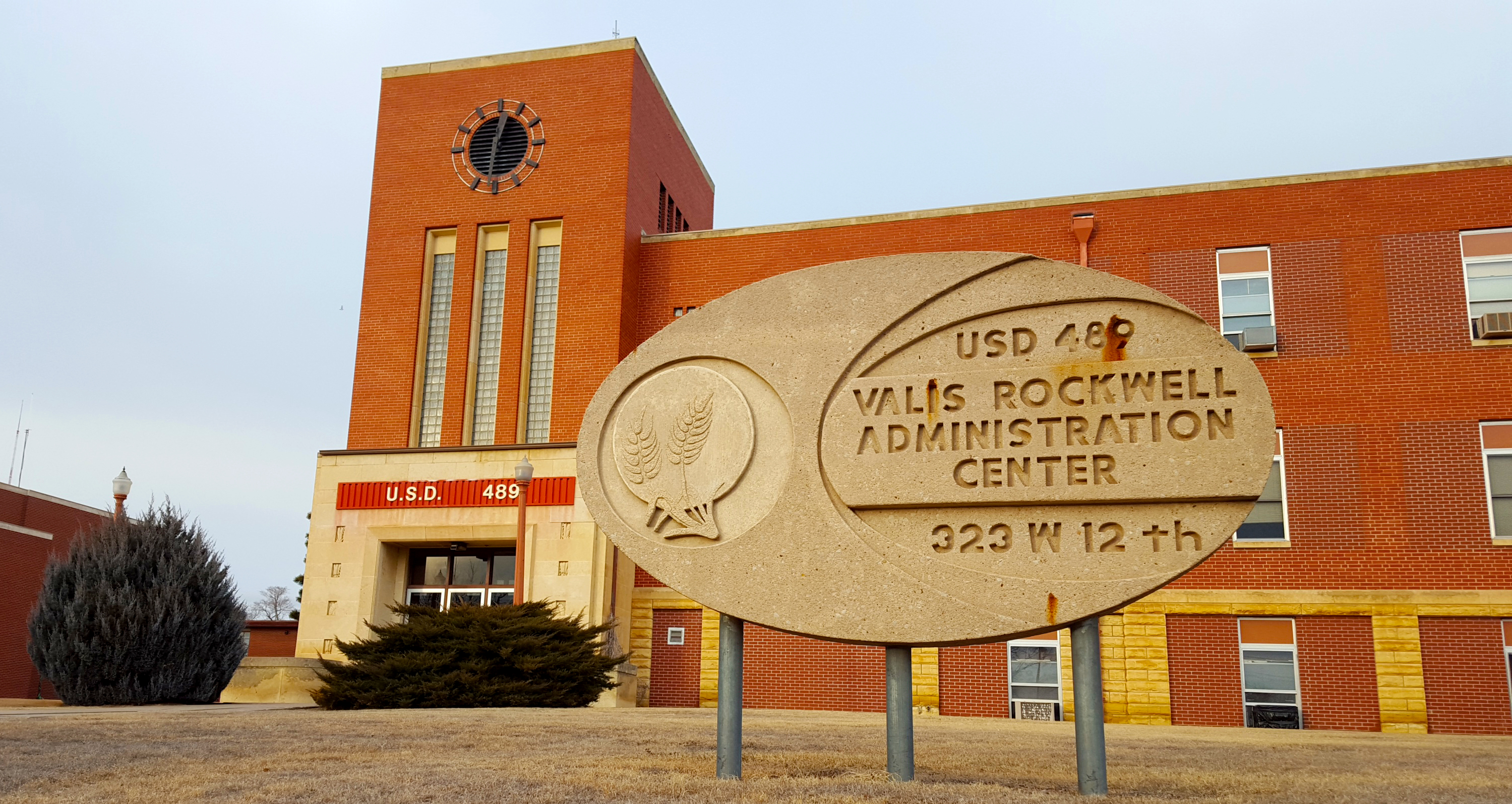
The Westside and Rockwell properties would still continue to house administration and maintenance. Superintendent John Thissen has said the district wishes to use the bond money to focus on projects that directly affect students.
If the district determines it is more efficient to shutter Westside and Rockwell in favor of other locations, that will be considered at a later date.
Hays has no bond projects on the books currently and has not had since 1990, which puts it at the bottom of a list of like-sized school districts in the state.
It’s overall mill levy, 43.673 mills, is next to last on a similar list for overall mill levy.
Hays is considered a wealthy school district and receives no additional state aid. All the funds for the bond issue must come from local taxes.
The district’s plan seeks to lower the district’s capital outlay mill levy by 2 mills. The bond issue mill levy would be 11.43 mills over 30 years. This would be a net mill levy increase of 9.43 mills. The monthly cost to the owner of a $150,000 home would be $16.43.
Three groups came together to create the bond issue proposal, an executive team, made up of administrators; a staff planning team; and a community vision team made up of teachers, parents and members of the community.
In addition the district conducted a community survey and teacher in-service while developing the plan.
The district had a $94 million bond issue that failed in 2016 and has tried to address issues of trust and tax structure that were issues during that election.
The planning teams debated the need to build two new elementary schools. Much of this discussion centered around the cost of renovation compared to new construction, considering the age and value of the buildings.
A renovation of Wilson Elementary School would cost about $15.6 million, which is about 73 percent of the $21.4 million cost of constructing a new building.
If the bond issue is approved by the board on Monday, it could go on the ballot as soon as the general election on Nov. 7.
The board also will consider dropping the material/workbook fee for all students from $135 to $90 for the upcoming school year. The state has approved a budget that will increase funding to the state’s school districts, and USD 489 plans to use a portion of that money to offset the $90,000 reduction in fees.
In other business, the board will discuss:
• Board president appointments
• Filling the board vacancy left by the resignation of member Sarah Rankin
• Teacher negotiations
• Board goal setting
• Health insurance
• Pre-enrollment class projections
• Special meeting notices for the budget and budget hearing
• Copy paper bid
• Title VI-B budget approval and SPED update
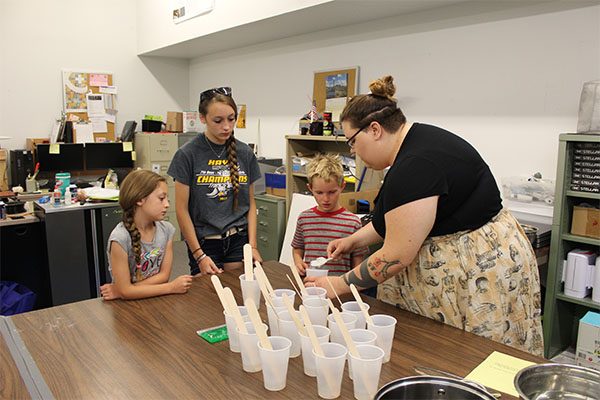
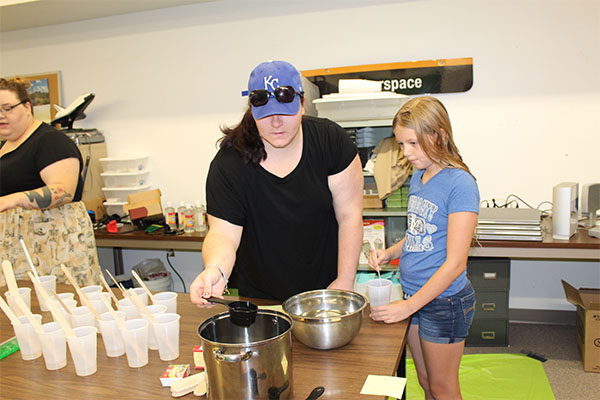
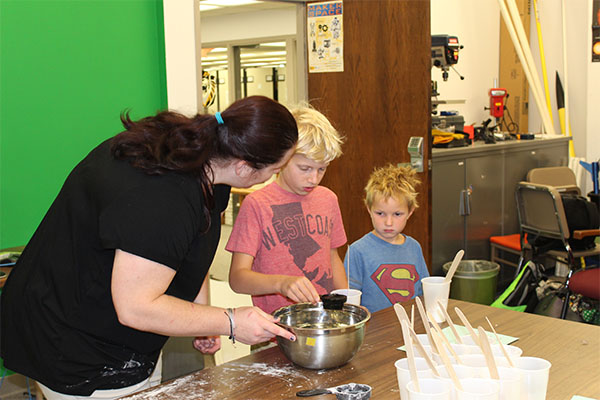
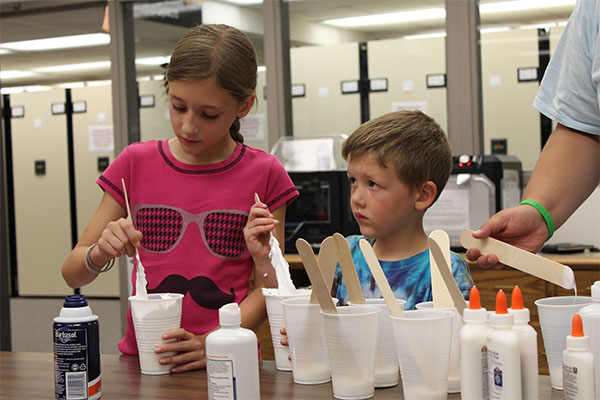
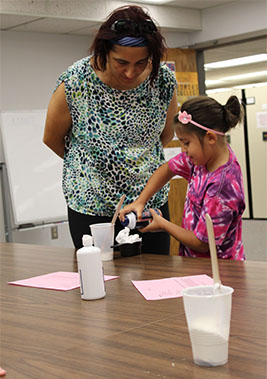
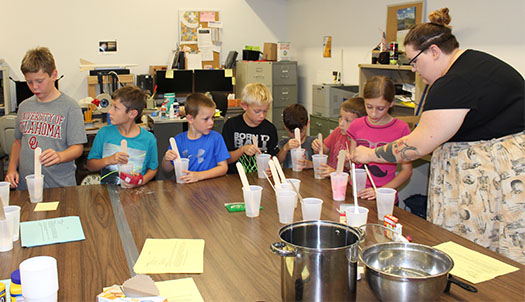
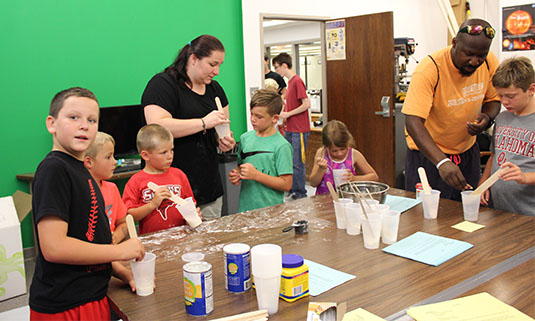
Children crowded into the Makerspace at the Forysth Library at Fort Hays State University Thursday morning to get icky and sticky.
Slime Time let children try their hands at making three types of slime: clear slime, fluffy slime and oobleck.
Slime is a non-Newtonian fluid. It’s viscosity can be affected by factors other than temperature, according to Brian Rohrig and his article,“The Science of Slime.”
Viscosity is a fluid’s resistance to flow.
In the case of slime, it may almost act like a solid, but it if you add pressure to the slime by squeezing it in your hand, it begins to flow like a liquid.
A polymer is a large chain of molecules made up of smaller units that repeat themselves, which are called monomers. A single polymer molecule may comprise hundreds of thousands of monomers, Rohrig said.
The white or clear school glue in the slime is a polymer. When the liquid starch is added, in this case Borax, it changes the structure of the chain making the polymer thicker.
According to Rohrig, common synthetic polymers are rubber, plastic and nylon. Common natural polymers are starch, DNA and some proteins.
Megan Adams, summer director at the Makerspace, said it is not so important that the children understand the scientific properties of the slime.
“They get to have a hands-on experience with science they may not have the opportunity to have in the summer,” she said.
The exercise also helps the children develop problem-solving skills, she said.
Lima McLoughlin, 8, just thought it was icky fun.
Mariah Werth, 10, of LaCrosse said she loves science, but it is just fun to make slime, which she has done at home.
“It is supper fun to play with,” she said. “It is easy to work with. I have made it with my different cousins. It’s gooey, but it won’t ever stick to you.”
Maysyn Tippy, 11, of Hays, was trying her hand with the fluffy slime for the first time.
“It is fun to create. It is fun to work with and makes a mess. It makes it all gooey,” she said.
Maysyn’s mom was just glad that she and her cousin were making the mess at the Makerspace and not at home.
“They are always making it at home,” she said. “It is always messy, and it is not always successful.”
Recipes
Clear Slime
Ingredients:
Glue Base:
1/4 cup of clear school glue
1/4 cup of water
food coloring
Activator:
1/2 cup of warm water
1/2 tablespoon of Borax
Instructions: In a bowl, mix together Borax and warm water until Borax is completely dissolved. Set aside and let cool.
In a separate bowl, mix the first three ingredients together until combined. Add activator (Borax solution) tablespoon by tablespoon, stirring your slime after each addition until the slime reaches desired consistency. If you are unable to stir your slime, remove it from the bowl and knead it on waxed paper.
Store slime in an airtight bag, Wash hands after use.
Fluffy Slime
Ingredients:
1/4 cup of white school glue
1 cup of shaving cream
food coloring
3 squirts of contact solution
Activator:
1/2 cup of warm water
1/2 tablespoon of Borax
Instructions: In a bowl, mix together Borax and warm water until Borax is completely dissolved. Set aside and let cool.
In a separate bowl, mix the first three ingredients together until combined. Add three squirts of contact solution, mixing after each addition. After this, add activator (Borax solution) tablespoon by tablespoon, stirring your slime after each addition until the slime reaches desired consistency. If you are unable to stir your slime, remove it from the bowl and knead it on waxed paper.
Store slime in an airtight bag, Wash hands after use.
Oobleck
Ingredients
1/2 cup of cornstarch
1/4 cup of water
Food coloring
Instructions: In a bowl, measure out 1/2 cup of cornstarch. In separate container, combine food coloring and water, mixing well. Add water to the cornstarch tablespoon by tablespoon, stirring after every addition. Continue to add water until the mixture can be grabbed and formed into a ball, but is still runny.
If the mixture is too runny, add in cornstarch a tablespoon at a time. If the mixture is too thick, add in water a tablespoon at a time.
Store in an airtight bag. This mixture will eventually dry out but can be easily rehydrated by adding water.
BERNINA of America, the premier manufacturer of sewing, embroidery and quilting machines announced Sew Easy Stitch Lounge, a BERNINA store in Hays, will host a BEAR-NINA Sew-In event from 9 a.m. to 4 p.m. on Saturday at the store located at 2506 Vine.
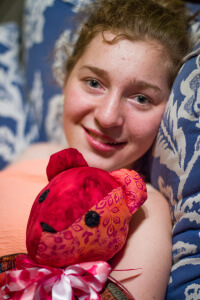
The dealer invites the community to the store to make stuffed bears that will be donated to children with rare diseases through the RARE Science program.
RARE Science is a non-profit organization that works globally with patient families and foundations to help aid in finding cures for children with rare diseases.
The event costs $8 and includes fabric, the bear pattern, fiberfill, special fabric feet and the registration tag. Refreshments will be served. Registration is required as seats are limited. To register, call 785-628-1001 or stop by the store.
“We are so excited to invite the community into our store to enjoy sewing for a good cause,” said Annis Werth, owner of Sew Easy Stitch Lounge.
Sew Easy Stitch Lounge is an authorized BERNINA Dealer which provides top-quality service to area residents. The Dealer offers BERNINA sewing machines, software, and accessories, and also provides a variety of sewing, embroidery and quilting classes for people of all skill levels. For more information, visit www.seweasystitchlounge.com
About RARE Science, Inc.
RARE Science Inc. is a non-profit research organization that focuses on accelerating identification of more immediate therapeutic solutions for kids with rare disease by empowering patient families and lowering the barriers to rare disease medical research.
The RARE Bear Program is supported by the ever-growing RARE Bear Army of volunteers that span 15 countries and partners including BERNINA, The Quilt Show, Spoonflower, Mountain Mist and Simplicity that help make one-of-a-kind bears for special one-of-a-kind “rare” kids.
The RARE Bears are instrumental in worldwide patient community outreach enabling research for rare disease. Each unique RARE Bear is matched to a child’s favorite hobby and colors and is identified by a unique serial number on the tag of authenticity. For more information on RARE Science and the RARE Bear Program, visit https://www.rarescience.org, or contact [email protected].
“When you tell a landlord the wheat made 80 bushels-per-acre and you’re going to double crop beans on his (recently) harvested land, they get a big smile on their face,” says Kris Bogart.
Now that’s good news. The kind a Kansas land owner welcomes but doesn’t hear too often.
Not because his/her tenant doesn’t do everything possible to raise a bumper wheat crop each year, but Mother Nature is fickle. This year, she’s inflicted fire, a late spring blizzard, too much moisture and in some cases, not enough. Her wrath has dealt a crippling blow to many western Kansas grain growers.
Fortunately, none of those conditions impacted Bogart who farms in central and southern Dickinson County. He and brother, Kelly, harvested wheat yields ranging from 64 to 95 bushels-per-acre. Test weights ranged from 61.8 to 63.5.
“We harvested a phenomenal crop,” Bogart says. “We were right in a spot with ideal growing conditions.”
The Dickinson County grain farmer realizes his family harvested a rare crop this year. Bogart doesn’t need to travel far from his farm to find wheat yields not nearly as good.
While he wishes all farmers could have shared in the same bounty, Bogart understands the land giveth and taketh. He’s learned to see his vocation not as it is, but rather as it could, or will be.
We’re really fortunate,” he says. “Believe me, it may be many years before we harvest such a crop again.”
Still, as he waited for his wheat fields to dry out after a small shower traveled across the stubble the second week in July, Bogart did not fret too much about planting his late field of double-crop soybeans. He knew this would only dry the soil out a bit more and decrease the chance of the press wheels on his planter filling up with mud.
It goes without saying, he’d much rather spend time doing just about anything than cleaning mud out of press wheels on a 100-degree July day with 70 percent humidity. That’s what he calls a sweaty mess.
After more than a decade of double cropping soybeans immediately after wheat harvest, the Bogart brothers are convinced this rotation is good for their family farming operation.
“It keeps our fields cleaner and crops produce better,” the Dickinson County farmer says. “The longer we no till it seems like we fight more weeds and disease. Double-crop soybeans behind wheat will pay for the chemicals we would have used and keep the ground just as clean.”
In 2016, Bogart raised as many beans per acres on double-cropped fields as their full-season. He attributes this to the abundance of moisture the full-season soybeans received.
Seems last year’s full-season crop grew a much bigger plant than necessary. On the other hand, the double-cropped soybeans didn’t grow as much vegetation and put more input into the pods and beans.
Every year is different. Conditions vary. Moisture arrives or doesn’t. Who can predict what disease or insects might flock to the fields?
We try to maintain a positive outlook,” Bogart says. “Some years, we’re blessed – others, not so much.”
Like all farmers, they take the good with the bad. When it’s a bad year, the Bogarts look toward the next year and hope it’s better.
John Schlageck is a leading commentator on agriculture and rural Kansas. Born and raised on a diversified farm in northwestern Kansas, his writing reflects a lifetime of experience, knowledge and passion.
Jamie Nemechek, left, 18, of Goodland was crowned the Miss Ellis County Rodeo Queen Tuesday night.
By CRISTINA JANNEY Hays Post
Two sisters from Goodland came away with the Miss Ellis County Rodeo Queen and Princess titles Tuesday at the Ellis County Fair Rodeo.
Jamie Nemechek, 18, who is a K-State student in pre-veterinary medicine, was crowned Queen, and her sister, Sara, 10, was honored with the Princess title.
They are the daughters of Jerry and Penny Nemechek.
Jamie’s hobbies include reading, spending time outside and working with her 4-H project animals.
Both girls will be showing sheep at the Kansas Junior Livestock Show and the state fair. They also plan on showing their horses at the state fair.
Jamie exhibited the grand champion lamb at the 2016 Northwest Kansas District Free Fair. Jamie and her siblings also manage a small herd of commercial cows.
“I come from a long line of pageant royalty,” Jamie said. “I really love pursuing and doing pageants. I recommend it to anyone who wants to learn more about rodeo.”
Jamie said her favorite portion of the pageant was horsemanship during which she rode her horse, Skip.
The young ladies competed the weekend of July 8 in horsemanship, modeling, talent or speech, and personal interview. They were also required to take a written test on rodeo and horses and submit photographs in their western wear.
During the horsemanship portion of the competition, the ladies compete in reining. The ladies are given a course that is written on paper and they have to replicate it in the arena. The riders also complete a queen’s run and flag run.
Sara said she wished to follow in her sister’s footsteps. This was her first pageant.
Sara Nemechek, 10, Goodland was named the Miss Ellis County Rodeo Princess Tuesday night.
“I thought a pageant would be a lot of fun to do,” she said. “I decided to try it out for the first time.”
Sara also said she most enjoyed the horsemanship portion of the competition, riding her horse, Babe.
The girls who did not win said they also had good experiences. Mariam Towns, 12, Palco, enjoyed the interview portion of the contest. Towns had to overcome a fear of horses to compete in the rodeo competition. She was bucked from a horse at the age of 6.
“I have taken it a little bit at a time, and I work with the horses every day,” she said.
Emma Pope, 16, said she hopes to take her 4-H experiences in public speaking and parlay them into a career.
Emma Pope, 16, Hays, Miss Ellis County Rodeo runner-up.
“I would really like to do something in science. I really like biology, anatomy and physiology. I would like to do something that coordinates the two,” she said.
She said she hoped to inspire other young girls through her participation in the pageant.
“I know when I was little, I was inspired by rodeo queens. They do a lot with the younger kids and in the community, and, of course, they go to a lot of rodeos. I like the atmosphere. Everyone is positive, but it is competitive too.”
Queen candidate Hailey Fisher, 16, Plainville, also competed.
The outgoing royalty for 2016 were Queen Jaylinn Pfeifer of Ellis High School and Princess Jaelyn Himmelberg of Lawrence, Nebraska.
The ladies who were named royalty this year will help plan next year’s pageant and assist at fair activities. They are required to travel to at least two other state rodeos and participate in local events as a representatives of the rodeo.
The Sternberg Museum is joining the City of Hay’s sesquicentennial celebration with a Summer Science Day.
From 10 a.m. to 2 p.m. Thursday, the museum will have special displays, presentations, and activities exploring the topic of weather.
Interact with museum and FHSU scientists to learn about weather phenomena, the effects of weather on plants and animals, and the differences between weather and climate.
There will be activities for all ages.
There is no additional costs for special programming, but normal admission fees apply.
The museum and exhibits are open all day, but special programming is from 10 a.m. to 2 p.m. only.
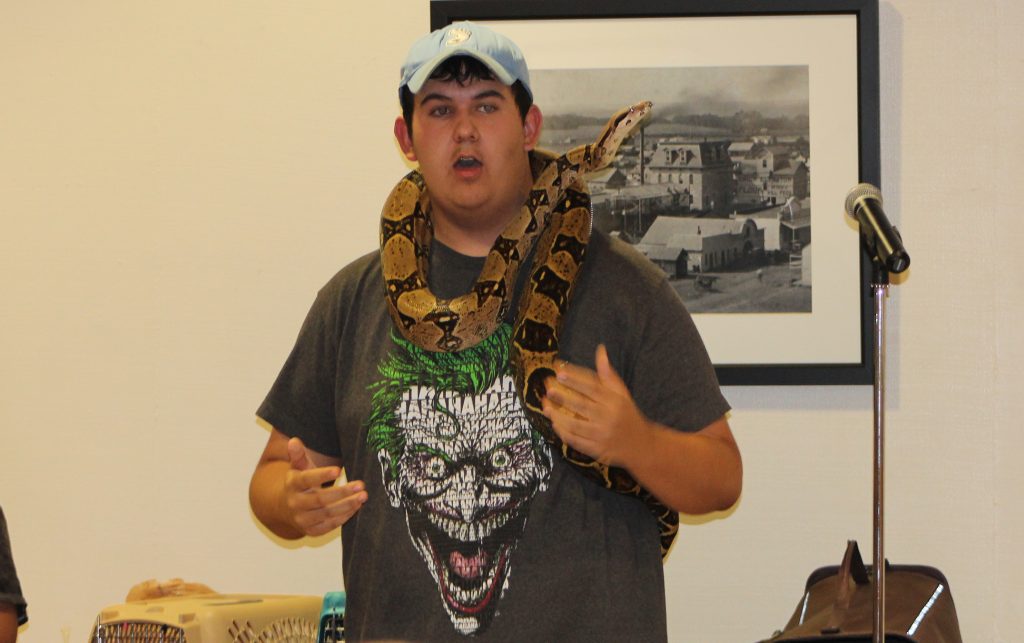
There are probably days designated for just about everything, but Monday was a day honoring all creatures that slither and hiss.
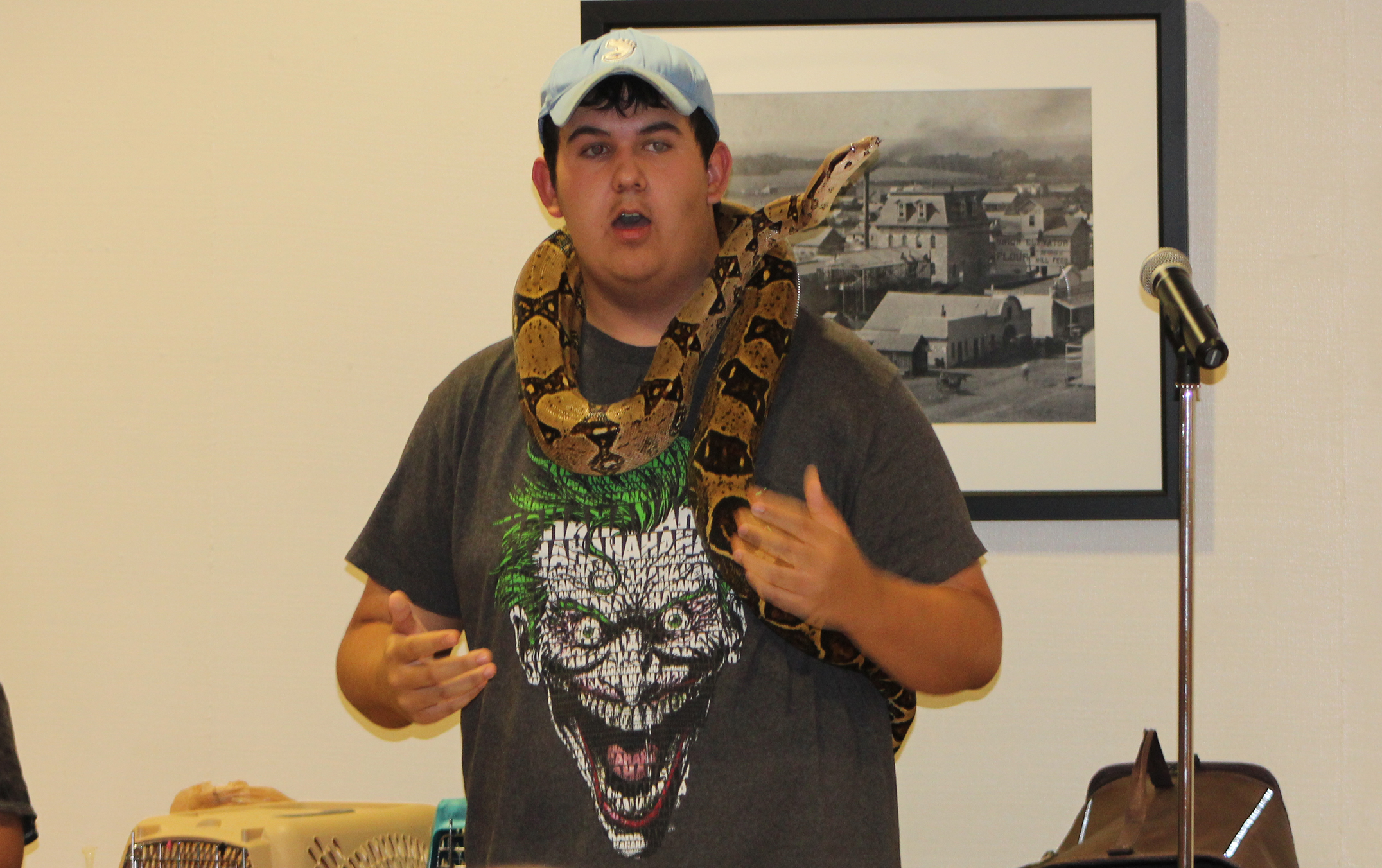
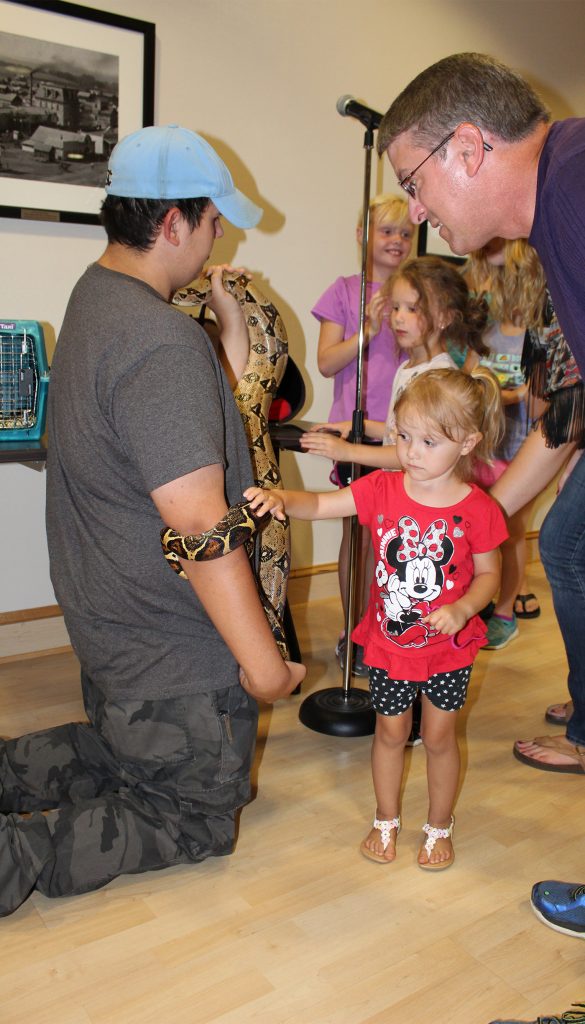
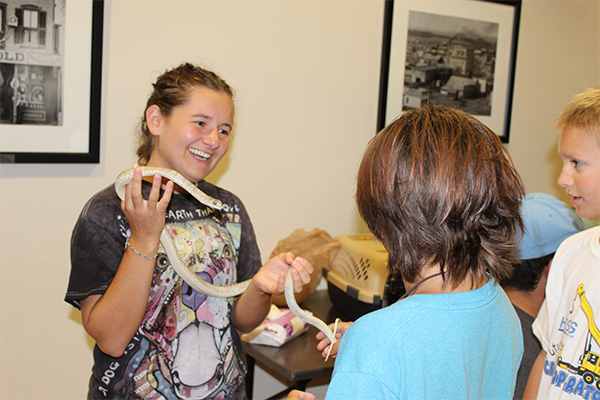
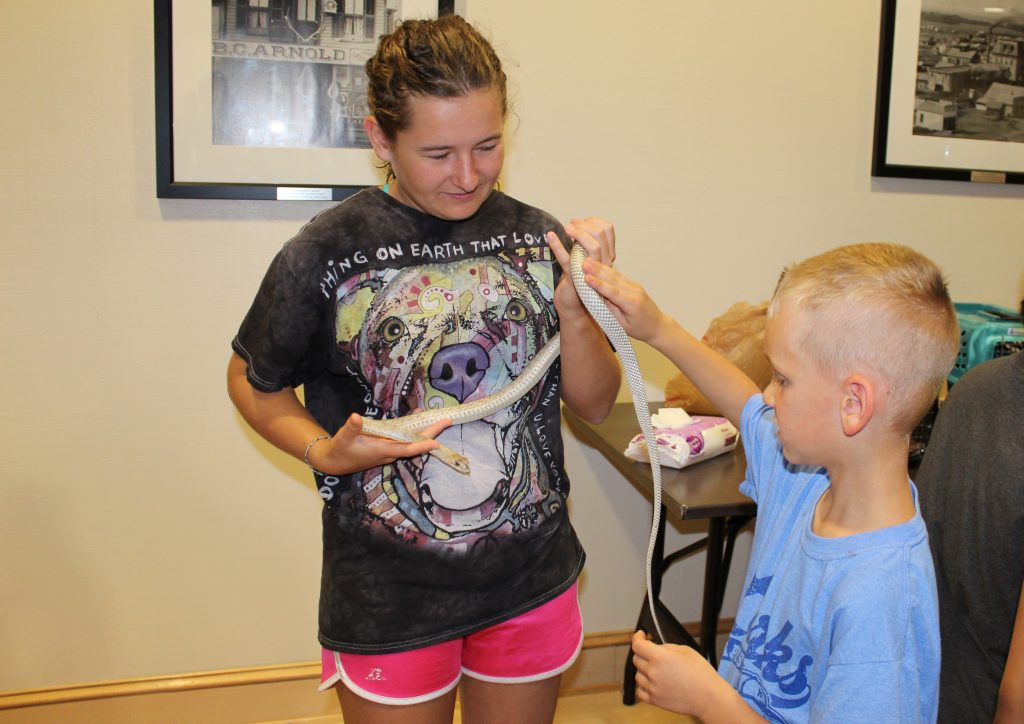
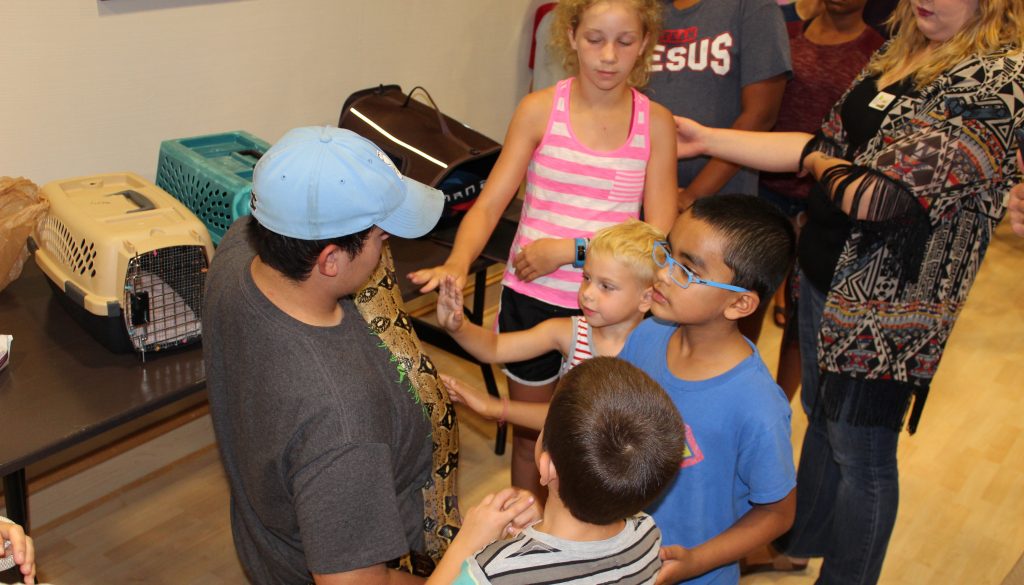
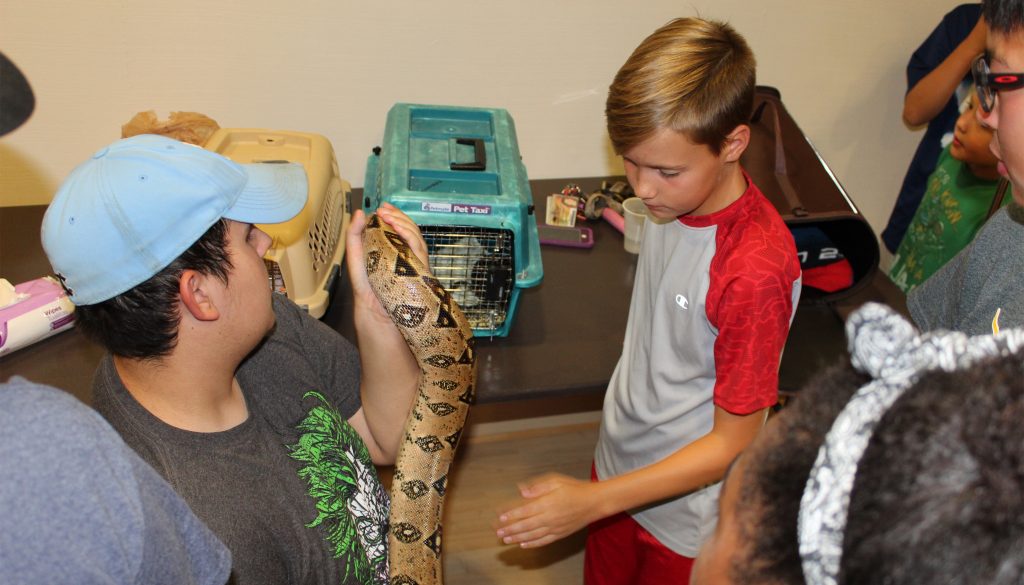
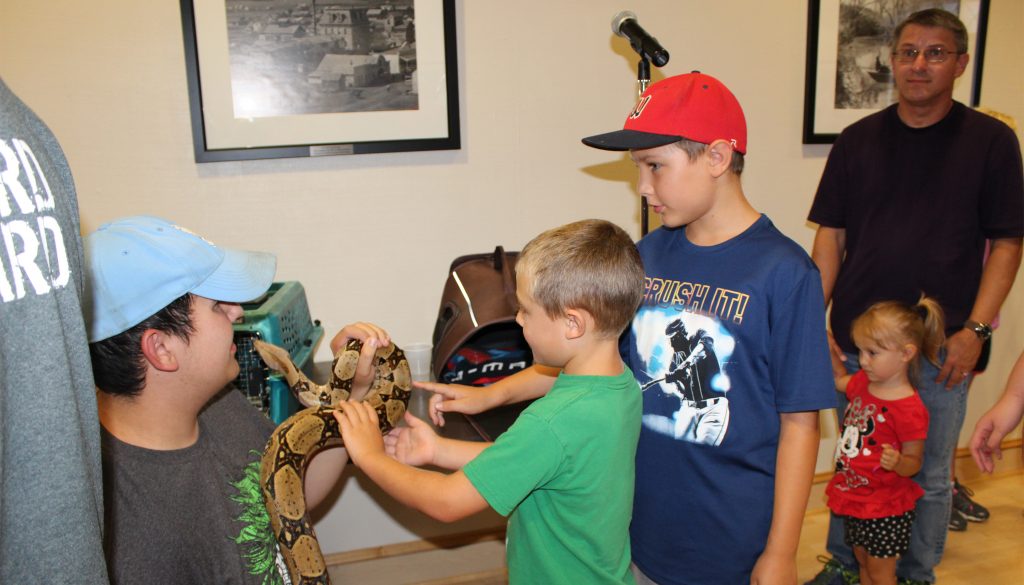
More than 130 people crowded into the Schmidt Gallery at the Hays Public Library Monday night to see and touch snakes as the library honored Snake Day.
Guests were greeted by three species of native snakes from the Sternberg Museum collection and a boa from a private collection.
The native species were Buddy, a plains rat snake; Whipper Snapper, a coach whip; and Cooper, a speckled king snake.
Buddy is a rat eater and is a constrictor. Whipper snapper thrashes or drowns its pray. Cooper eats other snakes including rattlesnakes and is a constrictor.
The last snake was a non-native species, a 6-foot Colombia red tail boa constrictor named Zeus,
The species is native to South America, including the countries of Colombia, Ecuador, Peru and Venezuela.
“Zeus is a lot stronger than Buddy or Whipper Snapper,” Jackson Stanton, museum volunteer and snake owner, said. “If he would wrap around my hand, I would not be able to physically pull him off by myself, and he has done that a couple times. My fingers were purple by the end of it.
“They are incredibly strong snakes. They are almost 100 percent muscle.”
Zeus, who weighs 16 pounds, eats rats, rabbits, guinea pigs and squirrels.
The pattern that goes through Zeus’ neck also goes through his eye, which helps him blend into his native habitat.
“Most of the snakes we have had out eat mice and rats, so if we got rid of all the snakes, imagine if they were all gone off the face of the earth,” Ian Trevethan, Sternberg outreach coordinator, said. “Think about this, an average field mouse reproduces and has babies every three weeks, and then those babies are ready have babies. Then three weeks later you have a whole bunch more mice If nothing was eating the mice like snakes, we would be up to our ears in mice and mouse poop and disease would be bad.
“We should thank the snakes around us for that because they do a really, really important job in nature.”
Unfortunately, when rattlesnakes or other venomous snakes come in contact with people, it can result in some unfortunate circumstances.
Stanton said, “Rattlesnakes don’t want to bite people. It is hard to make that venom. They don’t want to bite us. They want to get away from us as a fast as they can. Snakes aren’t bad. They aren’t inherently bad. Snakes are terrified of humans. We are giant monsters to them. They don’t want to bite us. They don’t want to have any interaction with us whatsoever.”
If you see a snake in the wild, it is best to leave it alone, the speakers said.
“As long as you don’t bother them, they are pretty chill. I suggest you stay a distance a way and let them go on their merry way,” Rachel Unruh, Sternberg student employee, said.
There are four types of venomous snakes in Kansas the prairie rattlesnake, timber rattlesnake, copperhead and massasauga rattlesnake.
The prairie rattlesnakes and massasauga rattlesnakes can be found in the Hays area.
Poisonous snakes can be easily misidentified, which can lead to dangerous bites. Juvenile rattlesnakes can be easily confused for the nonvenomous hog nose snakes. Children try to pick up the snakes and get bitten.
“The moral of this story is if you see a snake, even if you think it is a harmless hog nose, leave it alone, just in case it is a baby rattlesnake or some other type of snake,” Trevethan said.
Baby rattlesnakes can’t control their venom, so you may receive more venom from a baby than an adult.
The snakes that were shown at the library all have been handled and fed by humans and are used to human contact, but a wild snake might play dead, try to mimic a rattlesnake and shake its tail or it might bite.
Children also made crafts and were offer snacks by the library staff.
The Intensive Care Unit (ICU), Special Nursing Service (SNS), the Breast Care Center and Communications Center were recently named the patient satisfaction award winners for the first quarter of 2017 at HaysMed.
The HaysMed ICU Department is honored for its award.
Each quarter HaysMed recognizes the patient satisfaction award winners based on results from CAHPS (Consumer Assessment of Healthcare Providers and Systems) surveys administrated by HealthStream.
HealthStream is the research firm HaysMed contracts with to conduct the government required Consumer Assessment of Healthcare Providers and Systems (CAHPS) hospital surveys on patient experience.
The CAHPS survey is the first national, standardized, publicly reported survey of patients’ perspectives of hospital care. The CAHPS Hospital Survey is a survey instrument and data collection methodology for measuring patients’ perceptions of their hospital experience.
The Special Nursing Service Department is honored for its award.
Four areas are recognized every quarter including an inpatient department, an outpatient department, a clinic and a non-clinical area.
The inpatient ICU Department was recognized for having had a score of 100 percent putting them at the 99th percentile for overall courtesy and respect.The ICU is a 12-bed unit, and they have 20 full-time associates.
The SNS, an outpatient department, also received a unit score of 100 percent putting them at the 99th percentile for patient courtesy and respect.The unit has six treatment rooms and is
The Breast Care Center is honored for its award.
open 7 a.m.–7 p.m. seven days a week.
Garnering the clinic award was the Breast Care Center (BCC).They scored a 97.4 percent putting them at the 97th percentile for courtesy and respect.The BCC provides comprehensive diagnostic, prevention and survivorship services for those who have a need for specialized breast care.They have 10 full-time associates.
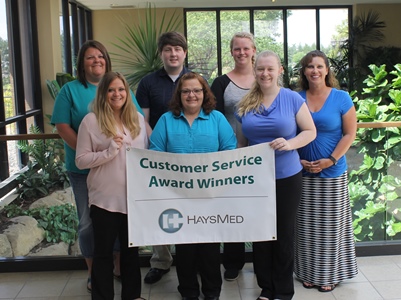
The Communication Center received the Customer Service Award for their courtesy and respect in helping HaysMed be successful.The department consists of eight associates, and they answer an average of 18,000 phone calls a month.
The Communication Center is honored for its award.
Each area honored displays a patient satisfaction award winner banner in their department.
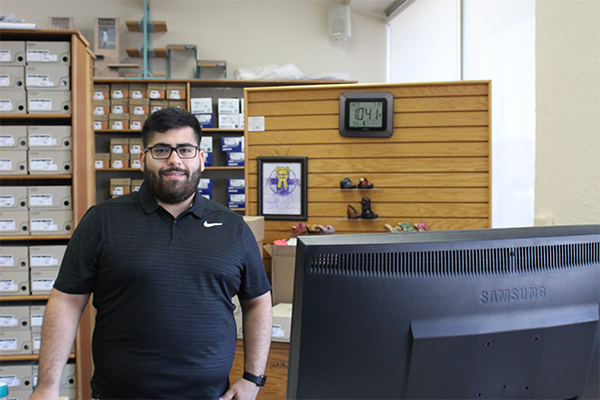
Brown’s Shoe Fit Co., 2510 Vine, is under new ownership and management as of Wednesday.
Eric Brincks, who has owned and operated the store for more than 10 years, has handed over the business to Alex Salgado of Liberal.
Brincks had the opportunity to move to a store in Ankeny, Iowa, and he jumped at the chance to move closer to family in the area.
“It is just one of those things, and ultimately, it just fell together very fast,” Brincks said.
Brincks said he has enjoyed his time in Hays and wishes Salgado the best as the store moves forward.
“I have had a lot of fun with the store,” he said. “It has transformed quit a bit. Hopefully, it will continue on the good path it is on.”
Brincks last day was Tuesday. Salgado has already been at the store for several days and is getting accustomed to the routine. There will be no interruption in operation at the store.
Salgado is in the process of moving some items around in the store and plans to offer more athletic shoes and insoles.
“Our mission is to help people have healthy, happy feet,” he said.
Salgado has moved to Hays from Liberal where he was an assistant manager at a Brown’s Shoe Fit. He brings with him his wife, Francis, and son, Mateo, 6 months.
“I am happy to be here. I am looking forward to meeting everybody, and I am thankful for the opportunity,” Salgado said.
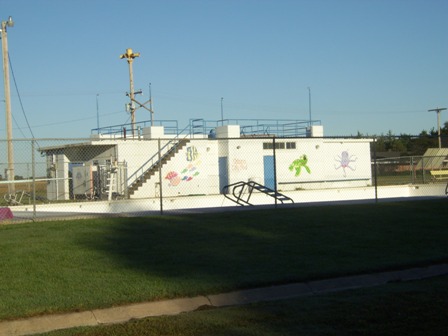
OSBORNE — A group raising money to build a new city pool in Osborne will have two fundraisers Saturday, July 22 — a kickball tournament and softball tournament.
The kickball tournament will be from 8 a.m. to 1 p.m. with check-in starting at 7:30 a.m.
Cost is $60. Games will be 30 minutes with double elimination.
Teams must have at least nine players, consisting of three members from each age group — kindergarten-4th, 5th-12th and adult. At least one team member has to be an adult.
Contact Marci Lantz at 785-346-6401 to sign up.
The co-ed softball tournament will be 2 p.m. to midnight July 22 with check-in at 1:30 p.m.
Cost is $150 per team. Games will be five innings or 45 minutes with double elimination. Team members must be 16 years old or older. Teams must have at least nine members with even numbers of men and women or at least four women.
First place wins $100 in Oz Cash.
Contact Lacey Holloway at 785-346-6603 to sign up.
For those who wish to make a monetary donation to the project, you may mail a check to the Osborne Community Foundation in care of Osborne City Hall at 128 N. First St., Osborne, KS 67473.
Note Osborne City Pool in the memo line.
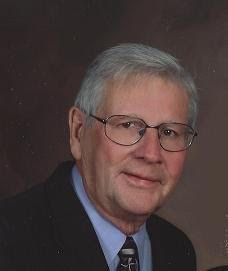
VICTORIA—John C. Younger, age 84, died Sunday, July 16, 2017, at his home in Victoria. He was born Jan. 18, 1933, in Hays, Kansas, to Jacob P. and Catherine (Mader) Younger. He married Ethel M. (Stegman) on May 1, 1965, at Holy Cross Catholic Church in Pfeifer, Kansas.
John attended grade school at Catharine, Kansas, and was a 1951 high school graduate of St. Joseph’s Military Academy. He then attended one year of junior college at St. Joseph’s Military Academy and went on to continue his education at Fort Hays State University, graduating in 1958 with a B.S. degree in Business Administration. He was a life-time Ellis County resident with the exception of the two years he served in the United States Army from 1953 to 1955.
John was the owner of Younger Gambles Store and Younger Appliance for 50 years and was known as “Victoria’s Maytag Man.” He and his wife also own J & E Storage of Victoria. John served as past president, of the St. Fidelis Parish Council, U.S.D. 432 School Board and the former Victoria Lions Club. He was an affiliate to the Capuchin Province of Mid-America, a member of The Basilica of St. Fidelis Church in Victoria, the Victoria Knights of Columbus, the Half Century Club at Fort Hays State University and the Hays American Legion.
Survivors include his wife, Ethel, of 52 years, of the home; one son, Michael Younger and wife, Sarah, rural Pfeifer; three daughters, JoAnn Seaman and husband, Tim, Arvada, Colorado; Maria Munro and husband, Jeff, Leawood, Kansas; Annette Zeigler and husband, Tracy, Natoma, Kansas; eight grandchildren, Molly and Hannah Seaman, Sophia and Jack Munro, Taitem and Alyvia Zeigler, Myah and Grace Younger; one sister, Nadine Pederson, Rogers, Minnesota; four sisters-in-law, Jeanette Younger and Det Younger, both of Victoria; Laverna Younger, Hays; and Mary Ann Adams, Salina, Kansas.
He was preceded in death by his parents; six brothers, Richard, Albert, Jack, Bernie, Francis and Tom; one infant brother; and five sisters, Lucille Miller, Rita Desch, Lietta Niernberger, Catherine Bitterman and Sister Patricia Younger.
Services are at 10 a.m. Friday, July 21, 2017, at The Basilica of St. Fidelis Victoria. Burial in St. Fidelis Cemetery, Victoria, with military honors by the Victoria V.F.W. Post No. 1751 and Fort Riley Kansas.
A vigil service is at 7 p.m. Thursday, followed by a Victoria Knights of Columbus and Victoria Daughters of Isabella Rosary both at 7:30 p.m. Thursday, at the Basilica of St. Fidelis, Victoria.
Visitation is from 5 to 9 p.m. Thursday, and 8:30 to 10 a.m. Friday, all at The Basilica of St. Fidelis Victoria.
Memorials are suggested to the Capuchin Province of Mid-America or the Basilica of St. Fidelis.
Cline’s-Keithley Mortuary, 412 Main St., Victoria, KS 67671 is in charge of arrangements. Condolences can be left by guestbook at www.keithleyfuneralchapels.com or can be sent via e-mail to [email protected].