We have a brand new updated website! Click here to check it out!

Low wages hamper DSNWK’s search for care staff

By CRISTINA JANNEY
Hays Post

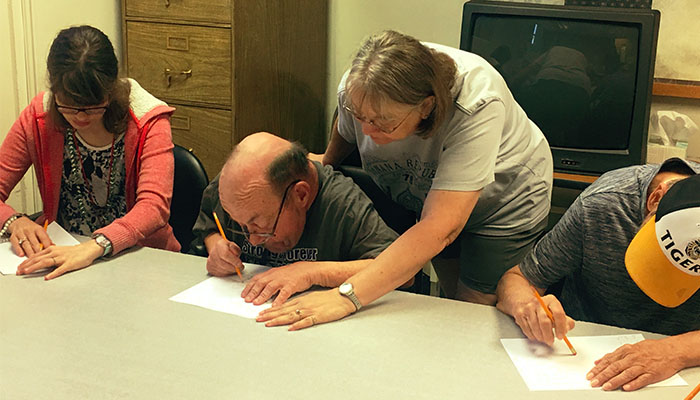
Nathan Young, lead paraprofessional at the Reed Development Center, aids a DSNWK client Wednesday,

Nathan Young works three jobs to support his family.

Even at full-time, he does not make enough at his job at Developmental Services of Northwest Kansas  to get by. He also works another 16 hours per week aiding another disabled individual as well as a semi-professional gamer.

Young, lead paraprofessional at the Reed Development Center, works with lower-functioning individuals. He helps his clients with basic care like feeding themselves, toileting and keeping themselves clean.

He said he loves his job, but he wishes he was paid more.

“The thing I like the most is not just the smiles I get everyday with everyday interactions. I am able to help someone to the fullest of my abilities. It just brightens their heart,” Young said.

Young, 31, as a direct support professional, is not alone in his struggles to make ends meet. He is one of many workers at DSNWK who work physically and mentally demanding jobs for low wages.

Jerry Michaud, DSNWK president, said because of state-set reimbursement rates, the wages DSNWK can offer direct care workers is low. This, coupled with low unemployment in northwest Kansas, means it is difficult for DSNWK to recruit and retain employees. The agency constantly has vacancies.

DSNWK has about 345 employees across its 18-county coverage area. As of the end of June, DSNWK had 27 open positions — mostly direct support professionals.

The overall unemployment rate for DSNWK’s coverage area is 2.84 percent, which is very low.

“It means there are not a lot of individuals out there in the workforce, so that is one challenge right off the bat,” Michaud said. “It is a challenge in all our communities, so I think that is something all employers are up against.”

A direct support professional helps a DSNWK client. Direct support professionals are paid only $9 an hour.

How much DSNWK is reimbursed for caring for disabled individuals is complicated. The state assigns disabled individuals to a tier system based on their needs, and then the state reimburses DSNWK based on that tier system. DSNWK serves people on all tiers.

The bottom reimbursement rate is $7.68 per hour. Minimum wage is $7.25. DSNWK recently raised its direct support professional starting pay to $9 an hour.

Michaud acknowledges $9 is not a high wage, but DSNWK still has to make up the difference between $9 an hour and the state reimbursement.

“I will tell you that the rates that are paid don’t cover the cost,” Michaud said. “That is in part of why we approach our counties to help us to fill the gap.

“What we ought to be paying is something different,” he added. “That is part of the equation we haven’t even broached. What is a prevailing wage in this community versus the next community? That is where it become more complicated to try to figure out what that is.”

Turnover is directly tied to wage, Michaud said.

Turn over is high among direct care professionals because of the difficult work and low wages.

“How do you live on a $9 a hour wage?” he said. “Can you find housing? Can you pay for your housing on $9 an hour alone? I am saying these things knowing it is a hard reality.”

The answer, in Young’s case, is you don’t.

Not only is Young working extra jobs, he has also had to reach out for state assistance.

DSNWK offers health insurance benefits to its employees. Young is able to purchase health insurance for himself through DSNWK, but he can’t afford the family plan that would cover his children. They are covered by state insurance.

Young said turnover can be a problem. He sees fellow employees come and go. It is a tough job for not much pay. He said the people who stay are like him — committed to the people who they serve.

“I would like more pay,” he said. “It would definitely financially aid me, but it is not about the money there. I love seeing my friends every day. I know I work for them. They are so much fun to hang out with and help them grow.”

Turnover definitely has an effect on the quality of care that the people DSNWK serve receive.

DSNWK celebrates its 50th anniversary. File photo

“Let us assume for a moment that I am the person who receives services, let’s just say I require personal services — using the restroom, toileting, showering, and those kind of things,” Michaud said. “If you have new people coming and going all of the time, helping you in some of those most personal times, that would be hard. I can’t sugarcoat that.

“It really solidifies making a change or making a difference so we can slow that revolving door and have greater stability. That is why we are doing what we are doing.”

Not only does turnover have ramifications on care, constantly training new employees is costly and time-consuming.

“When you go through that process and a person stays for a month or a few months, that is not necessarily a good thing,” Michaud said.

DSNWK employs university students in Hays. Although those students might not leave due to wage, they usually eventually leave due to graduation.

DSNWK has a capital campaign to address in part some of its employment challenges. However, long-term, Michaud said the reimbursement rates for care need to increase in order to deal with the direct support professional pay issue.

Michaud said increases in reimbursement rates have not kept up with inflation and neither have wages. From 2008 until a couple of years ago, state reimbursement rates remained flat.

“As a state, we’ve got to find a way to have a realistic funding structure that is practical as far as the ability to hire, recruit and retain a workforce that can provide these vital services. I think the state understands this,” Michaud said.

The state has had to increase wages on the institutional side at facilities, including Larned State Hospital and Osawatomie.

On a related issue, the state has tried to reduce the number of disabled individuals waiting for Medicaid-funded services. There are 107 people on that list in DSNWK’s coverage area and more than 4,000 people on the list statewide.

The Legislature this spring allocated more funding to decrease two of the Medicaid waiting lists. One-hundred seven people were removed from the wait list statewide with that funding. Only one of those people was from northwest Kansas.

Although the state needs to reduce the waiting list, it also needs to address the wage issue., Michaud said. If more people come into the system without increasing wages, DSNWK and other agencies like it in the state will have capacity problems, he said.

DSNWK is taking steps internally to fill its need for employees. This includes recruiting employees human resources believe will feel fulfilled working with people and tapping untraditional markets, such as retirees.

The agency is also engaged in a capital campaign it hopes will partially address the wage gap, Michaud said.

But for every step forward, there seems to be a step back. Due to a budget shortfall in Ellis County, the county cut $25,000 in funding for the DSNWK and another $10,000 in funding from ACCESS, general transportation, which DSNWK manages.

The ACCESS cuts also mean a loss in KDOT matching funds. The total loss to the agency will be $57,000 for the coming budget year.

Michaud said the DSNWK has limited means to address those funding cuts, and it definitely does not help its struggle to increase wages.

For those interested in employment with DSNWK, you can visit its website. If you are interested in donating to DSNWK click here.
🎥 Sternberg staffer replicates ‘Star Wars’ creatures in name of science

Sternberg outreach coordinator Ian Trevethan discusses the fictional creatures of the “Star Wars” saga and how they relate to real animals. Photos courtesy of Sternberg Museum

Sternberg Museum of Natural History

Since its premiere in 1977, “Star Wars” has become a staple in many cultures.

Vulptex (crystal fox)

It has connected people all over the world, making it one of the most successful franchises. Not only has it impacted our culture, but our science as well.

The connection between science fiction and actual science has not only helped people have a better understanding of science, but has given them an appreciation for it.

Sternberg outreach coordinator Ian Trevethan has found this connection to be a useful teaching tool to get people excited about science. This summer, Trevethan has been working on a project to show people the connections between “Star Wars” animals and real animals.

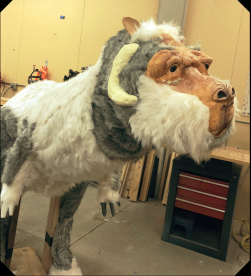
The project has led Trevethan to get creative. To help show off the marvelous animals of the “Star Wars” Universe, he has created a Vulptex (crystal fox), seen from “Episode VIII: The Last Jedi,” and a Taun-Taun, seen in “Episode V: The Empire Strikes Back.” The fox in the story lives on a mineralized planet.

“The minerals on this planet, the salt, basically crystalize on this animal’s fur, and you have a crystal critter,” Trevethan told Mike Koerner in a Discover Under the Dome video interview.

It took Trevethan six months of work using thousands of crystals to hand make the creature.

In June Sternberg Outreach coordinator Ian  Trevethan took his creations to Smallville Con 2019 and participated in a Zoology of Star Wars panel.

In June, Trevethan took his creations to Smallville Con 2019 in Hutchinson and participated in a Zoology of Star Wars panel.

His future plans for these fictional critters is to use them for his outreach programs this summer, teaching the public how to look for the correlations between them and the real animals that inspired them.

He wants people to start thinking critically, asking questions like, “How is the environment affecting the animal?” “Why did the fox get crystals on its fur?” “What helps the Taun-Taun move so quickly over the snow?”

Taun-Taun

By exercising this critical thinking skill, people can start to understand how to apply it to real animals and the environment we live in today. To see if Trevethan will be in a town near you, follow Sternberg social media or contact your local library to see if they will be hosting Ian Trevethan this summer.

Reptile personalities shine at Sternberg’s ‘Meet the Animals’

Alicia Gaede, naturalist, holdsKawaai, a Savannah water monitor, as a child looks on at the Meet the Animals event Friday at the Sternberg Museum.

By CRISTINA JANNEY
Hays Post

The Sternberg Museum’s Discovery Room was abuzz on Friday with children ooh-ing and aww-ing.

Some cautiously approached Alicia Gaede, naturalist, and stroked African Savannah water monitor Kwaai’s head. Once Alicia or one of the children stroked just the right spot at his ears, Kwaai closed his eyes and flicked his tongue in apparent pleasure.

His name, Kwaai, means fierce, but he is very gentle for his carnivorous species. He eats insects and mice and even once popcorn chicken. He regularly dons a harness and accompanies Gaede on walks around the museum. He has also become a popular museum ambassador, participating in birthday parties and other public events.

“When people meet him, they can’t believe he acts so much like a dog,” she said. “He is our scaly puppy, and we have one downstairs that is our scaly cat. The one downstairs wants to be carried everywhere. If you make him angry, he will poop on you.”

Kwaai was someone’s pet. The owner could no longer take care of him, so Kwaai came to live at the Sternberg two years ago.

“He was here for a while, and we were just trying to make him healthy again,” Gaede said. “When I got this job here, I decided to make him able to be handled. It was really a fast turnaround, maybe two weeks when he was looking for people to be touched.

“He was interested to go for walks. He likes to take baths and curl up in a towel. He will sleep with you for hours curled up in a towel. It is like I am walking around with this really weird baby.”

Kwaai was accompanied Friday by Toothless, one of the museum’s chuckwallas.

Chuckwallas are native to the Arizona desert. Much smaller than the Savanah water monitor, Toothless easily fit in handler and volunteer Malachi Chance’s hand. Chance, 11, has been volunteering at the museum for seven years.

Chance ran into a little problem when Toothless climbed up his shoulder and into his hair, but Chance was able to extract him with hurting himself or the chuckwalla.

While humans secrete salt when they sweat, chuckwallas spit it out of their noses. Toothless’ roommate is Hiccup. Gaede said Hiccup is a little larger and may be a female. The chuckwallas will soon be getting three new roommates — Sonoran desert toads that recently came to the museum after being illegally trafficked.

The toads’ natural habitat is also the Arizona desert.

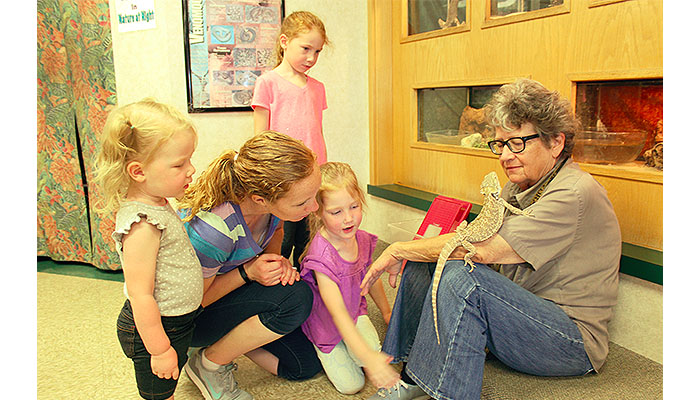
Thea Haugen, retired Sternberg naturalist, was showing off bearded dragon, Yoshi.

The dragon belongs to one of the museum staff members and is a frequent guest at museum programs.

Bearded dragons eat both vegetables and insects like crickets.

Thea Haugen, retired Sternberg naturalist, shows off bearded dragon Yoshi on Friday at the museum.

The reptiles’ visit was a part of the Meet the Animals program at the Sternberg. The program started in June is supposed to run through the end of July from 11 a.m. to noon each Friday. However, Gaede said the program has been so popular she might extend it into August, at least until school starts.

“A lot of kids are afraid of reptiles or amphibians,” she said. “It is different than seeing them behind glass. They are not moving a lot, and a lot of people think our animals are fake. So being able to meet them like this shows them that they are not quite as scary. … People are taught to be afraid of these things.

“I love that we can not only teach them about species, but about our animals individually, because reptiles, personally I believe, they can have personalities.”

People see a snake and they automatically think it is venomous, Gaede said. However, only a small portion of the snakes in Kansas are venomous.

The program is free with admission. New animals will be featured each Friday.

Keep up with what’s happening at the museum on the  Sternberg’s Facebook page  or visit its website at https://sternberg.fhsu.edu/.

Lee Ross Salmans

Salmans

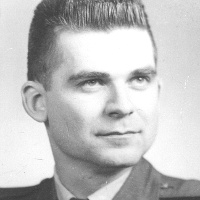
HANSTON – Lee Ross Salmans, 83, passed away July 14, 2019 at Hodgeman County Health Center, Jetmore, Kan.

He was born Jan. 7, 1936 in Larned, Kan., the son of Otha Truman and Sylvia May Clifton Salmans.

He graduated from Baylor University and was commissioned into the United States Air Force as a second lieutenant. His duties while in the Air Force included test pilot and physicist.

In 1963, he married Francie Stinnett and together they had four children, before her passing in 1982. Lee was blessed to be happily married to Karen Rufenacht for over 34 years.

After his retirement, Lee returned to Hanston where he served at Faith Fellowship Church and faithfully served his community.  Additionally, Lee worked with his brothers, Larry and Walt, on their family farm.

Other survivors include: children, Nancy Salmans, Eielson Air Force Base, Alaska, Gary (Kim) Salmans, San Antonio, Texas, Brian (Kristin) Salmans, Lawrence, Kan., Jill (Bob) Miller, Waco, Texas; two brothers, Larry (Marilyn) and Walt (Gwen) Salmans, both of Hanston, Kan.; two sisters, Sylvia Ann (BJ) Barron, Ft. Myers, Fla.,  Jana Jordan, Hays, Kan., eight grandchildren, and numerous nieces and nephews.

He was preceded in death by his parents and a sister, Elaine Keeten.

Lee’s greatest legacy that he passed on to his children and grandchildren was not material things, but rather a legacy of character and faith. Lee was an extraordinary man who modeled exemplary integrity, and he will be greatly missed.

Funeral service will be at 10 a.m. Thursday at Faith Fellowship Church, Hanston, with Pastor Doug Ellison presiding. Visitation will be from 9 a.m. to 8 p.m. Wednesday at Beckwith Funeral Home, Jetmore. Burial will be in the Hanston Cemetery, Hanston with military graveside rites.

Memorials may be sent to Faith Fellowship Church in care of Beckwith Funeral Home, Box 663 Jetmore, KS 67854.

Dwaine George Grubb

Grubb

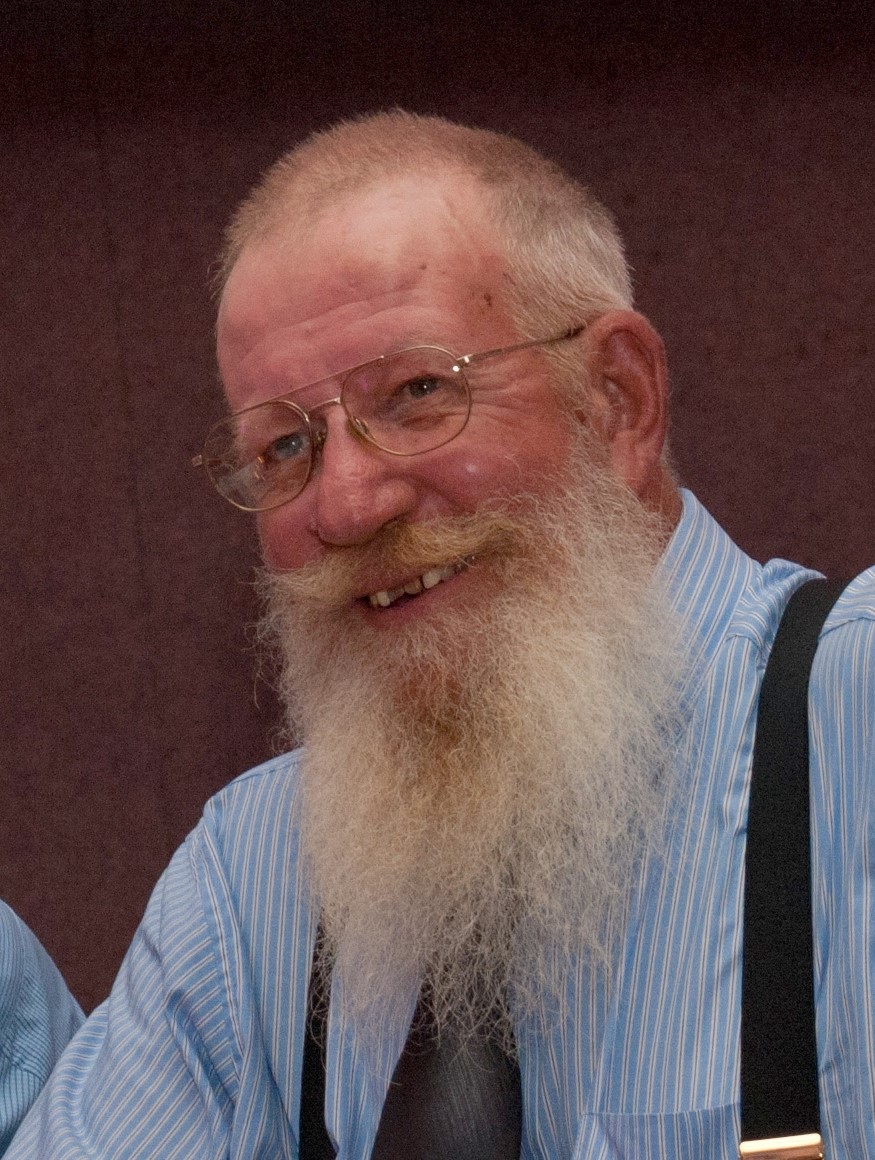
Dwaine George Grubb, 72, of Holyrood, Kansas, died on Thursday, July 4, 2019, at the Ellsworth County Medical Center in Ellsworth, Kan.

Dwaine was born on April 26, 1947, in Wilson, Kan., the son of Arthur and Edna (Malir) Grubb. He grew up in the Wilson, Holyrood and Ellsworth, Kan., areas and graduated from Wilson High School.

After high school, he served his country by joining the U.S. Army. He met, fell in love and was united in marriage to Janice Oshel on June 5, 1971, in Holyrood, Kan. From this union Dwaine and Janice were blessed with three children Mitch, Ted and Lesah. He was a member of the American Legion and he attended the First Baptist Church in Wilson, Kansas. He enjoyed hunting, fishing, spending time outdoors, working with his hands and riding his motorcycle. Most of all he enjoyed spending time with his family.

Surviving family include his sons Mitch Grubb (Jacqueline) of Hoisington, Kan., and Ted Grubb (Tara) of St. George, Kan.; daughter Lesah Beagley (Terry) of Russell, Kan.; brother Harry Grubb (Kay) of Atlanta, Ga. and nine grandchildren. He was preceded in death by his parents and wife Janice in 2007.

A memorial service to celebrate Dwaine’s life will be at 10:30 a.m. Monday, July 22, 2019, at the First Baptist Church in Wilson, Kan. Cremation was selected by the family and a private family burial will take place at a later time. Memorials may be given to the Dwaine Grubb Memorial Fund and sent in care of the mortuary. Pohlman-Varner-Peeler Mortuary of Russell, Kan., is in charge of the funeral service arrangements.

Hays Summer Lunch, children’s library programs see increases

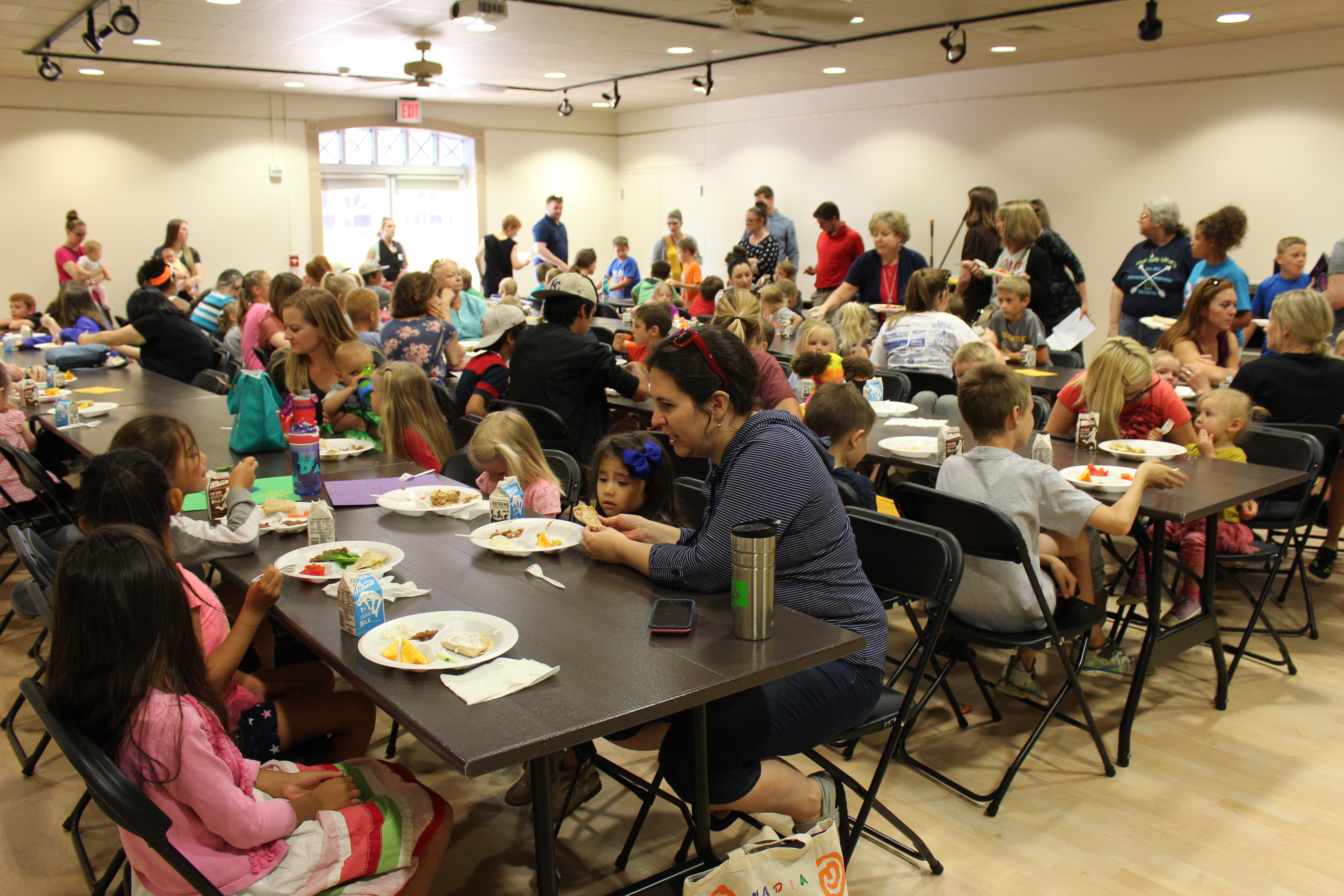
The Schmidt Gallery at the Hays Public Library fills with children and adults attending the Summer Lunch Program earlier this summer.

By CRISTINA JANNEY
Hays Post

The USD 489 Summer Lunch Program has seen more than a 50 percent increase in the number of children it is serving this summer, and the director is attributing the jump to the new location at the Hays Public Library.

The program was moved to the library temporarily this summer because the Early Childhood Connections program, where the lunch program was formerly, is being moved to its newly renovated space on 13th Street.

Both Jessica Younker, USD 489 nutrition director, and Meagan Zampieri, children’s librarian, credited increases in attendance for both programs at least in part to the partnership between the lunch program and the library.

“It’s the same food and the same service. The only thing we have really changed is the location and the activities that are surrounding it,” Younker said.

In June last year, the summer lunch program averaged 128 children per day. In June this year, the program averaged 193 students per day. On its busiest day this summer, the program served 289 children.

Children 18 and younger can eat hot, healthy meals for free Mondays through Fridays at the Hays Public Library.

Any child 18 or younger eats free through the program. Adults pay a small fee to eat with children. The program has also fed more adults this summer — 350 meals last June and 434 this June.

USD 489 initiated an afternoon snack program in 2018. That program has seen a slight increase. Last year, the program served an average of 61 children per day, and this year it is serving an average of 68 children per day. Those snacks are also free for children.

Zampieri reported 1,000 more participants in programs at the library in the children’s department in June.

The library has added programming to coincide with the summer lunch program. It has offered a Astronaut Training Academy at 11 a.m. Lunch is served beginning at 11:30 a.m.

Children’s library programs at other times are also up, which Zampieri attributes in part to the hiring of a new early literacy coordinator, Sara Schoenthaler. Storytime is up a total headcount of about 200 children compared to last year, Zampieri said.

“I think the lunch absolutely helps,” Zampieri said. “I think the things we are bookending it with are big.”

The library had 46 children in for its alien parfait program this week.

“It’s hot. They are here already. If we can sneak in a little education in there, that is really exciting for us,” Zampieri said.

She said she also thought the library, which also has a new communications coordinator, Callie Kolacny, is also doing a better job of getting the word out about its programs.

“People who visit the library frequently post about the library and post about what we are doing, so they know they can come here and get work done and take care of their kids and give their kids some fun things to do,” Zampieri said.

The increases have caused some issues for both programs.

On a couple of days, the lunch program ran out of the hot meal entree. However, it always has peanut butter and jelly sandwiches in reserves, so no one ever goes away hungry.

Although the children’s department on the second flour of the library has the space to accommodate the increase in the number of visitors, the space could be used better, Zampieri said.

At certain times, the department could use more chairs and tables for children to play games. She said reconfiguring the spaces is something library officials are going to consider in its strategic planning.

Younker said the summer lunch program usually sees a significant decrease in participants in the month of July; however, she said participation has remained strong so far this month.

Although the partnership between library and the lunch program was initially supposed to only be temporary, both Younker and Zampieri said they would recommend the program remain at the library.

“In my mind, this partnership will continue for years to come,” Younker said.

If your child wants to eat

Hot meals will be served in the Schmidt Gallery from 11:30 a.m. to 1 p.m. Mondays through Fridays through Aug. 2. Adults can eat with children for $3.75 per meal. Children do not have to live in or attend USD 489 schools to participate. Click here for the July lunch menu.

Healthy snacks will be available free for children from 3:30 to 4:30 p.m. Mondays though Fridays in the children’s department on the second floor of the library. Click here for the July snack menu.

Library programs

To learn more about the HPL programs, visit the library website or call the children’s department at 785-625-9014.

Simon Peter Korbe Jr.

Simon Peter Korbe Jr.

Simon Peter Korbe Jr., age 87, passed away on Sunday, July 14, 2019 at Wichita County Health Center in Leoti, Kansas.  Simon was born August 2, 1931 in Wallace, Kansas, the son of Simon Peter and Katie (Dechant) Korbe Sr.

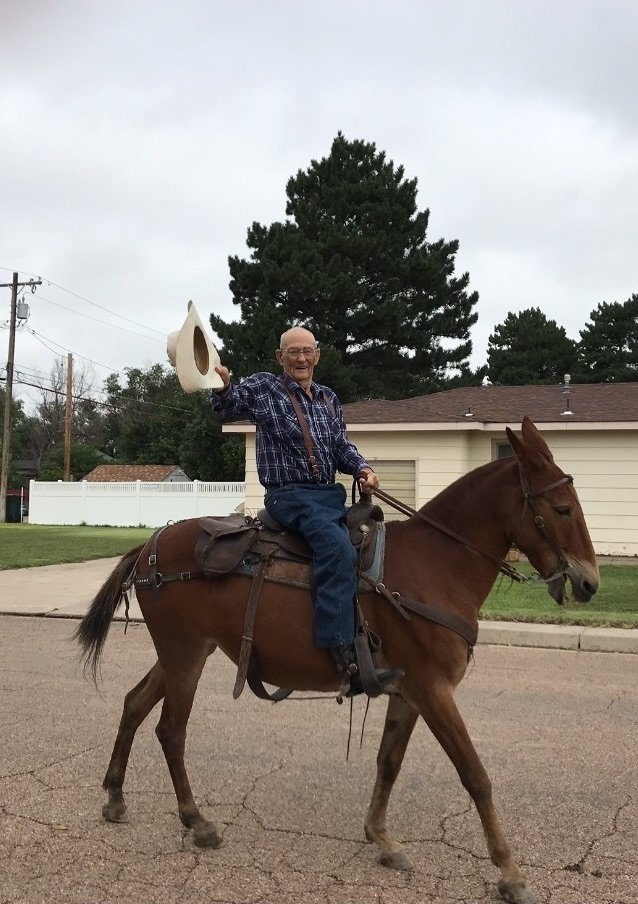
A lifetime resident of Wichita County, Kansas, he was a farmer, welder and worked in construction.  Simon served as Wichita County Deputy Sherriff in the 50’s and 60’s and always enjoyed riding his mule, Dolly.

Simon attended the Abundant Life Fellowship Church in Leoti, Kansas

On October 19, 1950, he married Ruby Evalee Turner at Las Animas, Colorado. Ruby passed away on June 18, 1999 in Leoti, Kansas.

Simon’s surviving family includes-

Two grandsons-Trenton Guerra- Leoti, Kansas, Jason Guerra- Leoti, Kansas

Two great grandchildren-Tason Guerra- Leoti, Kansas, Tatum Guerra- Leoti, Kansas

Numerous nieces and nephews

His parents, a daughter, Kathy Guerra and several siblings precede him in death.

Funeral services will be at a later date and will be announced by Price & Sons Funeral Homes.

Burial will be in Leoti Cemetery in Leoti, Kansas.

Memorials may be given to the Abundant Life Fellowship Church in care of : Price & Sons Funeral Home, PO Box 161, Leoti, Kansas 67861.

Kenneth L. Grizzell     

Born March 27, 1937, to Georgia Mullinex and Robert Grizzell in Great Bend, Kansas.

He passed away July 14, 2019 in Lawrence, Kansas.

Grizzell

Ken graduated from Claflin High School in 1955. He married his high school sweetheart, Suzanne Miller on March 30, 1959. He attended Fort Hays State University and Wichita State University with a bachelor’s degree in Secondary Education and a master’s degree of Fine Arts. He was an art professor at the University of Nebraska at Lincoln and the University of South Dakota in Vermillion, S.D.

After retiring in 1999, Ken and Sue moved to Lawrence. He loved watching his grandchildren grow up. He watched many basketball and soccer games, dance and music recitals. He saw high school and college graduations. Other loves in his life besides his family were working in his art studio creating silk screen prints. He also loved Nebraska football.

Survivors include; wife, Suzanne of Lawrence; brother, George Grizzell of Logan, Utah; daughter Lisa Davis and son-in-law Chris Davis; grandkids, Bobby, Carly, and DJ Davis all from the Lawrence area.

Friends may sign the book 9 a.m. to 8 p.m. Friday, with family to receive friends from 6 to 8 p.m. Friday, at the funeral home. Funeral service will be at 10:30 a.m. Saturday, July 20, 2019, at Nicholson-Ricke Funeral Home, Hoisington. Burial will follow at Pleasant View Cemetery in Claflin.

Memorials may be made to the Wounded Warrior Project in care of Nicholson-Ricke Funeral Home, PO Box 146, Hoisington, KS 67544.

Illegally trafficked toads find new home at Sternberg

Sternberg Museum of Natural History

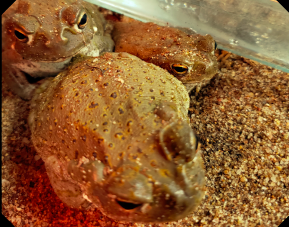
The Sternberg recently received three young Sonoran Desert Toads that were being illegally kept and sold.

Once staff members at the museum heard about the unfortunate event, they were happy to take them and add them to museum’s animal family.

None of them have names yet, but they are quickly making their way into the hearts of the Sternberg staff. Especially with Sternberg volunteers who have had the opportunity to spend lots of time with them, helping them adjust to being handled.

If you have ideas for names for the toads, there is a suggestion box at the museum admissions desk.

They love to eat crickets and to splash around in their water bowl. They have already grown in the few weeks the museum has had them. Alicia Gaede, Sternberg naturalist, said the toads will likely get much larger than they are now, and eventually will eat mice.

“I am happy we have them, but I hate the circumstances of how we got them,” she said.

The museum previously had a Sonoran Desert Toad, named Jabba, but it died of natural causes.

The toads are not on display yet, but once they get a little bigger and learn to eat from their caretakers’ hands, they will be moved to the bigger cage with the chuckwallas, where the public can see them. Staff hopes to have the toads on the display by the end of the summer.

As the name suggests, these toads are found in the Sonoran Desert in Arizona and are the largest toads native to the United States. Sonoran Desert toads have extremely potent, defensive toxins that are released from glands in the skin.

Gaede said once the toads have been handled as pets, they are unlikely to cause harm to humans.

These toads depend on water more than most desert species typically do. During dry periods they will burrow and come out when it rains.

For more picture, and videos of these cuties, check out the Sternberg Facebook page every Monday in July. Click here to see a video of the toads.

Hays Post reporter Cristina Janney contributed to this story.

South Korean KAMS students conduct experiments related to solar energy

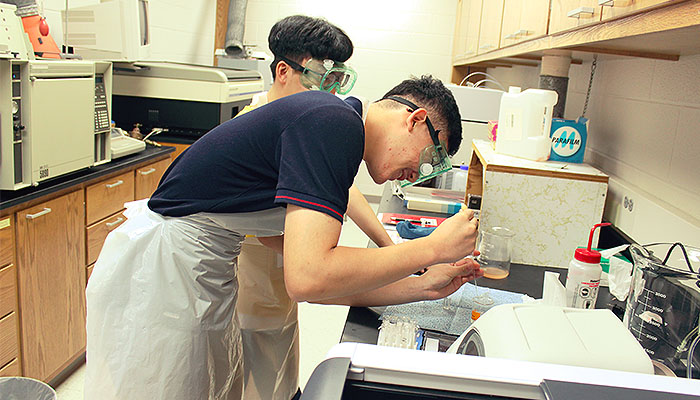
Two Korean students conduct science experiments with FHSU’s Dr. Arvin Cruz on  Thursday on the Hays campus.

By CRISTINA JANNEY
Hays Post

Eight students from South Korea peered into brightly colored test tubes and furiously scribbled observations during a week-long camp at Fort Hays State University.

The students are replicating experiments from research conducted by Dr. Arvin Cruz, FHSU chemistry teacher, on substances that might be used as conductors in solar panels.

The students taking part in this Kansas Academy of Mathematics and Sciences camp are 16 to 17 years old and from the Daejeon High School for the Gifted in Daejeon, South Korea.

“They are very passionate,” Cruz said during a KAYS Morning Show interview. “We started [Wednesday], and they are very dedicated and almost all of them indicated they wanted to go into some area of science as a profession.”

Cruz said this can be a recruiting tool for FHSU, but more importantly it is a way to interest more students in going into the sciences as a profession.

A KAMS volunteer assists a Korean student look for substances that could be used in solar panels during an experiment on the FHSU campus Thursday.

“A lot of this is science awareness,” Cruz said. “The future of science lies in these young kids. That is why we devote a lot of our time engaging them and having global partnerships, mainly for recruitment in STEM (Science Technology Engineering and Mathematics).”

Cruz said one student who studied with the program several years ago has now been admitted to a university in South Korea to study quantum knots, which is the subject on which the students in the KAMS program are conducting their experiments this summer.

The students in the exchange participate in a selection process, and only the best of the best are selected to come to the U.S. Cruz said he thinks that has made the program even more successful.

Students from Daejeon High School for the Gifted in Daejeon, South Korea, conduct chemistry experiments at FHSU Thursday.

Soyoung Lee, South Korean chemistry teacher and one of the students’ sponsors, said the work is allowing the students to understand chemistry’s broader effects on mankind.

She said, with fellow sponsor and English teacher Myoung Hee Choi translating, the students may continue their studies in another field, but they are learning the research process through their experiments with Dr. Cruz.

Lee said the students are not working toward a grade — they are not competing — so they can try new things and experience science just for the sake of learning.

In addition to learning aspects of chemistry and research, the students are also being immersed in the English language.

“Instead of just learning from texts, they are able to express themselves in English. They can communicate,” Choi said. “It has been a challenge even for me.”

This exchange began three years ago with chemistry students from the U.S. also traveling to South Korea. Although no U.S. students were able to go abroad this year, the South Korean students have continued to take advantage of FHSU’s hospitality.

In the evenings the students have been experiencing the Hays community, including a night out bowling. They also will tour FHSU’s Sternberg Museum and Exploration Place in Wichita.

Since all three years of the exchange have focussed on alternative sources of energy, the students last year toured Greensburg and were able to see how that community has made the transition to green energy.

“They were so excited about how it re-established itself,” Cruz said.

Both South Korean teachers said they wished to thank FHSU and everyone involved with the students for making the camp possible. The students will be headed home on July 16.

Comeau discusses fall of Dessin Fournir

By CANDACE RACHEL
Plainville Times Editor

PLAINVILLE — Following the June 27 auction of the Plainville Livestock Commission real estate and effects, another Plainville business is scheduled to go under the auction block Aug. 1.

The other shoe has dropped for Chuck Comeau and Dessin Fournir Cos. The once madly successful DFC Holdings, which includes several businesses in Plainville and Hays, despite filing for restructuring bankruptcy, is to be sold by sheriff’s auction.

RELATED: Dessin Fournir properties set for sheriff’s sale; bankruptcy case dismissed

Comeau commented that several things added up to the demise of the company, that virtually blindsided the company’s plan.

“Prior to 2008, there was nothing we could do wrong,” Comeau said. “It was all we could do to stay in front of it.”

The recession of 2008 started knocking the dominoes down, and according to Comeau, things went from bad to worse.
“Most businesses were developed to grow,” he said. “The hardest thing to do is to downsize. After 2008, in a nine-month period, we lost 40 percent of our business, and it’s been a fight ever since the recession happened. We had an infrastructure here and around the country to support growth, not to get smaller.”

He added leased show rooms in major cities across the country couldn’t be put on hold.

Comeau had to begin scaling down staff in 2016, and again in 2017.

“We tried to continue to grow, but the beginning of 2015 and into 2016, there was a huge change I did not expect. Into 2017, I lost all of my partners in one year.”

In 2017-2018, partner Chris Mraz suffered a disabling stroke; Comeau’s second partner, Len Larson developed severe dementia, and a financial partner died in August.

“It was all over. It was like all the pieces were thrown up in the air, and I had to catch them,” he said.

Not one to look for sympathy, Comeau said it all was on him, not anyone else’s problem, but he began to wonder what else could go wrong.

“All you’re doing [then] is to try to figure out how to stay afloat, and  you need to stop and reorganize,” he said. “We had to furlough everybody in April — and we thought it would be a short one, but it wasn’t.”

Comeau said steps to stop expenses were taken, and showrooms in New York,  Chicago, Los Angeles and San Francisco were closed.

Had the restructuring been given, Comeau and  his staff decided on different ways of selling the company’s products. His customers — high-end designers — now do the bulk of their shopping online.

“It’s hard to go from feeling positive to feeling negative,” Comeau said, “and losing key people.”

Comeau’s health has also been challenged. He believes stress has a part of those issues.

“But you just try to get out of a situation and give yourself time to heal,” he said. “There are a lot of things to be thankful for. I  have a brand new grandson, and now I have a daughter-in-law, so I have four kids, I have a great wife, and live in a great community.”

He said the biggest stumbling block to selling the company is that buyers want to take the business somewhere else.

Comeau and his doctors are keeping track of the non-Hodgkin’s lymphoma since 2016, and none other than his local hospital is where he prefers to be, any time he needs care.

He became ill when he was in New York, and those around him wanted to take him to a hospital there. Comeau commanded them to get him on a plane, so he could check himself  into Rooks County Health Center.

With the future up in the air, Comeau said, “for the last 20 years this town has been the backbone of this company.”

Now that future will be determined in the front lobby of the Ellis County Courthouse.

Copyright Eagle Radio | FCC Public Files | EEO Public File