The Hays City Commission will hear legislative reports form Rep. Barb Wasinger and Sen. Rick Billinger on the 2019 Kansas legislative session at 6:30 p.m. Thursday at Hays City Hall.
The commission is also set to discuss changes to its purchasing policy.
Revisions include adjustment of purchasing limits, removal of references to a purchasing agent, addition of contractual provision language, the addition of a service calls section, and codification of the current process to purchase vehicles and large pieces of equipment from government contracts.
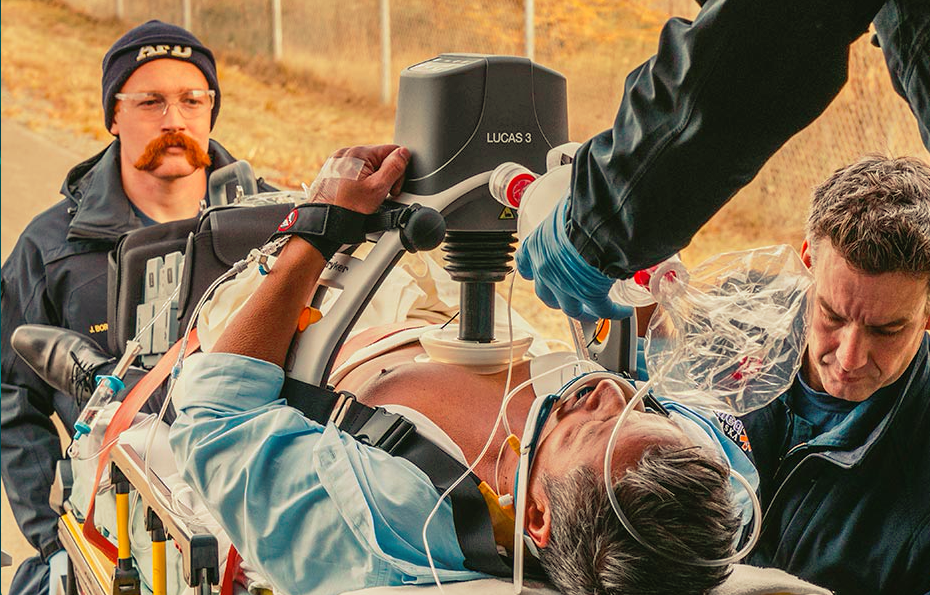
The Ellis County Commission approved the purchase of four mechanical CPR units for its front-line ambulances during its meeting Monday.
The county received a Kansas Board of EMS KARF grant to pay for half of three of the units. The commissioners opted to pay for the fourth unit on its own. The total cost to the county will be $35,472.
Health Services Director Kerry McCue said the mechanical units are superior to CPR given by a person. The use of mechanical CPR units also frees up EMS staff to monitor patient medication and heart monitors.
It also increases safety of EMS staff, because staff can seat-belted into the ambulance.
Commissioner Dustin Roths said he favored purchasing three units using the grant match and waiting to purchase the fourth unit.
However, Commissioner Butch Schlyer, a former nurse, said he favored purchasing the fourth unit now.
“CPR, it can wear you out really fast. To sustain it for more than a few minutes is really tough,” he said, adding he thought the purchase of these devices was a life-saving issue.
Ultimately, all three commissioners voted in favor of purchasing all four units.
In other business, the commission:
Approved a conditional-use permit for Nex-Tech to put up an 85-foot telephone pole for a cellular site at at 323 Pfeifer Ave. in rural Ellis County.
Reappointed David McDaniel to the Joint Planning Commission. Another position is open on the commission. Contact the county or a county commissioner if you have interest in being on the commission.
Approved Osborne County joining the Regional Household Hazardous Waste Program
Accepted a bid of $414,096 for 70,400 square yards, or about 5 miles, of cold in-place recycling of asphalt road surface.
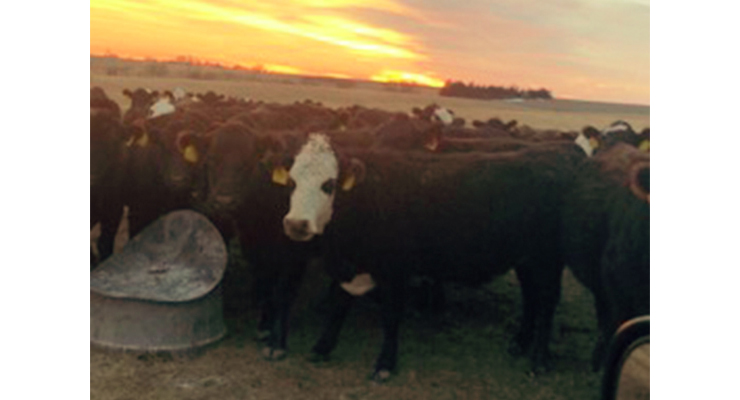
PLAINVILLE — Dozens of area ranchers are still waiting on their money after checks worth tens of thousands of dollars per producer bounced in a check-kiting scheme involving the Plainville Livestock Commission.
As the case has unraveled, ranchers have expressed shock and disappointment in the Tyler Gillum and his wife who owned the Livestock Commission, betrayal by the federal regulators who were supposed to protect the ranchers, and frustration at the legal proceeding that seem to be dragging on.
Rex Mulder of Mulder Farms in Logan said his family business has borrowed money to keep going as a result of not being paid for cattle they sold at the Plainville Livestock Commission.
He said the case has caused stress for his family and the entire ranching community.
Wes Cook, Plainville rancher, said he is hanging on for now without taking on more debt, but it has been difficult.
“I don’t know if I will ever see all of it,” Cook said of the money he is owed.
Checks from the Plainville Livestock Commission for two sales — one at the end of January and the other on Feb. 5 — bounced.
Money that was supposed to be set aside to pay cattle sellers was transferred from a custodial account to the Plainville Livestock Auction’s operating account. The Almena Bank froze both accounts, which resulted in bounced checks.
Almena Bank filed an interpleader case, which is legal action that seeks to determine to whom the money that was transferred out of the custodial account belongs.
Almena Bank has paid $916,652.29 into the Court Registry in the interpleader case, according to court records. That money is being held until the ranchers’ case is settled.
Plainville Livestock Commission declared bankruptcy on March 1. The interpleader case has been transferred from Norton District Court to federal bankruptcy court. The ranchers’ case is pending separately from the main bankruptcy proceedings and is still working its way through the court system.
“I was shocked and disappointed. They seemed trustworthy,” Mulder said of the Gillums when he had found out they had been indicted on federal charges.
The Gillums are charged with 31 counts of bank fraud, one count of making a false statement to the Small Business Administration in an application for a $1.5 million loan, and one count of making a false statement to Almena State Bank in an application for a $500,000 line of credit.
The indictment alleges investigators examined unfunded checks and wire transfers totaling more $2 billion sent by Tyler Gillum as part of the scheme.
The indictment alleges the Gillums defrauded Almena State Bank in Almena; Landmark Bank in Manhattan; Colorado East Bank and Trust in Lamar, Colorado; Astra Bank in Scandia; TBK Bank in Dallas; Guaranty State Bank in Beloit; and The Bank in Oberlin.
“I think something should be done,” Cook said of the Gillums. “They should lock him up or something.”
Mulder expressed frustration with the USDA, which regulates market agents like the Gillums under the Packers and Stockyards Act.
“The USDA failed us,” he said. “They should have shut them down. It should not have gotten to this point.”
The Plainville Livestock Commission had been cited before for not having sufficient funds in its custodial account, which by law is to hold money owed to cattle sellers.
Multiple filings have happened since the case was transferred to the bankruptcy court. Fifty-six parties to the case are listed on court records.
Parties in the case had until Friday, June 7, to object to any monetary claims filed in the case. Almena Bank did file objections on multiple claims and those people and entities have until June 21 to file responses to the objections.
James Overcash, the trustee for the bankruptcy estate, has filed a claim as a part of the interpleader case. That filings says that Overcash believes part of the money that is now being held by the court in interpleader case should be part of the bankruptcy estate.
However, other filings claim all of the money that was frozen by Almena State Bank should be used to pay unpaid cattle sellers.
The court hearing to discuss this and the other responses to disputed claims to the money that was frozen by Aleman Bank is set for 10:30 a.m. July 11.
Plainville Livestock CommissionBy CRISTINA JANNEY Hays Post
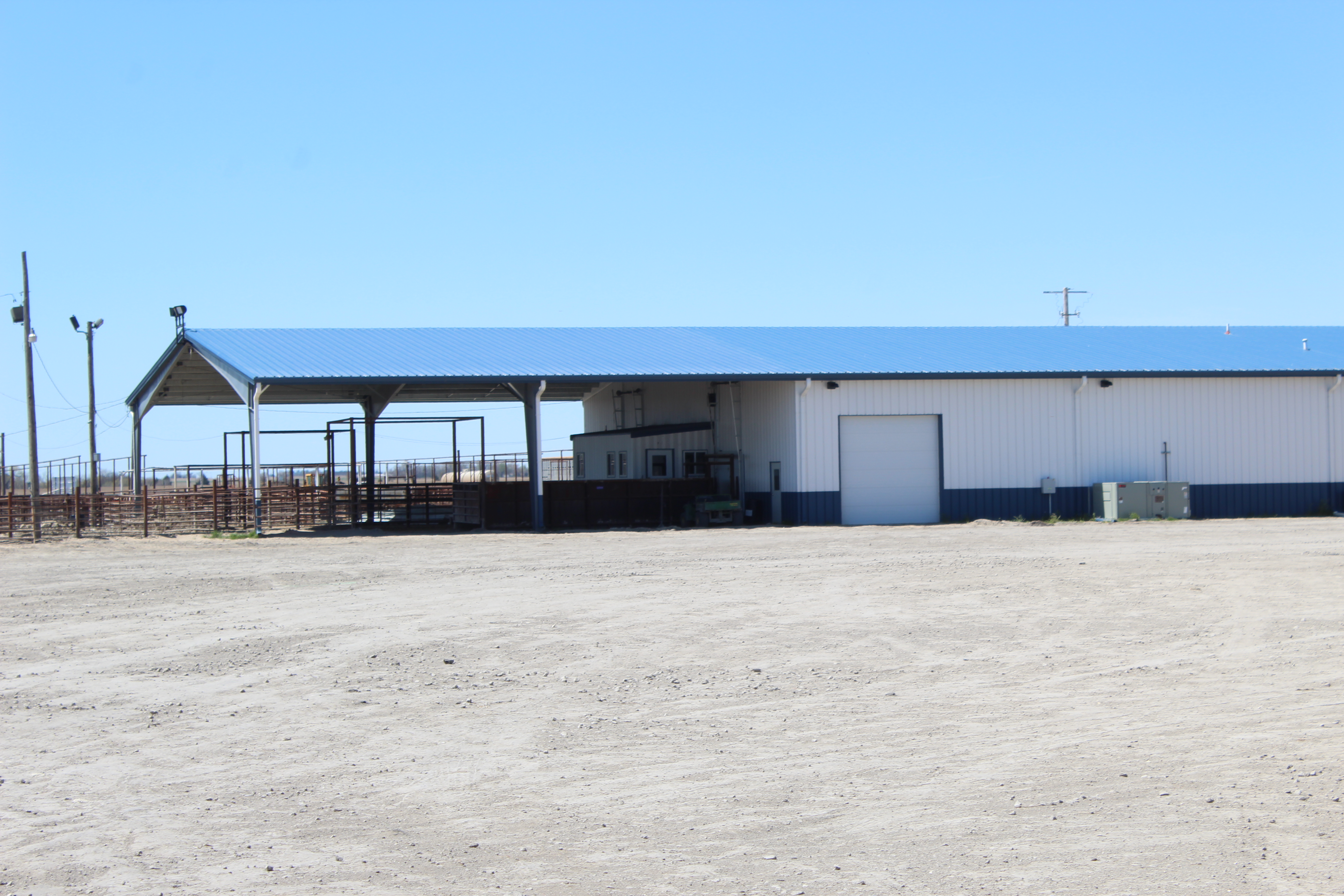
PLAINVILLE — An auction has been set for June 27 for the Plainville Livestock Commission’s real estate, vehicles and equipment in attempts to recoup some of almost $14.5 million in debt the business owes in its bankruptcy.
The real estate will sell at 11 a.m. and will be administered by the bankruptcy trustee, James Overcash. The equipment, vehicles and other property will be sold by Bud Palmer Auction starting at 1 p.m. at the livestock commission property at 907 NW Third in Plainville.
The Gillums are charged with 31 counts of bank fraud, one count of making a false statement to the Small Business Administration in an application for a $1.5 million loan, and one count of making a false statement to Almena State Bank in an application for a $500,000 line of credit.
The indictment alleges investigators examined unfunded checks and wire transfers totaling more $2 billion sent by Tyler Gillum as part of the scheme.
The indictment alleges the Gillums defrauded Almena State Bank in Almena; Landmark Bank in Manhattan; Colorado East Bank and Trust in Lamar, Colo.; Astra Bank in Scandia; TBK Bank in Dallas; Guaranty State Bank in Beloit; and The Bank in Oberlin.
Dozens of cattle producers were caught up in the scheme after money that was supposed to be set aside to pay cattle sellers was transferred from a custodial account to the Plainville Livestock Auction’s operating account. The Almena Bank froze both accounts, which resulted in bounced checks amounting to tens of thousands of dollars per producer.
Almena Bank filed an interpleader case, which is legal action that seeks to determine to whom the money that was transferred out of the custodial account belongs. In the interpleader case, Almena bank indicated Plainville Livestock Commission had defaulted on three loans with its bank totaling more than $3.49 million.
The interpleader case has been transferred from Norton District Court to federal bankruptcy court. That case is pending separate from the main bankruptcy proceedings and is still working its way through the court system.
According to court documents filed May 31 in federal bankruptcy court, the trustee indicated Almena State Bank has the first lien on the real property to be sold at the upcoming auction and the the second lien on the equipment.
The property consists of two tracts, one of which is 21 acres and the other 0.65 acres. The property is valued at $734,030, according to the Rooks County Appraiser’s office.
The trustee determined TBK Bank has first lien on the equipment. According to court records, TBK Bank is owed $227,238.
The attorney for TBK did not wish to comment on the bankruptcy or the pending auction, Almena Bank did not return previous calls regarding this story.
There are also secured loans on four trucks and a skid loader. The creditors that hold those liens will be paid first on the sale of those items. The claim on these items amount to more than $92,000.
The machinery, equipment, vehicles and office equipment were valued at about $542,000 with cash, equivalents and accounts receivable worth an additional $211,000 according to court records.
According to court documents, Plainville Livestock Commission debt is almost $14.5 million of which $3.7 million is secured debt. Landmark Bank of Manhattan is listed as an unsecured creditor with the commission owing $8 million.
In the time leading up to the Livestock Commission’s bankruptcy filing and the Gillums’ indictment, records show the Livestock Commission earned $2.2 million in 2017, $1.9 million in 2018 and $225,000 before the commission was shut down in 2019.
Some of the personal property to be auctioned includes office and kitchen equipment from the cafe, such as tables and chairs, computers, refrigerators, ice machine, and a grill.
Some of the stockyard equipment includes tractors, ATVs, mowers, chutes, trailers, gates, tanks, and a welder.
A representative of Bud Palmer Auction said a sale bill will be posted on the company’s website in the coming days.
The trustee has leased the sale barn to Lloyd and Judy Schneider dba Heartland Regional Stockyards, a livestock market agent with a separate license from the Gillums. They are also listed as creditors in the bankruptcy. Hays Post has also tried to contact the Schneiders about the case.
According to court documents, Heartland’s lease will be terminated within six days following the approval of the sale of the real estate by the bankruptcy court.
Any funds from the auction that are greater than what is owed to Almena Bank, TBK or other lien holders will go to the bankruptcy estate, according to court records.
Overcash is set to appear before the bankruptcy court to report on the sale at 9 a.m. June 28 or as soon after the sale as possible.
Any other remaining assets that are not listed in this sale will be sold at a separate, future sale, according to court records.
That includes trucks, a Chevy Camaro, more trailers, semi and other items.
Check Hays Post for more on this developing story as details become available.
Plainville Livestock CommissionBy CRISTINA JANNEY Hays Post
PLAINVILLE — An auction has been set for June 27 for the Plainville Livestock Commission’s real estate, vehicles and equipment in attempts to recoup some of almost $14.5 million in debt the business owes in its bankruptcy.
The real estate will sell at 11 a.m. and will be administered by the bankruptcy trustee, James Overcash. The equipment, vehicles and other property will be sold by Bud Palmer Auction starting at 1 p.m. at the livestock commission property at 907 NW Third in Plainville.
The Gillums are charged with 31 counts of bank fraud, one count of making a false statement to the Small Business Administration in an application for a $1.5 million loan, and one count of making a false statement to Almena State Bank in an application for a $500,000 line of credit.
The indictment alleges investigators examined unfunded checks and wire transfers totaling more $2 billion sent by Tyler Gillum as part of the scheme.
The indictment alleges the Gillums defrauded Almena State Bank in Almena; Landmark Bank in Manhattan; Colorado East Bank and Trust in Lamar, Colo.; Astra Bank in Scandia; TBK Bank in Dallas; Guaranty State Bank in Beloit; and The Bank in Oberlin.
Dozens of cattle producers were caught up in the scheme after money that was supposed to be set aside to pay cattle sellers was transferred from a custodial account to the Plainville Livestock Auction’s operating account. The Almena Bank froze both accounts, which resulted in bounced checks amounting to tens of thousands of dollars per producer.
Almena Bank filed an interpleader case, which is legal action that seeks to determine to whom the money that was transferred out of the custodial account belongs. In the interpleader case, Almena bank indicated Plainville Livestock Commission had defaulted on three loans with its bank totaling more than $3.49 million.
The interpleader case has been transferred from Norton District Court to federal bankruptcy court. That case is pending separate from the main bankruptcy proceedings and is still working its way through the court system.
According to court documents filed May 31 in federal bankruptcy court, the trustee indicated Almena State Bank has the first lien on the real property to be sold at the upcoming auction and the the second lien on the equipment.
The property consists of two tracts, one of which is 21 acres and the other 0.65 acres. The property is valued at $734,030, according to the Rooks County Appraiser’s office.
The trustee determined TBK Bank has first lien on the equipment. According to court records, TBK Bank is owed $227,238.
The attorney for TBK did not wish to comment on the bankruptcy or the pending auction, Almena Bank did not return previous calls regarding this story.
There are also secured loans on four trucks and a skid loader. The creditors that hold those liens will be paid first on the sale of those items. The claim on these items amount to more than $92,000.
The machinery, equipment, vehicles and office equipment were valued at about $542,000 with cash, equivalents and accounts receivable worth an additional $211,000 according to court records.
According to court documents, Plainville Livestock Commission debt is almost $14.5 million of which $3.7 million is secured debt. Landmark Bank of Manhattan is listed as an unsecured creditor with the commission owing $8 million.
In the time leading up to the Livestock Commission’s bankruptcy filing and the Gillums’ indictment, records show the Livestock Commission earned $2.2 million in 2017, $1.9 million in 2018 and $225,000 before the commission was shut down in 2019.
Some of the personal property to be auctioned includes office and kitchen equipment from the cafe, such as tables and chairs, computers, refrigerators, ice machine, and a grill.
Some of the stockyard equipment includes tractors, ATVs, mowers, chutes, trailers, gates, tanks, and a welder.
A representative of Bud Palmer Auction said a sale bill will be posted on the company’s website in the coming days.
The trustee has leased the sale barn to Lloyd and Judy Schneider dba Heartland Regional Stockyards, a livestock market agent with a separate license from the Gillums. They are also listed as creditors in the bankruptcy. Hays Post has also tried to contact the Schneiders about the case.
According to court documents, Heartland’s lease will be terminated within six days following the approval of the sale of the real estate by the bankruptcy court.
Any funds from the auction that are greater than what is owed to Almena Bank, TBK or other lien holders will go to the bankruptcy estate, according to court records.
Overcash is set to appear before the bankruptcy court to report on the sale at 9 a.m. June 28 or as soon after the sale as possible.
Any other remaining assets that are not listed in this sale will be sold at a separate, future sale, according to court records.
That includes trucks, a Chevy Camaro, more trailers, semi and other items.
Check Hays Post for more on this developing story as details become available.
Sixteen outside agencies presented requests Monday night to the Ellis County Commission for a total of $1.073 million.
The commission is facing a budget shortfall for the coming budget year and has already indicated cuts to outside agencies will be between $150,000 and $300,000.
Despite the prior notification the agencies’ funding would be reduced for 2020, few agencies presented reductions in their requests.
The Aging Council recommended total reductions for all its programs from $133,627 in 2019 to $112,750 for 2020. The Humane Society of the High Plains decreased its request from $4,500 to $3,000.
The county is required by law to fund High Plains Mental Health, which has the largest allocation at $280,000. Its uses a formula to determine its request based in part on population, resident usage and county valuation. Its request was down about $1,000.
Lee Dobratz, historical society director, received sharp criticism from Commissioner Butch Schlyer for its lack of a long-rang plan for sustainability.
Area in one of the Ellis County Historical Society buildings where plaster collapsed June 1. Photo courtesy of Ellis County Historical Society
A portion of the plaster on a wall collapsed in historical society’s main brick building June 1, Dobratz said. The damage was caused by water seepage. Emergency repairs were made, but collections from two rooms had to be moved to the adjoining brick church for safe keeping.
“We currently face two large obstacles, Dobratz said. “Our building is becoming direly in need of replacement and our funding continues to lower. Just a few years ago, we were allocated $120,000 per year from the county. … When I took over in 2016, thrifty spending was not as common as it is now. I immediately cut expenses until I better understood the needs of our organization.
“By the time I created the budget proposed here for 2020, I had cut line items to the bare minimum that it takes to stay open. Our fixed costs of utility, maintenance, insurance and off-site rental are rising mostly due to emergency repairs to the structures we possess.”
Dobratz said the historical society is working on a plan for a new building as well as a fundraising for an endowment.
However, she said if funding is reduced at this time, the historical society would have to cut staff.
Schlyer reminded Dobratz the county already has left positions in many departments unfilled as a result of the budget crisis.
“If you have to eliminate positions, so be it,” he said. “I guess I am not going to be heart-felt for that at this point in time. Our staff in Ellis County could be looking at some real dire hardships coming next year.”
GrowHays, formerly the Ellis County Coalition for Economic Development, presented a request for $50,000. The agency did not request any funds in 2018 and 2019, but received between $125,000 and $47,500 in past years. It has been spending down reserves. However, director Doug Williams said that is not sustainable over time.
Despite changing its name, location, board makeup and director, the mission of the organization remains the same, Williams said — business creation, retention, expansion and recruitment.
“What it boils down to is growing the tax base — that is what we are supposed to do,” he said. “As I look at issues facing Ellis County, and I realize they are substantial, the most productive method of solving these problems is absolutely growing the tax base, increasing taxes and sales tax. While cuts may be necessary, growing the tax base is overall the best long-term solution by far.”
GrowHays has enough funding to last through 2019 and part of 2020, depending on private funding. However, long-term, Williams said the organization will not be sustainable if it does not receive public funding.
Commissioner Dustin Roths served in the past on the Ellis County Coalition for Economic Development board.
“This is something at the most micro level of government we have to be aggressive about in terms of growing our tax base,” Roths said, “especially in western Kansas, northwest Kansas and rural America in general. If you are not aggressive, if you are not growing, you’re dying. …
“My thought for fellow commissioners is that if we don’t figure out a way to do some sort of funding for economic development for Ellis County, we are going to have to do it on our own with our own staff, and we can see the money they are asking for here —$50,000 … we all know that is basically one employee.”
During the KAYS Morning Show on Tuesday, Schlyer also said he thought supporting economic development is important.
County Administrator Phillip Smith-Haines said although funding is tight this year, if the commission decides to fund GrowHays, the county will come up with the money in the budget.
The Center for Life Experience was not funded last year through the regular budget process, but received a $1,000 special allocation from the county commission. For 2020, it has requested $6,000 as it transitions from the umbrella of the First Presbyterian Church to an independent community nonprofit organization.
The center offers grief support groups as well is the support agency for the local chapter of the National Alliance on Mental Illness.
Roths said he understood the need for the center and other outside nonprofits for funds and valued the services they provide, but he said he thought nonprofits should be supported through donations and not taxes.
“One of my biggest concerns about government funding of a lot of these types of organizations that we are talking about for outside funding is the difference between a tax and a donation,” he said. “I think it is why we keep harping on it. I think anybody who has been successful and has extra money to give should look at this list of organizations that we are funding and really consider a donation to them.
“I love the idea of funding through church organizations,” he said. “The main reason for that is I feel that is coming from a point of love. It is not from coercion. It is great because it really ties into the people who give actually caring about the organization and becoming a part of the organization and becoming part of its success.”
Smith-Haines and Schlyer said Tuesday morning they did not anticipate cuts to the agencies would be across the board. The commissioners will begin to discuss specific funding amounts for the agencies at their meeting next Monday.
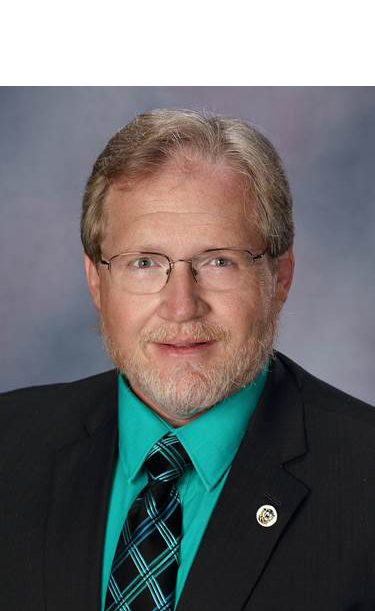
Paul Adams, a Fort Hays State University professor, has filed to run for a second term on the Hays USD 489 school board.
Adams, 58, joins a field of eight other candidates for four open positions on the board, including fellow incumbent Luke Oborny and newcomers Craig Pallister, Lori Hertel, Tammy Wellbrock, Alex Herman, Allen Park, Jessica Moffitt and Cole Engel.
“Part of it is there is still some unfinished work that I wanted to try to play a part in by being a board member,” Adams said on why he is running for a second term. “A bond issue was a part of that. That is a significant element that I think having some experience in the past would be beneficial to our district in playing a part in moving that particular agenda forward.
“The other is that I still need to provide a service to the public. I have some skills yet that would be helpful as we move forward with a new superintendent.”
Superintendent John Thissen resigned earlier in the school year citing personal reasons. He will be replaced by Ron Wilson, former Herington superintendent on July 1.
The school board had a special board meeting Monday to discuss facilities. Members came to a consensus they would like to move forward with a bond election in 2020. The board will look at possible timelines in July.
The district has had two failed bond elections in the last three years — in 2016 and 2017.
Although board members have not decided what projects will be included in the bond issue, they keep coming back to HVAC at Hays High School, expansion of the cafeteria at Hays Middle School, and expansion and renovation of Roosevelt Elementary School. An expansion at Roosevelt could allow the district to close Lincoln Elementary School, which is more than 90 years old and has significant infrastructure problems.
Adams said he is not settled on what projects should be done until he has more information.
“Those keep bubbling up as perennial topics. They are needs that haven’t gone away despite the best effort of our physical facilities and Rusty [Lindsay, director of building and grounds] and his team to do it. We keep coming back around to the same issues,” he said. “In terms of prioritizing, they are a very high priority. Will they come out in the end? It depends on what is the appropriate level of funding to request through a bond issue, and there is a great consider of the board members to set that direction.”
District officials hope a bond issue will allow the district to use existing capital funds to address other facility issues and be better stewards of taxpayers’ money.
“We need some capital infusion from the community to be more effective in what we do to maintain our buildings,” Adams said, “and advance what they need to be for our students and what we know and are seeing from research what we need to change our physical space to be more effective for learning.”
The district reached impasse with the Hays NEA during negotiations last year. Adams said he did not think that impasse was a bad thing. He said ultimately both parties were able to agree once an outside mediator was brought in.
Adams said he would favor the district to moving to interest-based bargaining, which is a win-win strategy that focuses on benefits for both sides in negotiations. Adams has participated in interest-based bargaining at FHSU.
“Instead a focus on I or my side, focusing on let’s look at the district. Our mission is to serve every child in this community. It’s not just limited to 489,” he said. “How can we be fiscally responsible to the district, reward the teachers what is just and fair for the work they do, but come to that resolution, we are here to do what is right by you, to do what’s right by the community and we do what’s right for the board’s responsibility to the take care not just of the individual employees but also the physical plant and the whole needs?”
The board hotly debated the purchase of new iPads for HMS this spring. Some board members favored going to a cheaper version of the Chromebook or eliminating the district’s one-to-one computer policy entirely.
Adams voted in favor of buying new iPads for HMS as part of a regular technology replacement program in the district.
“The reality is that the kids we are working with are going to have to be aware of what computational thinking is. They are going to have to be aware of what computer science is. They are going to have to be aware of coding,” he said. “It is viewed as an essential part of our society and an essential part of what is needed for career and work readiness of kids. …
“We made that decision many years ago, and there really has not been enough negative to say it was a bad decision,” Adams said of the one-to-one computer policy. “I think we have to support it where we are.”
Adams said he would like to have board members on the Technology Committee as ex-officio members in the future to help make the best decisions about what specific devices the district should purchase to meet the students’ education needs with the consideration of the district’s financial limitations in mind.
Adams said the district is making positive progress in the new KESA sate accreditation process. This has included a focus on social emotional learning, use of Career Cruising for career development and the JAG-K program, which is helping at-risk students graduate and prepare for post-secondary education or jobs.
The board was spilt on accepting a grant to renovate the Oak Park Medical Complex for the Early Childhood Connections program. Adams voted in favor of that project and said he looks forward to the grand opening of that facility this fall.
“In education, we are solid,” he said. “Our people are doing a great job, but I think we can do better if we can give them the right physical plant, so the bond issue is one of my true goals.”
Adams has four children who have graduated from Hays High School. He is involved with the National Science Teachers Association and on the sate level with several groups that promote science education.
His wife is employed by USD 489 and is the chairwoman of the science department at HHS.
Accessibility-focused park honored for meaningful contributions to Kansas community
The Accessible Recreation Complex (ARC Park) that is being constructed in Hays was recognized by Robcom LLC and Cenex, the energy brand of CHS, for being a unique source of pride in the community. ARC Park is an accessible play space for children of all abilities that is set to open this fall.
The Arc of Central Plains received a $5,000 donation to help fund construction of the park.
Once completed, ARC Park will provide children of western Kansas with a fully accessible playground, baseball field and splash pad where those of all abilities can play together. The space will emphasize inclusion, self-empowerment, collaboration and imaginative play for the 1,400 children and adults with disabilities in the area, along with their families and friends.
“Southside Convenience is proud to support our community,” said Tara Patel, owner of the Southside Convenience Cenex location in Hays. “ARC Park will be a tremendous asset to the city of Hays and to the thousands of children who will play there each year.”
The $5,000 donation was provided to Southside Convenience through a grant program that encourages Cenex retailers to share stories about what makes their local communities unique or special. In total, Cenex retailers will receive more than $100,000 to give back to their communities this year.
“The Cenex brand has a deep-rooted history of serving the people and communities of rural America,” says Bryan Brignac, director of marketing at CHS, the nation’s largest farmer-owned cooperative. “We are proud of our Cenex retailers, like Southside Convenience, who play an active role in enriching their communities.”
Applications for the grants are competitive among almost 1,500 stores in 19 states.
“The ARC Park has a unique opportunity to be the pride of western Kansas,” Brignac said. “we are supportive of any meaningful projects that will help enrich the lives for so many different families and kids in the Hays area. When you look nationally, how many of these parks are out there?
“This, in our eyes, is a very unique attraction that will definitely benefit not only the residents of Hays, but people from the surrounding communities. With an impact like that, we definitely thought it was unique and deserving of a community contribution.”
Cenex, the energy brand of CHS, provides high-quality refined fuels through nearly 1,500 locally-owned convenience store locations across 19 states. CHS owns and operated the refinery in McPherson, Kansas, where 800 people are employed. CHS buys the majority of its fuel that is processed at McPherson from framers and ranchers in the Kansas area, Brignac said.
Consumers depend on Cenex fuels, lubricants, propane and renewable energy products to power homes, businesses and communities. CHS, Inc.(www.chsinc.com), which owns the Cenex brand, is a leading global agribusiness owned by American farmers across the United States with domestic and international operations including energy, agronomy, grain trading and food processing.
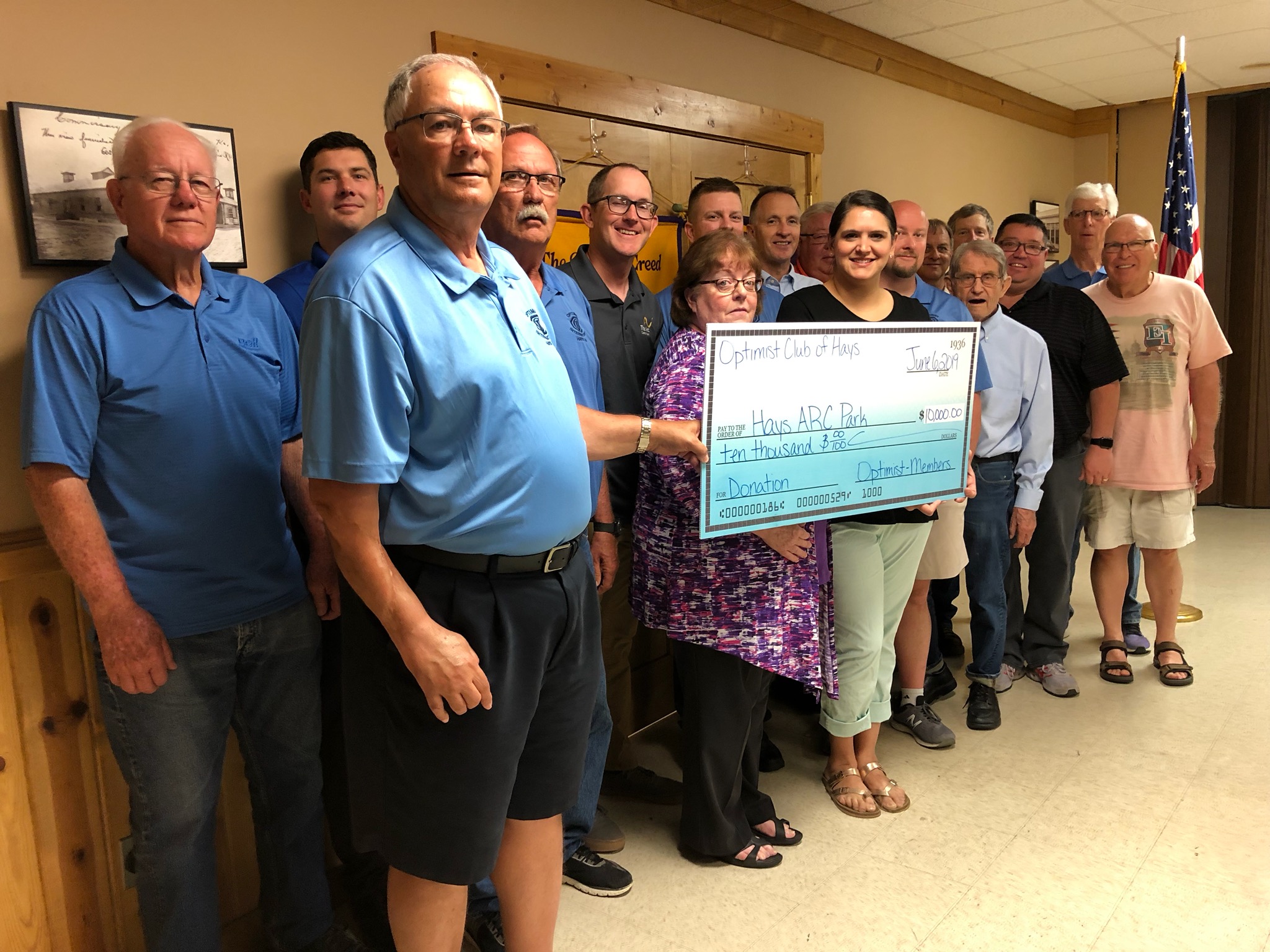
Hays Optimist members present a check for $10,000 to Sarah Meitner and members of the ARC administrative team.
Submitted
The Hays Optimist Club is proud to present a $10,000 contribution to the ARC of the Central Plains for the accessible park that they are constructing at the site of the Seven Hills Optimist Park.
Twenty plus years ago the Optimists in conjunction with the City of Hays provided funds to build a shelter house and purchase playground equipment for the park.
Optimist members in addition volunteered their time to build the shelter house and assemble and install the playground equipment.
Hays Optimists has been in existence since 1966. Three of the original charter members still regularly attend the weekly meetings. Optimist members in fall 2018 volunteered more than 244 hours to sell Christmas trees and also volunteered their time and efforts to sell raffle tickets. The proceeds of both projects were used to fund 21 different youth projects in 2019.
Funds for the contribution to the ARC project were the result of funds set aside from past tree sale projects. The members knew that at one time there would be a need to make additional improvements to the Seven Hills site.
When the ARC Park project was announced, they voted to use the funds that had been restricted to assist in the fundraising for the project.
Kansas voters who threw far-right Republicans out of office in 2016 and elected Laura Kelly as governor in 2018 should be pleased that state finance is on the mend after facing bankruptcy three short years ago.
In assessing the condition of state finance at the close of the 2019 legislative session, Kansans should not forget the disastrous financial mess of 2016:
· block grant funding of schools had been ruled unconstitutional;
· a $700 million state bank account had been drained empty by four years of unbalanced budgets triggering repeated downgrades in state credit;
· frequent borrowing had ballooned tax-supported state debt to an historic high;
· a reckless tax experiment bumped up property taxes as a portion of state and local revenues to the highest level since the 1980s;
· cutbacks in highway maintenance, suspended pension payments, child deaths, prison uprisings, and a decertified state hospital highlighted an overall deterioration in state services;
H. Edward Flentje is professor emeritus at Wichita State University.
To top off this debacle, far-right Republican lawmakers skipped town in 2016 after authorizing spending that exceeded revenues by more than $300 million.
Most Kansans correctly place primary blame for this mess at the feet of former Governor Sam Brownback and his tax experiment, but current legislators, including Senate President Susan Wagle, Senate Majority Leader Jim Denning, and House Speaker Ron Ryckman, had a hand in doing the governor’s bidding.
In 2016, Kansas voters rebuked legislative allies of Brownback and elected 40 centrist Republicans and Democrats to contested seats.
Then, in 2018, they chose Kelly over Kris Kobach, who wanted to redo the experiment.
A current snapshot of state finance demonstrates that elections do make a difference.
First, and most importantly, a genuinely bipartisan school funding package has been enacted. That package addresses specific issues raised by the Kansas Supreme Court and should end 10 years of turmoil over school finance.
Second, abandonment of the tax experiment in 2017 has restored state balances, estimated at $550 million by July 1, 2020. However, that balance could quickly evaporate if lawmakers fail to keep spending in line with revenues. For example, on the last day of the legislative session, Governor Kelly, with the help of Democrats and a handful of Republicans, successfully fought off an attempt to override her veto of partisan tax cuts that would have shrunk balances.
Third, axing the experiment has also rebalanced the tax mix among property, sales and income taxes. Relative equivalency among these tax sources should assure lower tax rates overall, reduce competition with other states, and promote tax fairness based on income.
Fourth, state legislators enacted a bipartisan budget package that begins to repair state services in a number of areas. Kelly trimmed the package with line-item vetoes but was overridden on those. This action diminished state balances by over $50 million.
Finally, state debt is being paid down from record highs, and state credit has edged upward since 2016.
While state finance is on track, thorny, unresolved issues could throw the recovery off course. Kelly narrowly blocked the Republican’s tax bill but pledged a comprehensive review of state tax policy in advance of the next legislative session. Kelly proposed extending the payoff of unfunded pension liabilities in order to achieve short-term financial flexibility, but Republicans balked at the cost her proposal. And Senate leaders stalled Medicaid expansion.
Kansans chose a bipartisan path forward in 2016 and 2018, and lawmakers produced. Kelly and legislative leaders now face the dual challenge of keeping on track while also finding consensus on continuing, unsettled issues of state finance.
After 37 years working in schools, former Hays Middle School Principal Craig Pallister is seeking to get back into education. He filed this week to run for the Hays USD 489 school board.
Pallister, 65, joins a field of eight other candidates for four open positions on the board, including incumbents Paul Adams and Luke Oborny and newcomers Lori Hertel, Tammy Wellbrock, Alex Herman, Allen Park, Jessica Moffitt and Cole Engel.
“My thoughts are still with public education,” Pallister said. “It is one of those [things I wanted] to give back now to education that I have the time to do it.”
Pallister said he does not think the district or the board needs any major changes.
“I moved to Hays 37 years ago when my oldest child was just getting into kindergarten because it had a great education system and it’s a great community to raise kids,” Pallister said. “We just need to publicize how good our public schools are. I don’t think people realize that if they went to other places around the state of Kansas, Hays is very, very lucky.”
In terms of facility needs, Pallister said he thought the biggest need is at the elementary level.
The district has had two failed bond issues in three years — in 2016 and 2017.
The school board has discussed adding two sections to Roosevelt Elementary School and closing Lincoln Elementary School, which is more than 90 years old and has significant infrastructure problems. The board will consider time lines in July for a bond election in 2020.
The board has also discussed including in the bond issue expansion of the HMS cafeteria.
“The specific need for Hays Middle School after being there for 25 years is the cafeteria,” Pallister said. “We were lucky to get additions built on a couple of times while I was there, so we have the space, but it is the cafeteria that is really the specific need. It is not a want; it is a need.”
The cafeteria was built for 400 students and is now serving almost 700 students.
“We get them fed, but we had to rush their lunches so much,” he said. “They don’t get to socialize. It is like being in a restaurant that is overcrowded and has people standing in line all of the time.”
The school district reached impasse with the Hays NEA during negotiations last year.
“The district just needs to listen to the teachers about their needs and what they want to change in the district,” Pallister said. “I think the district needs to get back to realizing our staff and faculty are the most important part of the school district. They are the ones that meet our kids every day. … If you have great staff and great teachers, you will have an outstanding district, and that is what we have.”
He said he thinks the district needs to promote itself to continue to draw quality teachers and staff members to the district.
“We should send out something that says, ‘Hays USD 489 — one of the best districts in the state of Kansas,’ ” he said, “and we could stand behind it because we have the teachers and we have the staff and our kids come out and are prepared.”
The board has also heavily debated its one-to-one computer policy.
“Technology is just part of the integral education process,” Pallister said, “but our kids need that solid technology background to be able to be successful through 12th grade and then through post-secondary education.
“I have had two daughters go through universities now, and they had a very good technology background after being in USD 489 and it is having it every day in front of them.”
Pallister was the assistant principal at HMS for four years before serving as head principal for 21 years. Prior to working in Hays, he was an assistant middle school principal for three years and a teacher for 10 years at the middle school in Dodge City.
He earned both his bachelor’s and master’s degrees from Fort Hays State University.
“I have the historical background because I have worked under four superintendents of schools in Hays,” he said. “I feel like I bring a lot of knowledge of education and the historical knowledge of how the district has done the good things and the times we have not done good things.”
Pallister’s wife also worked for the Hays school district. She retired this spring from her position as a librarian for Roosevelt and Lincoln Elementary schools.
Pallister said the most important reason he is running is because he has a granddaughter who will be a second grader at Wilson Elementary School in the fall.
“I just have the time, and I want to be involved in education because that has been my life,” he said.
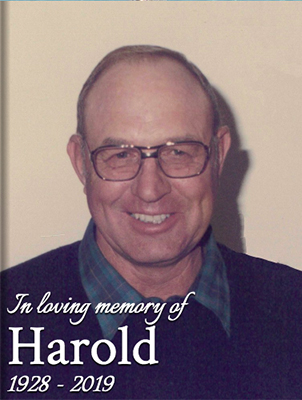
Harold W. White, age 90, passed away on Wednesday, June 5, 2019 at the Park Lane Nursing Home in Scott City, Kansas. He was born on October 14, 1928 in Tyron, Nebraska, the son of Roy and Rena Robertson White. A resident of Scott City, Kansas, since 1947 moving from Pueblo, Colorado, he was the owner and operator of White Concrete for over 25 years until retiring in 1990.
He was a member of the St. Joseph Catholic Church in Scott City, Kansas, and was a US Navy Veteran and was a member of the Knights Of Columbus, Pheasants Forever, El Quartellejo Saddle Club, Life Member of AQUA and Modoc Gun Club.
On April 20, 1949, he married Mary Ruth Gaschler in Marienthal, Kansas. She survives.
Survivors include his wife Ruth White of Scott City, Kansas, one daughter Susan and Brad Boulware of Scott City, Kansas, two granddaughters Brooke Boulware of Scott City, Kansas, and Kadra Boulware of Overland Park, Kansas.
He was preceded in death by his parents and five sisters Byrdena, Evelyn, Nina, Marie and Beulah.
Vigil services will be at 7 p.m. Sunday, June 9, 2019 at the St. Joseph Catholic Church in Scott City, Kansas.
A celebration of life will be at 10 a.m. Monday, June 10, 2019 at the St. Joseph Catholic Church in Scott City, Kansas.
Burial will be in the Scott County Cemetery in Scott City, Kansas.
Memorials in lieu of flowers may be made to the Park Lane Nursing Home or St. Joseph Catholic Church in care of Price & Sons Funeral Homes.
Visitation will be from 10 a.m. until 8 p.m. Saturday and 1 until 5 p.m. Sunday at Price & Sons Funeral Home in Scott City, Kansas.