Essie (Sycamore) Carmichael, played by Madelyn Seiler, and her husband Ed Carmichael, played by Aidan Normandin, a xylophone player,
By CRISTINA JANNEY Hays Post
Thomas More Prep-Marian students will perform “You Can’t Take It With You” Friday, Saturday and Sunday in the TMP-M Dreiling Theater.
Travis Grizzell, director, described the play’s plot.
“The plot is a look at two contrasting families and a young couple trying to navigate their place in the world, being from two totally different ways of life,” he said. “We have a very straight-laced, by the book businessman and his family whose son is in love with a girl from a very eclectic, care-free, live-in-the-moment family. The story progresses into a message about what ultimately matters in life.”
Ben Pfannenstiel as Martin (Grandpa) Vanderhoff
The Pulitzer Prize-winning play dates back to the 1930s with a film version, which won the Academy Award for Best Picture and Best Director, that was released in 1938. The film adaptation stared Jimmy Stewart.
“… there are definitely some time period things that we had to explain to the kids (and me even). But much like many classic plays or Shakespeare, the human elements are timeless and relatable to most everyone,” Grizzell said.
Despite a setting 80 years in the past, Grizzell said he thought modern audiences will be able to relate to the themes in the play.
“I think we’ve all had to deal with awkward family members and maybe been a little embarrassed by them. There’s also the father-son dynamic that a lot of families can relate to,” he said.
Penelope “Penny” Vanderhof Sycamore, played by Abby Peeler, is a writer of adventure- and sex-filled melodrama plays, and is married to Paul Sycamore, played by Hunter Flax.
Grizzell said the TMP students bring their own interpretations to the characters in the classic play.
“Sometimes the difference in generations can bring a very entertaining approach to characters like these,” he said. “The kids definitely bring some different things to these characters than I anticipated while reading the script. There’s always a little bit of the actor in each character, which makes a show like this that’s done so often unique to each cast and performance.”
Grizzell said he selected the play because it allowed many students to participate.
“The writing is great, and the story has held up so well over time. These authors also have so many good, entertaining characters in their plays,” he said.
Tony Kirby, played by Dylan Werth, is in love with Alice Sycamore, Penny Sycamore’s daughter. He is meeting Alice’s mother for the first time here.
Performances will be at 7 p.m. Friday and Saturday and 2 p.m. Sunday.
Cost of tickets are $8 each and can be purchased by clicking here or by calling the Fine Arts Ticket Line at 785-621-5478.
STOCKTON — The Phillips-Rooks County Extension District has set a lecture and Q&A on legal issues resulting from livestock buyer bankruptcy at 2:30 p.m. Friday in the Nova Theatre in Stockton.
Roger McEowen, Kansas Farm Bureau professor of law and taxation at the Washburn School of Law, will give a public presentation and then answer questions.
Rachael Boyle, organizer, said the event was sparked by the bankruptcy filing of Plainville Livestock Commission. More than 40 livestock producers were left with bounced checks as part of legal filings surrounding the market agency.
Tyler Gillum, owner of Plainville Livestock Commission, was set to be in bankruptcy court in Wichita on Thursday for a hearing.
Livestock producers affected by the Plainville Livestock Commission bankruptcy are set to meet in private with McEowen on Friday morning. That session is by invitation only and is closed to the public.
Registration for the public event begins at 2:15 p.m. Friday. The lecture starts at 2:30 p.m., and a question and answer session will follow at 3:30 p.m. Pre-registration is not required, and the event is free.
For more information, contact Boyle at (785) 425-6851 or email her at [email protected].
The event is also sponsored by the Rooks and Phillips County Farm Bureaus.
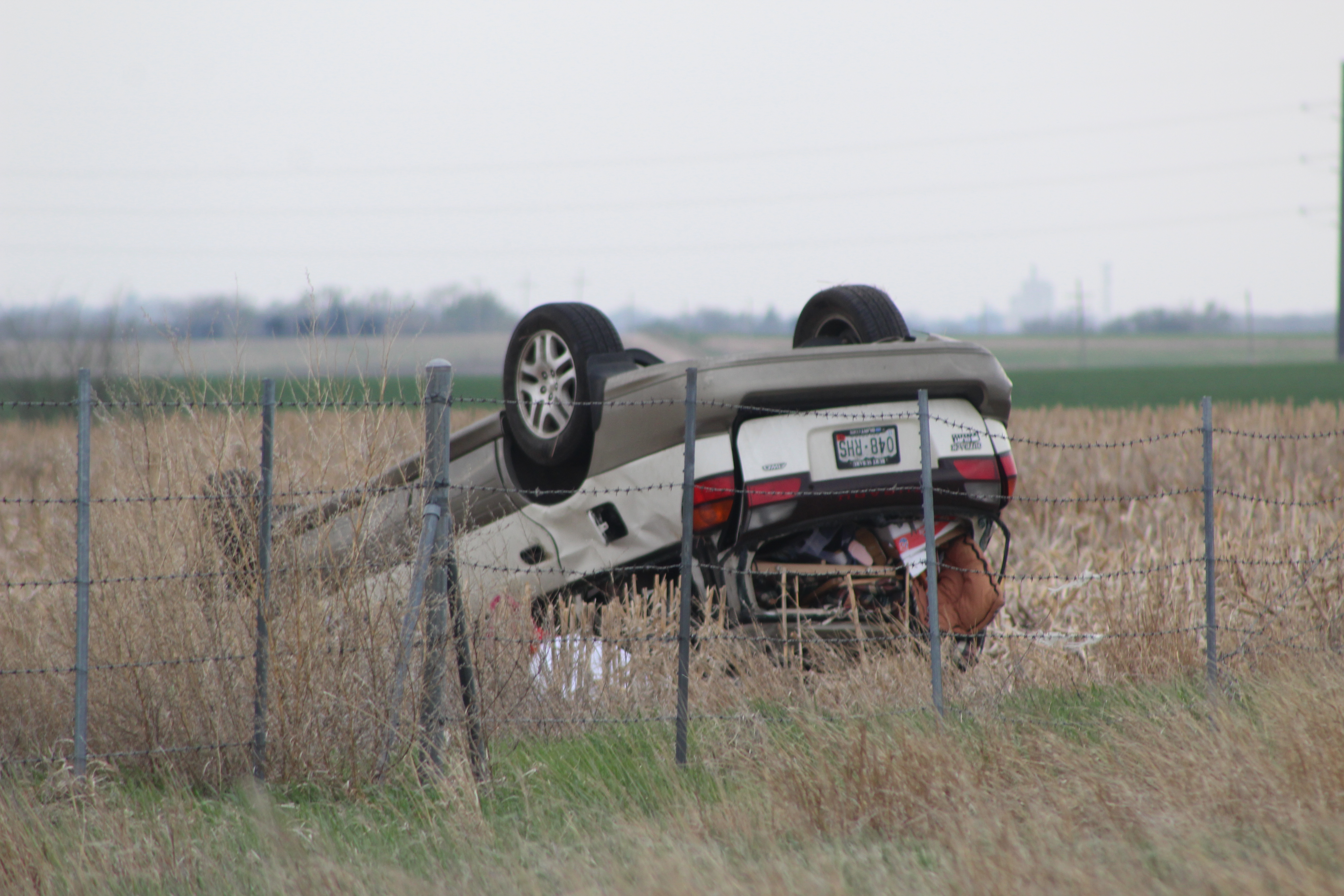
ELLIS COUNTY — One person was injured in an accident just before 5p.m. Wednesday in Ellis County.
The Kansas Highway Patrol reported a 2004 Subaru Legacy driven by Vicki F. Renninger, 65, Littleton, Co., was eastbound on Interstate 70 seven miles west of Hays.
The vehicle drifted off the left side of the road. The driver overcorrected. The vehicle traveled into the south ditch, struck an embankment and rolled into a field.
Renninger was transported to the hospital in Hays. She was properly restrained at the time of the accident, according to the KHP.
————-
By CRISTINA JANNEY
Hays Post
Just before 5 p.m. Wednesday an SUV westbound on Interstate 70 left the roadway at mile marker 152 between Hays and Ellis and rolled.
The SUV came to rest on its top, trapping the driver inside.
One woman was taken to the hospital with critical injuries, according to scanner reports.
The woman’s name has not been released.
The Interstate was not closed as a result of the accident.
Watch the Hays Post for more information as it becomes available.
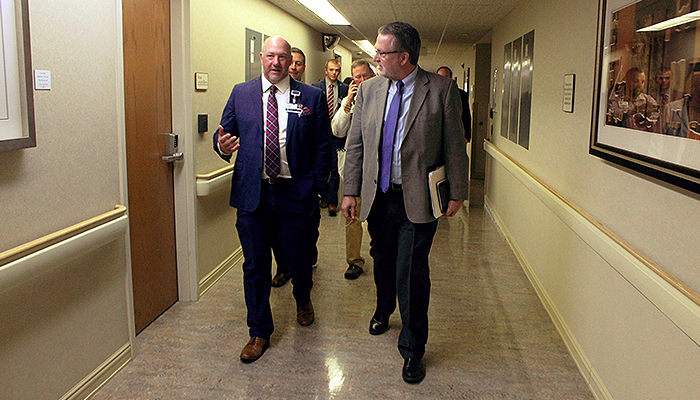
HaysMed CEO Edward Herrman, Lt. Gov. Lynn Rogers and Dr. Jeff Curtis talk during a tour of HaysMed on Tuesday.
By CRISTINA JANNEY Hays Post
Lt. Gov. Lynn Rogers said Medicaid expansion is not just an economic issue, it’s a moral issue, as he made a stop at HaysMed Tuesday morning for a discussion on health care.
Medicaid expansion legislation has passed in the Kansas House, but has yet to pass in the Senate. Medicaid expansion was a central piece of Rogers’ and Gov. Laura Kelly’s campaign platform.
In Ellis County, Medicaid expansion would insure 731 more residents, create 20 new jobs and have an economic impact of almost $4.9 million.
Rogers, as well as local health care professionals, gathered for a group discussion. The majority agreed Medicaid is needed to provide preventive health care for rural Kansans and maintain rural hospitals and health care clinics.
“We know Medicaid expansion won’t necessarily save a hospital, but we know it is one of the major indicators that has created problems,” he said.
About 30 Kansas hospitals are on a very vulnerable list, two rural Kansas hospitals have closed in the last 45 days, and two more have closed in the last year.
“Really what this does is Medicaid expansion takes 150,00 Kansans away from the highest cost medical service — emergency care— and puts them into preventive care, where they can have many of their services paid for in advance,” Rogers said.
“We see it as a very budget neutral situation now that we have a $25 per person per month fee and what it saves us in other state agencies it could really mean some really good things for the state of Kansas.”
The fee for families for Medicaid expansion would be capped at $100. These fees would generate about $20 million to $25 million of the $30 million cost to the state of Kansas for Medicaid expansion. The federal government currently pays 90 percent of Medicaid expansion. The House bill also stipulates if that federal match would be eliminated, the state would end Medicaid expansion.
HaysMed CEO Edward Herrman and Lt. Gov. Lynn Rogers and Dr. Jeff Curtis talk about health care during a tour of HaysMed on Tuesday.
Walt Hill, executive director of High Plains Mental Health, said Medicaid expansion would be a great boon to preventive mental health care. High Plains sees 6,000 patients per year in its coverage area. Out of a $10 million budget, $1 million a year is services provided to the uninsured.
“We have to find alternative sources of funding,” Hill said. “We often provide services on the backs of our staff who are very difficult to recruit and retain in the area.”
Rogers said in looking at mental health services in the state, the Sedgwick County jail is the third largest provider of mental health services only behind the two state mental health hospitals.
“We as taxpayers are spending $10 to $12 million on mental health services that probably would be covered under Medicaid,” he said.
Rogers and Hill both noted competition is high for health care recruiting. As Nebraska expands Medicaid, there is concern that qualified health professionals will continue to move out of state for more competitive wages.
Edward Herrman, HaysMed CEO, said although the amount rural hospitals would receive from Medicaid expansion doesn’t seem like much, it may be the difference between those hospitals breaking even.
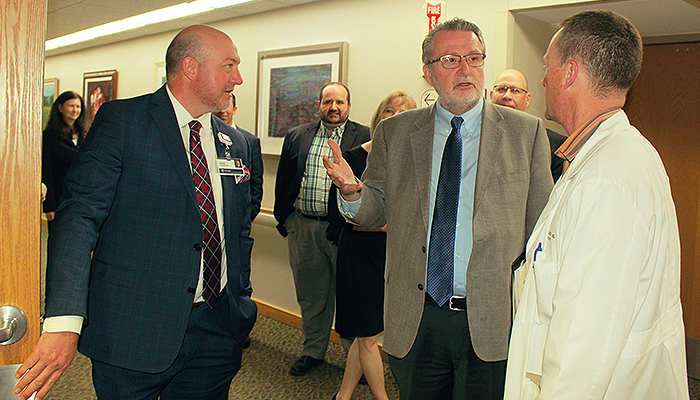
Health care providers and local leaders gather for a discussion on health care with Lt. Gov. Lynn Rogers at HaysMed on Tuesday.
“I can tell you that we know for sure that there are a few facilities that even if it is only $100,000 or $150,000 in benefit they would see, that is literally what they are missing in having a margin. …
“There are more people in the larger areas, but the actual impact is much larger in the rural areas. $100,000 in bottom line revenue means a heck of lot more to a Rush County hospital than $1.5 million on the bottom line for a St. Francis or the University of Kansas hospital.”
Herrman also noted during polls, three-quarters of Kansans said they are in favor of expansion.
Kansas is one of 14 states that has not expanded Medicaid. Kansans pay taxes to support Medicaid expansion, but the funds go to other states, he added.
“Most importantly, it is 150,000 Kansans who are falling in the gap and we are not even providing basic primary care for them,” Herrman said. “They do end up showing up in our ER in the most expensive place you can possibly receive care as well as many times not the appropriate place to receive your care.”
Bryan Brady, First Care Clinic CEO, said the clinic takes care of about 7,000 patients — 1,600 of those are uninsured. The clinic estimates about 1,000 of those patients would qualify for health insurance under Medicaid expansion.
“That would mean about $400,000 to our facility directly,” he said. “That is a huge amount. What we do is keep those patients out of the emergency room — the most expensive method of care.”
Dr. Heather Harris, family medicine provider with HaysMed, said a lack of insurance results in individuals waiting to get care until a health problem is acute and costs more to treat.
“Not only do they not come in for acute things, but they wouldn’t dream of coming in for anything preventive,” she said. …
“They come in late. They can’t afford the medicines. We have trouble giving them the education they need about food and exercise and smoking. If you can treat the parents, you can hope you will have healthier kids. It is just this continued trend. You can barely get them well for their acute things. You are never going to get them preventive care.”
Rogers said keeping people healthy, productive and employed benefits the state of Kansas.
First Care Clinic Medical Director Christine Fisher said Medicaid expansion would help the working poor.
“These are productive people, God help them, who are trying really hard, but they just need that extra bit of help that will make them even more productive members of society,” she said. “By making them healthier, you will only increase productivity and what you gain from the health care aspect will be very far reaching. If you give a person insurance, they will get their preventive care done, and if you don’t, they simply will not.
“If you don’t do primary care and preventive care, health care is extremely expensive down stream.”
HaysMed Cardiologist Dr. Jeff Curtis described himself as a “red doctor,” but he said he supports Medicaid expansion as a people issue and a patient issue.
“In the short term, I am in favor of Medicaid expansion, not just for our hospital, but for everything in western Kansas. It is a Band Aid until we can figure something else out. If we don’t get it and we don’t have it and we see all the other states around us getting it, that means people in our state are suffering.
“If we have it, we can expand the services in our bigger hospital — new equipment and new services — so patients don’t have to go to Kansas City, Wichita, Denver or Kearny. It helps us attract high quality health care workers, which is a challenge out here.”
The Hays USD 489 school board rejected a $129,000 bid to replace a clock and intercom system at Hays High School.
The bid also included installing new wiring and cable for a new phone system and security cameras that were set to be purchased at a later date.
The clock, intercom and phone systems are original to the building and are outdated, said Rusty Lindsay, building and grounds director.
The phone system software is no longer supported, and the school has had problems with the system.
As the district looked at replacing the phone system, HHS began having problems with the HVAC system. The HVAC system failed this year because of a problem with the clock system.
Lindsay said the more serious problem is the phone system, but the district does not have money in the budget this year to replace it.
Superintendent John Thissen said, “We also know there is the possibility we could get into the school year next year and have a catastrophic issue with our phones. That is a possibility, so they are just trying to ready it so it will be as quick or fast as possible when that time comes when we have the money or we feel we have to do something.”
Lindsay said he planned on coming back to the board in the fall with options to replace the phone system, but he said regardless of what the district does to replace the phone system, the infrastructure covered on this bid has to be in place to install a new phone system.
Board member Lance Bickle asked if the facilities staff could install the cable.
The facilities staff is already committed to replacing more than 500 interior locks throughout the district buildings this summer. Scott Summers, technology director, and other staff are also going to be occupied with renovations at the Oak Park Medical Complex.
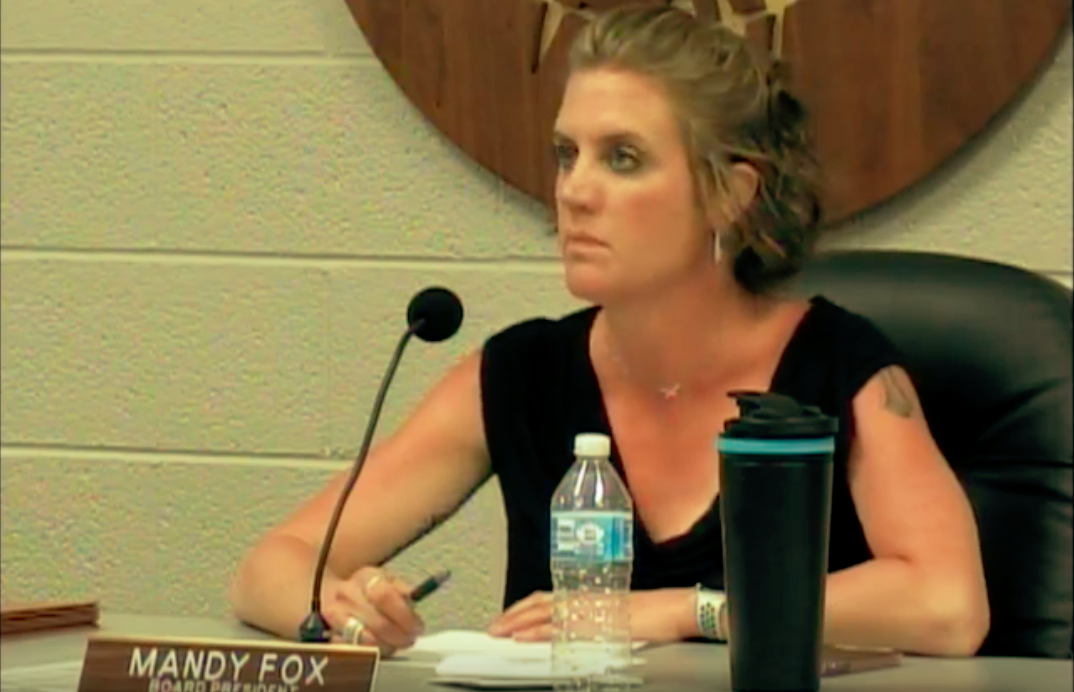
“A few weeks ago I din’t vote for the technology to move ahead the $250,000 for the iPads for the middle school,” Board President Mandy Fox said. “It wasn’t that I didn’t think we need those. It wasn’t because I don’t think that was something that didn’t need to be fixed. My problem on voting on some of these things to move forward is that I don’t understand that these are the greatest needs for that building or the district at this point in time.”
Lindsay said from a buildings and grounds perspective there is a need to take care of this issue at HHS.
“We are trying to address three other systems at the same time,” he said. “HVAC is something I have been coming in and talking to you about, and there is a great need there. Part of this system that we are replacing is the control part of the that. My failures this year have been on that side of it.”
The entire HVAC system went down earlier this school year because of one relays connected with the clock system failed, he said.
“In terms of total systems in that building,” Lindsay said, “this is my first step. It is my highest priority in terms of taking the next steps for it.”
Fox said, “It goes back to a facilities plan. I need a ranking system. When I go to work every day, I have a list. This is the most important thing and then this and then this. I fail to conceptualize that for the district. Not even on academic needs, just facilities. I need a list. If this doesn’t get fixed, we can’t operate.”
Lindsay said the problem is the facility needs are dynamic. He gave the example of roofs. The roof replacement at Roosevelt had to be moved up because of a more rapid deterioration in that roof.
“That is part of the problem of having systems that are all about the same age throughout the whole entire district,” he said. “You might have a plan that is static for you at that moment, but then it becomes dynamic because you have another system failure and that changes everything that you planned.”
Board member Sophia Rose Young also said she wished she had a better idea of what was happening with facilities.
Fox said to Lindsay, “I don’t like to put out fires. I like to plan. But I know you have been put in a position where you are putting out fires.”
Lindsay said he has a five-year capital improvement plan, some pieces of which are on schedule and other pieces are not.
Fox asked for estimates on the full phone and camera system. She said she thought the project needed to be done but said she needs more information. Lindsay agreed to bring back estimates.
The vote on the bid was 3-2. Commissioner Greg Schwartz was absent and Luke Oborny recused himself because he is employed by Nex-Tech, the low bidder on the project. A motion needs a majority of the seven members to pass, which is four votes.
Secure entrances
In other business, the board approved a project to add secure entrances at HHS and Hays Middle School. The district has received more than $86,000 in grants for the project. The district’s portion of these projects is $16,693. The district hopes to have the entrance project completed this summer.
The entrances will funnel visitors through the schools’ offices after the start of the school day.
Oak Park Complex
The board heard an update on the Oak Park Medical Complex renovation. They also briefly discussed renaming the facility, but no names were offered at this time.
HaysMed CEO Edward Herrman, Lt. Gov. Lynn Rogers and Dr. Jeff Curtis talk during a tour of HaysMed on Tuesday.
By CRISTINA JANNEY Hays Post
Lt. Gov. Lynn Rogers said Medicaid expansion is not just an economic issue, it’s a moral issue, as he made a stop at HaysMed Tuesday morning for a discussion on health care.
Medicaid expansion legislation has passed in the Kansas House, but has yet to pass in the Senate. Medicaid expansion was a central piece of Rogers’ and Gov. Laura Kelly’s campaign platform.
In Ellis County, Medicaid expansion would insure 731 more residents, create 20 new jobs and have an economic impact of almost $4.9 million.
Rogers, as well as local health care professionals, gathered for a group discussion. The majority agreed Medicaid is needed to provide preventive health care for rural Kansans and maintain rural hospitals and health care clinics.
“We know Medicaid expansion won’t necessarily save a hospital, but we know it is one of the major indicators that has created problems,” he said.
About 30 Kansas hospitals are on a very vulnerable list, two rural Kansas hospitals have closed in the last 45 days, and two more have closed in the last year.
“Really what this does is Medicaid expansion takes 150,00 Kansans away from the highest cost medical service — emergency care— and puts them into preventive care, where they can have many of their services paid for in advance,” Rogers said.
“We see it as a very budget neutral situation now that we have a $25 per person per month fee and what it saves us in other state agencies it could really mean some really good things for the state of Kansas.”
The fee for families for Medicaid expansion would be capped at $100. These fees would generate about $20 million to $25 million of the $30 million cost to the state of Kansas for Medicaid expansion. The federal government currently pays 90 percent of Medicaid expansion. The House bill also stipulates if that federal match would be eliminated, the state would end Medicaid expansion.
HaysMed CEO Edward Herrman and Lt. Gov. Lynn Rogers and Dr. Jeff Curtis talk about health care during a tour of HaysMed on Tuesday.
Walt Hill, executive director of High Plains Mental Health, said Medicaid expansion would be a great boon to preventive mental health care. High Plains sees 6,000 patients per year in its coverage area. Out of a $10 million budget, $1 million a year is services provided to the uninsured.
“We have to find alternative sources of funding,” Hill said. “We often provide services on the backs of our staff who are very difficult to recruit and retain in the area.”
Rogers said in looking at mental health services in the state, the Sedgwick County jail is the third largest provider of mental health services only behind the two state mental health hospitals.
“We as taxpayers are spending $10 to $12 million on mental health services that probably would be covered under Medicaid,” he said.
Rogers and Hill both noted competition is high for health care recruiting. As Nebraska expands Medicaid, there is concern that qualified health professionals will continue to move out of state for more competitive wages.
Edward Herrman, HaysMed CEO, said although the amount rural hospitals would receive from Medicaid expansion doesn’t seem like much, it may be the difference between those hospitals breaking even.
Health care providers and local leaders gather for a discussion on health care with Lt. Gov. Lynn Rogers at HaysMed on Tuesday.
“I can tell you that we know for sure that there are a few facilities that even if it is only $100,000 or $150,000 in benefit they would see, that is literally what they are missing in having a margin. …
“There are more people in the larger areas, but the actual impact is much larger in the rural areas. $100,000 in bottom line revenue means a heck of lot more to a Rush County hospital than $1.5 million on the bottom line for a St. Francis or the University of Kansas hospital.”
Herrman also noted during polls, three-quarters of Kansans said they are in favor of expansion.
Kansas is one of 14 states that has not expanded Medicaid. Kansans pay taxes to support Medicaid expansion, but the funds go to other states, he added.
“Most importantly, it is 150,000 Kansans who are falling in the gap and we are not even providing basic primary care for them,” Herrman said. “They do end up showing up in our ER in the most expensive place you can possibly receive care as well as many times not the appropriate place to receive your care.”
Bryan Brady, First Care Clinic CEO, said the clinic takes care of about 7,000 patients — 1,600 of those are uninsured. The clinic estimates about 1,000 of those patients would qualify for health insurance under Medicaid expansion.
“That would mean about $400,000 to our facility directly,” he said. “That is a huge amount. What we do is keep those patients out of the emergency room — the most expensive method of care.”
Dr. Heather Harris, family medicine provider with HaysMed, said a lack of insurance results in individuals waiting to get care until a health problem is acute and costs more to treat.
“Not only do they not come in for acute things, but they wouldn’t dream of coming in for anything preventive,” she said. …
“They come in late. They can’t afford the medicines. We have trouble giving them the education they need about food and exercise and smoking. If you can treat the parents, you can hope you will have healthier kids. It is just this continued trend. You can barely get them well for their acute things. You are never going to get them preventive care.”
Rogers said keeping people healthy, productive and employed benefits the state of Kansas.
First Care Clinic Medical Director Christine Fisher said Medicaid expansion would help the working poor.
“These are productive people, God help them, who are trying really hard, but they just need that extra bit of help that will make them even more productive members of society,” she said. “By making them healthier, you will only increase productivity and what you gain from the health care aspect will be very far reaching. If you give a person insurance, they will get their preventive care done, and if you don’t, they simply will not.
“If you don’t do primary care and preventive care, health care is extremely expensive down stream.”
HaysMed Cardiologist Dr. Jeff Curtis described himself as a “red doctor,” but he said he supports Medicaid expansion as a people issue and a patient issue.
“In the short term, I am in favor of Medicaid expansion, not just for our hospital, but for everything in western Kansas. It is a Band Aid until we can figure something else out. If we don’t get it and we don’t have it and we see all the other states around us getting it, that means people in our state are suffering.
“If we have it, we can expand the services in our bigger hospital — new equipment and new services — so patients don’t have to go to Kansas City, Wichita, Denver or Kearny. It helps us attract high quality health care workers, which is a challenge out here.”
Work is progressing on the Oak Park Medical Complex renovation.By CRISTINA JANNEY Hays Post
The Hays USD 489 school board will hear an update on the Oak Park Medical Complex project Monday.
The board will also discuss renaming the facility.
The complex is being renovated for use by Early Childhood Connections.
Representatives from Nabholz Construction and Paul-Wertenberger Construction will provide an update to the board on the progress on the $1.76 million renovation project.
The school district purchased the complex for $2 million, which will be paid for through a lease agreement out of capital outlay funds. The district received a $1.47 million federal grant and a $500,000 donation from HaysMed, the primary owner of the complex before it was sold, for the renovations.
The Oak Park Medical Complex is being renovated for use by Early Childhood Connections.
The district hopes to have the facility open sometime this fall.
The board will also consider two other capital projects during its meeting Monday.
It is set to vote on a plan to add secure entrances at Hays High School and HMS. The district has received more than $86,000 in grants for the project. The district’s portion of these projects is $16,693. The district hopes to have the entrance projects completed this summer.
The projects will funnel visitors through the schools’ offices after the start of the school day.
The board will consider bids for a project to pull wiring for new clock, phone and security camera systems at the high school. The low bid was from Nex-Tech for $129,337.
The board also will:
• Hear a report on HHS Pathways and Career Technical Education
• Hear a report on Kansas Education Systems Accreditation
• Hear a report from the HHS site council
• Hear a report from Tribe Broadcasting students
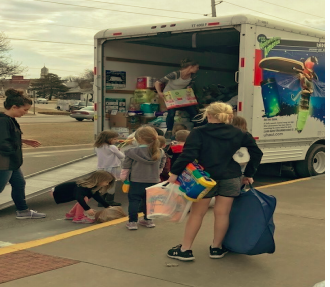
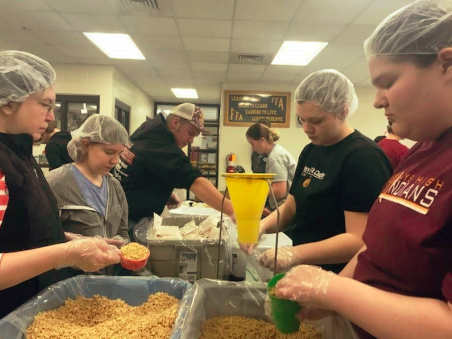
The Hays High School FFA students recently completed community service in the form of packaging 10,000 meals. The meals will be given to area families who are in need of assistance.
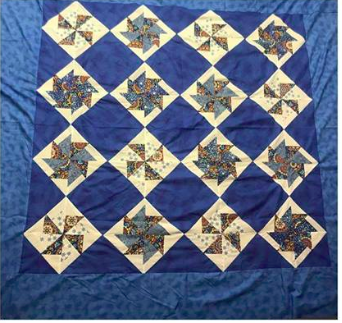
Quilt Cottage is hosting the “Fly Me to the Moon” art quilt show through April 25.
This show includes 56 art quilts commemorating the 50th anniversary of man’s first walk on the moon. The show is part of a larger collection that has been shown all across the country.
The quilts can be viewed during regular business hours 10 a.m. to 5:30 p.m. Mondays through Fridays and 10 a.m. to 3 p.m. Saturdays.
FHSU took a chance by giving an injured football player a scholarship to continue his education. For that student, Tré Giles, the opportunity was life-changing.
Giles, 25, has traveled across the world and affected scores of lives, but the college education that made all that possible almost evaporated before he had settled in as a freshman.
FHSU grad Tre´Giles is the youth minister for the CrossCurrent ministry at Celebrations Community Church in Hays.
Giles came to FHSU on a football scholarship. During football camp, he jumped up and his knee snapped. He tore three major ligaments in his knee, had reconstructive surgery and lost a lot of his muscle mass.
Football was no longer going to be an option.
Giles, a first-generation college student, grew up in Colorado Springs. It was just he and his mom, who worked 12-hour shifts at a local manufacturing plant to make ends meet. He described himself as a “knucklehead” in high school. It was about sports and meeting friends and that was it.
Stuck in Hays
“It honestly felt like I was stuck at Fort Hays out here at Hays,” he said. “I had one friend here that we came to Fort Hays together, but that was about it. It was a fresh new start in a place where everyone looked different than me. They talked different than me. That was the biggest culture shock I ever had in my life.”
Giles said the pace in Hays was a lot slower than back home. To fight boredom, he dug into his studies and looked for outlets to be involved on campus. He joined Black Student Union, the Management and Marketing Association, and Collegiate DECA.
However, without a football scholarship, Giles knew he did not have the money to continue his education.
“I was in the dorms and I remember getting a couple of letters in my mailbox saying I owed some absurd amount of money by this date otherwise you can’t continue your education. In my mind, my mom can’t come up with that kind of money and neither can I, so this was a cool run. I had an injury. I had fun while I was here and did good things and got good grades and got plugged in, but it’s not going to work. I pretty much had given it up.”
A second chance
When then Vice President of Student Affairs Dr. Tisa Mason found out Giles might have to leave school because of finances, she approached then-President Edward Hammond about finding scholarship money for Giles to stay.
“Our core values really get down to our personality characteristics of grit and determination, and that’s Tré. He works hard. He is determined. He’s positive. Not only did he come into a caring environment, but you know by his joy, he helps radiate that caring environment for every student faculty and staff that he meets,” Mason said.
She said she knew Giles was going to continue to make an impact on the world.
“I wanted him to enter that world with a Fort Hays degree,” she said.
Giles was working at the FHSU Union when Mason and Hammond approached him.
Giles during a study abroad experience in China.
“They pretty much just looked at me and said ‘We want you to know we have seen your investment in the campus and the groups, so just know you have a Presidential Scholarship. Your financial stuff is taken care of for this year,’ ” he said.
Giles said he broke down and cried.
“That is what kept me in Hays because in that moment, they empowered me to do things while I was here and stay here,” he said. “I developed a sense of loyalty to the community because of that moment.”
A turning point
Although Giles acknowledges there is a valid conversation ongoing in the U.S. about the necessity of students attending college, for him, college was a turning point in his life.
“College was not necessarily about the classes always or the piece of paper you get at the end,” he said. “To me, it was an opportunity to network and meet people. To me, it was an opportunity to get involved in organizations and other countries. Those opportunities would not have been in front of me if I wasn’t in college.
“I got to develop at a rapid pace and I was exposed to things that people from where I am from don’t really get exposed to because of this opportunity,” he said. “That taught me so much. It taught me how to lead people. It also taught me how to follow good leaders. It taught me how to empower others and to be empowered. It gave me a voice, and I realized that my voice means something and, in certain spheres, it is actually worth something. I don’t think I would have learned any of that if I had just gone back home or if I won’t have come to college.”
He said sticking it out in college changed everything.
Giles during a service trip as an undergrad to Guatemala.
Giles was a member of the Student Government Association and Global Leadership Project. He served on the board of Jana’s Campaign and worked with the United Nation’s Commission on the Status on Women during his tenure on that board.
During the Trayvon Martin trial, Giles organized a civil rights protest. He said the event was intense. A truck full of men attended the protest and broadcast racial slurs from a megaphone. Despite the tension, the protest was conducted peacefully.
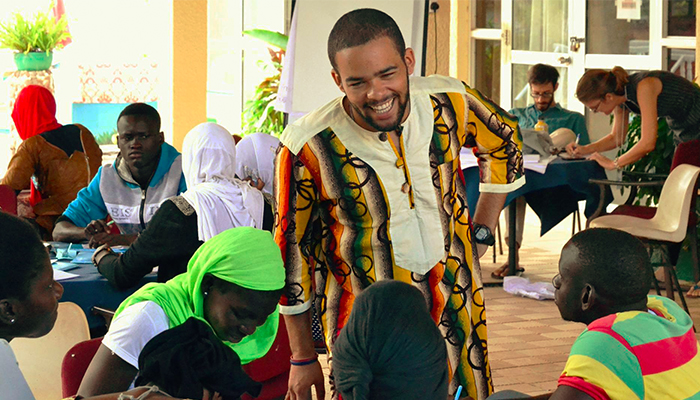
Giles had opportunity to travel to major cities across the United States and complete an internship with the Cancer Society in Kansas City. He spent time in China in an exchange program and volunteered at an orphanage in Guatemala. After graduation, he served in the Peace Corps in Africa.
Mason said if students lives are not changed during their time at FHSU, there has been a failure in the partnership between the student and the university. Helping students build confidence so they interact professionally and socially is important.
“It is more about learning who you are,” Mason said. “You are unlocking that untapped potential, gaining that sense of clarity and confidence about how you interact with other business professionals. …
“When we talk about wanting to have an impact on the world, it is really a broad impact, not only being good but bringing more social capital to our communities and economic prosperity and making Kansans and our families much, much stronger.”
A change for his family
Giles attributed much of his success to his professors who empowered him to use his voice and be a leader, but also to his mom.
She told him, “Tré, we struggled when you were young and I was younger, but we did everything we could to put you in a position so you wouldn’t have to struggle and you could change the narrative for our family.”
“My mom put in all the groundwork and all the foundation to where all I had to do was step into it and be consistent and show up,” he said.
“We have this saying with me and my mom. We call it, ‘Keep it pushin’. That just means no matter what shows up — the obstacles, the crap and even the triumph and success — no matter what’s in your way — you keep moving forward, you ‘Keep it pushin’.’ ”
Giles with his mother at graduation.
When Giles graduated, they both realized the significance of the moment.
“There was that moment that this might change us forever — our whole family dynamic. It is amazing that my kids — her grandkids — will have an even better life than I have because we are taking steps in that direction hopefully for generations to come. I get to be the first catalyst, because of my mom, to change our family.”
Finding faith
Giles also experienced a pivotal change in his spiritual life during college. Giles is now the youth pastor for the CrossCurrernt Ministry at Celebration Community Church in Hays, but he was not a Christian when he entered college.
He began talking to instructor LeeAnn Brown about her Christian faith. Giles’ father was not part of his life growing up, and Braun realized Giles had never had a father figure other than coaches.
At the end of his sophomore year, she introduced him to Dr. Jeffrey Burnett, health and human performance professor and leader of the college Encounter ministry. Giles was skeptical at first. He thought Burnett just wanted to use his influence on campus to bring more students into the ministry.
“For so long, I had seen Christianity as this cookie-cutter, boring thing where people were fake and pathetic, but that was the first time I met a Christian who was real,” Giles said. “He said, ‘Yo, it ain’t no cookie-cutter thing. This is about love. This is about sacrifice. This is about a decision and choice you make every day, and I want to challenge you with that.'”
Burnett described Giles when they first met.
“Tré always had that huge personality that attracted so many to his presence. Now he came from a home which was full of love from a very caring mother but also came with some hurts and instability from others,” Burnett said. “So even though Tré had his huge personality, he was a young man that was searching for a place to belong and really didn’t have a clear direction.”
Giles started going to the Encounter meetings on Wednesday nights.
“After a while, the narrative of Jesus became something I couldn’t live without anymore, and I really believed in it,” Giles said. “It healed me of so much hurt and pain and enabled me to be such a better leader, just leading how I believe Christ leads. I don’t have to say I’m doing it like Christ does. I just demonstrate it.”
Giles speaking at Celebration Community Church.
Giles continued, “Seeing something real and genuine, it was like ‘I will sacrifice for you and I will love you and I will stop and I will see you and I will support you and I will take your hand and I will walk you through the mud and I will celebrate you when you do good.’ That was Christianity for me, and that is what it is now for me. I cling to it.”
Alone in my hut
Giles said his experience in the Peace Corps solidified his faith. He was posted in Gambia in West Africa in a predominantly Muslim culture. The country is one of the poorest in the world.
He was sent to a village of 2,000 people — the only foreigner and the only Christian in the village.
“It was that time when I sat in my hut every day with no electricity and no running water and I would open my Bible and I would pray and my faith became mine because no one else around me could help me,” he said.
The connection he felt to his Christian faith was enhanced by the beauty he saw in the Muslim faith, he said.
“They sacrificed for each other. They all prayed together. There was so much family. The little they had they would give. There was not a single person who was starving in this village. Everyone took care of everyone,” he said.
Even if he does not move people to Christ, he said he hopes he instills self-dignity in them.
“I take all of these experiences and mash them all together for one thing you hope becomes a message that you hope people want to join and support,” he said. “I am learning now how to use all of these stories and experiences I have had in my short life to impact people.”
Self doubt
Despite being a regular motivational speaker, Giles said his greatest struggle is self-doubt.
“My biggest challenge has always been to be gracious with myself and to believe in myself,” he said. “That is what I care about is encouraging others and teaching them how to believe in themselves. I think that is why it is such a burden on my heart to help other people care for themselves and believe in themselves and to do things because that is my own struggle. I think the thing that burdens [people] the most is the thing that they can impact the best. …
“There is something about seeing someone figure out they are really worth something that helps me understand that I am really worth something.”
Giles with his fiancé.
Giles is recently engaged and is looking forward to his wedding and someday being a dad. He said his No. 1 goal is to be the “dopest dad ever and coolest, most supportive and loving husband.”
He said he is happy with his job working with students at Celebration Community Church, but he wants to keep expanding his reach to more people.
He said even at CrossCurrent, he knows he can’t reach every young person, but he can equip other leaders, so the ministry can reach every child.
“Someday, I want to get involved with taking so many micro-influencers — people who don’t have a million followers, but they have a thousand or a hundred really solid good people with them — and equipping those type of people to make big change.
“That is my dream. Do I know what that is going to look like yet? No. I know I will have a solid marriage and a solid family. I will be plugged into a solid church forever regardless of where I live, and I know I will always be involved in my community, trying to make those dreams a reality. I think if I do these things, the way it will happen will figure itself out.”
He added, “If we do well enough today, and another today and another today, I just feel the future will take care of itself, because we cared about today.”













 USD 489