Congressman Marshall has successfully led an effort to protect vulnerable patients from abusive behavior by air ambulance companies. In both Kansas and across the country emergency patients are being slammed with crippling and unforeseen bills from air ambulance companies who refuse to contract with the most common health insurance providers.
When driving is not quick enough for a patient in an emergency, one of three air ambulance companies are the only option for Kansans to get to the emergency treatment they need. But depending on which air ambulance company is called, the charge to the patient can vary by literally tens of thousands of dollars.
Just this year the Kansas Insurance Department has received more than 70 complaints from Kansans about air ambulance companies balance-billing more than $35,000 per emergency transport.
“For 30 years, I made patients and their care my top priority as a physician,” Marshall said. “These air ambulance operators who refuse to contract with hospitals or insurance companies are conning vulnerable patients. Leaving them in a position of choosing lifesaving care or an uncovered bill that could bankrupt them. This is simply unacceptable and immoral.”
Congressman Marshall’s bipartisan letter asked for the Federal Aviation Administration Reauthorization Act to include provisions authored by Rep. Woodall (R-GA) that work to address these egregious concerns.
The U.S. House of Representatives passed the conference report today, which included a great first step in addressing this issue. The legislation establishes an air advisory committee to focus on improving transparency and protecting consumers and allows the Department of Transportation to investigate and shut down unfair air ambulance practices.
“I was proud to see the conference report retain provisions that protect these patients, however this issue is far from rectified, and I look forward to continuing to advocate on their behalf.”
The USD 489 Foundation will have volunteers at the Hays High School football game from 6 p.m. until half time Friday to sell raffle tickets that will benefit Project 489.
Tickets can also be purchased at the district office at 323 W. 12th St. or over the phone with a credit card.
All proceeds from the tickets sold will help benefit the safety and security improvements in all of Hays public schools.
The sounds of children laughing and playing at FHSU’s Memorial Union grew to a roar Tuesday morning.
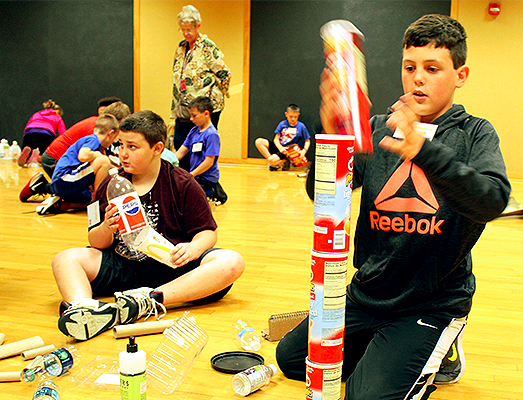
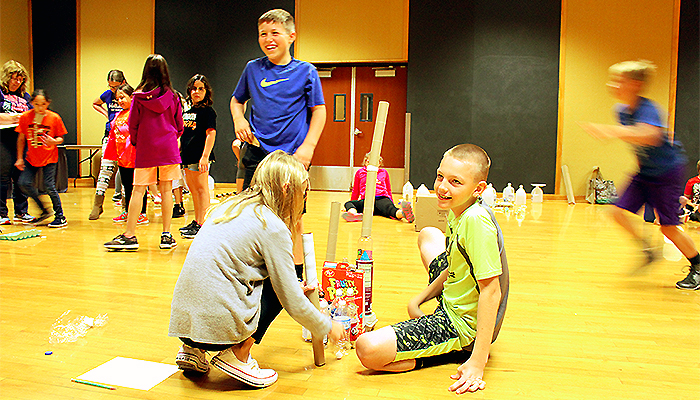
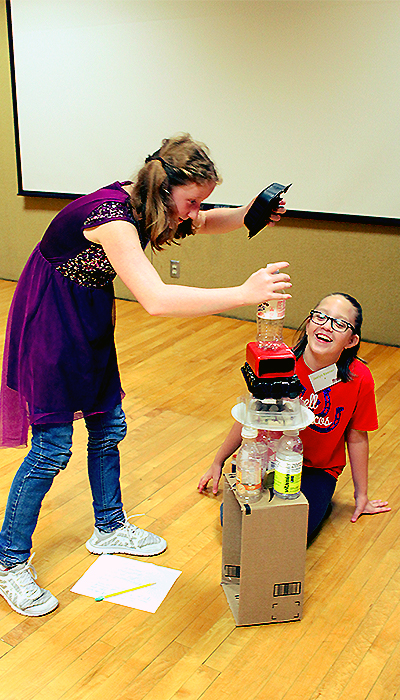
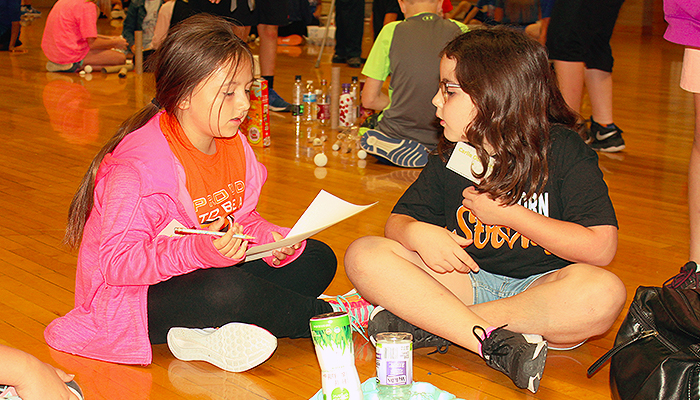
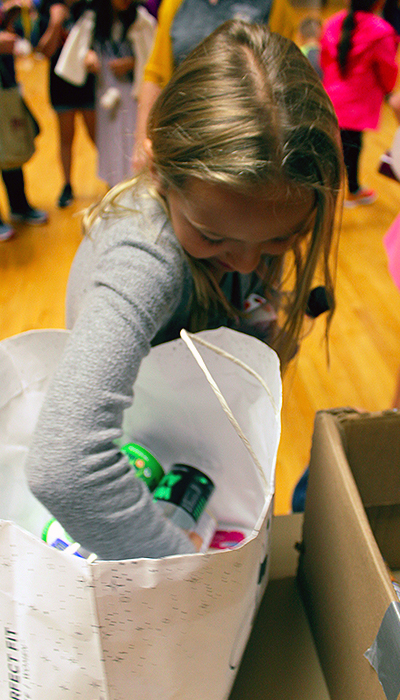
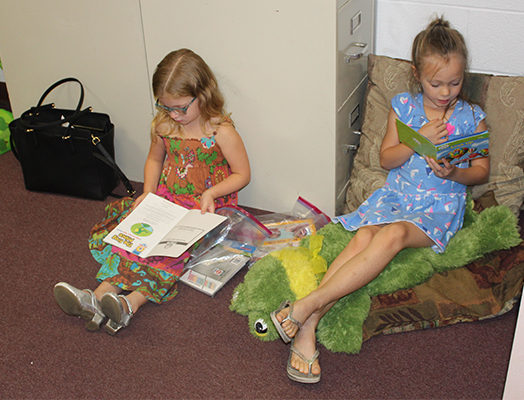
The students were encouraged to use recyclables to create their own games and then they were supposed to teach the games to other students during the Young Readers’ Conference at FHSU Tuesday.
The kids laid out paper towel rolls as race tracks, built towers and transformed plastic milk jugs into hungry monsters.
“I think it teaches them to be creative and to give them a little bit of ingenuity — ‘What can I make out of what other people see as junk?’ ” said Sarah Broman, FHSU assistant professor of education of the game-building activity.
The day started with an address from Dr. Tisa Mason, Fort Hays State University president. The students learned the story of William Kamkwamba from the book “The Boy Who Harnessed the Wind.” Kamkwamba used material gathered from the junkyard to build a windmill to power electrical appliances in his family’s home in Africa.
“Just to get kids thinking about that,” Broman said of Kamkwamba’s story. “Something that might be junk to somebody else could be something wonderful and help them and their careers or whatever down the road.”
Macy Patterson, fifth grader from Russell, described her group’s game.
“We are playing bowling,” she said. “We set up 10 bottles. We get two tries. We put corks in plastic eggs, and then it is basically just like bowling.”
Jonathon Franks and his friend Braxton Parsons, also Russell fifth graders, constructed Diaper Bowling.
These students used paper towel cores for pins and a square diaper box as the ball.
Both of the boys said they liked to read. Parsons said he liked to read the Stick Dog series, which is about a hamburger-hungry pooch.
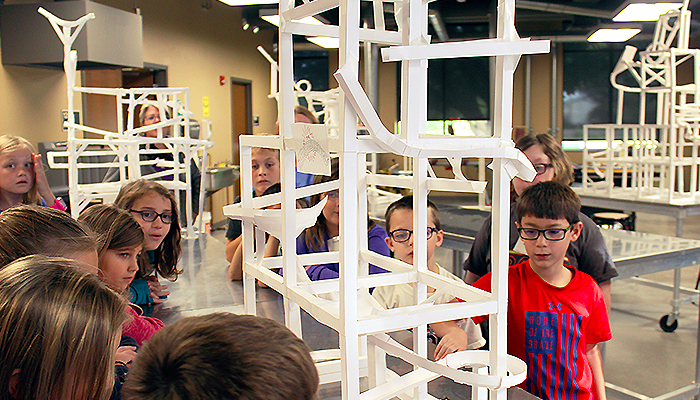
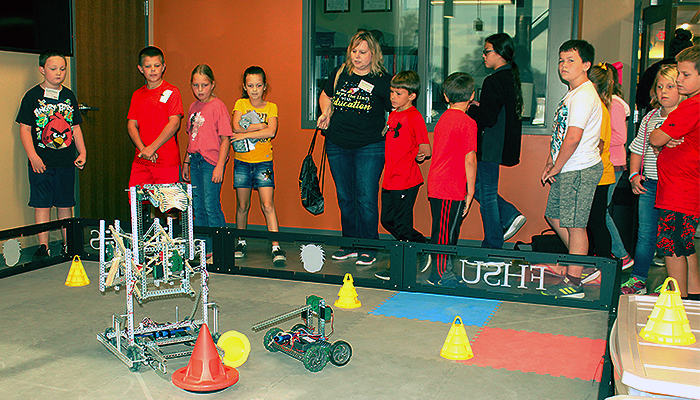
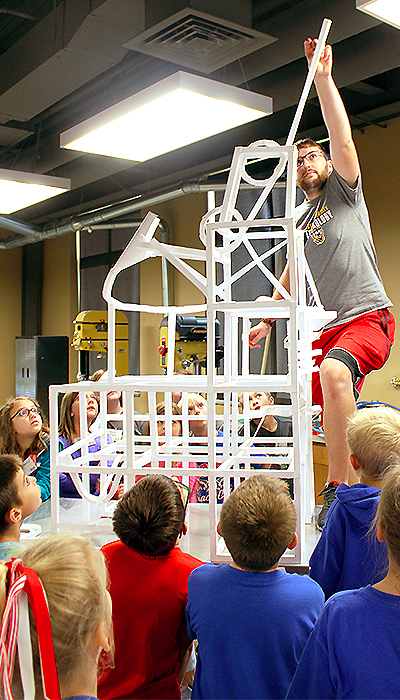
The students also visited with two authors, visited a bookstore created especially for them and visited the Center of Applied Technology building where they observed paper roller coasters and robot demonstrations.
Carrie Tholstrup, coordinator in the College of Education, said the tour at the Center for Applied Technology allowed students to better understand building materials.
“Our theme is ‘Reduce, Reuse, Recycle,’ so we were excited to have the paper roller coasters because we can show students you can make things out of unusual materials like maybe they wouldn’t have expected to make a roller coaster out of paper,” she said.
“We want to show them the principals of engineering and mathematics and that you can do fun things with those concepts.”
The Hays Public Library announced it will dedicate funds to each Hays USD 489 school library.
Vera Elwood, young adult librarian, announced the cooperative project at the USD 489 school board meeting Monday night. She said the first funds have already been requested.
“Our No. 1 goal at the Hays Public Library has always been is to get more books and more resources in the hands of more people, but particularly to the kids and students who need them most,” Elwood said. “We incredibly value working with schools and being able to work with USD 489 to reach out to those kids who are not always able come into our library for a lot of different reasons.”
The books that will be purchased with the HPL funds will stay at the schools and will not come back to the HPL unless they are no longer needed at the schools.
“The point of this was to empower and put that ability in the hands of staff that you have already determined to be so capable to make sure they have the resources they need to serve their students,” she said.
In addition, Elwood announced the HPL will be kicking off fundraising to purchase a book vending machine for Hays High School. She said the machine will be high tech and have many choices from which students can choose.
These two projects are just the latest developments in a partnership that has been growing over the last two years.
When schools in the district started its Reading Workshop program, teachers and school librarians realized they would need more books to accommodate the program than they had.
HPL checked out books to the schools in volume. It also offered books for temporary displays at the schools.
HPL staff helped students in groups and one on one to select books for book reports that were in line with teachers’ lesson plans.
Most recently, HPL conducted a library card drive. More than 650 students at HMS now have library cards. Students will not only be able to check out paper books, but be able to download ebooks.
Library staff will also be on hand at HMS and HHS for an upcoming teen book event.
Superintendent John Thissen thanked the library staff for their help.
“It is great to end up working with brilliant people. The brilliance of this is that we should have that collaboration — any community should have that collaboration between their library and schools’ libraries,” he said. “We have Individuals on the same page and it is the same book we are working from. We are really trying to do the same thing. …
“In the long run, who is going to benefits? It is going to be the children.”
The Hays USD 489 school board discussed the purchase of four new vehicles at its meeting Monday night.
The transportation purchasing schedule calls for the replacement of a gas bus, an activity bus, a car and a suburban.
The bid for the gas bus is $87,669. District staff requested a bid that was about $400 over the low bid, because it had the engine the district wanted.
The bid for the activity bus is $143,975, which was the low bid. Both bids were from Kansas Truck.
The district is also considering a purchase of an Impala for $38,952 and a Suburban for $21,194.
The total would be $291,790, which is less than the $304,000 that was budgeted for the purchases.
Board President Mandy Fox said since the vehicle replacement plan has been put in place, the transportation budget has been fairly consistent.
Russ Henningsen, transportation director, recommended a gas bus, because other districts have been having problems with the emission systems with their diesel buses. Those repairs can cost $5,000 to $10,000 for each bus. Henningsen said a repair such as that could wipe out the district’s transportation maintenance budget for the year. The gas buses are cheaper, gas is cheaper and the vehicles require less oil.
Board member Greg Schwartz questioned the move to a gas engine. He noted diesel engines generally get better gas mileage. Although they require more oil, they generally can go longer between oil changes. A diesel engine also generally can be driven more miles than a gas engine.
Schwartz also asked how many bus routes the district is running.
The district is running eight regular routes, three special needs routes and two Head Start routes, Henningsen said. Four years ago the district limited its bus routes to students living two and half miles or more from their schools. The district is required by law to bus these students and is reimbursed by the state for transporting them.
Special needs and homeless students are an exception, and Henningsen said the district has made exceptions for handful of other students. A computer program determines which students are eligible for busing and draws the routes.
The district also transports about 20 to 30 Holy Family and Thomas More Prep-Marian students. This is required by law if there is room on the buses. The district is not reimbursed for this service.
“It is a good shared resource for the community,” board member Paul Adams said.
Henningsen said it is common to have all of the vehicles out. Teachers use Suburban and cars for activities, such as golf and tennis, for teacher in-service trips, to transport students for work study, and to move small groups of students from school to school.
The district tries to keep at least one spare bus in case a bus breaks down, which has happened in the past.
By rotating out older vehicles, Henningsen said the district is trying to prevent breakdowns.
“That is always at the back of my mind — is the safety of students, especially during winter time being on the road and breaking down. We try everything we can to upgrade the fleet for the safety of everybody,” Henningsen said.
Schwartz asked if the district could use fewer Suburbans and more cars to reduce cost.
Henningsen said he teachers are required to car pool. The Suburbans are sent out full. The Suburbans are being used in lieu of buses, which are more expensive to operate and require paid bus drivers.
The older vehicles that are being phased out of the district fleet will be sold.
The board is set to vote on the vehicle purchases during its next meeting on Monday, Oct. 8.
The board also finalized its new goals.
At its last meeting, it narrowed goals to the following:
• Design a stable financial structure that allows the district to accomplish its educational mission.
• Create an educational improvement guide utilizing the Kansas Educational Systems Accreditation process.
• Develop a plan to prepare the district for the future.
The board also accepted the resignation of Tracy Kaiser, executive director of finance and support services, as part of its consent agenda.
The board met in executive session to discuss non-elected personnel, preliminary discussion on the purchase of property and teacher negotiations. No action was taken after the executive sessions.
The Family Night Out will be 6 to 8 p.m. Tuesday, Oct. 23
Vera Haynes, young adult librarian with the Hays Public Library, will present “Telling Your Story .”
Share with other parents what works and does not work in raising healthy children and building strong families. Interactive learning will be provided from a variety of professionals in their area of specialization related to child and family relationships. The event is for all families in our community with children 0-10 years of age.
There will be a meal and child care provided. The meal will be served from 6 to 6:30 p.m. RSVP for child care by noon Oct. 22.
This program provides support for immediate family members who are healing from the death of a child in their lives.
It is offered in a safe, confidential but friendly and informal environment where parents, grandparents and siblings can connect with others who understand the journey toward healing after the loss of a child.
The group focuses on identifying each individual’s personal strengths in helping them chart their healing journey according to their own situation and needs.
When: Thursday, Oct. 11
Gathering: 7:00 p.m.
Center for Life Experiences
2900 Hall St., Hays, KS 67601
For more info:
Ann Leiker – Coordinator – Call/Text 785-259-6859
Doris Schmidt – 785-735-2578
Healing After Loss of Suicide will meet at 5:30 p.m. Wednesday, Oct. 10 at Chinese Food Express |1312 Main St., Hays for dinner
It will meet at 5:30 p.m. Wednesday, Oct. 24 at Cancun’s Mexican Rest., 1011 Elm St., Hays for dinner.
A gathering will follow both nights at 7 p.m. at the Center for Life Experience, 2900 Hall St., Hays.
Supervised child care will be available.
This program offers family members and friends of those who have lost a loved one to suicide a place to connect with others healing after loss of suicide.
For more information, call Ann Leiker at 785-259-6859 or email [email protected].
The Healing After Loss group will meet Tuesday, Oct. 2.
Diner will be at 5 p.m. at Jalisco Mexican Restaurant, 2520 Vine St., Hays.
The group will also meet for dinner at 5 p.m. Tuesday, Oct. 16 at Thirsty’s Brew Bar & Grill, 2704 Vine St., Hays.
The group will gather both days after dinner at 6:30 p.m. at the Center for Life Experiences, 2900 Hall St., Hays.
Supervised child care will be available
This program offers mutual support for those who are healing from an adult loss in their lives such as a spouse, parent, sibling or friend. This group gives emphasis to the particular needs and situation of each individual by sharing the strengths and knowledge that each person brings to the group.
Many resources are available to the group through the Center for Life Experience library.
For more information, call Ann Leiker at 785-259-6859 or email [email protected].
National Alliance on Mental Illness Hays will have its Recovery Support Group and Family Support Group from 6 to 7 p.m. Monday, Oct. 1 at The Center for Life Experience. There will be no education workshop this month.
The Center for Life Experience shares in the leadership and administration of the NAMI Hays Affiliate and is the point of contact for the public for information, referrals and support.
The center provides the meeting facility and houses the Affiliate’s reference library.
For more information, contact Ann Leiker at 785-259-6859 or [email protected].
The Hays USD 489 school board will discuss new vehicle purchases at its meeting Monday.
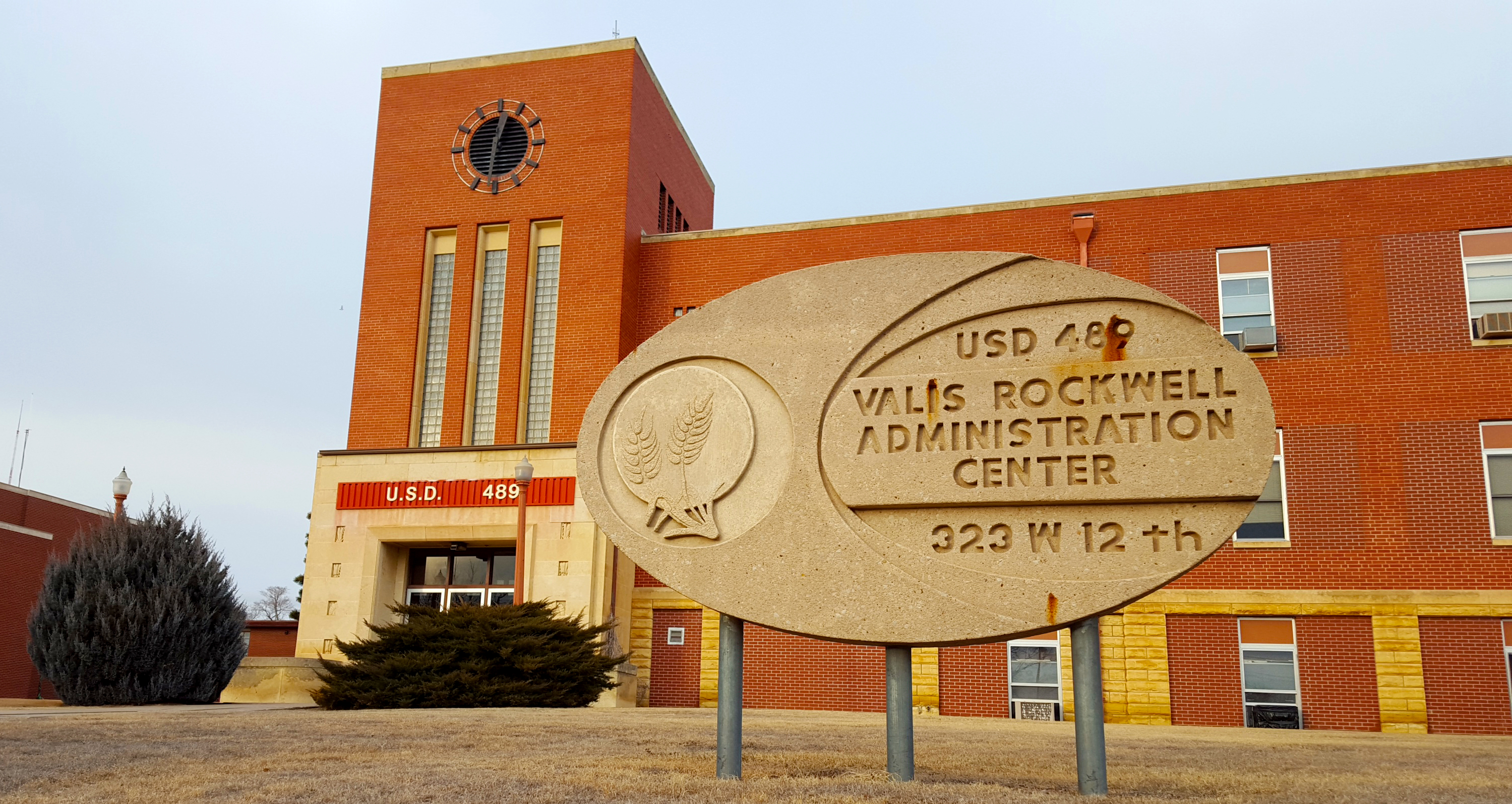
The board will meet at 6 p.m. at the Rockwell Administration Center.
The transportation purchasing schedule calls for the replacement of a gas bus and a yellow activity bus.
The bid for the gas bus is $87,669. District staff requested a bid that was about $400 over the low bid, because it had the engine the district wanted.
The bid for the activity bus is $143,975, which was the low bid. Both bids were from Kansas Truck.
The district is also considering a purchase of an Impala for $38,952 and a Suburban for $21,194.
The total would be $291,790, which is less than the $304,000 that was budgeted for the purchases.
The board also will continue to refine goals during its meeting.
At its last meeting, it narrowed goals to the following:
• Design a stable financial structure that allows the district to accomplish its educational mission.
• Create an educational improvement guide utilizing the Kansas Educational Systems Accreditation process.
• Develop a plan to prepare the district for the future.
The board will also meet in executive session to discuss non-elected personnel and teacher negotiations.
Ken Windholz, psychologist, will present “Your Child’s Rapidly Developing Brain—and You.”
Share with other parents what works and does not work in raising healthy children and building strong families. Interactive learning will be provided from a variety of professionals in their area of specialization related to child and family relationships. The event is for all families in our community with children 0-10 years of age.
There will be a meal and child care provided. The meal will be served from 6 to 6:30 p.m. RSVP for child care by noon Sept. 24.
Braden Mahin of Lincoln, Kansas, works on the radiator of a car in his auto mechanics class at NCK Tech in Hays.
Editor’s note: This is the third in series about technical training for a new workforce.
By CRISTINA JANNEY Hays Post
Nineteen-year-old Braden Mahin of Lincoln wants to work on electric cars.
He came to Hays to study auto mechanics at North Central Kansas Technical College right out of high school with no real experience working on cars.
“I have always had an interest in cars ever since I can remember,” he said. “I just wanted to know how they worked, and I never had anyone to teach me, so I thought coming here I would learn everything I needed to learn.”
Mahin is one of many students who are skipping college in favor of a technical education.
NCK Tech officials say the demand for their graduates is high — and their stats prove it. The technical college has been No. 1 in the nation in student placement two years in a row.
Richard Cox, auto instructor and former NCK Tech student, has worked for years to cultivate relationships in the auto industry and boasts of a 95 percent placement rate for his students.
Eric Burks, NCK Tech president, said enrollment at the technical school has remained steady, but insists there is a strong demand for trade skills now and will be in the future.
“We train in programs [and] jobs that are needed right here in Hays and in the communities these students come from. They have been needed for a long time, and I think they are going to continue to be needed for a long time. I think it is just the technology within those trades that is going to change,” Burks said. “The tools they use to do those jobs are going to change, but we are always going to need a plumber, we are always going to need a nurse, we are always going to need someone to fix our vehicles.”
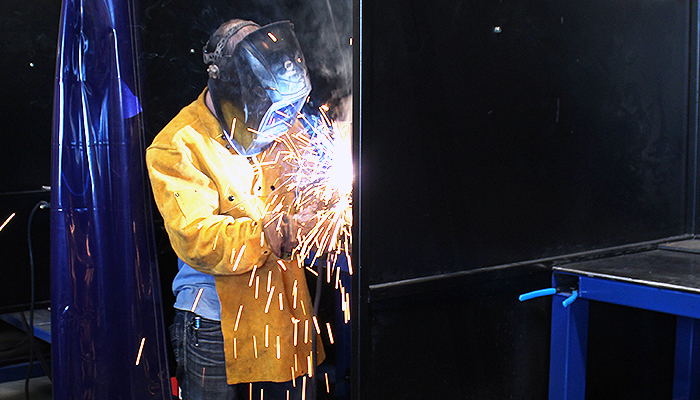
An NCK-Tech student works on a welding project. The college boasts of the best placement rate for students in the nation.
The economy is demanding skill sets, Burks said.
“Knowledge is great, and we want people who are very knowledgable, but at the end of the day, what can you do with that knowledge?” Burks said. “Just knowing it is one thing, but you have to be able to actually apply it. That is where these technical skills really become the difference maker for someone who not only has the knowledge of it, but the working ability to apply that knowledge.”
Sandra Gottschalk, dean of the Hays campus, said students learn their skills by doing.
“It’s a lot of hand-on practice,” she said. “With that hands-on practice, they get more skilled and they get more confident and more proficient. They learn the fundamentals in the course, but it is that hands-on experience that is what ties it together.”
Burks and Gottschalk said as they work with high schools, they are seeing a shift to more focus on technical education.
“I think it is because that is where the jobs are,” Burks said. “Not to keep going back to that job placement, but we have no trouble helping our students find jobs They have to meet a few requirements, but we guarantee placement, and that is because they are in such high demand.”
Burks said K-12 schools are seeing not everyone is headed to a four-year college.
“There is definitely that push toward technical because that’s what is needed, and it is also going to give our economy the boost that it needs,” Burks said. “If we push everyone into those four-year degrees, then we are not going to have enough people to do the other things that really need to be done, and they are high-paying jobs. It is not people who are living on the other side of the tracks. These are [people] living next door to four-year graduates. The quality of life is right there the same.”
As Burks addresses high school students he tries to dispel myths about vocational training.
“They are not choosing a lesser life if they go this route,” Burks said. “They may choose less debt if they just go through two years. A lot of these trades are highly sought after, and if they are skilled, they can get paid very well and very comparable to a four-year degree. …
An NCK Tech welding student grinds off an edge in the new Center for Applied Technology on the FHSU campus.
“Obviously, it is going to depend on their skill and how hard they work at it, but the sky is limit for someone who is disciplined, like we talked about earlier, and talented.”
Costs continue to rise for four-year degrees. Students going to a technical school are likely looking at less debt and being able to enter the workforce in their field sooner.
Most students graduate in nine to 18 months with tuition, tools, and room and board costs ranging from $5,900 to $15,000 per year. Costs usually drop for subsequent semesters as students do not need to repeat tool purchases.
Burks said we often think of education as linear, but for many students it is not. He said he thinks recent legislation and articulation agreements with universities like Fort Hays State University are making it easier for students to continue their education at a later date.
“Maybe they got some skills through their high school credits, and they want to go out and work for a little bit. Then they realize, ‘I need to upgrade my skills if I want to up my wages,'” he said. “So they will come to us for a year, go back and work in the field for a little while, and they will come back for another year and get some more skills and go back. We have tried to build this system, so if they want to do it linear and go one year after the next, great, but that is not how all students are going to work through this.”
Because NCK Tech is a technical college, students can start with NCK Tech and go on to a four-year college.
FHSU saw the growing need for trade leaders and constructed the new Center for Applied Technology on its Hays campus.
The building is housing students from both NCK Tech for classes, such as welding, and FHSU students who are training for applied technology degrees to be tomorrow’s managers and foremen.
FHSU has a bachelor of science in technology studies and a bachelor of science in technology leadership. These degrees are between technical degrees and engineering science degrees at a Division I school, said Kim Stewart, FHSU’s Department for Applied Technology chairman.
Students go on to be construction managers, project managers, superintendents, 3-D modelers or building information systems managers.
Just as NCK-Tech sees a blend of traditional and non-traditional students, so doses FHSU’s Department for Applied Technology.
In the department’s leadership program, students can transfer 40 hours from a technical or community college degrees and plug them into the bachelor’s degree program at FHSU. General education credits can also be applied.
The FHSU program is interdisciplinary with business, communication and leadership classes. This is an all online degree because most of these students have already developed their technical skills and are working and have positioned themselves to move up in their companies, Stewart said.
FHSU has had articulation agreements with other institutions for years, but it is recently revisiting those and making it easier for students to see and understand how courses they are taking at vocational or community colleges will fit into bachelor’s degrees at FHSU.
“I think it is going to open up avenues, based on students being able to see the path that is going to take to get to their educational goal,” Stewart said.
Stewart is seeing a growing demand for the department’s program’s and its graduates. Five years ago, the college started its construction management program with two students, and now it has 50. Many students are being recruited as juniors during their internships.
“There is a demand for labor people,” Stewart said, “and the more labor people that we have — those that have technical skills — means that we need more people to manage those people. So our niche is to create those people who can go out and be the project managers and superintendents — the people who work with the engineers.”
Misael Banderas is a 2016 FHSU graduate in construction management. He started working on construction sites when he was in high school and currently works as a senior project engineer for McCown Gordon Construction of Kansas City, Mo.
He said he was able to pick a company where he thought he could thrive professionally and personally.
“I think the biggest misconception that a lot of students have within the region is that they have to go to a KU or a K-State or an OSU for you to have the position that I have,” he said. “I can assure you based on opportunities that have come up for myself, I am driving my own career. I have been blessed with multiple, very exciting opportunities from the world’s No. 6 company in the world.”
He said his hands-on experience allows him to better relate to the people he now manages.
“My memories were all started with a shovel,” he said.
Banderas said he is proud to be a FHSU graduate and is now trying to open doors for other FHSU students at his company.
“I reached out to our talent development team and took a trip to recruit out of Hays,” he said. “I think moving forward we are going to have a partnership where we are reaching out every summer to try to have students as interns. If they work out, if they use every opportunity to grow, hopefully [we can] bring them on board when they graduate.”