We have a brand new updated website! Click here to check it out!

NEW ECONOMY: Public education opens paths to trade careers

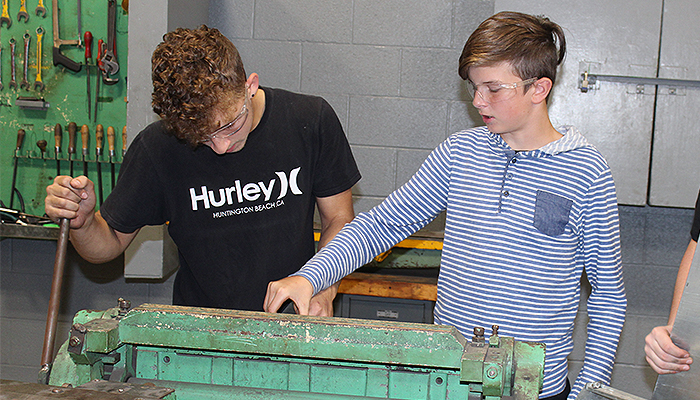
Larry Defoi, sophomore, and Devin Mayfield, freshman, work on a project in a beginning metals class at Hays High School. The Kansas Department of Education has 16 pathways in its Career Technical Education program.

Editor’s note: This is the second in a series about technical training for a new workforce.

By CRISTINA JANNEY
Hays Post 

At one time, students in high school were told the passport to prosperity led through college and was stamped with a four-year degree.

Although for certain students this is still going to be the case, the Kansas Department of Education has begun to acknowledge in its new accreditation process four-year degrees are not the answer for all students.

“They want to make sure we are tending to the needs of the students from the point of not just focusing on four-year college or four-year university degrees,” Hays USD 489 Superintendent John Thissen said. “They definitely want to focus on trying to prep children to work on HVAC systems, to be plumbers, to end up being an electrician, to be a welder.

“All of these are important jobs, and they are needed and they pay quite well too. We have a history in our school of not paying as much attention to prepping students for those areas.”

The new push is to create individual plans of study that highlight students’ strengths and allow them to explore career opportunities. This is includes many current and emerging careers that will require some sort of post-secondary trade education or certification. The students take surveys through the Career Cruising program that help them refine career choices.

Thissen said the assumption used to be “smart kids” all went to college. That now is not necessarily the case.

“It is crazy to think we would expect our kids to graduate from high school, go to a university, spend four years there and then realize that what I really want to do is be an electrician. That is ludicrous. It doesn’t make sense,” Thissen said. “We should do a better job of prepping the kids through public schools in K-12 that at least they have a good enough direction that they know what they want to do and they are not wasting their own time and their money.”

Sabrina Brown and Luke Letters, both HHS freshman, work on metals projects. The state’s new accreditation project includes individual plans of study, which allow students to explore careers.

KSDE supports 16 career pathways, which are careers the State of Kansas deems as high-tech, high-demand and high-wage, said Chris Dinkel, HHS industrial technology teacher.

Some of these include construction trades; metals and manufacturing; agriculture; business; consumer science; and radio/TV. Many of the pathways require a two-year degree or certificate and then students can go straight to work.

The demand for skilled workers is increasing, and so the education model needs to change with it, according to Dinkel.

Since the turn of the century, about 20 percent of the population were professionals, Dinkel said. They have at least a four-year degree and perhaps higher. These are doctors, lawyers, accountants, therapists, etc. That percentage has not changed per capita much in the last 80 years.

The majority of the remaining workers in the 1920s were unskilled. That has flipped in the last 30 years to a high percentage of skilled laborers.

“Kids coming out of school need to have some type of training, period,” Dinkel said.

Thissen said the KSDE is pushing districts to offer students paths to trade certifications while still in high school. This could be a welding, OSHA safety or Microsoft Office certification.

Matthew Bollig, HHS freshman, handles a piece of sheet metal. HHS teachers work with students on soft skills as well as learning trade skills in the CTE program.

Thissen said students are responding to Career and Technology Education offerings at the high school. The district is considering changing its hiring to accommodate what are now oversized welding classes.

Dinkel, who has been a CTE teacher for almost 30 years, said this need for skilled workers has been recognized, but states, including Kansas, still have challenges in meeting the needs of industry.

Focus on core curriculum and four-year professional training is an important part of K-12 education and must be an academic focal point, he said. However, it’s as important educators recognize the academics and skills needed for those students choosing CTE paths, Dinkel said.

Students who are in CTE pathways might not need calculus, but they might need industry-relevant math and English.

CTE has become increasingly oriented on cooperative learning and project learning. A student learns skills and practices them by building something in metal shop or wood shop. Students take a project from beginning to end and fit their skill sets into that project. There is more focus on skill development than there used to be, Dinkel said.

Schools are also trying to build cross-disciplinary cooperation. Students in a drafting class develop plans for a metal project or part. They learn in metals class how to use those plans to program the CNC plasma cutter. They then use welding skills to assemble the pieces into a final product.

The math instructors are also seeking floor plans from building trades teachers to create real-life problems to use in their classes.

Thissen said the district continues to try to expand its hands-on experiences for students. Hays High students can gain on-air experience on a new HHS radio station that launched last school year. The district IT department is also in talks with the administration about involving students in helping other students or teachers solve technology issues.

In some pathways, students can work in their fields through summer jobs or internships. However, now legally you have to be at least 18 to even operate a drill on a construction site. However, Dinkel said even working entry-level, service job can show a future employer a young person has the soft skills they need to be successful in a trade job later.

Another important thread is providing parents with information about careers within CTE pathways and the opportunities they provide.

Starting wages for technical school graduates are now higher than those for four-year college graduates.

Dinkel said he sees his job as preparing students to have the ability to make a choice between going straight to work, going to a technical school or to a four-year college or higher.

The Career and Technical Education program or CTE has an advisory board made up of people who work in the pathways the high school offers.

They generally say they have three levels of employee. The first level is entry-level. An employee can read, write, do basic math, show up to work on time and has the ability to work with others.

The second level is an employee is someone with some training. They may have a skill, such as welding.

The third level is a person with formal training, certification or experience.

“What industry is telling us is that if I can get someone to show up on time, to be honest and be able to work cooperatively, many of them will say, ‘I will train the rest because I can’t even find that,’ ” Dinkel said. ” ‘I can’t even find someone to show up on time and put in an eight-hour day.’ ”

Thissen said he also hears from employers their need for soft skills among future workers.

“They are finding there are a lot of students that graduate high school who may be knowledgable, but are very much lacking in what we would almost say are common-sense issues,” Thissen said.

Thissen said teaching students these needed skills is almost a hidden curriculum across all classes. He gave the example of mock interviews that were being conducted at the high school by the English department. Students not only learn how to create a written resume, but the practical skills of how to dress and speak during an interview.

“We even see people who are coming in for jobs for the school, and they come in 10 minutes late for an interview. That is already not a good sign, and they may show up in shorts and a tank top—very inappropriate dress for an interview,” Thissen said.

Dinkel said he thought young people have high expectations.

“Young people want to come in and make 12 bucks an hour right off the bat,” he said. “That salary is just not going to be there. That’s not high, but if they can’t make $10 plus an hour, it is below them.”

Dinkel said educators continue to struggle to keep up with evolving industries they are training young people to enter after graduation. Recently the metal shop received a grant to purchase a computer numerical control plasma cutter. Dinkel said CNC is really the direction industry is headed, but Hays is behind other schools who have had the technology for years.

For most, HHS needs another CTE instructor. The school can’t offer robotics, code reading, CNC, or materials and processes, which includes plastics, because the school does not have the staff or the space to do so.

Wood shop classes have 20 to 25 students, which Dinkel said borders on dangerous.

The district sought to expand and remodel its CTE space as part of a recent failed bond election. Thissen said he would still like to see work down in this area of the high school to better use the space and expand the school’s class offerings.

Dinkel sad he thought more young people would stay in the Hays area if there were more high-tech, high-paying jobs. However, the most abundant jobs continue to be lower-paying service jobs.

“It is kind of like fighting Peter to pay Paul,” he said. “Service-related jobs are not going to provide the type of salary that people need to live in this area because the cost of living is pretty high. It is a nasty circle here, because if you bring high-tech jobs in, what are you going to need — more service-related jobs. So which pool are you pulling from?”

Time running out to pick up Farm to Fork tickets

By CRISTINA JANNEY
Hays Post

The Downtown Hays Market third-annual Farm to Fork dinner is closing in on a sellout.

Only 30 out of 100 tickets remained as of Friday afternoon.

“We want people to have an intimate evening on the Bricks. We want people to have conversations with people they have never met before,” said Sara Bloom, Downtown Hays Development Corp. executive director. “We want them to interact with our Downtown Hays Market vendors who are able to attend. Some of the uniqueness of this event is the local meats and produce used in this meal, and we want people to be able to ask questions about what they are eating and share why they are there.”

The event will be 6 to 9 p.m. Friday, Oct. 12, at the Downtown Hays Pavilion.

Gella’s executive chef Manuel Hernandez will transform food from local producers into a an elegant five-course meals. Bloom said Hernandez really makes the event as he helps serve the food, talks about the ingredients and shares his passion for local produce and ingredients.

Diners will start with a choice of five appetizers, including honey chicken, roasted corn salsa and chips, bacon-wrapped dates, mushroom quesadillas, grilled and chilled veggies, and watermelon and mint salad. The soup course will be cream of asparagus. Then a cantaloupe, jamon, serrano and arugula salad will be served. The entrée will be a paella with sausage, pork, chorizo, chicken and seafood served with saffron rice. Home and pear cardamon cake will be served for dessert.

This will be the first year the dinner will be in the Pavilion.

“To be able to have an outdoor fall event in the Pavilion where the market actually happens and be hosting an event that benefits the market, it is going to be a really unique addition to the event,” Bloom said. “I am really excited to see decorations and the lighting underneath the Pavilion. It is going to be amazing.”

Flower arrangement will be done by Regeena’s Flowers, which may use flowers from Bethesda Place if they are available. Svaty’s Produce will provide miniature pumpkins as gifts to all the guests. Centerpieces will also be coming from Personalize It by Rhiannon.

Music will be provides by a jazz group from Fort Hays State University.

A Celebration Community Church group will be servers this year.

The $60 per person ticket also includes wines from Resurrection Vineyards and a honey beer created by L.B. Brewing Company made with local honey from Jensen Farms. You must 21 or older to attend.

Tickets can be purchased while they last on the DHDC website or at its new location at 1200 Main St.

All proceeds from the event support the marketing fund for the Downtown Hays Market. It allows the market to offer its spaces at no cost to its vendors.

The Downtown Market moved to the new Downtown Pavilion at 10th and Main streets this season, which Bloom said has been a great success.

She said people have loved having the market under the Pavilion instead of across the street out in the sun.

“It has given the market another environment and a special aura to it,” she said. “With it being under the Pavilion, people grab a free cup of coffee, they stay all day, they shop and they talk and it is has really become the gathering place that we have always pictured what the Downtown Hays Market could be.”

More than 60 vendors registered with the market this season with as many as 37 selling at a single market.

The market brought in vendors this year from the Nebraska border to Stafford to west of Colby and from as far east as the Salina area.

“For people to see the value in our market and to drive that far every week on a consistent basis really speaks not only for our market, but for the Hays community,” Bloom said. “It is generating sales tax on a weekly basis, not only from their sales, but they are eating breakfast here. They are eating lunch here. They are getting gas in their tanks before they leave. I think the economic impact of the market is bigger than a lot of people in our community realize. That is really exciting for us, and we can’t wait to see how it is going to grow.”

There will only be five weeks left in the market including this Saturday. The last market Saturday will be Oct. 20. The market is open 7:30 to 11 a.m. Saturdays spring through fall.

NEW ECONOMY: Lack of skilled workers biggest barrier to Ellis County growth

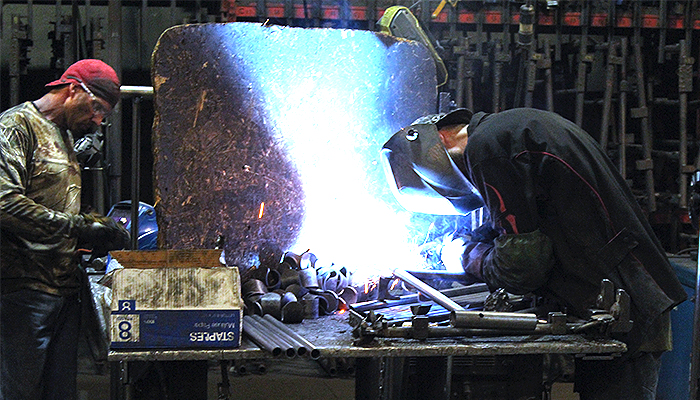
A worker welds a piece of equipment at A-1 Scaffolding in Hays.

Editor’s note: This is the first in a series about technical training for a new workforce.

By CRISTINA JANNEY
Hays Post

Finding qualified workers to meet the demand of Ellis County’s growing industries is the biggest obstacle to growing its economy, said the interim director of the Hays-area economic development agency.

Doug Williams, Grow Hays interim director, said Ellis County’s problem is a combination of low unemployment and lack of skilled workers.

“If a company cannot find capable workers, they are going to go some place where they can,” he said. “They are not only not going to grow with those workers they would potentially employ, but they are also going to potentially take the workers they have out of our community. It is a big problem, so that is why it is a high priority for us.”

Unemployment in Ellis County remains low at 2.9 percent as of July. Unemployment hit a 25-year low of 2 percent in October 2017. The Ellis County unemployment rate hasn’t been more than 4 percent since right after the 2008 recession.

“We have a very low unemployment rate,” Williams said. “Really the rate of unemployment would tell you anyone not working probably is choosing not to work. But what we are trying to do is increase skills amongst the workforce so they can get a better job or a higher-paying job because those are critical to our area, not just minimum-wage jobs, but technical jobs where they have a skill and can earn a higher living so they can buy a home, buy a car and live a better life and provide more economic growth.”

During the early 1990s, Dwight Allenbaugh was recruited to bring his A-1 Scaffolding business to Hays because the community needed employers. Today, Allenbaugh struggles to find employees of any skill level.

“It is not so much a need for skilled workers,” he said. “It is being in need of anybody that wants to work. The absence of workforce is huge.”

He said he thought a lack of affordable housing was a significant contributor to lack of workers.

“The cost of housing is way too high compared to Salina, Wichita, anywhere else in Kansas. It’s way too high,” Allenbaugh said. “For people to be able to afford housing here, they have to be in the $20 to $25 an hour range.”

A-1 Scaffolding owner Dwight Allenbaugh said he would hire at least six more employees at his Hays plant if he could find them.

Allenbaugh said he can’t keep up with that wage and stay competitive nationally.

He said he struggles to find workers with basic soft skills, such as showing up on time. He said the company used to have a policy that no-call, no-show meant automatic termination. Now he said he has had to ease such basic policies to maintain his workforce.

“It’s gone from a job interview to fog a mirror. If you can fog this mirror, you are hired,” he said.

A-1 Scaffolding implemented an Earn as You Learn program. A-1 starts new, unskilled workers out at about $9 an hour. He allows unskilled workers to spend the last hour or two of the day in the shop practicing their welding skills. As workers prove themselves, they are promoted quickly and given raises.

Grow Hays is trying to help match employer demands with the available workforce by promoting training programs.

“I do think it is more important than it has been in the past,” Williams said of vocational training. “For no other reason, there seems to be a huge shortage of technical workers. We work with manufacturers locally, and we constantly hear from them they can’t find qualified workers.

“We have taken the position as an engine for economic growth here in Ellis County, we need to come up with programs educate workers and provide more qualified workers to the job market, and that is what we are trying to do.”

A-1 Scaffolding has an Earn as you Learn program. Workers spend the last hour of the day learning to more advanced skills, such as welding.

Williams said employers are saying they especially see a need for welders and CDL drivers. Allenbaugh said having more welders in the workforce would benefit his recruiting efforts.

The demand for truck drivers is on the rise nationwide, according to the Bureau of Labor Statistics. Demand is anticipated to grow by 6 percent between 2016 and 2026.

NPR, in a January article, said an American Trucking Associations report indicated more than 70 percent of goods consumed in the U.S. are moved by truck, and the industry needs to hire almost 900,000 more drivers to meet rising demand. The current trucker pool is also aging, with the Bureau of Labor Statistics reporting the average age of a trucker at 55 years old.

The bureau stated the median pay for drivers nationally was $42,480 per year in 2017.

Most truck drivers have high school diplomas, but attend truck driving school to attain the commercial driver’s license needed for the profession. Until this fall, the closest truck driving course was offered through NCK Tech in Beloit.

However, this fall a new free class will be offered at NCK Tech in Hays. Funding for establishing the class and a another welding class the partners hope to offer before the end of the year came from a $200,000 grant from the Dane G. Hansen Foundation.

Students in the program will have both in-class and in-truck experience.

See related story: Applications open for free CDL course

See related story: MORAN: The DRIVE-Safe Act and Myth vs. Fact

“The theory is that we can turn out workers. They may not be able to step into a job and do what the company needs, but they have a basic skill level, and the company can then train them to specs they would want,” Williams said.

“We solve two problems,” he said. “We take someone who is not making a lot of money and having a tough time making ends meet and give them the opportunity to get to a higher level of pay. We also solve the problems that the companies have of finding qualified workers so they can get their products out of the door and continue to grow.”

Williams said the gap between what white-collar workers make and blue workers make is closing. This in addition to changes in emphasis in K-12 education in Kansas on career readiness may lead to more emphasis being placed on teaching trade skills in schools.

“I know some electricians, some plumbers, some welders, they can make a very good living now doing what they do in a technical capacity. I don’t think that has always been the case,” Williams said. “Historically the path to a really good, high-paying job was always through a four-year institution or a master’s — that kind of thing. I don’t think that is quite the path that it once was.”

Allenbaugh said vocational training in high school or at a technical school can be an option that can lead to good-paying jobs.

“I think vo-tech is an awesome for people who want to learn skills,” he said. “I think that is a good place to start. …

“It gives kids an option. They feel so much pressure to continue their education and go to higher education. They take it for granted their next step is college. Maybe there are some people who shouldn’t be in college.”

And it is not just young men who are going into the trades anymore.

Trade jobs, manufacturing and truck driving have been historically male-dominated. Only about 6 percent of truck drivers are women, according to the American Trucking Associations. However, Williams said some of those stereotypes and barriers are beginning to break down, and there is room for women in the new skilled workforce.

Filling the gaps in the workforce is not a problem that will be solved overnight, Williams said.

“It is not going to be something that we can find skilled workers easily,” he said. “It is going to take time, but every program that we put on that we can bring eight to 10 through, brings eight to 10 people into the job force that have a set of skills that they didn’t have before.”

Kelly seeks to keep Kansas on path to economic recovery

By CRISTINA JANNEY
Hays Post

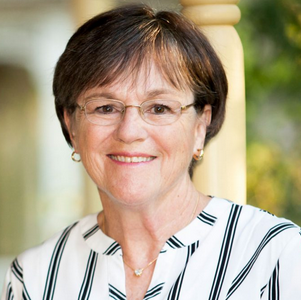
Democratic gubernatorial candidate Laura Kelly favors staying the course on taxes and reinvesting state revenue gains back into state-funded programs and services.

Kelly was in Hays for a campaign stop Thursday.

Since changes have been made on the federal and state levels, Kelly said state leaders need to take time to evaluate revenue results before making changes. State revenues have been coming in higher than projected in recent months.

“I think we are back on the path to recovery,” she said. “As you well know, our state was in a world of hurt. We did put ourselves on the road to recovery. We do need to evaluate that in the middle of next year and see where we are.”

Kelly said she would like to see reinvestment into many of the state agencies that have been cut in recent years.

This includes school funding. The state is still facing a lawsuit brought by several state school districts over school finance. Although the Kansas Supreme Court has ruled the most recent school funding formula is equitable, it is requiring additional funds be added to the formula to account for inflation.

See related story: Court: State still must add more money for schools, but not until next year

Kelly said there should be enough extra money in the state coffers due to last session’s tax increase to meet the demands of the Supreme Court.

“It think cutting taxes at this point or implementing the Kobach plan would have Kansas go into a tail spin,” she said. “We know that the Brownback tax experiment did not work, and what Kobach is proposing is to return to that experiment and then go further.”

Some of that refocusing of funds Kelly hopes would go to higher education. This would include money for career and technical education. New programs allow students to earn trade certificates or earn up to a full year’s worth of college credit while still in high school. These programs save students tuition and allow them to enter the workforce sooner.

“We have been harsh on our university systems during the last eight years,” she said. “We have restored some of that funding, but I think we are still about $80 million short. As revenues allow, we need to start restoring that funding.”

Education is the biggest economic driver in the state, Kelly said.

“We have seen the impact of underfunding our schools from early childhood through our university system in the fact that our Kansas economy has lagged behind our surrounding states over the past five to six years,” she said. “But also we are seeing a great out-migration. We are losing people from the state of Kansas to a much greater degree than any of the surrounding states. That’s got to stop.”

Kelly has created a Rural Prosperity Plan that addresses a variety of issues that affect smaller Kansas communities.

“We know over the last eight years, rural Kansas has probably been hurt the worst by the Brownback experiment. We have got to do something to help them revitalize and thrive,” Kelly said.

“What we are proposing in this plan, perhaps most importantly, is we plan to create an Office of Rural Prosperity within the administration. We will filter all policy, all budget issues through that office so people can take a look at it through the lens of rural and agricultural Kansas.”

Included in that plan is a housing program that was instituted in Pittsburg. Two abandon buildings in downtown Pittsburg were renovated to house Pittsburg State University students. The store fronts were remodeled into high-tech cooperative work environments. Students can ride a shuttle to the college. Students in turn are patrons of downtown businesses, which drives the local economy.

In addition, Kelly wants to focus on improving infrastructure, which would include Broadband access to all areas of the state.

She would also expand Medicaid and reform KanCare, putting it back under the control of a non-profit entity.

“We have had an opportunity to expand Medicaid for the last six years, and instead we have sent close to $3 billion now to Washington, D.C., of Kansas taxpayer dollars, which have been distributed across the country for other states to take care of their people and build their economies,” she said. “We need to bring those dollars back to Kansas and provide health-care access to 150,000 people, which would help our workforce. Healthy people are much better workers. It would expand our economy, but it would also create jobs.”

Two years ago, Louisiana expanded Medicaid. In the first year, the state saved $317 million and created 19,000 new jobs, Kelly said.

Republican candidate Kris Kobach has taken an anti-immigration stance in his run for governor.

Kelly said she and Kobach have very different approaches to immigration. She said she thinks immigration is a federal issue and would push the U.S. Congressional delegation to work across the aisle to finally develop comprehensive immigration reform. Kansas industry continues to rely on legal immigrant labor to get their products to market, and Kelly said that needs to be factored into reform.

“I think Kris Kobach’s stance on immigration shows us how out of touch he is with Kansas and the needs of Kansas, particularly agriculture and manufacturing,” she said.

Kelly has had some recent high-profile Republican endorsements, including former Gov. Bill Graves and former U.S. Sen. Nancy Kassebaum.

Kobach struck back, saying Kassebaum was a “has-been” who had “left the party.”

Kelly responded, “I think that the people who have come out to endorse me care about our state as much as I do and recognize I am the right person at this time to lead our state down the path to recovery. They recognize that I not only have the experience and the knowledge, but I have also built the relationships between parties to be able to get things done. …

“We are in a critical situation in the state of Kansas, and we have every possibility of crashing. I have the relationships already. I am good at bringing people together regardless of party or points of view and working toward a common solution that will work for Kansas.”

Holy Family time capsule unearthed 20 years later

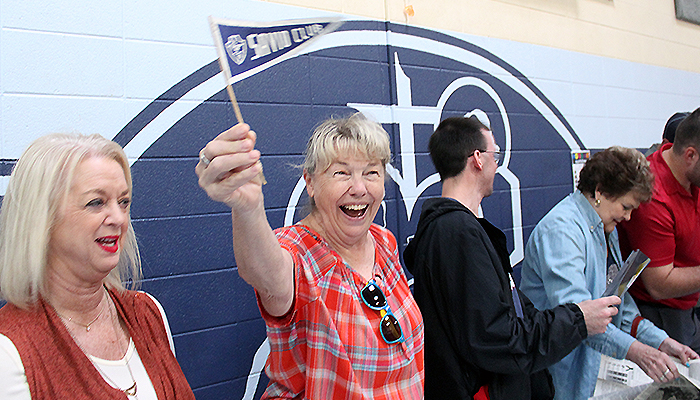
Shirley Dinkel, long-time Holy Family, teacher waves a Savio Club flag she found in a 20-year-old time capsule opened at the school Friday.

By CRISTINA JANNEY
Hays Post

A computer disk, newspaper articles, a green M&M character and a tiny handmade paper box containing a rosary were among the items unearthed Friday morning from a 20-year-old Holy Family Elementary School time capsule.

The enclosed PVC tube was buried in 1998 when the Catholic Diocese opened Holy Family in the former Jefferson Elementary School building at 1800 Milner.

Shirley Dinkel, a longtime teacher at Holy Family, was at the unearthing of the time capsule. She retired in May after 39 years as a teacher. Dinkel, now 69, was pictured in a newspaper article that was found in the time capsule about the opening of the new school.

“The community was so happy for us,” Dinkel said of the new school, “that we were getting a bigger location and we were actually going to be contained in one building. Before that, we were always moving over to Kennedy or another building — the CIC we called them in those days. We had a gym and our own cafeteria and Mass right there in our own building. It was almost like utopia to us and air conditioning and no stairs hardly.

“Honestly, I dreadfully missed St. Joe even with all of those accommodations that made it so better for the kids.”

Items that were found in a Holy Family time capsule that was buried in 1998 and unearthed Friday.

Dinkel waved a tiny flag from the Dominique Savio Club that she found in the time capsule. The club helped raise money for the poor — about $2,000 per year. Dinkel bought used toys at garage sales or people donated items. They also sold candy and pop. The children earned certificates for the club through donations and their reading program. Several of those 20-year-old certificates were also in the time capsule.

For Christmas gifts for the children’s parents, the students in their math class folded wallpaper samples into tiny gift boxes. One of these handmade boxes along with a rosary tucked inside was placed in the time capsule.

All of the teachers and the students at the time wrote notes to their future selves, and former teacher and students both were delighted Friday to read these yellow postcards, some of which had the students’ school pictures attached.

“I love my class and my new school,” Dinkel wrote on her card.

She talked about her one grandchild. Now she has 10. She wrote about missing her mother after her recent death and spending time with her father.

“I love teaching. I love my family and home, and I love God,” she wrote on the card.

Dinkel said that card was very special to her and she intended to keep it.

“It almost brings me to tears that I got to be part of a legacy like this,” she said.

The time capsule was buried near the Holy Family sign 20 years ago and unearthed Friday in time for the TMP homecoming weekend.

Madison Quimby, 28, of Hays was a third-grade student when the time capsule was buried.

“It’s exciting,” she said. “It is a little overwhelming to see everything. It is really fun to think back and reminisce.”

Quimby wrote on her card that she missed her old school, but she was excited to be at a new school, she made a new friend and she liked her teacher.

Quimby is back at Holy Family in her first year teaching sixth grade.

“I think that it is still the same family that it always has been,” she said of Holy Family. “It still has the deep roots. I think it has grown because what I see is that it is expanding and there are more students and there is more staff, but there is still that tight-knit family I remember as a student.”

Kelsey Stupka, 31, of Hays, who was a sixth-grade student when the time capsule was buried, said opening the capsule was a blast from the past.

“It is a rush of memories to see all of these things and go through them” she said.

The children from Holy family also made some predictions about 2018, which were read to the current Holy Family students. See some of those are below.

• A man or woman will walk on the planet Mars.
• Automobiles will no longer be fueled by gasoline.
• Digital TV will make action appear as if it is taking place in our living rooms.
• More than half of us will work from our homes, communicating via computers.
• Most homes will be equipped with video phones.
• Most annual publications will be replaced by CD-Rom disks.
• Pocket-size cellular phones will become a staple for all youth and adults.
• More than 75 percent of homes will own personal computers.
• Cars will be equipped with sensors to guide them to their destinations and avoid hazards.

Girls kindergarten through high school seniors invited to join Girl Scouts

Submitted

Girl Scouts of Kansas Heartland is inviting all K-12 girls to sign up for Girl Scouts and lead the way like a G.I.R.L. (Go-getter, Innovator, Risk-taker, Leader) in their community and make the world a better place.

Girl Scout troops are forming in Hays, and Girl Scouts would like to invite you to join them. Come find out more about programs and sign up from 10 a.m. to noon at the Hays Girl Scout office on Saturday.

Girl Scouts are rolling out their new Cybersecurity badges, and girls who attend that morning will participate in an activity that will help them explore and learn how protecting their most valuable information is important. They’ll earn their first Girl Scout patch on the day they join.

Whether girls want to become a rocket scientist or code their way to a safe digital experience, Girl Scouts has the tools and badges for her to take action. With Girl Scout’s focus on STEM, outdoor adventures, entrepreneurship and gaining life skills, it is the best space for building girls of courage, confidence and character who make the world a better place.

To join or volunteer, go to kansasgirlscouts.org/join, email us at [email protected]  or call 888-686-MINT (6468).

FHSU’s Science Café explores why we eat what we eat

An audience member at the Science Cafe tries to determine what food is in a bag. The items were marshmallows.

By CRISTINA JANNEY
Hays Post

You probably thought picking something to eat was all about taste — something that you did with your tongue.

But Associate Professor Glen McNeil, MS, RD/LD of Fort Hays State University, set out Monday night to demonstrate food choice has much more  involved. It relates to all your senses, emotions and external factors, such as education, religion and culture.

At the first Science Café at Thirsty’s Venue, McNeil started to look at food selection by looking at taste. That can be broken down into salty, sweet, sour, bitter and umami. Umami is flavor we experience from broths and cooked meets.

“So what we do is we take these five components and combine them now with texture, temperature and odor and that produces flavor,” he said.

Although some taste receptors are more concentrated on certain parts of the tongue than others, there are food receptors for all five tastes all over the tongue.

Humans have an acquired taste for the five tastes. He used the example of salt.

“The more you use, the longer you use it, the more it takes to taste the salt,” he said. “If you add salt to your plate before you ever taste it, why? You don’t even know if it needs salt or not. It’s habit.”

If you add enough salt to something until you taste it, you have added too much, he said. Salt is a flavor enhancer.

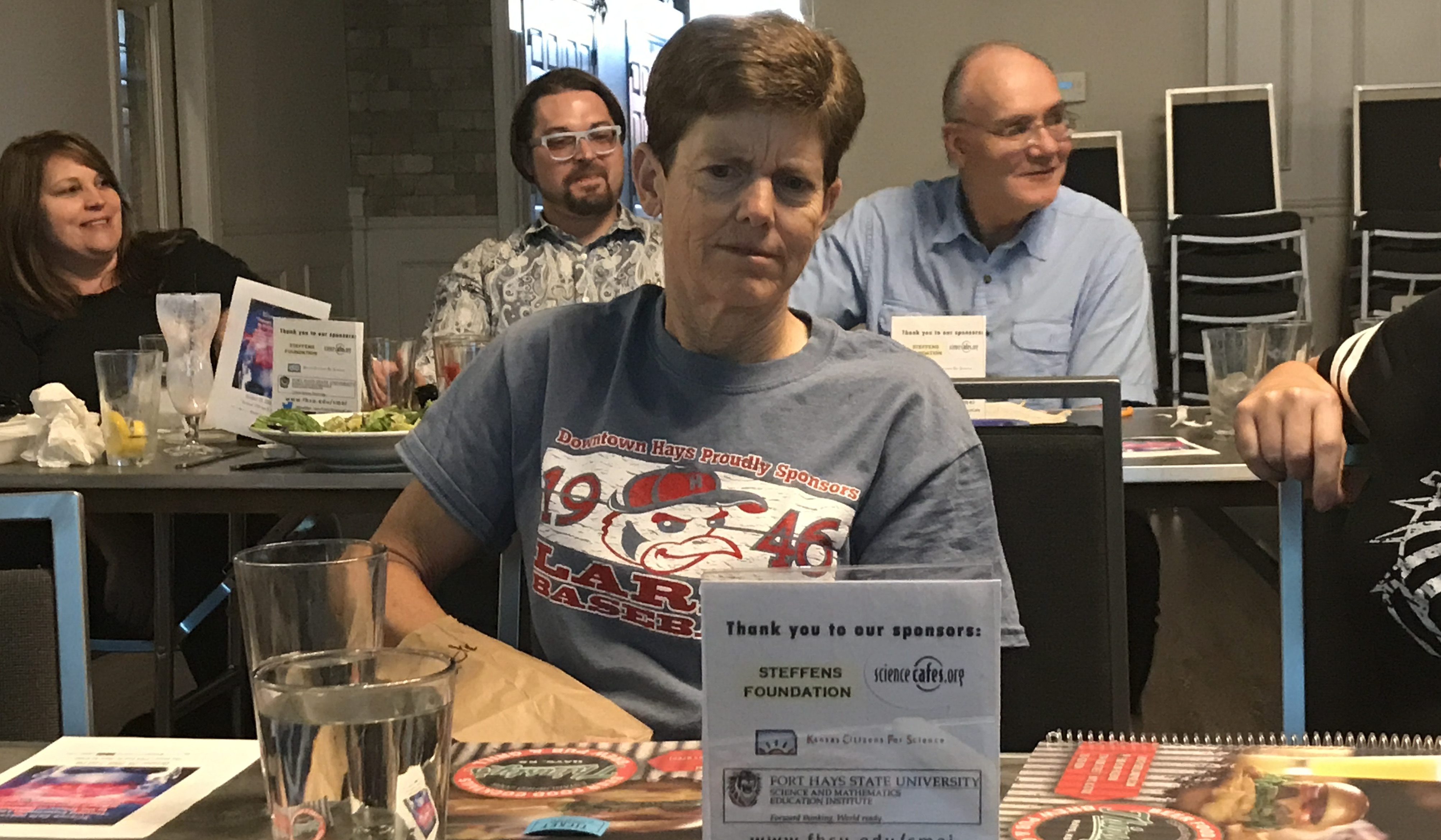
Glen McNeil

McNeil challenged the audience to try to stop salting their food and eating foods high in salt for three days and then go back to adding the same amount of salt they had in the past.

He said they will see a marked difference in how salty things taste.

McNeil gave a couple of examples of foods that start sweet and then go to bitter, such as a tomato. Artificial sweeteners, especially the early ones like Saccharin, started out intensely sweet and then made a bitter aftertaste on the back of the tongue and throat.

McNeil then had his audience explore food through sight. He asked each person in the room to take a jelly bean out of a paper bag and try to determine what it would taste like based on its appearance. They then tasted the jelly beans. Some people had guessed their flavors correctly, others had not and still others could not put a name to the flavor of their jelly beans.

He then held up a bright yellow banana. Some people said the banana was ripe. Others said it was green.

Ripe bananas are actually mostly brown, soft and are more sweet — too sweet for most people, he said. Green bananas are more starchy.

“What we see is not always what food is meant to be,” he said.

Color can be important in affecting our food choices and perceptions of foods.

“We eat with our eyes,” McNeil said. “We make choices and selections with our eyes. We begin to associate colors with foods from shortly after birth.”

Food processors use coloring to affect our food choices. Strawberry milk has no strawberries in it. It has artificial coloring to make it pink and a mix of chemicals to make sweet.

We associate certain colors with certain favors. Some relate red with spicy like a red peppers.

People associate blue sports drinks with a sweeter taste, despite the fact they are flavored no differently and have no more sweetener than the other colors.

Perception also has effected portion size. A bottle of pop used to be eight ounces. Now a standard bottled beverage is 20 ounces. Bagels used to be three inches. Now they are they can barely fit in your hand. Hamburger patties used to be 10 per one pound of beef. Now the standard is a quarter pound.

“Serving sizes have grown as we have gotten into looking at them, looking at how much they fill a plate, looking at what we see,” McNeil said.

McNeil also brought audience participation into his program with a hearing test. His wife, behind a screen, popped popcorn, opened a pop, snapped celery, opened a bag of chips and bit into an apple.

“Sounds drive us to make selections in foods,” he said. “Sounds are used to judge quality in foods and what we see.”

To demonstrate how we use touch in food selection, McNeil prepared paper bags and asked audience members to identify the contents only by touching them. The items were marshmallows.

“Touch tells a lot of things, and there are two ways we touch,” he said. “We can touch with our fingers. We can also touch with our tongues. There are different ways to sense.”

Finally to illustrate smell, McNeil prepared bags full of peanuts.

Although you primarily take in aromas through your nose, you can also take in odors through your mouth.

Food manufactures take advantage of our sense of smell to entice us to eat certain products. They look for chemical signatures that produce the strongest response in consumers.

“Every smell has a chemical formula they can replicate,” McNeil said.

People are also conditioned to eat certain foods culturally, noting the Catholic custom of eating fish on Fridays.

Some people in Kansas eat mountain oysters, which are cattle testicles.

McNeil and his family lived in eastern Kentucky for a couple of years. One of his students had to miss class because she needed to go home and help her family castrate hogs. The family usually fed the testicles to their dogs.

McNeil asked the young women to bring him some of the testicles. He and his wife fried them and ate them.

“They thought I was nuts,” he said. “When she graduated the only thing her dad wanted to do was meet me. He came up and said, ‘Mr. McNeil, I just had to meet a guy who would eat testicles.’ We do that all the time at home. You eat head cheese. That is not overly appealing to us and chitlins and tripe, which is not bad, but it is different.”

Money, fads, nutrition knowledge, level of education, peer influence, time, temperature, and likes and dislikes all affect our food choices.

“The further you go in the educational system, whether it is formal or informal, the more educated we become, the broader your palate becomes — the more likely you are to try new and different foods and experiment with foods. It gets us out and we meet other people and we hear things and some people travel,” McNeil said.

Local environments also dictate the availability of certain foods. On the coasts, produce and seafood are more abundant. In Kansas, beef and pork is more available.

In the winter, we usually eat more soups and chilis.

“We eat warm foods,” he said. “We also have a tendency to eat more because it is cold out and here comes our genetic heritage. We need a little more fuel.”

Hunger is the physical sign your body gives you that you need food. Appetite is the psychological signal our body gives us about food, and that also affects food choices.

Marketers play on these emotions.

Perkins restaurant was struggling, so it created a commercial in which it panned across a table full of pancakes and pie with a simple theme song touting its name in the background. Sales soared. 7 Up used a radio commercial that depicted the sound of ice clinking in a glass, the pop pouring and then someone drinking the beverage. It was very successful.

You can see a video of the full presentation at www.fhsu.edu/smei.

The next Science Café titled “Thought Experiments Leading to the Theory of Relativity” by Dr. CD Clark III, associate professor of physics at FHSU, will be at 7 p.m. Oct. 29 at Thirsty’s Venue, 2704 Vine St.


Laughing Matters teaches local children literacy skills

By CRISTINA JANNEY

Hays Post

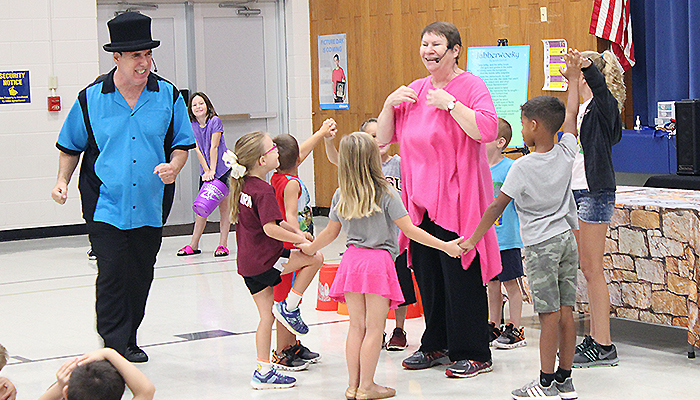
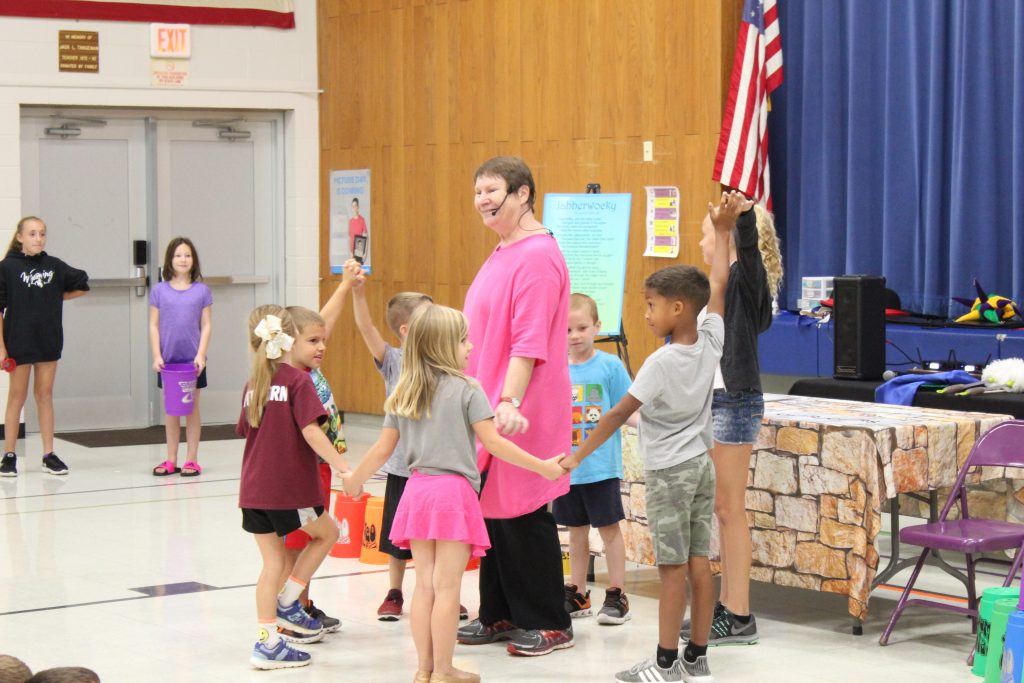
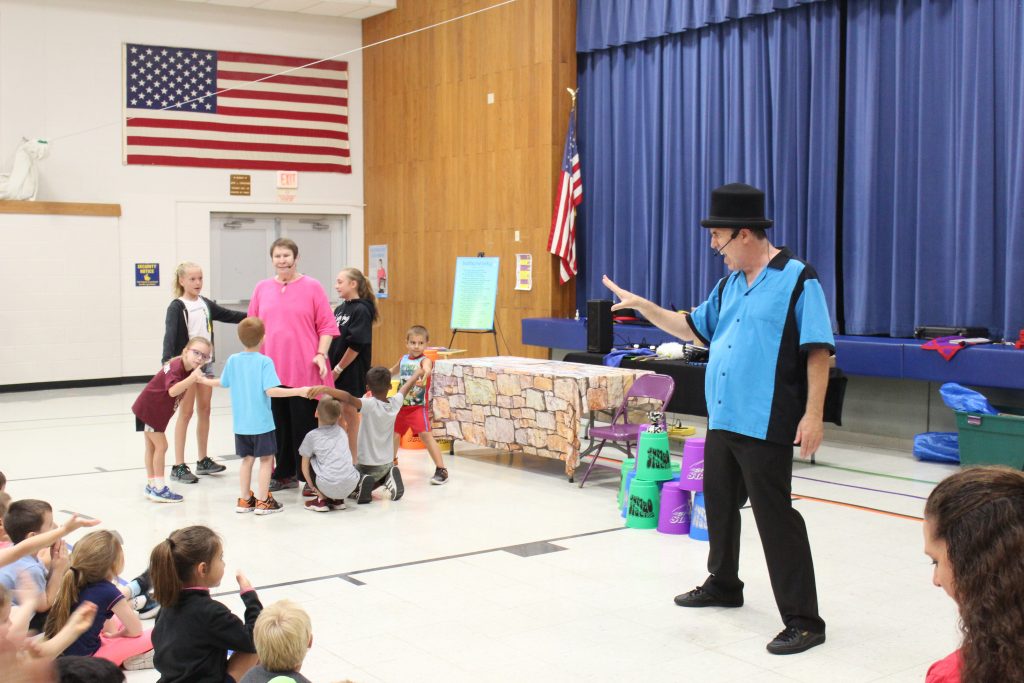
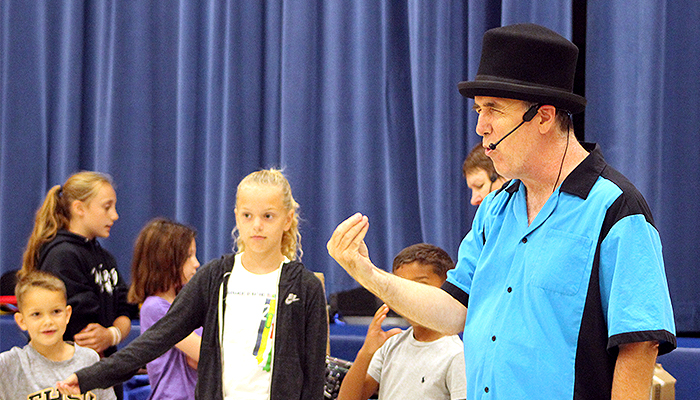
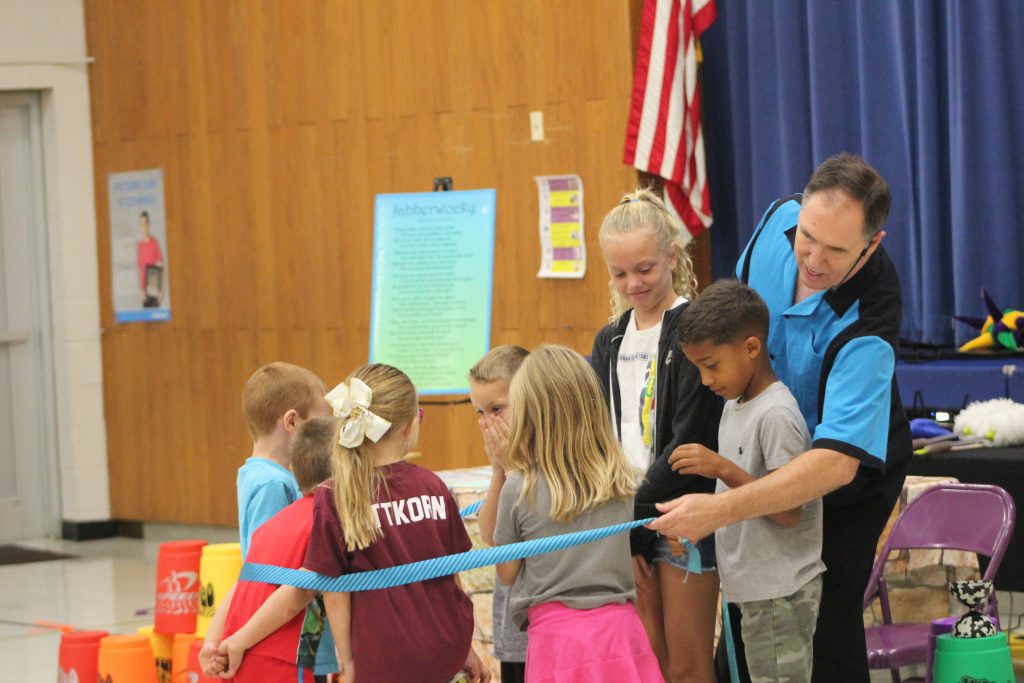
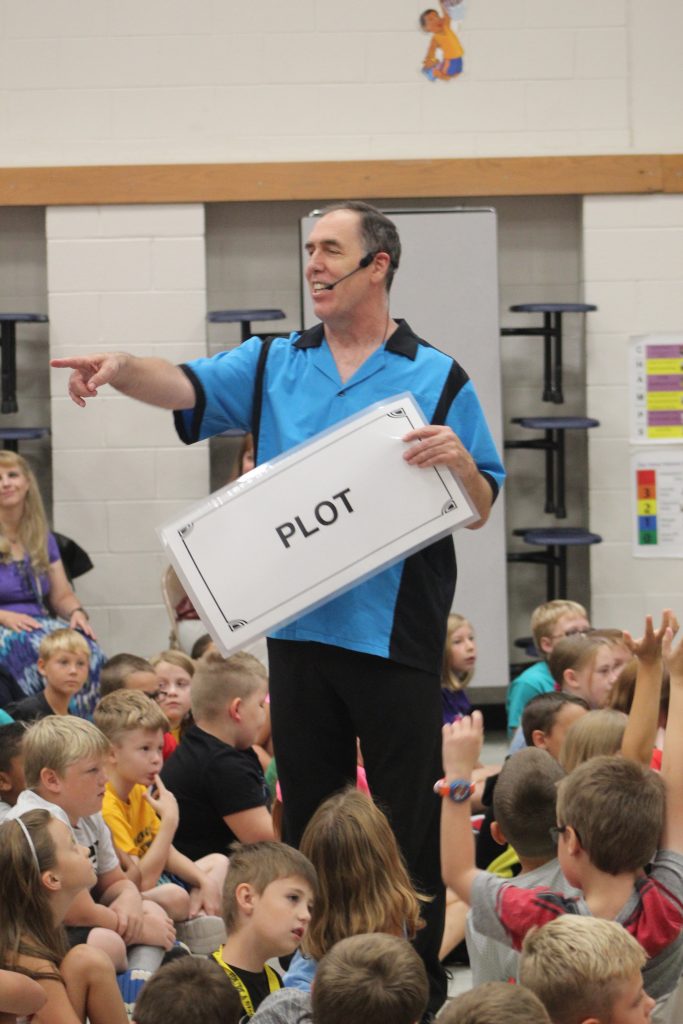
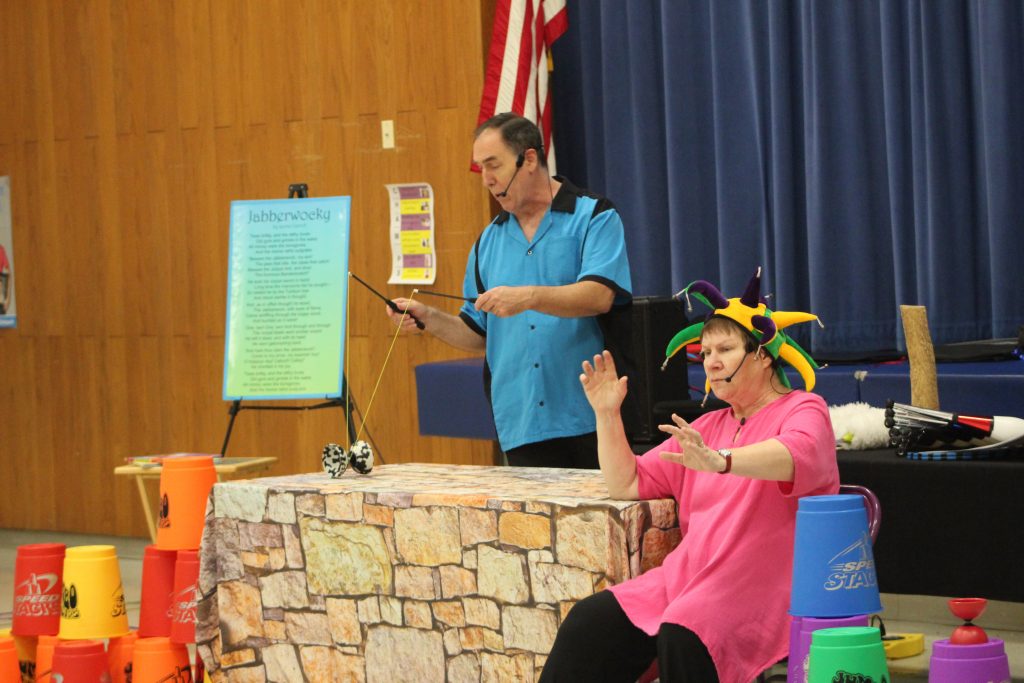
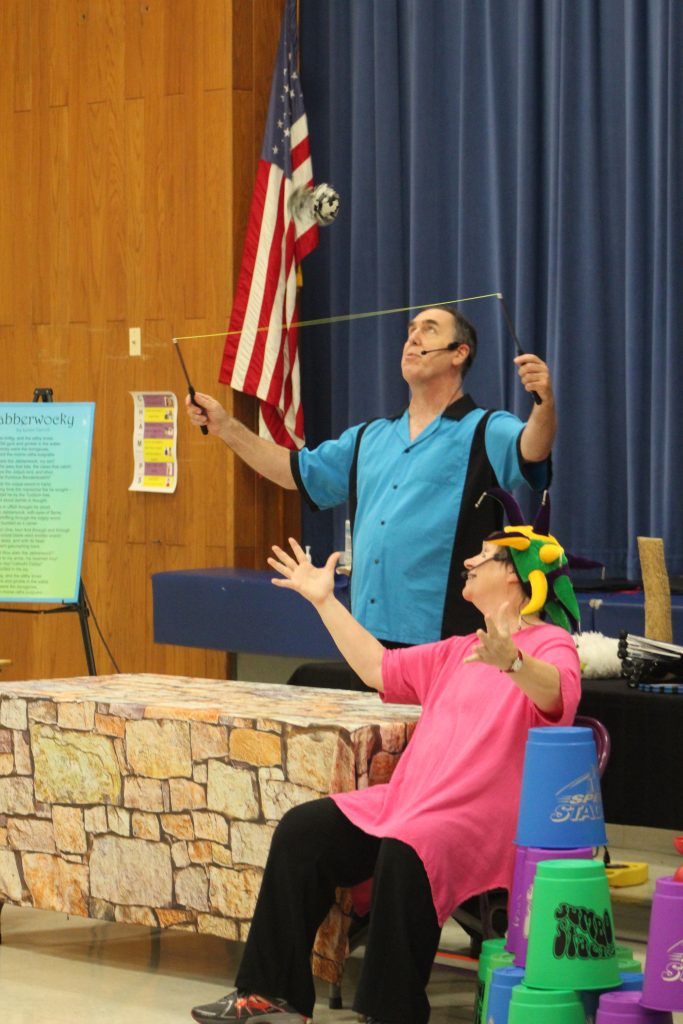
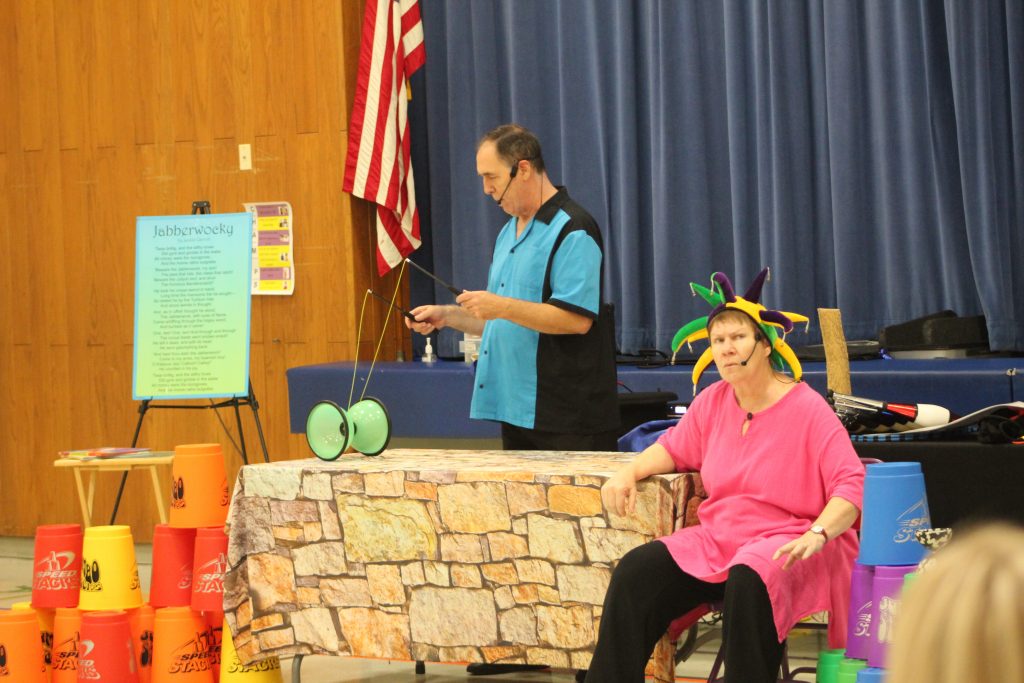
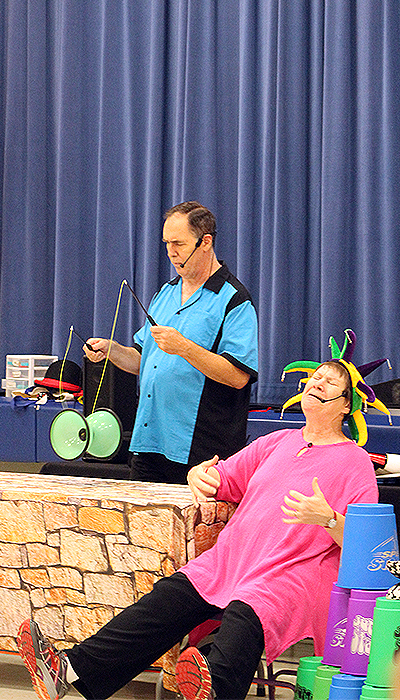
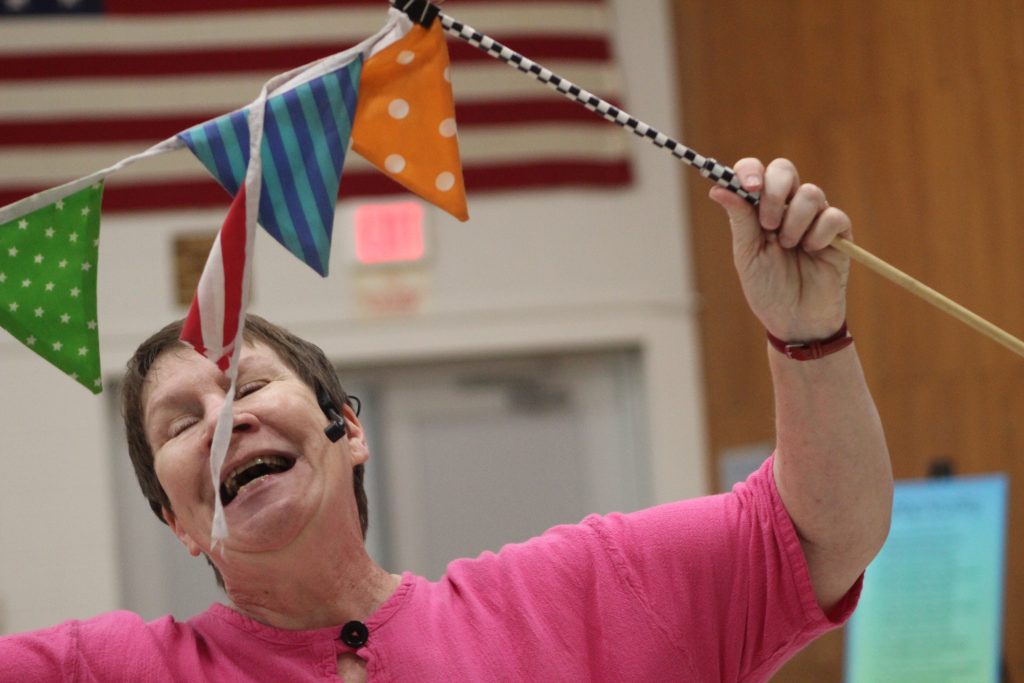
Jay and Leslie Cady—known as “Laughing Matters”—performed for children at Roosevelt Elementary School Tuesday morning.

The comic duo will be performing for children across the area thanks to the sponsorship of the Hays Arts Council.

The Cadys have performed for the HAC before. This year’s performance, “Tales with a Point: Fables and Fairy Tales,” focused on literacy skills.

The Cadys treated the children to a series of Aesop’s tales, which included “The Three Little Pigs,” “The Tortoise and the Hare,” and ” The Three Billy Goats Gruff.” The actors also portrayed the poem the “Jabberwocky.”

Through the laughs and hijinks, the kids learned about parts of the stories, including characters, plot and setting.

Full-time professional entertainers since 1980, the Cadys have performed more than 6,000 times in 36 states and seven foreign counties.

For this year’s public performance, the HAC has arranged for Laughing Matters to participate in Early Childhood Connection’s “Go Truck, Go!” event on Thursday with their roving performances taking place from 5:30 to 6:30 p.m. at the National Guard Armory in Hays.

Financial Aid Night set for Monday at Hays High

Submitted

Hays High School is hosting its annual Financial Aid Night for all interested seniors and parents at 7 p.m. Monday in the Hays High School Lecture Hall.

Families will learn how to apply for all types of state and federal financial aid using the FAFSA, the Free Application for Federal Student Aid.  

Completing the FAFSA is a required step when seeking most need-based scholarships, grants, loans and work-study. The FAFSA is used across the U.S. at nearly all colleges, public career/tech ed schools, and some private trade schools.

 Angela Delzeit, assistant director of Student Financial Assistance/scholarship coordinator of Fort Hays State University, will be the guest speaker for the evening. She will be speaking on behalf of all Kansas financial aid administrators. If you have questions regarding the Financial Aid Night, call the Hays High counseling office at 623-2608.

HAYP’s annual Adult Prom to raise money for ARC park

By CRISTINA JANNEY
Hays Post

The annual Adult Prom will raise money for the Hays Accessible Recreation Complex, a project being led by ARC of Central Plains.

The fourth-annual event will be Friday, Oct. 12, at the Rose Garden Banquet Hall, 2350 E. Eighth.

Audrey Werth, Hays Area Young Professionals member, said of the park “We just see the benefit it is going to bring for the entire community, especially for those who it is targeted for — kids with disabilities and really people of all ages who will be able to use it. We just want to be a part of the community, so any way we can help, we want to do that.”

This year’s theme is “ARC Across the Sky.” This brings together the elements of a starry night and the ARC fundraising effort.

The event includes a social hour from 6 to 7 p.m., dinner from 7 to 8 p.m. and dance from 8 p.m. to midnight.

Hays Area Young Professionals is sponsoring the event; however, it is open to the public (21 and older). Tickets are $30 per person. Table reservations can be made for tables of six.

Tickets are on sale through Sept. 27 at the following locations: Hays Area Chamber of Commerce (2700 Vine), Platinum Group (116 E. 11th) and The ARC (600 Main).

Although many will be wearing formal attire, you do not have to rent a tux or wear a formal dress to attend.

“It can be as big as you want to make it,” Werth said. “Just have fun with it.”

For more information, contact the Hays Area Chamber of Commerce at [email protected] or visit Hays Accessible Recreation Complex on Facebook.

Copyright Eagle Radio | FCC Public Files | EEO Public File