We have a brand new updated website! Click here to check it out!

Wonder Women League seeks to expand its programs in Ellis County

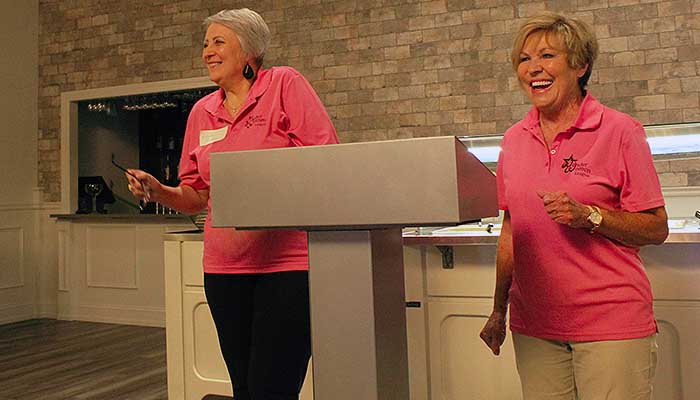
Wonder Women League Co-Chairs Rhonda Meyerhoff and Nancy Jeter speak at a League event Tuesday.

By CRISTINA JANNEY
Hays Post

The Wonder Women League is looking forward to several projects that will help children.

The nonprofit, which is affiliated with United Way of Ellis County, had a member drive luncheon Tuesday.

The Wonder Women League hopes to partner with HaysMed to buy stainless steel wagons and/or remote controlled cars for children who are patients at the hospital, Rhonda Meyerhoff, League co-chair, told the group.

“Mom or dad can take the child for a ride, and it is another way of transport,” she said.

The remote-controlled cars, can be a way a child can ride to surgery.

“I didn’t really think about it, but the impact on a child who is really, really scared …,” Meyerhoff said. “They want to cling to mom or to dad because they don’t know what is going to happen. They are scared. What we are told is if they can get the child into one of these motorized vehicles and into surgery, they have accomplished a lot with this child because the child is not going to fight them now.”

The Wonder Women League is a nonprofit that raises money for and implements projects that help children, families and the community.

HaysMed has approved the project, and it will be up for a vote in front of the Wonder Women in October. The group meets every other month on the second Thursday of the month for about an hour.

The group is trying to organize a cyber security program that could be presented to children in schools, the group also hopes to discuss this project at its next meeting.

The group also hopes to partner with the Fort Hays State University veterans organization to assist in its annual sports equipment drive. That could happen as soon as this fall.

“We know there may be children whose parents can’t afford the athletic equipment that they need to even do Hays Rec or some other team,” Meyerhoff said. “I don’t know about you, but it seemed every year I was having to buy new sizes of shoes for my kids for what they were going through because they had grown that much and the old pair just kind of got dumped.”

New equipment can be donated, but gently used equipment like basketballs, footballs, soccer balls or baseballs could also be donated.

The group has also discussed a long-term goal of creating a woman’s scholarship fund.

The League continues to participate in Matthew’s Gift in cooperation with HaysMed. The project provides bags with necessities, such as toiletries, bottled water, a lap blanket and snacks, to families who have loved ones who have to be transferred out of Hays on an emergency basis. The project was named for 3-year-old Matthew Wellbrock, who died as a result of an accident on his family’s farm.

Nancy Jeter, League c0-chair, said Matthew’s father and mother received a similar bag when Matthew was in the hospital. Matthew’s father told Jeter the bag was invaluable to the couple, because neither one of them wanted to leave Matthew’s side when he was in the hospital. They lived out of that bag until Matthew passed away.

Tammy Williams, HaysMed emergency department nurse, said the families who have received the bags have been very grateful. About three dozen bags have been distributed since the program began in the spring.

Meyerhoff said, “In my heart, when we give them that bag, I think we give them some love from Ellis County to go with them.”

Other projects Wonder Women have supported since the group launched two years ago included a self-defense class and Sunrise Park’s Born Learning Trail, which is a walking trail that includes interactive learning activities for children.

Prior to the event Tuesday, the group had about 35 members.

The group has changed its membership structure. The minimum contribution to become a member is $50. You can pay using check, cash or credit card. You can register online using a credit card.

You can volunteer for events or be on committees, but the League also offers a donor only option.

Registration is good for one year, and the money raised goes to support Wonder Women League projects. The group also accepts contributions from corporate sponsors. Although the League is under the United Way’s nonprofit umbrella, the funds raised through this organization are kept separate for League projects.

The exception is the annual Power of the Purse event, which jointly supports the League and United Way.

Science Cafe celebrates 100th lecture with call for citizen scientists

By CRISTINA JANNEY
Hays Post

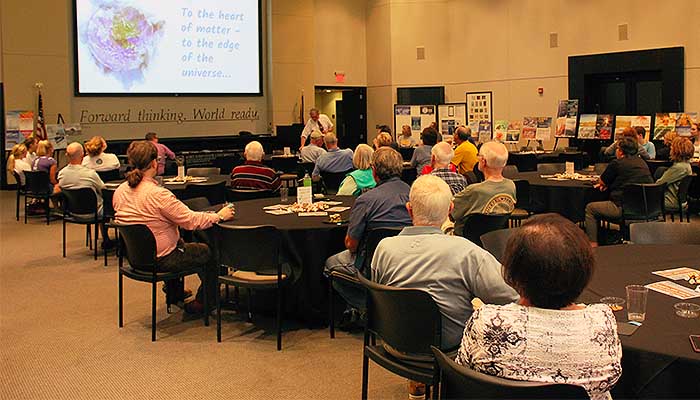
Fort Hays State University celebrated its 100th Science Cafe on Monday night by encouraging audience members to become citizen scientists.

Dr. Paul Adams, director of the FHSU Science and Mathematics Education Institute, presented the lecture at the Robbins Center Monday looking back on the last 99 lectures, looking forward to future lectures and offering suggestions on how every day people can become involved in science.

“What I am asking you to do and to take the challenge with me is to get more engaged in the scientific enterprise — be part of the science ecosystem in our area,” he said. “That means to become a citizen scientist.”

Adams said science educators when working with children will ask them to draw a picture of a scientist.

They often draw a picture of a white person, wearing glasses, in a lab with test tubes or an older man with a beard looking at the stars. Adams said as a science educator, he is trying to change that perception.

Dr. Paul Adams gives the 100th Science Cafe lecture Monday at the Robbins Center.

“It is not them,” he said. “The idea is that science is done by other people for others. It is not doing science for ourselves. This is a challenge for you. How can you be part of this? How can you be a scientist?”

Citizen science involves non-scientists, includes scientific processes and research standards, and has a goal of advancing scientific knowledge.

Citizen science is not new. The Chinese have records for 3,500 years of locust outbreaks. The royal courts in Japan have 1,200 years of records when the cherry blossoms bloomed. The French have 640 years of records of grape harvest data. The United States has a long record of citizens who keep track of weather data and harvests.

These records weren’t kept by scientists or the government. They were kept my citizens, Adams said.

In recent years, citizen science has improved with the aid of technology.

There are more than 1,000 choices available through clearinghouses online you can choose from to be a citizen scientist. Adams highlighted a selection of these during his talk on Monday. Most of these projects can be accessed online or through apps.

An early online citizen scientist project was Galaxy Zoo.

“This is taking images from deep space. Nobody has seen them. You can be the first person to tell if it is a bar or spiral,” he said. “Computers can’t read these. Computers can’t interpret it.”

What are now called green pea galaxies where discovered using crowd sourcing such as this.

“They found these galaxies no one had classified before, and we learned our models weren’t right because of the science citizen scientists did,” Adams said.

Globe at Night asks citizens to make a monthly reports on what stars and constellations are visible from their locations. This global initiative is gathering data on light pollution. You don’t have to have a telescope. You make your observations with the naked eye. The app has a constellation ID tool. Training takes only a few minutes. Adams said this is a great app to use with students.

Adams said he tells his students,”Don’t worry about getting it right, because we don’t know what right is.”

Some of these programs use large number of observers to report data, and then they pinpoint what statistically most of the observers report. If the observers can’t agree, then scientists may need to look more closely at what is being observed to determine if there is an anomaly present. This is how the green pea galaxies were discovered.

Journey North asks citizens to help track migration patterns for birds, monarch butterflies and other creatures.

NASA’s All Sky Fireball Network asks you to observe fireballs or meteors in the night sky.

Budburst ask users to track when flowers start to bloom, which is also an indicator of climate change.

Global Explorer asks users to look at satellite imagery to determine if archeological sites have been looted.

Stall Catchers is a game that is used as tool in Alzheimer’s research.

eBirds looks at bird populations; iNaturalist asks you to take pictures of different species of animals in your area.

Dust Storms asks you to take picture of dust storms and report their location. This data is also being used to monitor climate change, which scientist believe is going to spark more dust storms.

NASA alone has a substantial list of citizen science projects, which can be accessed at science.nasa.gov/citizenscientists  or at www.nasa.gov/solve.

If you are interested in social sciences, there are projects that ask people to transcribe works from contemporaries of William Shakespeare or notes from U.S. Supreme Court justices. Look for more projects on Zooniverse.

Computers can’t interpret some data, such as handwriting. That is why scientists use crowd sourcing.

“Satellites work, but they aren’t perfect. They need people to validate, interpret and understand,” Adams said. “On Globe Observer, you can do clouds. You can do trees. You can do mosquitoes. You can do dust storms. The reason you do this, and this a direct quote from a scientist, ‘Satellites don’t see mosquitoes.’ Even though the technology is good. Even though they can read license plates in Russia, we are told, they can’t see mosquitoes.”

Knowing more information on mosquitoes helps to track the spread of diseases such as West Nile and Zika.

“A satellite can tell us where it is wet, but it can’t tell if the mosquitoes are going crazy,” Adams said.

He said he would like to see the residents of the Hays come together to do a citizen science project as a community, and he said he is entertaining ideas of what that project could be.

Science Cafe is supported through private donations. The lectures are free and open to the public.

The next Science Cafe will be at 7 p.m. Monday, Oct. 14, at The Venue at Thirsty’s in Hays. You can order food or beverages at your own cost from Thirsty’s.

Keri Maricle, biology instructor at the North Central Kansas Technical College, will present “Importance of Scientific Education in Western Kansas.”

Holly Dickman, water conservation specialist for the city of Hays, will be back this year to talk about water conservation. Another speaker will discuss virtual and augmented reality. Adams said someone had suggested bringing in a speaker to talk about cultured meat (lab grown not from animals), and he has also considered giving a lecture on fire walking, which he used to participate in.

Videos of some of the previous Science Cafes are available online. If you wish to learn more about the lecture series or suggest a topic for an upcoming lecture, contact Cari Rohleder at [email protected] or 785-628-4743.


Makey Makey Monday Halloween Special Effects Makeup Class set at EPL

Have an extra creepy Halloween costume this year by learning special effects makeup from Taylor McClung at 4  p.m. Monday, Oct. 21 at the Ellis Public Library.

Pick up a registration form at EPL, fill it out and return it by Oct. 1 to reserve your spot and to ensure we have enough supplies. (No late registration) This event is open to ages 7-12, but kids younger than 8 should probably have a helper.

Also attend Makey Makey Monday Model Make ‘N’ Take.

Come to the EPL Maker Space at the Ellis Public Library at 4 p.m. Monday, Oct. 7 for a Model Make N Take hosted by Steve and professional model builder Mark Logan.

You can build either a Tom Daniel’s designed Chopper “Roar and Peace” or the “Leap Hog” 3 Wheeler produced by Atlantis Models.

These are the kits like your Grandpa built. The class is open to girls and boys ages 7-12, but kiddos younger than 8 will probably need a helper.

Registration forms are at EPL and need to be completed by Friday, Sept. 27, 2019, to ensure your spot and kit. No Late Registrations.

Watch for other Makey Makey Monday activities on the EPL Facebook page.

United Way of Ellis County opens funding application process

The United Way of Ellis County announced the opening of the 2020 CARE Council application process.

Any 501(c)(3) that provides services in Ellis County is eligible to apply. The services must meet one of the three criteria of education, health and financial stability.

The CARE Council is made up of 12 community volunteers who review the applications to determine funding for the United Way of Ellis County, City of Hays Social Service Funds and Alcohol Tax Funds and Ellis County Alcohol Tax Funds.

There will be an open community meeting for those interested in applying for funding from 4 to 5 p.m. Wednesday, Sept. 25 in the first floor conference room in the Hadley Center to learn about the online application process.

Applications will be accepted until 5 p.m. on Nov. 15, 2019.

For more information, contact Erica Berges, interim executive director, at 785-628-8281.

Cambodian woman finds Christ’s love through Operation Christmas Child

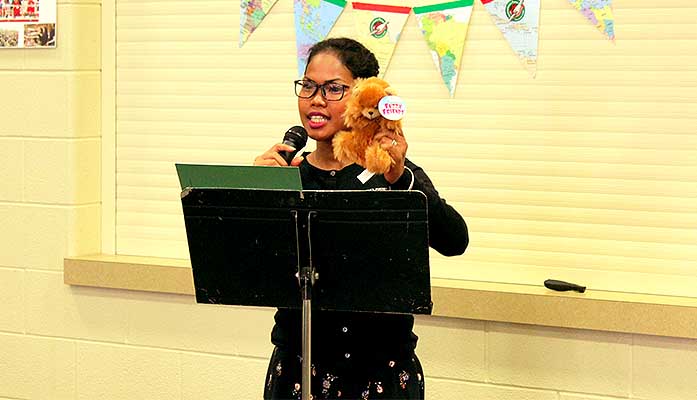
During a lecture Saturday in Hays, Boun Thorne, formerly of Cambodia, holds a stuffed animal similar to the one she received in her Operation Christmas Child box.

By CRISTINA JANNEY
Hays Post

A group gathers Saturday at Messiah Lutheran Church to learn about Operation Christmas Child. This year’s shoebox collection week is Nov. 18-25.

Boun Thorne, who had an abusive childhood in Cambodia, said an Operation Christmas Child gift changed her life and help her accept God’s love.

Thorne, who now lives in the U.S., spoke to a group Saturday at Messiah Lutheran Church in Hays about her experiences growing up and her Operation Christmas Child gift.

Operation Christmas Child is a project of Samaritan’s Purse, an international relief agency headquartered in Boone, N.C., and led by the Rev. Franklin Graham. Every Christmas, thousands of individuals prepare shoeboxes filled with small toys, school supplies and hygiene items, which are then delivered to needy children around the world.

This year’s shoebox collection week is Nov. 18 to 25. 

Operation Christmas Child volunteers will be making crafts to place in shoebox gifts from 1 to 3 p.m. Sunday, Sept. 22, at Messiah Lutheran Church, 2000 Main St. in Hays. For more information on this event or local Operation Christmas Child packaging, contact Rachel Albin at 785-639-1325, [email protected] or go to samaritanspurse.org.

Thorne’s family was very poor when she was growing up. She grew up on a boat in a floating village. Her father was a fisherman, but he was also an alcoholic. Thorne’s father would fish to earn money, but he would spend his money on alcohol, leaving his family with nothing.

“Because of that we never had money to buy food from the market,” she said. “Growing up, we would eat anything we could find around us. Fish and rice was our basic food three times a day, and we would eat the leftovers for breakfast. There would be special occasions when my dad would catch a snake or a monkey and that was when we got to eat something different than fish.”

There was no electricity, no school or hospital.

Throne’s father was abusive when he was drunk. He regularly beat Thorne’s mother. After a particularly brutal beating, her mother passed out and Thorne thought she was dead. Thorne and her siblings would swim to a neighbor’s boat to hide from him, but they weren’t always successful in getting away.

When Thorne was about 6 years old, she became very ill. Her mother asked her father to take Thorne to the hospital.

“My dad told my mom, ‘Just let her die. If she doesn’t survive, we will just make more babies,'” Thorne said. “When I heard that, I felt like my dad didn’t love me at all. I thought maybe I am not his daughter.”

Thorne survived her illness. She decided then she wanted to some day be a nurse or doctor so she could help children who were sick.

She went to her father and asked if she could go to school. He said no, she didn’t need to go to school. She was told she would eventually marry and stay home with her children.

When she was 8, she left her family and her village to live with her aunt so she could go to school. She had to help her aunt make and sell Cambodian cookies to pay her way.

Thorne woke up at 3 a.m to help her aunt cook. After school, she would be sent in to village to sell cookies. If she did not sell all the cookies for the day, her aunt told her she was lazy and sent her to bed without diner.

“No matter what happened. No matter what my dad did to us, my mom would make sure I had food in my tummy before we went to bed,” she said.

After two years, Thorne said she could no longer bear her aunt’s abuse, gave up on her education and moved home with her parents.

During a Cambodian holiday, her father became so drunk he couldn’t fish for the family. Thorne’s mother sent her to fish with her uncle, so the family would have something to eat. Her uncle abused her on that trip.

Her mother wanted to report the crime to the police, but she couldn’t do it that day because of the holiday. By the time her mother could report the crime, her father had alerted her uncle, and her uncle fled the area to avoid the authorities.

Because her village elder thought Thorne might be in danger from her uncle, a couple months after the abuse incident, Thorne moved to a Rapha House, an international mission aimed at ending sexual exploitation and sex trafficking of children.

She would have to leave her mother and siblings again, but she would get to go to school.

“My house mother showed me where I was going to get my food,” she said. “There was a table with a lot of food on it. We never had desert or anything like that, but on the table there is a lot of desert. I was just standing there crying because I really wished my siblings and my mom would get to eat all of this food with me.

“Then she showed me I had a bunk bed. I had my own bed with my own mattress. I never slept on a mattress before. At home we slept on a mat on the floor. I just wished my mom and my siblings could experience this all with me.”

One of her counselors told her about Jesus Christ. She told her that God wanted her to forgive her uncle and her dad, but Thorne said she was not ready to forgive.

“It didn’t make sense to me,” she said. “My dad didn’t love me. Why do I have to love him? My uncle didn’t love me. Why do I have to love him? It hurts me.”

Thorne regularly went to church, but she said she went to be with her friends, because she could sing and dance and they served snacks.

When she was 13, her teacher told her they had special gifts for the children. It was boxes from Operation Christmas Child. This was the first gift she had ever received. Christmas and birthdays are not celebrated in Cambodia. They were told these were gifts from the people who love God and they wanted to bless the children with these gifts.

The children were told they were supposed to wait until all the children received their boxes before they opened their gifts, but Thorne couldn’t wait.

Inside her box was a new pair of flip flops. This was special because the students at the school only received one new pair of shoes each year. At home, she and her family always went barefoot. The box also contained a stuffed animal.

“I never knew something like this existed. I never knew they could make an animal like this, so soft,”she said. “It’s new and smells good. I used to eat all kinds of animals, growing up, but I never knew there was an animal that I didn’t have to eat that I could snuggle with and smelled better than the real animal.”

She said the shoebox helped her fall in love with God more deeply and have a relationship with God.

“I realized that God was so big that he could make impossible things happen,” she said. “He can make someone who doesn’t even know who I am to love me and send me this gift. I realized what my teacher told me that God loves me and he wanted me to love my uncle and to forgive him.”

She added, “Even if my earthly father didn’t love me, there is a father in heaven who loves me, and he is way better than my earthly father.”

Her young brothers came to visit her while she was living in Rapha House, and they fell in love with her stuffed animal. She decided they needed it more than she did, so she gave her toy to them. Her mother later told her that her siblings often fought over the toy.

One day, the stuffed animal fell off their boat into the water. The children saw this and came crying to their mother that their stuffed animal was dead. Because they knew other animals floated when they were dead, the stuffed animal must also be dead. The toy was dried and fluffed, and her siblings exclaimed that their toy had been brought back to life.

Thorne, 25, eventually married an American, who she met when she was working as an interpreter in Cambodia. She is working toward her U.S. citizenship. Today, she lives in Oklahoma and is attending college to become a nurse. In the future, she hopes to periodically return to her home country to offer medical assistance.

FHSU SGA to hear student concerns on Chartwells health violations

By CRISTINA JANNEY
Hays Post

The Fort Hays State University Student Governing Association is compiling a report on Chartwells after the dining service for the university was cited for 12 priority health violations at McMindes Hall during its Aug. 28 health inspection.

Students will have an opportunity to speak about the issue during an open forum at the regular SGA meeting a 7 p.m. Thursday in the Black and Gold Room in the FHSU Student Union. SGA has also made a request online for students to contact SGA if they have concerns about dining services.

Student Body President Brad DeMers also said he hoped to have a representative of Chartwells at the meeting to address student concerns.

He initially said some of the health violations were “shocking.”

“We are hoping to get some stories to see what students are going through,” he said. “We are going to have a Chartwells representative come to one of our meetings to really answer some questions to see what they are doing to fix these issues and what they are going to be doing in the future to prevent.”

The issue first came to the attention of the SGA when a student expressed concern about the violations two weeks ago.

Among the violations were issues of food not being held at the correct temperatures, mishandling of food, dried food residue on utensils and containers, and issues with a hand-washing station. See the complete list here.

Chartwells had a repeat inspection on Monday, Sept. 9, in which they had four repeat violations, including food temperatures not being correct, expired food on hand and a food container not being clean and sanitized. See a complete list here.

After being informed about the latest violations Monday, DeMers said he wished to wait to comment until after the SGA meeting Thursday.

Through a Kansas Open Records Act request, SGA obtained a copies of health inspections for Chartwells for McMindes and the Union going back to 2010.

Those reports showed repeated issues with food not being held at the correct temperatures, issues with hand washing or hand-washing facilities, and issues with food surfaces not being clean and sanitized.

Going back further, there were repeated issues of cleaners not being stored properly and problems with plumbing.

Chartwells was contacted by Hays Post for this story, but an on-campus representative offered no comment.

Hays Post also contacted FHSU about the inspection and spoke with Teresa Clounch, assistant vice president of Student Affairs.

“After [Chartwells] received the report, they began to work on a food safety action plan to correct the violations. The action plan involves training and direct supervisory monitoring of food service operations on the front line,” she said.

FHSU contracts with Chartwells for dinning services. However, Clounch said she was not at liberty to release information about FHSU contract with Chartwells, including the renewal date for the contract.

Hays Post asked Clounch why FHSU continues its contract with Chartwells knowing of its repeated health violations.

“We take very seriously the importance of providing nutritious and healthy dining options for our students, faculty, staff and guests. Chartwells is our partner in providing this service, and they share in this commitment,” McMindes said in an email. “Chartwells’ charge is to hire and train a staff that they are confident in,” she said. “Chartwells has identified areas they need to address, and their senior leadership on campus is actively working to ensure they not only address the items pointed out in the most recent inspections, but that they establish and maintain only the highest quality of food service to our campus community.”

Clounch noted when a food service provider has violations, the Kansas Department of Agriculture does repeat inspections to make sure the violations have been corrected.

“As we look at these concerns that have been shared through the inspection, I and my senior leadership team we are having ongoing conversations with Chartwells that focus on providing the best service to our students and our guests in McMindes and all the other dining locations on campus,” Clounch said. “We are reviewing their operations and their progress on implementing these action plans.”

“They have shared a plan with us and with those directors in different areas. We will be working directly with the staff in those spaces that are the FHSU staff to make sure they are following the plan that has been put in place.”

Clounch did not release specifics of Chartwells’ plan to correct the health concerns. She said Chartwells has a plan to work through their latest violations on Monday, Sept. 9

“I am confident they are going to be able to implement necessary changes to their food service operations and get things in good order,” she said.

Farm to Fork dinner tickets on sale now

Sara Bloom, DHDC director, at last year’s Farm to Fork dinner. Courtesy photo

By CRISTINA JANNEY
Hays Post

Tickets went on sale at 8 a.m. Monday for the annual Downtown Hays Market Farm to Fork dinner.

The dinner will be at 6 p.m. Friday, Oct. 25, at the Downtown Pavilion. Tickets are $60 each or a table of eight for $450. They can be purchased online or at the Downtown Hays Development Corp. office, 1200 Main. Only 104 tickets will be available.

Farm to Fork supports the Downtown Hays Market. The market has about 80 vendors who annually sign up to sell items. The market does not charge a vendor fee, so the proceeds from the dinner are used in promoting the market, Sara Bloom, DHDC director, said.

The event begins with an hors d’oeuvres and cocktail hour. Musical entertainment will be provided, but the group has yet to be named.

Chef Manuel Hernandez, Gella’s Diner and Lb. Brewing executive chef, is preparing the meal again this year.

The menu is as follows:

Appetizers

  • Corn-roasted salsa with guacamole, tortillas and pita bread
  • Honeycomb with brie
  • Roasted veggies
  • Meatballs

Soup

  • Black bean soup

Salad

  • Mercado shredded salad with jicama (Mexican turnip), carrots, cucumber and mango

Entree 

  • Tricolored beef enchiladas

Dessert

  • Petite Mexican assortment of desserts with churros, tres leche cake and conchas (sweet bread)
  • Mexican hot chocolate
Centerpieces from last year’s Farm to Fork with materials provided by Bethesda Place and arranged by Norman Keller of Regeena’s. Courtesy photo

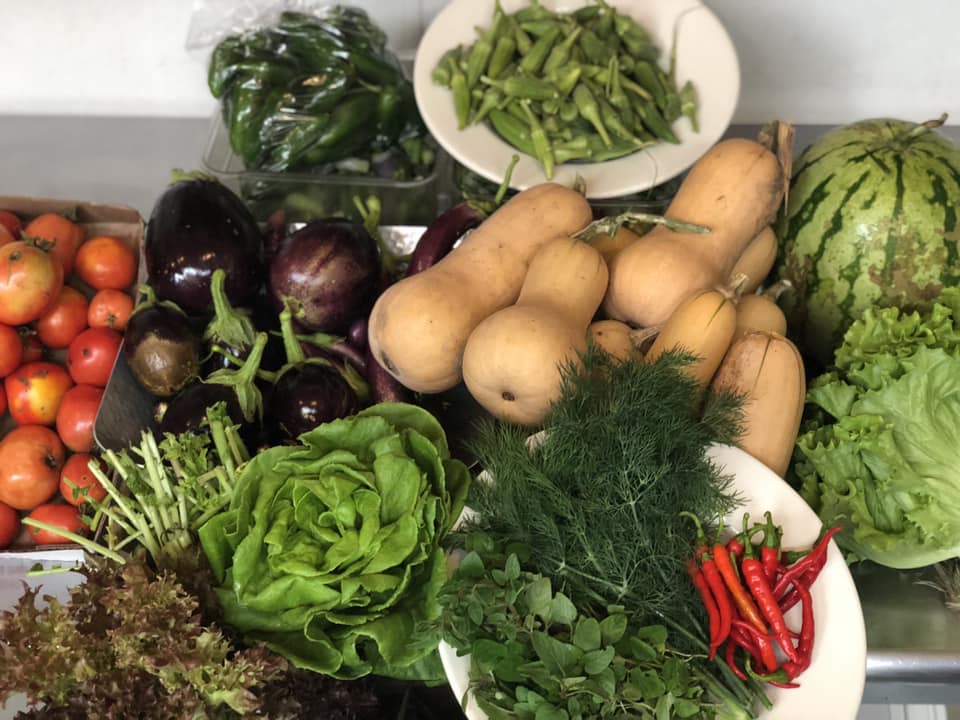
Once the chef has the menu, he provides DHDC with the list of needed ingredients, which he tries to source from local market vendors.

“That covers everything from the dairy products to the egg products to produce and meats,” Bloom said.

Vendors who do not sell food have the opportunities to donate merchandise that is given away during the event.

Resurrection Vineyard will again provide a selection of wines, and Lb. Brewing will offer a new dessert beer.

“We try to keep this event very small and intimate,” Bloom said. “We want the people to be able to meet people they haven’t met before and create a real intimate evening for those who attend.”

What truly makes the event unique, is Chef Manuel’s discussion of the ingredients that he uses and the dishes that he has prepared.

“He is the highlight of the evening,” Bloom said. “Listening to him talk about the ingredients and the difference between the eggs you find in a grocery store compared to ones you can get from a farm and just hearing him talk about his passion for food and his passion for local sources is just wonderful. He really does make the event.”

Lb. Brewing will provide a new dessert beer for the event and Resurrection will provide a selection of wines. Courtesy photo

The Downtown Hays Market will be wrapping up on Oct. 18. It is 7:30 to 11 a.m. through the summer and early fall every Saturday at the Downtown Hays Pavilion at 10th and Main streets.

“We have wonderful vendors who participate in that event,” Bloom said, “and it has truly become a gathering place for our community – free coffee and just good conversation and wonderful products and services that are down there. I always want to encourage people to check out the Downtown Hays Market, and if you are able to support that event by purchasing tickets to the Farm to Fork dinner, by all means, I hope that you do that.”

Out of Darkness Walk brings awareness to suicide

A group walks during the Out of Darkness Walk Saturday in Hays to bring awareness to suicide.

By CRISTINA JANNEY 

Hays Post

You are not alone — that was the message many of the walkers had at the annual Out of Darkness Walk in Hays had on Saturday.

About 70 people gathered at Municipal Park to remember friends and loved ones who have died as a result of suicide or to find support as they or someone they care for struggles with depression.

The Kelly Center, one of the sponsors of the event, provided colored beads that walkers could wear to show how they have been affected by suicide.

One woman, who did not wish to give her name, said not only has she struggled with depression, but she lost both her mother and grandmother to suicide. She was only 18 when her mother died. She said she felt as if her mother abandoned her.

“… that she  didn’t care enough and didn’t love us enough to stick around,” she said, “but at that time, I didn’t understand that has to do with suicide like I do now. I am more understanding now, and I don’t have any anger toward her. If anything, I want to give back.”

A desire to be here for her family has helped her resist acting on thoughts of suicide. She also leans on her friends, some of whom also struggle with depression and anxiety. She also goes to therapy regularly and takes medication.

“It is weird with people who have never been suicidal. It’s hard to explain. It is easier for them to say, ‘Get over it’ or ‘I’ll get you something that will make you feel better.’ There is always some easy solution. … ” she said. “A lot of people who commit suicide have a lot of things we don’t even know about as far as what they have gone through and their traumas.”

She added, “It is not any select group. It happens to the rich. It happens to the poor. It happens to people who have everything and people who have nothing.”

Jess Bieker, 30, also struggles with depression. She attempted suicide and survived. She also lost a friend in high school to suicide.

In her darkest time, she struggled to care for herself even to eat because of her depression. For almost a year, she almost never left her house.

“Taking a shower was like running a mile,” she said. “I could hardly get myself to do that.”

She was constantly hearing a voice that told her to kill herself. She was convinced nobody wanted her around.

“Suicide victims are not selfish,” she said. “When they are doing that act, they think they are doing everybody a favor. I thought by sacrificing myself, I thought I was going to help my family, not be a burden.”

To deal with her depression and anxiety, she goes to therapy regularly and changed her diet.

“I was isolating myself in my bedroom in big cycles, so I forced myself to get out and get sunshine,” she said. “I did a lot of self-worth talk. That was a problem. I thought I was worthless and everybody’s lives would be easier without me. I learned to love myself because I learned I couldn’t help anyone else until I helped myself.”

Bieker has a bachelor’s degree in psychology and has worked as a recovery specialist. She hopes to return to school and study for her master’s degree in social work and work with others who have struggled with mental illness.

Bieker encouraged people who also may be struggling with depression to reach out.

“There are people who care. Your brain tricks you. You are going to think nobody loves you at all. That is never true. There is at least one person that will listen. Please just talk to somebody.”

Emma Vredenburg, 17, of Hays said it was a friend physically pushing her into her school counselor’s office that led to her getting help for her depression and anxiety.

“It was really rough in the beginning. I didn’t feel anything in the beginning and then I felt all of these emotions,” she said. “I didn’t know where they came from or how to process any of it.”

Her depression made school very difficult. She wasn’t motivated to do her school work and she was anxious about even going to school.

Vredenburg is now participating in therapy.

“It helped me realize what I was doing to work through my depression wasn’t healthy and that I needed to change how I processed things to make my brain healthier,” she said.

She said she would tell other students her age that depression and anxiety is not just something that you are going through.

“There are people you can reach out to,” she said, “and it will help. In the beginning, it feels horrible, but if you talk to someone, even if it is just a friend or a teacher or a parent and then get professional help if you need it, you’ll feel way better.”

Vredenburg said she has struggled with suicidal thoughts, but her family has been there to listen and help her through those feelings.

She said she would tell others who may be struggled with the same thoughts, “Everyone is loved. No matter who you are or what you think of yourself, there is someone who loves you.”

Alexis White, 16, and a large group of other participants, walked for White’s best friend, Calista Isbell, an Hays High School student who died by suicide when she was a freshman. This is White’s second year participating in the walk. Isbell’s mother also participated in the walk, wearing a picture of her daughter pinned to her shirt.

“I just really feel like it is important to get the word about suicide out there,” White said. “It is one of the things that isn’t talked about as much. It is something that is happening all over the world.”

White said her friend’s death had a significant negative affect on her.

“I didn’t realize how much I relied on her until she wasn’t here anymore,” she said.

She said she and others felt a lot of guilt after Calista died.

“After awhile you learn to accept the fact that you couldn’t have changed what happened,” she said. “There is nothing that could have been said or done that could have changed anything if they were already in that state of mind.”

The Out of the Darkness Hays Walk is one of more than 375 Out of the Darkness Community Walks being conducted nationwide this year.  The events are sponsored by the American Foundation for Suicide Prevention.

High Plains Mental Health has a 24-hour crisis line that can be reached at 1-800-432-0333. The National Suicide Prevention Lifeline is 1-800-273-TALK (8255). The national suicide crisis text line can be reached at 741741.

The local National Alliance on Mental Illness (NAMI) group meets on the first Monday of the month at 6 p.m. at the Hadley Center. For more information, contact Ann Leiker, coordinator, at 785-259-6859.

Other resources on depression and suicide

Hays Area Young Professionals to host masquerade gala

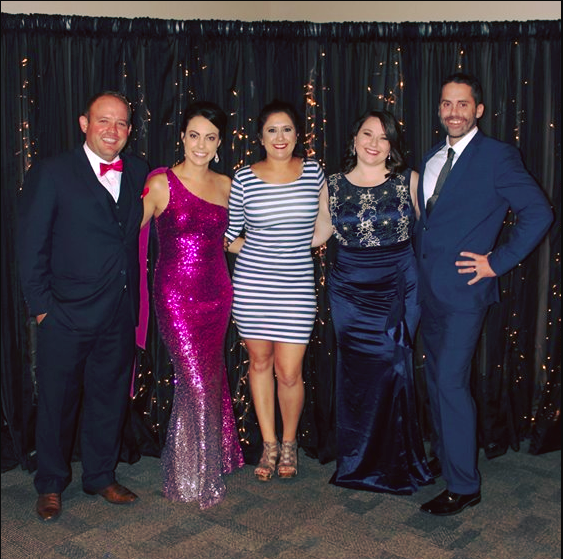
Last year’s HAYP Adult Prom.

Tickets are on sale for the 2019 Hays Area Young Professionals’ Adult Prom.

This year’s theme is Masquerade Gala.

The Hays Area Young Professionals will host an event on Saturday, Nov. 9, at the Rose Garden Banquet Hall, 2350 E. Eight St., Hays.

The event will consist of a cocktail social hour at 6 p.m., a catered dinner at 7 p.m. and a DJ’d dance with DJ’s KZNC Party DJ’s. There will be a cash bar available, presented by The Rose Garden Banquet Hall. Prom Attire is welcome, but not required. Masquerade masks welcome, and there will be a small selection of masks available at the event.

Throughout the night, there will be three raffles, as well as the crowning of the prom king and queen. Nominations for the prom court will be accepted through the Facebook event page and will be limited to five candidates for king and queen.

Community Drive

This year, HAYP is teaming up with the Humane Society of the High Plains for Adult Prom. The items requested for donation include: Purina Dog and Puppy Chow, Purina Cat and Kitten Chow, cat and dog Toys, leashes and collars, blankets and towels. Items for donation can be dropped off at any point before Nov. 8 to any of the ticket outlets, as well as during the event. There will be a short presentation from the Humane Society of the High Plains before the dance begins.

Tickets

Tickets will be for $30 each. Groups of six may reserve tables when purchased together. Adults 21 years and older are permitted. Cash and Check are the accepted payment method. Checks should be made out to Hays Area Chamber of Commerce. Ticket Outlets are

  • The Hays Daily News – 507 Main St.
  • CBD American Shaman – 2013 Vine St.
  • Hays Area Chamber of Commerce – 2700 Vine St.
  • Email [email protected] for tickets if you are unable to reach these locations

Tickets are available for purchase through Oct. 25.

For more information, visit the Hays Area Young Professionals Facebook Page.

CASA sets raffle for FHSU tailgate package, including Traeger grill

CASA of the High Plains is offering a raffle for an FHSU tailgate package.

Tickets are $20 each or six for $100. The prize package is valued at $1,200. See the flyer for a complete list of what is included in the prize package. Only 250 tickets will be sold. The drawing will be Oct. 4. You must be 21 or older to purchase tickets.

Raffle items will be on display at Big Creek Crossing.

Raffle tickets are available by calling 785-628-8641, at the CASA office at 107 W. 13th St., Hays, or from CASA board members.

Mental Health First Aid: Substance use disorder an illness for millions of Americans

Canstockphoto.com
A Hays Post series focusing on mental health issues.

By CRISTINA JANNEY
Hays Post

An occasional glass of wine with dinner is not a symptom of mental illness, but for more than 21 million Americans — 8 percent of the U.S. population older than 12 — substance use disorder is a debilitating disease.

Alcohol use disorder is the most common of the substance use disorders, with 17 million American affected, students in a recent Mental Health First Aid class offered by High Plains Mental Health learned.

Substance use disorders are characterized by a dependence on the substance.

“For instance, you no longer just want to have a glass of wine with dinner, you need a glass of wine with dinner,” Kaley Conner, trainer, said. “It can become something that people depend on like a coping mechanism or a way to relax for people with extreme social anxiety. It may become an unhealthy coping mechanism for how to socialize, how to make friends, to cope in society in some of those stressful situations.”

It can also mean substance use, which is use of alcohol or drugs, leads to problems at work, home, school, in their physical or mental health, or to legal problems.

Substance use disorders start at a median age of 20. They are common among people who suffer from other mental illnesses. People who have mood or anxiety disorders are twice as likely to have substance use disorders, and men are twice as likely as women to have substance use disorders.

Warning signs of alcohol use disorder can include an increased tolerance, difficulty controlling use, symptoms of withdrawal, preoccupation with alcohol, impairment of major functions in life — ability to live, love and learn — inability to stop drinking even though they have expressed a desire to decrease or stop drinking.

Mental Health First Aid uses a four-question screen to determine if someone is at risk for alcohol use disorder

Rapid Alcohol Problems Screen

  • During the past year, have you had a feeling of guilt or remorse after drinking?
  • During the past year, has a friend or family member told you about things you said or did while you were drinking that you could not remember?
  • During the past year, have you failed to do what was normally expected from you because of drinking?
  • Do you sometimes take a drink in the morning when you first get up?

Yes to any of these questions indicates that a person’s drinking is harmful to their health and well-being. The person should receive a full evaluation from a qualified professional, according to the Mental Health First Aid curriculum.

Risk factors

  • Availability
  • Social factors
  • Genetic predisposition
  • Sensitivity
  • Learning
  • Other mental health problems

“I think it is important we change our frame of understanding around substance use disorders. For a long time, it has been thought of as a moral failure and maybe we have not had as much patience with people who have substance use disorders,” Conner said, “but realistically it is a physical addiction. It’s an illness.”

How to help

The course offers the acronym ALGEE to help first aiders remember the steps in aiding in a mental health crisis.

  • Access risk of suicide or harm.
  • Listen non-judgmentally
  • Give reassurance and information
  • Encourage appropriate professional help
  • Encourage self-help and other support strategies

Alcohol and drugs can lower inhibition. About 26 percent of people who complete suicide have a substance use disorder.

In addition to suicide and self-injury, a person with substance use disorder can have medical emergencies, including alcohol poisoning, overdose or severe withdrawal that will need medical attention.

Continual vomiting; vomiting while unconscious; person falls into unconscious state; signs of head injury; irregular, shallow breathing; irregular, weak pulse; and cold clammy pale or bluish skin are all signs of alcohol poisoning. Call 911. If a person is unconscious, roll them on their side until medical help arrives to avoid the person choking on vomit.

Confusion, visual hallucinations, agitation, fever, seizures and blackout are signs of severe alcohol withdrawal. Seek medical attention.

Some people when they drink may become aggressive. Don’t put yourself or others in harm’s way.

Remain as calm as possible and try to de-escalate the situation by talking calmly, not arguing, not threatening, refrain from using negative words, don’t restrict the person’s movement, consider taking a break to allow the person to calm down, according to the MHFA curriculum.

The only thing that can really help a person sober up is time. Black coffee, water and other cures are a myth, Amy Byrd, MHFA trainer, said.

Talk when you are both sober and when you are in a calm frame of mind, Amy Bird, MHFA trainer, said.

“It is very different dealing with a friend or family member who you love and you really care about, not that you don’t care about your co-workers or someone you don’t know as well. This can be a really emotional topic,” Bird said. “There may be kids involved or someone else you love. There can be a lot of anger and a lot of emotion. The time to talk about your concerns is not when you are really upset or angry because then you are going to be talking out of emotion.”

A person who has a substance problem might not have good insight into their problem. They might not recall everything that happened when they were intoxicated. Pointing all of those things out, though, might not be helpful.

“My perception of what is going on and their perception of what is going on may be two very different things,” Bird said.

She suggested refraining from assigning labels, such as alcoholic or drug addict.

As when dealing with other mental illnesses, try to focus on “I” statements and avoid “you” statements that may seem to assign blame —”I am concerned about your drinking?” instead of “You are drinking too much.”

“I am not saying you are a bad person. I am concerned about what you are doing, but I am not saying you are bad,” Bird said.

When you try to give reassurance, the G in ALGEE, consider the following:

  • Changing a substance use habit is not easy.
  • Willpower is not always enough.
  • Advice alone might not help a person change their behavior.
  • If abstinence from drinking is not the person’s goal, reducing the quantity consumed is a worthwhile objective.
  • A person may attempt to change or stop their behavior more than once before they are successful

Don’t join the person in drinking or substance use. Don’t try to control the person through nagging or threatening. Don’t make excuses for the person to cover up their substance use or behavior. Don’t take on the person’s responsibilities. Try not to feel guilty. You are not responsible for someone else’s substance use.

“Sometimes addressing underlying depression or anxiety [may help],” Bird said. “Asking people, ‘What does drinking do for you?’ Not just assuming you are drinking because you want to be drinking.”

Major life changes may be required in recovery.

“In AA, they talk about when you get sober you have to change your playmates, your playthings and your playgrounds,” Bird said.

Treatment does not necessarily mean inpatient rehab. You may start with your primary care physician, a drug and alcohol specialist, mental health professional, certified peer specialist or a support group, such as Narcotics Anonymous or Alcoholics Anonymous, which have support groups worldwide. There is an app for Apple and Android devices to find AA meetings.

High Plains Mental Health has a 24-hour crisis line that can be reached at 1-800-432-0333. Valley Hope is an addiction treatment facility, which has a site in Norton. They can be reached at 1-800-544-5101.

However, there remains a treatment gap. In 2014, an estimated 22.5 million Americans 12 and older needed treatment for a problem with drugs and alcohol, but just 4.1 million people received help. Money, stigma, lack of insurance, waiting lists and proximity to treatment can all be barriers to receiving treatment, Bird said.

Although you can’t make someone seek treatment, you can be there during treatment. Statistics indicate sufferers of substance use disorder are more likely to be successful in treatment if they have supportive friends and family. Groups for those who have loved ones struggling with substance use include Al-Anon and Alateen.

Other resources

Illustration courtesy Canstockphoto.com

100th Science Cafe will promote citizen scientists

By CRISTINA JANNEY
Hays Post

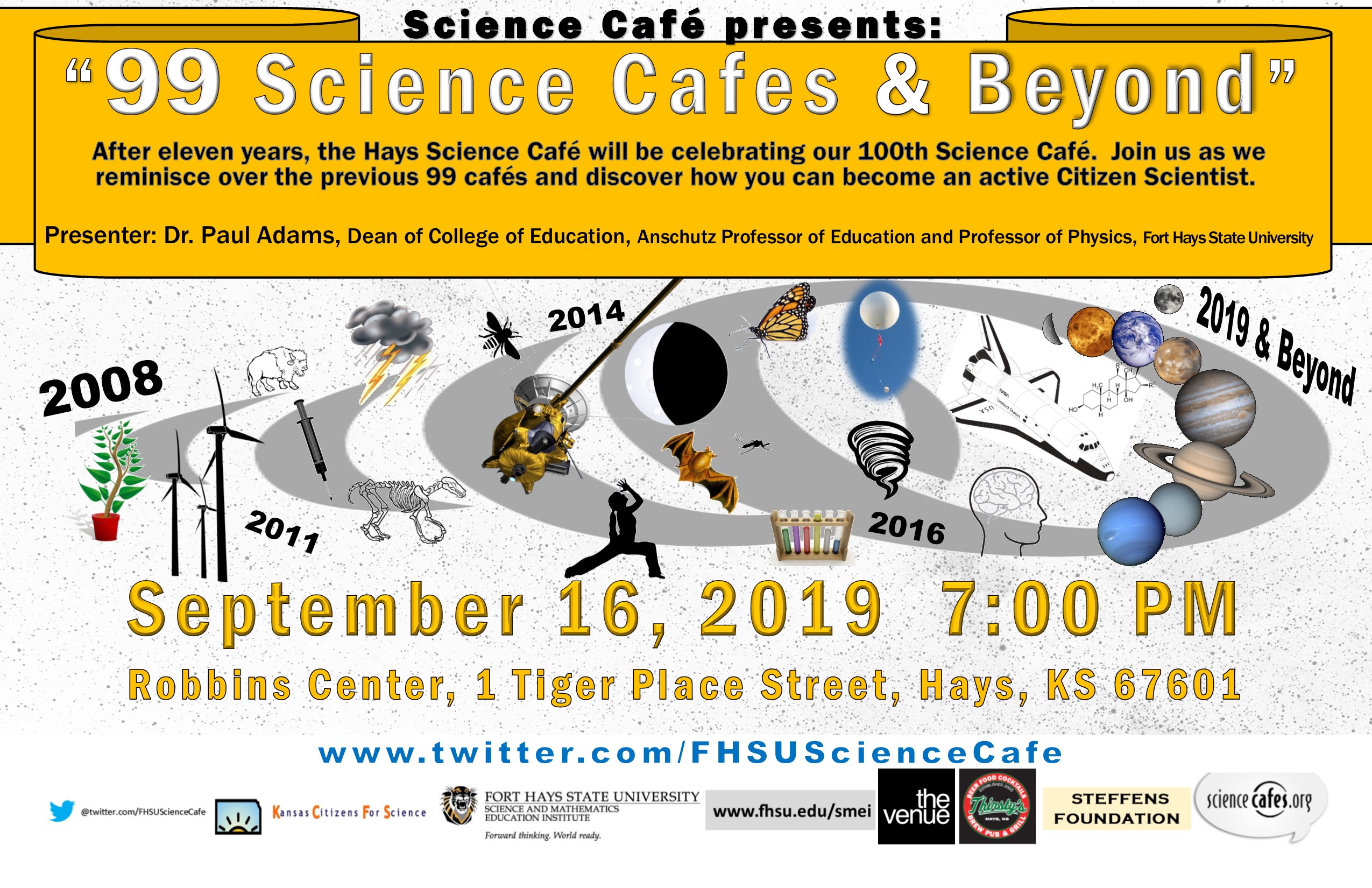
FHSU’s Science Cafe series will celebrate its 100th science lecture at 7 p.m. Monday at the Robbins Center.

Presenter Dr. Paul Adams, dean of the college of education, will discuss some highlights from past 11 years of Science Cafes, opportunities for average people to be citizen scientists and what to expect in the coming year from the lecture series.

One of Adams’ favorite lectures was on the movie “The Martian,” starring Matt Damon. Adams presented that lecture and discussed what aspects of the movie might be possible in reality if humans tried to live on Mars.

Adams

“That was interesting because of a lot of it was really on the edge of what we are going to be able to do,” he said.

The lecture “Mussels and Men” discussed how freshwater mussels use different appendages to fish for their food. A lecture on beekeeping prompted Adams to go out with Scout groups and put up bee houses.

In terms of citizen scientists, Adams said one of the topics in which he is interested is archeology from space.

“When we think of archeology, we think of everybody going in the field, going into Egypt and digging into the ground and whatever that may be,” he said. “Satellite imagery gives a lot back, but it is really tough to look at. To have citizens, anybody who want to go online, take a look at potential places to go and send archeologists to go find out about our past.”

Adams also uses an app called Globe at Night. This app looks at how much we have lost of our dark skies to light pollution and how does that play into urban planning. You go out at night, see what stars you can see and report it. The information is added into an international database. The app also has a legend of the constellations.

Another app, Globe Observer, enlists citizen scientists in monitoring dust storms. If you see a dust storm, you take a picture and turn that in.

“As we are warming and the climate changes, one of the predictions is that we will see an increase in activity and that has real impacts on farming and agriculture and business,” Adams said.

Yet another app asks citizen scientists to report mosquito populations. There is a federal clearinghouse with more than 500 citizen scientist projects. Some of these projects can be great for kids, Scouts, 4-Hers or school groups, Adams said.

“If you have an interest in the world in almost any area, even looking at ancient scrolls that are in Greek to figure out what those Greek letters are … It can be anything that is out there,” he said. “Scientists have discovered crowd-sourcing is a better way to go or computers don’t have the resolution to make out the images.”

Future topics that are being considered for Science Cafe topics, include cultured meat (IE meat created in a lab not from an animal), science education in northwest Kansas and other STEM developments that affect the Kansas economy.

Usually the Science Cafes are downtown or in restaurant in informal settings. For this special celebration, FHSU wanted to be able to serve cake and have space to display posters from past Science Cafes, so the event is scheduled in the Robbins Center. The event is free, and no registration is required.

Copyright Eagle Radio | FCC Public Files | EEO Public File