DICKINSON COUNTY — Law enforcement authorities are investigating a suspect on drug charges.
On Friday, the Dickinson County Sheriff’s Department reported the county drug enforcement unit, police and parole officers executed a search warrant at a home in the 300 Block of Opal Road lot 20, Red Rock Trailer Court, Abilene on December 20.
Deputies arrested 22-year-old Austin Michael Johnson of Abilene on suspicion of felony count of Possession of Methamphetamine, Possession of Marijuana, Possession of Drug Paraphernalia, on misdemeanor counts of Possession of Drug Paraphernalia, Endangering a Child and a Parole violation.
During the search of the residence, law enforcement officers seized methamphetamine and marijuana along with drug paraphernalia. Prior to conducting the search warrant there was a child present in the residence. Johnson has two previous drug convictions, according to the Kansas Department of Corrections.
The case is ongoing and further arrests are possible, according to Hoffman.
MANHATTAN — Activist and philanthropist Joyce Banda, the first female to serve as president of the African nation of Malawi, will present a Landon Lecture at 10:30 a.m. Monday, Jan. 29, 2018, at Kansas State University. Banda’s lecture will be in Forum Hall at the K-State Student Union and is open to the public.
“It a privilege to welcome her excellency, Joyce Banda, to Kansas State University as a Landon Lecturer,” said Jackie Hartman, chair of the Landon Lecture Series and the university’s chief of staff and director of community relations. “As the second female to lead an African nation, President Banda helped turn her country’s economy around and has been a longtime champion of women’s rights.”
As president of Malawi from 2012-2014, Banda was credited with turning around the nation’s ailing economy. Under the economic reforms she instituted, Malawi’s rate of economic growth rose from 1.8 percent in 2012 to more than 6.2 percent in 2014. In that same time span, Malawi’s operational industrial capacity rose from 35 percent to 85 percent.
Banda also repealed a number of laws which had weakened democratic institutions, infringed on civil liberties and restricted freedom of the press. The health of women and children was a priority in Banda’s presidency. She established the Presidential Initiative on Maternal Health and Safe Motherhood, which helped drop the maternal mortality rate in Malawi.
Before becoming president of Malawi, Banda served as the nation’s vice president, foreign minister, minister of gender and child welfare, and as a member of its Parliament. As minister of gender and child welfare, she championed enactment of the Prevention of Domestic Violence Bill in 2006, which provided the legal framework to support the prevention and elimination of all forms of violence against women and girls.
Since leaving office, Banda serves on the boards of Nutrition International Canada and the Tana High Level Forum of Peace and Security in Africa. She is a member of the Council of Women World Leaders and a distinguished fellow with the Woodrow Wilson International Center for Scholars and the Center for Global Development.
The founder of the Joyce Banda Foundation International in 1997, Banda continues her work with the foundation today to transform villages in Malawi by supporting women’s economic empowerment, education, maternal health and HIV/AIDS programs, leadership training and human rights. She also serves as a panelist and motivational speaker at international conferences and forums.
Banda’s work has drawn many honors. She was named one of the world’s most powerful black women by Forbes magazine in 2013 and 2014; one of the most influential people in the world by Time and Forbes; and one of the most inspirational women in politics by CNN.
Her degrees include a bachelor’s in gender studies from Atlantic International University and a master’s in leadership from the Royal Rhodes University of Canada.
Harold James Giebler, 90, Hays, died Sunday, December 31, 2017 at Via Christi Village.
He was born December 9, 1927 in Hays the son of Edmund and Anna (Staab) Giebler. He was a 1945 graduate of St. Joseph Military Academy and served in the U.S. Army during World War II and played with the 5th U.S. Army Band. On June 20, 1953 he was united in marriage to Petronilla “Nellie” Leiker at St. Joseph Catholic Church in Hays. They celebrated over 64 years of marriage. He attended Fort Hays State College for two years and was a mail carrier for many years with the United State Postal Service. After his retirement from the USPS, he was a bus driver and van driver for over ten years with USD 489. He was a member of Immaculate Heart of Mary Catholic Church, Third Degree Knights of Columbus Council #1325, and the Hays American Legion. He was a cantor for many years at Immaculate Heart of Mary, and was also a member of the church choir and the Volga German Men’s Choir. He was very active, true to his word, and was known to be able to build or fix anything.
Survivors include his wife Nellie, of the home in Hays, four daughters; Cecilia Burke and husband Marty of Lawrence, Rose Coon and husband Steve of Topeka, Teresa Schrant and husband Larry of Hays, and Barbara Gonzales and husband Mike of Wichita, a son; Andrew Giebler and wife Tara of Andover, a sister; Berniece Schumacher of St. Louis, two brothers; Norman Giebler of Hays and Patrick Giebler and wife Terri of Colby, eighteen grandchildren, eight great grandchildren, and numerous nieces and nephews.
He was preceded in death by his parents, and infant son; Stephen Giebler, a sister; Sybilla Schukman, and three brothers; Albert, Herbert, and Edmund Giebler, Jr.
Mass of Christian Burial will be at 10:00 am on Wednesday, January 3, 2018 at Immaculate Heart of Mary Catholic Church with Fr. Barry Brinkman officiating. Burial with military honors by the Hays VFW Honor Guard will follow in the St. Joseph Cemetery. Visitation will be from 5:00 pm until 8:00 on Tuesday and from 9:00 am until 9:45 on Wednesday, all at the Hays Memorial Chapel Funeral Home. A Daughters of Isabella rosary will be at 6:00, a parish vigil service will be at 6:30, and a Third Degree Knights of Columbus Council #1325 rosary will be at 7:00 pm, all on Tuesday at the funeral home.
Memorials are suggested to Immaculate Heart of Mary Catholic Church or to masses, in care of the funeral home. Condolences may be left for the family at www.haysmemorial.com
Susan M. Davis, 74, of Kansas City, Missouri, passed away peacefully Thursday, December 28, 2017, following a long-term illness.
Services will be held on Wednesday, January 3, at Little Sisters of the Poor, 8745 James A. Reed Rd, Kansas City, MO, where Susan lived since moving to Kansas City from Hays, Kansas, four years ago. She will be buried next to her parents at St. Fidelis Cemetery in Victoria, KS. Visitation will be held at 9:30 a.m. with a Rosary at 10:00 a.m., followed by a Mass of Christian Burial at 10:30.
Born on her Mother’s birthday, April 24, 1943, in Hays, KS, Susan grew up in nearby Plainville, KS, where she attended Sacred Heart Grade School and then graduated from Plainville Rural High School in 1961. She worked in the family grocery store from an early age until the store was sold a few years after she graduated from high school. Many years later, after starting her family, Susan returned to school, and in 1989 she earned an Associate of Science degree in Secretarial Administration from Fort Hays State University.
Susan was preceded in death by her parents, Emil E. Kuhn and Zita (Giebler) Kuhn. She is survived by her three children: Cynthia Davis, Michael Davis and wife (Shana), and Christopher Davis; four grandchildren: Micaela, Austin, Ayden, and Rylie Davis; five brothers: Ronald Kuhn (Cindy), Earl Kuhn (Kasey), Richard “Whitey” Kuhn (Fran), Raymond Kuhn (Jana), and Vernon Kuhn (Cindy); and one sister, Phyllis Schapker (Richard); as well as many loving nieces and nephews and their families.
In lieu of flowers, the family requests memorial contributions be made to Little Sisters of the Poor or the Kidney Foundation.
Intersection where the carjacking occurred-photo courtesy Fox-4 Kansas Cty
KANSAS CITY, Mo. (AP) – Police say a toddler who was inside a vehicle when it was carjacked in Kansas City has been found safe in a nearby suburb.
The Kansas City Star reports that the carjacking occurred around 11 a.m. Sunday when a man forced himself into the sport utility vehicle and then forced the driver and some children out, except for the 18-month-old boy.
Surveillance video from a nearby business shows the man and another person get in and speed away. The woman gave chase on foot and then in a taxi as the SUV headed south.
Belton police reported finding the SUV and the child about an hour later. An unidentified suspect was taken into custody.
The names of the woman and child haven’t been released.
NICODEMUS – Nicodemus National Historic Site presents the exhibit Times, Teams, & Talent from the Negro Leagues Baseball Museum. The display consists of panels that detail the history of the Negro League history of the leagues, basic questions about teams and players as well as information on the Negro Leagues Baseball Museum in Kansas City, Missouri.
The exhibit will be at the Nicodemus Township Hall in Nicodemus, Kansas through Friday, February 8, 2019 from 9:00 a.m. to 4:30 p.m. Monday through Saturday. The Visitor Center is open to the public free of change, and everyone is welcome to come in a view the display.
To learn more, contact Phyllis Howard at 785-354-1489 ext. 224 or [email protected]
The park is located on Highway 24, 13 miles east of Hill City and 19 miles west of Stockton.
The town of Nicodemus is symbolic of the pioneer spirit of African Americans. They dared to leave the only region they had been familiar with to seek personal freedom and the opportunity to develop their talents and capabilities.
Nicodemus NHS represents the western expansion and settlement of the Great Plains, and includes five buildings: The First Baptist Church, St. Francis Hotel, Nicodemus School District Number One, African Episcopal Church, and Township Hall.
HARPER COUNTY — The new year got off to a shaky start in Kansas. A small earthquake shook south-central Kansas. The quake just after 2a.m. measured a magnitude 2.6 and was centered approximately 22 miles south of Anthony, according to the U.S. Geological Survey.
It is the first quake in Kansas since a pair of quakes including a 3.1 magnitude temblor were reported in Harper County on December 15.
There are no reports of damage or injury from Monday’s quake.
Roberta Reh, 94, and former Natoma, Kansas, resident, died December 25th at Hilltop Manor in Cunningham, Kansas.
Roberta was born in Natoma, Kansas on September 26, 1923 the daughter of Arthur and Elise (Larsen) Hoskins. She was united in marriage to Marion Reh on June 30, 1940; they were married 52 years.
She was a former member of the First Baptist Church in Plainville, Kansas. She loved gardening, sewing, reading, painting and teaching her art. She continued painting into her nineties.
Roberta is survived by a sister, Neva Dodson of Salina, two sons Marion Reh of Rose Hill, Gary Reh (Robin) of Pratt, Kansas, 8 Grandchildren, 22 Great-grandchildren, 4 Great-great Grandchildren, other family and many friends.
Roberta was preceded in death by her parents, her husband, 2 brothers, 3 sisters and 1 son.
A celebration of Roberta’s life will be held at 11 A.M. on Tuesday, January 02, 2017, at the Pohlman-Varner-Peeler Mortuary in Russell, Kansas with Pastor Roger Dennis officiating. Burial will follow at the Natoma City Cemetery in Natoma, Kansas. Family and friends are invited for food and fellowship at the Natoma Community Center after the graveside service. Visitation will be from 9 A.M. to 11 A.M. the day of the service at the mortuary. Memorial may be given to the Natoma Community Center and can be sent in care of the mortuary at 610 N. Maple St, Russell, KS 67665. Pohlman-Varner-Peeler Mortuary of Russell and Natoma is in charge of the funeral service arrangements.
Native Kansan Karen Madorin is a local writer and retired teacher who loves sharing stories about places, people, critters, plants, food, and history of the High Plains.
Fresh beginnings make people reflect as well as anticipate. I’m no different as I behold the clean canvas of a brand-new year. Like many of you, genealogy and ancestry sites have captured my interest, and I’m intrigued by ancestors who migrated to begin fresh lives and kept on traveling. I’m curious about why so many kin made it to Kansas and stayed. As I explore their stories over the next few months, I hope your families examine your sunflower roots as well.
Our first Kansas ancestors arrived by train from Devizes, Ontario, Canada, in 1872. Although former brickmakers, they homesteaded along the Kansas/Nebraska border in Norton County, KS. While they exchanged longitudes, latitudes, and occupations, they maintained familiarity with their previous home by naming their new home Devizes, Kansas. According to family records, they donated land for a school, post office, and cemetery. Only the cemetery remains. Like so many start ups at the end of the 1800s, this little community withered til little except headstones remain to remind us of hopes that once existed in this isolated place.
This particular group of immigrants came not only to claim land, but also souls. Though Grandpa Reuben missed the Second Great Awakening of the earlier 1800s, he discovered a deep faith and committed himself and his family to the demands of a prairie Methodist Circuit rider. This meant he frequently left wife, children, and parents to develop the homestead while he and his pony traveled drainages with names of Beaver, Sappa, Prairie Dog, Solomon, Deer, and more. No matter the weather, he crisscrossed mostly empty miles, holding services for those settled far from town.
His tiny wife Hannah grew up as a daughter of ship captain who navigated Lake Michigan. Marrying Grandpa meant exchanging her predictable life for the exact opposite. I’m certain she surprised to herself by starting a family in a sod house far from any large body of water.
She made do in those first homes, offered bread and coffee to roaming Cheyenne, hid children in native grass to protect them from hostile natives, lived off missionary barrel goods sent by established eastern congregations, buried children, and in-laws, and lived to ripe old age before dying in Ford, Kansas.
Grandpa writes about arriving soon after the Rebellion when Kansans still reeled from the border wars. He detailed insect and weather-related devastation and expressed his satisfaction that many settlers hungered to hear the Lord’s message.
As I read his memoirs, I note town names have changed. Lenora was once Spring City while Glade was Marvin. He shared his frustrations with getting actual church buildings constructed. In Kensington, he and the Baptist preacher held services in the local saloon Sundays when it closed for regular business. He and the Methodists of Agra raised funds to build a sanctuary that was soon destroyed by a tornado. They didn’t give up. The community rallied and rebuilt their church.
With a love of history and so many roots in Kansas, I’ve stories to share. Perhaps our tales intersect with yours. I’m eager to hear from those with details to fill empty blanks in our saga.
Native Kansan Karen Madorin is a local writer and retired teacher who loves sharing stories about places, people, critters, plants, food, and history of the High Plains.
Starting at 2 p.m. Jan 8, though hopefully years earlier, the Legislature will be galvanized over the issue of respectful interaction between legislators, legislative staff, lobbyists and young legislative interns.
The issue, of course, is the result of complaints of sexual harassment or obviously improper interaction between interns and others in the Statehouse. The Women’s Foundation of Kansas City, which is advising legislative leadership on interaction in the workplace—yes, the Statehouse is a workplace—last week issued recommendations for the 2018 Legislature, which starts Jan. 8.
This issue is atop finding an answer to the likely $600 million price tag for a constitutional school funding formula, seeing a potential change of occupants in the governor’s office, plus highways, health care for the poor, just about everything else the state does.
The sexual harassment issue is focused on those college kids who are getting their feet wet in seeing how a legislature actually operates, the ins and outs and shuffles and tradeoffs and concessions made almost daily by people who are elected to the Legislature. It’s different than in the schoolbooks.
The issue itself evaporates if Statehouse denizens would just behave the way their mothers taught them, be polite and respectful, and not use one’s authority to harass or embarrass those who aren’t elected by a majority of voters in their districts. We’re guessing that no candidate’s palm cards note that the office-seeker is handsy.
Just telling the occupants of the Statehouse to act right and respectfully isn’t going to solve the problem. The Women’s Foundation of Kansas City is going to find itself with some political power to dispense because among its recommendations is to increase the number of women in leadership roles at the Capitol.
Leadership in the Statehouse is determined by votes, or almost as often by close working relationships based on trust—and votes.
What seems simple good behavior becomes more difficult when “fraternization” includes interns, legislative staff, elected officials and lobbyists. It’s the hall talk, the dinners and drinks, the fraternization that has long been the oil in the machine. There is good respectful fraternization and the other kind based on gender and power.
Oh, and the Women’s Foundation is also suggesting accountability and monitoring of sexual harassment, ranging from definitions of sexual harassment to safe reporting of that conduct, to representation and respect for complainants and consequences for violators. Oh, and no secret settlement deals to hide those who harass others.
Lots of work, but it all comes down to respectful behavior, and finding some way to define that.
The issue is serious, needs to be dealt with, but it also provides a grandstand for legislators who offer up bills dealing with the subject and, of course, higher visibility for the Women’s Foundation which wants more women in leadership roles in government, elected and appointed, and a broader base of government leaders that for decades in Kansas has been powerful, or at least relatively powerful, men.
What happens? Look for lawmakers to find ways to take public, well-orchestrated positions in favor of respectful treatment of women in the Statehouse. Ever think that just being respectful like they were taught as children turns out to be a campaign issue? Most probably wish that it wasn’t necessary.
Kansans, of course, want the collegiate legislative interns and others respected. The trick for lawmakers will be to balance needed work on the issue with an otherwise full plate of spending, budgeting, and representing and protecting their districts. Very little is very simple in the Statehouse. We’ll see how this comes out…
Syndicated by Hawver News Company LLC of Topeka; Martin Hawver is publisher of Hawver’s Capitol Report—to learn more about this nonpartisan statewide political news service, visit the website at www.hawvernews.com.
In the summer of 2005, the Legislature butted heads with the Kansas Supreme Court over a ruling that ordered an influx of money to public education.
The result? Kansas came closer than ever to a constitutional crisis.
With Kansas facing a similar Supreme Court deadline this spring, state lawmakers are talking about ways to challenge or restrict the court’s authority on the topic of K-12 funding. A special committee formed to address the latest court ruling will meet Monday and Tuesday at the Statehouse.
Key participants in the 2005 special session sat down with the Kansas News Service in recent weeks to share their memories of the 12 days in the House — and 11 in the Senate — when lawmakers debated defying the justices but ultimately backed down.
In the process, they missed a critical court deadline that raised the stakes of the session — and had people who doubted a school shutdown could ever happen rethinking their assessment.
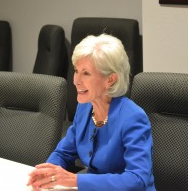
Kathleen Sebelius was governor of Kansas in 2005, when the Legislature and the Kansas Supreme Court sparred over school finance as part of the Montoy v. Kansas case.
‘Time is running out’
Kathleen Sebelius, governor at that time, recalled calling the special session that brought lawmakers back to Topeka in late June 2005.
That spring, the Legislature had attempted to resolve a school finance lawsuit — Montoy v. Kansas — by adding $142 million to the state’s education spending. Sebelius suspected that wasn’t enough. Though she didn’t veto the bill, she declined to sign it.
“I said that over and over during the session,” she said. “So we sent it quickly to the court without my signature.”
Sebelius believed the bill fell short of two requirements the state had to meet: putting enough money into schools to help student outcomes and distributing the money in a way that was fair to resource-poor school districts.
On June 3, 2005, the court agreed, ordering the Legislature to double that $142 million figure by the start of the new fiscal year on July 1 — an important date for school district budgets. The justices settled on that amount based on a school finance study the Legislature had commissioned four years earlier.
“Time is running out for the school districts to prepare their budgets,” the justices wrote in explaining the July 1 deadline. “The Legislature has known for some time that increased funding of the financing formula would be necessary.”
Sebelius wanted the Legislature to comply, and many moderate Republicans agreed.
“We thought we were putting an adequate amount of money in, but the court thought otherwise,” recalled former Senate president Steve Morris, of Hugoton. “So I thought, well we’ll just have to do what we have to do.”
Sebelius set a June 22 start date for the special session and Morris called a few of the Senate’s committees back early to craft legislation that would meet the court’s demands. When the full Senate returned, it passed the bill on its first day.
That’s not to say senators had no reservations about the situation. After passing the legislation, some Senate Republicans set to work pursuing possible constitutional amendments that would tie the court’s hands on school finance in the future.
Court out of bounds?
The House, meanwhile, was at a standstill. Complying with the court ruling was anathema to conservative leaders there who saw it as caving to a branch of government overstepping its authority.
“We were pretty shocked that this court would not only weigh into that issue,” said then-representative Mike O’Neal, referring to school finance, “but literally order the Legislature to appropriate a certain amount of funds.”
The Hutchinson Republican was the longtime chairman of the House judiciary committee and argued that separation of powers doctrine — and in particular provisions in the Kansas Constitution and legal precedent — meant the court was out of bounds.
Democrats and some moderate Republicans disagreed.
“We have equal branches of government, and we need to remember that,” Morris said.
The lack of a resolution frustrated members of the Senate who wanted the House to wrap up its work, get the money to schools and allow everyone to go home.
“At one point I put out a news release where I called it ‘Mays malaise,’” Senate Minority Leader Anthony Hensley said, referring to then-Speaker of the House Doug Mays. “They were unable to do anything.”
Mays, a Topeka Republican who left the Legislature a year later, didn’t respond to an interview request for this article.
Constitutional questions
Talk of potentially defying the court by ignoring its ruling, or asking Kansas voters to amend the state constitution, continued. The Kansas Constitution had — and still has today — a provision requiring the Legislature to suitably fund public schools, and potential ideas in 2005 included adding a line to it barring the court from weighing in on that matter.
In a legislative hearing, Washburn University law professor Bill Rich testified against the idea.
“That would mark a really radical change in the history of the relationship between the judicial and legislative branch,” Rich said.
It effectively would have carved out part of the constitution as unenforceable by the courts, Rich argued, and that could have broader implications. If lawmakers wanted to prevent judicial scrutiny of their compliance with a constitutional duty, Rich said, they should ask voters to remove that duty from the Kansas Constitution.
In this case, that would have meant deleting the clause requiring Kansas to suitably fund public schools. But asking the public to do that may not have been politically palatable.
“I think the Legislature knew that that was not going to pass,” Rich said.
As the impasse continued, lawmakers missed the court’s July 1 deadline, raising the possibility of school closure.
Political and government leaders knew school closure was a risk because a lower court ruling had made that clear. Absent a constitutional school finance system, the judicial branch was prepared to strike down the current one. In doing so, the court would block its implementation, which meant stopping the flow of money to schools.
The missed deadline increased pressure on everyone. School administrators like Randy Weseman, then superintendent of the Lawrence district, weren’t sure how long they would have the authority to keep paying the bills in the new fiscal year.
“When you’re talking about not providing education in August for 11,000 kids, 2,000 employees,” Weseman said, “it’s a huge undertaking to talk about just stopping that train.”
For Weseman, the matter was further complicated by the fact that Lawrence, a growing district, was in the middle of building new schools. He and other administrators watching the stalemate in Topeka began preparing to ask the Kansas Supreme Court to allow schools to continue paying certain critical expenses.
An ‘intense’ July 1 meeting
But the schools never closed. Two things happened in quick succession that appear to have pushed the legislative process forward. One was a closed-door nighttime meeting July 1 in Sebelius’ office, with key players like Morris, Hensley and Mays all present.
Mays reportedly left abruptly, dodging the questions of reporters waiting outside the room.
Hensley described the meeting as “very intense.” Mays knew, he said, that Democrats and moderate Republicans had been discussing a bill to comply with the court.
The other event, the next morning, was an order from the state Supreme Court, which wasn’t pleased with the Legislature missing its deadline. The justices gave state lawyers six days to prepare for appearing in court and presenting any last-minute arguments against blocking the flow of money to schools.
In the days that followed, the House and Senate negotiated.
“We basically had to pay the ransom and make sure the schools were going to open,” said O’Neal, who was one of the six negotiators.
They reached a resolution, and both chambers signed off on it two days before state lawyers were due back in court. That was a relief for moderate Republican leaders like Morris.
“It felt like we had taken a load off,” he said. “We had done what we needed to do.”
‘Quite a bit of reform’
O’Neal said conservative Republicans didn’t leave the negotiating table empty-handed. The final law approved by both chambers on July 6 included a raft of policies O’Neal and others pushed for.
Those included a policy goal for schools to spend at least 65 percent of their state aid on instruction, new procedures for filing school finance lawsuits against the state and provisions barring the courts from enforcing any rulings by cutting off money to schools.
“We felt like we got quite a bit of reform in exchange for writing a bigger check,” O’Neal said.
All attempts in 2005 to pursue a constitutional amendment, which would have required a two-thirds majority in each chamber before proceeding to a public vote, failed.
As for the statutory ban on closing schools, which lawmakers did pass, it’s not clear that the courts consider it binding absent a constitutional amendment. In more recent school finance rulings, cutting off money to schools has remained an option on the table despite the 2005 law.
Celia Llopis-Jepsen is a reporter for the Kansas News Service. You can reach her on Twitter @Celia_LJ.