Over the last five years, almost 15,000 workers disappeared from the Kansas workforce.
During the same timeframe, the state is growing economically, with a recent monthly report showing 14,000 jobs created in the last year and unemployment at 3.3%. That’s below the national rate.
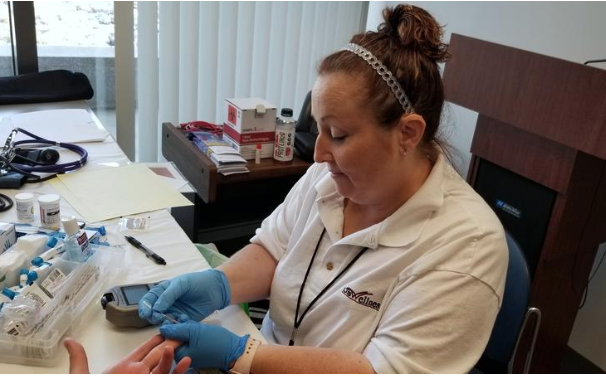
A worker draws blood during a health-care screening in Topeka. Health care jobs will be in high demand as Kansas’ population ages. STEPHEN KORANDA / KANSAS NEWS SERVICE
Despite the good news, Kansas officials see a long-term challenge: having enough employees to fill the state’s jobs, especially in high-demand careers like nursing and accounting.
The total labor force in Kansas peaked in 2009 at 1.521 million, likely driven by the economic downturn that caused people to enter the labor force who otherwise wouldn’t be working. That tapered off, and by the middle of 2014, Kansas’ workforce was 1.493 million.
By July, the number had fallen to 1.479 million.
There are multiple factors at play, Kansas Department of Labor Senior Labor Economist Tyler Tenbrink said, and it starts with the state population.
“Population growth has been almost zero for a few years now,” he said.
Other factors are delaying people from entering the workforce or causing them to leave it. One thing is age: Many in the baby-boomer generation are retiring or could soon.
There’s also pressure on the younger end of the age scale.
“We also have students who are staying in school longer, so they’re not getting into the labor force as quickly,” Tenbrink said.
Certain industries have greater challenges when it comes to the workforce. In the coming decades, the population of older Kansans is expected to grow faster than the state overall, which will require more workers in health care, a sector that’s already struggling.
The Kansas Hospital Association compiled a report outlining the challenges and noted many jobs with expected shortages, ranging from nurses to nursing assistants and home health aids.
“These are the folks that care for people, that are at the bedside,” KHA Vice President Cindy Samuelson said.
To try to tackle the problem, hospitals are partnering with colleges and universities to find ways to let people know there are good-paying careers in demand. Many positions just require a two-year degree, and people can work in the industry while training for a future higher position.
It’s not always as simple as advertising for good-paying jobs. Some hospitals are working to recruit outside of Kansas, but sometimes those workers don’t stay for the long term. It’s led some to find and train local hires, which is what Samuelson calls “growing your own.”
“There is a lot of cost associated with training and getting that person up to speed, and if they’re only there a short amount of years there is a loss,” she said.
It’s a tough nut to crack, and Kansas Labor Secretary Delía García wants state officials to make it a focus by working more closely with education and business groups to train workers while also having lawmakers and officials craft economic development programs to target the problem by attracting people.
“We are in good shape in Kansas, we are stable,” García said. “But we also want to be looking forward.”
Stephen Koranda is Statehouse reporter for the Kansas News Service. Follow him on Twitter @kprkoranda or email skoranda (at) ku (dot) edu.
Selection Board will review applications, interview candidates for admission to U.S. Service Academies
WASHINGTON – U.S. Senator Jerry Moran (R-Kan.) today announced members of his 2019 Service Academy Selection Board. The 20-member board will review applications and interview candidates who are applying for admission to U.S. Service Academies.
“One of the greatest responsibilities I have as a United States Senator is to nominate Kansas students to attend service academies,” Moran said. “I am proud of these young students for their desire to serve our nation, and I’m grateful to my Service Academy Selection Board for the thoughtful consideration they put into the application process. These students applying to enter service academies represent the best of Kansas, and I look forward to receiving the selection board’s recommendations and meeting with students in Hutchinson.”
Applications will be reviewed and selected applicants will be interviewed by the selection board on Saturday, Sept. 21, at the Cosmosphere in Hutchinson. The U.S. Service Academies include the U.S. Military Academy, U.S. Naval Academy, U.S. Air Force Academy and U.S. Merchant Marine Academy.
Members of the 2019 Service Academy Selection Board include:
Lt. Col. (RET) Bob Brock of Topeka – Director of Aviation, Kansas Department of Transportation, U.S. Air Force veteran;
Myca Bunch of Garden City – President, Garden City Area Chamber of Commerce, U.S. Air Force veteran;
LTC (Ret) Larry Burks, Sr., of Wichita – Director, Military and Veteran Services, Wichita State University, U.S. Army veteran;
Dennis Butler of Manhattan – Director, Riley County Police Department;
COL John Cluck of Wathena – Mayor, City of Wathena, Vice Commander, 139th Airlift Wing, Missouri Air National Guard;
Ardith Dunn, Ph.D., of Satanta – Retired high school mathematics/computer instructor, K-12 superintendent, mother of U.S. Air Force Academy graduate;
Michael Farris, M.D., of Altamont – Emergency Physician, Freeman Neosho Hospital, Served in the U.S. Air Force Reserves;
Sue Givens of El Dorado – Field Specialist, Kansas Association of School Boards, Retired K-12 superintendent;
Robin Jackson, Ph.D., of Hutchinson – Central Christian College Professor of Science and Mathematics;
Cheryl Kerns of Overland Park – Blue Valley West High School teacher, mother of U.S. Military Academy graduate;
Brian Kessens of Overland Park – Tortoise Capital managing director, U.S. Military Academy graduate;
Katrina Lewison of Manhattan – USD 383 Board of Education Member, Purple Heart recipient, U.S. Military Academy graduate;
Jayne Humphrey Pearce of Wallace – Wallace County Visitors Bureau Marketing and Tourism Director, U.S. Air Force veteran, mother of U.S. Air Force Academy graduate;
Rachael Pitchford of Dodge City – Assistant Principal, Comanche Middle School, U.S. Marine Corps veteran;
Sean Ritchie of Wichita – Cargill North American Operations Lead, U.S. Merchant Marine Academy graduate;
Halley Roberson of Oberlin – City Administrator, City of Oberlin, U.S. Army veteran;
Mike Souder of Prairie Village – Dean of Continuing Education, Johnson County Community College, U.S. Military Academy graduate;
Sam Turner of Leawood – Retired Shawnee Mission Medical Center CEO, Vietnam War veteran, U.S. Army veteran;
Ron Whitney of Emporia – American Legion member, Veterans of Foreign Wars member, U.S. Army veteran;
Beth Wilson of Girard – Business education teacher, Girard High School, mother of U.S. Naval Academy Midshipman.
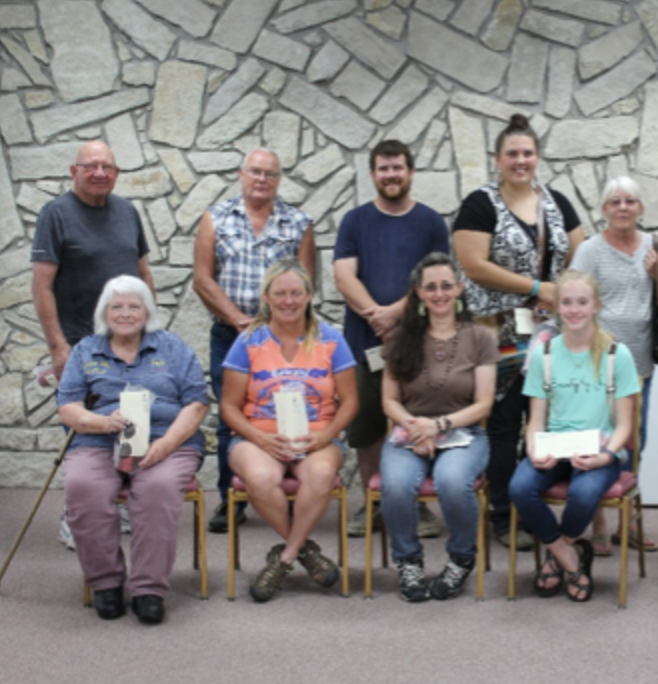
Back Row (L-R): Gale Lohrmeyer, Ron Howland, Sean Linden, Jordyn Leggett, Nancy Williams, Ron Hessling, Virgil Uhrich, Nancy Elting. Front Row (L-R): Joyce Underwood, Stephanie David, Marcia Anderson, Jaelyn Rumback, Dede Elsen, Sami Randle.
LOGAN – Each year, the Dane G. Hansen Museum Board requests the services of two qualified individuals to select 12 winners and two alternates from crafters taking part in the annual Hansen Arts and Crafts Fair.
These chosen crafters become our “Artists of the Month” for the next year. The Dane G. Hansen Museum is pleased to announce the following 46th annual Hansen Arts & Crafts “Artists of the Month” winners:
Stephanie David (Lenora, KS)
Jordyn Leggett (Logan, KS)
Jaelyn Rumback (Clayton, KS)
Virgil Uhrich (Wakeeney, KS)
Nancy Williams (Stockton, KS)
Ron & Betty Jo Hessling (Alton, KS)
Nancy Elting (Lincoln, NE)
Marcia Anderson (Cedar, KS)
Sean Linden (Collyer, KS)
Gale Lohrmeyer (Logan, KS)
Sami Randle (Russell, KS)
and Dede Elsen (Kearney, NE).
Ron Howland (Cawker City, KS) and Ron & Joyce Underwood (Everest, KS) were selected as alternates.
Crafters are selected for their uniqueness, creativity, presentation, individual art form, and excellence of craft. As a winner of this prestigious award, each received a high-quality engraved water bottle with a declaration of their award and the 46th Annual Hansen Museum’s Arts & Crafts Fair logo. Additionally, their craft will be exhibited and sold in the Museum for an entire month during the next calendar year.
The Museum is open Monday through Friday 9-12 and 1-4; Saturday 9-12 & 1-5; Sunday and holidays 1-5. We are closed Thanksgiving, Christmas, and New Years. We are handicapped accessible and admission is always free thanks to the generous support of the Dane G. Hansen Foundation. For more information or if you have questions, please contact us at 785-689-4846.
RENO COUNTY — One person was injured in an accident during a chase just after 2p.m. Saturday in Reno County.
The Kansas Highway Patrol reported a 2004 Suzuki motorcycle driven by Skyler J. Rupp, 21, Wichita, was fleeing from Mount Hope Police southbound on Obee Road six miles south of K-96.
The driver lost control of the motorcycle and crashed.
Rupp was transported to a hospital in Wichita. He was wearing a helmet, according to the KHP. Authorities have not released what prompted the chase.
WICHITA — Large industrial operations — think electrical power plants, oil refineries, ethanol facilities —cough carbon dioxide into the atmosphere by the ton. That, in turn, warms the planet.
Carbon dioxide is all around us. Plants use it for food. Humans exhale it. It’s used in dry ice and to make your soda fizzy.
But it’s produced in serious, problematic quantities when we burn fossil fuels — every time we jump in a car and to generate the majority of the electricity we use.
When we do that, we’re taking carbon that was once stored in the ground and putting it into the atmosphere as carbon dioxide, or CO2.
To prevent some of the catastrophes that would cause, researchers want to stash CO2 emissions back in the ground.
With funding from the U.S. Department of Energy’s CarbonSAFE program, researchers from the Kansas Geological Survey, environmental policy groups, lawyers and oil and gas companies spent the last three years investigating the feasibility of carbon capture and storage in Kansas.
(By Crysta Henthorne/Kansas News Service)Kansas Geological Survey petroleum engineer Eugene Holubnyak has been working on the carbon capture and storage project in Kansas for three years.
“No matter how you slice it,” said Eugene Holubnyak, a petroleum engineer leading the project at the Kansas Geological Survey, “we’re centrally located and I think we have all the necessary components that need to be in place to be a hub for distributing CO2.”
The research first looked at the potential of capturing CO2 emissions from Westar’s Jeffrey Energy Center, a coal-fired power plant located northwest of Topeka. It’s one of the largest emitters of carbon dioxide in the country.
The project would work like this.
First, capture the CO2 straight from the exhaust stacks of the power plant. Then, compress the gas into a liquid. It would then be put it in a pipeline and sent to southwestern Kansas where it would be pumped deep into the ground.
In some cases, it would be put into what’s known as a saline aquifer — essentially a natural underground storage tank.
In other cases, it would be used for something called enhanced oil recovery. That means injecting CO2 into the ground on one side of a deposit to push hard-to-reach oil and gas toward a well on the other side.
The researchers discovered that, at this point, that plan would be too expensive. Even with recently approved tax incentives aimed at jumpstarting carbon capture projects, it would cost Jeffrey Energy Center far more to capture and compress than it could make selling the CO2.
A possibility that might be more economically tempting would capture CO2 from a network of ethanol plants across the Midwest.
That’s because unlike the byproduct of burning coal, which contains multiple chemicals — pollutants that would have to be separated before you pump anything into the ground — ethanol coughs up relatively untainted carbon dioxide.
“The challenge is that, relative to the size of a power plant, ethanol plants are pretty small,” said Brendan Jordan who worked on the project for the Great Plains Institute, a non-profit that wants to transform the country’s energy systems.
Under that scenario, size would matter. To make the same kind of impact that capturing CO2 from a power plant would have, ethanol plants from all over the Midwest would need to be connected through a regional pipeline.
Jordan said that kind of network would be a start until the cost of capturing power plant CO2 and other industrial sources drops dramatically.
And it might rally a range of people often at odds with each other.
Environmentalists support it because it could help curb climate change. Ethanol plants like it because it opens up a new revenue stream selling CO2 to oil and gas companies. The oil and gas industry is on board because it’s looking for a cheap, consistent source of CO2 to use in enhanced oil recovery.
That kind of broad support makes Jordan optimistic a commercial project could launch in the next five to ten years.
“The problem we have in the Midwest is a mismatch between where a lot of the ethanol plants are and where the appropriate geology is,” Jordan said.
Kansas is right in the middle of that equation. Any major pipeline project would have to run through the state — allowing both producers and consumers of CO2 to easily connect.
“You’ve got the right geology to do saline projects and you’ve got a lot of oil and gas,” Duguid said. “Those fields are at the right depths and have the right properties to do enhanced oil recovery.”
But some environmentalists worry about the unintended consequences of the tax incentives that make any of this profitable enough for companies to try. Particularly since it might just enable more oil drilling.
Hawkins argues carbon capture and storage isn’t a grand solution for eliminating all fossil fuel emissions, but rather one of many tools to reduce their impact.
Even if carbon capture makes it easier to drill for, and burn, oil, Hawkins said it could ultimately offset the fossil fuel use it would make easier.
For now, at least, it’s all still an idea. Researchers and industry professionals are working to make it a reality. But a future with large-scale carbon capture, pipelines and storage projects still largely depends on potential regulatory changes, tax incentives, and the economy as a whole.
So when will the first project get built in Kansas?
“Bold statement: five years,” Holubnyak said. “If not in this time it’s probably never going to happen.”
Brian Grimmett reports on the environment, energy and natural resources for KMUW in Wichita and the Kansas News Service. You can follow him on Twitter @briangrimmett or email him at grimmett (at) kmuw (dot) org. The Kansas News Service is a collaboration of KCUR, Kansas Public Radio, KMUW and High Plains Public Radio focused on the health and well-being of Kansans, their communities and civic life.
KANSAS CITY. (AP) — A man has been convicted of killing his mother’s fiance after blaming him for burglarizing his home.
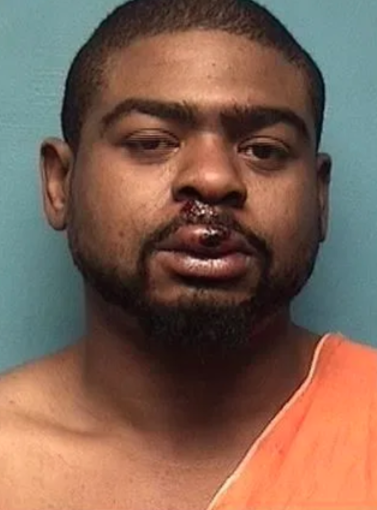
William Miller-Kirkland photo Jackson Co.
Jurors found 28-year-old William Miller-Kirkland, of Independence, Mo., guilty Thursday of first-degree murder and armed criminal action in the December 2017 shooting death of Teddis Burns-El. His sentencing is set for Oct. 25.
Court records say Miller-Kirkland’s mother told police that she was sleeping in her Independence apartment with her fiance when they were awoken by banging and screaming.
She says her son was drunk and believed that her fiance was either involved in the burglary or was covering for a cousin. She says her son shot her fiance once in the arm and several more times after he fell.
Police then arrested Miller-Kirkland after he briefly fled in a sport utility vehicle.
FORD COUNTY — Law enforcement and zoo officials are investigating injuries to a monkey at the zoo in Dodge City.
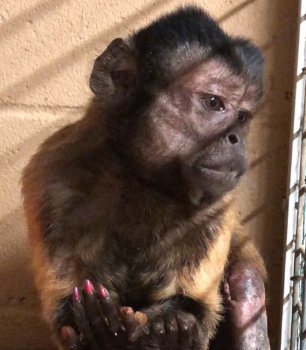
Capuchin monkey photo courtesy Wright Park Zoo
Wright Park Zoo and City staff previously released information that an older Tufted Capuchin Monkey, Vern, was found with minor injuries the same morning it was reported that another Capuchin from the Zoo’s troop, Pickett, was located just outside City Limits, according to a media release.
After further veterinary treatment, it was found that the injury was more extensive than it initially appeared and would require surgery. When originally reported, it was not yet determined how Pickett came to be outside the enclosure or how Vern was injured.
“Based on DCPD’s investigation as of Friday, we do not believe the little monkey, Pickett, found his way outside the enclosure on his own,” said Dodge City Police Chief Drew Francis. “Nor do we believe he traveled to where he was found on his own. The older monkey’s injury appears to be from blunt force trauma in excess of what would occur from a fall.”
Officer’s conducting the investigation suspect that someone gained access to the enclosure and injured the older monkey as he tried to protect his offspring from being taken.
Hannah Schroeder, Head Zookeeper, said, “Vern is very protective of the younger monkey and would not have let him go without a fight. Unfortunately, this suspected altercation resulted in a broken knee cap.”
After many discussions with the Zoo’s contracted veterinarian, Dr. Jennifer Wipf, it was decided that the, “best course of action for recovery was for Vern to be transferred to Kansas State University for surgery,” Schroeder said.
Surgery was performed on September 10, 2019, by veterinary and orthopedic specialists at Kansas State University to repair the broken bones and was deemed successful.
“Vern is recovering well but will have to spend the next 6-8 weeks away from his family while he recovers,” Schroeder said. “He is back at the zoo and will remain behind the scenes until his injuries are healed.”
While Vern recovers, the investigation into the incident continues, Francis said.
“Though I doubt the culprit has the decency to come forward,” Francis said. “I also suspect someone may know who committed this act or have an idea who would do this. If that’s you, we would greatly appreciate talking with you.”
ELLIS COUNTY — One person died in an accident just before 1p.m. Saturday in Ellis County.
The Kansas Highway Patrol reported a 2007 Saturn Ion driven by Monica Miller, 40, Columbia, Mo., was eastbound on Interstate 70 just east of the Yocemento exit.
The Saturn crossed the median and struck the front end of a 2015 Volvo semi driven by Daniel Czauz, 44, Thorton, Colorado.
The Saturn then spun down the side of the semi and hit a 2016 Freightliner semi driven by Donald R. Ryman, 57, Westmoreland, TN, and was pushed to the north shoulder of the westbound lanes.
Miller was transported to the hospital in Hays where she died. Czauz and Ryman were not injured. All three were properly restrained at the time of the accident, according to the KHP.
On Wednesday morning, I joined other Members of Congress on the steps of the Capitol in a moment of silence and prayer for those who perished on September 11, 2001. We also honored those first responders and troops who have fought and sacrificed since, and upheld the tradition of singing God Bless America. “One nation under God, indivisible…”
We will never forget.
WOTUS Rule Repealed
On Thursday, the Trump Administration announced the repeal of the Obama-era 2015 Waters of the United States (WOTUS) rule, bringing consistency and reliability back across all states.
This decision will scale back the federal government’s overreach of authority and restore longstanding and familiar Clean Water Act (CWA) regulations. The announcement is the first step of a two step process that will lead to a new definition of WOTUS that will limit the scope of waters regulated by the federal government.
For more information on the rulemaking process, repeal of the 2015 Rule, and the revised definition of WOTUS, click here.
Born-Alive Act Hearing
This week, I took part in a hearing on the Born-Alive Abortion Survivors Protection Act, which would protect babies born alive following an attempted abortion. As an OB-GYN who’s delivered over 5,000 babies, I never thought I’d be fighting harder to save babies’ lives in the halls of Congress than in the delivery room. I am appalled Nancy Pelosi and House Democrats have blocked a vote on this bill 80 times. To address this issue, I’m preparing to introduce new legislation which would provide funding to states ensuring abortion survivors receive appropriate health care. We must end infanticide. To see my questioning at the hearing, click here.
Honoring Fallen Soldiers Online
Recently, the VA announced the creation of the Veterans Legacy Memorial, the country’s first digital platform dedicated entirely to memory preservation for the millions of Veterans interred in VA national cemeteries. Each Veteran will have their own memorial page on a web-based platform, to provide a memorial that extends beyond the boundaries of a national cemetery. This a great use of 21st century technology to honor our Veterans for the rest of time.
For more information about the Veterans Legacy Memorial, click here.
American Cancer Society meeting
It was great to meet with Kansan patient advocates this week during the American Cancer Society’s Hill Day. Having worked with them over the past several years, I rely on them to provide me with updates on the value of basic medical research.
As a physician, I need innovative tools and medicine to help my patients and the National Institutes of Health (NIH) plays a vital role in basic medical research. To this end, I dedicate time each year advocating for robust funding to NIH. Another important topic we addressed was the need for palliative care and hospice education and training. H.R. 647, the Palliative Care and Hospice Education and Training Act, which was passed by the House last Congress, will award grants to improve the training of health professionals in palliative care. Additionally, it will enhance research in this field to build best practices for a more effective workforce.
K-State Leading On Agriculture Research
On Thursday, I met with Kansas State University’s Distinguished Professor of Agronomy, Dr. Charles Rice, was awarded the 2007 Nobel Peace Prize. Dr. Rice and I discussed my continued support for agricultural research funding.
We also discussed an announcement made earlier in the day by the U.S. Department of Agriculture awarding $77.8 million in research that will focus on sustaining a more abundant, nutritious, and accessible food supply. As part of this investment, eight land-grant universities, led by Kansas State University, will conduct projects aimed at integrating sustainable agricultural approaches covering the entire food production system. Over the next five years, this grant will fund up to ten faculty, twelve graduate students, and provide countless opportunities to undergraduates at K-State.
This project is part of a new program, Sustainable Agricultural Systems, within the National Institute of Food and Agriculture’s (NIFA) flagship competitive grants program, the Agriculture and Food Research Initiative (AFRI). For more information on these peer reviewed competitive grants, click here.
Growth Energy Fueling Growth Award
This week, I was honored to receive Growth Energy’s 2019 “Fueling Growth” Award presented by producers and supporters of the ethanol and biodiesel industries from across Kansas. As a co-chairman of the House Biofuels Caucus, I work with organizations like Growth Energy and their members in Kansas to help feed the world and fuel America in ways that achieve energy independence, improve economic well-being, and create a healthier environment for all Americans.
Kansas Electric Co-Op Meeting
It was great catching up with friends from the Kansas Electric Co-operatives, who were in town this week to discuss issues impacting co-ops across the state. We chatted about the ways that electric co-ops are partnering with regional and local partners to help with rural broadband deployment, utilizing some of the funds we included in last year’s Farm Bill.
We also discussed ways that electric co-ops are improving energy efficiency and including more environmentally friendly energy sources in their energy portfolios, such as solar and wind power.
Sunflower Electric from Hays was at the meeting, and I recently joined them as they broke ground on a new solar farm in southwest Kansas, two miles south of Johnson City.
Once completed it will be the largest solar farm in the state.
It’s great to hear how co-ops are innovating and using new technologies to improve service and drive down the costs for their customers.
Kansas Chamber of Commerce in D.C.
On Thursday morning, I met with the Kansas Chamber of Commerce, where I shared my thoughts on workforce development, health care, and trade. Across the state, industry leaders have been sharing concerns in retaining a qualified workforce, and are constantly looking for new partnerships to train the next generation to meet their growing demands. We also talked about my ideas to increase transparency, spur innovation, and increase consumerism as a way to drive down the overall cost of healthcare. Finally, we talked about trade and how agreements, such as USMCA, deliver wins for our farmers, ranchers, businesses and workers back home. It was great to spend the morning with them and I’m looking forward to continuing these conversations back in Kansas!
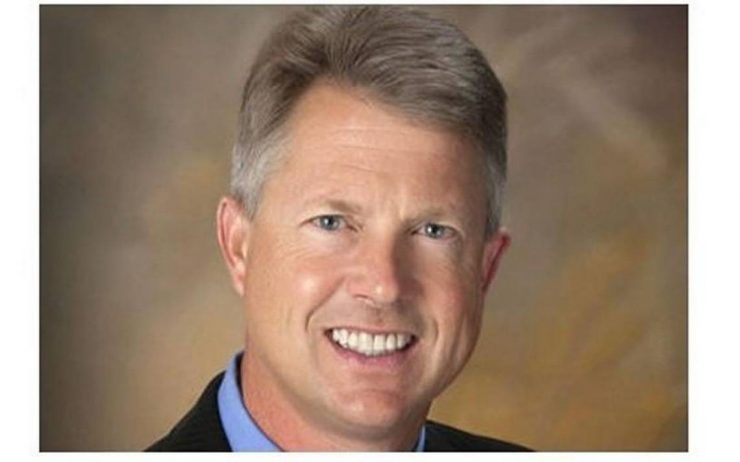
Dr. Roger Marshall, R-Great Bend, is the First District Congressman of Kansas.
SHAWNEE COUNTY —The Shawnee County Sheriff’s Office Criminal Investigation Division has been developing several suspects over the past couple of weeks in connection to the aggravated burglary that occurred in the 7600 block of SW Urish Road on August 26.
On September 10, officers from the Shawnee County Sheriff’s Office Criminal Investigations Division and Fugitive Warrants Unit arrested Matthew J. Kolbek Jr, 24, Topeka, in the 1200 Block of SW Belle Terrace after Kolbek jumped from a 2nd floor window and attempted to elude officers through a nearby park, according to Sgt. Todd Stallbaumer.
Authorities seized a firearm, ammunition, 8.3 lbs of Marijuana, over 60 THC vape cartridges, and approximately $3000 cash from the residence.
Additionally, Emily M. Kratochvil, 21, Sahayvian J. Griggs, 18, and Joshua M. Long, 23, all from Topeka, were located and arrested over the past couple of days in connection to the incident. The four suspects were booked into the Shawnee County Department of Corrections with the following requested charges includin gAggravated Battery – Use of a Deadly Weapon, Aggravated Assault – Use of a Deadly Weapon, Aggravated Burglary, Criminal Threat, Criminal Damage to Property and Criminal Use of a Firearm.
Kolbek has previous conviction for criminal threat, aggravated battery and stalking, according to the Kansas Department of Corrections.
DODGE CITY, Kan. (AP) — Fire officials say one person suffered smoke inhalation in a fire at a meatpacking plant in southwestern Kansas.
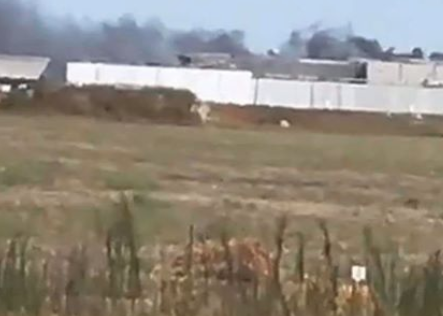
Fire at Cargill meat processing plant in Dodge City-photo courtesy Holcomb Community Fire Dept.
The fire broke out Friday afternoon at the Cargill plant in Dodge City.
The station says Dodge City Fire Chief Robert Heinz reported the fire was on the roof of the rendering side of the plant, and crews found a fire in the area’s ventilation system. The blaze was extinguished in minutes.
Heinz says a spark from welding work being done at the plant ignited grease. He says one person had to be taken to a hospital for smoke inhalation, but is expected to recover.
DETROIT (AP) — Leaders of the United Auto Workers union have extended contracts with Ford and Fiat Chrysler indefinitely, but the pact with General Motors is still set to expire Saturday night.
The move, plus a widening corruption investigation of union leadership, puts added pressure on bargainers for both sides as they approach the contract deadline and the union starts to make preparations for a strike.
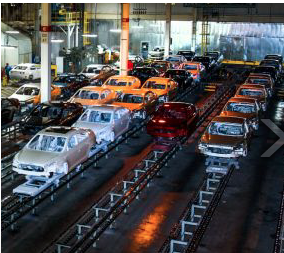
The General Motors Fairfax KC Assembly Plant (Photo by Susan McSpadden for Chevrolet)
The union has picked GM as the target company, meaning it is the focus of bargaining and would be the first company to face a walkout. GM’s contract with the union is scheduled to expire at 11:59 p.m. Saturday.
It’s possible that the four-year GM contract also could be extended or a deal could be reached, but it’s more likely that 49,200 UAW members could walk out of GM plants as early as Sunday because union and company demands are so far apart.
Picket line schedules already have been posted near the entrance to one local UAW office in Detroit.
Art Wheaton, an auto industry expert at the Worker Institute at Cornell University, expects the GM contract to be extended for a time, but he says the gulf between both sides is wide.
“GM is looking through the windshield ahead, and it looks like nothing but land mines,” he said, citing a possible recession, trade disputes and the expense of developing electric and autonomous vehicles. “I think there’s really going to be a big problem down the road in matching the expectations of the union and the willingness of General Motors to be able to give the membership what it wants.”
Plant-level union leaders from all over the country will be in Detroit on Sunday to talk about the next steps, and after that, the union likely will make an announcement.
But leaders are likely to face questions about an expanding federal corruption probe that snared a top official on Thursday. Vance Pearson, head of a regional office based near St. Louis, was charged with corruption in an alleged scheme to embezzle union money and spend cash on premium booze, golf clubs, cigars and swanky stays in California. It’s the same region that UAW President Gary Jones led before taking the union’s top office last year.
Jones and other union executives met privately at a hotel at Detroit Metropolitan Airport on Friday. After the meeting broke up, Jones’ driver and others physically blocked an Associated Press reporter from trying to approach him to ask questions. Jones has not been charged in the case.
Union spokesman Brian Rothenberg said Friday night that Jones remains in office, as does Pearson. “They didn’t make any changes,” he said.
In a 40-page criminal complaint, the government alleged that over $600,000 in UAW money was spent by union officials at businesses in the Palm Beach, California, area, including at restaurants, a golf resort, cigar shop and rental properties, between 2014 and 2017.
The union said the government has misconstrued facts and said the allegations are not proof of wrongdoing. “Regardless, we will not let this distract us from the critical negotiations under way with GM to gain better wages and benefits,” Rothenberg said.
At UAW Local 22 in Detroit, picket line schedules for three days were posted on the lobby windows. The local represents workers at a plant that straddles the border between Detroit and the hamlet of Hamtramck.
The 24-hour schedules don’t list any date to start but a separate schedule has a group reporting to the union hall at 6 a.m. on Sunday. The factory, which makes the Chevrolet Impala and Cadillac CT6, is one of four that GM plans to close.
Here are the main areas of disagreement:
— GM is making big money, $8 billion last year alone, and workers want a bigger slice. The union wants annual pay raises to guard against an economic downturn, but the company wants to pay lump sums tied to earnings. Automakers don’t want higher fixed costs.
— The union also wants new products for four factories GM wants to close. The factory plans have irked some workers, although most those who were laid off will get jobs at other GM factories. GM currently has too much U.S. factory capacity.
— The companies want to close the labor cost gap with workers at plants run by foreign automakers. GM’s gap is the largest at $13 per hour, followed by Ford at $11 and Fiat Chrysler at $5, according to figures from the Center for Automotive Research, an industry think tank. GM pays $63 per hour in wages and benefits compared with $50 at the foreign-owned factories.
— Union members have great health insurance plans but workers pay about 4% of the cost. Employees of large firms nationwide pay about 34%, according to the Kaiser Family Foundation. The companies would like to cut costs.
If there is a strike, it would be the union’s first since a short one against GM in 2007.
The union may have to strike at least for a while to show workers that it got as much from the company as it could, Wheaton said. Some workers, he said, mistrust union leaders due to the corruption scandal.
Negotiators are usually tight-lipped about the talks, but a week ago, UAW Vice President Terry Dittes wrote in a letter to local union leaders that GM has been slow to respond to union proposals. GM answered in a letter sent to factories that said it is moving as quickly as it can.
“We are working hard to understand and respond to UAW proposals and we have offered to meet as often as needed,” the letter said.
Just before 11:30 p.m., police attempted to stop a 2013 white Chevrolet Silverado for a traffic infraction, according to office Charley Davidson.
The vehicle was occupied by 29-year-old T.J. McMahan, 52-year-old Robert Boots, 24-year-old Skyler Bazil-Lounsbury all of Wichita and a known 25-year-old suspect.
McMahan, who was the driver, refused to stop, accelerated and fled from officers. A vehicle pursuit ensued and McMahan fired two shots at the officers while driving. The first shot fired was in the area of East 1st Street and North Spruce Street and the second was in the area of East 1st Street and North Estelle. The officers were not injured.
The pursuit continued south on Hillside and ended at Range Street after the truck’s tires were flattened by a tire-deflation device during the pursuit. All four suspects ran from the vehicle and into the neighborhood.
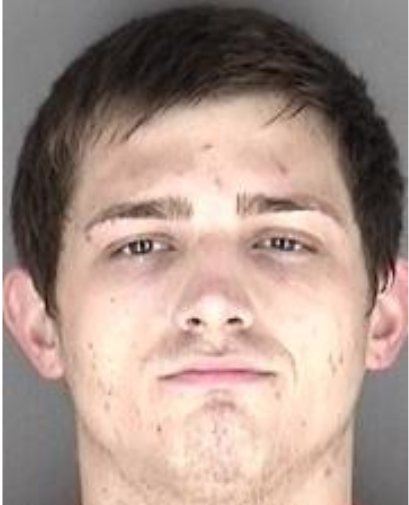
McMahan photo Sedgwick Co.
Officers set up a perimeter and utilized multiple police K-9s, drones, and a KHP helicopter to search for the suspects. McMahan, Boots, and Bazil-Lounsbury were located in the area and arrested without incident. Officers are working to locate the fourth known suspect.
McMahan is being held on a $250,000 bond on requested charges that include two counts of aggravated assault of a law enforcement officer, felony evade and elude, criminal possession of a firearm, as well as other drug and traffic-related charges. Boots of Wichita and Bazil-Lounsbury were both jailed for outstanding warrants, according to Davidson. Boots was no longer in custody Friday. Bazil-Lounsbury has a bond of $150,000 bond for probation violations, according to online jail records.
Officers also located methamphetamine, marijuana, a gun magazine and live ammunition in the vehicle. A handgun was also recovered during the investigation.