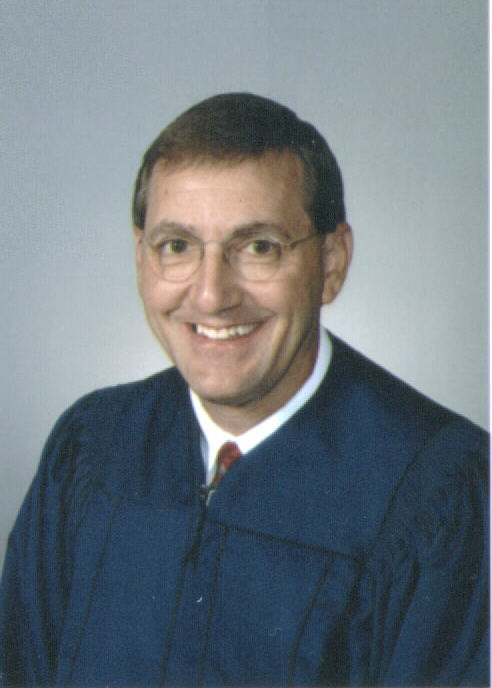
FlaxTOPEKA — The Kansas Supreme Court appointed District Magistrate Judge Richard Flax, District Judge Michael Hoelscher, and District Magistrate Judge Dale Snyder to the Judges Assistance Committee.
The Judges Assistance Committee provides help to any Kansas judge in need due to mental or physical disability, or addiction.
Flax and Hoelscher will serve four-year terms from July 1 through June 30, 2023.
Flax serves in Trego County of the 23rd Judicial District and succeeds District Magistrate Judge Keith Whitney, who serves in Meade County of the 16th Judicial District.
Hoelscher serves in Sedgwick County of the 18th Judicial District and succeeds Retired District Judge Steve Becker of Buhler, who served in Reno County of the 27th Judicial District.
Snyder will complete a vacated term on the committee that expires June 30, 2022. He serves in Rush County of the 24th Judicial District. He succeeds Moundridge Municipal Judge Amie Bauer.
Other members of the Judges Assistance Committee are:
District Judge Ben Burgess, who serves in Sedgwick County of the 18th Judicial District.
District Magistrate Judge Marty Clark, who serves in Russell County of the 20th Judicial District.
District Judge Sally Pokorny, who serves in Douglas County of the 7th Judicial District.
District Judge Mark Ward, who serves in Bourbon County of the 6th Judicial District.
Western Kansas Human Resource Management Association will hold its monthly meeting from noon to 1 p.m. Aug. 14 at the Robbins Center on the campus of Fort Hays State University.
Registration is from 11:15 to 11:30 a.m., with a short business meeting starting at 11:30 a.m.
The program for the August meeting will be “How Tos of Internships,” presented by Karen McCullough and Lisa Karlin with FHSU Career Services. The program will be submitted for SHRM continuing education credits.
WKHRMA members can RSVP at wkhrma.shrm.org. The deadline to RSVP is noon on August 9. WKHRMA is an affiliate chapter of SHRM (Society for Human Resource Management), a local professional organization for persons engaged in personal or human resource management.
For more information on WKHRMA, visit wkhrma.shrm.org.
Nothing has touched my soul and spoken to aging with grace quite like the ancient Indian medicine wheel and the traditions that have evolved from it. From the National Library of Medicine, I learned that in the Americas, Indian tribes have multiple interpretations of the four directions, but the following prayer is my own, geriatrician’s interpretation of a version from the book Black Elk Speaks and Oyate (Nakota, Dakota, Lakota) tradition.
First, we get down on our knees and feel the soil, the sacred Mother Earth, bringing the world around us, the animals, plants, prairies, lakes, mountains, the environment of our planet from where all food and sustenance comes. Earth is foundation. Then we stand up on our tiptoes, and raise our arms to sacred Father Sky, the sun, stars, clouds, rain, wind, air and breath of life, light and dark; from where all energy flows and ebbs. Sky is infinity. Earth and sky, the beginning and the end.
Around the central campfire and within the circle, first we bow east, symbolized by red, rising sun, springtime, birth, blood, the very young; a sense of innocence, youth. May we have hope for a future with an open mind to all things new and true.
We bow south, symbolized by yellow, full sun, summer, sexuality, the anticipating young woman and young man; a sense of unconquerable power and invulnerability, early adulthood. May we have the courage and strength to fight for justice.
We bow west, symbolized by black, setting sun, an approaching dark thunderstorm, oncoming night, autumn, resignation, the reality filled community leader and medicine woman/midwife; a sense of the horrors of war and reality of loss, mature adulthood. May we have the gravity to protect freedom of choice and face vulnerability with honest eyes.
Finally, we bow north, symbolized by white, starry night, winter, old age, wisdom, the sagacious elder and teacher; a sense of beauty, grandchildren and the circle of life, an experienced body and mind, release from the fear of change and death. May we have insight to savor family and friendship, and the good sense to walk in another’s moccasins.
Inside the circle is the tree of life, where we become aware of our self, our consciousness, tribe, community, country, world, and our connection to all direction.
Dear Mother/Father of Earth and Sky, thank you for your blessings, the sacred hoop of life, and especially the wisdom to find release from fear of death. May our sisters and brothers of all Clans and Nations realize our sacred connection and, in harmony, savor the joy and even the sorrow of our circle of life and aging.
For free and easy access to the entire Prairie Doc® library, visit www.prairiedoc.org and follow The Prairie Doc® on Facebook, featuring On Call with the Prairie Doc® a medical Q&A show streaming live most Thursdays at 7 p.m. central.
PRATT – Kansas Wildlife and Parks Magazine, a bimonthly publication of the Kansas Department of Wildlife, Parks and Tourism (KDWPT), will be managed by a female editor for the first time in the magazine’s 76-year history.
Current KDWPT employee Nadia Reimer, who was promoted to chief of information production in April, will serve as the magazine’s executive editor. Reimer previously served as the magazine’s associate editor from 2013-2015, and managing editor from 2015-2019. She follows in the footsteps of long-time executive editor, Mike Miller, who now serves as KDWPT’s assistant secretary of wildlife, fisheries and boating in Pratt.
“Nadia brings a wealth of talent, ideas and energy to her new role. As an avid angler and hunter, she also lives the outdoors lifestyle,” said Ron Kaufman, Director of Information Services at KDWPT. “We look forward to her leadership in continuing the fine tradition of the department’s flagship outdoor recreation magazine.”
Kansas Wildlife and Parks Magazine had humble beginnings in 1938 as a seven-page, typed pamphlet. Today, the award-winning 48-page, full-color publication has made it as far as 47 of the 50 states and three countries.
“Kansas Wildlife and Parks Magazine is the voice of our agency, and carrying on its legacy is a responsibility I feel privileged to take on,” said Reimer. “KDWPT employees are some of the most knowledgeable and passionate people you’ll meet, and when you combine their expertise with the experiences of our constituents, you get an incredible publication at the end of the day.”
Each issue of Kansas Wildlife and Parks Magazine features work from some of the state’s top freelance outdoor photographers and writers who, alongside department staff, cover wildlife, hunting, fishing, state parks, camping, conservation, recipes, tips and tricks, and more.
A single issue costs $3.75, a year subscription (six issues) is $13, a two-year subscription (12 issues) is $22, and a three-year subscription (18 issues) is $32. Interested readers can sign up to receive the magazine by calling the KDWPT Pratt Operations Office at (620) 672-5911, or by visiting ksoutdoors.com/Services/Publications/Magazine.
HAYS – The Hays Larks offense exploded in the seventh inning Saturday night as they rallied from down three to beat the Valley Center Mud Daubers 17-7 in eight innings.
Valley Center was able to keep the Larks offense at bay for a good portion of the game and built a 7-4 lead through six and a half innings but that is when the Larks offense came to life.
In the seventh the Larks sent 12 to the plate and scored nine runs to take a 13-7 lead.
Justin Lee delivered the first big hit of the inning, hitting his first grand slam as a Larks and then a few batters later Jimmy DeLeon added a three-run homerun to put Hays up by six runs.
In the eight inning the Larks added three more runs on wild pitches and then Matt Cavanagh delivered and RBI single that would give Hays the 17-7 run-rule win.
Tommy Garcia allowed two runs in two innings of relief and earned the victory.
Every starter for the Larks had at least one hit and all but two drove in at least one run.
Lee was three-for-five on the night with five RBI’s and three runs scored.
A Kansas roadcut reveals geological history through rock layers. (Photos by Kansas Geological Survey)
KU NEWS SERVICE
LAWRENCE – Sunflower. Meadowlark. Ad astra per aspera. Most Kansans are familiar with the state’s official symbols and motto. But as the summer road trip season kicks into high gear, a new resource from the Kansas Geological Survey invites travelers to dig deeper.
The mobile-friendly “Highways & Byways to Kansas Geology” website leads users on a geological tour of the state’s roadways with a scrolling format known as a story map. It explores what natural features like rock formations, wetlands and colorfully layered roadcuts reveal about the evolution of the ground beneath our feet and the cultural history of the people who settled and passed through the state.
“We were looking for a visual way to showcase the state’s wide-ranging geology and natural resources,” said Cathy Evans, KGS communications coordinator. “By creating a story map, we were able to roll colorful images, maps and narrative text into one dynamic presentation that has the added bonus of being free to anyone with computer access.”
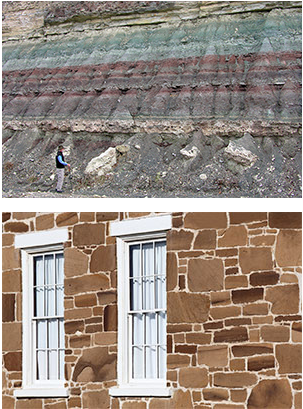
Many travelers have only experienced Kansas as a 75-mph blur while zipping down Interstate 70. What they might not realize is that as they cross the 424-mile route from the state’s eastern to western border, they are traveling forward in time. Rocks that contain 300 million-year-old marine fossils steadily give way to younger layers, ending near a high plains archaeological site where fossils of 13,000-year-old mammoths, camels and bison have been discovered near the surface.
Top photo: Limestone and shale exposed in a Geary County roadcut formed from sediment deposited in shallow seas during the Permian Period about 250 million years ago. Bottom photo: The buildings at Fort Larned National Historical Site on Kansas Highway 156 in west-central Kansas were constructed with Dakota Sandstone quarried nearby. The sandstone layers formed from beach sand and sediment carried by rivers into a sea during the Cretaceous Period.
“In between are the limestone and shale layers in the Flint Hills that developed from sediment deposited in intermittent seas about 250 million years ago,” Evans said, “and sandstone in the Smoky Hills formed from sand dumped by rivers draining into a later sea about 66 million years ago.”
Highways & Byways provides images, illustrations and mile marker references to help travelers identify these features.
For those who venture beyond I-70, more unusual sights await – like the Red Hills that flank U.S. Highway 160 in south-central Kansas. The region’s distinctive, rust-colored mesas, buttes and canyons are more commonly seen in the American Southwest.
Fort Larned National Historic Site on Kansas Highway 156 in west-central Kansas and Point of Rocks – accessible by an unpaved road off Highway 27 in extreme southwest Kansas – are 180 miles apart but linked together by Santa Fe Trail history.
“All the buildings at the fort – which served as an outpost on the Santa Fe Trail – are built from local sandstone, and the view of the surrounding plains is still unobstructed,” Evans said. “Point of Rocks – now appreciated for the expansive view it provides – was once a life-saving landmark towering over the Cimarron River and nearby springs. It signaled the first water source that trail travelers would encounter in more than 100 miles on their 15-mile-per-day journey.”
Undergirding the Highways & Byways website is the geospatial data collection, mapping and visualization expertise of specialists in KGS’s Geographic Information Systems (GIS) section. GIS staff host the Kansas Data Access and Support Center, the state’s official clearinghouse for geospatial data ranging from geologic to environmental to demographic.
Funneling that technical expertise into authoritative maps and infographics and combining those with text, images and video for presentations like Highways & Byways is just one way that KGS fulfills its state-mandated mission to foster a better understanding of the geology and natural resources of Kansas.
“Although collection and dissemination methods have changed drastically since the KGS was established in 1889, we continue to produce a wide variety of publications and maps – both technical and educational – for the scientific community, natural resource decision-makers, businesses and the public,” said Rolfe Mandel, director of the KGS. “Story maps are an innovative means of bringing attention to the state’s sights and natural resources.”
Highways & Byways complements two other KGS online resources designed for exploration and education:
GeoKansas, a website that provides more detailed information about the places featured in Highways & Byways and additional locations.
The KGS Photo Library, an image collection that users can search by county and keyword to see what they can expect to find while exploring the state.
Evans hopes Highways & Byways will spark curiosity and inspire travelers to experience Kansas in new ways.
“I always find scenic surprises driving backroads or even just by pulling off the interstate,” she said. “Photos I took at the Deep Creek exit on I-70 gave me a whole new perspective of a roadcut I’d driven by hundreds of times – and I actually saw the creek, not just its name on a sign.”
The Kansas Geological Survey is a research and service division of the University of Kansas. Its main headquarters is in Lawrence, and its Wichita office houses the KGS Well Sample Library.
SEDGWICK COUNTY — Law enforcement authorities are investigating a suspect for alleged child sex crimes.
David J. Smith photo Sedgwick County
On Thursday, police arrested David Justin Smith, 38, on a warrant, according to officer Kevin Wheeler. He is jailed on a bond of $150,000 on requested charges that include four counts of criminal sodomy and three counts of sexual exploitation of a child, according to the online Sedgwick County jail records.
The charges allegedly involved the sexual relationship between a 16-year-old minor and Smith, according to Wheeler.
Police will present the case to the Sedgwick County District Attorney.
WASHINGTON (AP) — President Donald Trump on Saturday delayed a nationwide immigration sweep to deport people living the United States illegally, including families, saying he would give lawmakers two weeks to work out solutions for the southern border.
The move came after House Speaker Nancy Pelosi called Trump on Friday asking him to call off the raids. But three administration officials said scrapping the operation was not just about politics. They said Immigration and Customs Enforcement leaders had expressed serious concerns that officers’ safety would be in jeopardy because too many details about the raids had been made public.
The officials spoke on condition of anonymity to speak about private discussions.
“At the request of Democrats, I have delayed the Illegal Immigration Removal Process (Deportation) for two weeks to see if the Democrats and Republicans can get together and work out a solution to the Asylum and Loophole problems at the Southern Border,” Trump wrote on Twitter. “If not, Deportations start!”
The operation, which sparked outrage and concern among immigrant advocates, had been expected to begin Sunday and would target people with final orders of removal, including families whose immigration cases had been fast-tracked by judges.
The cancellation was another sign of the Trump administration’s difficulty managing the border crisis. The number of people crossing the U.S.-Mexico border has risen dramatically under Trump, despite his tough rhetoric and hard-line policies. Balancing a White House eager to push major operational changes with the reality on the ground is a constant challenge for the Department of Homeland Security.
Trump gave the first public word of the planned sweep earlier this week, saying in a tweet that an operation was coming up and the agency would begin to remove “millions” of people who were in the United States illegally. Later, leaks to the media included sensitive law enforcement details, such as the day it was to begin, Sunday, plus specific cities and other operational details.
On Saturday, ICE spokeswoman Carol Danko criticized the leaks in context of their potential impact on ICE personnel, saying in a statement that “any leaks telegraphing sensitive law enforcement operations is egregious and puts our officers’ safety in danger.”
Pelosi called Trump on Friday night and the two spoke for about 12 minutes, according to a person familiar with the situation and not authorized to discuss it publicly. She asked him to call off the raids and he said he would consider the request, the person said.
It’s unclear what else was said during the call. But in a statement Saturday before the president’s decision was announced, Pelosi appealed to the same compassion Trump expressed in declining to strike Iran because of the potential for lost lives.
“The President spoke about the importance of avoiding the collateral damage of 150 lives in Iran. I would hope he would apply that same value to avoiding the collateral damage to tens of thousands of children who are frightened by his actions,” she said.
She called the raids “heartless.”
Pelosi responded to Trump’s announcement with her own tweet, saying: “Mr. President, delay is welcome. Time is needed for comprehensive immigration reform. Families belong together.”
Halting the flow of illegal immigration has been Trump’s signature campaign issue, but Congress has been unable to push his proposals into law with resistance from both Democrats and Republicans. Bipartisan talks over the immigration system have started and stalled but are again underway among some in the Senate.
Lawmakers are considering whether to give $4.6 billion in emergency funding to help border agencies struggling to manage a growing number of migrants crossing the border. The measure passed a Senate committee on a 30-1 vote. But the House is considering its own measure. Funding is running out and Congress is trying to approve legislation before the House and Senate recess next week.
Earlier Saturday, Trump hinted the operation was still on, saying the people ICE was looking for “have already been ordered to be deported.”
“This means that they have run from the law and run from the courts,” Trump said.
Coordinated enforcement operations take months to plan . Surprise is also an important element. ICE officers don’t have a search warrant and are working from files with addresses and must go to people’s home and ask to be let inside. Immigrants are not required to open their doors, and increasingly they don’t. Officers generally capture about 30% to 40% of targets.
The planned operation was heavily criticized by Democratic lawmakers as cruel, and many local mayors said they would refuse to cooperate with ICE. Immigrant advocates stepped up know-your-rights campaigns.
Another complication is that ICE needs travel paperwork from a home country to deport someone, so immigrants often end up detained at least temporarily waiting for a flight. ICE was reserving hotel rooms for families in the event the operation went off as planned Sunday.
The adult population of detainees was 53,141 as of June 8, though the agency is only budgeted for 45,000. There were 1,662 in family detention, also at capacity, and one of the family detention centers is currently housing single adults.
KANSAS CITY, Kan. (AP) — Residents of a Kansas City, Kansas neighborhood have filed a federal lawsuit over flooding during the summer of 2017 that accuses businesses and local officials of negligence.
The lawsuit filed earlier this month by five residents in the U.S. District Court for Kansas accuses the companies of leaving debris in a drainage creek west of the Argentine neighborhood. It also names the Unified Government of Wyandotte County and Kansas City, Kansas, as a defendant.
OPFD helping numerous people out of high water. Please don’t drive into water over the roadway! pic.twitter.com/mC68U7nkyZ
The lawsuit claims the debris clogged the creek, resulted in significant flooding and property damage and wasn’t cleared away until residents complained.
The Unified Government declined to comment. One of the companies being sued is the BNSF Railway and it said it was not responsible for the flooding.
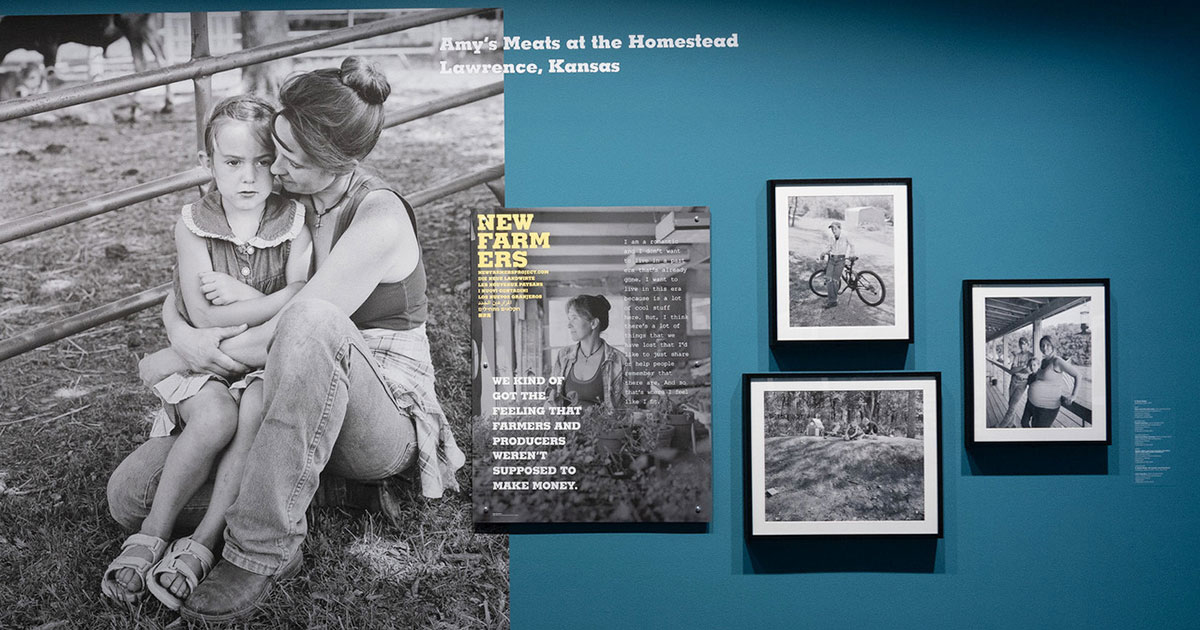
A panel from the Wichita Art Museum’s 2018 “New Farmers” exhibition featuring photographs by Bryon Darby, text by Paul V. Stock and design by Tim Hossler. (Credit: Kirk Eck)
KU NEWS SERVICE
LAWRENCE – Growing up on a farm and carrying on a family tradition is one thing. Taking on the trials of farming from scratch? That’s quite another.
The environmental and societal concerns that drive some 21st-century farm families away from cities and even divide them from their conventional-farming neighbors are the focus of the new book “New Farmers 2014/2018” (P&T Committee, 2019) created by a cross-disciplinary team of University of Kansas scholars.
The project had its genesis when Paul Stock, associate professor in the Department of Sociology and the Environmental Studies Program, met Bryon Darby, former KU assistant professor of photo media and now a lecturer in photography at Utah State University, a couple of years ago at a teaching seminar organized by KU’s Center for Sustainability.
Along the way, they were joined by Tim Hossler, associate professor of design, as designer.
Stock had just come to KU after spending years in New Zealand, studying how that South Pacific nation “went from being primarily a sheep-farming country to becoming the world’s largest dairy exporter.”
“I was working on a global scale, and I wanted to do something a little different, having just moved to Kansas and back to the Midwest,” Stock said. “I was interested in studying people that were getting into farming. Farming is hard. It’s hard to stay in; it’s hard to make money. Everything about it is hard. So what is going on with these people that are actively trying to get into it?”
Stock recalled Darby saying, “I’m really interested in photographing these new farmers, people who are at the farmers’ market. And I thought: That’s what I want to do.”
They launched the project that resulted first in gallery exhibitions and ultimately in “New Farmers 2014/2018.”
Darby and Stock set out first to interview and photograph Amy Saunders of Amy’s Meats north of Lawrence.
Stock credits Darby’s method of working for helping the subjects to open up about their feelings.
“Bryon set most of these up, and he’s like, ‘Can I come photograph you? And Paul’s going to come along, and we’re going to have a talk.’ He’s using this old-style view camera, with the cloth hood over his head and the whole deal. But the real gift of it to doing research is that it takes time. People have to stay real still … which lends itself really well to interviewing. With this way of shooting, they had to relax and be vulnerable.”
Stock and Darby branched out from there to other farmers’ market purveyors and beyond across eastern Kansas.
“It wasn’t just young farmers, and it wasn’t just brand new, because some of the people that were depicted in the book started farming 30 years ago, but they’re still mentoring people,” Stock said. “We asked them about their story of becoming a farmer. What was it that brought about that change in their identity?”
More than one farm family, Stock said, had come to agriculture from teaching.
“It’s not that radical a shift when you hear them talk about it, because it’s all about care and giving,” Stock said.
“New Farmers” is sort of a misnomer, Stock said, in that these farmers, even if not all are certified organic, are at least engaged in less technologically intense methods of raising food than a typical Midwestern row-crop farm with thousands of acres.
“They’re doing stuff that people around the world have been doing for thousands upon thousands of years,” Stock said. “The people we’ve spoken to are asking, ‘How do I live a good life? How do I live my best life with my family, with friends involved, with the community I care about?’ It’s hard. And we’re not going to make much money. But we’re going to be pretty happy and fulfilled.”
The “New Farmers” are not out trying to convert the world to their ways of thinking, living or agriculture, Stock writes in the book. They just want to be left alone to do things their own way. In this age of disputes over carcinogenic pesticides and right-to-repair-equipment laws, that may be harder than it seems at first blush.
Hossler said the combination of text and images he chose for the book “reflects a design history most notable from the Great Depression era, including photographers Dorothea Lange and Walker Evans, who worked closely with their writing collaborators. They are key examples of the book’s inspiration because of the specific combinations of text and imagery as well as the portrayal of farmers. The look of the book reflects those interests and the collaborative spirit of the project.”
Stock and Hossler said The Commons, a partnership among KU’s Biodiversity Institute, Hall Center for the Humanities and Spencer Museum of Art, and its director, Emily Ryan, played important roles in the evolution of the “New Farmers” project, including early research funding, gallery space and support for the book.
Hossler said many of the design choices reflected in the book were made when “New Farmers” started as a gallery exhibition. It returns to its exhibition form July 9-Aug. 11 for a display at the Lenexa City Hall Art Gallery.
“New Farmers 2014/2018” was recently named among the 50 best books and 50 best book covers of the year by Design Observer and AIGA, the professional association for design.
Register of Deeds Tonya Buckingham proposed offering the cards through her office as a way to combat people who falsely claim to be veterans.
The Sedgwick County Commission approved the plan on Wednesday. The cards will be free to veterans and Buckingham’s office will pay the costs. She expects to begin issuing the cards in about two weeks.
Buckingham says she got the idea from the Cook County deeds office in Chicago.
Sedgwick will be the first Kansas county to issue veteran ID cards.