Trust Women runs one of four clinics in Kansas where women can get abortions. FILE PHOTO / CREATIVE COMMONS
That landmark ruling bolsters an ongoing lawsuit to expand access to abortion in Wichita. The case aims to clear the way for a clinic there — unable to find any willing, local doctors — to lean more on physicians in other states.
Trust Women runs one of four clinics in Kansas where women can get abortions. It wants a district judge in Topeka to block the Sedgwick County district attorney and the Kansas Board of Healing Arts from prosecuting or taking other action against doctors who help it.
“People struggle to get access to health care,” Trust Women CEO Julie Burkhart said. “We want to be able to broaden that access for people in Kansas so they can continue to make decisions about their lives and their health care.”
At issue is a state ban on telemedicine abortions — in which a physician isn’t on site at the clinic where a woman takes medication to induce abortion. Instead, the physician consults with her, observes her ultrasound, reviews her medical records and guides her procedure over a remote video connection.
Kansas lawmakers banned telemedicine abortion years ago, but a judge blocked the ban pending a court challenge.
That case is ongoing. But a second lawsuit arose recently because Trust Women fears some state and local agencies won’t follow the judge’s injunction.
The Kansas Attorney General’s Office has argued the years-old injunction isn’t valid anymore and doesn’t apply to all state and local agencies.
The odds of the state winning either of these cases narrowed significantly last month when the Kansas Supreme Court ruled that women have a right to abortion under the state constitution.
The Attorney General’s Office has been arguing in ongoing lawsuits that no such right exists. It withdrew that argument on Wednesday at a hearing in one of the two ongoing lawsuits related to telemedicine abortion.
Wednesday’s hearing was the first in the new lawsuit, which could go to trial by the end of this year.
Trust Women said its staff and physicians already face regular harassment from protesters, and in recent months, they’re facing an investigation by the Kansas Board of Healing Arts, too.
The Board won’t publicly confirm an investigation, what might have prompted a probe and who might be a focus.
Lawyers for Trust Women say the investigation relates to telemedicine abortions, but they declined to elaborate.
Trust Women flies in doctors to Wichita from other states to offer abortions in person there two days a week. It says those hours were too limited, making it difficult for many women to schedule their procedures.
So last October, the clinic added more days by connecting out-of-state doctors to their patients through telemedicine. The clinic stopped at the end of the year for fear of legal trouble.
The clinic has struggled to find doctors based in Wichita. Abortion provider George Tiller — Burkhart’s boss at the time — was murdered at his church in Wichita by an anti-abortion extremist 10 years ago this month.
If it can resume telemedicine abortions, Trust Women hopes eventually to provide abortion in more locations through that means. Namely, remote and rural parts of the state.
Celia Llopis-Jepsen is a reporter for the Kansas News Service.You can reach her on Twitter @Celia_LJ or email celia (at) kcur (dot) org.
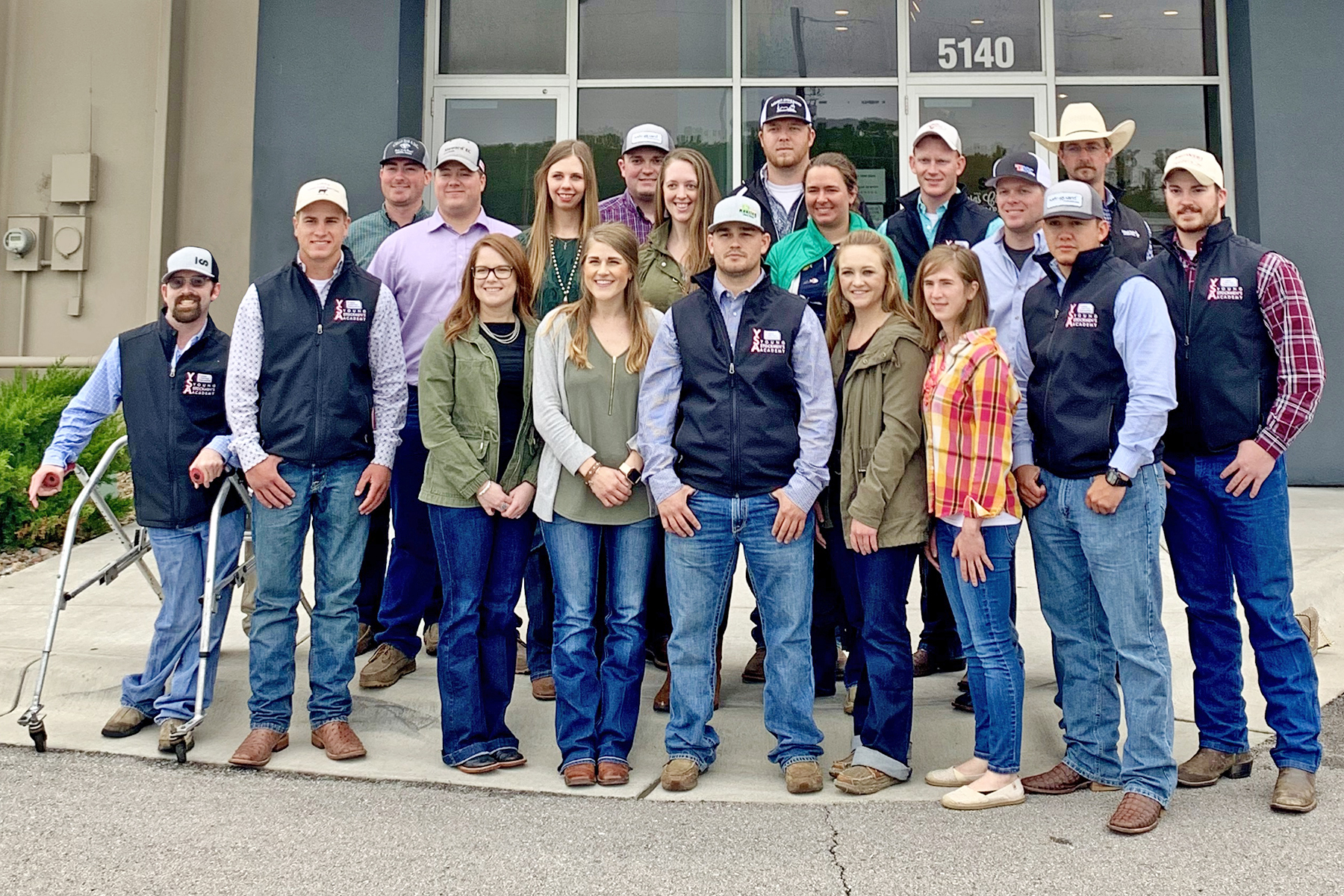
Pictured are (Back Row, L to R) Clayton Jarnagin, Protection; Evan Woodbury, Quenemo; Bryce Barnett, Muscotah; Reed Koop, Abilene; Taylor Hughes, Pratt; (Middle Row, L to R) Carl Clawson, Ulysses; Cami Roth, Sterling; Hannah Brass, Medicine Lodge; Jamie Holeman, Bronson; Garrett McKinney, Walton; Patrick Turner, Ingalls; (Front Row, L to R) Clinton Laflin, Russell; Thomas Thayer, LaCygne; Ashley Fitzsimmons, Pratt; Heather Gibson, Garden City; Dalton Rutledge, Plains; Grace Hammer, Sharon Springs; Jessalyn Strahm, Sabetha; and Socorro Martinez, Liberal. (Not pictured is Michaela Peterson, Dodge City.)Kansas Livestock Association
TOPEKA – Beef producers from across the state participating in this year’s Kansas Livestock Association (KLA) Young Stockmen’s Academy (YSA) gathered in the Kansas City area May 6-8. The class of 20 spent three days learning more about agribusiness and how beef is marketed to consumers.
Merck Animal Health, the exclusive sponsor of the YSA program, hosted the group at its office in DeSoto. Merck staff gave attendees an overview of the animal health industry, provided a tour of their research facilities and led a discussion on how to connect with others based on various personality types to create strong and effective relationships.
To gain a better understanding of the link between the processing plant and the consumer’s plate, the group toured Kansas City Steak Company and SYSCO. Both companies distribute high-end beef cuts to restaurants across the U.S. Kansas City Steak Company also has a mail-order business. The class visited Bichelmeyer Meats and Whole Foods Market to get a firsthand look at how beef is marketed in the meatcase. The Bichelmeyer family, which are KLA members, has been providing hand-cut meat to consumers for more than 70 years.
While distributing top sirloin samples at two Hen House grocery store locations, YSA members had the chance to visit with consumers about the beef they produce. The young ranchers answered questions about proper cooking methods and how cattle are raised.
In addition, the class visited the Valley Oaks feedlot and processing facility. The cattle are housed under one roof and are kept cool with the help of unique engineering and the use of big fans. Valley Oaks also has a registered Angus cowherd and a commercial cattle operation.
Members of the 2019 YSA class are Bryce Barnett, Muscotah, Hannah Brass, Medicine Lodge; Carl Clawson, Ulysses; Ashley Fitzsimmons, Pratt; Heather Gibson, Garden City; Grace Hammer, Sharon Springs; Jamie Holeman, Bronson; Taylor Hughes, Pratt; Clayton Jarnagin, Protection; Reed Koop, Abilene; Clinton Laflin, Russell; Socorro Martinez, Liberal; Garrett McKinney, Walton; Michaela Peterson, Dodge City; Cami Roth, Sterling; Dalton Rutledge, Plains; Jessalyn Strahm, Sabetha; Thomas Thayer, LaCygne; Patrick Turner, Ingalls; and Evan Woodbury, Quenemo.
The class will meet again in September to tour beef and dairy operations across the state. More information about YSA can be found at www.kla.org.
TOPEKA – The Kansas Department of Health and Environment (KDHE) announces that Dayna Brinckman, DDS, CHCEF, has been named as the State Oral Health Officer. This position had previously been vacant.
“We are excited to welcome Dayna to our agency. She brings a wealth of knowledge and outreach experience which will benefit our state greatly,” said Lee Norman, KDHE Secretary.
Brinckman received her Doctor of Dental Surgery degree the from University of Missouri, School of Dentistry, and her bachelor’s degree from the University of Kansas.
Brinckman previously served as the Chief Dental Officer for the Health Partnership Clinic in Olathe and as an Outreach Dentist for ReachOut Healthcare America in Kansas City, Kan.
Numerous historical figures come to mind when considering the continuous movement towards gender equality in the United States.
Susan B. Anthony and Elizabeth Cady Stanton fought for women’s suffrage. Amelia Earhart became the first woman to fly across the Atlantic Ocean. Harriet Tubman led more than 300 slaves to their freedom through the Underground Railroad. These women not only left a permanent and distinct mark on history, but inspired future women to challenge societal expectations and reach their full potential.
In the field of journalism, Nellie Bly is still a renowned historical figure known for her undercover time in a mental institution and her writings on her experience. While she remains one of the United States’ most famous journalists, her work also inspired a young Kansas native to become the first woman accredited as a war correspondent.
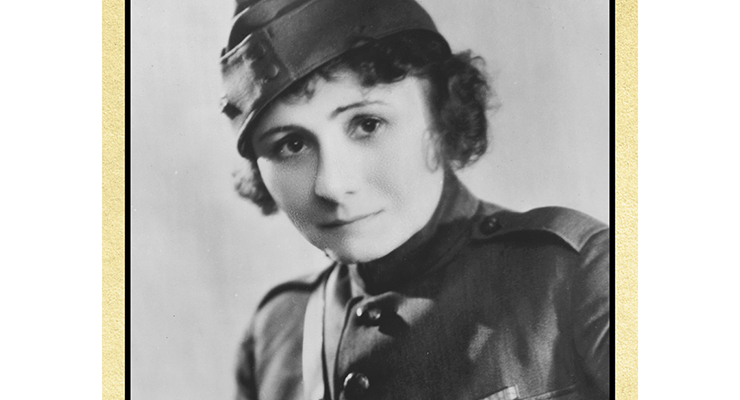
Henrietta Eleanor Goodnough Deuell was born December 30, 1889 in Bennington, Kansas, and grew up in Marysville. She began to go by ‘Peggy Hull’ after she wed her first husband, George Hull in 1910. Peggy was a rambunctious child who had sparse interest in the typical ‘feminine’ activities expected of a young lady at the time. She much preferred the company of the boys in her community.
Although she applied for a reporting job at the Junction City Sentinel at the age of 18, she was offered a typing job on the condition that she would not worry about her fingernails.[1] Peggy excitedly accepted the job and relocated to Junction City knowing she might work her way up to be a reporter. In an attempt to move West, Peggy took a job at the Chronicle-News in Colorado only to move to the Denver Republican shortly after she made the acquaintance of the owner’s brother. This seems to be a theme throughout Peggy Hull’s life. Her charisma and determination were strong tools used to help her career and even get herself out of sticky situations.
Peggy Hull (Photo courtesy Peggy Hull Deuell Collection, Spencer Research Library, University of Kansas Libraries)
Peggy moved to Cleveland, Ohio in 1916 where she attempted to obtain funding to report on the Ohio National Guard in New Mexico. Almost a year prior to the United States officially joining World War I, Peggy witnessed the training of officers at Camp Willis in Columbus, Ohio. It was there that Major Harold Bush, the commander of the artillery camp told Peggy, “A military camp is a matter of war – not friendship – and it’s no place for a woman.”[2] The unique challenges she experienced as a female at the military camp only further motivated Peggy to continue on and tell the world of her adventures.
One of her greatest tests of will came as she convinced a commander to allow her to join 20,000 soldiers on a fifteen-day hike into New Mexico. She later recalled, “I had a terrible time convincing him I could stand the hardships. When I finally gained his consent, I knew my military career depended upon [that] hike.”[3] Despite a myriad of physical and mental obstacles, Peggy powered through by imagining all the “women of [her] profession envying [her] trip”.[4] Impressed by her sheer will and determination, she received a promotion to the rank of first lieutenant.
Once the United States officially entered World War I, Peggy asked to be sent to France as a war correspondent, to which her editor exclaimed, “How perfectly ridiculous!”[5] Peggy was determined and persuaded her editor to sponsor her Paris travels. She was able to get a passport and visa despite the disbelief of those around her. As she was in route, Peggy knew her “whole future was staked on that trip to England”.[6] She received a good deal of attention for the work she was doing, and her columns were incredibly popular.
By 1918, Peggy had set her sights on full accreditation as a war correspondent. Peggy was met with opposition by men who believed a woman would never become accredited. Captain Carl Ruth was flabbergasted when Peggy presented a letter from a past acquaintance, General Peyton C. March, who demanded that Peggy not be denied accreditation due to her gender. She officially became the first woman accredited by the War Department as a war correspondent and headed to Siberia.
Peggy Hull continued to face setbacks during her time as an accredited war correspondent, but nothing could take away from the fact that she was the first woman to be accredited in a male dominated field. She was expected to fail numerous times throughout her career, and through hard work and determination, she changed the game for female journalists. In an article published in the Cleveland Plain Dealer in 1944, Peggy reflected on the unique challenges women often face saying, “Our presence in various fields is bitterly resented by the men we compete with. Overwhelming obstacles are frequently set up to prevent us from working and yet, odd though it may seem, women must live.”[7]
After divorcing her first husband later in life, Peggy married an Englishman in Shanghai, which nearly resulted in the loss of her United States citizenship. She lobbied against this law that targeted women who married non-United States citizens and managed to avoid deportation. A few years later she divorced the Englishman and married her third and final husband, Harvey Deuell, a longtime acquaintance from her early reporting days. She decided to retire from journalism only to return as a war correspondent during World War II. She struggled continuously with alcoholism and died of cancer at the age of 76.
Despite her accolades, the name ‘Peggy Hull’ is practically unknown today. Regardless, her impact on journalism paved the way for future women in the field. She proved to the men throughout her life that she was not one to be underestimated.
Peggy Hull is included in the Kansas mural painted by Hays artist Dennis Schiel on display outside the office of the Kansas Lieutenant Governor.
Peggy Hull’s picture and a brief description of her accomplishments can be viewed in the Lieutenant Governor’s office in the Kansas Capitol. There hangs a massive 10-panel mural, painted by Hays artist Dennis Schiel, complete with historical events and figures with Kansas origins.
Peggy Hull, born and raised in northern Kansas, paved the way for women in journalism and has forever left her mark on Kansas history. In a letter written in 1937, Peggy expressed her early motivations in the journey to become a war correspondent, writing, “I did not go to war because I liked the excitement or what my colleagues sometimes erroneously refer to as the glamour. I went because I was not a man and could not carry a gun and do something for my country.”[8]
From the rambunctious child who rose above what was expected of her as a young lady, to the first accredited female war correspondent, Peggy was the epitome of a strong woman. Just as Nellie Bly had once inspired a young Peggy Hull, her accomplishments will one day inspire numerous young girls to not allow themselves to be limited by their gender.
Caitlin O’Toole is a 2019 Legislative Intern for Sen. Elaine Bowers, Senate District #36. O’Toole graduated from St. Teresa’s Academy in 2016 and currently is a junior at KU majoring in Political Science and Communication with a History minor. She will be applying to law school next fall.
The Kansas Legislature Internship program is open to any student who is enrolled in a secondary or post-secondary education institution. Interns are required to attend a minimum of 12 days during the legislative session, attend the intern orientation, submit an evaluation of their internship and complete an evaluation of their legislator. One additional requirement is to submit a project assigned by their legislator. This year’s project was a research paper on a Kansan from the Senate District.
Memorial Day Mostly sunny, with a high near 84. Breezy, with a south southwest wind 13 to 20 mph.
Monday Night Partly cloudy, with a low around 61. South wind around 17 mph.
Tuesday Sunny, with a high near 80. Breezy, with a south southwest wind 13 to 20 mph, with gusts as high as 30 mph.
Tuesday NightMostly clear, with a low around 51. Southwest wind 8 to 14 mph becoming west northwest after midnight.
WICHITA, KAN. – A man who defrauded a Kansas non-profit medical clinic through an internet marketing scheme has pleaded guilty to multiple counts of deceptive commercial practice in Sedgwick County District Court, according to a media release from district attorney.
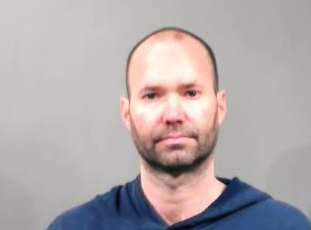
Daniel Fielding Glickman -photo Sedgwick Co.
Daniel Fielding Glickman, 37 of Tigard, Oregon, created an online company called FQHC Healthcare LLC that purportedly specialized in finding medical professionals for non-profit medical clinics nationwide.
In January of 2018, Wichita-based GraceMed Health Clinic hired Glickman to find two candidates for medical positions for their multiple locations in Sedgwick County and around the state. GraceMed, 1122 N. Topeka in Wichita, paid Glickman a $10,000 fee –$5,000 for each position that it was seeking to fill.
The investigation showed that the job candidates produced by the Oregon company either did not exist or were real medical professionals who had no idea that their names were being submitted as job candidates in Wichita.
As part of his plea agreement, Glickman pleaded guilty to two counts of Deceptive Commercial Practice and refunded the $10,000 in fees that he had collected from GraceMed. Glickman also was ordered to serve a 30-day jail sentence, which had been completed as of Friday.
Glickman admitted in court documents that he used his business to “knowingly and falsely” promise to produce job candidates for GraceMed in return for the payment of the fee. A website for Glickman’s company was no longer available on the internet as of Friday.
Glickman was arrested on the Kansas charges earlier this year by Oregon authorities. He was booked into the Sedgwick County Jail on April 10, 2019.
The District Attorney encourages businesses and non-profit agencies to fully investigate out-of-state companies before doing business with them. Online and telephone financialscams are one of the top reasons that consumers contact the District Attorney’s office tofile complaints.
The case was handled by the Investigations Division of the District Attorney’s office.
TOPEKA – The Kansas Department of Health and Environment (KDHE) has issued a boil water advisory for a portion of Russell County Rural Water District No. 3 located in Russell, Barton and Rush counties. The Advisory is issued for all Russell RWD No. 3 customers located West of Galatia.
Customers should observe the following precautions until further notice:
If your tap water appears dirty, flush the water lines by letting the water run until it clears.
Boil water for one minute prior to drinking or food preparation or use bottled water.
Dispose of ice cubes and do not use ice from a household automatic icemaker.
Disinfect dishes and other food contact surfaces by immersion for at least one minute in clean tap water that contains one teaspoon of unscented household bleach per gallon of water.
Water used for bathing does not generally need to be boiled. Supervision of children is necessary while bathing so that water is not ingested. Persons with cuts or severe rashes may wish to consult their physicians.
The advisory took effect on May 26, and will remain in effect until the conditions that placed the system at risk of bacterial contamination are resolved. KDHE officials issued the advisory because of a loss of pressure. Failure to maintain adequate pressure may result in a loss of chlorine residuals and bacterial contamination.
Regardless of whether the public water supplier or KDHE announced a boil water advisory, only KDHE can issue the rescind order following testing at a certified laboratory.
TOPEKA — Governor Laura Kelly has sent a request to President Donald Trump asking for emergency federal assistance to help address the widespread severe storms, tornadoes and flooding that have plagued Kansas in recent days.
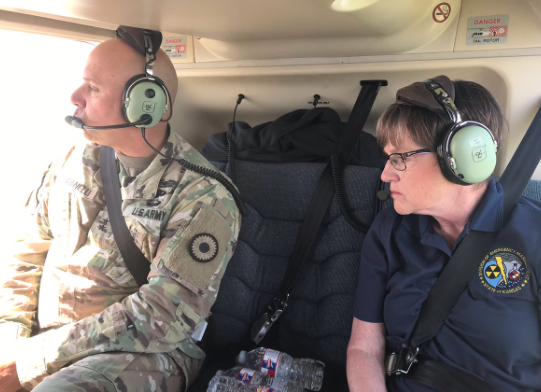
Surveying the severe floods impacting KS communities and farmland with @KansasEmergency officials. We’re doing all we can to ensure Kansans are safe and have the resources they need. #kswx#kslegpic.twitter.com/yhAYTHWgVV
— Governor Laura Kelly (@GovLauraKelly) May 26, 2019
The letter details the events leading up to the request and asks for Direct Federal Assistance for:
(1) Swift water rescue support;
(2) Shelter management support including short-term housing assistance;
(3) Mass care and human services support through commodities;
(4) Technical support and possible staffing for state logistics staging areas;
(5) Possible technical support regarding hazardous materials spills and orphan containers.
The request also anticipates the need for debris removal, which poses an immediate threat to lives, public health, and safety.
“Kansas is experiencing damage from severe weather and historic flooding due to extended heavy rain,” Kelly said. “Today I sent a request to President Donald Trump for emergency federal assistance for response and recovery. We are working with our local, state, and federal partners to ensure Kansans have the resources they need at this challenging time.”
Named in the request are the 46 Kansas counties listed in the state declaration originally signed by Kelly May 9 and later amended. These counties include Allen, Anderson, Barber, Barton, Butler, Chase, Chautauqua, Cherokee, Clark, Clay, Cloud, Coffey, Comanche, Cowley, Crawford, Dickinson, Doniphan, Elk, Franklin, Geary, Greenwood, Harvey, Jefferson, Kingman, Lincoln, Lyon, Marion, McPherson, Meade, Montgomery, Morris, Neosho, Osage, Ottawa, Pawnee, Pottawatomie, Pratt, Reno, Rice, Riley, Rush, Saline, Sumner, Wabaunsee, Wilson, and Woodson.
The request was made under the provisions of Section 401 of the Robert T. Stafford Disaster Relief and Emergency Assistance Act, 42 U.S.C. §§ 5121-5208 (Stafford Act), and implemented by 44 CFR § 206.35. Also today, the Kansas Division of Emergency Management sent out a request through the Emergency Management Assistance Compact for an advanced team to assist with coordinating interstate resource requests, and geospatial information system specialists to assist with development of mapping products.
“In order to proactively expand our resources and ensure the Kansas Division of Emergency Management has everything it needs to assist local partners and keep people safe, we have requested through the Emergency Management Assistance Compact an advanced team to assist our personnel. As we work with impacted communities, I want to ensure that every resource is being brought to bear to assist local emergency personnel so we can keep people safe and limit damage to property.”
WICHITA, Kan. (AP) — One year after Kansas lawmakers agreed to compensate people who were wrongfully convicted and incarcerated, the state has paid two claims, is negotiating one and is fighting two others.
In February 2018, Lamonte McIntyre spoke to a Kansas Senate committee. He was exonerated after 23 years in prison. Photo by Stephen Koranda/KANSAS NEWS SERVICE
Kansas agreed to pay $1.1 million to Richard Jones of Kansas City, who spent 17 years in prison after being wrongfully convicted of a 2000 robbery that he says was committed by someone who looks just like him. This week the state agreed to pay $1.03 million to Floyd Bledsoe , who spent nearly 16 years behind bars for the rape and murder of a 14-year-old girl — a crime that his brother claimed in a suicide note.
Among the remaining claims is one seeking $1.52 million for Lamonte McIntyre , who spent 23 years in prison for a 1994 double murder in Kansas City, Kansas. A local district attorney later called the case an example of “manifest injustice.” No physical evidence was presented and the case was based on allegedly coerced testimony.
The Associated Press obtained records from the Attorney General’s office on the cases through a request under the Kansas Open Records Act and from court filings.
Jones, Bledsoe and McIntyre testified at the Legislature last year in support of a bill to compensate former inmates who have been wrongfully incarcerated. The law provides for $65,000 for each year a person spent behind bars along with health insurance benefits, financial assistance for higher education and various social services.
When signing the bill last year, then-Gov. Jeff Colyer publicly apologized to McIntyre, Bledsoe and Jones — saying “we will make it right.”
But the cases have taken time to wind through the system.
Floyd Bledsoe was exonerated after spending 16 years in prison. He told lawmakers that financial compensation from the state would help him establish a footing in life that prison denied him. CREDIT STEPHEN KORANDA / KANSAS NEWS SERVICE
“The law moves slowly, from what I can tell you,” said Cheryl Pilate, one of the attorneys representing McIntyre. She said her dealings with the attorney general’s office have been cordial, adding there is no need to have “an adversarial” hearing in McIntyre’s case.
Sen. Molly Baumgardner, a Republican who helped write the law, said legislators wanted to make sure the process to pay claims was thorough and involved people outside the attorney general’s office.
The state is challenging two claims from former inmates.
Bobby Harper, who spent nearly two years in prison before his 1987 burglary conviction was reversed by the Kansas Supreme Court, is seeking $75,000 and other costs. The attorney general’s office asked a court to reject Harper’s claim because it says Harper cannot prove he’s “actually innocent,” as the compensation law requires. The state argued the statute was not intended to apply to people whose convictions were overturned by insufficient evidence or a legal technically, as in Harper’s case.
Harper’s attorney has not yet responded in court to the state’s filing and could not immediately be reached for comment.
Kansas is also disputing the claim brought by Michael Mata, who as a juvenile in 2011 was incarcerated for less than a year before his conviction for aggravated indecent liberties with a child was overturned on appeal. Mata is seeking $40,246 in compensation.
The attorney general’s office has asked a court to dismiss Mata’s claim, arguing his adjudication as a “juvenile offender” and his relatively short time at a juvenile correctional facility do not satisfy the elements for recovery of damages under the law. Mata’s attorney, Lora Ingels, said in a court filing that the state was “basically saying a juvenile’s life and liberty is not as valuable as an adult’s life and liberty.”
Meanwhile, Jones, — whose wrongful conviction became known as the “doppleganger” case because of his mistaken identity — has new legal problems. Federal prosecutors on Wednesday charged Jones in a new five-count indictment on weapons and drug charges.
WICHITA – After weather delays in the first two days of the Kansas high school track and field the last few events were pushed to Sunday and the final day wouldn’t have been complete without one final weather delay. But after a brief lighting delay they were finally able to complete the last few events.
In the girls 2A 4×400 meter relay Ellis finished 6th as a team with a time of 4:18.14. Ness City was 12th.
In the 3A girls 4×4 Phillipsburg finished third with a time of 4:07.17 and TMP was 12th. The TMP boys finished seventh in the boys 4×4 with a time of 3:31.53.
The Osborne girls finished third as a team in class 1A while their boys were the highest area team in 1A in 12th place.
In class 2A the Smith Center boys finished fifth while the Ellis girls tied for fifth, Plainville was seventh.
The TMP girls finished in a tie for 12th. The TMP boys were tied for 13th.
In class 5A the Hays High girls finished 29th and the boys were 24th.
KANSAS CITY, Kan. (AP) — Authorities say someone threw an explosive device into an SUV parked outside of a Kansas City, Kansas, apartment complex right before it blew up.
.@ATFKansasCity Special Agent/ Bomb Technicians and Explosives Specialist are working with @KCKPDHQ and @KCKFDPIO to determine the cause of this morning’s car explosion. To early in the investigation to know cause. https://t.co/XSuSQOtwLq
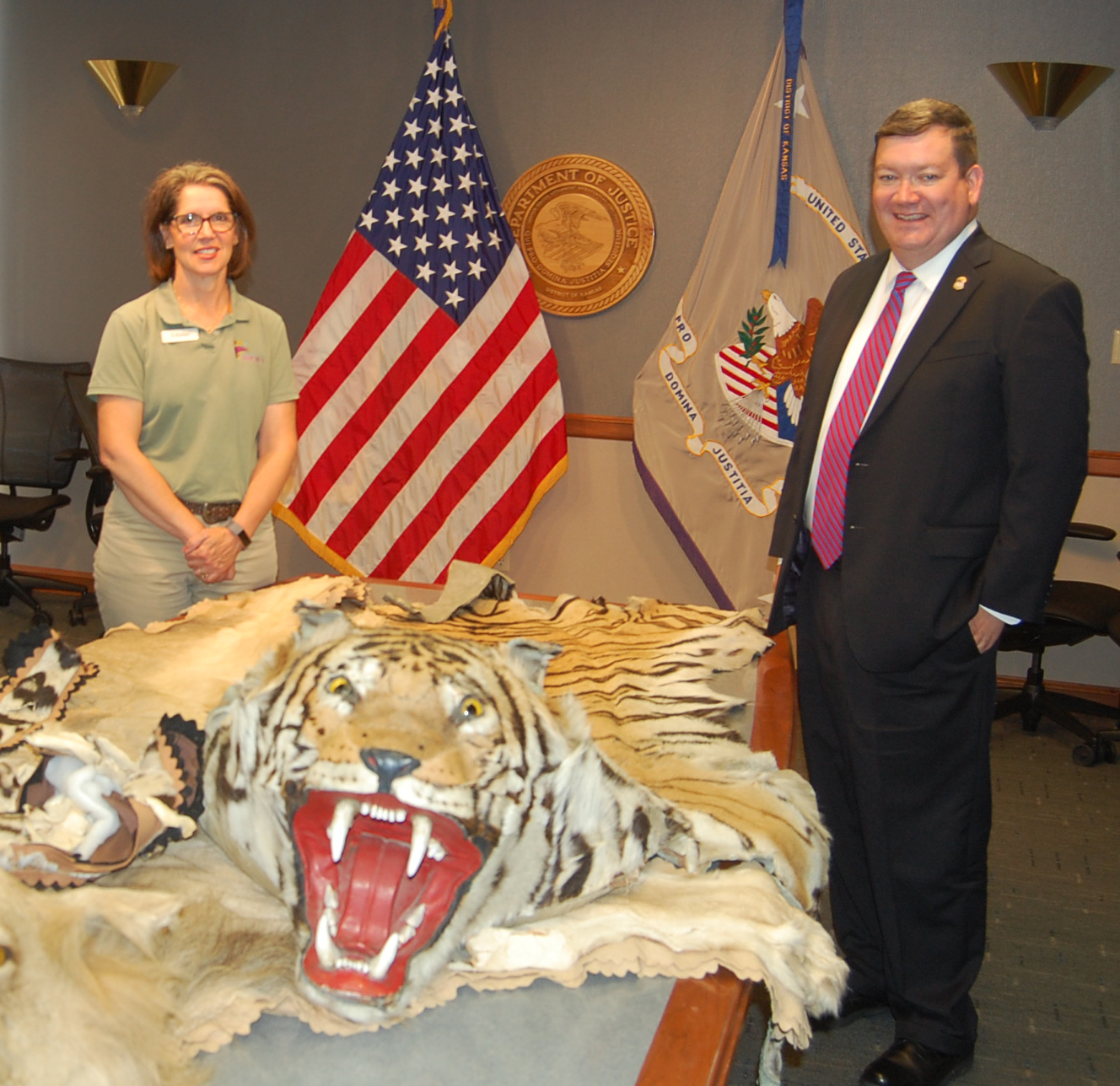
Some young animal lovers at the Topeka Zoo got to touch a tiger pelt Thursday. U.S. Attorney Stephen McAllister is in the center. At the far right is Dennis Dinwiddie, the zoo’s director of education and conservation.
OFFICE OF U.S. ATTORNEY
WICHITA – Zoos in Topeka and Wichita are receiving tiger and lion pelts that federal agents seized from wildlife traffickers, U.S. Attorney Stephen McAllister said Friday.
McAllister said his office donated the pelts to the Topeka Zoo and the Sedgwick County Zoo. The pelts were seized by agents of the U.S. Fish and Wildlife Service who were enforcing federal laws aimed at protecting endangered animals and disrupting the global black market for hides and other parts of protected wildlife.
“Poachers, wildlife smugglers and black market merchants are stealing our last chance to protect and preserve creatures of awesome strength and beauty,” McAllister said. “Once these animals go, they will be gone forever. They are a precious natural resource that the federal government protects, including by criminal prosecution of illegal traffickers.”
The Department of Justice’s Environment and Natural Resources Division (ENRD), together with United States Attorneys’ Offices across the country, is responsible for prosecuting international wildlife trafficking crimes, primarily under the Endangered Species Act (ESA) and the Lacey Act, as well as crimes related to wildlife trafficking, such as smuggling, money laundering, and criminal conspiracy.
Wildlife items forfeited or abandoned to the U.S. Fish and Wildlife Service are stored in a 22,000-square-foot office and warehouse located northeast of Denver that is called the National Wildlife Repository. Many of the items are donated to educational facilities and nonprofit organizations to aid in teaching about endangered species.
McAllister said the tiger pelts came from the wildlife depository.
Schanee Anderson, curator of education, accepted the pelts on behalf of the Sedgwick County Zoo. Note that the large tiger’s head has been distorted by a taxidermist trying to emphasize the animal’s size and ferocity.
Fish and Wildlife Service agents used some of them in a sting operation in Wichita in 2018. A Wichita man pleaded guilty to making a deal to pay $8,000 to have two tiger pelts delivered to him. Agents retrieved the tiger pelts and seized a lion pelt from his home when they arrested him.
McAllister said the Justice Department estimates the international illegal trade in wildlife generates as much as $23 billion annually.
In Kansas in recent years, federal agents have investigated wildlife trafficking cases including deer and elk that had been poached by guides and hunters, eagle feathers that were being unlawfully sold and Asian leopard cats unlawfully imported to Kansas. Federal prosecutors across the country also have pursued cases involving native turtles being exported to other countries.
Ron Wilson is director of the Huck Boyd National Institute for Rural Development at Kansas State University.
By RON WILSON Huck Boyd National Institute for Rural Development
Block22. That sounds like part of a play call in football. In this case, Block22 is the name of a redevelopment project which is helping transform a historic downtown in a key southeast Kansas community.
Heather Horton is an entrepreneur and owner of a small business located near the district known as Block22 in Pittsburg, Kansas. Heather grew up in the nearby rural community of Girard, population 2,789 people. Now, that’s rural.
In Girard, her high school sweetheart was Roger Horton whom she would later marry. Heather earned a bachelor’s degree in commercial art and a master’s degree in communications from Pittsburg State, while Roger studied at Fort Scott Community College.
“We would walk around downtown and enjoyed looking at the old buildings,” Heather said. However, as in many communities, the downtown area was suffering. In 2006, Heather co-founded the Pittsburg ArtWalk, a semiannual event which showcases local artists, musicians and more in downtown Pittsburg.
One downtown landmark, the historic Colonial Fox Theatre, was decaying and was likely headed for demolition in 2007. Local citizens, including Heather Horton and many others, rallied to save the old structure. The Colonial Fox Theatre Foundation, of which Heather was a founding member, was formed and is remodeling the building.
In 2017, a partnership developed between the city of Pittsburg, Pittsburg State University, and a private investor named the Vecino Group. The goal was to further improve the downtown while adding student housing. Together, these organizations created this remarkable project known as Block22.
Block22 takes its name from the city’s founding. According to the Pittsburg State website, the city’s forefathers originally platted Pittsburg into 51 blocks. Block number 22 included a historic opera house which is located in the area that was redeveloped.
Block22 now refers to the four historic buildings which are a part of this $18 million redevelopment project. These buildings now offer nearly 100 student residential units for Pittsburg State students, plus more than 16,000 square feet of innovation space. A shuttle service operates between downtown and the Pittsburg State campus.
“I think Block22 is going to be transformational for the community,” said Marty Beezley, chair of Pittsburg’s Economic Development Advisory Committee, as shown in a Pittsburg State video. The area is described as “a unique, mix-use, living-learning community in Downtown Pittsburg that features residential, commercial, dining, and entertainment spaces.”
“Our goal is to create a living, learning community that is an anchor for the growth that’s going to occur throughout this entire city, not just downtown,” said Dr. Shawn Nacarotto, chief strategic officer at Pittsburg State.
“The downtown is your heart,” Heather Horton said. “If your heart is not pumping correctly, the rest of your body is not going to function.” After graduation from Pittsburg State, Heather opened her own business downtown where she and Roger now live.
“When we decided to purchase our building in 2007, the heart of Pittsburg, downtown, was bare,” Heather said. “Fast forward 12 years and it’s more vibrant than ever, with tons of boutiques, two coffee shops, a bright night life and fun festivals. To see the hustle and bustle happening, people in this area walking around, watching the progress go on, that’s pretty cool.”
In 2017, Heather and Roger were recognized with the President’s Award from the Pittsburg Area Young Professionals. That same year the Pittsburg Area Chamber of Commerce honored Heather as a Woman of Distinction for her work to preserve the arts as well as being a successful small business owner, and in 2018, named her business its Small Business of the Year.
For more information about the downtown district, see www.block22psu.com.
Block22. It’s not a football play, but a remarkable downtown redevelopment project in Pittsburg. We salute Heather and Roger Horton, Marty Beezley, Shawn Nacarotto, and all those who support this project for making a difference with an innovative approach to providing student housing and rebuilding downtown. They are part of the building blocks for their community.
And there’s more. What is Heather’s business? We’ll learn about that next week.