SHAWNEE COUNTY — Law enforcment authorities are investigating a fatal shooting and have released the name of the victim.
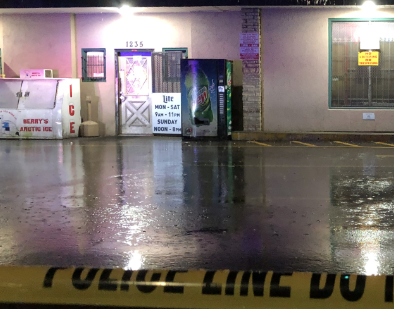
Scene of police investigation into the Saturday night shooting photo courtesy WIBW TV
Just before 9:30p.m. Saturday, police responded to 1235 SW Huntoon in Topeka for a report of a shooting, according to Lt. Aaron Jones.
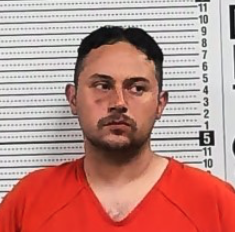
Bystanders were attempting to treat a single shooting victim identified as 34-year-old Darton A. Fields II of Topeka.
EMS transported Fields to a local hospital where he died, according to Jones.
The Topeka Police Homicide Unit is reviewing all investigative leads and evidence. Jones encouraged anyone with information to contact the Topeka Police.
BATON ROUGE, La. — The following local residents were recently initiated into The Honor Society of Phi Kappa Phi, the nation’s oldest and most selective all-discipline collegiate honor society.
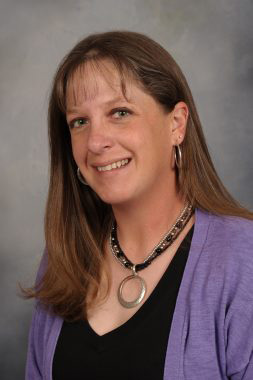
Kathay Johnson of Hays, was initiated at Fort Hays State University
Michael Musgrove of Hays, was initiated at Fort Hays State University
These residents are among approximately 30,000 students, faculty, professional staff and alumni to be initiated into Phi Kappa Phi each year. Membership is by invitation only and requires nomination and approval by a chapter. Only the top 10 percent of seniors and 7.5 percent of juniors are eligible for membership. Graduate students in the top 10 percent of the number of candidates for graduate degrees may also qualify, as do faculty, professional staff and alumni who have achieved scholarly distinction.
Phi Kappa Phi was founded in 1897 under the leadership of undergraduate student Marcus L. Urann who had a desire to create a different kind of honor society: one that recognized excellence in all academic disciplines. Today, the Society has chapters on more than 300 campuses in the United States and the Philippines. Its mission is “To recognize and promote academic excellence in all fields of higher education and to engage the community of scholars in service to others.”
More About Phi Kappa Phi Since its founding, more than 1.5 million members have been initiated into Phi Kappa Phi. Some of the organization’s notable members include former President Jimmy Carter, NASA astronaut Wendy Lawrence, novelist John Grisham and YouTube co-founder Chad Hurley. Each year, Phi Kappa Phi awards nearly $1 million to outstanding students and members through graduate and dissertation fellowships, undergraduate study abroad grants, funding for post-baccalaureate development, and grants for local, national and international literacy initiatives. For more information about Phi Kappa Phi, visit www.phikappaphi.org.
To say that we have had a wet spring would be an understatement to say the least.
This can be a concern for homeowners and their landscapes. I found a few pieces of advice from Ward Upham, K-State Research and Extension’s horticulture department to share with you this week that address a few concerns you may have. As always, if you have any questions, you can call me at 620-793-1910.
Too Wet to Mow the Lawn
What do you do when the lawn can’t be cut because of constant rain? The best thing to do is to set your mower as high as possible and bring it down in steps. It is always best never to take more than one third of the grass blade off at one time. If more is taken, the plant reacts by using stored energy reserves to quickly send up new growth.
This reduces the amount of energy available for the plant to deal with stress or damage done by insects or disease. However, sometimes it is just not possible to keep the “one-third rule.” In such cases, cut as high as possible even though it may mean you are cutting off more than one third of the blade. Bring the height down gradually by cutting more often and at progressively lower heights until you reach the target height.
Trees in flood
Trees differ markedly in their ability to withstand flooding. Some trees have mechanisms in place to provide oxygen to the roots of plants with water saturated soils and others do not. However, most trees will maintain health if flood waters recede in 7 days or less. It also helps if water is flowing rather than stagnant. If the roots of sensitive trees are flooded for long periods of time, damage will occur including leaf drop, iron chlorosis, leaf curl, branch dieback, and in some cases, tree death. Another danger of flooding is the deposition of sediment. An additional layer of silt 3 inches or more can also restrict oxygen to the roots. If possible, remove deep layers of sediment as soon as conditions permit.
This is especially important for small or recently transplanted trees. Try to avoid any additional stress to the trees this growing season. Ironically, one of the most important practices is to water trees if the weather turns dry. Flooding damages roots and therefore the root system is less efficient in making use of available soil water. Timely waterings are vital to a tree’s recovery. Also be diligent in removing dead or dying branches that may serve as an entry point for disease organisms or insect pests.
Alicia Boor is an Agriculture and Natural Resources agent in the Cottonwood District (which includes Barton and Ellis counties) for K-State Research and Extension. You can contact her by e-mail at [email protected] or calling 620-793-1910.
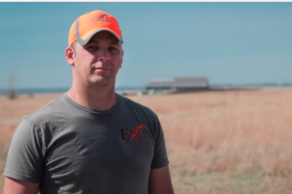
Standing near the corner of his property in southeastern Reno County, Nick Egli looked east and pointed to the proposed locations for several 500-feet-tall wind turbines.
Nick Egli stands in front of the grass airstrips he’s worked 10 years to establish. BRIAN GRIMMETT
Egli is standing on a grass airstrip he’s spent the last 10 years building. He pictures a few more homes, some hangars and, eventually, a residential community for pilots of small planes.
“If there’s turbines there, you’ve completely killed everything I’ve been working on the last 10 years,” he said.
It’s the latest of several projects NextEra has already completed in the state. And the company isn’t alone.
Businesses from all over the world have cashed in on Kansas’ abundant wind in the past decade. Most projects went up without much fanfare.
But stiff opposition facing the Reno County project has raised some anxiety in the industry as companies consider its implications for future development.
NextEra developer Spencer Jenkins addresses the Reno County Planning and Zoning Commission
CREDIT BRIAN GRIMMETT
Over the past 4 years, NextEra Energy signed deals with Reno County landowners to plant giant wind turbines on their property. It’s one step in a long process that needs a go-ahead from county officials.
Developers chose this part of Reno County because it has plenty of wind, it’s close to transmission lines that transport the electricity to places that need it, like Wichita, and it had enough willing landowners.
“Farming has not been an especially lucrative income producer,” Randy Jackson told the planning commission during one of several hours-long public hearings. “To continue to own our property, we need to take advantage of every income potential we have.”
But Jackson was among the few to speak in support, and most of those were landowners benefitting from the project.
The majority of speakers voiced their opposition.
“We could have chosen to live anywhere but we chose to live here,” Matt Amos said. “Had I known that this was going to happen, I would have not have chosen to live here.”
One after another, the stream of voices filled the conference hall.
“Why is this wind farm being built so close to concentrated populations of people and wildlife?” Darcy Gray of Andale asked. “I’m not opposed to wind energy, but the location does not make sense.”
Nick Egli also spoke at the hearing. But he ultimately blames his neighbors who signed leases, not county officials.
He recalled what one of his neighbors told him.
“He said, ‘Well, I’m going to make $4,500 a quarter,’” Egli said. “Really? That’s what you’re selling me out for?”
Egli isn’t against renewable energy. He’s actually an electrician and has installed solar panels on the roof of the house he’s building. It will provide him with enough electricity that he won’t need to connect to the grid.
He just wants what he calls sensible setbacks.
A setback is the distance a wind turbine has to stand from something, like a property line, road, or house. Egli thinks that if turbines are placed 3,000 feet away from the property lines of people who didn’t lease their land to NextEra, it would resolve concerns about noise and shadows.
But while he calls it sensible, a 3,000-foot setback from property lines would be the largest in the state. That type of setback in Kansas typically runs about 500 feet.
Setbacks have been a sticking point from the beginning, including for the Reno County planning commission. After failing to reach a consensus, the commission rejected the proposal.
He said this is the first project in the state he’s ever seen rejected by a county planning commission. Previously, if projects got enough landowners to sign leases, it was generally a sign the community was on board.
A decade and a half ago, local officials did stop a wind farm in Waubansee County. It created a controversy that led to a case that went all the way to the Kansas Supreme Court. But the trend has been decididly more pro-wind since.
While the decision in Reno County was unexpected, Peterson doesn’t think it’s a sign developing future wind projects is going to get harder in Kansas.
“It may be new to these portions of the state,” he said, “but we develop as an industry in many communities that are very similar.”
And NextEra’s Reno County project isn’t dead yet. The three-member county commission has the final say and will take up the issue June 11.
Like the landowners who support the project, Reno County stands to gain financially from its approval. Tax revenue from the turbines will generate as much as $39 million over the next 30 years.
But for those still opposed, it’s about more than just what the county will gain. It’s about what they could lose — a quiet home on a lonely prairie.
“I’m going to be able to tell our kids that I did everything I could,” Egli said, “before I had to sell our place I built for generations.”
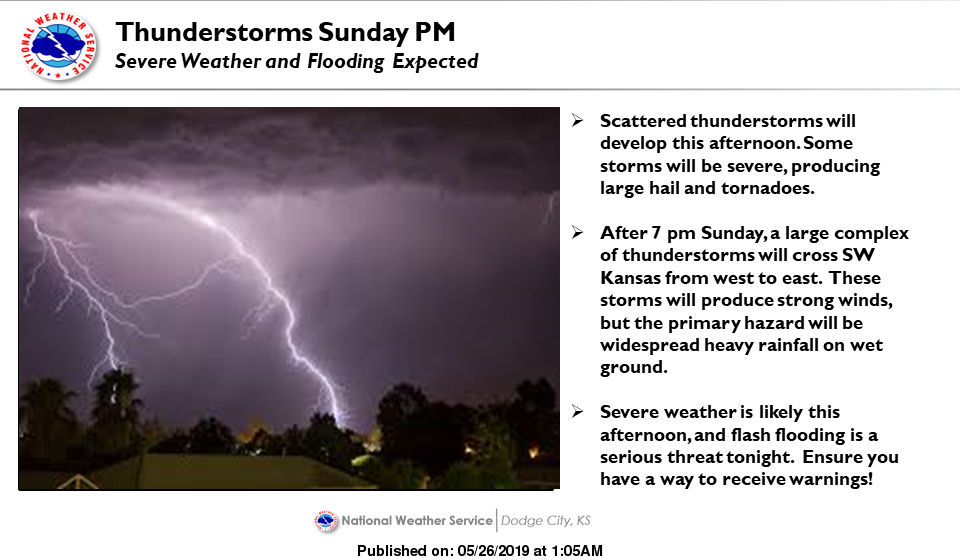
A 50 percent chance of showers and thunderstorms, mainly after 3pm. Some of the storms could produce heavy rain and frequent lightning. Increasing clouds, with a high near 73. Southeast wind 6 to 14 mph, with gusts as high as 24 mph.
Tonight
Showers and thunderstorms, mainly before 1am. Some of the storms could produce heavy rain and frequent lightning. Low around 61. South southeast wind 14 to 16 mph. Chance of precipitation is 90%. New rainfall amounts between three quarters and one inch possible.
Memorial Day
Scattered showers and thunderstorms before 7am. Mostly sunny, with a high near 84. Breezy, with a south southwest wind 14 to 20 mph. Chance of precipitation is 30%.
Monday Night
Partly cloudy, with a low around 60. South wind around 17 mph.
Tuesday
Sunny, with a high near 78. Southwest wind 13 to 17 mph, with gusts as high as 28 mph.
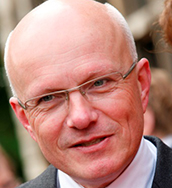
LAWRENCE – The Robert J. Dole Institute of Politics at the University of Kansas will welcome Dirk Wouters, ambassador of Belgium to the United States, for a public program this summer.
Wouters will deliver remarks at the institute at 2 p.m. June 13. The program is free and open to the public, and a free livestream of the event will be available.
In his talk, Wouters will highlight some of the current challenges facing the European Union and developments in the U.S. that have affected transatlantic relationships. This will include the current U.S. presidential administration’s approach to relations with Russia and China, trade deficits, NATO and Europe’s energy dependence.
The ambassador was appointed to his position in September 2016. He represents the king of the Belgians and Belgium’s federal government in the U.S. and in the Commonwealth of the Bahamas. He is responsible for the direction and work of the embassy and its consulates, including bilateral political and economic relations.
Prior to his current assignment, the ambassador was permanent representative of Belgium to the European Union (EU). Wouters has served his nation’s international interests extensively, having joined the Belgian Ministry of Foreign Affairs in 1980. In 1986, he began his efforts representing Belgium in European affairs, and he later received an assignment in Rome dealing with political and economic issues. Beginning in the mid-1990s, he served as deputy permanent representative of Belgium to the United Nations (UN) in New York City.
The ambassador’s work would shift to the EU in 2003-2009, where he served as permanent representative of Belgium to the Political and Security Committee. He would later join the office of the Belgian prime minister as a diplomatic adviser, and later, the office of the minister of foreign affairs as chief of staff.
The Robert J. Dole Institute of Politics is dedicated to promoting political and civic participation as well as civil discourse in a bipartisan, philosophically balanced manner. It is located in KU’s West District and houses the Dole Archive and Special Collections. Through its robust public programming, congressional archive and museum, the Dole Institute strives to celebrate public service and the legacies of U.S. senators Bob Dole and Elizabeth Dole.
More information on all programs, as well as ongoing additions to the schedule, can be found on the Dole Institute’s website, www.doleinstitute.org.
PHILLIPS COUNTY— One person was injured in an accident just before 9p.m. Saturday in Phillips County.
The Kansas Highway Patrol reported a 2014 Honda CRV driven by Francis L. Karlin, 72, Bloomington, MN., was southbound on U.S. 183 thirteen miles south of Phillipsburg. The driver lost control of the vehicle when he swerved to miss a deer.
The vehicle entered the east ditch and continued, striking several cedar trees.
EMS transported Karlin to the hospital in Phillipsburg. He was properly restrained at the time of the accident, according to the KHP.
WICHITA – With just a handful of events left severe weather forced officials to push the reminder of the KSHSAA State Track and Field meet to Sunday morning.
After the meet was delayed Friday morning for nearly three hours and then postponed in the afternoon they were able to get in most of the remaining events on Saturday before another round of storms moved into the Wichita area Saturday night.
In the events they were able to get in the Osborne Bulldogs won but the high hurdles races. Afftin Conway won the girls 100 meters hurdles and Darrien Holloway won the boys 110-meter hurdles. Holloway also won the 300 high hurdles.
The TMP girls finished seventh in the 3A girls 4×800 relay with a time of 10:16.76.
The TMP boys finished fourth in the boys 3A 4×800 relay with a time of 8:20.51.
Trego’s Helen Giefer claimed the title in the 2A girls 1600 meters with a time of 5:18.36.
In the girls 2A 400 meter dash Plainville’s Aubree Dewey earned a first place finish with a time of 58.31. Ellis’ Cassie Waldschmidt finished second in a time of 59.36. Waldschmidt also placed fourth in the 2A girls 200.
The TMP girls’ high jumpers all recorded a height of 5 feet. Jenna Romme finished third by tiebreaker with Kassidy Yost right behind Romme in fourth and Makinsey Schlautman finished tied for sixth.
Gavin Meyers placed third for the Hays High boys in the 5A boys javelin with a throw of 167 feet 1 inch.
Hays High’s Brooklyn Schaffer placed seventh in the 5A girls 300 low hurdles.
In class 2A Ellis’ Grace Eck placed second in the girls 800 meters.
Hays High’s Tucker Veach earned a sixth-place finish in the 5A boys pole vault clearing a height of 13 feet.
On Sunday the remaining field events will start at 10 a.m. with the running events starting at 11 a.m.
Tune into 101.9 The Bull for updates beginning in the 12:00 p.m. hour.
DODGE CITY – A Dodge City man was sentenced this week to 154 months in prison for distribution of methamphetamine, according to Kansas Attorney General Derek Schmidt.
Roman Del Real photo Ford County
Roman Del Real, 33, was sentenced by Judge Sidney R. Thomas in Ford County District Court. Del Real pleaded guilty in February to one count of distribution of a controlled substance.
The crime was committed in October 2016. The charge stemmed from an investigation by the Kansas Bureau of Investigation, Garden City Police Department, Dodge City Police Department, Ford County Sheriff’s Office, Finney County Sheriff’s Office and Kansas Department of Revenue Division of Alcoholic Beverage Control. Assistant Attorney General Melissa G. Johnson, former-Assistant Attorney General Jason B. Oxford and late-Assistant Attorney General Steven W. Wilhoft prosecuted the case.
DOUGLASS, Kan. (AP) — The National Weather Service has confirmed that a weak tornado touched down Friday afternoon in a rural area near Douglass in southeastern Kansas.
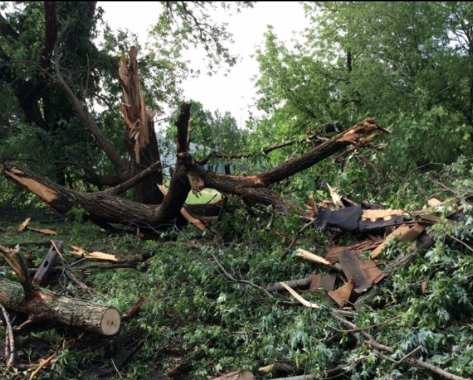
Storm damage near Douglas photo courtesy National Weather Service
An EF-0 tornado, with winds from 65 mph to 85 mph, hit about 4:20 p.m. Friday and stayed on the ground only a couple of minutes. The weather service says the damage was relegated to trees in the area. No injuries or building damage was reported.
Meteorologists say heavy rains — which could worsen flooding — as well as strong winds and hail could be seen Saturday evening into Sunday for parts of eastern Kansas. Dry weather is expected Monday and for several days after that.
RICHMOND, Va. (AP) — A new television series with Ethan Hawke starring as the fiery abolitionist John Brown is set to film in Virginia.
Image courtesy Penguin Random House
Brown led a raid in 1859 on a federal arsenal in Harpers Ferry, in what is now West Virginia, hoping to start an armed slave rebellion. The rebellion didn’t happen, and Brown was later hanged for treason.
Before the raid, Brown and a group of abolitionist settlers killed five pro-slavery settlers in Kansas in the Pottawatomie massacre.
JEFFERSON CITY, Mo. (AP) — Eight years to the day after a devastating tornado killed 161 people and injured more than 1,100 others in Joplin, another big twister ripped through Missouri — this time the capital of Jefferson City — but with a far different result: no deaths or serious injuries.
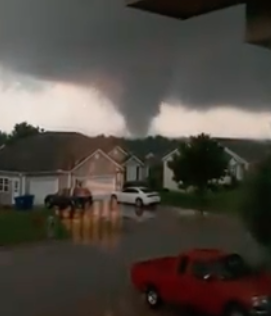
Tornado approaching Carl Junction, Missouri Wednesday night photo courtesy Sarah Harreus
The two storms hit Missouri cities roughly the same size on the same day of the year, May 22. And they both ravaged residential neighborhoods and business districts. But several factors created completely different scenarios — factors that worked against Joplin and helped spare the lives of Jefferson City residents like Debra Gary, who along with her husband, mother and four kids hunkered down in the basement before emerging to find their home badly damage.
“I always tell my kids, ‘Keep God first,’ because God was there for us,” Gary said Friday. “He kept us and our home safe when the tornado was going on.”
The Jefferson City twister was a big one, an EF-3 with winds estimated at 160 mph. But the Joplin tornado was a rarely-seen monster, an EF-5 with winds in excess of 200 mph. It was on the ground for 22 miles and 38 terrifying minutes, tearing through one-third of the town.
Then there was the timing. The Joplin tornado hit on a Sunday afternoon, as people were out and about, including hundreds who had just left the high school’s graduation ceremony.
“You had many more people potentially in the path, in vulnerable locations,” said Bill Bunting, chief of forecast operations of the National Oceanic and Atmospheric Administration’s Storm Prediction Center in Norman, Oklahoma.
The Jefferson City twister arrived in the middle of the night, which was actually a good thing, said Brian Houston, a communications professor and director of the University of Missouri’s Disaster and Community Crisis Center.
“We think of nighttime tornadoes being pretty dangerous because people might be asleep and not aware of them, but one of the good things is people tend to be at home, in structures,” Houston said. “It’s always better to be inside somewhere when a tornado strikes, rather than being out.”
The ability to find safe refuge from the storm also favored Jefferson City. Joplin sits in an area of southwestern Missouri where the soil is rocky, so basements are uncommon. In 2011, only about one in five Joplin homes had basements, which forced people to take shelter in far less secure places like bathtubs and closets. Basements are far more common in Jefferson City, which was built on rolling hills along the Missouri River.
Bunting and Houston agree that technology also was a factor that helped in Jefferson City. Smart phones are now omnipresent, and many people have alerts on their phones that warn of approaching weather danger.
Those warnings are now more precise, too. Houston said storm warnings are now more localized, meaning people “are hopefully more likely to take it seriously because you’re not getting these warnings for a tornado that’s on the other side of the county that might be dozens of miles away.”
National Weather Service image shows the track of the deadly storm moving from Kansas to Jefferson City-click to expand
Radar is more advanced, too. Forecasters were warning as far back as last week that the Plains and Midwest faced a highly dangerous storm scenario. On Wednesday night, central Missouri TV stations tracked the approaching storm and sirens in Jefferson City first sounded at 11:10 p.m., which was at least 30 minutes before the first property damage was inflicted. Gov. Mike Parson credited the warning system for saving lives.
As Jefferson City residents began the long task of cleaning up, they faced additional challenges: Flooding and heat.
The Missouri River topped a levee on the north side of town, threatening the airport and a few homes and businesses, including a golf course and events center Danny Baumgartner owns.
“It’s part of Mother Nature — these things happen, and you make the best of it and help each other out,” Baumgartner said. “With the tornado and this going on, it’s a lot of activities for a small community. But we’ll all make it.”
Flooding also forced the closure of some roads around the state Capitol, though the building itself sits on a bluff overlooking the river, out of harm’s way. The tornado also spared the Capitol building.
Ameren Missouri crews worked in sweltering humidity with a temperature nearing 90 degrees, replacing about 200 broken power poles and re-stringing lines in Jefferson City and Eldon, another central Missouri community hit by a tornado.
Ameren Missouri division director Chip Webb said it may be late Saturday before power is fully restored in Jefferson City.







 Today
Today