Kerry Wayne Garrison, 59, passed away on May 1, 2019 at the Hays Medical Center in Hays, Kansas. He was born on January 19, 1960 in Norton, Kansas the son of Darrell and Marvalee (Elling) Garrison.
Kerry was an over the road semi-trailer truck driver for 19 years. He also operated a backhoe and bulldozer in the oil field. He married Samantha Moore on Thursday, October 11, 2007, in Manteo, North Carolina. She survives.
Other survivors include his mother, Marvalee E. Garrison of Ness City; stepson, Eric Cothran and wife Tammy of Pinebluff, AR; two stepdaughters, Emily Cothran of Pinebluff, AR, and Crystal Jacobs of Ness City; three brothers, Monte Garrison and wife, Tammy of Great Bend, Tad Garrison and Jason Garrison both of Ness City; a sister, Lisa Dinkel and husband, Sean of Hays; sister-in-law, Denise Deboer of Hays; five step-grandchildren, Regan, Nicholas, Jacob, Tamara, and Tyler; 2 step-great-grandchildren; three nieces, Krista, Marissa, and Kenlie; three nephews, Dylan, Brayden, and Blake. He was preceded in death by his father, Darrell Garrison; a brother, Bob Garrison, and 2 nephews, Mike and Dalton Garrison.
A Celebration of Life will be held at a later date.
Memorial contributions may be given to the Ness City Library.
Ted Joe Hadley, son of Philip Marden and Rachel Esther (Conard) Hadley, was born February 23, 1942, in Norton, Kansas, and passed away at his home in Norton, on May 2, 2019, at the age of 77.
Ted grew up in the Norton community, attending the Farview country school and graduating from the Norton Community High School. At the age of 21, Ted joined the United States Air Force and was honorably discharged. Following his discharge, Ted married his sweetheart, Mary Ann Nuxoll on January 24, 1970, in Spokane, Washington. They made their home in Spokane until 1982, when they returned home to Norton, where Ted was a farmer and later a corrections officer.
Ted was an active member of the Immanuel Lutheran Church in Norton, where he served as an usher. He had also been a member of the Jaycees. Ted enjoyed participating in the local squaredancing club in the 80’s but his greatest joy was spending time with his loving wife, children and grandchildren.
Survivors include: his wife, Mary Ann Hadley, of their home in Norton; three children, April (Kelly) Karnopp, Norton; Richard (Nancy) Hadley, Olathe, Kansas; Bill (Heather) Hadley, Norton; one brother, Charles (Cindy) Hadley, Norton; two sisters, Edna (Dale) Hunt, Minden, Nebraska; Julia (JayDee) Daffer, Norton; six grandchildren; other relatives and friends.
Ted was preceded in death by his parents.
FUNERAL SERVICE – Tuesday, May 7, 2019—10:30 a.m.
PLACE – Immanuel Lutheran Church – Norton, KS
INTERMENT – Norton Cemetery – Norton, KS
VISITATION – Monday, May 6, 2019—5:00 – 7:00 p.m.
PLACE – Enfield Funeral Home – 215 W. Main – Norton, KS
MEMORIAL – Ted J. Hadley Memorial Fund
Mark TallmanBy MARK TALLMAN Kansas Association of School Boards
A new report from the Economic Policy Institute shows that average weekly salaries for teachers are nearly 20 percent lower than pay for similarly educated employees in other fields, and the gap has been growing for decades. The teacher pay penalty in Kansas is slightly worse than the national average. Adding non-wage benefits like insurance and retirement plans reduces but does not eliminate the growing gap.
Kansas education leaders have been raising concerns over a growing teacher shortage for several years, as fewer students enter teacher training programs and others leave the profession. This report suggests a major reason is that teacher pay has not only fallen behind inflation, but behind other professionals as well. Here are some of the key findings of the report.
Teacher salaries are increasingly lagging behind other professions requiring college degrees.
Average weekly wages for teachers have long been lower than average wages for non-teacher college graduates, but from the late 1970’s to the mid-1990’s, pay increased at about the same rate for both groups.
Since 1996, however, teacher pay nationally, when adjusted for inflation, has actually fallen about $20 per week, while non-teacher pay has increased by $323 per week.
The pay gap between teachers and other college graduates has widened, especially for male teachers.
This teacher pay gap or penalty is now 21.4 percent for all employees and has widened from 6.3 percent in 1996. Because professions dominated by men have traditionally earned more than teaching, which has been traditionally dominated by women, the pay gap for men is greater – 31.5 percent, compared to 15.1 percent for women. Prior to the mid-1990’s, female teachers actually earned more on average than female non-teachers with comparable education.
The report blames the widening pay gap on state tax and funding cuts.
The report says state tax cuts were a major contributor to the widening pay gap, at least since the Great Recession of 2008. In fact, the “teacher penalty” decreased slightly around 2010 as private sector wages fell, but it grew more rapidly as the economy recovered. The authors say: “It is noteworthy that the wage penalty shrank in the early portion of the Great Recession, as private-sector wages fared worse than those in the public sector, reflecting the greater short-run stability of teacher wages due to long-term contracts. This trend was more than reversed in the recovery beyond 2010 as state and local spending cuts sapped teacher wage growth while private-sector wage growth accelerated.”
In Kansas, average teacher salaries lagged behind inflation every year from 2009 to 2017, which includes the period of state income tax cuts passed in 2012 and largely repealed in 2017. Kansas teacher salaries also lagged behind the U.S. average for teachers and other private sector employees. (See previous post.) Following the repeal of Kansas tax cuts and in response to the Kansas Supreme Court’s Gannon school finance decisions, the Legislature boosted K-12 funding in 2018 and 2019, and teacher salaries rose faster than inflation for the first time in a decade. (See previous post.) This trend is expected to continue as additional state funding is phased in.
Whether because of, or in spite of, state income tax cuts, Kansas personal income growth has been among the lowest in the nation since 2013. This has also limited the state’s ability to increase school districts’ funding, which largely determines teacher pay.
The pay gap is reduced, but not eliminated, by better non-wage benefits for teachers.
Teachers receive higher benefits in the form of insurance and retirement plans than non-teachers. For non-teachers, non-wage benefits are over 20 percent of total compensation; for teachers the percentage is nearly 30 percent. The authors found this “benefits advantage” was 8.4 percent for public school teachers in 2018, which reduced the 21.4 percent wage penalty to a 13.1 percent deficit in total compensation.
The authors say while the benefits advantage is important to note, wages have a more immediate impact on individuals. “While the total compensation penalty rounds out our understanding of how teachers are faring compared with other professionals, the growing wage penalty is still important and critical to keep in mind given the different natures of wages and benefits—only wages can be spent or saved!”
Again, the Kansas experience reflects the national trends noted by the report. For example, school Kansas school districts increased spending on salaries for all employees by 38.3 percent from 2004 to 2018, but employment benefits increased by 170.3 percent.
In particular, Kansas Public Employee Retirement System contributions for school districts increased from $110.9 million to $375 million or 238 percent. Increased KPERS funding has been largely driven by the efforts to make up for past underfunding, not new benefits. These funds will eventually help pay for retirement benefits for school district employees but are also dollars not available for current teacher salaries.
Mark Tallman is the Associate Executive Director for Advocacy for the Kansas Association of School Boards.
State-of-the-art supply chain and logistics best-practices can trace their origins to the Spanish monarchy that established dominance in the Caribbean and South America in the 16th and 17th centuries, according to a new book chapter written by Dr. Robert Lloyd, assistant professor of management at Fort Hays State University.
Lloyd argues that the Spanish supply chain was truly revolutionary because of the distance, scope, and risks – piracy among the biggest – associated with transporting gold and silver from their New World vice-royalties.
“The Romans used well established trade routes into a relatively known world, Marco Polo’s route to Asia was exploratory in nature, and historical military conquests had a clear origin to front lines,” said Lloyd.
But, he said, “The Spaniards were the first to maintain consistent quantities over a sustained period of time (centuries) in an environment where the risks were unknown and extreme.”
Collecting, processing, protecting, and transporting these riches from the Caribbean to Spain was a tremendous undertaking and required the Spaniards to adopt new practices in supply chain management and to employ innovative logistical techniques.
According to Lloyd’s research, the Spanish successfully imported more than 89 million pesos of American origin between 1503 and 1660, all of which required innovations in transportation and supply.
Despite incessant depredations by pirates and political foes, Caribbean hurricanes, exhaustive conditions, and the risks inherent in any mining operation, the Spaniards were unrelenting as they sent fleet after fleet of war galleons to retrieve their precious metals.
“This project is the culmination of a life-long fascination I’ve had with pirates and Spanish imperialism,” said Lloyd. His captivation began while playing video games as a young boy and having to memorize the Caribbean political maps of the Golden Age of pirates, and only grew as he began travelling to the old Spanish forts.
“The first time I walked the ramparts and saw the fortifications that guarded the harbors in Havana, Porto Bello, and Cartagena, I could imagine the salvo of cannon fire that came from common pirates and famous privateers alike,” he said.
This personal fascination led him to investigate how the topic could be researched in his academic discipline of business management. He began construction of a manuscript in fall 2017 in collaboration with Dr. Wayne Aho, a colleague from Western Carolina University, Cullowhee.
His work on Spanish supply chain origins was accepted in the prestigious reference guide “The Palgrave Handbook of Management History,” described as the “the most comprehensive exploration of management history in the market, a definitive source and reference tool for academics, researchers, and graduate students working in the field of management history.”
The book is set to publish in early 2020. The book can be found at https://bit.ly/2vzrFOp.
OLATHE, Kan. (AP) — A man who pleaded guilty to vandalizing an Olathe cemetery on Christmas was sentenced to 50 hours of community service and ordered to undergo a mental health evaluation.
Deason photo Johnson Co.
42-year-old Alex Deason was also ordered Friday to pay $7,781 in restitution for damages. Deason pleaded guilty in March to criminal desecration at the Olathe Memorial Cemetery.
Authorities said Deason knocked over and vandalized headstones, some of which dated back to the 1800s.
At his sentencing hearing, Deason apologized and said he would like to write a letter to each family whose gravestones he damaged.
Deason has been ordered to have no contact with the Olathe Memorial Cemetery.
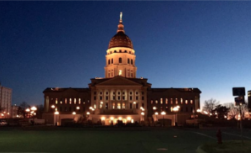
TOPEKA, Kan. (AP) — Republican legislators have pushed a tax relief proposal through the Kansas Legislature, ignoring predictions from Gov. Laura Kelly’s fellow Democrats that she will veto it, just as she did with a larger plan.
The House voted 83-41late Saturday night to approve a billdesigned to offer relief to individuals and businesses that have been paying more in state income taxes because of changes in federal tax laws at the end of 2017. The House’s vote came two days after the Senate approved it, so the measure is headed to Kelly’s desk. Republican leaders in the GOP-controlled Legislature appeared to have the two-thirds majorities necessary in both chambers to override a veto, something they couldn’t say with the first tax bill.
“Kansas should not take more of their money based on something the federal government did,” said House Speaker Ron Ryckman Jr., a conservative Kansas City-area Republican. “It’s the people’s money.”
The bill would save taxpayers roughly $90 million during the budget year beginning in July and about $240 million over three years. It’s less than half the size of a GOP tax relief plan that Kelly vetoed in late March, partly because it doesn’t attempt to make its changes apply retroactively.
Kelly issued a statement early Sunday calling for a comprehensive review of the state’s tax system. Her staff would say only that she will review the measure.
Kelly likewise refused to say beforehand that she would vetothe first tax bill. But she criticized that measure as a return to a tax-cutting experiment under former Republican Gov. Sam Brownback that made Kansas nationally notorious because of persistent budget woes that followed.
Bipartisan legislative majorities repealed mostof the Brownback tax cuts in 2017, and Kelly ran successfullylast year against Brownback’s political legacy. Democrats argued that enacting the GOP’s smaller tax relief bill also would lead to budget problems within a few years, and Senate Minority Leader Anthony Hensley, a Topeka Democrat, said it was “destined for a veto.”
“We can’t afford it,” said Sen. Tom Holland, a Democrat from northeast Kansas. “We need to buy ourselves some time and just see what’s going on with our economy right now.”
Republican leaders have argued that failing to act represents a tax increase.
“It’s very important to us that we make sure that businesses and individuals keep that money in their pockets, rather than having it go to the state of Kansas for bigger, bloated government,” said Senate President Susan Wagle, a conservative Wichita Republican.
Like other states, Kansas faced revising its income tax code because it is tied to the federal tax code. The federal tax changeschampioned by President Donald Trump lowered rates but also included provisions that raised money for Kansas, in part by discouraging individual filers from claiming itemized deductions.
The measure would allow individuals to itemize on their state tax returns even if they do not itemize on their federal returns. The bill also cuts taxes for corporations, particularly large firms with operations outside the U.S.
The measure also includes provisions aimed at helping the state collect more taxes from internet sales and start dropping the state’s 6.5% sales tax on groceries.
Kelly had promised during her campaign last year to lower the sales tax on groceries. Democrats scoffed at the incremental amount — less than 1 percentage point, or $1 on a $100 grocery bill, in 2021.
“I can hear the conversations at home: ‘Honey, the Kansas Legislature has given us a tax break. What are you going to spend your quarter on this week?'” said Rep. Boog Highberger, a Lawrence Democrat.
Fort Hays State University’s Sigma Tau Delta-International English Honor Society-Rho Psi Chapter received two prestigious awards at the recent Sigma Tau Delta International Convention in St. Louis.
FHSU earned an Outstanding Chapter Award and a second-place finish for Outstanding Literary Arts Journal for its campus publication, “Lines from the Middle of Nowhere.”
The Outstanding Chapter Award is designed to recognize local chapters that have exhibited outstanding motivation, creativity and service in the preceding year. Winnings include a check for up to $500 and a plaque. A travel grant of $350 may also be awarded for sending at least one student representative to the annual convention and bringing a chapter exhibit.
FHSU’s chapter is composed of 23 active members who participate in many campus activities throughout the academic year. Ten inducted members, one professor and an alumna member went to the convention. Seven students presented their work and two members proposed roundtables that were accepted.
“These awards would not have been possible without the hard work and dedication of the Rho Psi members and their sponsor, Dr. Lexey Bartlett,” said Judy Sansom, president of the FHSU Chapter.
“Our literary arts journal, ‘Lines from the Middle of Nowhere,’ is a student publication that accepts submissions from online and on-campus FHSU students,” said Sansom. “Without talented students, we would not have a successful journal.”
“Lines” highlights the talents of FHSU students and accepts work submitted by any member of FHSU, including virtual students. The work is then selected by a student-led editorial board composed of Sigma Tau Delta members. This year’s journal displays 15 poems, three short stories and 10 pieces of visual art by majors across the campus.
For the first time, Hays will have a citywide garage sale. Laurie Mortinger and others have come together to set a date for May 31 and June 1 for the inaugural citywide event.
“We’ve never had a citywide garage sale. People are always saying we need to do one because all these other towns have them,” said Mortinger, co-director of the Community Assistance Center in Hays. “I decided we need to pick a date and start doing it annually. It’ll start bringing people to town and it’ll be fun.”
The garage sale is open to anyone and everyone who wants to be a part of the event. Individuals can have their sales in their garages, yards or combine them at public buildings or parks. Businesses are also encouraged to participate in the sale.
SHAWNEE COUNTY —Law enforcement authorities are investigating after a dog was killed following an attack.
Just before 3p.m. Saturday, police responded to a report of a vicious dog attack in the 3400 block of SW 37th Street in Topeka, according to Lt. John Trimble.
At the scene, police discovered that a vicious dog had attacked several juveniles. The children’s father came out to investigate the screaming and commotion and was also bitten by the vicious dog.
Officers were trying to contain the dog and called for an Animal Control Officer to assist in capturing the dog. Before Animal Control could arrive at the scene, the dog attacked a Topeka officer, according to Trimble.
The officer fired his department issued handgun one time, striking and killing the dog before the dog could injure anyone else. One person sustained minor injuries from the incident.
HaysMed, part of The University of Kansas Health System, will host a Stroke Symposium on Friday, May 31, 2019. The program is jointly provided by HaysMed, The University of Kansas Medical Center Continuing Education and Professional Development and the Area Health Education Center West.The program will be held at HaysMed in the Hadley Conference Rooms.
Registration and breakfast for the program begins at 8:30 am. The program runs from 9:00 am – 3:30 pm.This program is designed to improve the strategies for secondary stroke prevention, stroke assessment, acute stroke intervention and regional stroke care.
Speakers for the program include Craig Shipley, APRN, FNP-BC, Aparna Pendurthi, MD, Alan Reeves, MD and Janice Sandt, RN all with The University of Kansas Health System.
The program is designed for Physicians, PAs, APRN’s, Registered Nurses, Licensed Practical Nurses, Social Workers, PTS, OTS and other interested Healthcare Professionals.
All participants requesting continuing education credit must complete validation of attendance and evaluation forms online for each session attended.The link, instructions and deadlines for completion will be emailed to registered participants.
Physician: This activity has been planned and implemented in accordance with the Essential Areas and policies of the Accreditation Council for Continuing Medical Education through the joint providership of The University of Kansas Medical Center Office of Continuing Medical Education and HaysMed, part of The University of Kansas Health System.The University of Kansas medical Center Office of Continuing Medical Education is accredited by the ACCME to provide continuing medical education for physicians.
The KU Medical Center Office of Continuing Medical Education designates this live activity for a maximum of 5.0 AMA PRA Category 1 CreditsTMPhysicians should claim only the credit commensurate with the extent of the participation in this activity.
CNE: Hays Medical Center is approved as a provider of continued nursing education by the Kansas State Board of Nursing.The course offering is approved for 6.0 contact hours applicable for RN, or LPN re-licensure.Kansas State Board of Nursing Approved Provider Number:LT0021-1138.
Respiratory Therapy
The Hays Medical Center Respiratory Care Continuing Education Evaluator, on behalf of the Kansas State Board of Healing Arts, has approved this program for 5.0 CRCE hours.Providership No. 004.
PT/OT
Paperwork will be provided to submit to KOTA and KPTA for credits.
ASRT
An application has been submitted to ASRT. Approval is pending.
EMS
Application has been submitted to EMS.Approval is pending.
The fee for the program is $60 for non HaysMed providers and $30 for CAH employees.There is no registration fee for HaysMed, Pawnee Valley Campus, St. Rose Medical Pavilion, Great Bend Campus Associates and Bistate consortium members.You can register online:www.haysmed.com/education and click on professional education or by calling 785-623-5500.You may pay online with a valid credit card or may choose to be invoiced.
Jeff Kahrs is regional director for the U.S. Department of Health & Human Services.
By JEFF KAHRS U.S. Department of Health & Human Services
Pockets of our country are experiencing a significant uptick in the number of measles cases.
Measles is not a harmless childhood illness. It is actually a highly contagious, dangerous disease that can even be deadly. But measles is also easily preventable with a vaccine.
There’s a lot of misinformation swirling around, so let me provide the facts: vaccines save lives. Vaccines protect our children from debilitating and deadly disease, and they promote the overall health of our communities. Vaccines are safe and highly effective. Large studies undertaken over the years have confirmed their safety again and again.
Vaccines do not cause autism and do not contain toxic chemicals. Any serious side effects from vaccines are exceedingly rare, and the protection from disease that vaccines provide far outweighs any potential risks.
If you’re a parent, talk to your child’s doctor to make sure your child is up to date on all of his or her scheduled vaccinations. This is especially important if you have an infant, because vaccinating your baby on the recommended immunization schedule provides protection against 14 serious childhood illnesses.
For measles, the Centers for Disease Control and Prevention recommends that children get two doses of the MMR vaccine, starting with the first dose at 12 to 15 months of age, and the second dose at 4 through 6 years of age.
If you’re an adult, check with your doctor about whether you’re up to date on your vaccines, too.
We all want our children to grow up in a world that is free from preventable diseases. The single most important thing each of us can do to achieve that goal is to get fully vaccinated – for ourselves, our families, and our communities.
You can find out more about the measles vaccine and other vaccines at Vaccines.gov.
Jeff Kahrs is regional director for the U.S. Department of Health & Human Services.
Mostly sunny, with a high near 78. South southwest wind 6 to 13 mph.
Tonight
A 20 percent chance of showers and thunderstorms. Mostly cloudy, with a low around 55. South southeast wind 7 to 11 mph becoming east northeast after midnight.
Monday
A 30 percent chance of showers and thunderstorms, mainly after 5pm. Mostly cloudy, with a high near 69. Northeast wind 8 to 13 mph.
Monday Night
Showers and thunderstorms likely, mainly after 7pm. Cloudy, with a low around 49. Northeast wind 10 to 13 mph. Chance of precipitation is 70%. New rainfall amounts between a quarter and half of an inch possible.
Tuesday
Showers and thunderstorms likely, mainly before 1pm. Cloudy, with a high near 63. Northeast wind 11 to 13 mph. Chance of precipitation is 60%. New rainfall amounts between a tenth and quarter of an inch, except higher amounts possible in thunderstorms.
Tuesday Night
Showers and thunderstorms likely. Cloudy, with a low around 53. Chance of precipitation is 70%. New rainfall amounts between a quarter and half of an inch possible.
Wednesday
Showers and thunderstorms likely, mainly after 1pm. Cloudy, with a high near 68. Chance of precipitation is 70%. New rainfall amounts between a quarter and half of an inch possible.
Wednesday Night
Showers and thunderstorms likely, mainly before 1am. Cloudy, with a low around 42. Breezy. Chance of precipitation is 60%. New rainfall amounts between a tenth and quarter of an inch, except higher amounts possible in thunderstorms.
TOPEKA, Kan. (AP) — Democratic Gov. Laura Kelly’s effort to expand Medicaid in Kansas this year died Saturday when enough moderate Republicans bowed to the wishes of the GOP-controlled Legislature’s conservative leaders and ended an impasse that had tied up the state budget.
The House voted 79-45in favor of an $18.4 billion spending blueprint for state government for the budget year beginning in July. Democrats and moderate Republicans held the budget hostageFriday and much of Saturday, hoping to force the Senate to vote on an expansion planpassed by the House and favored by Kelly. Republican leaders did not budge on putting off actionuntil next year and kept meeting with GOP moderates throughout the day to bring them back to the fold.
It helped them that the budget was a good one for Kelly, fellow Democrats and the GOP moderate, providing extra money for higher education and pay raises for state employees, though her administration had problems with how it allocated extra dollars for prisons.
Expansion supporters initially were willing to risk those gains to fulfill Kelly’s goal of expanding Medicaid health coverage to an additional 150,000 Kansas residents now. Some became more nervous as the day wore on, though, particularly with the Senate’s top Republicans determined to wait until next year.
Top GOP senators strongly opposed the House’s expansion bill. Rep. Don Hineman, a moderate Republican from western Kansas in the center of ongoing talks with GOP leaders, said he was reassured by public promises from Senate leaders that a bill would be drafted later this year and considered early next year, though Kelly’s office urged them to keep blocking the budget.
“Their message was, ‘Hold tough. We think we can get this,'” Hineman said. “Enough of us disagreed with that or became uncomfortable enough that the votes were there to adopt the budget.”
Kelly’s election last year raised hopes that Kansas would join 36 other states that have expanded Medicaid or seen voters pass ballot initiatives. But like North Carolina Gov. Roy Cooper and Wisconsin Gov. Tony Evers, two other Democrats, a GOP-controlled legislature can thwart expansion plans.
“For many of our neighbors struggling with illness or disability, time is something they do not have,” Kelly said in a statement after the House’s budget vote. “Due to the failure tonight, thousands of Kansans will go without health care for another year.”
Republicans leaders argue that the expansion plan Kelly backed would be more expensive for the state than her administration projected — $34 million in net costs for the state in its first full year. They also contend that lawmakers need more time to get the details right, control health care costs, and consider work requirements for people covered by the expansion.
GOP leaders also said their focus during the impasse was in getting a budget passed, so that state government could operate past June and lawmakers could wrap up their business for the year. The spending blueprint contained more spending — a 6.5 percent over the current budget year — than many conservatives wanted, GOP leaders said.
“Our ultimate goal was to make sure that we funded core government and that our schools were funded,” said House Speaker Ron Ryckman Jr., a conservative Kansas City-area Republican.
The budget bill went next to the Senate, where the expected favorable vote would send the measure to Kelly. The House budget vote also cleared the way for it to vote on a GOP tax billdesigned to provide relief to individuals and businesses paying more in state income taxes because of changes in federal tax laws at the end of 2017.
Democrats did not hide their bitter disappointment.
“We all stayed and a bunch of you strayed,” said Rep. Tim Hodge, a Wichita-area Democrat. “I can’t believe we can’t stay solid for a few hours.”
During the budget vote, Democrats briefly played rocker Tom Petty’s song, “I Won’t Back Down” as GOP leaders held the roll open for more than 90 minutes to get the last necessary yes votes — and then nearly all Republicans jumped aboard.
“They had everything going for themselves,” said Senate Minority Leader Anthony Hensley, a Topeka Democrat. “They had all the momentum and they just can’t put up with the pressure.”

 Kerry Wayne Garrison, 59, passed away on May 1, 2019 at the Hays Medical Center in Hays, Kansas. He was born on January 19, 1960 in Norton, Kansas the son of Darrell and Marvalee (Elling) Garrison.








 Today
Today