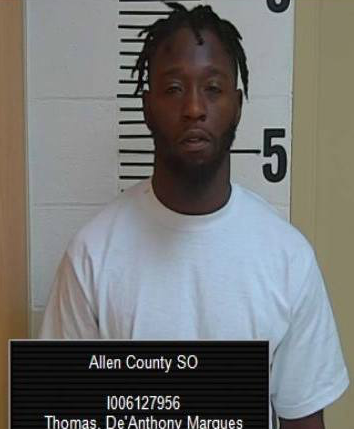
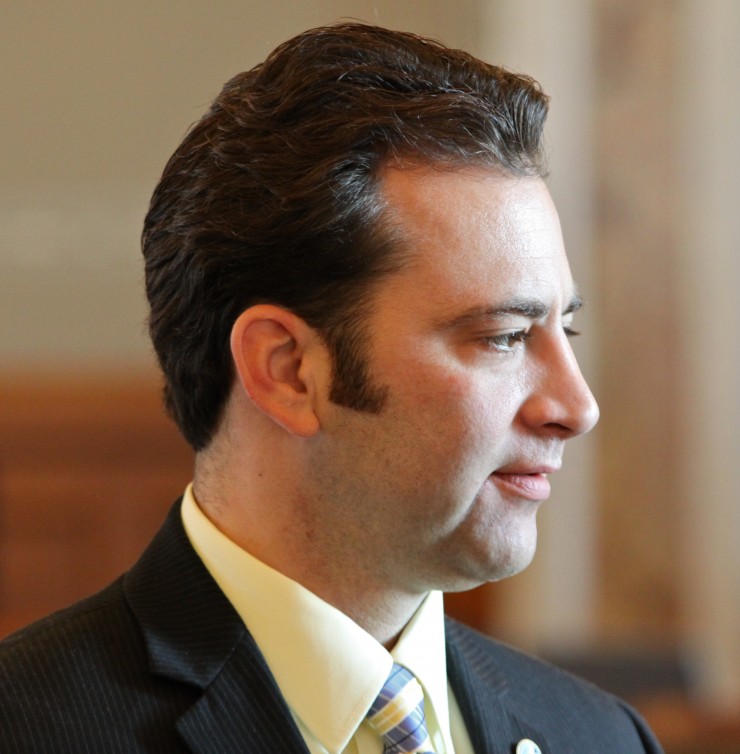
ALLEN COUNTY — Kansas City Chiefs wide receiver De’Anthony Thomas is out on bail after a weekend arrest, according to a report by the Allen County Sheriff’s Department.
Thomas -photo Allen Co. Sheriff
De’Anthony M. Thomas, 26, Lee’s Summit, Missouri, was booked Saturday into the Allen County Jail on suspicion of Possession of Marijuana and Possession of Drug Paraphernalia.
He was no longer in custody Sunday, according to online jail records.
The Chiefs selected Thomas from the University of Oregon in the 2014 NFL Draft. He played in five games in the 2018-19 season before a leg injury in practice ended his season.
The Chiefs had not released a statement on the arrest late Sunday afternoon.
LAWRENCE — Most people vastly overestimate the population of gun owners in the United States, and it potentially influences how groups approach gun policies, according to a study by two University of Kansas political scientists.
“Because gun owners are actually a minority, perceiving their group as larger and even as a majority could make them feel more empowered to advocate on gun issues,” said Don Haider-Markel, professor and chair of the Department of Political Science. “Likewise, non-gun owners that perceive a larger gun owner population now and in the future might be less likely to advocate for gun regulations.”
Mark Joslyn
Mark Joslyn, professor of political science, and Haider-Markel are co-authors of the study, recently published in the journal Politics & Policy. They examined results from a 2016 nationally representative survey of 1,290 American adults who answered questions on a variety of policy, election-specific, psychological and political questions, including a number on gun ownership and regulation.
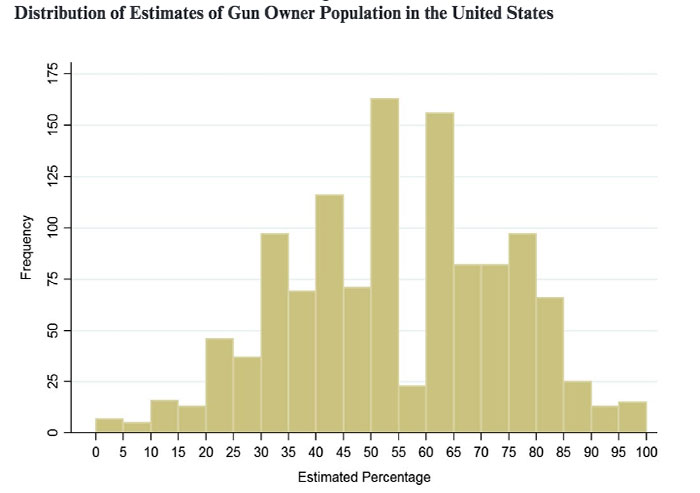
Specifically, the survey asked people to give their “best guess” on what percentage of Americans owned firearms. The actual percentage of U.S. individual gun owners is roughly 25 percent, and about 33-40 percent of U.S. households have at least one gun in the home, the researchers said.
However, the researchers found that more than 75 percent of respondents overestimated the number, and only a small minority, 2.3 percent, underestimated the number of gun owners.
The most common estimate was 50 percent, and nearly one-fifth of respondents estimated the gun owner population was 70 percent or higher.
“Generally speaking, less knowledgeable people tend to overestimate the size of groups, but so, too, do people who belong to the group, have contact with the group or have positive affinity towards the group,” Haider-Markel said. “In short, we inflate the size of groups we belong to or are close to.”
The overestimation of the population among both gun owners and non-gun owners could provide some explanation for the level of support surrounding pro-gun policies or the lack of support for federal gun control measures, even in wake of high-profile mass shootings, such as Newtown, Connecticut; Las Vegas; and Orlando and Parkland, Florida, though the professors said future research would likely examine potential trends after more recent advocacy efforts by gun violence victims.
“We see this as another in a line of politicized issues where facts are contested and factual beliefs might influence policy attitudes on the issue. As such, we wanted to explore basic knowledge about gun owners, perceptions of future gun ownership, and determine whether these perceptions influenced gun attitudes,” Haider-Markel said.
He added that past research in this area is built around the notion of a perceived threat of a group, but rarely is that threat actually assessed.
The researchers have conducted similar research on how people overestimate the gay population in the United States.
“As with the earlier study, people are not very good at estimating the size of groups, and this has implications for their policy preferences,” Haider-Markel said. “Here we can also show that people tend to think that the gun owner population will grow in the future even though all indications are that the gun owner population is getting smaller.”
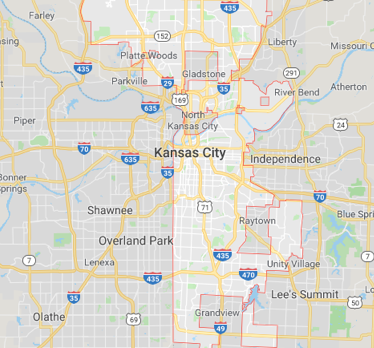
KANSAS CITY, Mo. (AP) — Some lawmakers are pushing legislation that could end a long-running economic borderwar between Missouri and Kansas that has prompted both states to spend millions of dollars in the last decade to lure businesses in the Kansas City metropolitan region across the state line.
Kansas spent $184 million in incentives since 2010 to entice businesses to move, while Missouri spent about $151 million in the same time period, according to the Hall Family Foundation. Those millions resulted in a net of about 1,200 jobs in Kansas.
“We’re using (economic development incentives) to divide the pie, not increase the pie,” said Bill Hall, president of the foundation and a Kansas City metro area civic leader.
Missouri passed a law in 2014 that prohibited the use of state incentives to poach businesses in Douglas, Johnson, Miami and Wyandotte counties. But the law required Kansas to pass a similar bill pledging not to go after businesses in Clay, Cass, Jackson and Platte counties in Missouri, The Kansas City Star reported.
Kansas lawmakers and then-Republican Gov. Sam Brownback rejected the plan. Brownback suggested a similar proposal two years later but it ultimately failed.
Missouri’s bill expired in 2016. Sen. Mike Cierpiot, a Republican from Lee’s Summit, has filed a bill this session that would renew the legislation through 2021 to provide a chance for further discussion.
“I don’t understand why reasonable people can’t sit down and figure this out,” Cierpiot said. “It’s just bad policy.”
Critics of the tax incentives say companies get millions of dollars in tax breaks to move a few miles and often add only a few new jobs.
For example, Kansas spent $3 million in tax breaks to move about 60 jobs at HCA Midwest Health four miles from Kansas City, Missouri, to Overland Park, Kansas.
New Kansas Gov. Laura Kelly said in a statement that everyone agrees the current situation doesn’t make sense “but the devil is in the details.”
“We will be looking at this issue and reviewing the legislation to determine if it is in the best interest of Kansas,” she said.
Some Kansas City metro area question the need for legislation, saying the economic realities are different than they were in 2014.
Blake Schreck, president of the Lenexa Chamber of Commerce, questioned how urgent the problem is now because the economy is healthy and both sides of the state line are flourishing.
“We’re all growing and doing fine, so it hasn’t been a huge issue,” he said.
But he said getting a bi-state agreement to award incentives only for net new jobs would help both sides.
“I would anticipate we’ll take a crack at it sometime this year,” he said.
Bill Hall, who has spent years advocating for a cease-fire in the incentives border war, said now is a good time to get an agreement because of the strong economy.
“The economy is not always going to stay good,” Hall said. “This is the perfect time to deal with it because emotions aren’t as high and more reason can be brought to it, because people aren’t fighting for every last job.”
St. John – Pamela (Pam) Jean Herrenbruck, 53, passed away January 24, 2019 at Stafford County Hospital, Stafford.
She was born October 26, 1965 in St. John, the daughter of Glenn Arnold and Betty Jean Farmer Pound. A lifetime area resident she was an LPN II, at Leisure Homestead, Stafford, Kansas.
Pam enjoyed gardening, canning, attending basketball games, spending time with her family and friends, and has spent her entire life helping anyone in any way she could.
On April 30, 2002 she married Roy Robert Herrenbruck; he survives.
Other survivors include; her mother, Betty, St. John; two sons, Christopher (Marisa) Mansel, St. John, Shane Herrenbruck, Ellinwood; a daughter, Melissa (Troy) Mead, Larned; two brothers, Arnold R. Pound, Wichita and Terry Lee (Cindy) Pound, Lyons; brother-in-law; Ronald Tanner, St. John; seven grandchildren; numerous nieces, nephews, great nieces, great nephews along with extended family and friends.
She was preceded in death by; her father, Glenn, an infant brother, Dennis Pound, sister, Glenna Tanner and sister-in-law Cynthia Ann Pound.
Celebration of Life service will be 11:00 a.m. Saturday, February 2, 2019 at the IOOF lodge, 700 E. 1st Ave., St. John, Kansas 67576; with Pastor Wade Russell presiding. Cremation has taken place and a private Inurnment will be at a later date.
Memorials may be given to Leisure Homestead, Stafford, in care of Beckwith Mortuary, P.O. Box 477, Larned, KS 67550.
Donald T. Brummer, 94, of Downs, KS passed away on January 25, 2019 at the Mitchell County Hospital in Beloit, KS. Donald was born on April 21, 1924 to Frank & Katherine (Ketter) Brummer in Tipton, KS. He had 7 siblings.
Donald married Maxine M. Mans on October 15, 1946 and to this union 5 children were born. Donald & Maxine made Down, KS their home. They attended both the St. Mary Catholic Church of Downs, KS & the St. Aloysius Catholic Church of Osborne, KS. Donald was a farmer/cattleman.
Donald was preceded in death by his parents; wife, Maxine in 2005; 2 infant sons, Lonnie Brummer & Gilbert Brummer both who died in infancy; 1 brother & 1 sister.
Donald is survived by daughters: Jolene Aquilera of Edmond, OK; Deborah Bernard of Russell, KS; son Danny Brummer of Bennington, KS; sisters Vivian Steerman of Osborne, KS; Ruth Ellen Dubbert of Downs, KS; Carol Suter of Aurora, CO; brothers: Wendell Burmmer of Downs, KS; Wayne Brummer of Great Bend, KS; 15 grandchildren & 28 great-grandchildren.
Richard M. Basye, 88, born April 27, 1930, to Richard and Viola (Kempke) Basye in Kanopolis, Kansas.
He was a patient at Clara Barton Hospital when our Heavenly Father decided to receive him on January 24, 2019. He was preceded in death by his wife of 64 years, Joyce Mae (Mathews) Basye.
He was preceded in death by his mother Viola (Kempke) Basye and father Richard, and mother Velma Basye; two sisters, Roxie and Alyssa Basye; four brothers, and two sisters-in-law, Marvin Basye, Lewis and Roberta Basye, James and Eileen Basye, Del Basye; and brothers-in-law, Dick Condit and Jim Mathews.
Survivors include; brothers, Ronnie and wife Judy Basye, Dennis (DK) Basye, Garland Basye; sisters, Janice and husband Doug Martin, Janet and husband Bob Stephens; and sister-in-law, Ginny Condit.
They had three sons; Steve and wife Vickie Basye of Hoisington, Bruce Basye and Jan McKee of Derby, and Doug and wife Linda Basye of Great Bend.
Eight grandchildren plus their spouses; Sheven and husband John Copp, Stacie and husband Shelby Stone, Katey Basye and Josh Gonzalez, Addie and husband Tane Brown, Amanda Basye, Jordan and wife Brynne Basye, Olivia and husband Daniel Hotujac, and Brett Basye.
Nine great grandchildren; Jacob Basye, Jayme Bradley, Jaicie Bradley, Gentry Stone, Dylan Stone, Liam Stone, Daphne Copp, Brayden Copp, and Elliott Copp.
On April 28, 1950 Richard married Joyce Mae Mathews and they resided in Hoisington their entire life. He was a courier for the Military Army. After the service he worked for Shirer Oil Service, Marlette Homes, Duke Drilling, Big Springs Drilling, and Brower Oil. He had a TV repair shop in Hoisington for three years. After retiring he worked for Town and Country Grocery Store. Throughout his younger years he was a baseball coach for his boys and their friends.
He was a devoted father, grandfather, and great grandfather. He loved his wife and family and in return was loved very much and will be deeply missed. He also loved to fish and watch football on TV and was always ready to go to his sons sporting events.
Funeral service will be 10 a.m., Tuesday, January 29, 2019, at Nicholson-Ricke Funeral Home, with Pastor Sandy Kennedy officiating. Interment in Hoisington Cemetery.
Visitation 9 a.m. to 8 p.m., with the family attending from 6 p.m. to 8 p.m., Monday, January 28, 2019, at Nicholson-Ricke Funeral Home, Hoisington, Kansas.
In lieu of flowers memorials may be made to Wounded Warriors Family Support, Hoisington Stray Animal Fund, or any cancer group of your choice (Kans for Kids, etc.), in care of Nicholson-Ricke Funeral Home, PO Box 146, Hoisington, KS 67544.
SMITH CENTER – Darlene Miller, age 86, passed away on Friday January 25, 2019 at the Smith Center Health & Rehab Center in Smith Center, KS. Darlene was born the daughter of Louis & Hilda (Suhr) Rahjes on December 24, 1932 in rural Agra, KS. She was a homemaker.
She was preceded in death by her parents, husband Dean, sister Arvella Riat; 3 grandchildren Jason, Courtney and Jacob.
Survivors include her daughters Janese (Ed) Erickson of Kearney, NE, Mary (Steve) Hagedorn of Tuscon, AZ; sons Stan (Lisa) of Denton, TX, Kent (Denise) of Gage, OK, Tim (Denise) of the family farm near Agra, KS. Brother Wes Rahjes of Kensington; 11 grandchildren; 12 great grandchildren.
WICHITA, Kan. (AP) — A county sheriff is warning parents in the Wichita area about illegal vape cartridges that are packaged with cartoons and contain high levels of THC, the compound that gives marijuana its high.
Image courtesy Sedgwick Co. Sheriff
Sedgwick County deputies recently seized THC-infused vape cartridges intended for medical marijuana use, which were smuggled into the state from California, according to Sheriff Jeff Easter. The cartridges contain 80-90 percent THC, which is more than most marijuana products seized by the federal Drug Enforcement Administration.
Kansas law prohibits possessing or distributing THC vape products. It’s also illegal for anyone under 18 to sell, buy or possess any type of electronic cigarette.
The vapes found in the Wichita area may cause symptoms of cannabinoid hyperemesis syndrome , such as nausea and vomiting, Easter said. It’s unclear whether any children have been affected by the product.
The county sheriff said police are concerned that children are being targeted because the colorful packaging is decorated with cartoon characters, such as Looney Tunes’ Pepe Le Pew and Disney’s Goofy.
The vape flavoring masks the odor of marijuana, which could make it difficult for parents to identify the smell, Easter said.
Sheriff Easter is giving a press conference on THC filled vape cartridges seized in Sedgwick Count https://t.co/jHKi63o3gJ
“I guarantee you there’s kids that have been bringing this home or people bringing it home living with their parents and grandparents and they have no idea what it is,” he said.
The sheriff directed parents to call 911 if they find their kids in possession of the products.
Ron Wilson is director of the Huck Boyd National Institute for Rural Development at Kansas State University.
By RON WILSON Huck Boyd National Institute for Rural Development
“We’re number 1!” That cry goes up in sports arenas across the country. Today, around Kansas Day, the state of Kansas can point to many Kansas firsts. These are accomplishments in addition to sports where our state was number one in historic developments.
Marci Penner is executive director of the Kansas Sampler Foundation, author, and passionate advocate for rural Kansas. Her organization’s website, www.kansassampler.org, plus Kansapedia and other online sources list numerous cases where Kansas was number 1.
For example, the first U.S. patent for a helicopter was issued to Kansans William Purvis and Charles Wilson of Goodland. They invented the helicopter in 1909. A replica of their original helicopter can be viewed at the High Plains Museum in Goodland.
In addition to helicopters, other Kansans made their mark in aviation. The booming airplane production in Wichita led to that city being called the “air capital of the world.”
In the 1920s, Clyde Cessna of Kingman, Lloyd Stearman of Wellsford, and Walter Beech worked on one of those pioneering airplane companies in Wichita. Walter Beech and his wife Olive Ann from Waverly started their own business, Beech Aircraft Company, in 1932. When Walter became ill, Olive Ann Beech took over the company. Olive Ann was the first woman to receive the National Aeronautic Association’s Wright Brothers Memorial Trophy.
Of all women in aviation, Amelia Earhart was the most famous. Earhart, from Atchison, was the first woman to fly across the Atlantic Ocean. She was preceded by the first man to fly solo non-stop across the Atlantic. His name was Charles Lindbergh. When Lindbergh was barnstorming as a young pilot, he lived near Bird City.
On a more down to earth note, the world’s first bulldozer was invented by J. Earl McLeod and Jim Cummings in Morrowville.
There are many, many other Kansas firsts. Several involve women in politics. Susanna Salter of Argonia was the first woman elected mayor in the U.S. in 1887. She was a member of the Prohibition Party, which reminds me that Kansas was the first state to pass a law to prohibit all alcoholic beverages (that one didn’t work out so well.)
In 1949, banker Georgia Neese Clark of Richland was appointed by President Harry Truman as the first woman Treasurer of the United States. That meant her signature was printed on millions of dollars’ worth of U.S. currency.
In 1978, Nancy Landon Kassebaum was elected to the U.S. Senate, becoming the first woman elected to a full term in the Senate without being preceded by a husband. She would later retire to the family ranch near Burdick.
Kansas women and minorities made their mark in other fields also. Hattie McDaniel of Wichita was the first African-American woman and, for that matter, the first African-American of any gender, to win an Academy Award for her role in “Gone with the Wind.” Another woman founded the first black women’s academy in New England. She came to Kansas and is buried at the rural community of Elk Falls, population 107 people. Now, that’s rural.
In sports, Lynette Woodard of Wichita was the first woman to play for the Harlem Globetrotters. In politics, Charles Curtis of Topeka was the first Native American to become U.S. vice president.
Some firsts are less prominent. The nation’s first chain restaurant was the Harvey House restaurants which served Kansas railroad travelers. A Harvey House Museum is in Florence. Decades later, the country’s first national hamburger chain was founded when White Castle opened in Wichita.
The world’s first synthetic diamond was made by Dr. Willard Hersey on the McPherson College Campus in 1926. Also in McPherson was an amateur athletic basketball team sponsored by the local oil refinery. In 1936, the first year that basketball was an Olympic sport, the Globe Refiners from Kansas became the first basketball team to win a gold medal in the Olympics.
“We’re number 1!” These are some of the Kansas firsts which we find in our history. We salute Marci Penner and others who are making a difference by finding and sharing these Kansas accomplishments. I appreciate the way that they have helped put Kansas first.
John Richard Schrock is a professor at Emporia State University.
“You should probably know that one of your ancestors was an American President,” my Mom told me one day. I was in fifth grade, so probably about 11 years old. And I had never heard my relatives talk about an ancestor who was President.
“Which one?” I asked.
“James K. Polk,” she answered, and went on with her housework with no further words.
I could hardly wait to get to school. I was a kid who did my homework. So I always had extra time while the teacher worked with other students. A nod from the teacher and I headed straight back to the reference books. I was already working my way through the encyclopedia page-by-page, reading those things that were most interesting (and most were). But I had not yet arrived at the “P’s’.
And there it was: James K. Polk.
My first question was what his middle initial “K” stood for (remember, I am just in fifth grade). It is “Knox.” My Dad worked on road construction—we moved around a lot—and I had just spent the prior semester going to school in Knox, Indiana. Strange to name a place after a person’s middle name. “Probably some other Knox” I correctly guessed. But what did this president do? I read on.
Oh, dear!
You do not see prominent statues of President Knox in the Capitol or read much about him today. He was the great invader, the man who put our nation’s “Manifest Destiny” into action with vengeance. At that time, the U.S. had no West Coast. Mexico extended up through what is now California. And Britain held all property from there northward to Alaska (at that time Russian).
There were two major parties back then, the Whigs and the Democrats. Polk was an expansionist and the 1844 Democratic platform advocated that the entire region held by Britain, from Oregon north to the southern edge of Alaska, should be claimed for America. That northern limit was at a latitude of 54 degrees 40 minutes North, leading expansionists to shout “Fifty-four forty or fight!”
At the Democratic Convention, Polk was a “dark horse” candidate, only nominated by the ninth ballot. As our 11th President, Polk settled the dispute with Britain by extending the Canadian boundary along the 49th parallel. Britain wanted to avoid war. The treaty was signed in 1846.
Then he started “Polk’s War.” Most Americans, including Congress, were not in favor of this war just to seize land. Polk was a skilled liar, a politician and supremely arrogant.
As a little kid, I could read between the lines where the encyclopedia tried to smooth over the atrocities. Today, the book “Invading Mexico” by Joe Wheelan provides even more details.
What is now New Mexico, Arizona and California belonged to Mexico. Mexico had won them in a war with Spain 25 years earlier. But Mexico was no military power, having lost their war with Texas 10 years earlier.
Polk sent a message to the retired General Santa Anna (the general who lost Texas) in Cuba asking him to now help the U.S. against Mexico. Instead, Santa Anna returned to Mexico, became president, and led their unsuccessful defense of Mexico.
The Polk War took a terrible toll on Mexico civilians due to our massive shelling of villages. American troops eventually occupied Mexico City. Polk’s War ended with the Treaty of Guadalupe Hidalgo on February 2, 1848. Our North and South now debated how slavery would expand into these new territories and the drumbeat to our Civil War quickened. That is why you will find no national monuments to this Mexican War of 1846-48. Polk was a one-term President and died in 1849.
It takes the long hindsight of history to fully evaluate a Presidency. There are certainly other candidates for “worst President in history.” Andrew Jackson, William McKinley, Warren Harding and James Buchanan often make scholars’ “worst list” too. That is a lot of embarrassed descendants.
As a little kid, I remember thinking how it might be wise if we let people run for President only if they had no offspring. Then there would be no need for little kids to hide their ancestry.
John Richard Schrock is a professor at Emporia State University.
Appropriations Committee
The Kansas Legislature had a condensed week this week while we observed Martin Luther King, Jr. Day on Monday, an ice and snow storm blanketed Topeka Tuesday night. Due to the ice and snow, the Kansas Legislature did not reconvene until late Wednesday morning. Due to the delay and the safety of our staff, the Appropriations Committee canceled the meeting for Wednesday morning.
On Thursday, the Appropriations Committee did have hearings from a varied list of agencies. Due to Governor Kelly’s budget proposal on reamortizing the unfunded liability for the Kansas Public Employee Retirement System (KPERS), we had the executive director, Alan Conroy, give a presentation on the status of the KPERS system.
We then had an update from the Kansas Department of Agriculture that presented the current details of the agriculture sector. Their main focus was regarding commodity prices, credit, trade, agriculture economics, and the recently passed farm bill by Congress.
The final information briefing was an overview of the Joint Legislative Transportation Task Force, of which I was a member. The Research Department detailed the subject matter of each meeting we had across the state of Kansas and the future transportation plan.
Kansas Watershed Annual Meeting
On Tuesday, January 22nd, Senator Dan Kerschen, chairman of the Senate Agriculture and Natural Resources committee, and I spoke at the Kansas Watershed Annual meeting. Senator Kerschen gave a detailed explanation about some of the bills that were passed last session regarding agriculture. I discussed the current budgetary status for the state of Kansas. I also gave an overview of Governor Kelly’s budget that was released last Thursday and the direction that I see the House Appropriations committee will take to address the state budget. Thank you to all of the individuals that were there from the Wet Walnut Creek Watershed in Rush County.
Bills Introduced
As with any legislative session, there are numerous bills that have already been introduced by either committee, individual legislators, or interest groups.
In the Appropriations Committee, the only bill introduced, at this time, is Governor Kelly’s bill to address the Kansas Supreme Court decision for K-12 education. It was introduced as a formality; other education bills, I presume, will also be introduced.
Some other legislation that has been introduced vary from eliminating day light savings time in Kansas, restrictions on legislators becoming lobbyists, to election crimes and penalties. As the session continues, I will focus on some of the noteworthy items of legislation that have been introduced.
Contact Information
As always, if you have any concerns, feel free to contact me (785) 296-7672, follow on twitter at #waymaster4house, visit www.troywaymaster.com or email me at [email protected]. Also, if you happen to visit the statehouse, please let my office know.
It is a distinct honor to serve as your representative for the 109th Kansas House District and the state of Kansas. Please do not hesitate to contact me with your thoughts, concerns, and questions. I always appreciate hearing from the residents of the 109th House District and others from the state of Kansas, as well.
Troy Waymaster (R-Bunker Hill) is the 109th Dist. state representative and chairman of the House Appropriations committee. The 109th District includes Osborne, Russell, and Smith counties and portions of Barton, Jewell, Lincoln and Rush counties.
Most Kansas students graduate high school nowadays. Yet many still struggle with the skills of reading and writing.
Now a task force of educators, parents and lawmakers hopes to help close that gap.
A student with dyslexia gets specialized tutoring at Pittsburg State University’s Center for READing. FILE PHOTO / KANSAS NEWS SERVICE
Over the past half year, the Dyslexia Task Force put together recommendations and this month handed them off to the Kansas State Board of Education.
The group’s work is well worth paying attention to. It could change reading instruction for every public school student in the state.
The goal? Catching a wide range of struggling readers and spellers earlier on.
Signs of dyslexia according to research at Yale University
It extends far beyond dyslexia — though even that, some researchers say, is far more common than parents and teachers realized in the past.
Ugh, English is hard.
Though, bough, cough, tough.
You’ve probably reflected on the woes of English spelling before. Usually we just throw up our hands. Or shrug. Or jokingly congratulate ourselves on having the strangest writing system in the world, then move on.
That’s not acceptable to teachers who specialize in instruction for children with dyslexia.
Unbeknownst to many of us, much of the “weirdness” does follow patterns. (English professor Anne Curzan has this enjoyable column to that point.)
Angie Schreiber began learning these nitty-gritty guidelines after finding out her son had dyslexia. Now she runs an Emporia private school that teaches students like him.
“English is 80 to 85 percent regular,” she argues. “If we teach to the regularity and not use the irregularities as an excuse, we can teach our kids to read, write and spell.”
A couple examples:
Check out the “ie” words in the photo below. Shield, tie, brief, die, and so on.
This is a photo of a teacher’s laptop while her eighth-grade student with dyslexia practiced reading them aloud. It helped him to recall that “ie” often sounds like an “i” at the end of a word, but like an “e” if it’s in the middle.
And what about spelling “back”? What’s that “c” doing before the “k”? Schreiber explains that English usually uses “ck” at the end of a one-syllable word after a short vowel. Hence “back” and “truck” get a “ck” that “bank” and “think” don’t.
Solution to the big ole reading gap?
Teaching such guidelines are one part of “structured literacy,” an approach to reading instruction that may soon be required of every elementary school in Kansas.
Some people swear by it. Others roll their eyes.
The disagreement is part of “the reading wars” — a decades-long and nationwide rift in the sphere of literacy education.
How can there be so much to debate about teaching kids to read? Well, because so many people worry we still haven’t figured it out.
Even the optimism around No Child Left Behind waxed and waned. Nearly two decades later, Americans continue to enter adulthood without mastering this vital skill.
Though almost 90 percent of Kansas students graduate high school, a third of the state’s high-schoolers score below grade level on English tests. More than two-thirds test below the higher proficiency bar that Kansas uses for federal accountability.
Structured literacy teachers argue they know how to resolve a big chunk of that reading gap.
They’re not saying all those children have dyslexia — they’re saying research shows structured literacy improves reading and spelling across the board.
Did you miss the Kansas News Service’s feature on dyslexia?
Plenty of literacy specialists disagree (hence the “reading wars”). Sometimes, experts on either side even cite the same research as showing totally different things.
Rethinking classrooms and college
So, back to the dyslexia task force’s decision this month.
Pending approval from the Kansas State Board of Education, the group wants to make structured literacy part of the college coursework required to teach in this state. To get their licenses, many teachers would need to pass a test that shows they understand and can teach in depth things like “phonemic awareness” — which involves recognizing and breaking down individual sounds in words.
Schools would need to offer training for teachers already in the field and incorporate structured literacy into general reading instruction for all students.
Read a draft of the task force’s recommendations.
Reports from state-appointed panels don’t always lead anywhere. Some end up looking more like political theater than anything else. Don’t expect that fate for this one.
“This, obviously, is not going to be one of those reports that sits on a shelf someplace,” said retired superintendent Jim Porter. “It’s going to get the attention it deserves.”
Porter chaired the task force and, until recently, the state board.
Adopting structured literacy would add Kansas to a national wave of states passing laws and policies meant to better serve children with dyslexia.
Even among those states, though, a radio documentary by APM Reports suggests implementation has proven tricky.
The state board of education may vote on the task force’s recommendations in the coming weeks or months. Rolling out new standards in thousands of schools and training a critical mass of teachers will take longer.
“I’m worried that it’s going to be a 10-year process,” says Christina Middleton, a Lenexa mother whose son wasn’t diagnosed with dyslexia till the summer before fifth grade.
That’s when she took him to Children’s Mercy Hospital for tests, got a diagnosis and signed him up for private instruction in structured literacy.
Half a dozen reading programs had failed him before that point, she says. Now in high school, he reads at grade level.
Teaching schools wanted a seat at the table
Colleges of education may well ask the state board to rein in some of the recommendations. They worry Kansas is on the brink of sweeping changes that bypassed them.
The sole professor on the dyslexia task force was psychologist David Hurford, who founded a center focused on researching dyslexia and teaching children who struggle with reading.
The dyslexia task force membership
“There is a voice missing,” Ken Weaver, dean of the Emporia State Teachers College, wrote in an email this week. “That is the literacy faculty from all the Regents universities.”
Those professors likely would have expressed concern that task force members were misunderstanding the thrust of decades of research on reading education. Or underestimating the extent of phonics and related instruction already taking place in Kansas schools.
But from the point of view of parents who say schools failed their children year after year, the status quo just hasn’t been working.
Celia Llopis-Jepsen is a reporter for the Kansas News Service. You can reach her on Twitter @Celia_LJ.