We have a brand new updated website! Click here to check it out!

Update: Militia members get decades in prison for SW Kansas bomb plot

WICHITA, Kan. (AP) — Three militia members convicted of taking part in a foiled plot to massacre Muslims in southwest Kansas were sentenced Friday to decades in prison during an emotional court hearing in which one of the targeted victims pleaded: “Please don’t hate us.”

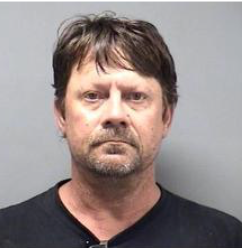
Patrick Stein-photo Butler Co.

U.S. District Judge Eric Melgren sentenced Patrick Stein, the alleged ringleader, to 30 years in prison and Curtis Allen, who drafted a manifesto for the group, to 25 years. Gavin Wright, who authorities said helped make and test explosives at his mobile home business, received 26 years. The plot was foiled after another militia member alerted authorities.

Melgren dismissed defense attorneys’ request that he take into the account the divisive political atmosphere in which the men formed their plot to blow up a mosque and apartments housing Somali immigrants in the meatpacking town Garden City, about 220 miles (355 kilometers) west of Wichita, on the day after the 2016 election.

“We have extremely divisive elections because our system is to resolve those through elections and not violence,” Melgren said.

Stein’s attorneys have argued that he believed then-President Barack Obama would declare martial law and not recognize the validity of the election if Donald Trump won, forcing militias to step in. Stein’s attorneys noted that during the 2016 campaign, all three men read and shared Russian propaganda on their Facebook feed designed to sow discord in the U.S. political system.

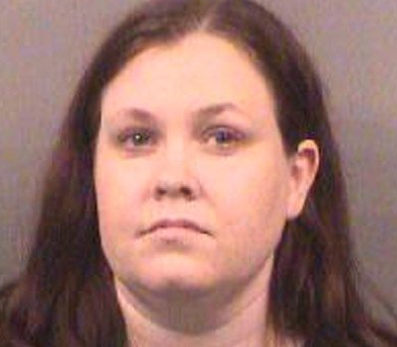
Curtis Allen-photo Sedgwick Co.

Attorney Jim Pratt told the judge that for years Stein had immersed himself in right-wing media and commentators, who normalized hate. But Melgren was openly skeptical, telling Pratt: “Millions of people listen to this stuff — whether it comes from the left or the right.”

Prosecutors presented video testimony from some Somali immigrants who were the targets of the bombing. In one clip, Ifrah Farah pleaded: “Please don’t kill us. Please don’t hate us. We can’t hurt you.”

Allen, 51, choked up as he addressed the judge, prompting his attorney to step in and finish reading a prepared statement in which Allen offered “my sincere apologies” to anyone who was frightened and asked for their forgiveness. But Stein, 49, apologized only to his family and friends, and the judge noted when sentencing him that, unlike Allen, he had shown no remorse.

Gavin Wright-photo Harvey Co.

Wright, 53, apologized to the court, saying the plot is “not who I am.” He also apologized to the immigrants who lived at the apartment complex. The judge later said Wright’s courtroom statement showed he was still in denial about what he did, adding and he did not buy that there was any remorse on Wright’s part.

Melgren sentenced Stein to 30 years for conspiracy to use a weapon of mass destruction and 10 years for conspiracy against civil rights. He sentenced Allen and Wright to 25 years for conspiracy to use a weapon of mass destruction and 10 years for conspiracy against civil rights. Those sentences will run concurrently. Wright also got an additional year to be served consecutively for lying to law enforcement, bringing his total sentence to 26 years.

The judge told all three men that the planned attack was worse than the Oklahoma City bombing because the Garden City plot was motivated by hatreds of race, religion and national origin.

The Kansas plot was thwarted when militia member Dan Day tipped off authorities to escalating threats of violence. He testified at the men’s trial last year that Stein started recruiting others to kill Muslim immigrants after the June 2016 mass shooting at the Pulse nightclub in Orlando, Florida, by a gunman who had pledged allegiance to the Islamic State group.

Recordings that prosecutors played for jurors last April portrayed a damning picture of a splinter group of the militia Kansas Security Force that came to be known as “the Crusaders.”

Acting Attorney General Matthew Whitaker in a news release called the sentences “a significant victory against hate crimes and domestic terrorism.”

“These defendants planned to ruthlessly bomb an apartment complex and kill innocent people, simply because of who they are and how they worship,” FBI Director Christopher Wray said.

The sentencing hearings for the men came a day after two members of an Illinois militia known as the White Rabbits pleaded guilty in the 2017 bombing of a Minnesota mosque , admitting they hoped the attack would scare Muslims into leaving the U.S. No one was injured in that attack.

———

5:20 p.m.

The alleged ringleader of a foiled plot to massacre Muslims in southwest Kansas has been sentenced to 30 years in prison.

Patrick Stein was sentenced Friday for his role in the plot to blow up a mosque and apartments housing Somali immigrants in Garden City. The attack was planned for the day after the 2016 election. Stein was one of three militia members convicted last year.

The plot was thwarted by another militia member who tipped off authorities to escalating threats of violence. He testified that Stein started recruiting others to kill Muslim immigrants after the June 2016 mass shooting at the Pulse nightclub in Orlando, Florida, by a gunman who had pledged allegiance to the Islamic State group.

Prosecutors had sought life in prison. Stein’s attorneys asked for 15 years.

A judge sentenced Stein to 30 years for conspiracy to use a weapon of mass destruction and 10 years for conspiracy against civil rights. The sentences will run concurrently.

Curtis Allen was sentenced to 25 years for conspiracy to use a weapon of mass destruction and 10 years for conspiracy against civil rights. The sentences will run concurrently.

Late Friday, the judge sentence Gavin Wright to 25-years in prison along with an additional 10- years supervised release. He also received a one 1-year sentence for lying to the FBI.

___

12:10 p.m.

A man who authorities say drafted a manifesto for militia members involved in a foiled plot to massacre Muslims in southwest Kansas has been sentenced to 25 years in prison.

A judge sentenced Curtis Allen on Friday for his role in the plot to blow up a mosque and apartments housing Somali immigrants in Garden City. The attack was planned for the day after the 2016 election. Allen was one of three militia members convicted last year.

Allen was sentenced to 25 years for conspiracy to use a weapon of mass destruction and 10 years for conspiracy against civil rights. The sentences will run concurrently.

Authorities say Allen drafted the group’s handwritten manifesto that outlined grievances against the government for — in the document’s words — “not enforcing our borders.” Authorities say the men planned to release the manifesto after the bombing.

Prosecutors had sought life in prison. Allen’s attorneys asked for 10 years.


___

10 a.m.

Somali immigrants targeted in a foiled plot to blow up their mosque and apartments in southwest Kansas told a judge through video testimony that they are still scared.

Prosecutors played five video clips of the Somalis at the sentencing Friday of Patrick Stein, Gavin Wright and Curtis Allen. The three militia members were convicted last year of plotting the attack in Garden City for the day after the 2016 presidential election.

In one video, Ifrah Farah pleaded: “Please don’t kill us. Please don’t hate us. We can’t hurt you.”

Garden City police Chief Michael Utz asked the judge to send a strong message that this type of behavior will not be condoned.

Prosecutors are seeking life terms. The men are asking for shorter terms of 15 years, 10 years and time served.

The plot was thwarted after another militia member tipped off authorities.

___

By ROXANA HEGEMAN ,

WICHITA, Kan. (AP) — Three militia members face the possibility of life in prison for a foiled plot to massacre Muslims in southwest Kansas by blowing up a mosque and apartments housing Somali immigrants.

At separate sentencing hearings for the men on Friday, the government plans to play video clips of the intended victims talking about the impact the case has had on their community.

Patrick Stein , Curtis Allen and Gavin Wright , all of whom are white, were convicted last year of plotting an attack in Garden City for the day after the 2016 presidential election. The meatpacking town is about 220 miles (354 kilometers) west of Wichita. Prosecutors are seeking life terms for the three men, while defense attorneys are variously pleading for shorter terms of 15, 10 or even time served. The men have been imprisoned since their October 2016 arrests.

In court filings, defense attorneys asked the judge to take into account rhetoric from President Donald Trump that they say has encouraged violence. Stein’s attorneys noted that during the 2016 campaign, all three men read and shared Russian propaganda on their Facebook feed designed to sow discord in the U.S. political system.

Attorneys for Stein, who prosecutors have alleged was the ringleader, are seeking 15 years. Allen, who allegedly drafted a handwritten manifesto for the group denouncing the government for “not enforcing our borders,” is asking for 10 years. Wright, who authorities said helped make and test explosives at his mobile home business, is asking that he be sentenced to “time served.”

Their sentencings come a day after two members of an Illinois militia known as the White Rabbits pleaded guilty in the 2017 bombing of a Minnesota mosque , admitting they hoped the attack would scare Muslims into leaving the U.S. No one was injured in that attack.

The Kansas attack was foiled when another member of the group tipped off authorities about escalating threats of violence. Dan Day, who was given the code name “Minuteman” by his FBI handlers, agreed to wear a wire as a paid informant .

The investigation captured months of profanity-laced recordings in which militia members discussed plans and referred to the Somalis as “cockroaches.” Recordings that prosecutors played for jurors at the April trial portrayed a damning picture of a splinter group of the militia Kansas Security Force that came to be known as “the Crusaders.”

Day testified that Stein started recruiting others to kill Muslim immigrants after the June 2016 mass shooting at the Pulse nightclub in Orlando, Florida, by a gunman who had pledged allegiance to the Islamic State group. In one recording, the three men talked about how they hoped the Kansas bombing would “wake people up” and inspire other attacks against Muslims around the U.S.

Stein, Wright and Allen were convicted of conspiracy to use a weapon of mass destruction and conspiracy against civil rights. Wright was also found guilty of lying to the FBI.


Update: Kansas diocese inquiry into abuse of minors names 22 clerics

KANSAS CITY (AP) — A law firm that reviewed 75 years of clergy files in the Roman Catholic Archdiocese of Kansas City in Kansas found 22 substantiated claims of sexual abuse against priests or other clerics, the archdiocese announced Friday.

The archdiocese released the names of all 22 men in its publication, The Leaven . None of the 22 men are currently ministering in the archdiocese, according to list. Eleven have died; seven have been “laicized,” meaning they were removed from clerical service; one was “removed from ministry;” one was last known to be at a friary in Denver; and the status of two others are unknown.

Archbishop Joseph Naumann said in a column in The Leaven that it is difficult to “discern the truth” of an event from decades ago, especially when the accused is deceased and other people’s memories have faded.

“The list that we are providing today is accurate based on the information we possess at this moment,” Naumann wrote.

The Husch Blackwell law firm reviewed about 1,080 clergy files to compile the list. A report based on the investigation has been shared with the Kansas attorney general’s office and the list will be updated if more information becomes available, the archbishop said.

The archdiocese hired the law firm in August when the Catholic Church was shaken by a grand jury report that found abuse by up to 300 priests in six Pennsylvania dioceses over the last 70 years, and reports that Pope Francis and other church leaders knew about sexual misconduct allegations against the former archbishop of Washington, Theodore McCarrick, but rehabilitated him anyway.

“I thank the victims who have courageously come forward with allegations in order to prevent someone else from being victimized, as well as to assist with the progress of their own healing process,” Naumann wrote Friday.

Ten of the men were formerly priests in the diocese, and the others were either priests from another diocese or from a religious order ministering in the archdiocese.

The archdiocese also listed the names of four clerics with previously publicized allegations that investigators were not able to substantiate.

The review went back to the 1940s, with the most cases — nine— from the 1980s. No substantiated cases were found after 2000.

Attorney Rebecca Randles, who has represented several people who say they were abused by priests in Kansas and Missouri, applauded the release but said it’s important that the archdioceses figure out what it needs to do next.

“How do you make this better? How do you help the victims?” Randles asked. “Our experience has been the Kansas City, Kansas, diocese has not led the way with helping or dealing with these individuals.”

Naumann detailed steps the archdiocese has taken to 2003 to help prevent sexual abuse in the church, such as child safety program, criminal background checks for adults, annual safe environment audits by an independent firm and requiring all clergy, employees and volunteers to undergo safe environment training. He noted the archdiocese, which has more than 100 parishes across northeast Kansas, has passed every safe environment audit since they began in 2004.

But David Clohessy, a member of the Survivors Network of those Abused by Priests criticized the lack of details in the list, saying it should include photos, whereabouts and work histories of the clerics.

“This is a long-overdue move to mollify an outraged flock,” Clohessy said. “How does any church employee — from bookkeeper to bishop — justify hiding for years or decades the names of these credibly accused child molesters?”

———–

KANSAS CITY, Mo. (AP) — The Archdiocese of Kansas City in Kansas has released the names of 22 clergy with substantiated claims of sexual abuse involving minors.

None of the 22 men whose names were released Friday are currently ministering in the archdiocese. Eleven have died and seven have been laicized.

Ten were formerly priests in the diocese, and the others were either priests from another diocese or from a religious order ministering in the archdiocese.

In a statement in the archdiocese’s publication, The Leaven, Archbishop Joseph Naumann thanked victims who came forward to help with the investigation.

The Husch Blackwell law firm reviewed about 1,080 clergy files to compile the list. The archdiocese says the report has been shared with the Kansas Attorney General’s office.

The review found no substantiated cases after 2000.

Kan. man dead, woman hospitalized after 2-vehicle crash

COWLWEY COUNTY — One person died in an accident just after 10a.m. Friday in Cowley County.

The Kansas Highway Patrol reported a Dodge Grand Caravan driven by Maurice
Howe, 72, Burden, was southbound on U.S. 77 and crossed the center line striking a northbound Chrysler 200 driven by Darissa Ann Topper, 24, Winfield.Howe was transported to Southwest Medical Center where he died.

Topper was transported to a hospital in Wichita.

Both drivers were properly restrained at the time of the accident, according to the KHP.

Recall: 180,00 Dodge pickup trucks; power steering can fail

DETROIT (AP) — Fiat Chrysler is recalling nearly 180,000 pickup trucks in North America to fix an electrical problem that can knock out the power steering.

The recall covers Ram 1500 pickups from the 2019 model year. Most are in the U.S. and one-third are still on dealer lots.

The company says a fastener that grounds the battery wasn’t secured properly in manufacturing. The connection can become loose, which disables the power steering. Drivers can still steer but the effort it takes wouldn’t be consistent.

FCA says it has no reports of crashes or injuries.

Dealers will secure the fastener at no cost to owners. Fiat Chrysler says it doesn’t have a date for the recall to begin, but it under U.S. law it has to start within 60 days.

Hays High announces 2019 Indian Call candidates

Indian Call candidates for Hays High School have been selected. The king and queen will be announced between the girls and boys basketball games on Feb. 8.

2019 Hays High Indian Call candidates:  Front row – Alyssa Underwood, Hannah McGuire, Madyson Flax, Brittany Pflaum, Hannah Harman. Back row – Tradgon McCrae, Cade Swayne, Jack Fort, Johnny Fuller, Jacob Maska.

Boil order rescinded for Rush County community

Google

KDHE

TOPEKA – The Kansas Department of Health and Environment (KDHE) has rescinded a boil water advisory for the city of Timken, located in Rush County. The advisory was issued because the city could not maintain the minimum required chlorine residual. Failure to maintain required chlorine residual levels may put the system at risk for bacterial contamination.

Public water suppliers in Kansas take all measures necessary to notify customers quickly after a system failure or shutdown. Regardless of whether it’s the supplier or KDHE that announces a boil water advisory, KDHE will issue the rescind order following testing at a certified laboratory.

Laboratory testing samples collected from the City of Timken indicate no evidence of contamination and all other conditions that placed the system at risk of contamination are deemed by KDHE officials to be resolved.

Ashlen Leigh Lemon

Ashlen Leigh Lemon, 19, Hays, died Tuesday, January 22, 2019 at the Geary Community Hospital in Junction City, Kansas.

She was born February 14, 1999 in Hays the daughter of Claude T. and Teresa A. (Schonthaler) Lemon. She graduated from Hays High School in 2017 and was attending Fort Hays State University majoring in Psychology. She worked in the bakery at Wal-Mart in Hays as a cake decorator.

She was very sweet, loving, caring, simple, and creative, and she loved animals and her grandmother.

She is survived by her parents, Claude Lemon and Teresa Lemon, both of Hays, her maternal grandmother, Judy Yarrow of Hays, her paternal grandmother, Beverly Lemon of Monte Vista, Colorado, her boyfriend, Nelson Kawano of Kansas City, Missouri, an uncle, Harold Lemon and partner Jasmin Limtiaco of Fort Garland, Colorado, an aunt and uncle, Carol and Wayne Wise of Sacramento, CA, and her dog Ella and cat Jasper.

She was preceded in death by her maternal grandfathers, William Schonthaler and Stan Yarrow, paternal grandfather, Thomas Lemon, and two aunts, Gina Schonthaler and Leslie Schonthaler.

The family will receive friends from 5:00 pm until 7:00 on Thursday, January 31, 2019 at the Hays Memorial Chapel Funeral Home, 1906 Pine Street, Hays. Inurnment will take place at a later date in the St. John Lutheran Cemetery north of Ellis, Kansas.

Memorials are suggested to the Humane Society of the High Plains, in care of the funeral home. Condolences and memories of Ashlen may be shared with the family at www.haysmemorial.com.

Portions of Kansas rattled by Friday afternoon earthquake

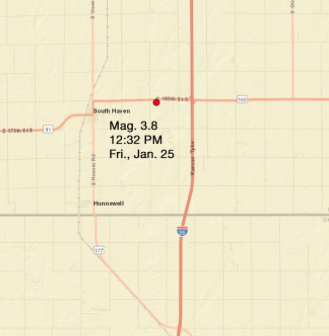
SUMNER COUNTY — An earthquake shook portions of Kansas Friday afternoon.

Image courtesy Kansas Geological Survey

The quake just after 12:30p.m. measured a magnitude 3.8 and was centered approximately 11 miles east of Caldwell in Sumner County, according to the U.S. Geological Survey.

The quake follows a 2.8 magnitude quake near the same area January 20 and a series of four quakes ranging from a magnitude 2.5 – 4.5 in Sumner County January 16 and 17, according to the USGS.

There are no reports of damage or injury, according to the Sumner County Sheriff’s Department.

Police: Kan. woman hospitalized after fall off railroad bridge into river

RILEY COUNTY — One person was injured in an accident on Thursday afternoon in Riley County.

Google map

Just before 4p.m. Thursday, police responded to a report of a medical emergency near Linear Trail and E Poyntz Avenue in Manhattan, according to the Riley County Police department activity report.

First responders found a 29-year-old woman with major injuries and she had fallen off the railroad bridge just south of US-24 and into the Kansas River.

She was transported to Via Christi in Manhattan for her injuries. The incident remains under investigation and is not believed to be suspicious at this time.

Jury: Kan. woman guilty of taking GoFundme donation meant for burn victim

SEDGWICK COUNTY– A  jury returned a guilty verdict Thursday against a Kansas woman accused of taking charitable donations meant for a young burn victim.

Davis -photo Sedgwick Co.

Cinthia Davis, 34 of Haysville, was convicted of felony theft after a three-day trial before a jury in Judge Bruce Brown’s courtroom, according to a media release from the Sedgwick County Attorney.

Evidence at trial showed that Davis set up an account on the GoFundMe website to raise money for a 10-year-old Haysville girl who was burned in 2015. The account raised $8,145 from 124 donors in less than a month.

An investigator from the Haysville Police Department testified that all the funds were withdrawn from the GoFundMe account and spent over a period of 60 days after the fundraiser ended. The mother of the injured girl testified that the family only received a few hundred dollars of the donations.

Davis’ husband, Martin Joe Kerr, also was charged with felony theft in the case. Kerr pleaded guilty to his part in the theft and was sentenced to probation in 2018.

Sentencing for Cinthia Davis is scheduled for March 12th.

First Amendment: Why we should be more civil to our civil servants

Lata Nott

The longer the government shutdown persists, the more aware we all become of just how many functions the federal government actually performs.

Last week, the Daily Caller published an anonymous op-ed from a senior Trump official who stated s/he hopes the shutdown “lasts a very long time, till the government is changed and can never return to its previous form…Senior officials can reprioritize during an extended shutdown, focus on valuable results and weed out the saboteurs. We do not want most employees to return, because we are working better without them.”

Some results of the shutdown? Farmers have been unable to secure USDA loans. Three people have died while visiting our currently-unstaffed national parks. And thanks to the shortage of TSA agents at airports, a passenger managed to make it through security and onto a flight with a gun in his bag.

I can’t speculate about the identity of the official. I can’t speak to the validity of his/her complaints about government inefficiency — I’ve never been a federal government employee (although my husband is one). But I can safely say that, no, things are not working better without them.

The ripple effects of the shutdown can be seen in a lot of unexpected places. Here are just a handful of ways it’s impacting our First Amendment rights:

We’re less informed about what’s going on in our own country. How’s our economy doing? Are the Trump tariffs actually working? Is it a good time to buy a house, start a business or invest in the stock market? No one knows. As the Brookings Institution reports, “The people who collect, analyze and release all the basic data tracking the path of the economy and its principal aspects are on furlough.” Ordinarily, businesses and consumers rely on these reports to make critical and informed decisions. That’s why the First Amendment protects public access to this information. But there’s not a lot it can do when there’s no information to access.

Businesses can’t communicate with their customers. Last week, D.C. brewery Atlas Beer Works filed a lawsuit claiming the shutdown is violating its First Amendment right to speak to consumers. The Alcohol and Tobacco Tax and Trade Bureau can’t review and approve Atlas’ new labels for its seasonal beer, the brewery can’t ship its kegs interstate without those labels and in the meantime 40 barrels of perishable, apricot-infused India pale ale might go bad. You may scoff at the idea of a beer label as free speech, but as Atlas’ lawyers point out, “It cannot sell, and no one will purchase, random, unidentified liquids.” The requirement for a government agency to review this sort of communication protects consumers from the harm that false or misleading labels could cause.

Prominent First Amendment court cases have ground to a halt. While the courts are still operating, many of them have suspended work on civil cases involving U.S. government lawyers, among them the Pen American Center’s First Amendment lawsuit against President Trump.

While the majority of the Department of Justice (DOJ)’s lawyers are still working during the shutdown, they’re a bit overtaxed right now. Just last week, they had to contend with a lawsuit brought by several groups of federal workers against the government for forcing them to work without pay. The DOJ lawyers defending the government in court were also working without pay.

To add insult to injury, there are limits to how they can express their displeasure about this. A law, the Hatch Act, prohibits federal employees from engaging in political activity when they’re at work and new guidelines have stated that hanging up a “resistance” poster or advocating for impeachment falls into that category. But while there’s been some concern that the new guidelines are too restrictive on the speech of federal employees, the Hatch Act is grounded in a noble purpose. It was passed to protect federal employees from political coercion and ensure their advancement is based on merit and not political affiliation. At the heart of this is a belief in the value of career civil servants, people who are experienced in the way that government runs and do their jobs to the best of their abilities regardless of who’s in power.

That’s why it’s disheartening to read the anonymous Trump official’s call to “weed out saboteurs” in the government, or President Trump’s tweets that most of the federal workers going without pay are Democrats (implying he has less of a reason to care about the shutdown than his Democratic opponents in Congress). He’s using partisan terms to dismiss hundreds of thousands of people who have sworn to do their jobs in a non-partisan fashion.

Lata Nott is executive director of the First Amendment Center of the Freedom Forum Institute. Contact her via email at [email protected], or follow her on Twitter at @LataNott.

LETTER: Wasinger prevails, despite rampant voter fraud

By a very small margin, Barbara (Barb) Wasinger was elected our new state representative, but I recently learned from a colleague who had visited her to discuss ways to increase voter participation of her allegations that certain residents of the 111th District tried to steal the election from her.

Who are these unscrupulous characters who wanted to torpedo this fine Republican’s chances for high office? According to Representative Wasinger, they are the notorious FHSU students. Apparently, Ms. Wasinger feels like the District can take their tuition money, their food money, their rent money, their beer money and the money they spend in the mall and downtown stores. They also pay city and state sales tax on most of these purchases. But when it comes to District representation in state government, their political participation is not welcome, if not illegitimate. These students “live” somewhere else, so let them vote somewhere else, seems to be her attitude, even though they spend well over half of their time and money in Hays.

If you think of what Hays would be without FHSU students, another WaKeeney, and the fact that state legislators control FHSU, determine state funding levels to offset tuition costs and set the tax structure that determines how much taxes college students pay, it seems blatantly unfair and un-American to deny them any say in who their state representative will be. Somewhere I heard, “No taxation without representation.” The City already burdens them with additional sales tax they wouldn’t pay at other Kansas universities. Now Wasinger wants them to pay state sales tax with no representation in the state legislature.

It is no secret. The tide is turning. Women, young people, ethnic minorities and now college students are finally realizing that the Republican Party caters to white, male fat-cats like Donald Trump, most of his cabinet and about 5% of his base. They are desperate at this point and looking for any way to suppress the Democratic vote. FHSU students will not be made second-class citizens just because they move to Hays to attend college or because they lean toward liberal political policies.

Ms. Wasinger will see a voter registration drive on the FHSU campus in 2020 that will show her what real democracy looks like. I invite her to speak at a Times Talk session to explain in detail the election fraud these students perpetrated on her campaign. Perhaps our champion against voter fraud, Kris Kobach, can help her stop the corruption she alleges. Nothing is more important for democracy than a valid and inclusive election.

Gary Brinker, Hays

Kansas receives additional WIC funding during the government shutdown

TOPEKA – The Kansas Department of Health and Environment (KDHE) has received additional federal funds from the U.S. Department of Agriculture (USDA) to keep the Special Supplemental Nutrition Program for Women, Infants and Children (WIC) operational into March, during the Federal Government shutdown.

On Thursday, KDHE received an additional $1,603,809 in food funds and $602,897 in administrative funds. These funds now allow Kansas to purchase foods until March 20, 2019 and keep staff operational until March 26.

“We are pleased to receive these additional funds,” said David Thomason, Director of the Nutrition and WIC Services Section in the KDHE Bureau of Family Health. “There is an average daily food cost in Kansas of $92,134 under this program, and we continue to work with the USDA to see that WIC funding in Kansas continues through the shutdown.”

The USDA monitors state WIC programs and is working to ensure that programs remain operational. States were instructed to contact the USDA prior to implementing any changes to the program that would curtail operations or in any way limit or restrict access to the program and its benefits.

Copyright Eagle Radio | FCC Public Files | EEO Public File