July 7, 1930 – October 11, 2019
An obituary is pending with Pauls Funeral Home.
Click HERE for service details.
July 7, 1930 – October 11, 2019
An obituary is pending with Pauls Funeral Home.
Click HERE for service details.
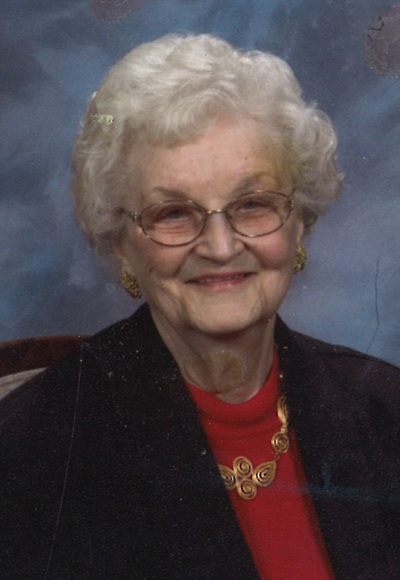
 Edith Ione Strohm, 98, passed away Saturday October 12, 2019, at River Bend Assisted Living, Great Bend. She was born January 16, 1921, in Windom, the daughter of Charles E. and Merle (Smith) Rostine. She was united in marriage to Wayne O. Strohm on October 6, 1940, in McPherson. He preceded her in death September 22, 2006.
A resident of Great Bend since 1957 coming from Lyons, Ione was a homemaker. She was a member of the First Christian Church, Great Bend, Christian Women Fellowship and The Feisty Five. Ione enjoyed reading, Bible studies, crafts, and cherished fellowship with her family and friends.
Survivors include one daughter, Dianna Werrick of Oklahoma City; two grandchildren, Andrea Komarek and husband Mike Koerner of Andover, and Mark Komarek of Phoenix, Ariz.; and two great grandchildren, Alyssa Komarek and Ashton Komarek.
She was preceded in death by two brothers, Ralph Rostine and Charles L. Rostine; three sisters, Delta Bradford, Elma Frey and Drucilla Rostine; and by one grandson, Matthew Komarek.
Visitation will be held from 1:00 to 9:00 p.m., Thursday, October 17, 2019, at Bryant Funeral Home, with family receiving friends from 5:00 to 6:00 p.m. Funeral will be at 2:00 p.m., Friday, October 18, at the First Christian Church, Great Bend, with The Reverend Joshua Leu presiding. Interment will follow in the Great Bend Cemetery. Memorials are suggested to the First Christian Church, in care of Bryant Funeral Home.
 Tommy Joe Moorhous passed away on October 8, 2019, at the age of 63, due to diabetes complications.
Tom was born to Johnny Ray and Annette (Robben) Moorhous on September 19th, 1956, in Oakley, KS. Upon graduating from Oakley High School, he graduated from Colby Community College and Fort Hays State University, with a Bachelor’s Degree of Fine Arts, a Master’s Degree in Political Science and a Master’s Degree in History. After teaching one year at Osborne High School, Tom completed his 40 years of teaching at Barton County Community College and Colby Community College, teaching History, Political Science and Sociology. During this tenure, he served on the Colby Community College Endowment Foundation Board, the Lecture Series Board, coached the Quiz Bowl Team and coached the women’s softball team.
Tom’s life passion was educating, encouraging and inspiring students to strive for and reach their goals. He never turned away a student who asked for help. He was a private person, very humble about his awards and achievements and had a quick wit and great sense of humor. While at CCC, he was awarded the Tangeman Award for Teaching Excellence and was recently inducted into their Hall of Fame. Upon retirement, Tom continued to teach online classes for various colleges and volunteered his time and effort to the FHSU library and the Oakley Area Chamber of Commerce.
Tom leaves behind many friends, students and his family: siblings, Joni (Dave) Chalfant, Hill City, KS, John (Elaine) Moorhous, Oakley, KS and Lori Thornburg, Dodge City, KS; nephew Morgan Chalfant; nieces, Jaclyn White, Shelly Bridges, Aubony Chalfant and Veronica Thornburg.
He was preceded in death by his parents, Jack and Annette Moorhous and grandparents, Clarence Ray and Bertha Moorhous and Francis and Mary Ann Robben.
Visitation is 5-7:00 p.m. Sunday, October 13, 2019, at Baalmann Mortuary, Oakley, with a Vigil at 7:00 p.m. Funeral Mass is 10:00 a.m. Monday, October 14, 2019, at St. Joseph Catholic Church, Oakley, with burial in the Oakley City Cemetery. Memorials are suggested to the Colby Community College Endowment Foundation, for the Tom Moorhous Scholarship Fund or Oakley High School, sent in care of Baalmann Mortuary, PO Box 204, Oakley, KS 67748. For information or condolences visit www.baalmannmortuary.com
 Bertha Josephine (Windholz) Brown, 92, of Walker, Kansas returned to her heavenly home on Wednesday, October 9, 2019, at Main Street Manor in Russell, Kansas.
She was born to Alexander J. “Alex” and Clara (Mermis) Windholz on the family farm north of Walker, Kansas on January 12, 1927. She began her schooling at a country school near the farm and finished her education at Gorham High School.
Bertha was blessed with a large and loving family. She married her best friend Richard A. Brown, on April 22, 1946, in Emmeran, Kansas. He preceded her in death on January 31,1980. This marriage was blessed with six children, Colene, Richard, Jr., Jolene, Roger, Galene and Rodney. Bertha raised her six children with love, strong religious values, and compassion. She taught them to work hard, be honest, and live by the golden rule, “treat others the way you want to be treated.” From the very beginning, she dedicated her children to God.
Bertha was a homemaker who loved the outdoors, and worked seven years at Travenol Labs. She was a member of St. Mary’s Catholic Church, Gorham, Kansas. She was kind and outspoken, and always let you know where you stood. She always welcomed guests with a table full of food. Her grandchildren never left without a handmade gift that she spent hours creating with her own special touch. She will be dearly missed by her loved ones, who celebrate the fact that she is at peace with her creator.
Surviving to honor her memory are her children, Colene Schmitt and husband, JW, Gorham, KS; Richard Brown, Jr., Walker, KS; Jolene Purvis and husband, Joe, Hobbs, NM; Roger Brown, Walker, KS; Galene Steckel (Rod), Russell, KS; Rodney Brown and wife, Michelle, Gorham, KS; one sister, Arlene Brown, Ellis, KS; two sisters-in-law, Henrietta Windholz, Hays, KS; and Rosie Guerico, Victoria, KS; 18 grandchildren, 43 great-grandchildren and one great-great-grandchild.
She is preceded in death by her parents; husband, Richard; her sisters, Evelyn Dreher, Amelda Bieker, Viola Weigel, and one infant sister; her brothers, Louis Windholz, Edward Windholz, and Francis Windholz; and grandson Clayton Brown.
Funeral Mass will be at 2:00 P.M. Tuesday, October 15, 2019 at St. Mary’s Catholic Church in Gorham, Kansas with a burial immediately following at St. Fidelis Cemetery in Victoria, Kansas.
Visitation will be from 5:00 to 8:30 P.M. Monday, and from 12:00 to 2:00 P.M. Tuesday, St. Mary’s Catholic Church in Gorham, KS.
A family rosary will begin at 6:30 P.M. Monday, followed by a vigil service at 7:00 P.M. Monday, at St. Mary’s Catholic Church in Gorham, Kansas.
The family suggests memorials to Main Street Manor/Russell Regional Hospital.
Services are entrusted to Cline’s-Keithley Mortuary, 412 Main Street, Victoria, Kansas 67671. Condolences can be sent via e-mail to [email protected] or can be left by guestbook at www.keithleyfuneralchapels.com.
Laurita Mae (Braun) Dinkel, age 90, of Topeka, Kansas has left this world to be with God, and return to her beloved husband, Marvin, and many other family members on Wednesday, October 9, 2019. She was born on May 21, 1929, to John B. and Albina (Dreiling) Braun.
She leaves behind many who loved her including daughters, Jackie Shufelberger and Judy Dinkel; her grandchildren, Sara (Shufelberger) Luna and Shaun Shufelberger; and five great-grandchildren.
On behalf of the Frontier Staff at Brewster Place Retirement Center in Topeka, who also loved her dearly, in lieu of flowers, the family asks that memorial contributions be sent to the Brewster Place Foundation and designated for the Employee Assistance Fund in care of the mortuary.
Funeral mass will be at 10:00 A.M. Tuesday, October 15, 2019, at the Basilica of St. Fidelis Victoria, Kansas. Inurnment will be at St. Fidelis Cemetery Victoria, Kansas.
A rosary will be at 9:45 A.M. Tuesday, at the church and the family will receive friends from 9:00 to 10:00 A.M. Tuesday, at the church.
Services are entrusted to Cline’s-Keithley Mortuary of Hays, 1919 East 22nd Street, Hays, Kansas 67601.
Condolences can be sent via e-mail to [email protected] or left at guestbook at www.keithleyfuneralchapels.com
PRATT – A Kansas Department of Wildlife, Parks and Tourism (KDWPT) Law Enforcement K-9 known as “Tibbie” died August 6, 2019 when the idling vehicle she was kept in stalled, disabling the air conditioning system and causing the cab temperature to rise to dangerous levels.

According to a media release from the KDWPT, her game warden handler Adam Pack and a local veterinarian gave Tibbie, a Labrador retriever, emergency treatment before being rushed to the Veterinary Health Center at Kansas State University where she ultimately passed. A thorough investigation was completed on October 11, 2019.
“K-9 handlers have a bond with their animal that is as strong as any human partner, and this team was no different,” KDWPT Law Enforcement Division director Col. Jason Ott said. “These K-9s aren’t just a law enforcement asset, they’re also a friend and colleague. We feel for Adam and the loss he’s experienced, and the impact this has on the K-9 program and law enforcement division.”
The pair were on patrol when Tibbie was secured in the idling vehicle while the game warden conducted business that did not require K-9 assistance. As is standard practice, the specially-equipped patrol vehicle was left locked with the engine running.
Because each KDWPT law enforcement vehicle that carries a K-9 is outfitted with a state-of-the-art heat-alarm system – specifically designed to lower the windows and engage fans if the engine stalls and the cabin temperature reaches a certain threshold – the vehicle was immediately taken out of service and an investigation was conducted into the cause of the incident.
While a report from the vehicle manufacturer was inconclusive in determining the cause of the vehicle stall, the heat-alarm system manufacturer determined that the heat alarm was not engaged during the time of the incident. An internal investigation confirmed these findings and determined the game warden had not checked that the heat-alarm system was in working order the day of the incident.
The KDWPT Law Enforcement Division is conducting a check of all vehicles that carry a K-9 officer, and modifying K-9 program procedures and officer training to help prevent such an incident from occurring in t
KANSAS CITY, Kan. (AP) — Two convicted felons facing criminal charges over a Kansas bar shooting that killed four people and wounded five others had previous brushes with the law that could have kept them behind bars had judges and other officials made different decisions, according to a review of court records by The Associated Press.

But observers say those decisions — to let one man out on bond pending trial and to let the other serve probation rather than return to prison — weren’t in themselves unusual and underscore the kinds of issues judges often must assess to determine which offenders pose a public danger.
One of the men, who remains on the lam, even spent two nights in a local jail within two weeks of the shooting early Sunday at the Tequila KC bar in a close-knit Kansas City, Kansas, neighborhood.
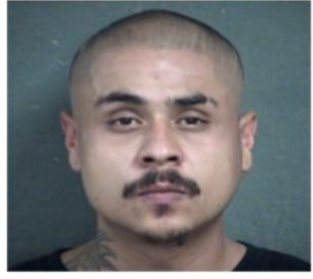
Hugo Villanueva-Morales, 29, had been caught with synthetic marijuana during a stretch of more than four years in a state prison for robbery and had been released by the time he was sentenced for trafficking contraband. The judge could have sent him back to prison for nine years but instead put him on three years’ probation. Villanueva-Morales violated probation by testing positive for marijuana use in September and agreed to serve two days in jail, according to a review of court records by AP.
Villanueva-Morales left the jail in neighboring Leavenworth County on Sept. 29, a week before police say he caused a disturbance at the bar and returned with 23-year-old Javier Alatorre to shoot it up.
Alatorre also had been released from jail in September across the state line in Jackson County, Missouri, where he still faces charges of fleeing from police in a stolen vehicle. A judge released him on his own recognizance after his attorney sought to have his bail lowered.
Probation is the most common result in Kansas for a conviction involving trafficking in prisons or jails, imposed nearly 66% of the time over the past three years, according to the Kansas Sentencing Commission. The charges Alatorre faced in Missouri were “run-of-the-mill felony cases,” according to Rodney Uphoff, a law professor for the University of Missouri’s flagship campus in Columbia.
“No one has a crystal ball,” Uphoff said. “No one can predict with 100 % accuracy whether someone who is released will be safe or not.”
Both Villanueva-Morales and Alatorre now face four counts of first-degree murder in district court in Wyandotte County, where the bar is located. Authorities arrested Alatorre hours after the shooting at a Kansas City, Missouri, home. He had his first court appearance on the murder charges Thursday and is due in court again Oct. 15.
Authorities say people should presume Villanueva-Morales is armed and dangerous. Stymied investigators conceded Thursday they don’t know whether he has left the area and sought the public’s help. Leavenworth County District Judge Michael Gibbens also issued a warrant Thursday for his arrest for violating the terms of a three-year probation that Gibbens imposed in September 2018 in the contraband-trafficking case.
At the time of the bar shooting, Villanueva-Morales also was facing charges in an assault case in which prosecutors allege he fought with a sheriff’s deputy outside a Kansas City, Missouri, bar in August. Charging documents say the scuffle happened after an unknown man was kicked out of the bar and returned later with Villanueva-Morales.
Leavenworth County Attorney Todd Thompson filed a request this week to have Villanueva-Morales’ probation revoked. In an affidavit, a community corrections official said he had failed to report the August incident to probation officers as required and that crossing the state line without permission, using a gun and going to a place where alcohol is served violated his probation.
In the summer of 2018, Thompson’s office had argued for returning Villanueva-Morales to prison. Though online Kansas Department of Corrections records list 30 infractions inside prison walls, Villanueva-Morales still earned enough good-time credits to be released in January 2018, a little more than nine months early, according to the department.
But Villanueva-Morales’ attorney argued that he was caught in 2015 with only a small amount of synthetic marijuana for personal use and the crime would be a misdemeanor outside the walls. He had obtained a GED while in state custody, and Leavenworth County court records include a positive statement from an employer and a church’s baptismal certificate.
Though the complaint in the case said Villanueva-Morales was caught in April 2015 with the drug — hiding it in his rectum, Thompson said — the charge wasn’t filed until February 2017.
Randy Bowman, a spokesman for the Kansas Department of Corrections, said he can’t say why it took so long to file charges against Villanueva-Morales and that investigators with the department filed an affidavit in the case on Aug. 17, 2015.
Gibbens departed from the state’s sentencing guidelines by setting a five-year sentence and then suspending it for three years’ probation. The judge also made news this year when he reduced the sentence of a convicted sex offender because he said the 13- and 14-year-old girls the man abused were actually the “aggressor.”
In his form detailing the sentence in the contraband case, Gibbens noted that Villanueva-Morales accepted responsibility.
On Wednesday, after The Kansas City Star reported on the case, Gibbens filed an updated version that said: “Defendant doing well on parole as evidenced by letter form supervising authority; the amount of contraband (synthetic marijuana) was small and was indicative of personal usage.”
A court administrator said Friday that Gibbens is the presiding judge in the case and is prohibited from commenting on it.
Thompson said that when an offender has been released, judges often look to see how they’re doing on probation or parole.
“We can’t foresee what someone’s going to do,” Thompson. “Every time they come out of prison, we have to have the hope that they learned their lesson.”
And when Villanueva-Morales tested positive for marijuana on Sept. 9, a 2013 state law designed to keep non-violent drug offenders from filling the state’s crowded prisons called for a two-day jail sentence. He acknowledged the violation and accepted the punishment without a court hearing, records show.

Meanwhile, Alatorre had been in and out of jail in Missouri in the months prior to the shooting. In Kansas, he was on parole for evading a road block and driving recklessly while attempting to evade capture, having served a little more than a month in prison for violating probation.
In the fleeing-from-police case, dating from 2018, Jackson County, Missouri, Judge Kevin Harrell reduced Alatorre’s bail and released him on his own recognizance last month over the objections of prosecutors.
Harrell provided no explanation for his decision in the order and a county court spokeswoman said rules bar judges from commenting on pending cases, but the defense attorney who argued for his release cited revamped bail rules that took effect in July. The rules stemmed from scrutiny of the Missouri court system in the wake of the 2014 deadly shooting of Michael Brown in Ferguson, Missouri.
After Brown was killed, complaints started surfacing about the way some municipal courts were handling pretrial releases or detention. The new rules mandate that pretrial release decisions must begin with non-monetary conditions of release, and the courts may impose monetary conditions, such as a bond, only when necessary and only in an amount needed to ensure the defendant’s appearance in court or the public’s safety.
But J.R. Hobbs, a Kansas City, Missouri, defense attorney, said the rules still allow for bail and for defendants to be held without it.
“Pretrial release is a careful balance of what conditions will assure the appearance in court and the safety of the community,” Hobbs said.
___
WICHITA, Kan. (AP) — A Wichita lawyer accused of plotting a cyberattack on websites with information criticizing his work has told a federal court he intends to change his plea.
A docket notation Friday shows attorney Bradley Pistotnik has a change-of-plea hearing Tuesday.
The move comes two days after his co-defendant , VIRAL Artificial Intelligence co-founder David Dorsett, notified the court of his plea change. Dorsett’s hearing is Oct. 21.
Both men pleaded not guilty last year to computer fraud and conspiracy. Pistotnik is also charged with making false statements to the FBI.
The indictment alleges they are responsible for cyberattacks on Leagle.com, Ripoffreport.com and JaburgWilk.com in 2014 and 2015. The indictment accuses Dorsett of filling website inboxes with threats. An email purportedly demanded that a webpage be removed or the hackers will target advertisers.

By CELIA LLOPIS-JEPSEN
TOPEKA, Kansas —Cigarettes are so yesterday.
Or yesteryear.
That’s why that old-fashioned, combustible path to a nicotine buzz wasn’t the top concern for a small group of high schoolers in Sabetha — a 2,500-person town about an hour north of Topeka near the Nebraska border — when they got city council to hike the minimum age for buying tobacco products to 21.
“I don’t really know anyone that smokes cigarettes around here because they’re really gross,” Sabetha High senior Kinsey Menold said. “Then, like, Juuls came in.”
The slender, chic vaping devices took off among teens in recent years. Notoriously easy to hide from parents and teachers, Menold says her classmates took hits of nicotine in the hallways, in the bathrooms — sometimes even in class.
“It was like our new thing instead of cigarettes,” she said. “Our new challenge, for our generation.”
Statewide, more than two dozen cities and counties have raised the age for buying tobacco and vaping products by three years, part of a national “Tobacco 21” movement that includes more than 500 city and county ordinances.
Yet enforcing those rules has proven tricky because of the gap between state and local law. That could change. This winter, health advocacy groups will press state legislators to make 21 the law of the land.

They’re bracing themselves for pushback from tobacco lobbyists. Major industry players support Tobacco 21, but their critics accuse them of co-opting the effort, leading in some places to watered-down laws that lack teeth or pre-empt other anti-tobacco efforts.
“Absolutely,” said Jordan Feuerborn, a lobbyist for the American Cancer Society Cancer Action Network. “We’ve seen this play out in other states.”
The law that her group will seek together with the American Lung Association, American Heart Association and others would target shop owners who flout the minimum age, rather than blaming the cashiers or teens who get caught.
“The profit-gaining entity should be the party responsible,” she said. “We don’t want to punish minimum wage workers, and we really don’t want to punish children.”
Easier said than done
No one has tried to enforce Tobacco 21 in Kansas longer than Wyandotte County and Kansas City, Kansas — an area with one of the state’s highest smoking rates and where most high schools sit within short walking distance of convenience stores that sell cigarettes and vape pens.
In late 2015, the combined city-county government kicked off the cascade of local ordinances that today cover a third of the state’s population, largely in northeast Kansas.
The change looked better in print than in practice. Two years into the new regime, Wyandotte-KCK put 130 shops to the test to see if they’d sell to someone under age. A quarter did.
The city-county government will ramp up compliance checks on cigarette and vape sellers, thank those that pass and urge the rest to do better.
“We don’t have any clear way of enforcement,” said Bianca Garcia, who is in charge of the city and county’s anti-tobacco efforts. “That’s why we’re looking into this reward and reminder program.”
It’s a soft-glove approach, but going after the cashiers who screw up doesn’t appeal to city-county officials. Nor can they suspend the licenses of the shop owners, they say, because the state licensing system only requires those shops not sell to minors.
A recent Kansas Health Institute* study found none of the state’s local ordinances have the necessary teeth to clamp down on problem shops. Health experts who applauded their passage now see them as only partial victories.
“We learned, we learned,” said Edward Ellerbeck, a University of Kansas School of Medicine professor who researches tobacco cessation. “I was at the beginning of this. I thought we were doing the right thing.”

Anti-tobacco groups such as the American Cancer Society will hammer home that lesson while pushing legislators in the 2020 session for an air-tight Tobacco 21 law — with ample funding for compliance checks and solid penalties for businesses that don’t toe the line.
Addiction and the brain
Smoking remains the country’s top preventable cause of death, killing about half a million people per year. For every one of those, another 30 are seriously sick.
In Kansas, the Centers for Disease Control and Prevention estimated, health problems stemming from tobacco cost the state and its residents about $1 billion in a single year.
But cigarettes have enticed fewer and fewer new smokers as their death toll and massive anti-tobacco campaigns transformed public opinion.
In 2005, half of Kansas high schoolers reported ever trying a cigarette. In 2017, that was down to one-quarter. By then, though, vaping had arrived on the scene. A third had tried it.
High school journalists in Johnson County surveyed their peers and found a third said they owned Juuls, often puffing their way through more than one cartridge a week (roughly a pack of cigarettes).
Nicotine poses the greatest risk for these still developing brains, scientists say, because they’re most likely to end up wired for a lifelong habit.
Cities and counties saw a chance in Tobacco 21 to cut off a key nicotine pipeline to their minors: the many 18-year-olds still in school. Topeka battled to do so all the way to the Kansas Supreme Court.
“Tobacco use stopped at an early age can extend the life,” Mayor Michelle De La Isla said this June, when her city finally defeated a legal challenge that could have overridden local ordinances across the state. “Municipalities should be able to have (that) ability.”
A 2014 survey found most American adults support the higher age. Most smokers, too.

Vaping versus smoking
Eric Cope estimates his small specialty vape shop, Top Shelf Vapors, near a busy intersection in west Topeka offers more than 300 e-liquids.
Fruits and sweets sell best, and Cope bristles at the narrative that options like strawberry-lemonade target kids. Adults of all ages want to escape the taste of cigarettes, he says. Few people ask for tobacco flavor.
“A cigarette tastes terrible,” Cope said. “If you want to know, go lick an ashtray.”
Though cigarette giant Altria now has a hefty stake in Juul Labs, vape shop owners harbor no love for Big Tobacco, which they see as peddling poor health and quashing fledgling competitors.
Topeka’s Tobacco 21 ordinance means Cope can’t sell to 18-, 19- and 20-year-olds, but that hasn’t cost him much business, he says. Most of his customers were older — smokers who’ve ditched cigarettes or want to.
But Cope, himself a former long-time smoker who refuses to stock combustible tobacco, worries the non-vaping public has whipped itself into a frenzy of fear that blows the risk of e-cigarettes vastly out of proportion.
“Vapor is pretty safe,” he said. “At least 95% safer than smoking. And it should get a lot of credit for that.”
“I work at this every day and I see the transformation of people,” he said. “They all say, I can taste better. I can breathe better, I can sleep better. I have more energy.”
That “95%” comes from Great Britain, where an English public health agency argues vaping is that much safer, and that smokers should urgently switch.
The Royal College of Physicians agrees, calling vaping’s risks nothing compared to the potential “to prevent death and disability” by quitting cigarettes.
Many scientists disagree.
KU pulmonologist Matthias Salathe tests vaping on human respiratory cells. That British 95% ballpark isn’t based on trial results, he said, but rather assumptions about chemical content and carcinogens.
“I have a hard time (with) that logic,” he said. “We don’t have the data.”
Salathe’s own findings in pre-clinical and animal trials have him worried that vaping could cause chronic bronchitis.
More than 1,000 people nationwide have sustained lung injuries from vaping in recent months. Most have so far reported using fluids laced with cannabis compounds. Public health officials in Kansas, where two people are dead, have urged people to stop vaping immediately.
Physicians in England and the U.S. alike agree on one thing: Whether vaping is safer than smoking or not, that doesn’t make it safe.
“The vast majority of youth that take up vaping,” Ellerbeck at KU said, “are not doing it to quit smoking.”
Juul in the crosshairs
Nationwide, litigation against Juul is piling up.
In Kansas, the Goddard and Olathe school boards announced lawsuits last month, accusing the company of marketing to minors and making schools divert precious resources to deal with the fallout.

A Johnson County man sued, too, arguing he got hooked in high school and paid a steep personal price in just a few short years.
Juul Labs has said its products were only ever meant to help adult smokers give up cigarettes.
Call tobacco researcher Stanton Glantz a skeptic.
“If your campaign is nominally trying to reach middle-age smokers,” the University of California San Francisco professor said, “you don’t run it on Instagram promoting parties with hip 20-somethings.”
In decades past, tobacco companies brazenly marketed to teens, and Glantz says Juul’s tactics follow that tradition.
Explore Stanford’s gallery of historical and modern tobacco ads
The company pounded social media feeds with chic short videos of ultra fashionable young people dancing to hip beats and sparse messages — “Get #vaporized” — that didn’t mention kicking any habits.
Juul has suspended its U.S. advertising as state and federal lawmakers and regulators ratchet up scrutiny. It’s thrown its weight behind Tobacco 21 efforts, too, at both state and federal levels.

Eighteen states have now passed Tobacco 21 as state laws.
In several cases, though, health advocates argue tobacco interests watered down the bills and the ability to enforce them through shrewd lobbying. They want Kansas to adopt clear enforcement funding and procedures.
Public policy and investment analysts at DC-based Beacon Policy Advisors say Tobacco companies glomming onto Tobacco 21 see it as “the lesser of two evils.” They’ve lobbied to at least include provisions that undercut other anti-tobacco efforts, such as flavor bans.
“There’s a general sense that tobacco companies are willing to make a compromise,” senior analyst Ben Koltun wrote in an email, “if it heads off potentially more negative developments.”
*Editor’s note: The Kansas Health Institute receives funding from the Kansas Health Foundation, a financial supporter of the Kansas News Service.
Celia Llopis-Jepsen reports on consumer health and education for the Kansas News Service. You can follow her on Twitter @Celia_LJ or email her at celia (at) kcur (dot) org.

By DIANE GASPER-O’BRIEN
FHSU University Relations and Marketing
He won a national championship the final race of his standout collegiate career. Now, Brett Meyer is inspiring other Fort Hays State University runners to set their bars high while still pursuing some lofty goals of his own.
After claiming the NCAA Division II national championship in the 1,500-meter run at last spring’s track and field season finale, Meyer joined the FHSU cross country and track coaching staff as a graduate assistant this fall.
In between, he ran a sub-4-minute mile for the second straight summer while chasing a dream of qualifying for the 2020 Olympic Trials in the 1,500.
And he is close to meeting that goal. Meyer’s mile times convert to 3 minutes, 39 seconds in the 1,500. The qualifying standard for the Trials is 3:37.
Meanwhile, heading into the Tigers’ annual home cross country meet Saturday, both the men’s and women’s teams are undefeated this fall.
That is no coincidence, says Tessa Durnell, one of the leading runners for the Tiger women’s team.
“Brett has done a really good job of helping every runner set expectations for themselves,” said Durnell, a senior from Harwood, Mo. “It’s pretty cool to have a national champion coaching us. Not every athlete gets to have that resource, that experience.”

After watching Meyer compete as an All-American athlete for three years – he earned that honor six times – Durnell is just as impressed with his coaching style.
“I think he might be a better coach than athlete,” Durnell said. “I know that’s a pretty bold statement, because he’s a national champion. But watching him as a coach for just a few months, he is really inspirational, wants everyone to get the most out of their ability that they can.”
One Tiger runner who has been watching Meyer’s progress from afar for several years is Trever Medina, a freshman from Weskan.
During his high school days at Sharon Springs High School, Medina set his sights on becoming another successful western Kansas runner. Meyer is from Scott City, about an hour from Sharon Springs.
That inspiration, along with a reputable radiology program, drew Medina to Fort Hays State, and ultimately alongside his idol.
“I’ve looked up to him a long time,” Medina said. “I thought, ‘I want that to be me someday.’ He wins a national championship, and now, he’s coaching us and he’s practicing for himself at the same time. We learn a lot just by being around him, seeing his work ethic.”
FHSU head coach Jason McCullough said he thinks it’s good for his athletes to be surrounded by people who have been successful.
“It makes the athletes realize people (like Meyer) are normal people,” McCullough said, “and that they can accomplish big things, too.”
After graduating from FHSU with his bachelor’s in health and human performance last spring, Meyer chose to work on his master’s in sports administration and serve as a graduate assistant for the Tiger runners this year. That allows him to train while working on his degree.
One might think a standout middle distance runner who ran sub-4-minute miles twice this summer and is training for the 2020 Trials might choose a more predictable climate in which to train.

Not Meyer.
For starters, he is a loyal sort. Fort Hays State is one of the few colleges to offer him a scholarship out of high school, even after winning the 800 meters at the state track meet and anchoring two state championship relays.
Plus, if his goal of running professionally doesn’t pan out, Meyer will be halfway through his master’s program. He has aspirations of coaching at the college level someday.
Meyer became a collegiate runner himself when he decided to follow his high school sweetheart to Fort Hays State. Kelly Wycoff was a standout sprinter for the Tigers and went on to earn All-America status, too.
They married this summer, and Kelly also is working on her master’s. She is a graduate assistant for the Tiger track and field team.
The Tiger teams and their head coach are supporting Meyer, who McCullough said he thought early on could be a sub-4-minute miler.
Meyer had mostly run the 400 and 800 in high school and wasn’t so sure about the longer distance.
“I knew he could if he believed in it and trained for it, he could do it,” McCullough said. “I tried to put it in his head early.”
Now, Meyer watches as another freshman has similar interests.
Medina might be willing to increase his mileage, just as a certain national champion did three years ago.
“In Trevor, I see a lot of myself,” Meyer said. “I peaked my senior year of high school, and so did he. As coaches, that’s our job to talk to them and make them see that they can get out of their comfort zone.”
And when Meyer talks, the Tigers listen.
“He tells us what we’ve doing wrong and how we can improve,” Medina said. “He tells us how to run smarter, how to eat, a lot of things. Based on his experience, if anyone knows what should be done, he does.”
The Tigers will get to see some strong competition Saturday. The 36-team team field includes Colorado School of Mines, whose men are ranked first in NCAA D-II, and its women’s team is ranked third. The meet is set for 9 a.m. at Sand Plum Nature Trail just outside Victoria, known as one of the finest cross country courses in the Midwest.
“That type of competition is rare around here, and it always motivates us to work harder and allows us to grow and get better for our conference and regional meets,” Meyer said. “It’s also nice to see that those powerhouse Colorado schools are made up of normal people, just like us.”
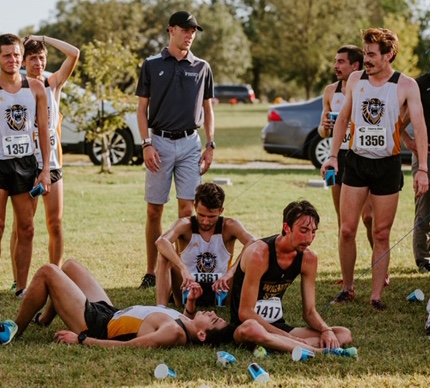
Cutline: Fort Hays State University’s Brett Meyer, center back, national champion in the 1,500 meters last spring, is a graduate assistant coach for the Tiger cross country team this fall.
DOUGLAS COUNTY — Three people died in an accident just before 6p.m. Friday in Douglas County.
The Kansas Highway Patrol reported a 2004 Chevy Classic driven by Tiffany Cox, 20, Ottawa, was southbound on U.S. 59 Two miles south of Lawrence.
The driver lost control of the vehicle and crossed over the grassy median in to the northbound lanes of traffic. A northbound 2019 Nissan Sentra driven by Craig Russell McKinney, 62, Topeka struck the Chevy broad side.
Cox, and passengers in the Chevy Kiffany Mietchen, 19; Azreal Ubelaker, 8-months, both of Baldwin City were pronounced dead at the scene.
EMS transported McKinney to KU Medical Center. Mietchen was not wearing a seat belt, according to the KHP.

[email protected] — Let me hear from you. — Kirby Ross

By KIRBY ROSS

As stated, use your discretion in reading further — it gets graphic from here.

From the Topeka State Journal—
And he was surrounded by his large family. The final gift his big sister had made possible for him 82 years before.