A courtroom is not a place where you expect to find scenes of celebration and tears of joy, unless, of course, it’s drug court.
This May drug courts throughout Kansas will join more than 3,000 programs nationwide in celebrating National Drug Court Month. This year alone, more than 150,000 individuals nationwide who entered the justice system due to addiction will receive lifesaving treatment and the chance to repair their lives, reconnect with their families, and find long-term recovery.
National Drug Court Month is a celebration of the lives restored by drug court and it sends the powerful message that these programs must be expanded to reach more people in need.
Nearly 30 years ago the first drug court opened its doors with a simple premise: Rather than continue to allow individuals with long histories of addiction and crime to cycle through the justice system at great expense to the public, use the leverage of the court to keep them engaged in treatment long enough to be successful. Today, drug courts and other treatment courts have proven that a combination of accountability and compassion saves lives while also saving valuable resources and reducing exorbitant criminal justice costs.
Drug courts are the single most successful criminal justice intervention for seriously addicted offenders. Proven to save lives, save money, and reduce crime, these courts treat substance use disorders and produce tax-paying, productive citizens, while breaking the cycle of addiction.
The Ellis County Drug Court began August 30, 2018 and has already experienced success and changed lives. Our court is one of thousands that demonstrate why treatment courts are so critical in the effort to address addiction and related crime. The scientific research agrees:
Numerous studies have found that treatment courts reduce crime and drug use and save money. Research shows treatment courts also improve education, employment, housing, financial stability, and family reunification, which reduces foster care placements.
Treatment courts represent a compassionate approach to the ravages of addiction. Ellis County is privileged to be able to reap the economic and societal benefits of its drug court. The drug court team thanks the community for its continued support of our efforts to make a difference in Ellis County.
Steve Gilliland
One of my favorite ’60s bands was Credence Clearwater Revival. The first line of their song “Who’ll Stop the Rain” goes “Long as I remember the rains been coming down.”
Who’d have thunk that we Kansans would ever be complaining about too much rain? Then when it finally stops raining and the sun comes out, the humidity is so high you feel like it’s raining again! Even though I know how high rivers and streams get around here when we’ve had big, hard rains, I can take solace in the fact that we live well above sea level, and don’t get hurricanes.
I’ll always remember a picture I saw on Fox News a few years back of a casket floating down the street in Louisiana after a hurricane. I just don’t think I could live somewhere that was below or barely above sea level.
Wildlife are greatly affected by floods too as it temporarily drives some from their homes. And severe flooding this time of year can be especially harmful as it can easily drown fawns and destroy nests or young chicks of wild turkeys, pheasants and quail. It’s quite common to see more snakes, rats, mice and rodents during and after a flood, as animals that would normally not dream of parking themselves in your yard this time of year are suddenly there in abundance.
So if you suddenly see more critters around your home and buildings after an extended time of heavy rain don’t worry; the Ark has not suddenly unloaded in your backyard! As the water recedes they’ll be gone. So with that in mind, here are some zingers I came up with that play on our recent glut of rainy weather.
It’s been so wet that the other day I watched some rodeo cowboys practicing calf roping from seahorses.
I noticed a fire hydrant near the dog park yesterday that was so tired of getting wet it had on a raincoat. Another hydrant up the street was actually chasing dogs away.
It’s rained so much lately that last night the ducks in the park were all wearing floaties and carrying canoe paddles.
The other day I was walking along a creek where I trap beavers and heard a strange sound coming from the weeds ahead. It’s rained so much lately it was a beaver trying to blow up a life raft, but his teeth kept getting in the way.
I got stopped for speeding the other night, and it’s rained so much lately that the officer also gave me a citation for not having the specified number of life jackets in my pickup.
It’s rained so much lately that all the “crabgrass” in my lawn is pulling itself out of the ground and heading for drier land.
It’s rained so much lately that now when our dogs have to go out to do their business I strap each one to a pool noodle and just toss them off the deck.
I heard on the news that it’s been so wet lately the walking catfish at the zoo are wearing boots and carrying umbrellas.
It’s been so wet lately that a fish I caught the other day actually climbed into the boat on its own and thanked me for finally pulling it from the lake.
During the summer we pick up unwanted apples and feed them to the deer by scattering them on the ground around our deer feeders where we have trail cameras. It’s rained so much lately that we actually have pictures of deer bobbing for apples.
Mosquitoes love wet weather, but it’s rained so much lately that our Kansas mosquitoes are flying around with protest signs.
A bull frogs call sounds like a deep base “harum, harum, harum,” but it’s been so wet lately that the other night I would swear one frog was saying “enough, enough, enough.”
As the saying goes here in Kansas, “If you don’t like the weather, wait five minutes and it will change.” Today it’s nice and sunny, but when it gets hot I’m sure I’ll complain about that too. I guess it all boils down to which I dislike the most, but at least hot sunny days won’t cause the local ducks to wear floaties and carry canoe paddles….Continue to Explore Kansas Outdoors.
Steve Gilliland, Inman, can be contacted by email at [email protected].
Ignorance may well have been bliss to 18th-century English poet Thomas Gray, but in 2019, widespread ignorance of our core freedoms and how our government functions is just plain dangerous.
A just-released Survey of Civic Literacy, conducted by the American Bar Association (ABA) and released May 1 to mark national Law Day, finds many of us do not know much about either subject.
The survey’s theme and the ABA’s Law Day focus was on “Free Speech, Free Press, Free Society.” The survey findings are generally in line with the Freedom Forum Institute’s annual State of the First Amendment survey, conducted since 1997: Many — sometimes a majority — of us get our rights “wrong.” History tells us that if we are not aware of our freedoms, it is that much easier to lose them.
There is some good news in the results, particularly in strong support for free speech: More than eight of 10 respondents of the 1,000-person sampling said we should be able to publicly criticize a president or any other government leader and that we should have the right to ask for government records and information. Three of four agree the government should not be able to restrain the press in reporting on political protest.
Then there are these findings:
18 percent don’t know freedom of the press or the freedom of assembly are elements of the First Amendment;
30 percent of respondents believe freedom of speech applies only to U.S. citizens rather than correctly to all in this nation;
23 percent said Ruth Bader Ginsburg is chief justice of the U.S. Supreme Court; just 49 percent correctly said it’s John Roberts;
18 percent thought the first 10 amendments to the U.S. Constitution are called the Declaration of Independence; 75 percent correctly identified them as the Bill of Rights.
It is reassuring that 88 percent of respondents know that the government does not have the “right to review what journalists write before it is published,” but that means more than 10 percent wrongly believe government does have a right to censor.
Again, it is good that a strong majority sees no problem in openly criticizing public officials. But nearly 20 percent are opposed or unsure whether or not we should have that right, which is more than unsettling — it’s sizeable doubt about a core principle of what it means to be an American.
Sometimes the ignorance shown in the survey concerns current law: 54 percent said there is no free speech right under the First Amendment to burn a U.S. flag in political protest. In fact, in a 1989 decision, Texas v. Johnson, the U.S. Supreme Court said just the opposite, setting up flag burning as a demonstration to the world of our commitment to freedom of expression.
The ABA’s survey is just the latest demonstration of the need for a new national campaign by schools and civic and professional groups to educate our citizens about the meaning and importance of the role and purpose of First Amendment freedoms and, beyond that, how our government works — and why it works.
Without that effort, the warning signs are in – thanks to the ABA’s survey and others – that we could lose our basic freedoms, our representative form of self-government and undermine the basic rule of law for simply the sorrowful, sad, embarrassing reason that many of us simply will not know, or perhaps even care, that they are gone.
Gene Policinski is president and chief operating officer of the Freedom Forum Institute and an introductory speaker at the May 1 release of the ABA’s Survey on “Free Press, Free Speech, Free Society.” He can be reached at[email protected], or follow him on Twitter at@genefac.
Legislators, Commissioners, and agency managers must sort facts and opinions to make the best decisions for the public good. It is critical to hear from the public — and then sort through those comments carefully, thoughtfully, and compassionately.
They’ll get advice. Some good, thoughtful, constructive. And some mean-spirited, resentful, and cringe-worthy. The latter often emanates from people claiming the mantle of stern adult responsibility, bent on teaching what, for them, pass as Christian values.
Consider two citizen commenters at a Saline County hearing on a possible new Salina jail. One cited the Bible encouraging use of “the rod of discipline.” For him, jail seems “too comfortable.” Three meals a day, warm in winter, cool in summer free medical, no work required, TV—all were seen as coddling. So, to make jails really rehabilitate, we’ll just shut down air conditioning in 100+ degree temps.
“Known murderers” (disregarding recent examples of false convictions) should be executed “in a timely manner.” God’s word in Genesis so decrees, said he. His solution? Teach his version of religion in schools.
Another cited excess alcohol use and drug abuse as choices, not diseases. Despite all evidence to the contrary, including the US’ No. 1 standing as incarcerator-in-chief, he cited the “social experiment of the past 60 years’ as ’soft on criminals’” and “the biggest failure this country has ever seen.” Again, air conditioning, heat and three meals a day became soft, coddling measures to be dispensed with.
Where does one begin responding to such illogic and incitement to riot? First impulse is to shrug off these sentiments as aberrations and dismiss them. But these attitudes constitute a canary in our coal mine.
Though not as extreme, other similarly dismissive, jarring attitudes are impacting public policy as we speak. Sadly, they come from public servants themselves, not the testifying public.
And here, pity for public servants comes to a screeching halt.
Case in point: the KS ledge’s last days. As Kansas Interfaith Action so clearly spells out, “Medicaid Expansion ……[is] a clear moral imperative, and its failure to pass is not just a disappointment, it’s an injustice. . . . . The failure to hold hearings, the refusal to allow a vote in the Senate, are nothing less than moral failures, and blame for them rests solely at the feet of House and Senate leadership.”
On top of that, another large tax cut was passed, replacing the one vetoed by the Governor. Says KIFA, “The fact that a big tax cut that will largely benefit multinational corporations and the wealthiest Kansans can pass, but a policy that will help working people, and is supported by 70% of Kansans, by a majority of the legislature and by the governor, cannot, shows how twisted the priorities of legislative leadership were this session.”
Now, 150,000 Kansans are denied access to health insurance, and approximately 627 Kansans may die this year in the absence of expansion. “Justice delayed is {not just] justice denied,” says KIFA, “[it] is life denied.”
KIFA’s life-affirming, compassionate, faith-tradition-taught values stand in stark contrast to the pious, judgmental, punitive attitudes displayed in the latest legislative last-minute games. Adhering to the best of our religious values means revering and supporting all our fellow creatures.
Attitudes to the contrary must be called out at their root, in public meetings, on-air or in-print, in social media, in private conversations, and at the ballot box.
Those adopting such attitudes should not be allowed in positions where their rhetoric becomes reality.
Allowing that to happen is immoral and, well … un-Christian.
David Norlin is past Chairman of the Salina Planning Commission, former President of Salina Access TV, and an occasional Salina Journal columnist. He is a retired College English Department Chair and Director of Broadcasting. He has twice run for the Kansas Legislature.
We all owe a debt of gratitude to three Kansas law enforcement officers who sacrificed their lives for the safety and protection of others.
National Police Week is May 12 to May 18.
The names of Sedgwick County Sheriff’s Deputy Robert Kunze and Wyandotte County Sheriff’s Deputies Theresa King and Patrick Rohrer will be added to the National Law Enforcement Officers Memorial in Washington, D.C., during a ceremony May 13.
“We must never forget these brave officers,” McAllister said. “We will strive to be worthy of the sacrifices they made for us and to carry on their dedication to law enforcement. I invite the public to join our office in showing support for their families and their fellow officers.”
King and Rohrer were shot to death June 15, 2018, in Kansas City, Kan., while transporting prisoners between jail and court. Kunze was shot to death Sept. 16, 2018, during an arrest in western Sedgwick County.
According to the FBI, 55 law enforcement officers died in 2018 from injuries received during felonious incidents
Victim officer profile:
Average age: 37 years old
Average length of service: 10 year
Gender: 52 male, 3 female
For more information, see of the FBI report Law Enforcement Officers Killed and Assaulted, 2018 at https://ucr.fbi.gov/leoka/2018/.
Stephen McAllister is the U.S. Attorney for Kansas.
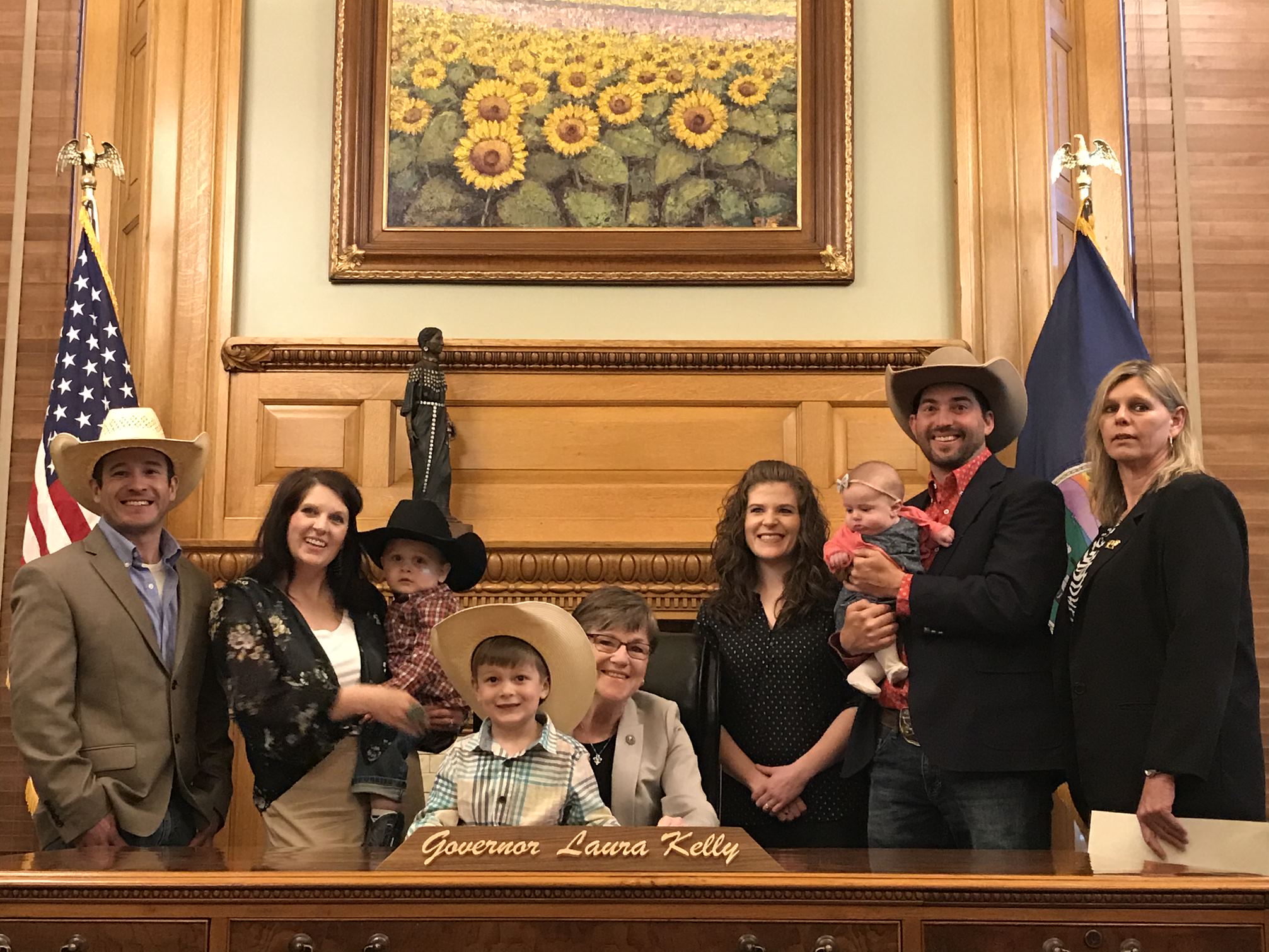
TOPEKA – Many products get publicity and special recognition during the year. But in Kansas, if any product deserves its own month, it’s beef. That is why Kansas Governor Laura Kelly has declared May as Beef Month in the state. This declaration makes the 35th consecutive year beef has received this honor.
According to Kevin Thielen, executive director of the Kansas Beef Council, the value of beef to the economy and social fabric of the state is remarkable.
“With more than 6.35 million cattle on ranches and in feedyards in the state, Kansas ranks third in the country,” says Thielen. “That’s more than twice the state’s human population. Kansas cattle producers are proud of the nutritious, delicious beef they help bring to tables in this state, across the country and around the world.”
Kansas has about 46 million acres of farm ground. Not all of this land can be used to grow crops, however. Grazing cattle is an ideal technique for efficiently utilizing grasses and plants growing on nearly 15 million acres of Kansas pasture and rangeland. These acres would be wasted if not for ruminants like cattle that can turn these resources into essential protein and nutrients for humans.
Kansas ranked second in fed cattle marketed, with 4.9 million in 2017. Beef cattle and calves represented 52.8% of the 2017 Kansas agricultural cash receipts.
The effect of the beef industry on employment is significant as well. According to the American Meat Institute, Kansas companies that produce, process, distribute and sell meat and poultry products employ as many as 19,502 people, while generating an additional 48,070 jobs in supplier and associated industries. These include jobs in companies supplying goods and services to manufacturers, distributors and retailers, as well as those depending on sales to workers in the meat industry.
The product they help bring to market is one that contributes substantially to the human diet. Lean beef provides 10 essential nutrients, including zinc, iron, protein and B vitamins. It does all this for only 170 calories per 3-ounce serving. In fact, a serving of beef provides the same amount of protein as two servings (1 ½ cups) of cooked black beans – which have 341 calories.
Kansas ranchers and feeders are committed to producing beef responsibly and sustainably, Thielen says. But beef production refined over many generations is only part of the story. Producers also keep consumer needs and wants top of mind.
“While all aspects of beef raising and processing are important, producing beef that is delicious, safe, wholesome and nutritious is ‘job one’ for our industry,” Thielen says. “After all, producers of beef are also consumers of the beef they produce. They’re proud of their role in supplying this terrific food that so many people enjoy.”
Have you ever wondered how to make a meal faster? Have you ever wished you were a master of Excel? If you have said yes to one or both of these questions, the next Women on the Farm program is for you!
Women on the Farm of Barton, Pawnee, and Rush counties invites all people that are interested in either learning more about electric pressure cookers and/or Excel or our next program. This program will take place on Tuesday, May 21, at the Haas Building in Larned. Registration will begin at 10:30 and there is a small fee to cover the cost of lunch. The morning will be spent learning to cook different items in an electric pressure cooker. While you don’t have to bring a cooker, please feel free to do so!
If you are just wanting to attend the Mastering Excel portion of the day, there is no cost and it will start at 1:00 p.m. You are welcome to bring your own computer to work on, but there will be computers available for use.
You are welcome to attend one or both programs, but we you will need to RSVP so that we have enough materials available. Please RSVP to the Pawnee County Extension office by 5:00 on May 17th by calling 620-285-6901.
Alicia Boor is an Agriculture and Natural Resources agent in the Cottonwood District (which includes Barton and Ellis counties) for K-State Research and Extension. You can contact her by e-mail at [email protected] or calling 620-793-1910.
Did you know that an average male Kansan lives to 75 years of age, and the average woman lives to 80?Why is that? Is it because we men are more prone to violent deaths early by going to war, riding motorcycles or driving cars faster? Nah! This accounts for only a small part of the difference.
I think more likely it is because men, who are genetically built larger and more muscular (likely in order to be the defender or hunter for the family) no longer need to use those muscles in this modern world.
Just look at most 22-year-old men, they come built almost automatically ready to fight or lift or throw or build. But instead, in this society, you find them driving a car, sitting at a desk or laying on the couch rolling through the channels looking for videos of people playing games and being physically active.
Even our young boys are often living through the pretend movements of action figures or computer-generated warriors, rather than actually running through fields in some sort of sport, or chase, or hunt. As men age, their activity drastically reduces while their caloric intake continues excessively on. All the while their bellies grow. I truly believe this combination of excessive calories and reduced activity accounts for the sleep apnea, diabetes, vascular disease and, overall, increased death rate of men over women.
But there is one more factor, which should be added here. Men are also built to deny and do what they can to avoid going to the doctor to have a check-up. Let’s face it, denial has something to do with being a man. It goes with the testosterone, guns, action toys, and channel changers. You would think a man would rather face a charging lion than the yearly physical exam.
Men, please don’t just think about it, find a way to stay active, participate, don’t just watch. Prevent or lose the belly by eating smaller amounts (fewer calories) and by being more active. Also, go see your doctor every once-in-a-while. You just might live longer and feel better too.
For free and easy access to the entire Prairie Doc® library, visit www.prairiedoc.org and follow The Prairie Doc® on Facebook, Instagram and Twitter featuring On Call with the Prairie Doc® a medical Q&A show streaming live on Facebook most Thursdays at 7 p.m. central.
During the month of May we celebrate National Small Business week. As the Kansas State Treasurer, I have had the privilege of working with small businesses in many capacities. One of my favorites is when I have the opportunity to reunite small businesses with money that has somehow gone unclaimed.
Currently the Treasurer’s office has over $50 million dollars that belongs to “non-human entities”, which means businesses, schools, cities, counties, and the like. Of that 50 million, the bulk belongs to small businesses like family farms, local gas stations, lawn care businesses, corner cafes.
Kansans are tremendously vigilant when it comes to searching our website for themselves and/or their loved ones but it’s important to know that roughly 15% of the missing money that the state owes your community is owed to the businesses within your community. Local businesses often invest locally and it is gratifying to watch unclaimed money go from just sitting in Topeka to being returned and reinvested within communities throughout the state.
One such opportunity came about last year when our office was touring all 105 Kansas counties conducting local searches to connect Kansans with their unclaimed cash.
In the city of Sedan, a local resident noticed a substantial sum of money that belonged to the Sedan City hospital. She reached out to the hospital administrator and they were able to claim $24,000, just the amount they needed to finish the hospital’s aging roof.
Both the hospital and the residents of Sedan were delighted at the windfall. The new roof meant they could finish the much-needed renovations for the hospital without adding extra financing. In a town the size of Sedan, keeping their hospital open means hundreds of citizens won’t have to drive hundreds of miles for their medical care, people who work for the hospital can continue to keep their jobs, and family members of those who need hospital care can remain close by while their loved ones are being looked after. Win, win, win.
I want to encourage anyone with a small business to check our website regularly as part of their business practices. It is very simple to search online at kansascash.com to see if there is any unclaimed property there waiting to be found. We work very hard at the Treasurer’s Office to reunite both individuals and businesses with this unclaimed cash because it belongs to them and we want them to be able to use it where it can do the most good.
Dr. Roger Marshall, R-Great Bend, is the First District Kansas Congressman.
Friends,
As many of you are aware, the negotiations with China have soured recently. Last weekend, we saw the trade talks get complicated when the Chinese began to waffle on previously-agreed-to terms, walking back their commitments on a new agreement. In response, the trade war escalated with President Donald Trump announcing today raising tariffs on China from 10 percent to 25 percent on $200 billion worth of Chinese goods.
I have been assured that this does not mean that discussions for a trade deal have broken down completely. To the contrary, negotiations are continuing, and the President is making his stance clear. I am hopeful that a great deal will be result of this back and forth with China.
We need a deal; our farmers cannot withstand another round of tariffs.
Talking Trade With Ambassador Doud
Earlier this week I had the opportunity to visit with U.S. Trade Ambassador, Gregg Doud, a native of the Big First from Mankato, Kansas and KSU graduate. As the Country’s Chief Agricultural Negotiator, Ambassador Doud is well positioned to help advance trade agreements and policies that directly benefit our farmers and ranchers back home in Kansas. We discussed the work that is being done by the administration to secure agreements on the pending trade deals with China, Japan, Mexico and Canada, as well as ways Members of Congress from ag districts can help educate our colleagues about the benefits of finding new export markets around the world. Gregg is a true patriot and I am proud to call him a friend. EMAW!
Kansas Aviation Manufacturers- Flying in!
I had a wonderful meeting with the General Aviation Manufacturers Association (GAMA) this week. In our meeting, we discussed the important role that the aviation industry plays and the ways it impacts our economy. It was great to meet with some of the manufacturers from Kansas.
We also had the opportunity to talk about the funding concerns for the Federal Aviation Administration (FAA). The FAA’s mission focuses on making sure that air travel is as safe and efficient as possible. America is a global leader in airline manufacturing, and we need to do what we can to keep it that way!
Ending Sticker Shock at the Doctor’s Office
The GOP Doctors Caucus held a special round-table discussion this week, inviting their medical colleagues from across the aisle to discuss the importance of addressing surprise medical bills. Surprise medical bills occur when you receive a bill from an out-of-network provider during an in-network hospital visit. This has rightly received a lot of attention and is a priority issue for many Americans facing sky-rocketing medical bills.
To address this, we went straight to the source at the state level to a see what can be done at the federal level. Some proposals brought to us included ‘baseball arbitration’ where the provider and insurer would submit a proposed amount to an independent arbitrator that would the set the final amount. This would eliminate patients from being stuck in the middle. We also discussed limiting patient cost-sharing to the amount they would owe to an in-network provider and setting a payment standard regarding what insurers owe providers in these situations.
This remains a complicated issue, and one that my colleagues and I will continue to work on.
Looking Out For Our Local Pharmacies
Yesterday, my colleagues and I joined together for a Special Order on the House floor in support of pharmacists and seniors across America. The Centers for Medicare and Medicaid Services have proposed a rule that would reform the use of pharmacy direct and indirect remuneration (DIR) fees, or pharmacy price concessions, in the Medicare Part D program.
DIR fees by plan sponsors and their pharmacy benefit managers (PBMs) have increased by more than 45,000 percent over the past seven years. The increase of DIR fees over the last several years has raised out-of-pocket costs for our seniors and put our local pharmacies at financial risk, often operating in negative margins. Far too regularly PBMs collect DIR fees from pharmacies months and months after the claim. It’s completely unpredictable and unfair… while the benefit all goes to the pocket of the PBM. The proposed rule would end this issue by requiring that all DIR Fees are done at the point of sale.
Earlier this year I led a letter from proposing to have this rule finalized and implemented by 2020. There are 506 chain drug stores and 253 independent community pharmacies across Kansas and we need to make sure that they are being treated fairly!
Video of my speech can be found here!
Celebrating Kansas Small Businesses!
This week is national Small Business Week! We honor the millions of people across the country that take risks, invest in their communities and create jobs!
In Kansas, more than 80% of all businesses are considered to be small businesses, in industries ranging from manufacturing to retail, construction to health care. Each year, small businesses bring more than 15,000 new jobs to the state, according to the Small Business Administration, boosting both the rural and overall state economy.
Over the past two years I’ve had the privilege of touring many small businesses across my district, companies like Vortex in Salina, which designs and manufactures components for handling and processing dry bulk solids, such as cement, grain, or rubber. Sugar Creek Country Store in St. Mary’s is a family owned specialty grocery store and deli that was also awarded the 2018 Emerging Business of the Year by Kansas Small Business Development Centers. In Atwood, Carlson Choke Tubes has been manufacturing a variety of chokes for a wide range of shotgun models, and was recently named a top pick for turkey gear by Outdoor Life Magazine.
Of course, these are only a handful of the amazing small businesses found in the Big First, working to grow our local economies and bring jobs to rural America. I have loved getting to know many of the wonderful and creative entrepreneurs across the district, and it’s been a priority of mine to ensure that we continue to roll back regulatory burdens, increase access to capital, and provide training and support to small businesses so that these startups can continue to grow and contribute to the vibrant business landscape found in Kansas.
Kansas is home to hundreds of small, innovative agribusinesses, retailers, restaurants and more that play an integral part in keeping our Kansas economy strong.
US Army War College: “Congress Must Work Together”
A group from the United States Army War College (USAWC) stopped by my office this week. The USAWC was founded in 1901 and for well over 100 years now has educated and produced leaders invaluable to the United States military. They were on the Hill to discuss a wide range of issues important to our armed forces.
Diplomacy plays a huge role in our national defense and the team from USAWC stressed the importance of strengthening our alliances around the world. These partnerships allow the United States to promote our values and share information as we work with foreign leaders and military personal to keep our nation safe and prosperous.
We also touched on how important it is that Congress bridge the partisan divide. We must move past polarizing politics and get to working for the American people; this is particularly true when it comes to our national defense and our military. I am ready to work across the aisle and make sure that the brave souls responsible for protecting America have all of the support their government can offer. I want to thank those from the Army War College for coming to the office and assure you all that our troops have my full support.
Discussing the Road to Recovery For Substance Use Disorder
This week I met with the leadership team at Valley Hope, an organization that helps Kansans with substance use disorder (SUD). I had toured their facility in Atchison a few weeks ago and was so happy to have the opportunity to follow up with them to learn more about their what they do and the issues they face.
Last year, the Republican led 115th Congress passed the Consolidated Appropriations Act of 2018 and the Bipartisan Budget Act of 2018, together appropriating nearly $10 billion to help the help against substance use disorder and mental health issues – the largest investment to date. This funding goes to enhancing state grants, public prevention programs, and law enforcement activities related to SUD and mental health programs.
I was happy to share with them available funding opportunities through the Substance Abuse and Mental Health Services Administration that would help provide additional grant funding for medication assisted treatment. I look forward to working with Valley Hope or any organization in the district that seeks to help patients suffering from substance use disorder get on the road to recovery.
Railroads – Vital to Our Ag Producers
The American Short Line and Regional Railroad Association (ASLRRA) and the Association of American Railroads (AAR) were in Washington for their “Railroad Day on Capitol Hill”.
I am fully aware of how important short line railroads are to the agricultural industries in Kansas. The farmers and ranchers of Kansas work incredibly hard, and it is vital that they have the infrastructure necessary to get those commodities, such as wheat, corn, sorghum, and beef to market. I appreciated these operators coming to D.C. to share their thoughts with me about the upcoming infrastructure package, as well as the importance of things like trade and workforce development.
Dr. Roger Marshall, R-Great Bend, is the First District Kansas Congressman.
Ron Wilson is director of the Huck Boyd National Institute for Rural Development at Kansas State University.
By RON WILSON Huck Boyd National Institute for Rural Development
Iron clad. The term suggests something that is certain and stable. It is also the name of an innovative place which is now providing shared space for Kansas entrepreneurs to work and grow.
Darin Miller is the founder and owner of Iron Clad Coworking in Wamego and Manhattan. Darin grew up near Newton. He went to school at Berean Academy in the rural community of Elbing, population 229 people. Now, that’s rural.
As a student, he competed at the state cross country meet at Wamego. “I could see that Wamego was a community with a winning attitude,” Darin said. He studied mechanical engineering, worked at Cessna in Wichita, and then happened to come to Wamego for a project at Caterpillar. He and his wife decided to stay.
Darin noticed a change in the way corporate life operated. “Managers said they didn’t have enough room (for employees’ offices) but at any given time, a third of the people were out working on projects elsewhere,” he said. Technology was making it possible for people to work without being confined to a particular office. “Entrepreneurs were using coffee shops and libraries, but those didn’t work for some business purposes,” he said.
“I did some research and came across the concept of coworking,” Darin said. Essentially, this meant that several businesses could share a single location as needed. Coworking spaces were being created on the east and west coasts.
Darin decided to open a coworking space in Wamego. He and his wife bought the former Duckwall’s building in Wamego, opened it up and refurbished it. It now has the look of an upscale, casual urban office space while preserving the stone walls and historic feel.
“It was the largest closed building in downtown so the space needed to be filled,” Darin said. He also appreciated the history of the building.
“In the 1800s, this building was the site of the Iron Clad hardware store and lumberyard,” Darin said. “It was owned by a Civil War veteran. At the time, being iron clad was the leading technology of the day.” After all, it was iron clad Civil War ships which dominated sea battles.
“We also wanted to fit with the Wizard of Oz theme in downtown Wamego,” Darin said. “We used the Tin Man as a symbol. Just like him, we care about the heart.”
Iron Clad Coworking became the name of his coworking space which opened in May 2016. “It’s like a fitness center for office people,” Darin said. “You buy a membership and then you use it whenever you want.” For example, Iron Clad Coworking makes it possible for a start-up business to have a brick-and-mortar address without all the costs of taxes and utilities.
Iron Clad has conference space where a member can meet with clients when needed. Members have access 24/7. There are tables, chairs, large screen televisions, and excellent wi-fi, plus cabinets where private material can be secured. WTC, the local telecommunications company, provides high capacity internet access which rivals or exceeds that in urban settings.
Iron Clad’s event space has other uses as well. It can be booked for professional or social events. In 2017, Iron Clad opened a second location in downtown Manhattan. Iron Clad also joined the Proximity Coworking Network so Iron Clad members have access to similar spaces in locations across the nation and beyond.
“People are looking for flexible work in the shared economy,” Darin said. “My wife grew up in San Jose. She was in the Silicon Valley. Now we’re in the Silicon Prairie. It is possible to have a world-class company, right here in the Midwest.”
Iron Clad. It was the name of a historic business in downtown Wamego, and now it is an innovative space for business in 2019. We commend Darin Miller for making a difference by pioneering the coworking concept in small-town Kansas. Rural communities need more innovation, and that guarantee is iron clad.
And there’s more. Darin helped pioneer another initiative to support entrepreneurs. We’ll learn about that next week.
The Kansas Supreme Court ruled recently that the state constitution protects a woman’s right to an abortion. Conservative politicians in Topeka may back putting a constitutional amendment on the 2020 ballot to counter that ruling. If a lengthy abortion campaign is looming, then let’s start with facts about how average Kansans feel about abortion. That means avoiding convenient or self-reassuring stereotypes, and realizing that most Kansans are mixed on abortion and may care little about the issue.
Patrick R. Miller is an Assistant Professor of Political Science at the University of Kansas.
Kansas isn’t polled frequently, so data are unfortunately infrequent. The last Kansas poll that I can find that asked about “pro-choice” or “pro-life” was 2005. SurveyUSA showed that 50 percent of Kansans called themselves pro-choice and 45 percent pro-life. Old data here are fine because choice versus life is oversimplified. Most people who call themselves pro-life in surveys support abortion rights under some circumstances, and most pro-choice people oppose abortion in some cases.
More recently, the 2018 FOX News/AP Voter Analysis survey gave Kansans these options on abortion: 14 percent said “illegal in all cases,” 32 percent “illegal in most cases,” 35 percent “legal in most cases,” and 19 percent “legal in all cases.” Thus, you can correctly say from FOX/AP that 54 percent of Kansans support abortion rights in all or most cases, 86 percent support abortion rights to some degree, and 81 percent favor restricting abortion to some degree.
The 2017 Kansas Speaks survey sheds light on Kansans in the middle. In that, 26 percent of Kansans opposed abortion “in all situations” and 29 percent said “abortion should be permitted for any woman who choses it.” Among the remaining 45 percent who were mixed on abortion, 96 percent supported allowing abortions “when the mother’s life is in danger,” 86 percent “in instances of incest,” 86 percent “in instances of rape,” 65 percent “when there is evidence that the fetus will have serious future health problems,” but just 14 “when the mother cannot afford to have a baby.”
Surprised? Speaking of stereotypes, just 43 percent of Kansas Republicans in the Kansas Speaks survey totally opposed abortion in all cases. Only 55 percent of Kansas Democrats said that abortion should always be permitted. Likewise, many stereotypes about how religion, race, and gender shape abortion attitudes aren’t that accurate, either.
Recent national polls include some useful questions that we haven’t seen in Kansas. Often only 40-50 percent of Americans say that abortion is an important issue, about 40 percent say that abortion is not a moral issue, and most people who say that abortion is “morally wrong” support abortion rights under certain circumstances. Low knowledge is also common. Up to 70 percent of Americans admit to being unfamiliar with basic national and state abortion laws and often half are unfamiliar with Roe v. Wade.
Yes, Kansas is famed for anti-abortion protests and abortion gets significant legislative attention here, but that doesn’t reflect average Kansans or likely their priorities. Absolutely, in surveys people who oppose abortion rights often care more about abortion than people who support those rights. Those intense activists become the stereotype of Kansas and are the main audience for anti-abortion politics in Topeka.
But ultimately, the Kansans in the middle who will decide the fate of any constitutional amendment support abortion access with limitations, may not personally view abortion as a strong moral question and might not respond to moralized hyperbole from left or right, and truly may not care much about abortion. If abortion is on the ballot, though, they will vote on it. And the side that can momentarily capture those fundamentally conflicted to indifferent voters may well prevail.
Patrick R. Miller is an Assistant Professor of Political Science at the University of Kansas.
Donna KrugIt didn’t take long for the recent rains to bring a number of mold and mildew related questions to the Extension office. The saying “Water always wins” is so true.
Whether it is a crack in the foundation, a leaky roof, or the water table raising so that water enters a basement or crawl space, water damage can take a toll on the health and well-being of family members.
Molds are usually not a problem during dry weather. However, when mold spores land on a wet or damp spot and begin growing, it doesn’t take long for a problem to develop.
Molds have the potential to cause health problems. Molds produce allergens, irritants, and in some cases, potentially toxic substances. Inhaling or touching mold or mold spores may cause allergic reactions in sensitive individuals. Molds can also cause asthma attacks in people with asthma who are allergic to mold. In addition, mold exposure can irritate the eyes, skin, nose, throat, and lungs of both mold-allergic and non-allergic people.
Mold needs food in order to grow. Organic compounds like the back side of dry wall, wallpaper or paneling, the top side of ceiling tiles, or the underside of carpets and pads can feed mold. If wet or damp materials or areas are dried 24-48 hours after a leak or spill happens, in most cases mold will not grow. So you must act quickly when water damage happens.
During a flood cleanup, the indoor air quality in your home or office may appear to be the least of your problems. However, failure to remove contaminated materials and to reduce moisture and humidity can present serious long-term health risks. Standing water and wet materials are a breeding ground for microorganisms, such as viruses, bacteria, and mold. They can cause disease, trigger allergic reactions, and continue to damage materials long after the flood.
The best course of action if you detect mold growth is to clean and repair water damage immediately. Make sure the ground slopes away from the building foundation so that water does not enter or collect around the foundation. Keep indoor humidity below 60 percent (ideally between 30 and 50 percent) and increase ventilation with the use of fans.
People are constantly asking me “How do I test for mold?” The answer I share is from Curtis Reddington, an environmental specialist from Wichita, who shared a program about mold a few years ago. “If you see it or smell it, you have it.” Since no EPA or other federal limits have been set for mold or mold spores, sampling cannot be used to check a building’s compliance with federal mold standards.
There is an excellent EPA bulletin available on-line titled, “A Brief Guide to Controlling Mold, Moisture, and Your Home.” It has information on identifying and cleaning up moldy areas. Just google the publication title and you will see the link.
Donna Krug is the Family and Consumer Science Agent with K-State Research and Extension – Barton County. You may reach her at (620)793-1910 or [email protected]

 A courtroom is not a place where you expect to find scenes of celebration and tears of joy, unless, of course, it’s drug court.