We have a brand new updated website! Click here to check it out!

Prairie Doc Perspectives: Suicide, a permanent answer to a temporary problem

Rick Holm

By RICHARD P. HOLM, MD

Years ago, a family brought a 25-year-old farmer into the emergency room with a gunshot hole over his heart and with no pulse or breathing for more than ten minutes. It was a self-inflicted wound and this young farmer would farm no more. The family was besides themselves with loud and sorrowful wailing that wrenched my soul. They told me that the impending harvest looked poor, the loan was coming due, and he had been isolating himself, drinking more and getting angry at every little thing. They had no clue he was at risk of suicide. Sure, he was a little down, but not this! He picked a permanent answer to a temporary problem.

Significant thoughts of suicide occur in one of four women and one of eight men. Although there are more attempts by women, more deaths occur by men. In 2017 there were 1.4 million attempts and 47,000 deaths due to suicide, and despite these high numbers, the money invested in depression and suicide research is sadly low.

Risk factors for suicide include family history or prior experience of depression or manic depression, a history of being abused or being an abuser, excessive use of alcohol, sleeping pills or substance dependence, a recent emotional loss or a significant medical illness. Also, there is higher risk during local epidemics of suicide in youth especially on reservations. Sometimes depression and suicide have no reason whatsoever.

How can any of us help ourselves or a person at risk? First, remember it never hurts to ask, “Are you thinking about suicide?” Those words will NOT bring it on but could encourage the person to find someone to give lifesaving assistance. If you sense there is an emotional downward change happening, encourage that person to get help. If depression is milder and NOT at the suicide level, nonmedicinal treatment can give relief. Examples abound such as daily 30-minute walks, regular interaction with friends and family and the regular opening of one’s heart to spiritual connectedness. If more help is needed, talk with your physician or care provider and consider medicines that effectively work for depression. Although two thirds of people with depression do not seek or receive help; when the one third who do get help are treated, four out of five of those folks are better in a month. Get help if needed.

Finally, if you are in crisis, call the Suicide Prevention Lifeline at 1-800-273-TALK (8255) which is available 24/7. Please don’t chose a permanent answer to a temporary problem.

Richard P. Holm, MD is founder of The Prairie Doc® and author of “Life’s Final Season, A Guide for Aging and Dying with Grace” available on Amazon. For free and easy access to the entire Prairie Doc® library, visit www.prairiedoc.org and follow Prairie Doc® on Facebook, featuring On Call with the Prairie Doc® a medical Q&A show streamed most Thursdays at 7 p.m. central.

BOOR: Fall is a good time for soil testing
 

Alicia Boor

Though we often think of soil testing as a spring chore, fall can
actually be a better time. Soil-testing laboratories are often very busy
during the spring resulting in a longer turnaround from submission to
recommendations.

Also, soils in the spring are often waterlogged, making
taking samples difficult. If your soil test suggests more organic
matter, fall is a much better season because materials are more
available than in the spring (tree leaves), and fresher materials can be
used without harming young tender spring-planted plants.

Begin by taking a representative sample from at least six locations
in the garden or lawn. Each sample should contain soil from the surface
to about 6 to 8 inches deep. This is most easily done with a soil
sampler.

Many K-State Research and Extension offices have such samplers
available for checkout. If you don’t have a sampler, use a shovel to dig
straight down into the soil. Then shave a small layer off the back of
the hole for your sample. Mix the samples together in a clean plastic
container and select about 1 to 1.5 cups of soil. This can be placed in
a plastic container such as a resealable plastic bag.

Take the soil to your county extension office to have tests done
for a small charge at the K-State soil-testing laboratory. A soil test
determines fertility problems, not other conditions that may exist such
as poor drainage, poor soil structure, soil borne diseases or insects,
chemical contaminants or damage, or shade with root competition from
 other plants. All of these conditions may reduce plant performance but
cannot be evaluated by a soil test.

If you have any questions, or would like more information, you can contact me by calling 620-793-1910, by email at [email protected] or just drop by the office located at 1800 12th street in Great Bend. This is Alicia Boor, one of the Agriculture and Natural Resources agents for the Cottonwood District which includes Barton and Ellis counties. Have a good week!

KRUG: Basement moisture problems continue

Donna Krug

For many people the huge amount of rain our area encountered last May is a distant memory. But for those who have been dealing flooded basements the saga continues. Recently a home owner brought a jar of a white powdery substance that was coming out of the cracks in the floor and walls of his basement into our office. He didn’t think it was mold and he was right in his assumption.

The white substance is “efflorescence.” It often looks like mold, but really it is caused by salt deposits. When water seeps through concrete, brick, or stone, it can leave behind salt deposits. When the water evaporates, what remains is a white crystalline substance that resembles mold. It’s not a fungus, though, won’t grow or spread, and does not cause any of the health problems that mold sometimes causes.

How can you tell if you have white mold or efflorescence? First, look at the type of material on which you see the white substance. If you see it on anything other than concrete or masonry, it is most likely mold. Second, spray the substance with a little water in a spray bottle and simply wipe it with a rag. If that removes it, it is not mold.

The steps to get rid of efflorescence include:

Fill a bucket with warm water. Use a large sponge to thoroughly wet down the efflorescence spots on the walls. Work in sections about 3 square feet so the water does not dry before you have a chance to get rid of the efflorescence.

Scrub the section of the basement wall briskly with a plastic-bristled scrub brush. Rinse that section of the wall with a clean sponge and water. Use plenty of water when rinsing the wall. Let the walls air-dry.

Fill a bucket with undiluted white vinegar if the efflorescence remains. Fill a separate bucket with warm water. Use a plastic-bristled scrub brush to scrub 3-square-foot sections of the walls with the vinegar. Rinse well with plenty of clean water.

I have continued to direct people with questions to the EPA Brief Guide to Mold, Moisture and Your Home. It has excellent pictures and descriptions on how to clean up mold. You can download a copy HERE.

Donna Krug is the Family & Consumer Science Agent and District Director for K-State Research and Extension – Cottonwood District. You may reach her at: (620)793-1910 or [email protected]

HAWVER: Primary change and its effect on Democratic Senate race

Martin Hawver

In one of the more interesting political machinations in recent memory, Kansas Democrats have virtually eliminated a costly and party-divisive primary election campaign for the nomination for the U.S. Senate seat being retired by Sen. Pat Roberts, R-Kan.

That whirlwind change? State Sen. Barbara Bollier, D-Mission Hills, formally announced she will run for the U.S. Senate. Former U.S. Attorney for Kansas Barry Grissom — a couple of months into his campaign for the nomination — about the time most of us were walking back in from the driveway with our newspapers with the Bollier-in story, got out of the race.

Bollier immediately became the No. 1 Democrat candidate to take Roberts’ chair. There are a couple other Democrat candidates for the Senate nomination: Manhattan city councilwoman and former mayor Usha Reddi and retired Sedgwick County Court Services Officer Robert Tillman, of Wichita.

But…we’re thinking that Reddi and Tillman aren’t going to get a lot of cosigners for their races with most of the attention directed to Bollier. The Democratic nomination is essentially locked up for her, especially after the leading candidates, Grissom and former 2nd District U.S. Rep. Nancy Boyda D-Kan., looked and then dropped out of the contest.

So, for Democrats in Kansas, it’s pretty well wrapped up. Reddi and Tillman can have a good time campaigning, meeting people, probably spending less than $100,000 on their races, and generally getting free dinners and drinks at Democratic events until next August.

Republicans? Well, they have a real scrap on their hands to select a nominee, with former Kansas Secretary of State — and pretty well healed-up after his beating by Democrat Gov. Laura Kelly last year — Kris Kobach, State Senate President Susan Wagle, R-Wichita, 1st District U.S. Rep. Roger Marshall, former KC Chiefs football player and restaurant owner Dave Lindstrom, Manhattan political consultant Bryan Pruitt and already-filed Gabriel Mark Robles, of Topeka, in the race.

But, practically, we’re wondering whether Pruitt and Robles would have to offer free drinks to attract enough voters to fill a room at a campaign rally.

Count on Kobach to be worth maybe 35% of the GOP primary vote, Marshall to have to introduce himself to Republicans in three congressional districts, Wagle to have to manage a typically divisive election-year Senate, and Lindstrom may have to dig out his old football jersey because, well, who knows him for owning a few Burger Kings?

At this point in the GOP campaign, Kobach’s supporters will be loyal to him, and represent the biggest identifiable portion of GOP primary voters…for now. But he’ll have a spirited and expensive and likely exhaustive primary that if he manages to win, will see him spend a lot of money that he’s going to need in the general election.

Wagle? Marshall? Lindstrom? They will spend probably better-used campaign funds trying to defeat Kobach. Now, the party will, of course, gather behind the GOP primary winner, but the contest will be not only expensive but divisive.

That’s how primary elections work: Candidates tout their best ideas, their most politically attractive actions…and a laundry list of reasons to vote against their party’s other candidates. Chances are good that whoever survives the primary will have some flesh wounds from his/her own Republican Party voting base.

And don’t forget that every primary election issue that Republicans use to win the nomination is a primer for the Democrat who runs in the general election. Yes, Democrats will politely hold the coats of Republicans as they punch each other in the primary.

Might just make the GOP primary more interesting to Bollier and Democrats who work to win a Kansas seat in the U.S. Senate for the first time since the 1930s.

Syndicated by Hawver News Company LLC of Topeka; Martin Hawver is publisher of Hawver’s Capitol Report—to learn more about this nonpartisan statewide political news service, visit the website at www.hawvernews.com

News From the Oil Patch, Oct. 21

By JOHN P. TRETBAR

Kansas Common crude at CHS in McPherson starts the week at $44 per barrel after dropping 25 cents a barrel on Friday.

Baker Hughes reported 851 active drilling rigs across the U.S., a decline of six natural gas rigs. Pennsylvania was down four rigs. The count in Oklahoma was down two, while Texas was up three. Canada reported 143 active rigs, down three.

The rig count across western Kansas was down one to 24 last week, while the count east of Wichita was unchanged at seven. Independent Oil & Gas Service reports drilling underway on two leases in Stafford County and operators either moving in or preparing to spud new wells in Barton, Ellis, Russell and Stafford counties.

Regulators approved 41 permits for drilling at new locations across Kansas last week, 848 so far this year. There are 19 new permits east of Wichita and 22 in Western Kansas, including three in Barton County and one in Ellis County.

Independent Oil & Gas reports Kansas operators completed 28 wells last week, seven of them in eastern Kansas and 21 west of Wichita, including four in Barton County, two in Ellis County and one in Stafford County. So far this year, operators in the Sunflower State have completed 1,107 new wells.

U.S. producers set another weekly record for crude oil production. According to the Energy Information Administration, operators pumped 12.585 million barrels per day. That beats the previous record from the week before by 12,000 barrels per day.

EIA said U.S. crude inventories are now about two percent above the five year average after increasing more than nine million barrels last week.

The government predicts continuing production increases next month from the seven major shale formations in the U.S. Big gains in the Permian Basin of Texas and New Mexico were offset somewhat by declines in the Eagle Ford and Anadarko basins. The Energy Information Administration says shale production will increase by some 58,000 barrels per day in November to a record 8.971 million barrels per day. Total conventional and unconventional U.S. production is currently over 12 million barrels per day.

The Association of American Railroads reports total freight train traffic was down seven percent during the week ended October 12, but petroleum and petroleum products showed a 7.7% increase over the same week last year.

The newest airport in the U.S. opened to passenger service last week. Williston Basin International Airport, northwest Williston, North Dakota, kicked off service October 10 when United Airlines Flight 4643 touched down. It is the first new commercial airport in the United States since Denver International opened 24 years ago.

The boom in the Permian Basin continues to fuel a surge in New Mexico construction jobs. The state added 4,300 construction jobs in a year, nearly all of them supporting the oil and gas industry.

Crude oil production in North Dakota, the #2 producer in the country, reached an all-time high in August. According to the Department of Mineral Resources, North Dakota producers pumped nearly 1.48 million [[“one point four eight million”]] barrels per day in August. Producers also set a record for the amount of natural gas captured at the well head, although at 81%, the total is still well short of earlier goals set by regulators. August production totaled nearly 45.8 million [[“forty-five point eight million”]] barrels.

Officials in North Dakota are celebrating the discovery of two new deposits of fracking sand in their state. The Bismarck Tribune says permits are in process and some excavation is already underway. One analyst pegs the possible savings at up to $300,000 per well.

The Canadian province of Alberta has gone corporate with its fight against bad press in the oil patch. Energy Minister Sonya Savage told the legislature their “war room” is now incorporated and will be formally titled the Canadian Energy Centre. Savage says they will focus on improving the reputation of Alberta’s oil and gas sector and challenging those it believes are delivering misinformation. The province has also launched a $2.5-million public inquiry into foreign funding of anti-oil advocacy groups.

MARSHALL: Doctor’s Note Oct. 21

Friends,

I was blessed to greet Kansas veterans at the National World War II Memorial last week, as part of their visit to Washington, D.C. with Kansas Honor Flight.

I caught up with an old friend, Buzz from Junction City, who made the trip this year. Also attending were veterans from Abilene, Andover, Cunningham, Eureka, Geuda Springs, Hays, Haysville, Hesston, Hutchinson, Junction City, Lindsborg, McPherson, Narka, Potwin, Pretty Prairie, Salina, Stuttgart, Tecumseh, Topeka, Towanda, Wakefield, and Wichita.

One of the best parts of my job is meeting courageous men and women who have defended our freedoms in war. Their stories can be so inspiring. Thank you to each of the veterans who were in attendance today, and to all who have served our country, for your bravery and honor defending our nation.

First All Female Space Walk

Astronauts Christina Koch and Jessica Meir made history when they became the first all-women team to participate in a spacewalk on the International Space Station (ISS). The two women left the ISS at 7:50 A.M. on a mission to make critical repairs to their power system.

I am extremely proud of the technological progress that we have accomplished as a nation, and I will continue to dedicate my efforts as a member of the Science Space and Technology committee to promoting STEM education so that our youths develop the skills and knowledge that they need to continue these types of advancements. Congratulations to Astronauts Koch and Meir on making history today and thank you for the incredible service you provide to the scientific community, country and world.

Click Here if you would like to watch this historic event.

Breast Cancer Awareness Month

October is Breast Cancer Awareness Month. One in eight women will be diagnosed with breast cancer during their life.

During my time as an OB/GYN, I had to inform hundreds of women of their breast cancer diagnosis. As a member of Congress, I’ve requested robust funding for the Department of Defense Peer Reviewed Breast Cancer Research Program and have been supportive of fully funding the 21st Century Cures Act, which provides increased funding for the NIH and FDA, but also targets increased efforts on treating breast cancer.

Meeting with Ambassador Doud

The House Agriculture Committee held a briefing with Chief Agricultural Negotiator Gregg Doud, a fellow Kansan and First District producer, regarding the status of the Administration’s ongoing trade deals. We discussed the importance of Japan, USMCA, China, EU, and other initiatives he and his staff are working on for farmers and ranchers around the nation. I am extremely proud of the work Ambassador Doud and his team have accomplished so far and look forward to their future success for Kansans and the Agriculture community.

VAWA Grants Coming to Kansas

The Office on Violence Against Women (OVW) develops the nation’s capacity to reduce domestic violence, dating violence, sexual assault, and stalking. I’m pleased to share some great news from the Department of Justice this week regarding funding for this important work.

OVW recently announced that there will be $3,512,887 dollars coming to Kansas from 4 newly awarded grants. The Executive Office of the State of Kansas will receive $3,065,565 from three different VAWA grants, and the remaining $447,322 was awarded to the Iowa Tribe of Kansas and Nebraska.As a physician and former sexual assault examiner, I have seen the horrible violence that women often endure and I am glad to see the federal government investing in the safety of women and girls in Kansas and around the country.

CFTC Commissioner

Members of the House Agriculture Committee sat down with Commissioner Brian Quintenz of the Commodities Futures Trading Commission (CFTC), to discuss issues related to market regulation, federal oversight, and consumer protection. It was a great conversation, and timely as the Committee begins discussions related to CFTC reauthorization. I appreciated Commissioner Quintenz’s comments and insights as we continue to work together to improve the CFTC.

PCOS Challenge Award

I was honored that PCOS Challenge awarded me with a Public Service Leadership Award for my work advancing the legislative priorities of those who are afflicted with Polycystic ovary syndrome (PCOS).

Throughout my career as an OB/GYN I have seen incredible advancements in technology and surgical techniques in many areas, however for diseases like PCOS not much has changed. I am committed to seeing that it does and will continue to work with my colleagues across the aisle to advance research opportunities at the National Institutes of Health to accomplish this goal.

National School Lunch Week

President Donald Trump declared last week National School Lunch Week, to celebrate food service professionals, educators, and the farmers and ranchers who make daily school meals a reality for millions of children across the U.S.

Proper nutrition is essential to healthy, prosperous children. It is important that we feed our children wholesome, nutrient-rich foods and I am excited about the USDA’s effort to give local food service professionals more control over their menus and lunch lines.

As a father of four, I know how important it is for children to enjoy a wholesome noon meal and applaud the hard work of our farmers and ranchers who raise our food, along with the food service professionals who deliver it to our students.

Crop Insurers

On Tuesday I had the opportunity to talk with Ron Miller and Ted Lung from the American Association of Crop Insurers. Crop insurance is critical to the financial stability of American farmers and we discussed the importance of ensuring that farmers have access to information about how crop insurance is an essential risk-management tool. I was happy to be able to inform them that I recently became the newest member of the Congressional Crop Insurance Caucus which works with stakeholders to  educate members and staff on the benefits of the crop insurance program.

We also talked about ongoing trade deals and the recently signed Japanese trade agreement that will provide a major benefit to producers across Kansas.

Medicare Tele-Town Halls

It’s time to get ready for Medicare open enrollment. From October 15 to December 7, America’s seniors will have the opportunity to find a plan that best suits their needs. During this period, my office will host three tele-town halls to connect seniors in the Big First with regional experts from the Centers for Medicare and Medicaid Services (CMS) to provide a general overview of 2020 options and answer questions.

Tele-Town Hall Dates:

  • Wednesday, October 23, 2019 – 2:10 p.m.
  • Wednesday, November 13, 2019 – 10:00 a.m.
  • Wednesday, December 4, 2019 – 6:00 p.m.

For those that want to preview and compare 2020 health and drug plans, Click Here to get started with the newly updated Medicare Plan Finder.

Call-in information for all three calls will be: 877-229-8493 / PIN 116489.

Dr. Roger Marshall, R-Great Bend, is the First District Kansas Congressman.
Exploring Outdoors Kansas: Zombie deer in Kansas

Steve Gilliland
Chronic Wasting Disease is a debilitating, fatal disease that attacks the central nervous system of whitetail deer, mule deer and Rocky Mountain elk, actually resulting in small holes developing in their brains.

CWD was first diagnosed in captive animals in Colorado and Wyoming in the late 1960s and 1970s, and was seen in free ranging animals in the early 1980s. Kansas’s fish and game officials have been testing hunter-harvested Kansas deer since 1996, and during the 2005 firearms season, the first documented case was discovered in a whitetail doe taken near the Cheyenne County town of St. Francis, in the northwestern corner of the state.

Later that year, KDWPT staff harvested 50 deer, 29 mule deer and 21 whitetails within a 15-mile radius of where the infected doe was shot. Tissue samples from each deer were collected at a field lab and sent to KSU for analysis, and all 50 dear tested negative for CWD. To date over 28,000 tissue samples have been tested, but sadly 216 Kansas deer have tested positive for Chronic Wasting Disease, with most found in Decatur, Rawlins, Sheridan and Norton counties in Northwestern Kansas.

In 2018, more than 350 tissue samples were tested from hunter-harvested Kansas deer, with the target area being the southwestern part of the state. Thirty-seven of those deer tested positive for CWD. Positive tests came from the counties of Cheyenne, Rawlins, Decatur, Norton, Phillips, Smith, Thomas, Sheridan, Gove, Rooks, Scott, Lane, Hamilton, Hodgeman, Ford, and Stafford, and sadly the counties of Haskell, Edwards, Pratt, Osborne and Reno were added to the list last year, showing that the disease is spreading south and east.

CWD appears to target animals older than I year, and it can be several months or up to two years before outward symptoms become apparent. Animals in advanced stages of the disease will seem listless, may walk in repetitive patterns with their head lowered, will probably exhibit excessive salivation and a blank expression, and will look to be in very poor overall health; in short, they will appear zombie-like. If you witness deer or elk with any of these symptoms, report it to a conservation officer immediately!

Despite ongoing research, there is currently no known cure for Chronic Wasting Disease, and quite frankly I don’t have a clue how a cure would ever be administered if one were found. To date, the only tool to prevent it’s spread is to restrict the transport of deer carcasses from areas where CWD is known to exist. Once an infective particle (a “miss-folded” protein called a prion) is deposited in the environment, either from an infected carcass or from a live infected animal, it may remain capable of infecting a healthy animal for decades. Other diseases of this same group are scrapie in sheep and goats and mad cow disease in cattle.

Although CWD is always fatal to infected deer or elk, humans have never been known to contract the disease. Cattle and other domestic livestock appear to be naturally resistant to CWD. Common sense should dictate not to consume any part of a known infected animal. Special precautions are also urged for hunters harvesting deer or elk from an area known to have produced an infected animal. All meat from these carcasses should be boned-out, and none of the brain, spinal cord tissue, eyes, spleen or lymph nodes should be consumed. Extra care should also be taken to thoroughly wash and disinfect hands and butchering equipment. Carcass waste should be left or buried on the property where the deer was taken or double-bagged and taken to a landfill. Online electronic check -in is available to allow hunters to transport boned-out deer harvested with an antlerless permit.

I like to end these columns with some snappy, witty comments, and I could get a lot of traction from the title Zombie Deer, especially near Halloween. But I can’t bring myself to go there this time, given the implications of Chronic Wasting Disease on the Kansas deer population and on Kansas deer hunting. Let’s pray that God allows research to find something to conquer this disease…. Continue to Explore Kansas Outdoors.

Steve Gilliland, Inman, can be contacted by email at [email protected].

Now That’s Rural: Farmer Bob Ralph, Princeton Popcorn

Ron Wilson is director of the Huck Boyd National Institute for Rural Development at Kansas State University.

By RON WILSON
Huck Boyd National Institute for Rural Development

100 to 1 return. Wow, that sounds like a remarkable return on investment. In this case, it doesn’t refer to a financial investment as much as it describes the process of growing a crop and multiplying the grain. Today we’ll learn about an innovative first-generation farmer who is finding his reward in multiplying his crop of popcorn. Thanks to Marlin Bates of K-State Research and Extension – Douglas County for this story idea.

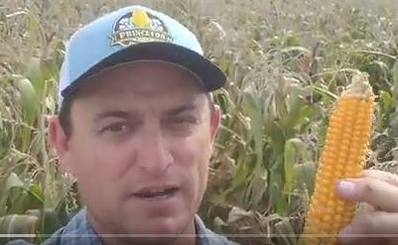
Robert Ralph, also known as Farmer Bob, is the founder of Princeton Popcorn. Bob grew up in Overland Park when farm ground was still intermingled with the suburbs. “I was three or four years old and I remember petting cows through a barbed wire fence,” Bob said. That experience encouraged a lifelong interest in agriculture. He bought a small herd of cows and kept them with a friend outside of town.

After a few years, Bob bought some farmland of his own near Princeton, Kansas in Franklin County. The acreage had some timber, but no fences. “A friend of mine bulldozed a 30-foot path through the trees so I could build fence,” Bob said. “When I burned the brush pile and spread the ashes, I found that it enriched the soil.”

The concept of growing crops became exciting for him. He looked into the cost of seed and equipment and did a budget analysis. As a beginning farmer, with crop prices so low, he recognized that traditional row crops would not pay. Instead, he thought about alternative crops.

Bob bought a three-pound bag of popcorn off the shelf, fenced off a corner of his acreage, and planted it by hand. “A couple weeks later, I dug down and found a seed with a little root emerging from it,” Bob said. “It was like I found a million dollars. By the time that plant grew to 10 feet tall, I was really hooked.”

When he harvested the popcorn and tried popping it, it was initially too wet. When it dried and he popped it a couple of weeks later, it worked great. “I was elated,” Bob said. He gave away the popcorn for family and friends to try.

Robert Ralph

Since that time, he has expanded his popcorn acreage, purchased improved farm equipment, and experimented with various cooking oils and flavors. He remains fascinated with the concept of multiplying a crop. “You put one seed in the ground and get hundreds back. That’s better than Vegas,” he said with a smile.

Bob bought popcorn seed from Zangger Popcorn Hybrids in Nebraska. “I couldn’t have gotten luckier,” he said. “Josh Zangger came down and gave me lots of great advice.”

“I’ve learned so much, I got to thinking that I should document this,” Bob said. His videos as Farmer Bob on Facebook have generated hundreds of views. Using the community name, he named his company Princeton Popcorn. “It’s a vertically integrated business, from seed to store,” he said.

Farmer Bob is working with Balls Food Stores and others to get his popcorn on the market. In 2020, he anticipates that Princeton Popcorn will be on sale in 90 stores in the Kansas City area. Bob was also contacted by a couple of movie theater owners in Germany. They were looking for top quality popcorn to sell, and they found Farmer Bob. In 2020, Bob will be shipping Princeton Popcorn to their movie theaters in Germany.

It’s remarkable to see popcorn going direct to Germany from a rural community such as Princeton, population 277 people. Now, that’s rural.

For more information, see www.princetonpopcorn.com.

Can a first-generation farmer succeed? “This is America,” Bob said. “I would like to encourage kids to open up their minds. You need confidence, determination, and a willingness to fail, but you can try again. This is a land of opportunity.”

100 to 1. That’s not a financial return as much as it expresses the remarkable growth of a crop, from a single seed to thousands. We commend Farmer Bob Ralph for making a difference with innovation, entrepreneurship, and growth – a hundred-fold.

INSIGHT KANSAS: The common sense of ranked-choice voting

Burdett Loomis, Professor, Political Science, College of Liberal Arts and Science, University of Kansas

As the dust settled after the 2018 Republican gubernatorial primary election, Secretary of State Kris Kobach defeated incumbent governor Jeff Colyer by 350 votes, of 128,838 total votes (40.6%). Lagging far behind were moderate Jim Barnett (8.8%), Insurance Commissioner Ken Selzer (7.8), and three other candidates, who garnered 2.2% of the vote.

In assessing the results, Republican political pros were despondent and Democrats gleeful. Republicans had nominated the candidate who was, by far, the most likely to lose the general election to Democrat Laura Kelly. Indeed, that is exactly what happened, as Kobach extreme’s conservatism turned off many Republicans and independents in the November contest.

It is a truism that the rules often help determine who wins a contest. Political scientists have long understood that rules are never neutral. But there are ways to produce better outcomes than Kobach’s 2018 candidacy. Most notably, Republicans could have used ranked choice voting (RCV) to determine the primary winner, with voters ranking the candidates in order of their preference. If no candidate receives a clear majority (50 percent), the candidate with the lowest number of votes is eliminated, and his or her votes are distributed to the second-place choices. This continues until a winner is receives a majority in an “instant runoff.”

In 2018, Governor Colyer would almost certainly have emerged as the winner, since the trailing candidate with the largest cache of votes, Jim Barnett, would have had his tallies go overwhelmingly to Colyer, as would have a fair number of Selzer’s.

The benefits of RCV are numerous, but let’s consider just two. First, Republicans would have put forward their strongest candidate. Second, those voters who supported either Barnett or Selzer could have made a sincere first vote choice, backed up with a strategic second choice.

Nor is the Kobach example singular in Kansas GOP politics. In 2018, newcomer Steve Watkins won the 2nd District Republican nomination with 26.5 percent (20,052) of all votes. RCV procedures would have likely given the nomination to one of his establishment GOP challengers, as most Republican voters viewed Watkins as unqualified. Still, with just a quarter of the primary vote, he won the right to run (and narrowly win) as a Republican in the general election.

A similar scenario propelled Tim Huelskamp into office in the 1st District in 2010, when the ultra-conservative state senator won the nomination with less than 35 percent of the vote. His election in this traditionally Republican seat led to three terms of controversy, before Roger Marshall unseated him in the 2016 primary.

Next spring, Kansas Democrats will use RCV in their May presidential primary; by then, several candidates will have dropped out. The system might be best employed when a large number of candidates remain in the race. Still, it’s a step in the right direction.

Across the nation, many cities have adopted RCV, and Maine has used it in a general election. Indeed, the Maine results demonstrate the impact of RCV, as the Democratic challenger in the 2nd congressional district trailed the Republican incumbent by 2,171 votes, only to emerge victorious by 3,519 votes when two independent candidates’ second-choice votes were redistributed.

A majority candidate thus won election, and more than 16,000 independents did not “waste” their votes.

As we worry about legitimacy, representation, and participation, ranked choice voting is fast becoming a highly attractive option to encourage voting by all factions while producing majority victors. A win-win situation for parties and voters.

Burdett Loomis is an emeritus professor of political science at the University of Kansas.

Fall control of bindweed

Stacy Campbell is Agriculture & Natural Resources Extension Agent for the Cottonwood Extension District.

Field bindweed is a deep-rooted perennial weed that severely reduces crop yields and land value. This noxious weed is estimated to infest just under 2 million acres and is found in every county in Kansas.

Bindweed is notoriously difficult to control, especially with a single herbicide application. During the fall, but prior to a hard killing freeze, can be an excellent time to treat field bindweed — especially in a year when good fall moisture has been received.

This perennial weed is moving carbohydrate deep into its root system during this period, which can assist the movement of herbicide into the root system.
 
The most effective control program includes preventive measures over several years in conjunction with persistent and timely herbicide applications. The use of narrow row spacings and vigorous, competitive crops such as winter wheat or forage sorghum may aid control.

No-till has been very beneficial for managing bindweed by providing routine herbicide treatments through time and not breaking up the root system and dragging root segments around the fields. No-tillage maintains much of the bindweed seed soil bank at a depth too deep to germinate. It is common to see a resurgence of bindweed after tilling fields that have been in long-term no-till.

Dicamba, Tordon, 2,4-D ester, Facet L (also generics) and glyphosate products alone or in various combinations are registered for suppression or control of field bindweed in fallow and/or in certain crops, pastures, and rangeland. Apply each herbicide or herbicide mixture according to directions, warnings, and precautions on the product label(s). Single herbicide applications rarely eliminate established bindweed stands.

Applications of 2,4-D ester and glyphosate products are most effective when spring-applied to vigorously growing field bindweed in mid to full bloom. However, dicamba and Tordon applications are most effective when applied in the fall. Herbicide treatments are least effective when applied when bindweed plants are stressed.

Facet L, at 22 to 32 fl oz/acre, a new quinclorac product that replaced Paramount at 5.3 to 8 oz, or QuinStar quinclorac products, can be applied to bindweed in fallow prior to planting winter wheat or grain sorghum with no waiting restrictions. All other crops have a 10-month pre-plant interval. Quinclorac products can be used post-emergence in sorghum to control field bindweed during the growing season. In past K-State tests, fall applications of Paramount, now replaced by Quinclorac (Facet L, QuinStar) have been very effective as shown below in the table.
Additional noncropland treatments for bindweed control include Krenite S, Plateau, and Journey.

Considerable research has been done on herbicide products and timing for bindweed control. Although the research is not recent, the products used for bindweed control and the timing options for those products haven’t changed much since this work was done. As a result, the research results in the table below remain very useful today.

Fall-applied treatments for control of field bindweed: Randall Currie, Southwest Research-Extension Center 1992-1997.

Stacy Campbell is an Agriculture and Natural Resources agent in the Cottonwood District. You can contact him by e-mail at [email protected] or calling 785-628-9430. 


Kansas Farm Bureau Insight: A world of Octobers

By KIM BALDWIN
McPherson County farmer and rancher

The temperatures have dropped, and it’s truly beginning to feel like fall on the farm. The air feels crisper, the sky seems brighter and everything seems a bit fresher now that the summer heat has left. It’s as if the plants, animals and people have all perked up after they’ve had to conserve their energy, seek shade and retreat from August and September.

But it’s now October, where the true magic happens.

I may be a bit biased about my affection for October. After all, it’s my birthday month. It’s also the month where I brought both of my babies home to the farm. I will always have in my mind the feelings of anxious anticipation as my belly reached maximum capacity while wondering how many acres of soybeans would be harvested or how many fields of wheat would be sowed before having to make our way to the hospital.

I always will have in my mind the image of my tiny daughter, wearing a petite bow on her head, snuggled peacefully in her car seat while a combine roared past harvesting soybeans.

I always will have in my mind the image of my tiny son warmly snuggled in my arms while sitting in the bleachers at the sale barn listening to the auctioneer introduce our lot of good looking, healthy weaned calves as they entered the ring.

I always will have in my mind the image of my kids straddling their bikes on our dirt road waving goodbye to a trailer load of our cattle headed to another pasture where they’d spend the winter months away from our home.

Yes, some of my best memories are from October.

If I could, I’d gather October in a Mason jar. Just like canning the bounties from a summer garden, I’d place this season on my pantry shelves and enjoy servings throughout the year.

And while tasty, it’s not the pumpkin spice that I’d truly want. It’s the cool, crisp air in the mornings that sends shivers through one’s body that isn’t quite ready to wear a heavy coat yet. It’s the beautiful evenings with a pink and orange painted sky that you can enjoy while watching children ride their bikes around the farmyard. It’s the time in the combine sitting next to my husband harvesting rows of soybeans. It’s the consideration of turning on the heater or waiting a few more days. It’s the sound of honking birds above that are beginning to make their trek south. It’s the clear night sky, and a bright full moon, and the sounds of farmers toiling in nearby fields that carries just a bit more into one’s senses.

I tend to catch myself taking deep breaths when I walk outside as if I know this season is only here for a limited time before we begin seeking refuge from the cold. Try as I might, I can’t quite breathe in enough of this beautiful month.

Just as Anne reveled in the world of color about her in the children’s novel “Anne of Green Gables,” I, too, am so glad I live in a world where there are Octobers.

“Insight” is a weekly column published by Kansas Farm Bureau, the state’s largest farm organization whose mission is to strengthen agriculture and the lives of Kansans through advocacy, education and service.

HAWVER: OK, it’s probably time to give Kan. lawmakers a raise

Martin Hawver

Sometimes you ask for information that, once you get it, you wonder why you even asked for it in the first place.

The Legislative Committee on Post Audit did just that.

It asked Post Audit how Kansas’ leaders’ salaries compare to leaders in other states. The answer wasn’t good, but it is something that practically, legislators can’t do anything about…at least not in the upcoming election-year session when every seat in the Kansas House and Senate is up for election.

The numbers? Members of the Kansas legislature, with a few exceptions, make about $22,000 a year for their service in the 90-day sessions. That’s the $77 a day for the session plus a per-diem payment of about $13,700 for the session to cover housing and other costs of living in Topeka during the session for out-of-towners.

There’s no asterisk in the per diem to keep track of just how much those lawmakers save on meals because there’s almost always some event at lunch and dinner when lobbyists could pick up the cost of meals and drinks and entertainment.

That Post Audit report makes an important differentiation between full-time legislatures. Kansas is lower than all but Nebraska. Oklahoma lawmakers? They take home about $50,000, Missouri and Colorado more than $40,000, Iowa about $40,000 and Nebraska a dab less than Kansas’ $21,900.

If you ran home to tell your mother that you’d just got a job that pays $22,000 a year, she’d probably tell you to keep looking.

But it’s a full-time job only from January to maybe June, with a month off for Spring Break and a pretty good holiday schedule.

And, most legislators have other work during the rest of the year that we presume makes the house and car payments in their districts or they are retired. Some farm, some have businesses that allow them to take part of the year off. Because the legislative day has some breaks, there’s time to get in a little real work at their businesses. Or…they farm and don’t have to be there every day to make sure the wheat and corn actually grow when they are in Topeka.

But…that low salary probably means there are folks out there in the state who can’t afford to serve in the Legislature, even if they managed to round up the campaign money to get elected.

When done right, that 90-day session is just a part of their job. The rest of the year: Campaigning, meeting with constituents, learning everything possible about their district and constituents so they can represent them well in the Statehouse.

Chances are excellent that just because voters in a district — from a few square blocks in a city to a dozen counties out west – elected them, they don’t know how every piece of legislation is going to impact their district. That takes hundreds of hours a year.

There is also the mingling at events in their district during the year, showing up for parades and meetings. And every legislator has a story about watching the ice cream melt in the grocery cart while a constituent complained about fence laws or property taxes or the school district’s budget.

Part-time job? Not by a long shot when done well so that they can represent their constituents.

Kansas lawmakers probably need a raise. But which of them, except probably some who aren’t seeking re-election, want their vote recorded to raise their salaries?

Hmmm…not seeing a majority of a quorum of either chamber ready to make that vote in an election year.

Because we’re not seeing anyone propose one “free” vote in the upcoming session…

Syndicated by Hawver News Company LLC of Topeka; Martin Hawver is publisher of Hawver’s Capitol Report—to learn more about this nonpartisan statewide political news service, visit the website at www.hawvernews.com

News From the Oil Patch, Oct. 14

By JOHN P. TRETBAR

Crude futures prices were down more than three percent in morning trading Monday (10/14). The benchmark Nymex contract dropped to $52.93 per barrel and London Brent dipped to $58.65. Kansas Common crude at CHS in McPherson gained a dollar and a quarter on Friday, and starts the week at $45 a barrel

Baker Hughes reported 712 active drilling rigs nationwide, an increase of two oil rigs and a decline of one natural gas rig. Texas saw an increase of six rigs last week, while Oklahoma and New Mexico were each down one.

Independent Oil & Gas Service reported seven active rigs in eastern Kansas, which is down four, and 25 west of Wichita, down one from last week. Regulators approved 32 permits for drilling at new locations across Kansas last week, including one in Ellis County and two in Stafford County. Independent reports 26 newly-completed wells across the state, 15 in eastern Kansas and 11 west of Wichita, including one dry hole completed in Ellis County.

The government says U.S. operators had their best production ever, pumping 12,573,000 barrels per day for the week ending Oct. 4. That’s up 193,000 barrels per day from the week before, and is 73,000 barrels per day better than the previous record set Aug. 23.

The Energy Information Administration said inventories were up 2.9 million barrels from the week before, but remain at the five-year average for this time of year.

EIA reported crude-oil imports of 6.2 million barrels per day, down 67,000 barrels per day from the week before. The four-week average is down nearly 17% from a year ago.

The attacks last month on Saudi oil facilities prompted the steepest fall in almost 17 years in OPEC production. According to a survey by S&P Global Platts, the drop in Saudi output, combined with the effects of U.S. sanctions on Iran and Venezuela, dropped OPEC production by 1.48 million barrels per day last month. The group has other problems. Two members, Ecuador and Qatar, are pulling out of the cartel. Last week its Secretary General invited all 97 oil-producing countries in the world to join the so-called “OPEC-plus” alliance that has been managing the world’s oil supply for nearly three years.

Saudi Arabia will soon return its oil patch to full production after a years-long agreement to cap production and prop up prices.. The CEO of Saudi Aramco told CNBC they will return to what he called “maximum sustained capacity” of 12 million barrels per day by the end of November. He said Aramco’s revenues were not reduced in the wake of the recent attacks.

Saudi Aramco is moving forward with plans for a public stock offering, with some shares available before the end of the year. The Wall Street Journal reports the state-owned oil company could sell 1% to 2% of its shares on Saudi Arabia’s domestic exchange as soon as November. Aramco is poised to release its prospectus later this month.

Russia’s top oil exporter Rosneft is hoping end-run U.S. sanctions by conducting business in the European currency. Reuters reports Rosneft has now set the euro as the default currency for all its new export contracts, including for crude oil, oil products, petrochemicals and liquefied petroleum gas. The company ships about 2.4 million barrels of crude oil per day.

The governor of California over the weekend approved a ban on pipelines and other oil-and-gas infrastructure on state property, which they hope will deter energy development on adjacent federal lands. Governor Gavin Newsom also formally renamed the office of the state’s chief energy regulator, amid scandals involving runaway fracking permits and conflict of interest charges.

It cost a record $8 a barrel to ship West African crude to Asia, roughly four times the average for January through August. Bloomberg says the spike is driven by another attack on an oil tanker, as well as U.S. sanctions on a Chinese shipping firm.

Total rail-freight traffic was down another seven percent, but oil-by-rail showed a slight uptick. Operators moved 12,592 rail tanker cars laden with petroleum and petroleum products according to the latest weekly numbers from the Association of American Railroads. That’s a half a percent higher than the same figure a year ago. The cumulative total so far this year is up more than 16% from last year.

A senior scientist at the Kansas Geological Survey (KGS), who specializes in high-resolution seismic exploration, has been elected president of the Society of Exploration Geophysicists, an international research and education organization. According to an announcement from The University of Kansas, Rick Miller’s work at the KGS has led to advances in the investigation of earthquakes, land subsidence, detection of tunnels and subsurface mines, and assessment of dam and levee stability.

Copyright Eagle Radio | FCC Public Files | EEO Public File