We have a brand new updated website! Click here to check it out!

MARSHALL: Doctor’s Note Oct. 14

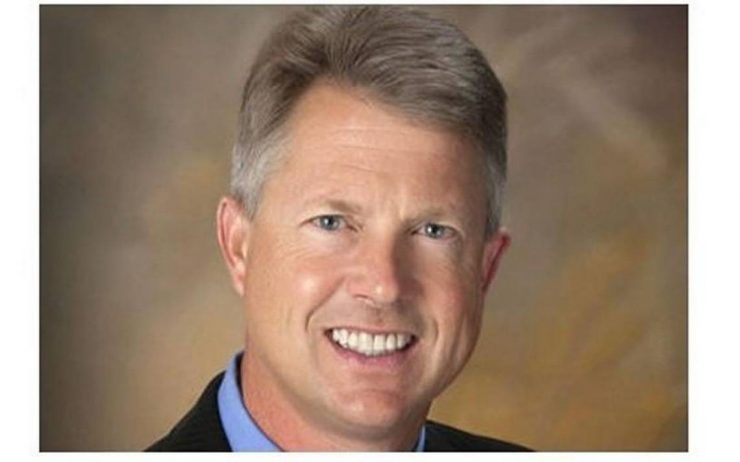
Dr. Roger Marshall, R-Great Bend, is the First District Kansas Congressman.

Friends,

Saturday was National Farmers Day, a day with deep roots where we take time to recognize and thank farmers for their hard work and contribution to the economy.

Agriculture is the largest economic driver in Kansas, accounting for 44.5% of the state’s total economy. The agriculture sector employs 13% of Kansas’ workforce through direct and indirect careers.

Kansas is the nation’s 7th largest agricultural exporting state, shipping $4.8 billion in domestic agricultural exports abroad in 2017. Agriculture in Kansas is not just about growing crops and raising animals, it includes renewable energy production, food processing, research and education, agribusiness and more. I am proud to represent the farmers of Kansas that provide the food, fiber, and fuel that sustain our great nation.

So make sure you thank a farmer?

Dairy Margin Coverage Program

Enrollment for the 2020 Dairy Margin Coverage (DMC) program has been opened by the USDA’s Farm Service Agency. The DMC was authorized by the 2018 Farm Bill and is a program designed to help producers manage economic risk brought on by milk price and feed cost disparities.

The DMC program offers reasonably priced protection to dairy producers when the margin between the all-milk price and the average feed cost falls below a certain dollar amount selected by the producer. So far in 2019 dairy farmers have earned more than $300 million from the program.

Enrollment is open until December 13, 2019. If you want more information on the program Click Here. You can also visit the USDA’s DMC program homepage Here.

Supporting Rural Transportation

U.S. Department of Transportation (DOT) Secretary Elaine Chao announced the Rural Opportunities to Use Transportation for Economic Success (ROUTES) Initiative, with a goal of dedicating discretionary U.S. DOT resources to improving the safety and usability of the nation’s rural infrastructure.

The roads in Kansas and other rural states are vital to the movement of goods and services across this country. But many of the rural transportation systems – roads, bridges, and highway-rail crossings – lack the investment necessary to keep them safe and usable.

U.S. DOT will assist rural stakeholders in better understanding and utilizing the grants and funding programs to identify critical rural transportation concerns and coordinate efforts among DOT’s different modal administrations. To learn now about the ROUTES initiative, Click Here.

Disaster Aid Coming to Kansas

The U.S. Department of Agriculture Office of Rural Development recently announced $150 million in additional funding to help communities hardest hit by adverse weather and natural disasters.
The counties included in the 2019 FEMA disaster declaration, highlighted in the graphic, can apply for funds through the Community Facilities Program to make improvements to buildings, infrastructure, and public facilities using USDA grant dollars.

The Community Facilities program can help rural communities in their recovery efforts by ensuring they have the facilities and infrastructure to support their residents and businesses.

Interested communities are encouraged to contact a USDA Rural Development Community Programs Specialist in Kansas. A list of specialists in Kansas can be found Here.

Combating School Violence

Morris County Public Schools has been awarded a grant of $452,913 by the Department of Justice’s Community Oriented Policing Services (COPS) office. Recipients were given the grants under the School Violence Prevention Program (SVPP) which granted $32.5 million dollars across 103 grantees.

The SVPP program provides funding directly to states and units of local government to be used to improve security at schools and on school grounds. Money can be used in a variety of methods, from coordination and training with local law enforcement to the placement of metal detectors, locks, lighting, and other deterrent measures. Thank you to the COPS office for their investment in the safety of the next generation of Americans.

USDA Roundtable

USDA Deputy Under Secretary for Food Safety Dr. Mindy Brashears and Food Safety and Inspection Services (FSIS) Administrator Carmen Rottenberg traveled to Kansas last week. They meet with small protein production facility managers and provide plant operators an opportunity to hear updates from FSIS leadership as well as ask questions about proposed changes and labeling requirements.

Under USDA Secretary Sonny Perdue’s leadership, the agency has placed a large emphasis on customer service and removing unnecessary regulations. Events like this week’s roundtable are part of the reason America has the safest and most affordable food supply in the world.

Following the roundtable, Deputy Under Secretary Dr. Brashears traveled to Manhattan to meet with veterinary medicine students at Kansas State University to discuss career opportunities within USDA.

National Co-Op Month

October is National Co-Op Month. Kansas is home to more than 525 co-op locations serving 600,000 members and generating millions of dollars for local economies.

These member-owned and member-driven organizations are an important part of the Kansas way of life, providing everything from farm credit to electric power.

For more than 100 years, these organizations have been serving communities across the district, and will continue to be vital to Kansas’ growth and success.

National 4-H Week

Last week was the Inspire Kids to Do National 4-H Week. From October 6th through the 12th counties all across the country have been celebrating everything 4-H and showcasing the incredible experiences that 4-H offers young people. The Inspire Kids to Do theme was chosen to highlight how 4-H encourages kids to take part in hands-on learning experiences in areas such as health, science, agriculture and civic engagement.

During my time in Congress I have had the opportunity to meet with many 4-H groups and am continually impressed with the leadership and drive that I see in these young Kansans. 4-H equips our youth with the skills they need to reach their full potential and I am proud to celebrate 4-H Week with them.

Rural and Independent Innovators Conference

The Kansas Small Business Development Center will be hosting one of their Rural & Independent Innovators Conferences (RIIC) at Fort Hays University on October 15th. These conferences are modeled around supporting Kansan entrepreneurs and innovators with information and education, with the goal of fostering connections and business opportunities.

Executive Director of Grow Hays, Doug Williams, will be the keynote speaker at this upcoming RIIC and will be speaking on “Growth Through Innovation.” There will also be presentations on business growth, market access, and raising capital. This is a great opportunity to network and learn, and I hope many of you have a chance to attend.  Additional information, along with registration details, can be found on their website Here.

Dr. Roger Marshall, R-Great Bend, is the First District Kansas Congressman.
BOOR: Now is the time to check forage for prussic acid

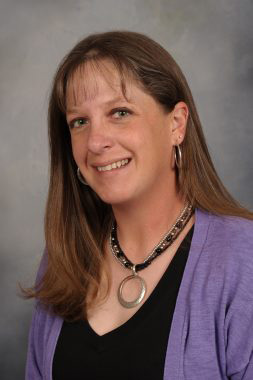
Alicia Boor
After sorghum harvest, many producers want to move their cattle onto milo stalks to graze. With an early hard freeze, it is a good idea to be aware of prussic acid in sorghum, and if you are concerned, have your forage tested. A quick test now can give you peace of mind when you turn your livestock out to utilize the stalks and grain that are in the field.

Below are some key considerations: 
 
1.  Prussic acid (HCN) poisoning is more of a concern when grazing sorghum than when harvested for hay or silage because HCN will dissipate in harvested forages if properly ensiled/cured. For grazing it is best to wait approximately seven days after the hard freeze to graze.
 
2.  Sorghum silage – Most of the HCN will dissipate within 72 hours following warm weather after a hard freeze. However, if HCN levels are high at the time of harvest, wait at least four weeks before feeding the forage. The HCN will volatilize during the fermentation and feed mixing process.
 
3.  Hay – The curing process for hay will allow the HCN to dissipate as a gas, reducing the HCN content to safe levels.
 
Testing for Prussic Acid
 
1.  If high prussic acid concentrations are suspected prior to grazing or at harvest, forage should be tested before grazing or feeding. There are quantitative and qualitative tests available to learn more about the potential for prussic acid poisoning in a particular forage.
 
2.  If HCN levels exceed 200 ppm on an ‘as-is’ basis or 500 ppm on a dry basis, the forage should be considered potentially toxic and should not be fed as the only source of feed to animals.
 
3.  Contact the forage lab that will conduct the HCN analysis prior to sending in samples so that proper handling procedures can be followed. 
 
To monitor the freeze conditions in Kansas, go to the Kansas Mesonet Freeze Monitor tool:  https://mesonet.k-state.edu/weather/freeze/
For more information on how to use the Freeze Monitor, please read the recent eUpdate article, “Fall has arrived and the Mesonet freeze monitor returns”, in Issue 712.

If you have any questions, or would like more information, you can contact me by calling 620-793-1910, by email at [email protected] or just drop by the office located at 1800 12th street in Great Bend. This is Alicia Boor, one of the Agriculture and Natural Resources agents for the Cottonwood District which includes Barton and Ellis counties. Have a good week!

FIRST FIVE: Protecting religious freedom has a domino effect

Benjamin P. Marcus

By BENJAMIN MARCUS
Freedom Forum Institute

Earlier this month, thousands of people gathered in Houston to mourn the death of Harris County (Texas) Sheriff’s Deputy Sandeep Dhaliwal. Dhaliwal, who was shot dead during a routine traffic stop in a non-hate crime-related ambush, not only served and protected his community as a law enforcement officer — he also served his religious community and country as a champion of religious freedom.

In 2015, Dhaliwal became the first turbaned Sikh law enforcement officer in Harris County after the county added a religious accommodation policy to its uniform regulations. The change was made thanks to advocacy by the Sikh American Legal Defense and Education Fund (SALDEF), the Sikh Coalition and Dhaliwal’s colleague, Deputy Navdeep Singh Nijjar. Previously, on-duty officers could not have a beard or wear a turban — forcing some Sikhs, including Dhaliwal, to make the heart-wrenching decision between their careers and their articles of faith.

Dhaliwal and his colleagues’ success in Texas had a domino effect: the same year Dhaliwal was finally allowed to come to work as his whole self — turban, beard and all — the New York City Police Department (NYPD) reached out to Harris County Sheriff Adrian Garcia to find out how the NYPD could change its own policies to better accommodate observant Sikhs.

But members of minority religious communities have not always been invited enthusiastically to serve without comprising their convictions. Shared experiences of exclusion from public spaces bind marginalized communities together in an “inescapable network of mutuality,” borrowing a phrase from the Rev. Dr. Martin Luther King Jr.

Richard Foltin, senior scholar at the Religious Freedom Center, explains: “Just as Sikhs are confronted with workplaces that place obstacles to their wearing a turban and beard, even though their dress and grooming presents no real impediment to the performance of their jobs, so also observant Jews sometimes face the danger of losing or being denied jobs because they are obligated to wear a yarmulke or a beard or, in a more frequent situation, must take days off from work in observance of the Sabbath or holy days.”

Indeed, an observant Jew pushed down a domino on behalf of religious freedom before Dhaliwal. In 1986, the U.S. Supreme Court ruled in Goldman v. Weinberger that a Jewish Air Force officer did not have a constitutionally protected right to wear a yarmulke while on duty and in Air Force uniform.

In response, Congress included a provision in the 1988 version of the annual National Defense Authorization Act that permits “a member of the armed forces to wear an item of religious apparel while in uniform, except when the secretary of the military department concerned determines that: (1) the wearing of the item would interfere with the performance of military duties; or (2) the item is not neat and conservative.”

Nevertheless, some members of minority religious communities are still forced to decide between serving their country and honoring their religious identities. According to the Sikh Coalition, the U.S. Air Force, Marines and Navy still have policies that prohibit Sikhs and others from wearing certain articles of faith.

But the dominos set in motion by Goldman and Dhaliwal continue to fall. After Dhaliwal’s death, 98 former and current Sikh service members and law enforcement officers delivered letters to the U.S. Department of Defense and national police agencies to advocate for policy changes that would allow members of minority religious communities to serve with dignity.

We all benefit when our workplaces — public or private — become more diverse. In fact, research shows that Americans who personally know someone from a religious community express warmer feelings toward members of that community and they answer more questions correctly about that community on a religious knowledge survey. And as the American Academy of Religion argues, decreasing religious illiteracy can decrease the bigotry and prejudice that plague our communities and fuel violence.

That’s why we need people like Dhaliwal, who fight for everyone’s right to participate fully in public life. In the words of Arsalan Suleman, the Muslim-American president and chair of America Indivisible: Dhaliwal’s story “is significant because he made the Harris County Sheriff’s Office better — better because it had him on the team, better because their policies now were more consistent with U.S. constitutional protections and better because the sheriff’s office became more welcoming to and representative of Houston’s diverse residents. His service, and his triumph, also made his city of Houston better and our country better — because every time there is a triumph like Dhaliwal’s, as a society we get closer to that more perfect ideal to which we aspire.”

On Friday, Sept. 27, America lost a First Amendment hero who reminded us that we serve our entire country when we stand up for our rights. Do you feel a gentle nudge? That’s Deputy Dhaliwal’s legacy pushing you to knock down barriers against religious freedom for the next generation.

Benjamin P. Marcus is religious literacy specialist at the Religious Freedom Center of the Freedom Forum Institute. His email address is: [email protected].

INSIGHT KANSAS: Sleep deprivation hits the urban poor the hardest

Michael A. Smith is a Professor of Political Science at Emporia State University.

Sleepless in Kansas? Maybe not, if you are a student at Emporia State.

ESU has contracted with a private company to install two sleeping pods. They are designed to be dark, quiet and clean. Pods must be reserved in advance, the areas are secure, private and monitored, and the pods are cleaned after each user.

Reaction on social media has been passionate and mixed. Most ESU students willing to venture an opinion are excited, but some alumni and community members remain unconvinced. Snarky comments abound, featuring the predictable accusation that today’s college students are coddled, along with the inevitable “back in my day…” reminiscences.

What are the hard facts about sleep deprivation in Kansas? We have good data, thanks to countyhealthreports.org, a website created in partnership between the Robert Wood Johnson Foundation and the University of Wisconsin. The site is a treasure trove of facts, organized by county for every U.S. state. We can compare Kansas counties to one another and to other states.

For me, a visit to countyhealthreports was a classic lesson in good social science. I visited the site with preconceived notions—ones which the data failed to confirm. When I think of sleep deprivation here, I immediately thing of harried young parents in places like Johnson County, stuck in traffic or racing the SUV through the drive-through lane for a triple-caf latte, trying desperately to stay awake in between the extra hours at work and prearranged playdates for the kids.

This is exactly why we need to test our preconceptions with real data. Despite my stereotypes, Johnson County has the lowest incidence of sleep deprivation in the state. In 2016, 25% of Johnson Countians reported normally getting less than seven hours of sleep per night, compared to 31% statewide. The state’s most sleep-deprived county is their neighbor—Wyandotte, home of Kansas City, Kansas, and a good deal less wealthy than Johnson County.

There is a pattern here. Counties with the combination of urban areas and high poverty have the most sleep deprivation. Still within the fringes of the KC area, Leavenworth and Atchison Counties rank second and third after Wyandotte for sleepiness, while Wichita’s Sedgwick County ranks fourth. To the east, St. Louis City ranks as the most sleep-deprived in Missouri, while Kansas City’s Jackson County is second.

To our west, Colorado’s mountains are famous for outdoor recreation, popular with migrants moving or vacationing there to experience it. Not surprisingly, the United Health Foundation ranked Colorado as America’s eighth healthiest state in 2018. Yet the pattern can be seen there, too. In Pueblo, the median income is a good deal lower than the state as a whole, and Pueblo County is the state’s most sleep-deprived. Growing suburban counties outside Denver and Colorado Springs tend to be the state’s least exhausted.

Sleep deprivation is a state and national epidemic, and it correlates with many of the deadliest ailments Americans suffer today. These include high blood pressure, stress, obesity, and reliance on toxic stimulants like nicotine—or worse—to stay awake. Stereotypes about the harried suburban soccer mom notwithstanding, the largest concentrations of Kansans suffering these effects are in lower-income, urban areas. Here at ESU, the new sleep pods will help those students who choose to use them, and also call attention to a serious, national health problem.

This is commendable, but as the hard data remind us, the ones hit hardest by our state’s sleep problems are the urban poor.

Michael A. Smith is a Professor of Political Science at Emporia State University.

MASON: Measuring success through the achievements of graduates

Dr. Tisa Mason, FHSU president

Whether it’s for the holidays or a class reunion – coming home is such a special time to rekindle relationships, share joyful (and sometimes mischievous) memories, and take time to reflect on our growth. A university, like a family, provides roots for that growth. And like a family, there is often a lot of planning, preparation and heart that accompanies traditional coming-home events.

And so I begin this column expressing my deep gratitude to everyone who will work hard throughout this weekend to create a wonderful homecoming celebration.

Homecoming also provides us with an extra special opportunity to recognize our alumni through our awards programs. Celebrating their success is especially important. In fact, if you pay special attention to our mission, our work with our students is not really measured by their success while they are students. Our mission is about developing engaged global citizen leaders. Thus the true measure of our success is how our alumni live their lives after they graduate; how they serve their professions, their communities, and our world.

I really value how our awards align with that mission. The Alumni Achievement Award, established in 1959, honors graduates of the university for outstanding accomplishments through career and profession, meritorious service in community betterment, philanthropic activities, and educational achievements.

Past recipients of this award include George F. Sternberg, a 1933 graduate whose first paleontological discovery was of a nearly complete plesiosaur at the age of 9. He became a world-renowned paleontologist and is credited with discovering the famous Fish-Within-A-Fish fossil. John C. Thorns Jr., a 1950 graduate, is also a past recipient. In addition to serving as a faculty member and Art and Design Department chair, he also founded the Hays Arts Council and was a leading force in establishing the on-campus art gallery now named the Moss-Thorns Gallery of Art.

Oh!, and by the way: Don’t miss the ribbon cutting for our beautiful Art and Design Building at 9 a.m. tomorrow.

The Distinguished Service Award, established in 1974, recognizes individuals, alumni or friends of the university, who have demonstrated a continuing concern for humanity on a universal, national, state or community level; who support spiritual, cultural and educational objectives; and who endorse and exemplify the highest standards of character and personal attributes. This truly mission-centered award has celebrated the compassion of people like Earl and Winona Field (Earl was a 1937 graduate) and Steve Shields, president and CEO of Action Pact Development and an emeritus member of the FHSU Foundation Board of Directors, who is relentlessly focused on positively impacting the quality of life and healthcare for senior citizens.

The Young Alumni Award, established in 1977, recognizes the outstanding achievement and recent accomplishments of 10-15-year graduates. The award is based on professional and educational achievement, community activities, honors and awards received and other noteworthy items of merit since graduation.

Last year’s recipient, Jennifer Lapka (a 2003 graduate) really touched my heart, and we have remained in contact throughout the year. Jennifer is the founder of Rightfully Sewn, a charitable organization with two special purposes. One is to provide seamstress training for at-risk women so they can enter, and thrive in, the fashion industry. The second is to re-establish Kansas City as an “epicenter of garment manufacturing” and then market Kansas City fashion designers in the production of “affordable, high-quality, American-produced garments.”

I am so eager to meet this year’s award recipients and hear the amazing stories of how they delivered big on our mission.

The four recipients of this year’s Alumni Achievement Award are:
• Buck Arnhold ’74, ’76, ’80, a retired artist living in Olathe whose commercial work has included art for Boulevard Brewing Co. and the Kansas City Chiefs.
• Kevin Faulkner ’83, ’83, a retired investor relations officer who lives in Pebble Beach, Calif.
• Dr. Leigh (Bunn) Goodson ’94, president of Tulsa Community College in Tulsa.
• Michael R. Miller ’85, ’86, ’93, Kansas City, who is a retired special agent with the FBI.

The two recipients of this year’s Young Alumni Award are:
• Dr. Cole Engel ’07, ’07, ’09, Hays, an assistant professor of accounting at FHSU.
• Joshua W. Snider ’05, an attorney and the managing shareholder for Gordon Davis Johnson & Shane P.C. in El Paso, Texas.

Dr. Christie (Patterson) Brungardt ’01, and Dr. Curt Brungardt ’81, ’84, Council Grove, both emeritus professors of leadership studies at FHSU, will receive the Distinguished Service Award.

Their accomplishments and generosity are truly inspiring, their impact profound. The stories of their contributions, in large part rooted in the strong relationships and learning developed at The Fort, will be recounted and celebrated.

And I, like all of the presidents before me, will take great pride in how generations of faculty and staff have facilitated the fulfillment of our mission, and in doing so, made this world a better place.

Now That’s Rural: Chris Broeckelman, Natoma woodworking

Ron Wilson is director of the Huck Boyd National Institute for Rural Development at Kansas State University.

By RON WILSON
Huck Boyd National Institute for Rural Development

“If you can dream it, you can do it.” That inspirational slogan might describe the work of Chris Broeckelman and his industrial technology students at Natoma High School. They are using their classes to develop skills, not just in the shop, but in life. It’s today’s Kansas Profile.

Chris Broeckelman is the industrial technology instructor at Natoma High School in northwest Kansas. Chris grew up on a farm near Selden, one of eight children of Joe and Cathy Broeckelman.

“I always had an interest in carpentry,” Chris said. During high school, he worked at the local lumberyard. “I had a high school woodworking teacher that I thought very highly of.”

Chris studied Technology Studies and Secondary Education at Fort Hays State with a minor in business. He also worked at a cabinet shop. After graduation, he took the teaching position at Natoma. He married Megan. They now have six children.

Broeckelman / USD 399

“When I was 5 or 6 years old, I said I wanted to be a carpenter or a vegetable farmer when I grew up,” Chris said. “Now I’m teaching woodworking and have a big garden, so I’m about there.”

His industrial technology program begins with basic mechanical drafting, autocad, and woodworking classes during junior high. At the high school level, the elective classes in computer aided design and woodworking become progressively more challenging each year.

The woodworking program begins with wood processing where students learn about milling methods, identifying trees, and different drying processes. It progresses to the students imagining, designing and building a project of their own. Safety is the top emphasis throughout.

The wood is sourced locally. Farmers or power companies often donate logs which the students can cut. This year, windstorms uprooted several trees. “Ninety percent of our wood comes from salvage,” Chris said. “We resell the wood at cost to the students, which saves parents and kids thousands of dollars and supports the program.” Walnut, hackberry and white oak are popular.

The state technology competition is a motivational tool for Chris’s students. For more than 50 years, Fort Hays State University has conducted a Western Kansas Technology Fair competition open to any school in the state. Outside judges evaluate the quality of the entries. There are competitions in drafting, graphic communications, power, energy and transportation systems, plus production systems, including metalwork and woodwork, which is the largest category.

Participants receive white, red, or blue ribbons depending on the quality of the work. Superior products can be awarded a gold rosette. “It takes a lot of work to get that,” Chris said. “The kids make a big deal of it.”

More than 300 projects were entered last year. “Eleven of my 19 high school students brought home rosettes,” Chris said. Among Chris’s students, a sixth grader, eighth grader and freshman won best in class overall. Natoma has consistently been a top winner.

That’s a remarkable record for students from a school in a rural community such as Natoma, population 335 people. Now, that’s rural.

What products do students build? “The sky’s the limit,” Chris said. “I tell them, `If you can dream it up, we’ll find a way to build it.’ And they challenge me.” Projects typically include bedroom sets, dressers, dining room tables, coffee tables, and many more.

“Quality is our goal,” Chris said. “I tell them that they’re building a project that their grandkids can fight over after they’re gone.”

Not only are they building a project that will last, they are learning life skills. “To see a kid who starts with no confidence and see them grow is huge,” Chris said. “It’s about having a challenge and overcoming it, problem-solving and learning to work with others. It’s more than just wood-working, we’re teaching life.”

“If you can dream it, you can do it.” This teacher and his students are making that motto reality. We salute Chris Broeckelman and his students at Natoma High for making a difference with their creativity and skill. When a young student earns that rosette at the state competition, it can be like a dream come true.

LETTER: Wasinger files for re-election to state House

By BARBARA WASINGER
111th District, state rep, R-Hays

Yesterday I filed to run for re-election in 2020 to the office of State Representative for the 111th District of Kansas. I believe progress is being made without the chaos of past years. Visiting with my constituents as I walk door-to-door helps me to understand their concerns serve them in Topeka.

During this first Legislative session I organized a tour for U.S. Congressman Roger Marshall (KS 1st District), Kansas Commerce Secretary David Toland, Kansas Assistant Transportation Secretary Lindsay Douglas, Ellis County and Hays City Commissioners along with other community leaders to look at the northwest corridor around Hays and show the need to improve this dangerous freight corridor. It is essential to keep Ellis County on the radar in Topeka. I continue to work with all parties to get the necessary funding for this corridor.

Also, in keeping with the promises I made during my campaign in the first election, I voted for school funding with accountability, twice voted against increasing taxes due to Federal tax changes, voted and worked for restoring funding to KDOT and voted to make a long overdue payment of $115 million dollars to KPERS – the first regular payment made in 25 years.

It has been my honor to represent the people of Hays and Ellis County as your Representative in Topeka and I look forward to continuing to serve them.

BOOR: Seminar will focus on freezer cooking

Alicia Boor

What’s for dinner? This question probably gets asked in most households every night by every family member. If you are the preparer, you may even ask this question. The Women on the Farm group would like to help take the guesswork out by offering a Freezer Cooking Workshop on Nov. 2 at the Haas Building at the Pawnee County Fairgrounds in Larned.

Freezer Cooking is when you cook a bunch of meals at one time to put in your freezer and then pull out as need be. Each participant will walk away from the day with 8 meals to put in their freezer. Each meal will serve 5 people with some left overs.

We will be making Honey Rosemary Chicken, Green Chile Pork Tacos, Beef & Creamy Potato Casserole, Chicken Pot Pie, Cheesy Ham & Potatoes, Swiss Steak & Veggies, Breakfast Casserole, and Pizza Casserole. Each participant is asked to bring a knife, cutting board, measuring spoons, liquid measuring cup, and a box/cooler to take all of your meals home in! This will be a productive morning and a great way to get all of your week’s cooking done! An added bonus is we are doing all of the grocery shopping for you.

This method of cooking is a great way to save time and money. Because we are buying in much larger quantities, we can stretch the food dollar. By spending a morning as a large group making this happen, it will help free up your evenings to relax or get to a project you have been meaning to do!

We will have people register at 8:30 a.m. and start cooking at 9:00 a.m. We hope to finish around noon. Please RSVP by October 28th to Pawnee County Extension at 620-285-6901. Space is limited and there is a 75.00 fee to cover the costs.

Alicia Boor is the Agriculture and Natural Resources agent for Barton County K-state Research and Extension. One can contact her by email at [email protected] or calling 620-793-1910

Kansas Farm Bureau Insight: Collision course

By JACKIE MUNDT
Pratt County farmer and rancher

Like many children, I once dreamed of becoming President of the United States. A big, old White House and a high-power job were awe-inspiring.

When I was 13 years old, President Clinton was impeached, and that shiny vision cracked a little. The following trial set a different tone for my generation’s relationship with politicians. As we have grown, that vision has completely disappeared with a string of dishonest politicians with messed up personal lives and poor decision-making abilities.

Discrediting a political rival has become the high stakes poker of politics. If you can find the right piece of dirt, you can end a career. However, someone may call your bluff or trump your allegation with even more dirt to defeat your own candidate. The worst part of this base practice is the American public loves the drama.

Enter President Trump. Now, instead of spending time ratifying an important trade agreement that would help farmers and other industries with USMCA, Congress is spending time on impeachment inquiries into a politician who was trying to dig up dirt about another politician.

I’m not taking a position on the President’s guilt or innocence. My point is voters played an important hand in all this. Americans chose a divided government in 2018 and set the county on this collision course.

An impeachment inquiry for charges of “high crimes and misdemeanors,” where the term high refers not to the magnitude of offense but the level of authority of the office should cause us to reflect on our own part in this. What responsibility do we bear in the current norms of our political system, and how do they affect who enters life in the public eye?

Good people who would be great public leaders have no interest in public service because it is a thankless job. The pay and benefits cannot make up for the heartache of ineffectiveness. There is no joy in watching your family and your own reputation being drug through the mud; and, if elected, there is constant, personal criticisms being freely and violently launched.

The inability to separate personal feelings and surface judgments are pulling our country apart. We need to change our paradigm about politics and politicians. If we actually want to “Make America Great Again,” it has to start with us.
Start learning about what is actually happening in our political system beyond the headlines. Have conversations with your family, friends and neighbors to learn what matters to each of you. Be sure to argue on some things and do not hold it against someone who takes an opposing view. Sometimes that opposing view can be the key to a great solution for everyone.

Talk to your elected representatives. Not only does this help them understand your viewpoint, it also holds them accountable to the people they represent. If you think they aren’t representing you well, run for office yourself or find another candidate to support. Remember they should be earning the authority to be a leader.

Most importantly stop following the sensationalized stories. Our system of government is not broken; we just haven’t been doing our part. If we own our opinions and start actively participating in the political process, this country has a chance to overcome our differences and live up to its potential.

“Insight” is a weekly column published by Kansas Farm Bureau, the state’s largest farm organization whose mission is to strengthen agriculture and the lives of Kansans through advocacy, education and service.

Prairie Doc Perspectives: The cost of health care

Dr. Tom Dean

By DR. TOM DEAN

Health care costs too much. The U.S. spends twice as much as other wealthy nations and yet we have poorer outcomes. Patients in this country visit physicians less frequently and spend less time in hospitals than residents of other wealthy countries. So, why such high costs? It’s a complex issue with no simple answer.

Experts have identified three major factors contributing to this situation. The most significant is higher prices, followed by costly administrative complexity and finally, the use of ineffective or overly aggressive medical interventions that provide little benefit to patients.

What about prices? The average U.S. hospital discharge costs over $29,000 compared to $18,000 in the Netherlands and $16,000 in Canada. The average MRI price in Australia is $350 compared to $1145 in the U.S.  Prices, especially drug prices keep going higher. Lantus insulin introduced nearly 20 years ago at about $35 per vial now sells for $260. The U.K. price is $26. Gleevec, a remarkably effective drug for leukemia, introduced in 2001 at $26,000 per year, more recently sells for $120,000. The generic form sells for $96,000.

Trying to control costs in the U.S., both the government and insurance companies have applied complex regulations resulting in the addition of administrative staff and steadily increasing expenditures. Studies show that 20 to 30 percent of health care expenditures now go to cover admin costs, a much higher rate than other countries.

What to do? As a society we have depended on market forces to control prices. This is effective when selling groceries and gasoline but in health care it has failed. The simple explanation is that health care providers do not compete based on price. Even when patients have comparative cost information, they all too often do not select the most cost-effective approach.

Too little incentive exists for providers, especially physicians, to seek out the most efficient approach to care. In fact, existing financial incentives often push physicians and other providers in the opposite direction – the more you do the more you are paid.

Bottom line: As a society we in the U.S. have never figured out where health care fits in the spectrum of economic activity. Is it a commercial product like automobiles and blue jeans where those with more resources can purchase more elaborate products, or is it a basic human service like public education or fire protection to be made available to everyone?

In the words of the late Professor Uwe Reinhardt, one of the giants of health policy analysis, what we have is a philosophical and ethical challenge not an economic one.

Tom Dean, MD of Wessington Springs, South Dakota, is a contributing Prairie Doc® columnist who has practiced family medicine for more than 38 years. He served as a member of the Medicare Payment Advisory Commission. For free and easy access to the entire Prairie Doc® library, visit www.prairiedoc.org and follow Prairie Doc® on Facebook, featuring On Call with the Prairie Doc® a medical Q&A show streamed most Thursdays at 7 p.m. central. 

HAWVER: Debate brews over who gets final say on Kan. Supreme Court picks

Martin Hawver

It appears that at least us folks who hang out at the Statehouse — and possibly the rest of voting-age Kansans —

may get dragged through the debate over who gets the final say on who gets to sit on the Kansas Supreme Court.

There are seven pretty good jobs on the high court, paying $145,600 a year (a dab more for the Chief Justice) and which include reserved indoor parking, so if they have automatic garage door openers at home, they don’t have to wear a coat to drive to work. Nice.

But choosing who gets those nice jobs is now pretty much the decision of the governor, who picks from three candidates who have been screened for qualification, or maybe weight, by the nine-member Supreme Court Nominating Commission. That commission is headed by a Kansas lawyer, and the roughly 10,000 Kansas-licensed lawyers elect one member from each congressional district to sit on the commission. The governor appoints four members, one from each congressional district, who may or may not be lawyers but generally have some free time.

Once the governor looks through the list of nominees, she/he names a winner, and the person is on the court.

Well, that’s not the way some folks look at it. They figure that lawyers choose lawyers for the majority of the commission, and those lawyers choose the nominees who will be recommended to the governor. Sort of an insiders’ deal among lawyers, they say.

Conservatives, generally, want something between that governor’s choice and the black robe, and want the Senate to have to confirm the governor’s choice—essentially veto power over an appointment they don’t like or feel may turn the court in a direction they don’t like, or maybe just a slap at lawyers winnowing the field for the court.

Some other folks figure that having a lot of lawyers on the Supreme Court Nominating Commission means that they’d probably nominate folks who have a pretty good background in the law so the governor can choose from journeymen, not apprentices.

The Special Committee on Judiciary last week suggested that the 2020 Legislature consider changing the state constitution as it deals with filling Supreme Court vacancies—getting rid of that nominating commission and letting the governor nominate a candidate who needs approval by the Senate.

The issue splits relatively oddly, even for the Kansas Legislature. Conservative Republicans don’t like Democrat Gov. Laura Kelly naming the next two members of the Supreme Court. Justice Lee Johnson and Chief Justice Lawton Nuss are retiring this year, and Kelly will get to name their replacements without Senate confirmation. That much is locked up…she’ll make her appointments before a constitutional amendment could be considered by Kansas voters.

But a constitutional amendment to give the Senate the final say and eliminate the Supreme Court Nominating Commission? That might—if approved in the Legislature by a two-thirds vote and a simple majority of Kansas voters—give the Senate the power to derail future nominations.

It puts all the power in the hands of 21 senators.

The result? Probably that lawmakers of a party different than that of the governor can blast the governor for making a bad choice, or at least a choice they don’t like. While governors for years have said they don’t specifically ask even in private meetings with the nominees just where they stand on, say, abortion or the death penalty or any number of controversial issues, don’t count on senators to even assert they won’t ask about issues, just general temperament.

Will one person make the decision about who gets to sit on the Supreme Court, or 21? And do a majority of voters care?

We’ll see…

Syndicated by Hawver News Company LLC of Topeka; Martin Hawver is publisher of Hawver’s Capitol Report—to learn more about this nonpartisan statewide political news service, visit the website at www.hawvernews.com

Exploring Outdoors Kansas: Just a chip off the old rock

Steve Gilliland

At the recent Kansas Fur Harvester’s convention, I strolled past a booth where several dozen beautiful flint-blade knives were displayed for sale. The owner and creator of those knives was Chris Yackle from Paola, Kansas who told me “As a young boy I was absolutely fascinated by the large collection of Native American artifacts, tomahawks, knife and lance points and arrowheads collected by my great grandfather George from Hillsdale.”

The artifacts were displayed on the wall in front of his great grandfather’s favorite chair, and as punishment when they got into trouble at great granddads house, Chris and his siblings would be forced to stay in the house and sit in that chair. Chris says he actually looked forward to that punishment so he could look at all the artifacts. When Chris was still very young his dad got a job with a pipeline crew and because of his job they moved every three years from the time he was in sixth grade until he graduated from high school. That sounds brutal for a kid, but Yackle told me he didn’t mind because that made for a huge area on which to hunt for Native American artifacts, and the cool part was that when he was along with his dad on the pipeline, he had permission wherever they went.

When Chris was fifteen, they moved to a home near Ft Scott, Kansas. On a trip to Ft Scott’s annual festival called Good Old Days, Yackle met Dennis Croffland from Haysville, Kansas who had a vendor booth there at the festival. Croffland was a flint knapper, making knives with stone blades, and Yackle decided on the spot he had to learn flint knapping. Chris had been experimenting with making stone knives for years so with Croffland as a mentor; flint knapping was easy for him to learn.

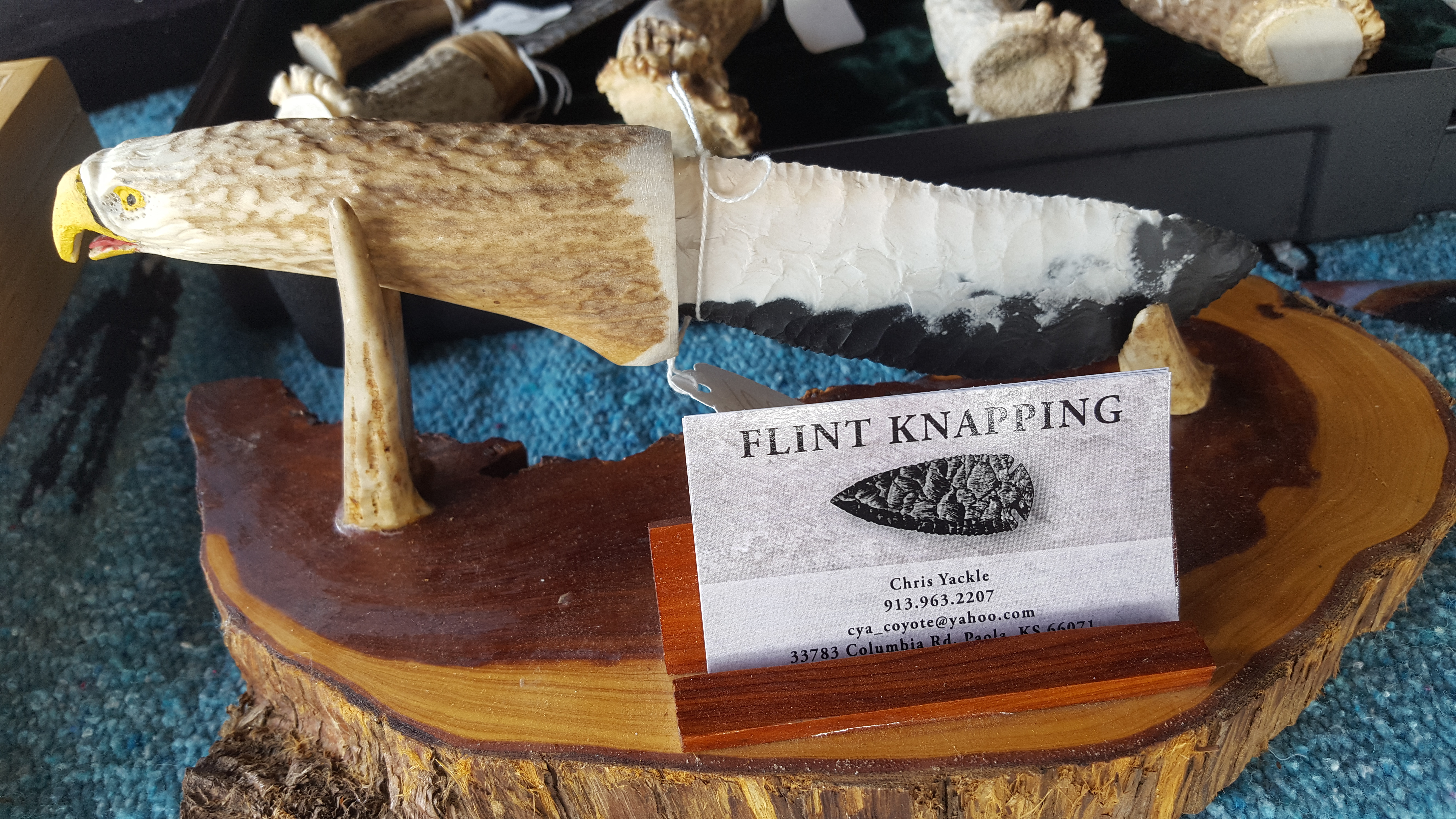
A picture of Chris Yackle’s favorite knife.

Flint knapping came about in England as a way to make flints for flintlock rifles. Yackle says that although some stone here in America is called flint, the only true flint comes from England where the process originated. Chris says that in school, he had no use for physics or geometry and couldn’t see how he would ever use either in life. Now however, he finds flint knapping to be all about physics and geometry.

He says “Flint knapping at its core is simply shaping and sharpening a rock. You first decide what you want to get out of a particular rock, and then look the rock over to see how that can be achieved. Look for flaws and cracks you’ll need to work around, figure out where the blade edge can be gotten, then once you’ve pictured and planned the blade or whatever you choose to make from the rock, simply remove all the stone that shouldn’t be there.” He buys most of his stones already precut into slabs from a man known as Bear Carpenter in Wellsville, Kansas, who also became a second mentor to him.

Yackle says the ultimate tool for removing material from the rock is antler, but he usually uses a “billet,” a round wooden piece with a hard copper cap on one end. A piece of heavy leather or other material is laid over his thigh, then the rock is held there with one hand while he slowly and meticulously removes small chips by striking just the right place with the billet until what is left is the finished knife blade.

Nearly all the rock he works with is some variety of agate or jasper; some is from Kansas but most is not. He prefers to use antler for knife handles, but a few are wooden. Once the blade is complete, a slot is cut into the selected handle and the blade is inserted into the slot and held in place with a two-part epoxy.

Yackle’s favorite knife has an antler handle and a blade made from Arkansas Novaculite, the same hard stone used to make Arkansas whetstones which are well known for their ability to sharpen knives. The handle is head of a bald eagle, and the blade has the perfect color and markings to look like an eagle feather. Chris said he had the handle for over a year before finding just the right stone for the blade.

I’m sure Chris Yackle’s great grandfather would be very proud to know that he passed his love for rocks and Native American artifacts down to Chris; sort of a chip-off-the-old-block you could say…or maybe a chip-off-the-old-rock….Continue to Explore Kansas Outdoors!

Steve Gilliland, Inman, can be contacted by email at [email protected].

News From the Oil Patch, Oct. 7

By JOHN P. TRETBAR

Kansas Common crude at CHS in McPherson gained a quarter per barrel on Friday and starts the week at $43 per barrel. The Kansas benchmark had ups and downs last month. CHS reports the average for the month of September for Kansas Common was $46.91 per barrel, although it ended the month at $44.25, down a dollar from the first of the month.

Baker Hughes reported a drop of three oil rig and two gas rigs in its weekly Rotary Rig Count for a total of 855 active rigs across the U.S. New Mexico added four rigs while Texas dropped four. Oklahoma was down three rigs. Canada reported 144 active rigs, up 17 on the week.

Operators are about to spud a new well on a lease in Barton County, and drilling is underway at one site each in Barton, Ellis and Russell counties. Independent Oil & Gas Service reports eleven rigs in eastern Kansas that are moving in, rigging up, drilling or relocating, up one for the week. There are 26 active rigs west of Wichita, which is down three.

The government reported U.S. crude production for July at 365 million barrels, an increase of about 3.5 million barrels over the month before. Total production nationwide through July of this year topped 2.5 billion barrels. EIA said July production in Kansas totaled at 2.81 million barrels in July, or about 90,000 barrels per day.

Oil-by-rail traffic increased by one percent, marking one of only two freight categories to show a weekly increase. During the week that ended September 28, operators moved 12,245 rail tanker cars carrying petroleum or petroleum products, according to the latest report from the Association of American Railroads. Amid declines in total rail traffic, oil-by-rail last week posted its first year-on-year decline in recent memory.

The government reported U.S. crude-oil production last week of 12.38 million barrels per day, down about 92,000 barrels per day from the week before but well ahead of the 11 million barrels produced during the same period last year.

Crude oil inventories increased last week by 3.1 million barrels, but remain at the five-year seasonal average at 422.6 million barrels. The Energy Information Administration reports imports are down 87,000 barrels per day from the previous week. The four-week average for imports is more than 15% below the same period last year, at 6.6 million barrels.

A small lizard found among the dunes straddling New Mexico and West Texas in one of the nation’s richest oil basins is at the center of a legal complaint filed in federal court in Washington Tuesday. Environmentalists want the U.S. government to add the dunes sagebrush lizard to the endangered species list. It’s part of a fight that stretches back to the Bush and Obama administrations and could affect part of the multi-billion dollar energy industry in the Permian Basin.

The merger-and-acquisition frenzy in the oil patch continues. The Daily Oklahoman reports on three mega-deals last week, including the sale of Roan Resources to Citizen Energy Operating. That deal is worth a reported one billion dollars, and includes the assumption of about $780 million of Roan’s debt. Analysis from Austin, Texas-based Enverus notes that the industry’s merger and acquisition activity topped $17 billion in the third quarter and reached more than $85 billion through the first three quarters of this year.

The oil and natural gas industry in New Mexico last year provided more to the state’s annual budget than any other industry, nearly $2.2 billion, or 32% of the $6.88 billion in state funding for schools, infrastructure, health care and public safety. The CEO of the American Petroleum Institute says contributions from oil and gas to New Mexico through leases and royalties grew by $465 million from the year before.

Research into the treatment and possible recycling of oil-and-gas wastewater in New Mexico got a $100 million boost from the U.S. Department of Energy. According to reporting from the Carlsbad Current Argus, the Governor enacted a memorandum of understanding with New Mexico State University last month to begin studying how to treat and recycle produced water in the desert state. The school then announced its College of Engineering was awarded a five-year federal grant to create what’s being called the Energy-Water Desalination Hub.

Copyright Eagle Radio | FCC Public Files | EEO Public File