We have a brand new updated website! Click here to check it out!

Cybersecurity expert offers tips on keeping your data safe

Dallas Haselhorst, founder of TreeTop Security, discusses cybersecurity at the Hays Public Library on Wednesday night as he wrapped up a series of sessions to mark Cybersecurity Month.

By CRISTINA JANNEY
Hays Post

Your data is today’s gold.

Dallas Haselhorst, founder of TreeTop Security, discussed cybersecurity at the Hays Public Library on Wednesday night as he wrapped up a series of sessions to mark Cybersecurity Month.

“At the end of the day, there are a lot of people’s livelihoods that get affected adversely by getting hacked,” Haselhorst said.

Sixty percent of small business go out of business within six months of a major cyberattack, he said.

“That’s people’s jobs. That’s people feeding their families,” he said.

One misconception is that technology — anti-virus software or firewalls — will protect you from cyberattacks.

Attackers are going to go after wherever your business or home is weakest. If you are a business owner, Haselhorst suggested offering cybersecurity awareness training for your employees. At home, hackers will target the most vulnerable, too. That could be parents, kids or seniors.

“People say, ‘I don’t have anything that an attacker would possibly want,’ ” Haselhorst said. “That just couldn’t be further from the truth.”

Some of this information can include:

  • Credit card and financial information
  • Medical data and insurance information
  • Computer resources
  • Use or your email credentials

Medical data is seven times more valuable than credit card data, Haselhorst said. Credit card companies are getting exceptionally good at stopping fraud, he said. With medical data a scammer can perpetrate identity fraud, prescription fraud and insurance fraud.

You can change a credit card number, but you can’t change your Social Security number, Haselhorst noted.

Hackers can use your computer for nefarious purposes. They can use it to send ransomeware. They can use it as a jump point, which is when your computer is used to attack someone else.

“The FBI has unfortunately kicked down wrong doors before thinking someone has child pornography things on their computer,” he said.

Your email is tied to many other aspects in your life, such as resetting passwords on your bank account.

“If you think there is nothing on my computer,” he said, “there absolutely is in every single situation.”

Backups are one of the only guaranteed ways to get your information back from ransomware.

“In doing IT for the past 20-some years, one thing I can tell you is that I have seen time and time again somebody says, ‘We have backups. We have tons of backups.’ You go back and find they don’t have any backups and they haven’t been backing up for the last six months,” Haselhorst said.

Thirty-five percent of users never have backed up their data. Only 6 percent of users back up daily.

He also warned against leaving a USB drive or an external hard drive plugged into your computer. If your backup device is attached to your computer, it can be ransomwared too. Use the Cloud or disconnect your backup device.

Every day, 360,000 pieces of malware are released. Keep your devices updated. Most updates contain security updates. This includes operating systems on computers, tablets and cellphones.

Anti-virus software needs to be updated every few hours to keep up with the onslaught of malware. Browsers matter too. Haselhorst said Microsoft is no longer recommending using Internet Explorer.

Devices in the realm referred to as “the internet of things,” such as dog food feeders and surveillance systems, do not update automatically. Alexa, Google Home, a lot of the doorbells and thermostats do update automatically.

Passwords are still important to protecting your data. Don’t write down your passwords and stick them on your computer.

If you store passwords anywhere on your computer in a Word, Excel or Notepad document, these can be easily found by hackers.

You can use secure password managers, such as LastPass, KeePass and 1Password to keep your passwords safe. These applications will allow you to store all your passwords in one secure place. You unlock the program with one long password. The programs can also autofill passwords and usernames on your device.

If you use a password manager, you can use a different password for every account. If one account is compromised, that is the only data that is at risk. You can also use randomly generated passwords because you don’t have to remember them all.

“Everyone has heard about the breaches in the news. There is like a breach everyday. What happens is the systems get breached, and the hacker pulls down the password and username database,” Haselhorst said.

“What happens with that password and username data is you can get Gina’s email address and password and then I’m going to try it on Facebook. I’m going to try it on her bank account. I’m going to try it every single place I can think of that she might have an account for.”

Ninety-five percent of passwords are shared within their household. Fifth-nine percent of people use one password for all accounts.

Avoid using passwords that can easily associated with you. These include:

  • Address
  • Phone number
  • Pet name
  • Birthdate
  • Sports teams
  • Child’s name

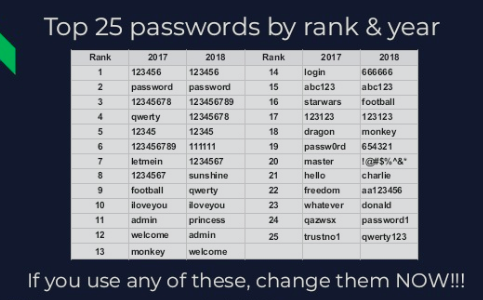
Haselhorst recommends passwords of 16 to 18 characters. Length is more effective than complexity. He suggested using password phrases, such as MysonwasbornNovember1995! versus P@ssw0rd.

Haselhorst discussed ways to keep you safe from malicious links. These included verifying the link, hovering over the link, giving it the sniff test and finally clicking if it passes all of the previous three tests.

You may receive an email from someone you know, but red flags could be in the subject line, strange wording, an odd signature or a strange link, especially those outside of the U.S. To hover, let your cursor rest on the link without clicking. This will show where the link is actually going to take you.

Hackers can have a link that says anything in the text of an email or text, but it may take you to a completely different site. If there are numbers in the URL instead of letters, don’t trust it, Haselhorst said.

Scammers will also try to use condensed links to hide where they are really taking you. You can use www.linkexpander.com to find the expanded address.

You can also receive links through SMS messages. Is the message expected and from someone you trust? You can “hover” on a tablet or cell phone with a prolonged press on the link.

Scammers will also use a sense of urgency both online and over the phone to get you to click on links or had over sensitive information. Companies like Apple and Microsoft are never going to call or email you personally, Haslehorst said, although scammers are using their names.

Ninety-two percent of all malware is delivered by email. Stop and think before you click on attachments. Are you expecting the email? Are you expecting the attachment? Don’t enable editing if macros have been disabled.

Scammers will also using “phishing” or “whaling” to create a targeted attack. Haselhorst gave the example of a scammer using the name of the CEO of a company to send an email to the CFO of a company asking him or her to set up an illegitimate vendor or account. The scammer then asks the CFO to deposit money in the bogus account.

When individuals are targeted, scammers might ask for gift or prepaid credit cards or financial information. Technical safeguards are not effective in stoping these scam.

“These are emails. This is text,” Haselhorst said. “There is nothing on the planet that is going to stop these things except who is sitting in a chair. Somebody is going to have to think about that.”

Robocalls continue to be an epidemic in this country. Remember scammers can make the number look like it is coming from your local area. If you have any question about who you are talking to, hang up and call back on a published number.

Other general security tips include use caution when attaching phones or other devices to your computer that could infect your computer with malware. Be careful of WiFi hotspots and avoid public computers.

Haselhorst also noted even trusted websites can be hacked and be hosting malware.

You can contact TreeTop Security at www.treetopsecurity.com or 785-370-3444.
KDWPT offers new details on mountain lion killed in Rooks Co.

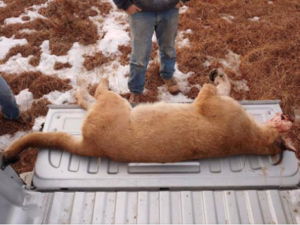
Photo courtesy KDWPT game wardens

The Kansas Department of Wildlife, Parks and Tourism has offered new details about a mountain lion kill in Rooks County earlier this year.

The mountain lion, found in late January, was shot and killed by bird hunters, according to the KDWPT.

The department sent tissue samples to the U.S. Forest Service’s Rocky Mountain Research Station in Missoula, Mont., for testing.

The results showed the male mountain lion had a 99.8 percent probability of belong to the South Dakota/Nebraska breeding population, which includes animals sampled from the Black Hills of South Dakota and western Nebraska, according to KDWPT.

For more information about wildlife sightings or other rare encounters, click HERE.

Preventing identity theft is topic of meeting

“How to Prevent Identity Theft” will be the topic of the Hays After 5 Christian Women’s meeting from 7 to 8:30 p.m. Monday, Nov. 11. The event will take place at the Rose Garden Banquet Hall, 2250 E. Eighth.

Speaking will be Kristen Schmidt with the Hays office of the Northwest Kansas Area Agency on Aging.

“This is a topic that all women need to be educated about, so we invite women of all ages to attend,” said Linda North, program chair.

Also on the program will be inspirational speaker Marti Ford of Topeka. Ford said for several years she lived in fear and tried to control life. After several tragic events, including divorce, she said she began to see that some of her problems were “self-inflicted.”

Ford will share how she took steps to be an “overcomer” in her presentation titled “Moving From a Life of Fear to Trust and Peace.”

Cost of the dinner program is $12.50. Reservations are due by Thursday to (785) 202-1036 or to [email protected]. Hays After 5 is affiliated with Stonecroft Ministry of Overland Park.

Cover photo courtesy https://www.canstockphoto.com

School district facing rewrite of capital improvement plan

By CRISTINA JANNEY

Hays Post

The director of buildings and grounds told the Hays school board on Monday it could no longer wait to make repairs on some of its older buildings.

The school district had postponed some major repairs, especially on the older elementary schools, because it had hoped to pass a bond issue to build a new elementary school and make other repairs.

However, two bonds have failed since 2016. Although the school board discussed mounting a third bond attempt, no plan ever took shape.

Rusty Lindsay, buildings and grounds director, told the board he was going to have to significantly rewrite his capital improvements plan, because issues at Wilson and O’Loughlin elementary schools were becoming serious enough they could no longer wait.

Lindsay said he hoped to have the revisions to the school board by January.

Repairs to leaks at the transportation shop also can no longer wait, he said. The repairs are likely to be costly, Lindsay said, because there is asbestos that will have to be removed during the repairs.

Work to the Roosevelt Elementary School roof is set to begin in the next week and a half, weather permitting. The district also finally received an order of locks to finish replacing interior door locks at Roosevelt, Hays Middle School and Hays High School. The locks at Roosevelt will be replaced over Christmas break, and the locks at HMS and HHS will replaced over spring break.

Buses

Russ Henningsen, director of transportation, came before the board to request the purchase of two diesel route buses and one gas route bus as part of the district’s five-year transportation plan.

The bids on the buses were updated Monday. The total cost for the buses will be $283,987, which was $20,013 under budget.

Board member Greg Schwartz asked Henningsen about the possible purchase of a coach activity bus. He said that was a possibility, but he recommended the purchase of the route buses this year, because they are needed more. They also are less expensive than the coach buses, which can cost about $240,000.

Superintendent Ron Wilson acknowledged a new activity bus is needed. He said the district could include that purchase in its transportation purchases for the next fiscal year. If it ordered the bus in July, the district should have it delivered before the end of the fall semester 2020.

The school district transports about 335 students per day 541 miles per day on its regular daily route. When activities are added in, the district is averaging 1,900 miles per day and 561 passengers per day.

Henningsen said the district needs all of the buses it has now. It has eight route buses and five activity buses. He said it is not uncommon to have all five activity buses out at one time. The district also uses activity buses for spares when route buses break down.

HAWVER: Revenue report will set the stage for Kan. policy decisions

Martin Hawver

The Kansas Statehouse is going to shake Thursday afternoon, when a group of economic/tax/business experts deliver the Consensus Revenue Estimate (CRE) for the state for the upcoming fiscal year.

That obscure document will become the legislative basis for the budget for the remainder of this four-month-old fiscal year, and the number on which the upcoming legislative budget machinations will be based.

And…while the state is looking a little better in terms of revenues—that’s the taxes you have paid—there remains all that talk about a recession that would reduce state receipts.

While the CRE talks about the state of the Kansas economy and makes observations and predictions about the state’s health, the real key will be the prediction of the movement up or down and by how much of the State General Fund (SGF).

It is the SGF which is the fuel for almost everything Gov. Laura Kelly will propose in her upcoming—second—budget as governor, and almost everything the Legislature will do in this upcoming session, after which House and Senate members will stand for re-election.

Will there be enough revenue flowing into the SGF to make good on its spending approved last session for the remaining months of this fiscal year? Will there be enough revenue flowing into the SGF for meeting the state’s expenses, to pay the bills that it agreed to last year?

And…will there be enough money to expand programs that are beneficial to the state and its people, and which people?

Nope, the CRE isn’t likely to become the topic of discussion in many bars across the state, but it is going to be a major factor when the upcoming session convenes in January.

If revenues remain stable…well, that’s good news because it probably means that the state can meet its obligations—and remember, those obligations include a boost in spending on K-12 schools over the next four years which lawmakers approved last session and which the Kansas Supreme Court is going to enforce if necessary.

But for nearly everything else ranging from spending on highways to raises for state employees to ever-increasing spending on social service programs and just keeping the lights on, that CRE is the key to how Kansans live.

Will there be spare money for some sort of tax cuts that we all like? Enough that the revenue stream from, say, sales tax on food can be reduced through a tax reduction, and keep everything else running? Enough that the state can expand Medicaid to maybe 130,000 Kansans without health-care insurance, at an estimated cost of maybe $40 million?

Those are all the downstream calculations that are going to be made based on that CRE memo we’ll get later this week.

Putting together that CRE has been going on for several weeks. It’s this week that the Division of Budget, Legislative Research, the Department of Revenue and three economists from state universities will assemble their final best-guess of the money that is going to be available to finance state government for the rest of this fiscal year and next.

Remember, this is the election year legislative session, and while one can expect a little reach by lawmakers who want something catchy to campaign on, bullet points for their palm cards, such actions will cost the state money, or reduce income to the state.

And remember, also, that we are heading into an election year in which the governor’s name isn’t going to be on the ballot, and she’ll be looking into the future when she can stand for re-election and would like to have some nice moves to use in that 2022 election year.

Happy Thursday?

Syndicated by Hawver News Company LLC of Topeka; Martin Hawver is publisher of Hawver’s Capitol Report—to learn more about this nonpartisan statewide political news service, visit the website at www.hawvernews.com

Exploring Outdoors Kansas: Mud on the boots

Steve Gilliland

This time of year, when the eight-letter word “football” fills many people’s thoughts, our thoughts as hunters and trappers should dwell on another eight-letter word, “scouting.” Here in the farm country of the Midwest, game movement patterns often change from year to year and even from season to season because of annual crop rotation, weather extremes and habitat changes, among other things. Although many good hunting and trapping hotspots produce game and fur year after year, many do not because of these factors.

Annual crop rotations play a huge part in the daily lives of wildlife. Where we used to hunt deer in southern Meade County, the terrain is rather bleak and the main crop by far is wheat. There’s always some hay around for deer to eat, but the tender green wheat is their mainstay. Any changes in wheat field locations from year to year mean certain changes in deer patterns and often in their home ranges. Here around McPherson County, annual crop changes don’t have such a drastic effect because there’s always an edible field crop of some sort near a deer’s chosen home range. Crop changes here effect wildlife movement most of all. For instance, tall crops like corn and silage offer excellent cover for deer and coyotes as they travel. Movement or harvest of those crops probably won’t change where these animals hunt, feed and bed, but it will often change the way they travel to get there.

Weather extremes, namely droughts and floods change wildlife patterns dramatically. Floods have a very temporary effect as they dictate where wildlife can and cannot travel, feed, hunt and bed during those times of high water. When the waters recede, life soon goes on again as usual. Drought on the other hand can have a long-lasting effect on wildlife patterns as they are often forced to relocate nearer to the few sources of water.

Habitat changes probably have the most effect on wildlife patterns. Removing overgrown tree and fence rows, bulldozing old orchards, tearing down and cleaning up old buildings in overgrown woodlots and even new construction such as building a new home on a previously empty and overgrown lot all destroy travel ways and hunting areas of local wildlife.

So, what to do? It’s called “mud on the boots!” Physically getting out into the areas you plan to hunt and trap before season is the only way to compensate for man and natures changes. Trail cameras are a good way to do that’ especially for deer. Hanging it near a trail will soon show you if the trail is used, by what and how often. Another good way is scouring the area for tracks. Be it deer, raccoons or coyotes every creature has four feet and wherever you find tracks you can bet the animal belonging to those four paws was mighty close! Last week I drove into and walked some new property I have permission to trap. I was becoming disappointed at the few coyote tracks I saw…until I crossed over a brushy overgrown lane into another field and suddenly found more coyote tracks than I’d ever hoped to see. I had walked that field this summer and found nothing, proving my point about seasonal wildlife patterns.

Even in this age of digital trail cameras and GPS technology the best and most reliable scouting tool available to the hunter and trapper is still the farmer and land owner. If you have permission to harvest game on their land, they are usually more than happy to talk with you about where and when they see that game, especially deer and coyotes, and no one knows that better than the farmers.

Just like we have to find new ways to travel around construction projects, or choose a new place to shop when our favorite grocery store is closed, so wildlife must adapt to the ever-changing world in which they live. So, to remain successful harvesters of that wildlife, we must occasionally get “some mud on our boots” and adapt our harvesting strategies to their changes…Continue to Explore Kansas Outdoors.

Steve Gilliland, Inman, can be contacted by email at [email protected].

Grow Hays accepting applications for board positions

Grow Hays is accepting candidate applications for board of director positions that will open in 2020. There will be three open positions the board will fill.

Prospective candidates must be willing to serve a three-year term. The Grow Hays Board meets a minimum of once a month, on the fourth Wednesday of the month at 3:30 p.m. Board members are occasionally asked to serve on additional committees, which meet as required.

Grow Hays is a nonprofit organization aimed at advancing the economic health and vitality of Ellis County. Long known for its efforts to promote a robust economy through business creation, retention, expansion, and recruitment, Grow Hays continues to develop and maintain strong relationships with local, state, and federal organizations in an effort to bring resources and support to businesses located in the community.

If you have any questions regarding the expectations if they are elected to the board, or the nature of the work required of Grow Hays Board member, call Doug Williams or Ernee Sly at (785) 628-3102.

Candidate applications are available at www.GrowHays.com or at BriefSpace, 219 West 10th. Deadline to apply is noon Nov. 15.

Bridge replacement over Cedar Creek planned in Smith County

KDOT

The Kansas Department of Transportation this week expects to begin a bridge replacement project along K-9 in Smith County.

Crews will be replacing the bridge over Cedar Creek located approximately one mile east of Cedar. Work this winter will consist of constructing a temporary bridge and shoofly detour in preparation for the bridge replacement work to take place next spring. The project is expected to be completed by November 2020, weather permitting.

L&M Contractors is the primary contractor with a total project cost of approximately $2.5 million. For more information, contact Phillipsburg area construction engineer Jim Riener at 785-543-2163 or [email protected].

News From the Oil Patch, Nov. 4

BY JOHN P. TRETBAR

Baker Hughes last week reported another big drop in its weekly rotary rig count to it’s lowest total in more than two years. Across the U.S. there were 822 active rigs, down five oil rigs and three seeking natural gas. Oklahoma was down three, while Texas and New Mexico each dropped two. That makes a decline of 22 oil rigs in the last two weeks.

Independent Oil & Gas Service reports a slight drop in the Kansas rig counts. There are five active rigs east of Wichita, which is down one. In Western Kansas, the count is unchanged at 24 active rigs. Drilling is underway on two leases in Barton County, and operators are about to spud one well in Barton County and two in Ellis County.

The Kansas Corporation Commission signed off on 154 new intent-to-drill notices last month, bringing the year-to-date total to 996. There are five new intents on file in Barton County, six in Ellis County, two in Russell County and two in Stafford County.

Kansas Common crude at CHS in McPherson closed out the month of October last week at $45.25 per barrel. That’s down 75 cents from the week before but $1.50 a barrel more than the price at the start of the month. The average price for October was $44.40 per barrel. Prices jumped $1.25 on Friday, so Kansas common starts the week at $46.50 per barrel.

Operators obtained 31 permits for drilling at new locations across the state last week, which makes 907 so far this year. There were nine new permits in eastern Kansas and 22 west of Wichita, including one in Barton County, two in Ellis County, and one in Russell County.

Of the 32 newly-completed wells across Kansas last week, 17 were in the western half of the state and 15 were east of Wichita. Independent Oil & Gas Service reports four new completions in Barton County (including one dry hole), two in Ellis County, and one each in Russell and Stafford County. Operators have completed 1,167 wells statewide so far this year.

The government reported a slight dip from last week’s record U.S. crude-oil production. But, at 12.55 million barrels per day, the total for the week is still the third-best ever.

The U.S. Energy Information Administration reports domestic crude inventories rose 5.7 million barrels on the week. Stockpiles now stand at 438.9 million barrels, about one percent above the five-year seasonal average.

EIA reported crude-oil imports of 6.7 million barrels per day last week. That’s an increase of 840,000 barrels per day from the week before. The four-week average is about 6.3 million barrels per day, down more than 16% from a year ago.

Total railroad freight traffic continues to drop, and last week oil-by-rail was also down. The Association of American Railroads reported 12,993 tanker cars laden with petroleum and petroleum products for the week ending October 26. That’s down one and a half percent from the same weekly total a year ago. The cumulative total so far this year is up more than 15% from last year.

Continental Resources of Oklahoma City, the biggest player in North Dakota’s Bakken shale formation, reports a drop in third-quarter income, prompted by lower oil prices. Data from the company’s financial report show a 20% increase in average daily production. But third-quarter earnings fell by about half to $158 million, compared to $314 million a year ago.

The decision by the Carlyle Group to abandon a crude-export project off the coast of Texas marks what Reuters called “the start of a shake out” among the nine deep water terminal proposals vying to export U.S. shale oil. The five U.S. crude-export projects currently under federal review would add a combined 8.36 million barrels per day of export capacity, or about two-thirds of current U.S. crude production. The Carlyle facility, which is under review by a different federal authority, would boost that total even more. Its construction partner, Berry Group, has vowed to continue the project.

ConocoPhillips posted higher-than-expected third-quarter earnings despite lower crude prices. This marks the company’s eighth earnings “beat” in nine quarters. BP’s profits fell sharply in the third quarter, but strong refining operations helped the company beat expectations despite a one-off $2.6 billion charge linked to asset sales.

Copyright Eagle Radio | FCC Public Files | EEO Public File