We have a brand new updated website! Click here to check it out!

🎥 Hays Police officers protect, then serve 92-year-old resident

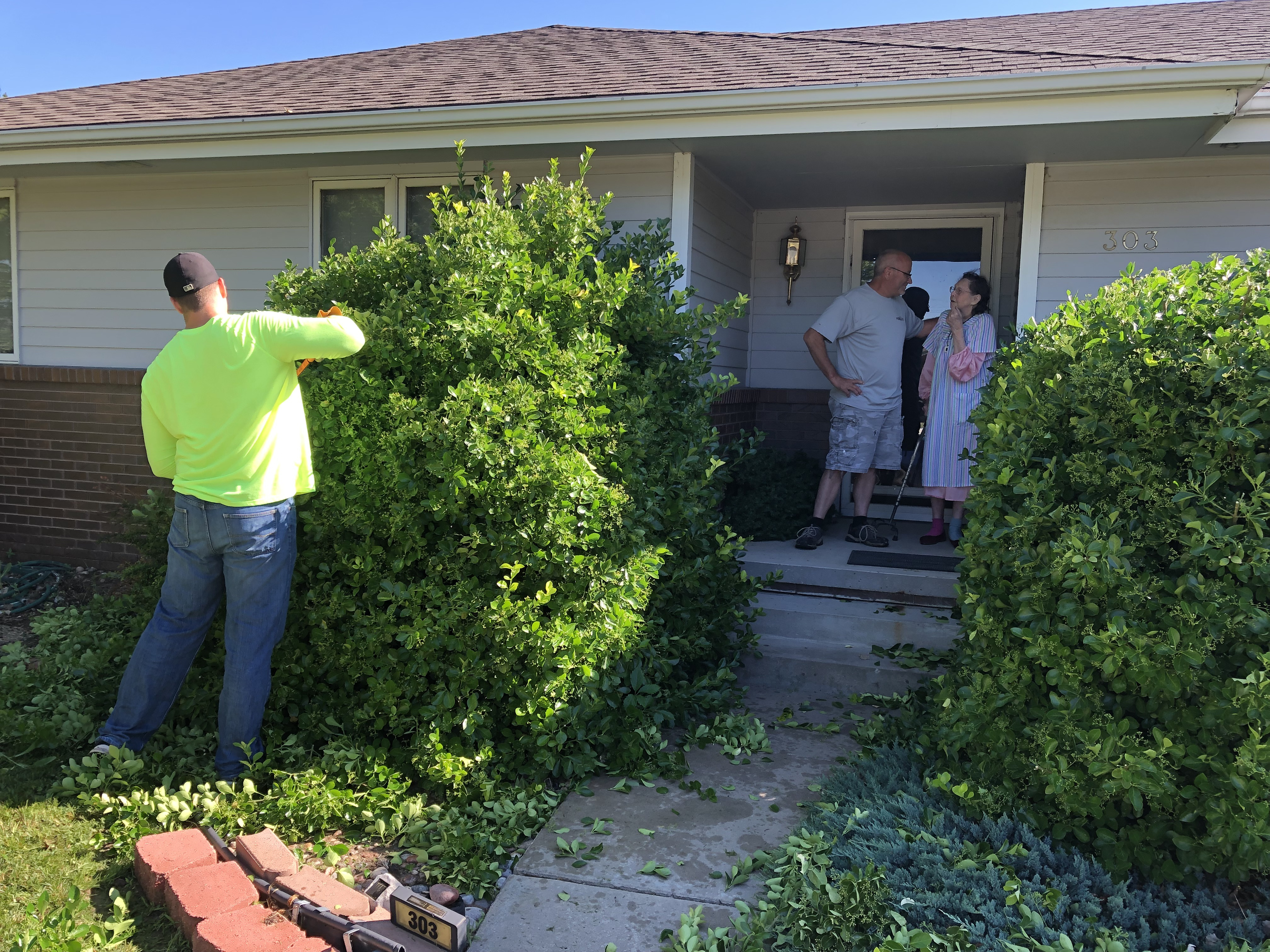
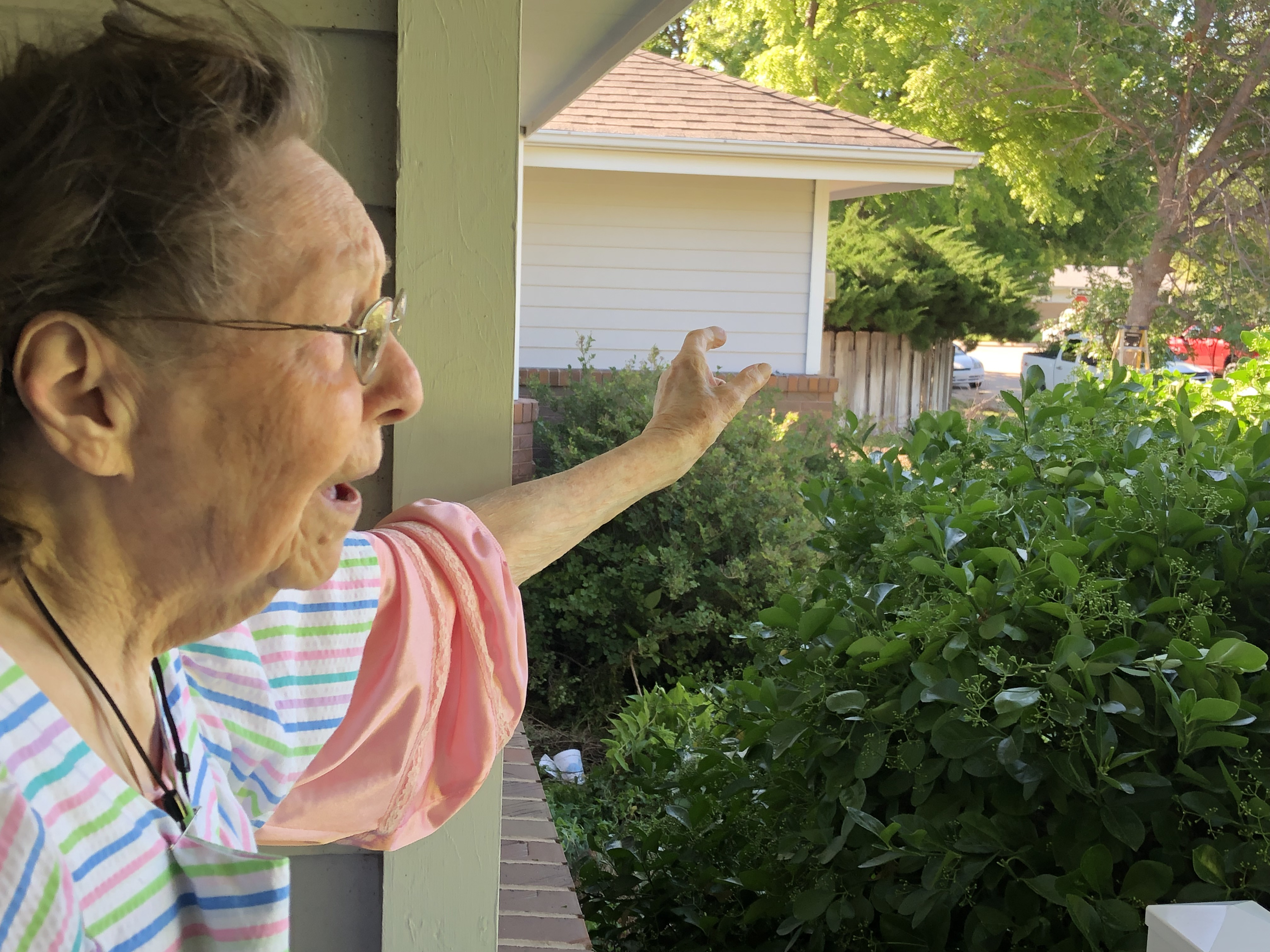
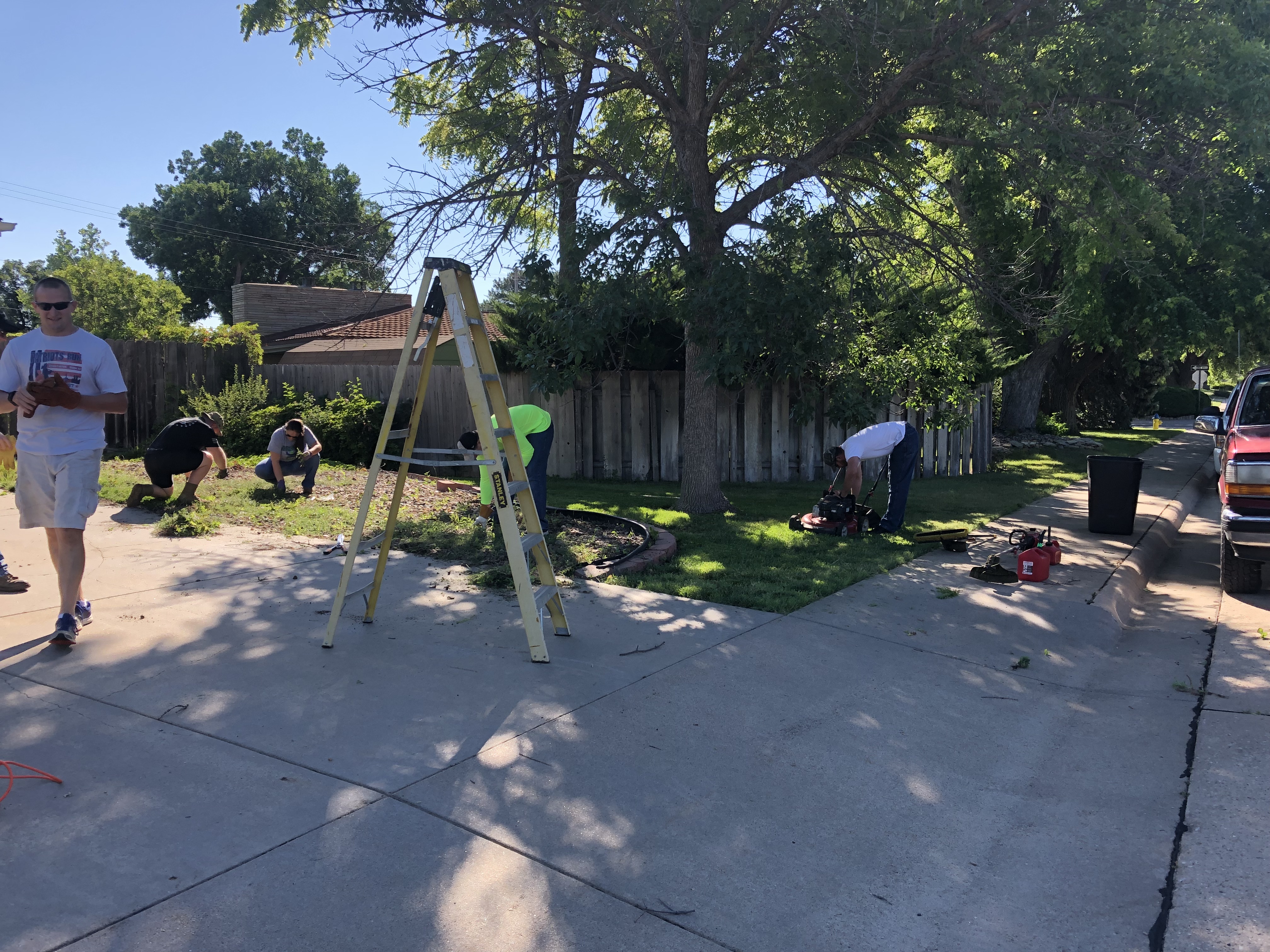
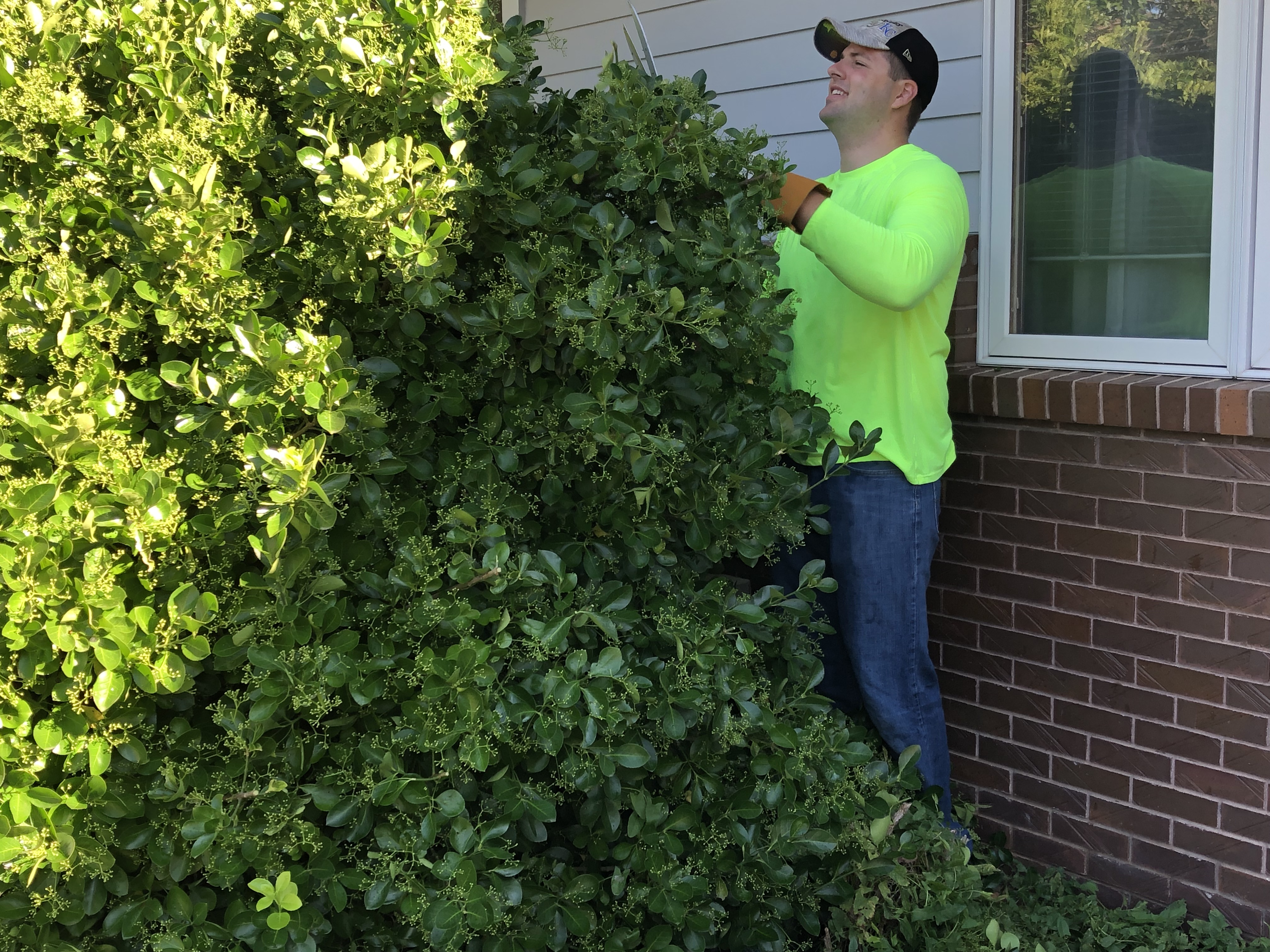
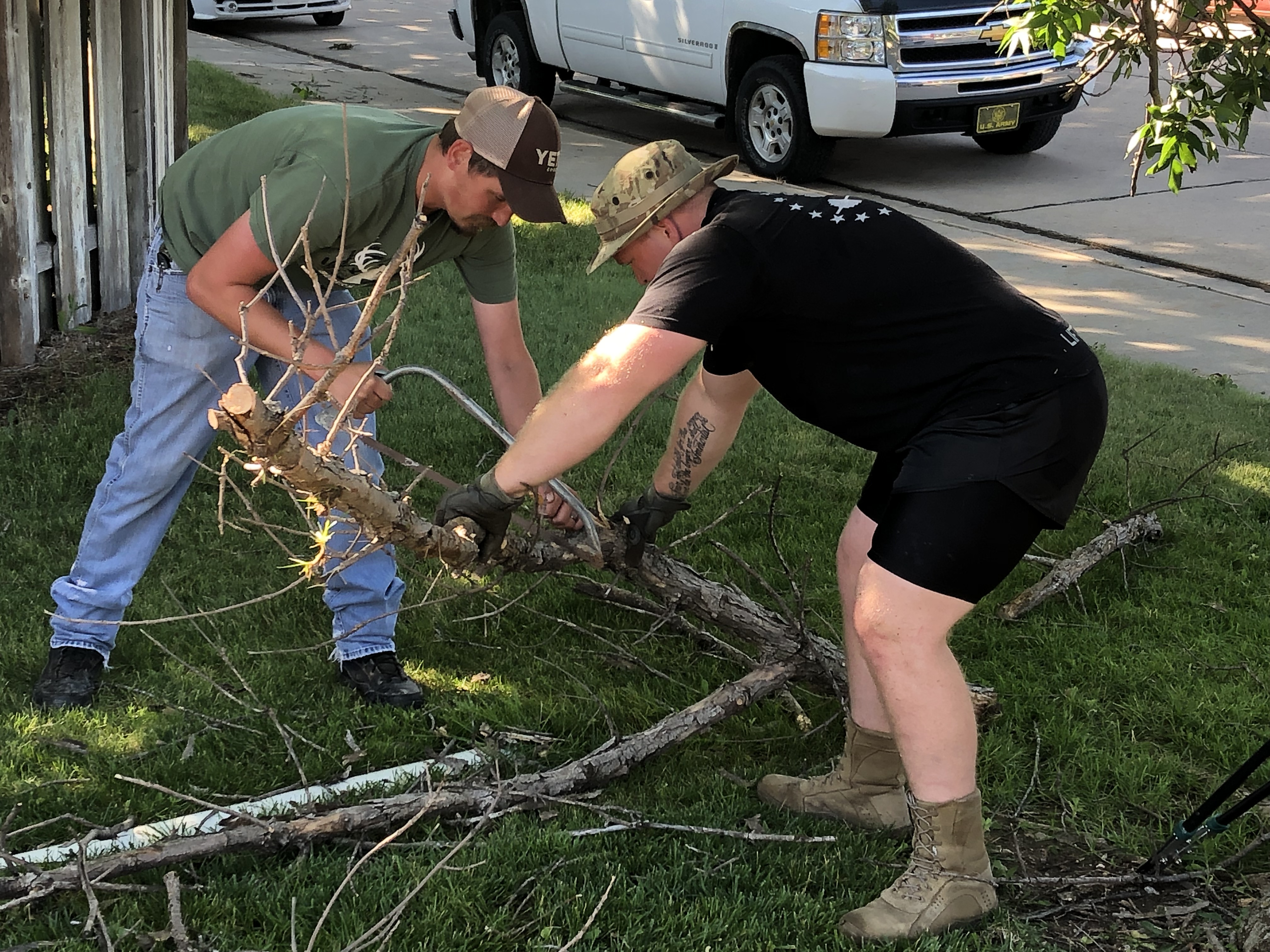
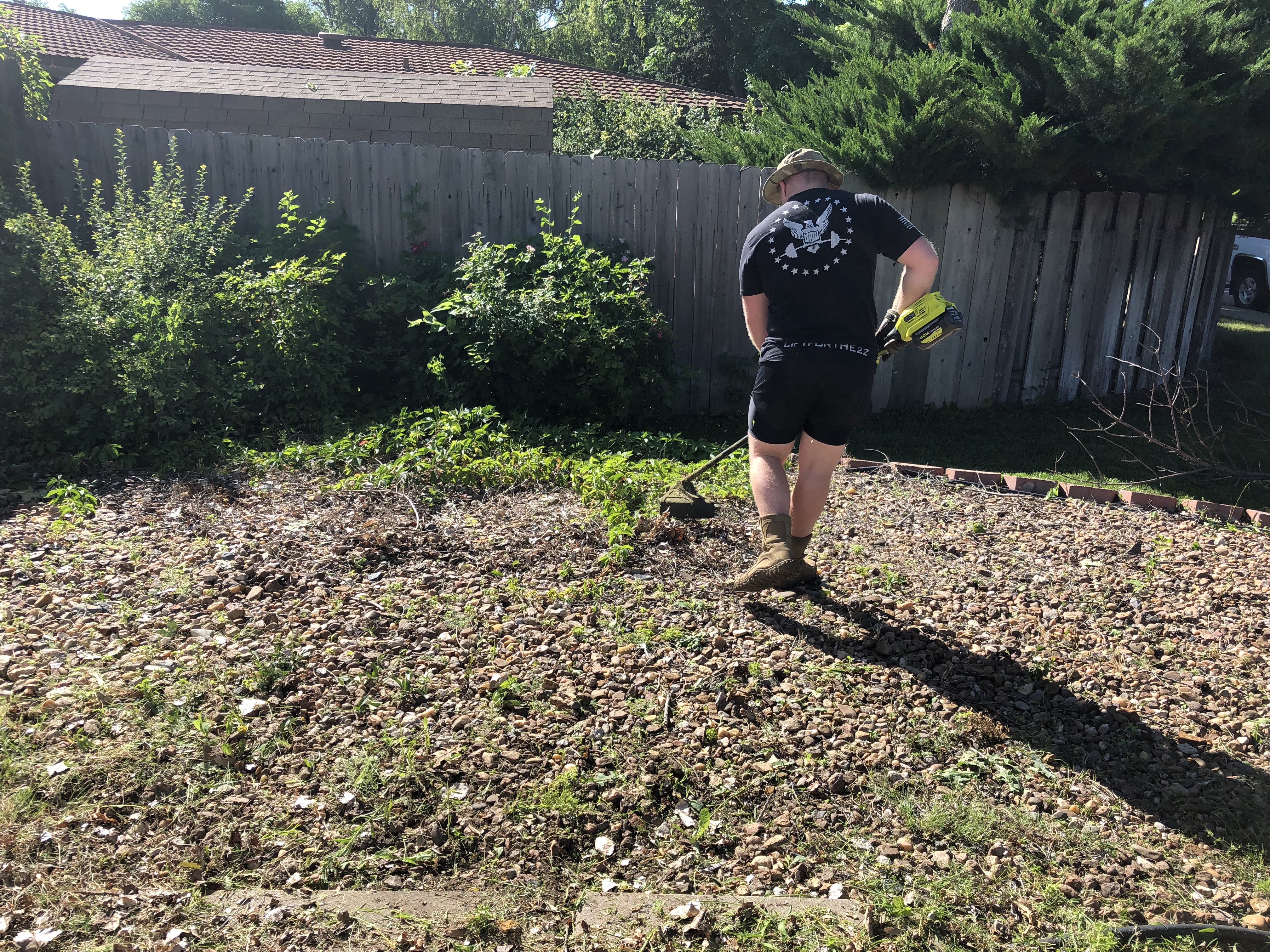
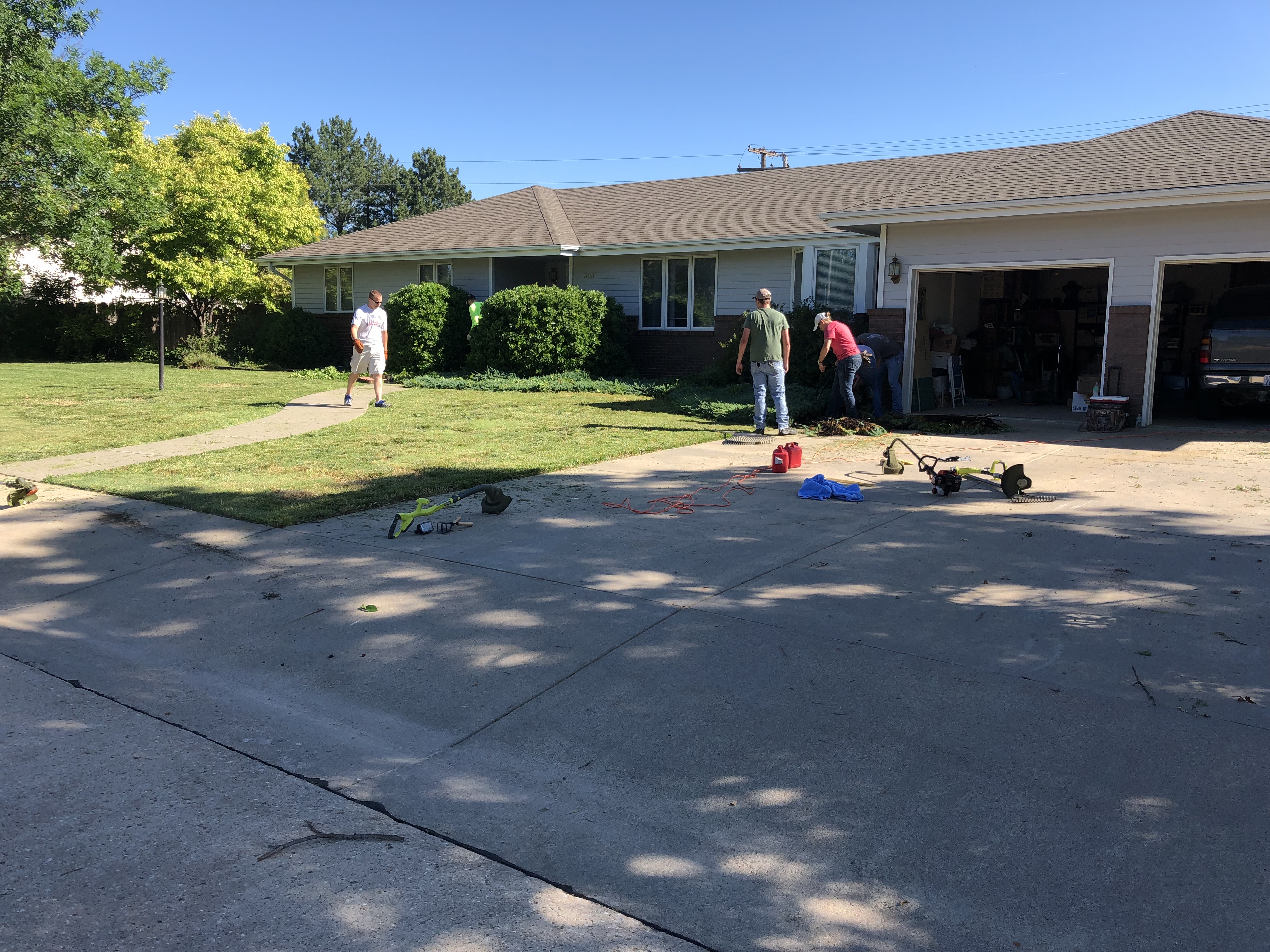
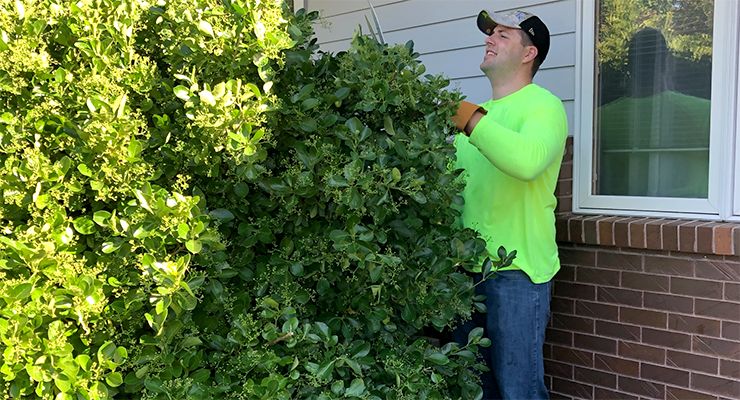
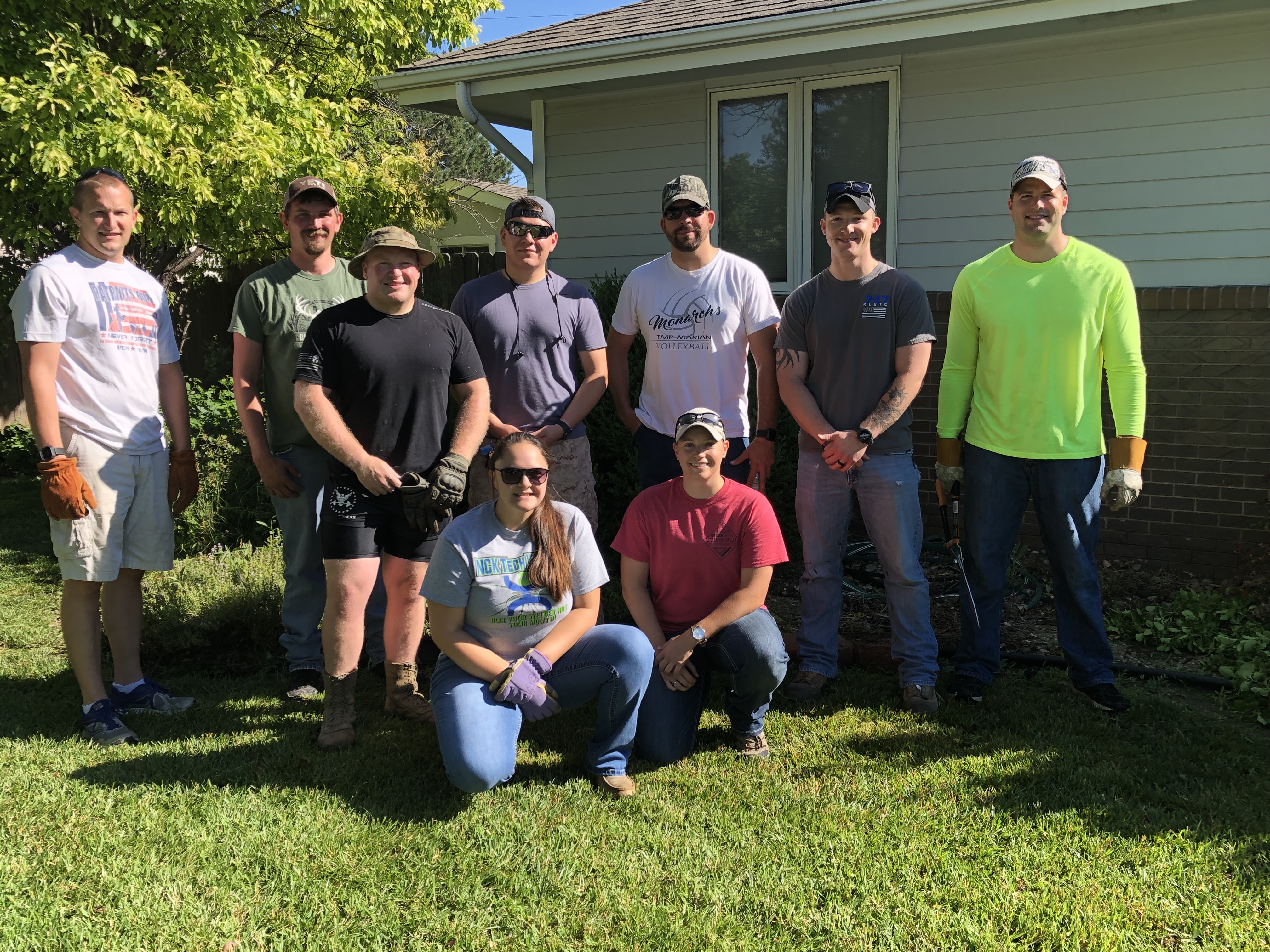
Hays Police Officer Ryan Blecha and the other members of his shift spent their day off doing lawn maintenance for 92-year-old Margaret Vine of Hays. (Back row L to R): Sgt. Brandon Hauptman, Dispatcher Josh Cooper, Ofc. Aaron Ewy, Ofc. Mackenzie Smith, Cpl. Vilaysing, Ofc. Ryan Blecha, Ofc. Scott Heimann (Kneeling) Dispatcher Alanna Hansen, Ofc. Samantha Nielsen

By BECKY KISER
Hays Post

It was their day off, but the entire law enforcement shift that works with Hays Police Officer Ryan Blecha got together anyway.

All nine of them gathered at 9 a.m. to do major lawn maintenance at the home of 92-year-old Hays resident Margaret Vine.

“She really needed her lawn done,” Blecha said during a short break in the frenzy of activity Monday morning.

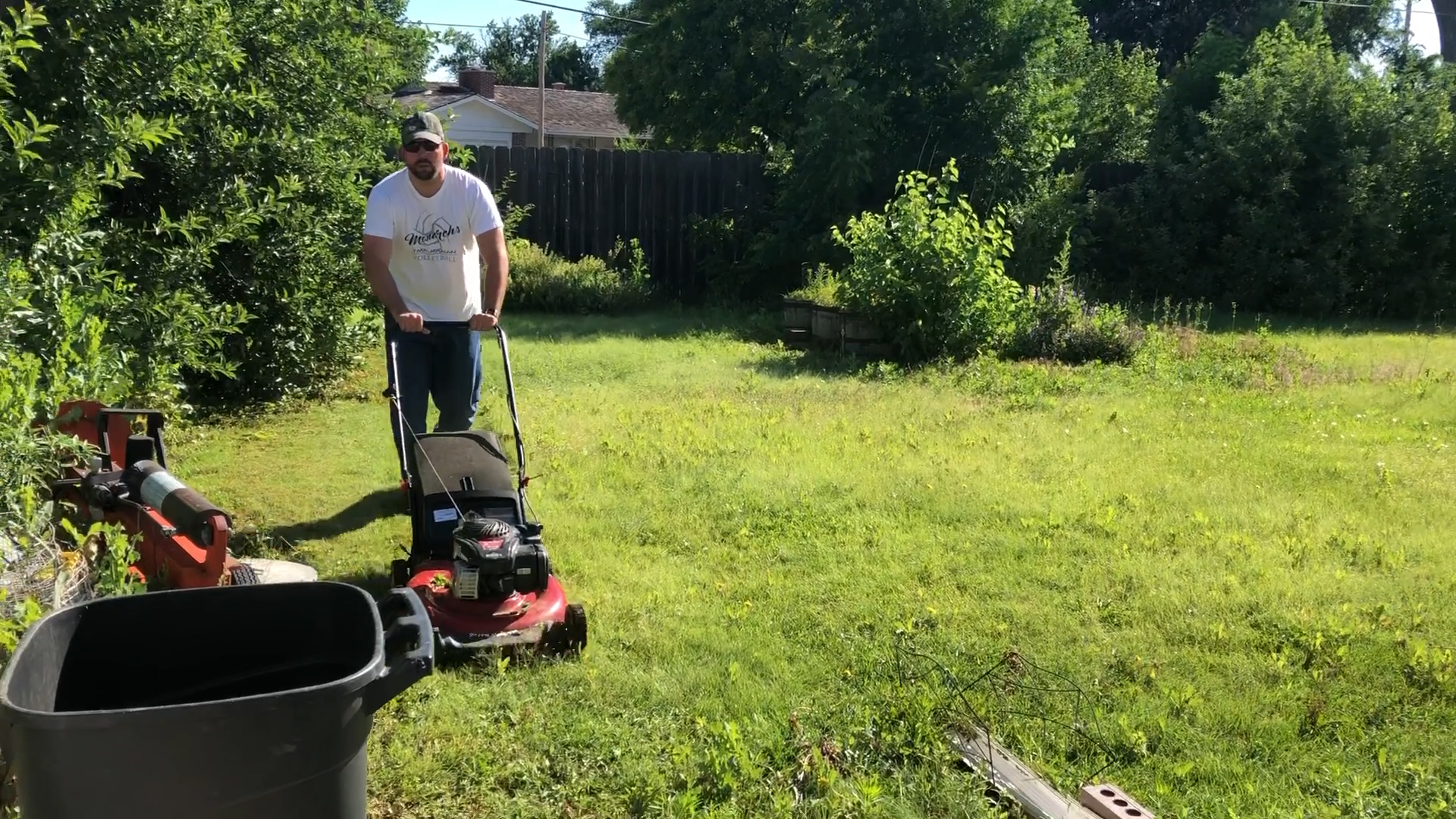
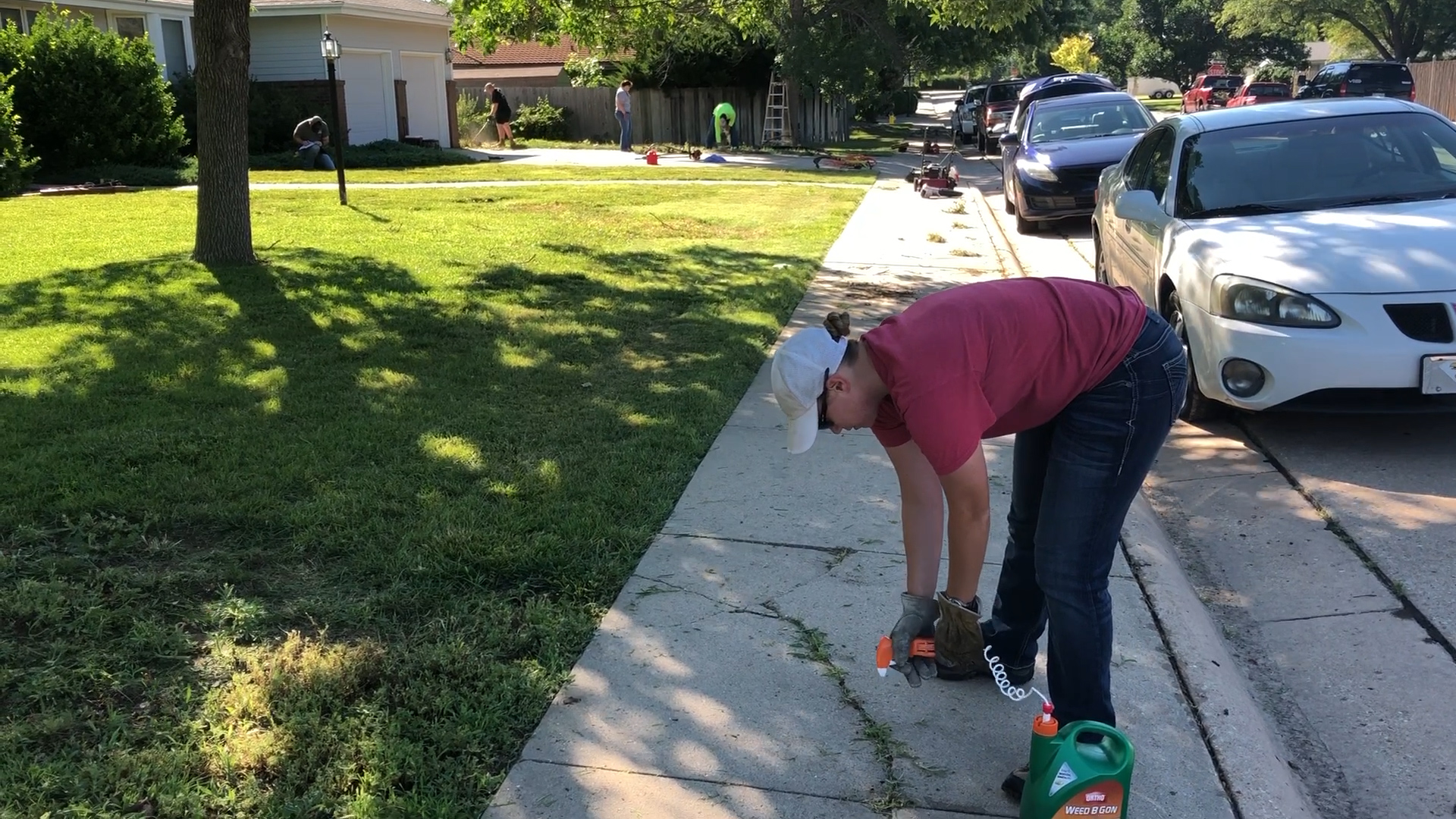
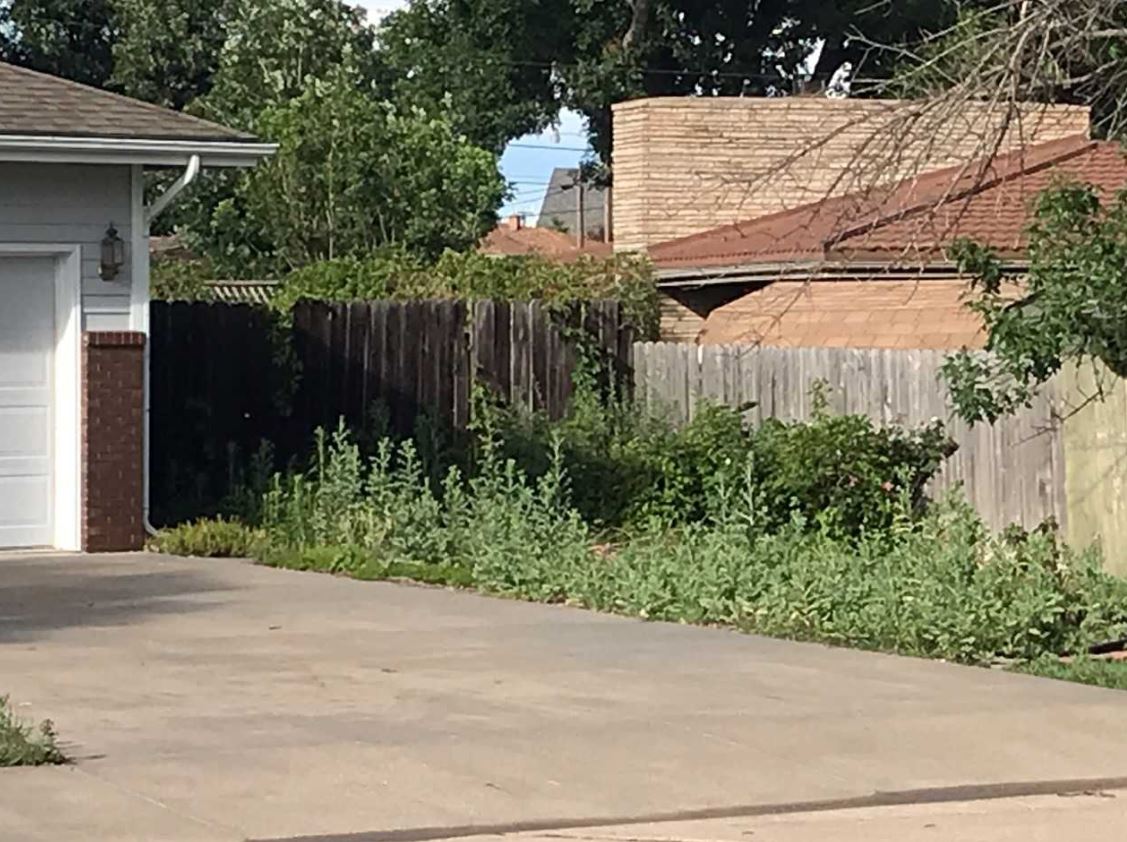
Nobody was in uniform. Instead the seven officers and two dispatchers were dressed in work clothes and boots, with yard and garden tools in hand as they clipped bushes, mowed grass, weeded, raked, and sawed dead tree limbs in Margaret’s large front and back yards.

Blecha saw the overgrown front lawn and landscaping early Sunday morning during a patrol check at Vine’s house in the 300 block of West 25th. Hays Police were called by Vine’s granddaughter when she saw an unfamiliar vehicle and driver in front of their house.

Blecha responded to the call and made sure Vine and her granddaughter were safe. He left his business card with them.

“I saw the lawn was overgrown and didn’t want Margaret to have to worry about calling somebody or getting more help to do that,” he said.

A neighbor across the street, Dennis Budke, came over to check on Margaret when he saw the police car pull up. Budke told Blecha she has a lawn mowing service but “they don’t really do the deep stuff.”

Blecha also gave his business card to Budke, who “offered help with water and other power equipment.”

During a lull later in his Sunday shift, Blecha asked the other shift members if they’d be interested in helping him help Margaret.

“They all said yes,” Blecha said. “Basically, it was all put together in about 30 minutes on shift.”

The group brought their own lawn and garden tools, plus herbicides to kill the weeds. They filled their pickup beds with grass, leaves, bush clippings, weeds and dead tree limbs that were sawed off mature trees and hauled it all to the Ellis County Landfill.

Budke, whose son is a Kansas Highway Patrol trooper in Goodland,  was also on hand during the lawn work, explaining to Margaret exactly what was going on.

When Blecha stepped up onto the porch to greet Margaret, she didn’t recognize him.

“Well, I have the card that nice young man left me last night on my table,” Margaret said slowly.

“And this is him,” Budke pointed to Blecha as he shook Margaret’s hand. “He’s just not in his uniform today.”

Margaret gasped a little as Budke explained everyone swarming over her property is a Hays police officer.

“Oh, they not only keep us safe, they do something like this,” Margaret smiled. “We have a wonderful community.”

The Hays police officers volunteering their time were:

Sgt. Brandon Hauptman
Cpl. David Vilaysing
Ofc. Samantha Nielsen
Ofc. Mackenzie Smith
Ofc. Scott Heimann
Ofc. Ryan Blecha
Trainee Ofc. Aaron Ewy
Dispatcher Josh Cooper
Dispatcher Alanna Hansen
USD 489 election: Engel says bond should be smaller, include only needs

Cole Engel
By CRISTINA JANNEY
Hays Post

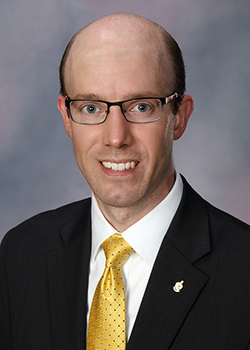
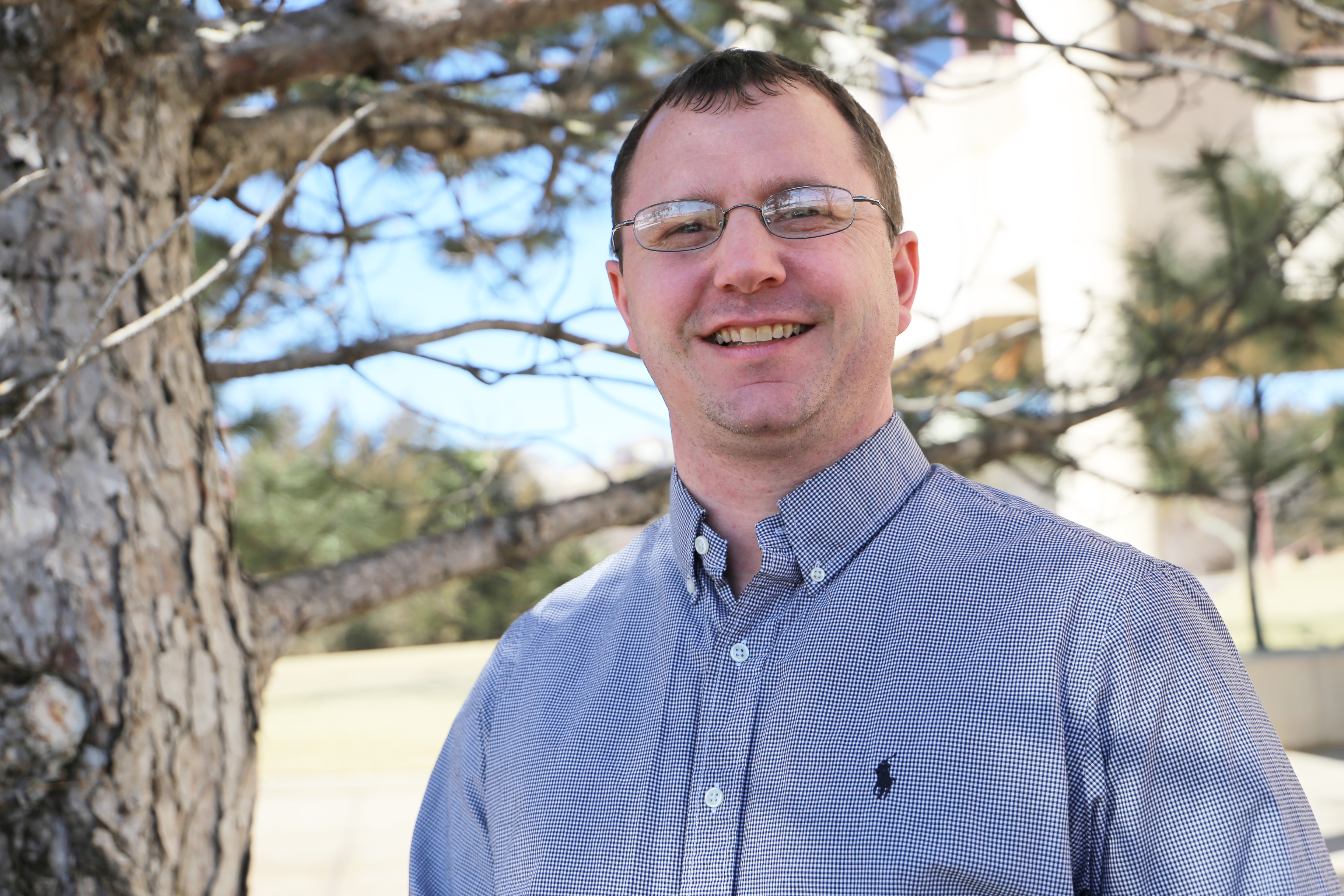
Cole Engel, Fort Hays State University assistant professor of accounting, wants the Hays USD 489 school district to propose a smaller bond issue that only includes needs.

Engel, 36, joins a field of eight other candidates for four open positions on the board, including incumbents Paul Adams and Luke Oborny and newcomers Lori Hertel, Tammy Wellbrock, Alex Herman, Allen Park, Jessica Moffitt and Craig Pallister.

USD 489 has had two failed bond attempts in the last three years — in 2016 and 2017. The board is discussing moving forward with a third attempt.

Engel said he did not support the bond issues in 2016 and 2017.

“I think the school district has a responsibility to educate the public on what exactly the needs are and differentiate the needs from the wants,” he said, “and I don’t think they have done that because if they had, the bond wouldn’t have failed twice.”

Engel said he thought the district underestimated the economy.

“They didn’t have a good feeling or a good temperature of the citizens at the time or what they were willing to support,” he said. “I think they asked for too much, and I don’t think they convinced the citizens what the true needs were versus the wants. I think we went too big too fast and our local tax base just didn’t support it. I didn’t either.”

He said he would like to see the school district find more efficiencies in its budget. If it has made cuts, the district needs to better communicate that to the community, he added.

“I would kind of like to know how we got here. How did we get to the point where we have let deferred maintenance go so long? It seems like we are in this devastating situation financially, but I wonder if it is really that bad?” he said.

Engel said he was encouraged to run for school board by district faculty and staff. At the time he filed, he said he was concerned about what appeared to be a lack of community interest. Only four people had filed for four open positions on the board leading up to the final day to file.

On the day of the deadline, four other candidates filed besides Engel for the race.

“I think another reason why I decided to run is because part of our mission here at the university — our mission statement says — we develop engaged, global citizen leaders,” he said. “Part of our mission as faculty is to encourage our students to participate in their communities and get involved, and I think as faculty members we need to lead by example.”

Engel graduated from Hays High School.

“Service and sacrifice is important. I certainly didn’t get where I am on my own,” he said. “It is time to pay it forward and make sure USD 489 continues to provide the quality education it provided me and the foundation for my success academically, professionally and personally well into the future.”

Engel said now is a good time for education in Kansas and the board has the opportunity to make serious improvements.

“I think the school board needs to remember what its purpose is, and the purpose of the school board is to govern, to set policy, not to manage,” Engel said. “The superintendent and the principals and administration manage, not the school board.”

Engel said one of his goals is to have the board work together.

“We work together as one cohesive board of education, and we are not just a group individual board members,” he said.

The USD 489 school board went to impasse during negotiations with the Hays NEA last year.

Engel has served on the university’s negotiating team for two years and will be the lead negotiator for the faculty next year.

“I think the administration and the faculty should be on the same team,” he said. “There are some different interests there for which the team needs to bargain, but I think it is important that we don’t think of it as sides. We think of it as what’s the issue we’re trying to solve.”

He said faculty is the most important aspect of a school district.

“We have to have good teachers. We have to have dedicated teachers, and we have to take care of those teachers, and it is important that they’re happy,” he said. “If there are communications issues between the board and the teachers or there are communication issues between the administration and the teachers, that needs to be addressed.”

The board also has had split votes recently on purchases for its one-to-one student computer program.

“I think we have to integrate technology,” Engel said, “but it can be over done. I don’t think we need to be using technology for technology’s sake. I don’t think we need to use the newest, most flashy tool just because it’s new and great and flashy.”

Engel does not have children.

He earned bachelor’s degrees in business administration in computer information systems and accounting and his MBA from FHSU and his doctorate in advanced accounting from Northcentral University.

He is a member of the FHSU Faculty Senate, advises FHSU student groups and is a trustee for the FHSU Foundation.

Kansas Farm Bureau Insight: Comparative events

Greg Doering

BY GREG DOERING
Kansas Farm Bureau

There’s something about humans–we always use past events and people to give context to current experiences. Every political scandal, no matter how large or small, is compared to Watergate. Every so often the terminology changes as there become fewer people who lived through an event. When I grew up, the Great Depression was the economic event by which all others were judged. I suspect my grandchildren will come to view the Great Recession in a similar manner. Every basketball star is still judged by the standard of Michael Jordan.

While these provide a reference for people on a national scale, this past month two others have been on the top of my mind. First is the Flood of 1993, which happened before I was old enough to truly understand the devastation it wreaked on the Midwest and in Manhattan where I now live.
In July of that year, rain pounded the watershed of Tuttle Creek Lake, filling the basin to the point that the Corps of Engineers opened the emergency gates on the spillway. The release of some 60,000 cubic feet per second flooded entire neighborhoods.

The “bomb cyclone” that caused so much pain along the Missouri River this spring also contributed to the Corps holding water in Tuttle, which dumps into the Kansas then Missouri and finally the Mississippi. Then May hit and round after round of storms filled the lake to just inches from having to open the gates for a second time. Tensions rose along with the water and by Memorial Day some had evacuated their homes. Thankfully sunshine and controlled releases averted another disaster, but every rain still puts people on edge.

The other event I’ve heard repeated mentions of recently is the 1980s farm crisis. It came up at the Agricultural Relations Council’s annual meeting in Kansas City last week as part of a session on “hot topics” in ag. The ’80s farm crisis featured record production, trade problems, soaring prices for inputs and other factors present today. Panelists said a repeat of the 1980s is unlikely.

The University of Missouri’s Scott Brown noted that while some factors may be similar, farms are structured differently today, and bigger operators have more options when they get in trouble.

Kansas State University professor and agricultural economist Mykel Taylor admitted that two years ago she believed farmers were on the verge of a similar event, but she’s changed her mind. “It’s complicated, but not the same,” Taylor said. “We have our own special drama going on.”

Taylor said debt is increasing and lenders are seeing demand for loan restructuring, but government payments, like the Market Facilitation Program, helped inject cash into farmers’ hands to service their debt. “Those are floating us,” she said. Land prices also have fared better than expected with demand from investors and recreational buyers, giving owners breathing room. And interest rates have stayed low.

Taylor and Missouri Director of Agriculture Chris Chinn both said agriculture will see blue skies again, though neither offered a date. Chinn believes genetic engineering will limit the disease risk not only for crops, but livestock as well. Taylor said big data will help farmers and ranchers make better decisions.
I do know one thing that does not change throughout the ages.

No matter what problem or crisis arises, farmers and ranchers will continue finding ways to stay in the game. It’s what they were made to do.

“Insight” is a weekly column published by Kansas Farm Bureau, the state’s largest farm organization whose mission is to strengthen agriculture and the lives of Kansans through advocacy, education and service. 

Expert: No need for alarm after numerous earthquakes recorded in the area

Over 22 earthquakes recorded in Ellis, Rooks and Russell counties since June 1

By JAMES BELL
Hays Post

There is no need to rush to buy earthquake insurance, according to earthquake expert and Palco resident Don Steeples, despite the 22 earthquakes that were recorded by the Kansas Geological Survey through Ellis, Rooks and Russell counties since June 1.

The largest was rated a 4.5 on the Richter scale, the scale used to judge the intensity of an earthquake, in Rooks County early Saturday.

But despite the increasing frequency and intensity of late, there is little risk of a more damaging earthquake, Steeples said.

Steeples / KU

The fault lines that have caused recent earthquakes are a feature of the geological region called the central Kansas uplift, which is also responsible for the oil found in the area.

“There is a system of faults that run basically from Wichita up through this area and on up all the way through the Black Hills in South Dakota,” he said.

The recent 4.5 earthquake in Rooks County may be the largest residents have felt, but it is not the most significant earthquake known to have hit the area.

While there was no Richter scale at the time, he believes the largest earthquake in the area occurred in 1879, near Stockton, based on newspaper reports.

“If I were going to guess it, in terms of Richter scale, I would guess somewhere probability 4.7 to 5,” Steeples said. “So we know that earthquakes were occurring here before there were any effects from anything that humans have done.”

While the frequency of the earthquakes in the area is unusual, he is not worried about future earthquakes.

“Anytime you get multiple earthquakes in an area, in a month, that is certainly unusual compared to what we saw 30 to 40 years ago,” Steeples said.

The earthquake network Steeples operated in Kansas from 1977 to 1989 recorded about 200 earthquakes.

While the frequency might be increasing, he said the magnitude is limited by geology.

“I would speculate that the biggest earthquake that we could get in this part of the state, with a return period of several hundred years, would be somewhere in the Richter magnitude of 5.5 to possibly approaching 6,” Steeples said. “But certainly nothing above 6.

“I can tell you I don’t have earthquake insurance and don’t intend to buy earthquake insurance,” he said.

While western Kansas might be off the hook for a large, damaging earthquake, Steeples said an earthquake with a rating of around 6 on the Richter scale is possible around Manhattan every 200 years or so, but anything larger is unlikely and he does not expect a magnitude 7 or stronger earthquake to ever occur in Kansas.

“That is based on the maximum length of the faults that are present in the subsurface,” he said.

With earthquake intensity 6 or below, damage to structures is extremely limited when using frame construction, which is common in the area.

“The same thing that you build a building to withstand a 100 mph wind is the same construction that will withstand an earthquake up to a magnitude 6,” Steeples said. “In terms of structural damage that would cause someone to need to rebuild a part of a house, you really don’t start getting into that until you get into the magnitude 6’s in the U.S.”

Even cracked plaster noticed after an earthquake report is not likely a result of any single seismic event.

“It is really difficult to pin the responsibility for a crack in the sheetrock on a particular earthquake,” he said, but instead could be noticed after and attributed to the event.

Steeples obtained a Ph.D in earthquake seismology from Stanford and prior to his retirement served as the McGee Distinguished Professor of Applied Geophysics at the University of Kansas where he specialized in near-surface, high-resolution seismic reflection research, according to his KU bio page.

Dance fundraiser scheduled for Victoria VFW kitchen remodel

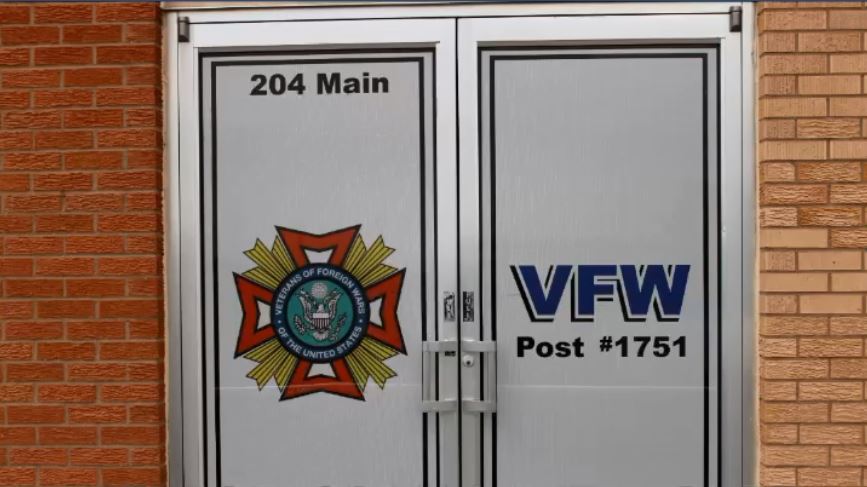
Jimmy Dee and the Fabulous Destinations are putting on a benefit dance Saturday, June 29 at the Victoria VFW Post 1751.

Proceeds will go toward the remodel of the VFW kitchen.

The VFW will be serving hamburgers and brats from 5:30 to 8 p.m. or until the food runs out.

Jimmy Dee will be starting the dance at 8 and go to 11 p.m.

For more information, contact Anthony Pfeifer at 785-365-0780 or Harland Rupp at 785-623-1368.

New publication on integrated pigweed management now available

Stacy Campbell is Agriculture & Natural Resources Extension Agent for the Cottonwood Extension District.

By STACY CAMPBELL
Cottonwood Extension District

A new weed control publication from the Department of Agronomy and K-State Research and Extension is now available. This publication, MF3448 “Integrated Pigweed Management” aims to assist producers in developing an integrated strategy to manage pigweed in summer crops and fallow periods. Used in conjunction with local expertise, this guide can help tailor a targeted strategy for each field.

Pigweed is a summer annual broadleaf that emerges from April through October in Kansas with the majority emerging in May and June. Although there are numerous pigweed species, this publication focuses on Palmer amaranth and waterhemp. Pigweed can cause drastic yield losses and harvesting difficulties in summer crops. Controlling emerged pigweed can be challenging due to its rapid growth rate, which can easily exceed 1 inch in height per day. Pigweed is a prolific seed producer with large plants capable of producing nearly one million seeds.

What is “Integrated Pigweed Management”?

An integrated approach combines many different control tactics such as crop rotation, herbicides, tillage, and row spacing to manage pigweeds in a cropping system and has three main purposes.

  1. Decrease the risk of selecting for resistant biotypes to an herbicide or other management practice.
  2. Reduce pigweed seed population.
  3. Increase long-term profitability and sustainability.

With enough selection pressure, it is possible to select for pigweed resistant to cultural or mechanical practices. For example, shifting crop planting date earlier may select for a biotype that emerges later in the season after POST herbicides are applied, or by implementing sequential tillage operations in fallow, a shift toward alternative seed dormancy mechanisms could occur. With an integrated approach, it is less likely for these types of shifts to occur because the selection pressure is shared among various tactics.

When developing an integrated pigweed management plan, consideration should first be given to cultural control tactics. It is not always possible or applicable to implement all strategies in certain systems; therefore, consideration must be given to how each tactic fits in combination with the other goals of the cropping system (Figure 1).

Figure 1. When developing an integrated pigweed management strategy, cultural practices should be considered first. Too often, it is easy to place all consideration on herbicide and neglect the potential benefits of cultural and mechanical tactics. Graphic from MF 3448, Integrated Pigweed Management, K-State Research and Extension.

Cultural practices are discussed in more detail in the full publication. They include: crop rotation, crop cultivar selection and planting date, cover crops, row spacing, field border maintenance, and seed transfer.

Building an Integrated Strategy

Combining control tactics yields the best results. When developing these recommendations, have realistic expectations and make considerations from a cropping systems point of view. It can be difficult to see direct economic profit from some cultural practices such as narrow row spacing, cover crops, or crop rotation; however, long-term gain will be realized through delaying the onset of herbicide resistance and reduced weed seed production.

Developing Herbicide Recommendation for Pigweed Management

A common pitfall when trying to justify the cost of integrated strategies is through a reduction in herbicide use. This concept is not supported with research, and all integrated strategies still must be combined with a comprehensive herbicide program. Research shows herbicide programs targeting pigweed must have three key components (Figure 2).

Figure 2. Three key components that should be found in every pigweed herbicide program.

More information about each of these three components can be found in the publication.

The full publication, “Integrated Pigweed Management”,  is available online at: https://www.bookstore.ksre.ksu.edu/pubs/MF3448.pdf.

Information provided by Dallas Peterson, Extension Weed specialist, and Marshall Hay.

Harvest off to slow start; yields and moisture levels encouraging

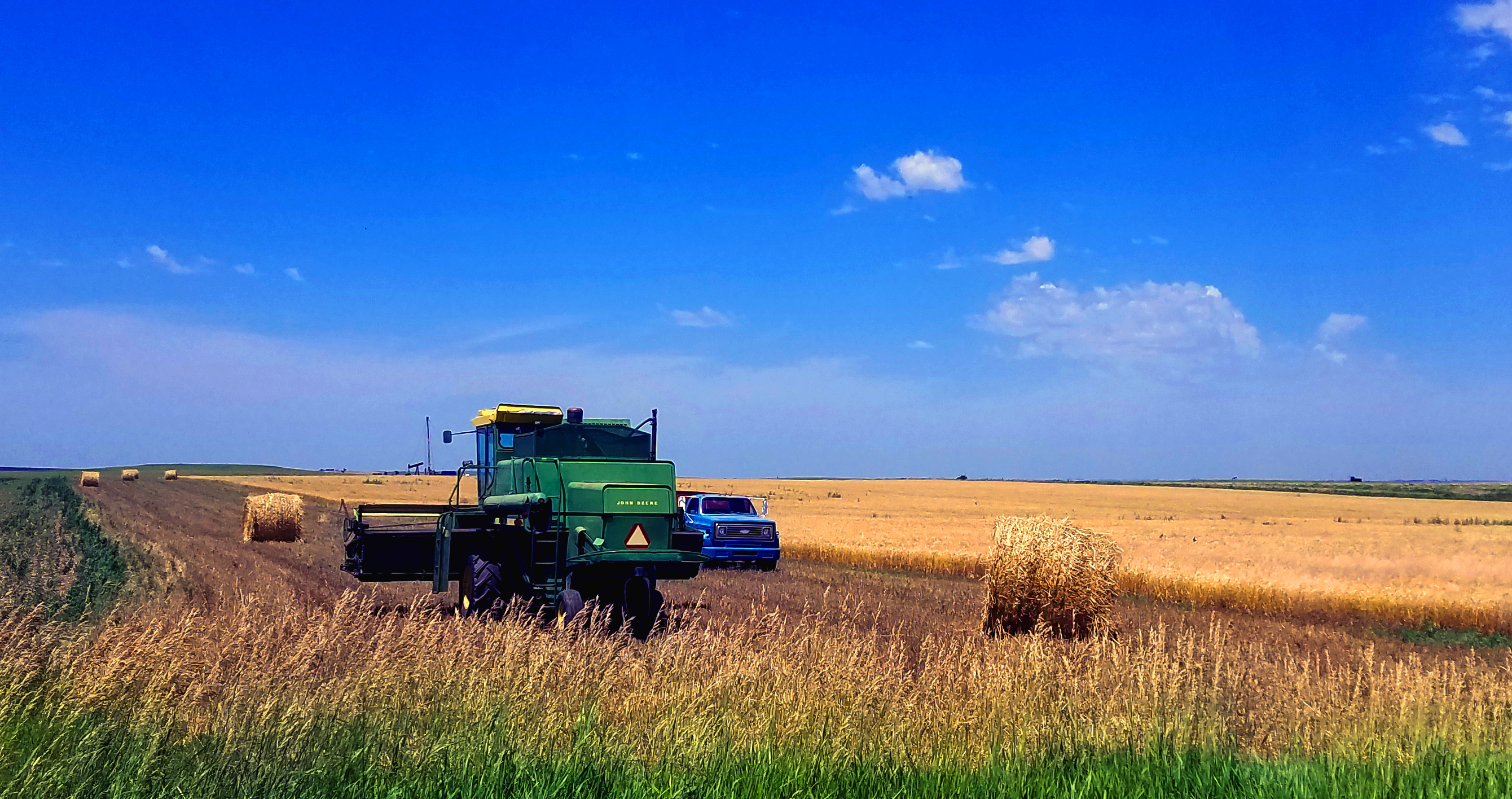
A combine and grain truck sit idle in a field south of Ellis on Wednesday afternoon as the winter wheat harvest in western Kansas gets off to a slow start.

By JAMES BELL
Hays Post

Slowly but surely, the winter wheat harvest around Hays has begun, with early reports showing potentially high yields, due to recent cool and overcast weather following a mild winter.

Midland Marketing in Hays had two loads come in Tuesday night and three more Wednesday morning, according to Brian Witt, Hays coordinator at Midland Marketing.

“We are just getting started. There are only a few guys that can actually cut,” Witt said.

Grain that came to the elevator in Hays had been cut late Tuesday, according to Witt, with nothing being cut on Wednesday as rain threatened to hit Hays.

Through the day, however, rain would not materialize over the area — good news for farmers waiting for fields to dry from heavy spring rains.

But so far, wheat delivered into Hays is showing encouraging yields.

Moisture was running from 11.5 to 12.5, Witt said, with test weights in the lower 60s.

“Sixty-one has been the lowest I have seen so far,” Witt said, “which is really good.”

Protein tests are also on the low side at 10 to 10.5.

“The kernels currently look great,” Witt said.

The elevator in Yocemento was also reporting good wheat numbers, according to Clint Pfannenstiel, Yocemento coordinator at Midland Marketing.

“So far, we have had about 5,000 to 6,000 bushels come in,” he said.

“That wheat is testing 62 to 62.5 test weight,” he said, calling the yields “excellent.”

“Some of it could be 60-70 bushels an acre,” Pfannenstiel said. “It looks really good.”

While wheat is coming in around Hays, the harvest is not yet progressing to the south.

“South of Hays, around McCracken and Brownell, (we) did not take any grain,” Pfannenstiel said. “We are progressing quicker than they are south of here 20 or 30 miles.”

This year’s harvest has been delayed from normal, which is likely to push harvest completion into mid-July.

“Normally we say Father’s Day weekend is about an ideal consistent start,” Witt said. “Anything before or after that is either or late, at least in this area.”

The late start might be unusual, but likely welcome as the conditions that have delayed the harvest are also contributing to the exceptional results.

“The later your harvest is, the better your yield. The earlier it is, the more stress it has been through, or things have gone wrong so it dies off and doesn’t have as much growing period,” Witt said. “With cool weather and overcast skies, the wheat wasn’t drying down, which is actually good. … As far as increasing your yield, you get larger kernels. Everything generally produces better.”

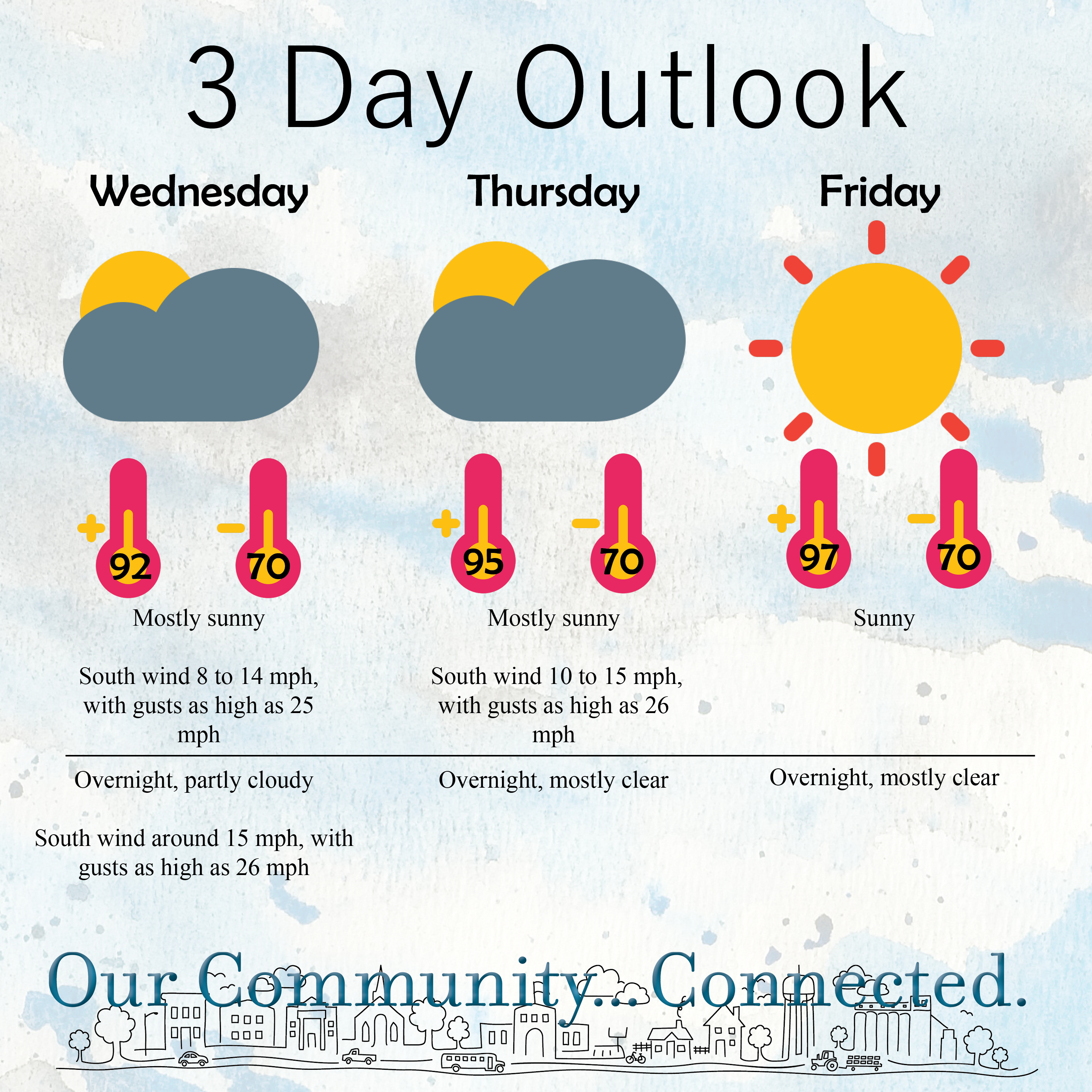
Now with warm windy weather in the forecast for the weekend, both Witt and Pfannenstiel expect harvest to be in full swing by Monday at the latest.

“We want to get these couple of days of hot and windy,” Pfannenstiel said. “Another day or two of that and we will be going strong.”

While fields around Hays were generally spared from damaging storms during the spring, a few instances of crop loss were being reported in the area.

Witt said he heard reports about a strip south of Victoria where a few fields were lost, as well as a field or two southwest of Hays.

Pfannenstiel noted reports of some damage to the southwest as well.

“In that area, it was probably hit twice, with two different storms, probably 15 to 20 days apart,” Pfannenstiel said.

But it could have been much worse.

“We have been very fortunate considering how many storms we have had come through this year,” Witt said.


Failing bridge leads to emergency closure on K-147 in Trego County

KDOT

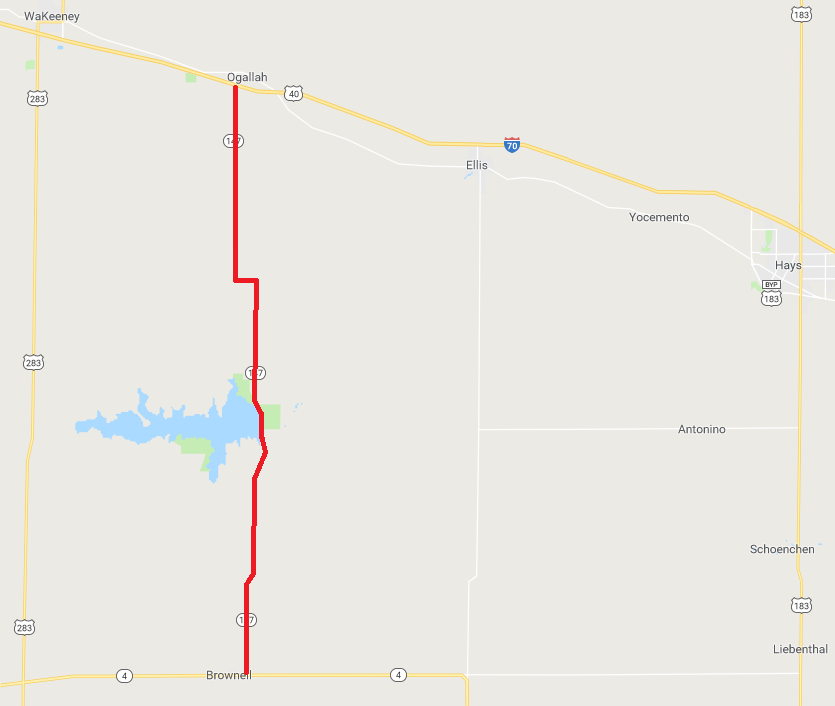
The Kansas Department of Transportation has closed K-147 in Trego County to through traffic as of Wednesday.

The closure is necessary because of public safety concerns about structural deficiencies found during a recent inspection by KDOT and its engineering consultants on the bridge spanning the Cedar Bluff Reservoir spillway. Plans are currently being developed for an emergency bridge replacement project to be completed in 2020.

The road will be closed from Ogallah to Brownell.

Traffic will be detoured using I-70, U.S. 283 and K-4. For more information on the closure, contact KDOT area engineer Kevin Zimmer at 785-625-9718.

— KDOT

Check Hays Post for more on this developing story as details become available.

Strong thunderstorm moving east into Ellis County

The National Weather Service in Dodge City has issued a significant weather advisory for Ness, Trego, Rush and Ellis counties until 11 a.m. Wednesday.

At 9:55 a.m., radar was tracking a strong thunderstom along a line extending from near Ogallah to 8 miles north of McCracken. The storm was moving east at 15 mph.

Winds in excess of 40 mph and frequent lightning could be possible.

Check the radar and latest conditions HERE.

LETTER: USD 489 should rename Oak Park in honor of longtime educator

To The USD 489 board and other interested parties:

I note that media reports are that the request to name the Oak Park facility after Emma Kolb, who dedicated her life to education here, was summarily rejected because someone ( nameless) in Topeka told someone on your staff not to name a building after a person. Please see my earlier letter about this.

Having been raised and educated in this school district, with schools named Washington, Lincoln, Jefferson, Felten, Kennedy, O’Loughlin, Wilson, and Thomas More, that reasoning seems to be logically fallacious.

It would be a break in tradition to NOT name the building after a person, and what better person than Emma Kolb.

Please try to apply some common sense to your decision as you deliberate this issue in the Toepfer Board Room at the Rockwell Center.

John T. Bird
Attorney at Law
Hays, Kansas

Copyright Eagle Radio | FCC Public Files | EEO Public File