As the school year nears a close, administrators at Hays High School and Hays Middle School both said they have seen a spike this year in vaping referrals at the schools.
Neither HMS Principal Tom Albers nor HHS Assistant Principal John Linn had exact number of referrals they have received as a result of vaping, but both agreed the number of students using nicotine products at school has increased.
The 2017 Kansas Youth Risk Factors Survey shows one in three (or 34.8 percent) Kansas high school students have tried e-cigarettes and one in 10 (or 10.6 percent) were current users.
In light of the jump the Kansas State Board of Education will receive a presentation on vaping during its regular May meeting on Tuesday.
HHS is seeing very few referrals for traditional tobacco products, such as cigarettes or chewing tobacco, Linn said.
A Juul electronic cigarette / Wikipedia Commons
Easy to conceal
Linn said the most common devices he finds students using are Juuls, which is specific brand of vape device. The Juuls tend to be small, easy to conceal and sometimes resemble flash drives.
“I will be honest with you. I didn’t even know Juuls existed until the last couple of years,” he said, “and these things have just blown up.”
Albers said the vaping devices are easier for students to conceal than traditional tobacco.
“The one thing about cigarettes is that you can’t really do that without people seeing and smelling,” he said. … “Vape ends up being something that is easy to hide. It doesn’t produce smoke. It just produces a vape. It is really hard to see or find.”
Education lacking
Both administrators said despite information sent out to district patrons earlier this year about vaping as well as education in health classes, many students and parents are still not aware of the dangers of vaping.
“When I talk to our kids, it is more about trying to fit in,” Linn said. “I get very little about ‘I am trying to quit smoking so this is the best alternative to do that.’ You try to tell them no its not because it has the same amount of nicotine in those substances as a pack of cigarettes.”
Linn said he didn’t think students think about the addictive nature of nicotine when they vape.
“I think they think it is a safer alternative than smoking,” he said. “There has been multiple times this year that I have talked to students about vaping and these issues and asked them specifically, ‘Do you even know what you are sucking into your lungs? Do you even know what it is?’ You would be amazed about how many of them tell me no. They don’t know what it is. It just tastes good.”
Albers said companies are marketing to kids with sweet flavors. They also manipulate the amount of nicotine in vape pods. One pod can have the same amount of nicotine as three and half packs of cigarettes.
“Kids become addicted whether they realize it or not,” he said.
Most parents Linn said he has talked to are aware their children have tried vaping, but may not be aware they have a vaping device and are vaping on a regular basis.
“Again it comes back to education and letting them know it is the same issue as any type of tobacco product,”‘ Linn said. “It has nicotine, and that’s addictive. It is not good for students of this age whose brains are developing like they should.”
Not only is the nicotine you can consume through vaping dangerous, but so are other chemicals and heavy metals you take into your lungs when you vape, she said.
Vaping liquids are loosely regulated by the federal government and 95 percent of the juices are made in China.
Vaping in teens can permanently stunt lung development. Nicotine, specifically, can cause cancer, is addictive and damaging, especially to the adolescent brain. It can also cause heart attack and stroke, Pope said.
School nicotine policy includes vaping
The Hays USD 489 school board passed revisions to its tobacco policy at its April 29 meeting. Superintendent John Thissen said the changes clarify what nicotine products are banned at the school.
This includes “any device that can be used to deliver nicotine or nicotine salts to the person inhaling from the device. Such definition shall include, but may not be limited to, any electronic cigarette, cigar, cigarillo, pipe or personal vaporizer.”
Vaping is banned not only in schools during school hours, but in any district facility; in school vehicles; at school-sponsored activities, programs, or events; and on school owned or operated property. The policy is the same for both school employees and students.
The consequences of vaping at school
For students, the policy goes on to discuss the consequences for students caught with nicotine or tobacco products.
According to the policy, “Student violations may result in parent/guardian notification, participating in tobacco education program, suspension and/or expulsion from school and/or extracurricular activities, community service, and/or notification of law enforcement.”
Linn said standard discipline at HHS for students caught with vaping devices or tobacco products is an automatic two-day in-school suspension. If the student is younger than 18, the police are contacted. If students are caught subsequent times, the disciplinary action can be heightened, Linn said.
“This is really frustrating, because the devices have changed so much. They are so difficult to detect,”Linn said. “I can search bags and all that kind of stuff, but if they hide it on themselves, it is very difficult to find sometimes. The companies have made it really easy for the students to use them and hide it.
“We do take it very seriously, and hopefully, we can get some kids to think before they do something like that.”
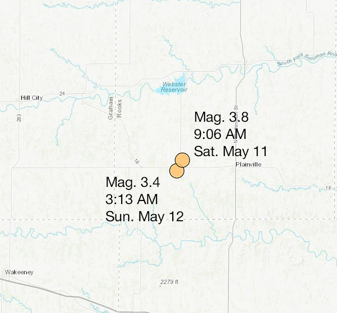
ROOKS COUNTY—Several earthquakes shook Rooks County over the weekend.
According to the Kansas Geological Survey, the two largest were magnitude 3.8 at 9:06a.m. Saturday and a magnitude 3.4 at 3:13a.m. Sunday. The United State’s Geological Survey also reported a 2.6 magnitude quake centered 8 miles northwest of Plainville on Sunday.
These are among the first reported quakes in Kansas since a 2.6 magnitude quake in Saline County on March 21.
The Rooks County Sheriff’s office reported they received no calls about the weekend quakes and there were no other calls of damage or injury.
———–
ROOKS COUNTY — A small earthquake shook northwest Kansas Sunday. The quake just after 3 a.m. measured a magnitude 2.6 and was centered approximately 8 miles northwest of Plainville, according to the U.S. Geological Survey.
These are among the first reported quake in Kansas since a 2.6 magnitude quake in Saline County on March 21.
There are no reports of any damage or injury from Sunday’s quake.
The KBI reported Sunday evening 71-year-old Michael Stamm had been found and is safe.
————–
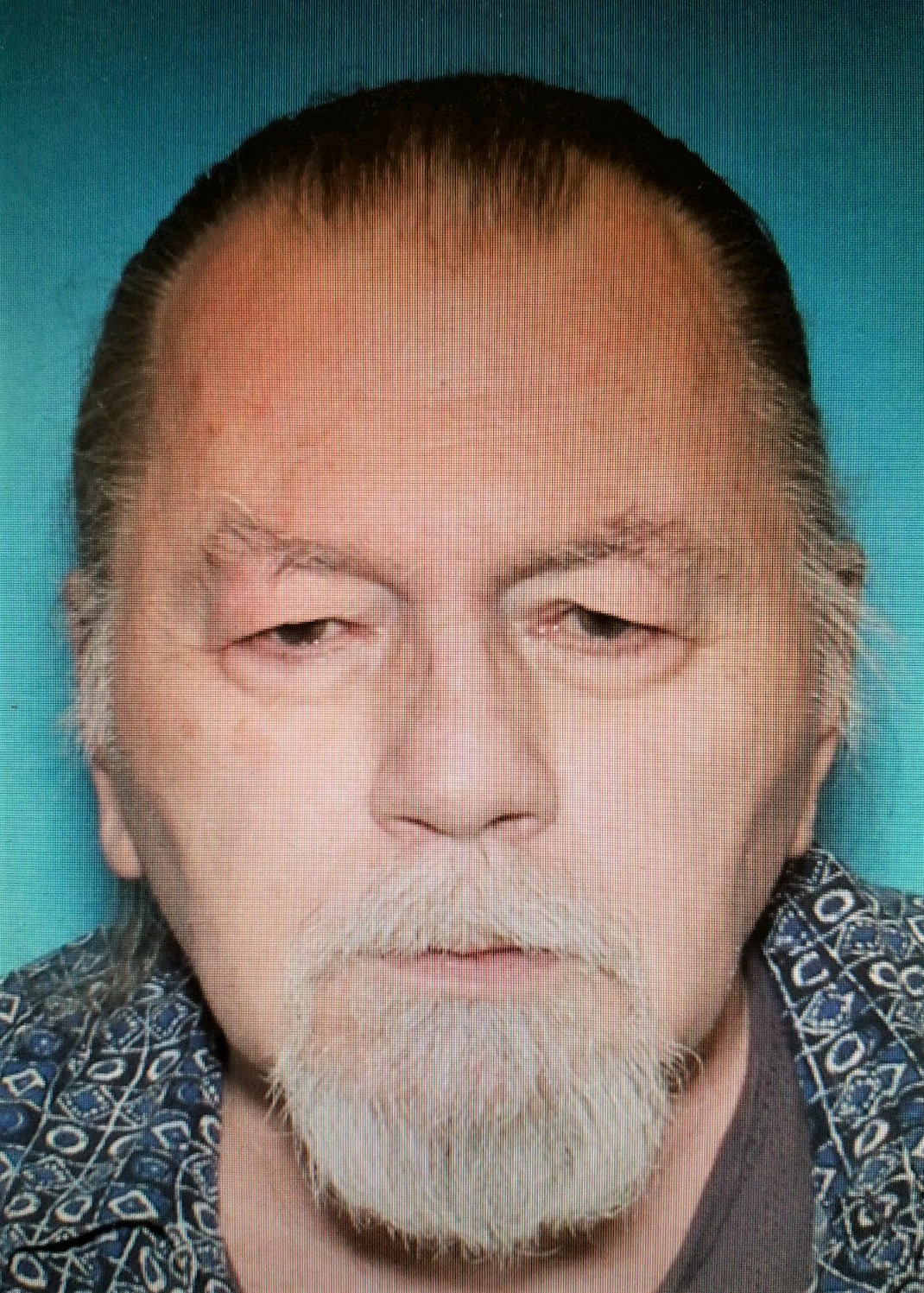
Stamm
SHERMAN COUNTY – The Goodland Police Department has requested that the Kansas Bureau of Investigation issue a statewide Silver Alert for a missing Goodland man.
The whereabouts of Michael Stamm, 71, are unknown, and the public’s assistance is requested to help locate him. Stamm is a white male with grey hair and a ponytail. He has hazel eyes and wears glasses. He is 5 ft. 9 in. tall and weighs approximately 265 lbs.
See the below press release from the Goodland Police Department with additional details regarding this missing man.
If you see Stamm or his vehicle, please immediately contact the Goodland Police Department at (785) 890-4575.
—————-
Goodland Police Department
Press Release
On May 11th, 2019, at approximately 8:30 p.m. Goodland Police officers initiated an investigation into the whereabouts of Michael Stamm, 71, of Goodland. Mr. Stamm was last seen by his wife on My 11th at approximately 1:00 p.m. Officers were able to locate surveillance footage of Mr. Stamm leaving the local Wal-Mart Superstore in Goodland at approximately 5:11 p.m. driving a white Chevrolet Venture van bearing a Kansas “In God We Trust” license plate, number AE740. The van only had a half or quarter tank of gas when it was last seen.
According to family members, Mr. Stamm has been diagnosed with Parkinson’s disease, diabetes, and does have cognitive memory function disabilities. Mr. Stamm did not have any money or credit cards in his possession before leaving home. Law enforcement as issued a nationwide bulletin attempting to locate Mr. Stamm.
MANHATTAN, Kan. — The harsh conditions in Kansas this past winter have prompted one of the state’s leading weather agencies to develop a tool that will help cattle producers in the future.
Officials with the Kansas Mesonet, a Kansas State University-based network of weather monitoring stations across the state, has announced the release of the Cattle Comfort Index, a tool that they say will help cattle producers better monitor the needs of their herds during normal and extreme weather conditions.
“We’ve already had a lot of negative impacts on the cattle industry because of the cold temperatures this winter,” said Mary Knapp, the assistant state climatologist with Kansas Mesonet. “This tool will also look at extreme high temperatures.”
The Cattle Comfort Index compiles such climatological factors as weather, humidity, solar radiation, wind speed and more to help producers determine the level of stress their animals may be experiencing at any given time.
“The index is driven by our five-minute data that is available from Kansas Mesonet,” Knapp said. “It will be calculated real-time and updated on a regular basis so that producers can see how that will change during the day.”
The climate information is gathered from each of the Mesonet’s 61 reporting stations in Kansas. For each, the system reports the perceived comfort level of cattle in that area, from no stress, to mild, moderate and severe.
Knapp said, “the actual animal response to temperature stress will be dependent on a number of factors not accounted for in the index,” including age, hair coat, health, body condition, micro-environment, and acclimatization.
“The index shown may start off at a reasonable comfort level in the morning, but as you get into the afternoon when that heat starts developing and the humidity hasn’t abated, that’s when you can get some of the heaviest stress on the livestock,” she said. “A chart will show the level over time, but historical data is limited to the week, ending with the current day.”
The tool was developed from research conducted at the University of Nebraska. The Kansas Mesonet website includes a map that shows conditions across the state and how that might play into risk for cattle.
For more information, interested persons may visit the Kansas Mesonet website, or call 785-532-7019.
Have you ever wondered how to make a meal faster? Have you ever wished you were a master of Excel? If you have said yes to one or both of these questions, the next Women on the Farm program is for you!
Women on the Farm of Barton, Pawnee, and Rush counties invites all people that are interested in either learning more about electric pressure cookers and/or Excel or our next program. This program will take place on Tuesday, May 21, at the Haas Building in Larned. Registration will begin at 10:30 and there is a small fee to cover the cost of lunch. The morning will be spent learning to cook different items in an electric pressure cooker. While you don’t have to bring a cooker, please feel free to do so!
If you are just wanting to attend the Mastering Excel portion of the day, there is no cost and it will start at 1:00 p.m. You are welcome to bring your own computer to work on, but there will be computers available for use.
You are welcome to attend one or both programs, but we you will need to RSVP so that we have enough materials available. Please RSVP to the Pawnee County Extension office by 5:00 on May 17th by calling 620-285-6901.
Alicia Boor is an Agriculture and Natural Resources agent in the Cottonwood District (which includes Barton and Ellis counties) for K-State Research and Extension. You can contact her by e-mail at [email protected] or calling 620-793-1910.
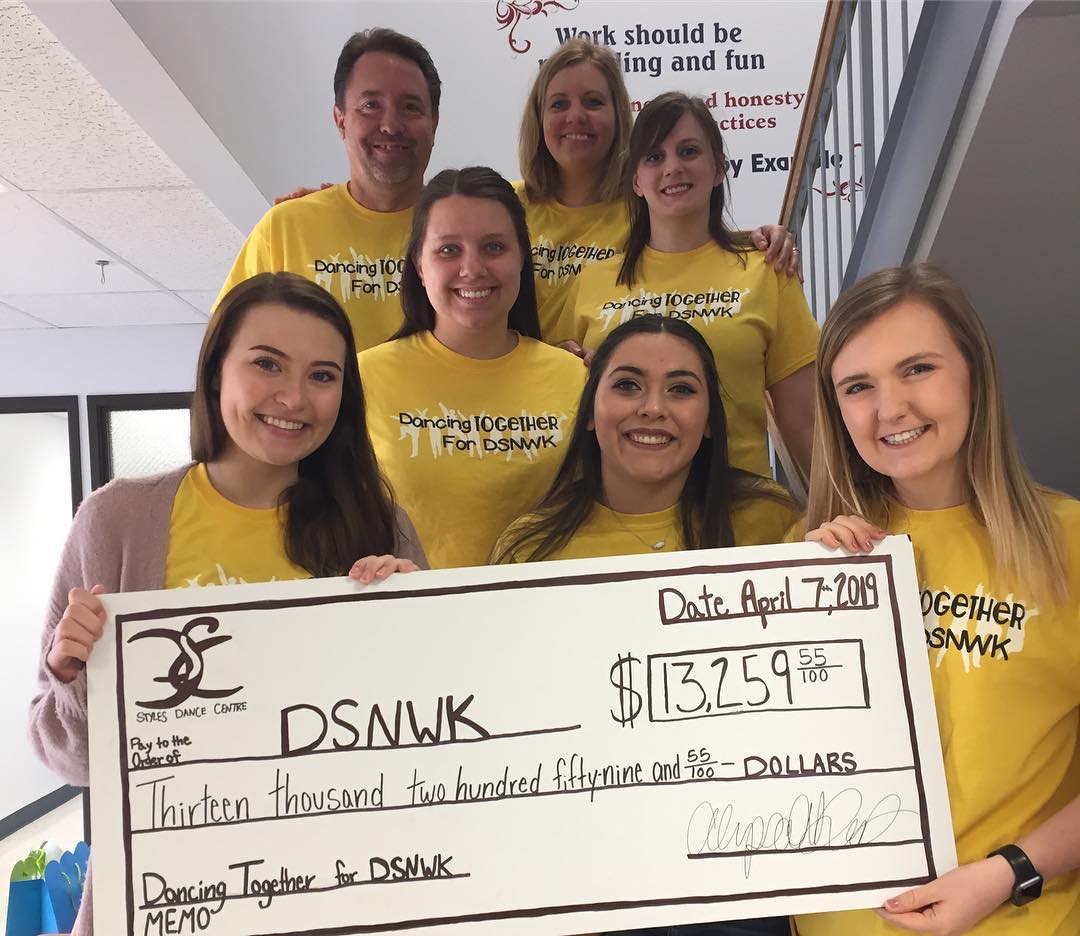
Members of Fort Hays State University’s Leadership 310 team that raised a record $13,000-plus for the “Dancing Together with DWNSK” fundraiser are, front row, left to right, Brenna Erdman, Claudia Castro and Tyra Hayden. Middle row is Macey Pfeifer, instructor, Styles Dance Center. Back row: Steve Keil and Sara Biggs, DSNWK, and Styles owner Alyssa Dechant.By DIANE GASPER-O’BRIEN FHSU University Relations and Marketing
Caden Frank came to Fort Hays State University planning to focus on pre-engineering coursework.
After one class in the Department of Leadership Studies, Frank changed his mind.
“I got involved with the leadership certificate program,” Frank said, “and I realized this is something I felt passionate about, not just as a hobby but as a career.”
Frank and the other three members of his team are part of a record-breaking group in LDRS 310: Fieldwork in Leadership Studies.
The two sections of this spring’s 310 class – as it is commonly referred to – raised a staggering $35,000 for the Hays community through their social change projects. That’s the largest amount raised in one semester since the start of the 310 class more than 15 years ago.
Ironically, Frank’s team project took more of a human relationships route than that of a fundraiser.
Nonetheless, “Breathe Out” and others like it were still impactful, said Dr. Seth Kastle, assistant professor of leadership studies.
Take for example, the “Hansen Entrepreneur Marketing Consultants.” The five-student team helped fill the Dane Hansen Scholarship Hall with an entrepreneurship mindset for fall 2019. It will be the first time that all 32 residents will be involved in entrepreneurship activities. The residence hall was built in 2016 targeted for entrepreneur-minded students.
“This service learning class is about executing a social change project, so it’s teaching people to take ownership in the communities they live in, no matter what that might be,” Kastle said. “We educate these students how to do this now, so when they move on from Fort Hays State, when they see a need, they can address it.”
“Breathe Out” took a couch from Breathe Coffee House to several locations in town and just visited with people, “having intentional conversations with people about how to get involved in their community,” a team spokesman said.
“We want people to be radically changed by their community and to radically change something in their community,” Frank said during his team’s demonstration. He said he has already been radically changed by Fort Hays State and the city of Hays, whose population of 25,000 is considerably smaller than his hometown.
“This town is amazing,” said Frank, who grew up in Omaha, Neb. (population 466,000). “It’s obviously smaller than Omaha but large enough that no matter what your skill set is, it will align with something in town.”
From his initial plan of attending FHSU for three years as a physics major, then transferring to an engineering school in Nebraska, Frank now has his sights set on graduating from FHSU with an organizational leadership degree and working with a nonprofit.
Community partners visit the 310 class early in the semester, and the students then choose a project, write strategic plans and then execute those plans.
Students learn a variety of lessons in the 310 class: planning, organization, teamwork and collaboration, creating awareness, sustainability and even reflecting on what they might have done differently during the project.
“Hindsight is 20-20,” Kastle said. “That purposeful reflection is how the learning takes place. It’s about reflecting about what might have gone wrong and what they might have done different.
For Kensington junior Tayler Petersen, it was tackling a tough project. She and her team, “In Defiance of Cancer,” partnered with the Cancer Council of Ellis County and raised about $3,000. While sponsorship made up most of that total, Petersen said she learned that the smaller amounts (from T-shirt sales and a raffle) added up, too.
“Paula told us not to choose something easy but to do something that would be a challenge and it would mean more, and that really stuck with us,” Petersen said of Paula Flesher, executive director of the local cancer council. “As college students, we kind of just do our thing – do our homework and go to class – and don’t think so much about the community at-large. This has definitely changed my perspective on the impact we can all have on a community.”
Petersen is a criminal justice major who currently works as a corrections officer in Norton and hopes to become a counselor someday. She said she realized early on in her college career that leadership would be a complementary minor to her major.
Like Frank, Petersen was hooked on leadership after one class.
“I just loved it,” she said, “and I knew then what I wanted to minor in.”
The “ARC Park” team raised nearly $10,000, and the top team – another record breaker – was $13,259.55.
That was turned in by “Dancing Together for DSNWK,” which sponsored a fundraiser that featured dancers from Styles Dance Centre in Hays and clients from DSNWK in a public dance recital.
The fundraiser was originally created two years ago by Macey Pfeifer, a Styles instructor who was part of a 310 class at the time. The project was continued by a 310 team last year and this year as well.
“There’s a balance there because the idea is that 310 is going to support the community projects,” Kastle said. “Part of their assignment is to figure out sustainability. This one definitely displays sustainability. Others blaze new trails and take some bumps and bruises along the way. But what a great way to learn.”
During these projects, Keil said, students get the chance to give back to the community that supports Fort Hays State in so many ways.
Ditto for the community partners, said Steve Keil, director of development for DSNWK.
“Being a non-profit, we’re always looking for the community to help and support our activities,” he said. “Fort Hays State has always stepped up to the table, and we appreciate everything FHSU has done for us.”
Keil has been witness to partnerships between the Hays community and Fort Hays State since the 1980s. He graduated from FHSU with a bachelor’s degree in communication in 1986 and earned his master’s in organizational leadership in 2005.
“We get a lot of support from Fort Hays State in a variety of different ways,” he said. “We are all very lucky to have this university in Hays.”
Did you know that an average male Kansan lives to 75 years of age, and the average woman lives to 80?Why is that? Is it because we men are more prone to violent deaths early by going to war, riding motorcycles or driving cars faster? Nah! This accounts for only a small part of the difference.
I think more likely it is because men, who are genetically built larger and more muscular (likely in order to be the defender or hunter for the family) no longer need to use those muscles in this modern world.
Just look at most 22-year-old men, they come built almost automatically ready to fight or lift or throw or build. But instead, in this society, you find them driving a car, sitting at a desk or laying on the couch rolling through the channels looking for videos of people playing games and being physically active.
Even our young boys are often living through the pretend movements of action figures or computer-generated warriors, rather than actually running through fields in some sort of sport, or chase, or hunt. As men age, their activity drastically reduces while their caloric intake continues excessively on. All the while their bellies grow. I truly believe this combination of excessive calories and reduced activity accounts for the sleep apnea, diabetes, vascular disease and, overall, increased death rate of men over women.
But there is one more factor, which should be added here. Men are also built to deny and do what they can to avoid going to the doctor to have a check-up. Let’s face it, denial has something to do with being a man. It goes with the testosterone, guns, action toys, and channel changers. You would think a man would rather face a charging lion than the yearly physical exam.
Men, please don’t just think about it, find a way to stay active, participate, don’t just watch. Prevent or lose the belly by eating smaller amounts (fewer calories) and by being more active. Also, go see your doctor every once-in-a-while. You just might live longer and feel better too.
For free and easy access to the entire Prairie Doc® library, visit www.prairiedoc.org and follow The Prairie Doc® on Facebook, Instagram and Twitter featuring On Call with the Prairie Doc® a medical Q&A show streaming live on Facebook most Thursdays at 7 p.m. central.
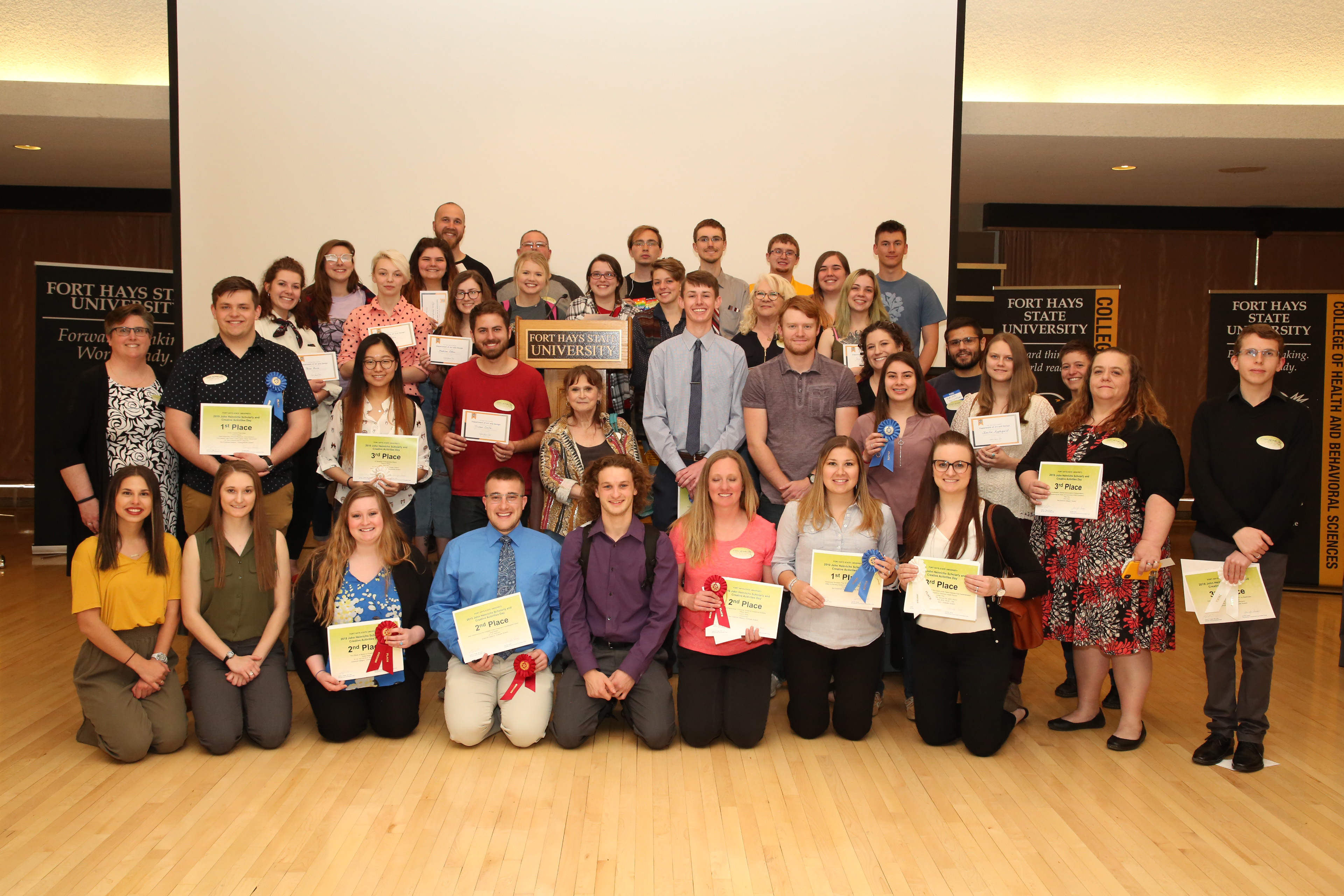
Over 100 posters were exhibited and over 840 students, faculty and community members participated as presenters or attendees at Fort Hays State University’s annual John Heinrichs Scholarly and Creative Activities Day on Wednesday, April 24.
An exhibit of 150 creative works was also available for viewing. Twenty oral presentations were given by faculty and students and special lectures, receptions and exhibits also took place on campus.
FHSU annual John Heinrichs Scholarly and Creative Activities Day, 2019
The John Heinrichs Scholarly and Creative Activities Day celebrates the research, scholarly and creative work conducted by varied disciplines within the university. Departments across campus sponsored special activities, including seminars and research presentations.
The main event was a poster and creative works exhibition in the FHSU Memorial Union Ballrooms featuring student and faculty work from College of Arts, Humanities and Social Sciences, the W.R. and Yvonne Robbins College of Business and Entrepreneurship, the College of Education, the College of Health and Behavioral Sciences and the Peter Werth College of Science, Technology and Mathematics.
Awards were given for poster presentations to Undergraduate, Graduate, and Faculty/Staff for Empirical and Non-empirical research and scholarly work. A “People’s Choice Award” was also given.
The following awards are listed by category.
Empirical research involves examining a research question that is clearly defined and answerable by using standardized statistical methods on collected data. This may include either quantitatively or qualitatively collected data.
Non-empirical research is a comprehensive and careful consolidation of available information within a domain or a reinterpretation of that information within a new framework or context. Non-empirical research does not use standardized statistical methods on collected data.
Undergraduate Students – Empirical
1st – Jacob Lutgen, Basehor senior majoring in biology, presented “RNA Interference of X-Box Binding Protein 1 in Acyrthrosiphon pisum.” Co-investigators were Dr. James Balthazor, assistant professor of chemistry, and Jared Ridder, Buhler graduate student majoring in biology.
2nd – Rylee Staab, Holcomb junior majoring in criminal justice, presented “The Effects of Stress on Prospective Memory.” Co-investigators were Dr. Gordon Carlson, associate professor of communication studies, and Dr. Trey Hill, chair of the Department of Psychology.
3rd – Skylar Markham, Maple Hill senior majoring in chemistry, presented “Synthesis of 2,2’-Bipyridine Via a Phosphorus Extrusion Reaction.” Co-investigators were Dr. Bruce Atwater, assistant professor of chemistry, Kaitlyn Hillery, Winona sophomore majoring in chemistry, Sierra Smith, Larned freshman majoring in chemistry, and Dr. Benjamin Wicker of Southeastern Louisiana University. Undergraduate Students – Non-Empirical
1st – David Oakley, Lyndon junior majoring in political science, presented “FHSU Student Price Index.” Co-investigators were Dan Fisher, Paola senior majoring in human resource management, Zetta Hamersley, Butler sophomore majoring in political science, Ciara Helstrom, Sedgwick sophomore majoring in management, Cory Hiebert, Halstead junior majoring in international business, Dr. Yang Jiao, assistant professor of economics, finance, and accounting, Hannah Magathan, Meriden senior majoring in finance, Dr. Sam Schreyer, associate professor of economics, finance, and accounting, Brady Stephenson, Little River sophomore majoring in finance, and Cristal Ugarte, Kansas City graduate student majoring in business administration.
2nd – Kylee Poague, Salina senior majoring in nursing, presented “Effect of Physical Activity on Blood Glucose Control.” Dr. Christine Hober, professor of nursing, and Darby Hirsch, Topeka senior majoring in nursing.
3rd – Seoyun Jeong, Indianapolis KAMS student, presented “3D Modeling of Phospholipid Bilayer.” Co-investigators were Dr. Krisztina Bencze, assistant professor of chemistry, Sujin Kim, South Korea KAMS student, and Carlson.
Graduate Students – Empirical
1st – Blake Chapman, Montgomery, Texas, geosciences major, presented “Predicting the Distribution of the Extinct Sea Bird Hesperornis.” Dr. Laura Wilson, associate professor of geosciences was the co-investigator.
1st – Steven Bolin, Olathe psychology major, presented “Evaluating the Effect of Mental Illness Stigma on Voting Behaviors.” Brooke Mann, instructor of psychology, was the co-investigator.
2nd – Jared Ridder presented “RNA Interference of the Unfolded Protein Response in Acyrthosiphon pisum.” Balthazor was the co-investigator.
3rd – Jonathan Clayton, Mullinville political management major, presented “What Makes a State Swing?” Graduate Students – Non-Empirical 1st – Christina Lawver, Plainville nursing major, presented “Performing Simulation Prior To Operating Room Clinicals And Its Effect On Nursing Student’s Perception And Overall Experience.”
1st – Peng Zhang, China, general studies major, presented “The Next Dimension 3.0.” Co-investigators were Dr. Nicholas Caporusso, assistant professor of informatics, Conner Chessmore, North Platte, Neb., information networking and telecommunications major, Yangyang Cui, China, web development major, Meng Ding, China, web development major, and Monica Michaud, Hays computer science major, and Carlson.
2nd – Tiffany Tipton, Holcomb special education major, presented “Parent Partnerships: Promoting Growth of Exceptional Students.” Co-investigators were Jerrie Brooks, advanced education programs instructor, and Dayne Fletke, Middleville, Mich., graduate student.
3rd – Tipton presented “Effects of Audiobooks and Group Discussion in Inclusive Special Education.” Dr. Brooke Moore, interim chair of the Department of Advanced Education Programs, was the co-investigator.
3rd – Helber Fernandes Ribeiro, Brazil music performance major, presented “Creating a performance of the Sonata op. 111 by Beethoven.” Dr. Eduardo Henrique Soares Monteiro was the co-investigator.
3rd – Petz presented “Nursing Student Perception of Time Spent at the Patient Bedside Post Implementation of a Replica Academic Electronic Health Record.” Co-investigators were Alicia Arias, assistant professor of nursing, Hober, and Shauna Keil, assistant professor of nursing.
3rd – Scout Harrison, Brooklyn, Wisc., biology major, presented “Plant-Soil Microbiome Feedback Impacts on Native and Non-native Grasses Throughout Kansas.” Dr. Mitchell Greer, assistant professor of biological sciences, was the co-investigator.
Faculty – Empirical
1st – Caporusso presented “User Discrimination of Content Produced by Generative Adversarial Networks.” Co-investigators were Daniel Jachetta, Brighton, Colo., senior majoring in management information systems, Devon Patchin, Mound Valley freshman majoring in information networking and telecommunication, Spencer Romeiser, Otis information assurance management major, Noah Vaughn, Hays freshman majoring in information networking and telecommunications, Dr. Angela Walters, interim chair of the Department of Informatics, Kelei Zhang, instructor of informatics and Carlson.
2nd – Dr. Amanda Buday, assistant professor of sociology, presented “Impact Geographies of Wind Energy Development in Kansas.” Co-investigators were Dr. Keith Bremer, assistant professor of geosciences, Ashten Clark, Fowler senior majoring in geosciences, Connor Mountford, Colby senior majoring in political science, Connor Phelan, Holyrood geosciences major, and Criquet Smith, Berryton junior majoring in geosciences.
3rd – Dr. April Terry, assistant professor of criminal justice, presented “The gravel pathway to the revolving door: Criminal justice involvement for girls from rural coercive sexual environments.” Autaum Poley, Concordia senior majoring in criminal justice, was the co-investigator. Faculty – Non-Empirical
1st – Dr. Amanda Adams, instructor of biological sciences, presented “Bats’ use of natural areas in an urban landscape.” Co-investigators were Natalie Allison, Lawrence freshman, Sandra Ruelas-Aranda, Rolla freshman majoring in nursing, Clayton Sargent, Canton junior majoring in biology, Jacob Schumacher, Garden Plain freshman majoring in agriculture, Matthew Tanis, Cawker City freshman, Curtis Schmidt, museum collections manager, and Greer.
2nd – Dr. Jackie Lubin, assistant professor of advanced education programs, presented “Teaching College Students with Autism Spectrum Disorder (ASD).”
3rd – Kelly Cole, assistant professor of nursing, presented “Incentivization Towards Advancement in Professionalism – Underlining the Impact and Importance of BSN Completion.” Arias was the co-investigator.
Terry and Poley won the People’s Choice Award for their poster.
The following art exhibition awards are listed by category.
Ceramics
Kaitlyn Scriven, Wichita freshman majoring in art, with “Baeshara Galanodel.” This piece also won the People’s Choice Award for art.
Haley Gottschalk, Westminster, Colo., junior majoring in art, with “Nest Basket.”
Clayton Barnett, Wichita sophomore majoring in art, with “Brick Box.” Sculpture
Braden Bartlett, Cheney senior majoring in art, with “Up in Smoke.”
Emily Kohls, Hutchinson senior majoring in art, with “Birth of Venus.” Ben Cornwell, Bison senior majoring in art, with “Ring #2.” Drawing
Kohls with Self-Portrait in “Blue.”
Tristan Smith, Larned senior majoring in art, with “Self-Portrait.” David Younger, Victoria junior, with “Wiggly Field.” Painting
Noah Wellbrock-Talley, Salina senior majoring in art education, with “Self-Portrait.” Sam Brown, Hoxie senior majoring in art, with “Wonderland.”
Kohls with “REM.” Printmaking
Alexis Karabinas, Salina junior majoring in art, with “Oof.” Chandler Reich, Russell junior majoring in art, with “Monoprint and Self 1.”
Molli Banks, Great Bend sophomore majoring in art, with “Unconditional.” Photography
Laura Kelly with “Noir #2.”
Jennifer Applequist, Larned junior majoring in accounting, with “Morning Market.”
Liz Mayne, Avendale, Ariz., senior majoring in art, with “Tropical.” Design
Madison Otter, Great Bend junior majoring in graphic design, with “Rupert Dominos.”
Kylie Thomas, Garden Plain junior majoring in graphic design, with “Milieu Collages.”
Tessa Kriss, Emporia senior majoring in graphic design, with “Ace and Co.” Graduate Art
Libby Reimer, Hesston graphic design major, with “Wise One.”
Kathy Robb, Kansas City art major, with “Contemplation.” Zane Mahanna, Hoxie art major, with “Atomic Scarecrow.” Jordan Brown, Hays senior majoring in art, was awarded the Senior Recognition.
Jee Hwang, assistant professor of art and design, received the Faculty Recognition. Diana Unrein, Hays, was given the Special Student Recognition.
“This is the 14th year for this prestigious event,” said Leslie Paige, office of scholarship and sponsored projects, “It not only showcases the significant work being conducted by faculty and staff, but also exemplifies the opportunities that FHSU students have to conduct research, engage in scholarship and to produce creative works, with guidance from their faculty mentors.”
Scholarly and creative activity encourages critical thinking, innovation, collaboration, and leadership. Participation provides the opportunity to clarify academic and professional goals while promoting advancement in a particular field of study. Fort Hays State University supports developing new areas of excellence in all disciplines as part of its mission to advance knowledge and further the economic growth of the state.
Dr. John Heinrichs
Named after the late Dr. John Heinrichs, who championed research at FHSU, Scholarly and Creative Activities Day is sponsored by the Fort Hays State University Scholarship Environment Committee, with support from the Office of the Provost, the Deans, the Kansas Academy of Mathematics and Science, the Graduate School, the Office of Scholarship and Sponsored Projects, Forsyth Library and other FHSU colleges and departments.
Door prizes donated by area businesses include: Auto World, Billy Sims BBQ, Gella’s, Indigo, Nex-Tech Wireless, Pools Plus, Regeena’s Flowers and Events, and Salon 1007/Rock Haven.
The 15th annual John Heinrichs Scholarly and Creative Activities Day has been scheduled for April 22, 2020. The public is invited to attend.
The DAV Vintage Bike Show brought bikers from across the region to raise money for a new van for the DAV.
The organization needs to raise $15,000 toward the van and then the national DAV will supply the remaining funding for the van.
The van is used to bring veterans from outlying areas into Hays for appointments and to bring veterans from Hays and the surrounding region to the Bob Dole VA Medical Center in Wichita.
Doug Nichols of Palco is a Veterans of the Vietnam War. He was wounded in combat during the Tet Offensive and received the Purple Heart and the Silver Star. He has been a member of the DAV every since.
Nichols brought his 1977 Yamaha, which he bought new in 1977. He still rides the bike.
“It’s a nostalgia thing,” he said. “It is an older dirt bike. I had similar bikes when I was younger. In 1977, this was brand new — the ultimate bike. I bought it then and have enjoyed it every since.”
Nichols also has three other road bikes. He has ridden with the Run For the Wall group to Washington, D.C., every May since 2006, but will but will be sitting this year out.
“It is total freedom,” Nicholas said of riding. “You are on your own, and you have to use your own ingenuity if something goes wrong. It is nothing like being in the cage of a car. I like to call them cagers — people who drive cars. It’s the freedom of it and the adventure and being able to interact in the environment more than you do in a car.”
John Weber’s 1947 Chief Indian
John Weber of Denver brought four bikes to the show — an 1947 Chief Indian, 1940 Sport Scout, 1938 Junior Scout and 1929 Henderson with a side car.
Weber said he married into a bike family. His father-in-law rode the Henderson until he was 84. His mother-in-law and father-in-law rode a 1928 Super X Excelsior while they were dating.
Weber’s favorite bike of the four is the Sport Scout, which was all in boxes when he bought it.
Weber rides all of his classic bikes.
“They’re different,” he said. “I get on a modern bike, and I’m bored.”
John Weber’s 1940 Sport Scout
The Henderson has a manual spark advance. As the motor RPM goes up, the spark tends to lag, so you have to manually advance it.
Weber said he enjoys going to shows and has already been to more than a dozen this year. He is president of the Antique Motorcycle Club of America. He also likes to go on club rides.
“You are in the space,” he said of riding. “When you are in a car, you’re in a box. Inside that box is your space. When you are on a motorcycle, you’re not restricted.”
The Patterson brothers bought the 1926 in Wichita from the original owner’s son, who was 83 at the time. The brothers rebuilt and restored the bike from the frame up.
He also brought to the show a 1946 Harley UL.
“I have been riding bikes since I was 8 or 9 years old, and every year they got bigger and faster and faster. I found myself seeing how fast I could make it to Sturgis. As I have gotten older now, I jus wanted to slow down. These bikes run about 45 or 55 miles per hour. You slow down and enjoy the day. You enjoy the environment. It is a whole different style than how quick can you get there.”
He said on the older bikes, you ride them for a couple of hours and then wrench on them for 30 minutes.
“It’s just more of a journey on the old bikes, and that’s what I enjoy doing right now,” he said.
Gary Shormam’s 1928 Harley Davidson
Gary Shormam of Hays brought to the show his 1928 and 1940 Harley Davidsons. He started riding on his family’s farm when he was about 8 years old.
“It’s fun to ride. It is fun to find the old ones and bring back some history of how motorcycles got started,” he said.
Shorman said he likes to see how the motorcycle has progressed.
“The difference even between the ’40 and the ’28 is big,” he said. … “How they just advanced year, after year, after year to become better and now the new ones are like cars today.”
Gary Shormam’s 1940 Harley Davidsons
He said the 1928’s engine is fairly simple.
“When you look at that, it is a pretty simple single-cylinder motorcycle engine that runs that,” he said. “There’s not a lot to it. You have a battery, a spark plug. Put some oil in it and gas, kick it and away you go.”
Shorman said the appeal of riding is being outside.
“Many times you are in meetings all day long and you are working in different areas that are inside — being outside on the weekend and playing with these …” Shorman said was the reason why he owns the bikes.
“The other thing is you can take them apart. You can take them apart and put them back together. You can take the head off that and put it back on, clean it up. The new stuff you really have to take to a real professional. It is a real engine you can work on.”
All of the men said they enjoyed talking to other motorcycle owners, but the real reason they came was to help raise money for the DAV.
Editor’s note: Gary Shorman is the president and CEO of Eagle Communications, which owns and operates the Hays Post.
Jonathan Clayton, a Fort Hays State University Virtual College student, was accepted to present his research, “What Makes a State Swing?,” at the quarterly Research Association for Interdisciplinary Studies conference at Johns Hopkins University in Rockville, Maryland.
Clayton will graduate this spring with his Master of Professional Studies with a concentration in political management. He also received his Bachelor of Arts in political science from FHSU.
His research received a Graduate Scholarly Experience Grant from the FHSU Graduate School and Scholarship Environment Committee and also placed third at the 2019 John Heinrichs Scholarly and Creative Activities Day in the graduate empirical research category.
The paper tests the definition of a true “swing state” in presidential elections by examining battleground states, bellwether states and shift states, or those states who alternate between political parties during an election.
Clayton then studied the results of these elections to determine what these swing states have in common based on household income, racial demographics, population density, political party affiliation, voting behavior and voter registration.
Clayton will present virtually for the conference on the afternoon of June 11.













 Today
Today