Planning a garden? Test your soil through the master gardener extension office.
Category: Local
Hays High shares CTE needs, looks toward renovation


By CRISTINA JANNEY
Hays Post
The Hays school board and guests toured the Career and Technical Education wing of Hays High School on Monday night, learned about some of the needs of the programs and discussed hopes for a renovation of the program’s space.
As Hays High sees an increase in enrollment, the demand for CTE classes is also increasing. However, the school is limited in adding more course offerings by both staff and space.
For the fall semester of 2019-20, HHS has 888 students (seat-time) in its CTE programs.

Martin Straub, HHS principal, said he would like to double the size of its health care pathway. A room that used to be occupied by a preschool program is now being used used by a NCK Tech teacher to offer allied health classes.
The preschool program was moved to the former Oak Park Medical Complex with the Early Childhood Connections program.
Straub said he would like to be able to have a health pathways instructor on staff, but the shared instruction is working for now. HaysMed recently donated hospital beds for that program.
Although it is not related to CTE, there is a transitional living room in the CTE wing. The room is set up like an apartment. Students in functional special education learn life skills in that program, such as cooking meals, cleaning, budgeting and shopping.
The addition of this room means students don’t have to go off campus to learn these skills. The class averages about 20 students.
Metal shop
The metal shop recently added a new lathe and computer numerical control (CNC) machine. However, metals teacher Alex Ford said the program lacks the space and the equipment to teach all of the skills he said he thinks students need to be prepared for the work world.
Chris Dinkel, CTE instructor, said the department would like to knock down one of the walls and expand the shop into the adjacent room. The program would also like to put in an overhead door on the back of the shop so students could bring in larger projects like trailers, which now have to be worked on outside.
“His student-to-equipment ratio — you have 20 students in here and you have two lathes,” Dinkel said. “That’s a problem. You count the number of machine shops we have within a five-, six-county area, it’s well over a dozen. There is an employment issue too.”
Ford said, “I have one mill. It’s a great machine, but I have 20 students. I can’t teach anything on it. I can’t have 20 students on one machine. I actually need two or three of them. I need four lathes if I want to really teach my students. I have all the welders I can ask for, but I don’t have the machining capability.”
He continued, “CNC is the biggest push right now. I have one CNC machine. I would like to have two or three more. I would like to have classes just on that.”
Lathes cost $5,000 to $10,000. A mill can cost $15,000 to $20,000.
Dinkel said High Plains Machine Works has a large mill it would like to donate to the program, but the high school has no place to put it.
Radio/TV
HHS has an award-winning radio and broadcast program. However, Dan Balman, broadcast instructor, said the classroom space doesn’t fit the program. Balman also teaches American government. When his broadcast students need to shoot video, they have to move all of the desks out and set up the green screen and all of the audio and video equipment.
He would like to see a room that is adjacent to the program’s radio studio reconfigured into a broadcast studio. The room is currently being used for storage. The school board has already approved construction of a metal storage building for HHS, but that building has yet to be constructed.
What is now being used by Heath Meder for the graphics arts program could be converted into an editing classroom for the broadcast program. The CTE program would like to add a door between the two rooms that would be used for the broadcast program. Graphic arts could be moved to what is now being used by Allied Health.
Art

Art teacher Heath Meder offers a jewelry making course. The space is shared with the ceramics program. Meder said the space is so tight it is unsafe for students.
The CTE program would like to knock out a wall to expand the jewelry program’s space into an adjoining classroom. They also are proposing adding a dividing wall between ceramics and jewelry.
Jewelry is a popular class. It has about 60 requests per enrollment period, but only 20 spots are available.

The student learn lost-wax casting. Students who may not take any other shop classes learn to use drill presses and buffers.
“It is a [class] we are talking about math, science, metallurgy. They are using things that I don’t think they will if they don’t have an opportunity in a class like this,” Meder said.
Meder found an aluminum foundry that has been at the school since it was built. Meder said he would like to use foundry in his art classes. A new shed was added outside of the ceramics studio for a new gas-fired kiln, and that area could be used for the foundry.
Jennifer Younger, art teacher, said other art classes, including art exploration, drawing and painting also are usually full, and the department has had to turn away students. The program does not have a dedicated room for painting, so the students can’t leave their art pieces out.
Younger said the art department would like to have a dedicated art exploration teacher, so she and Meder could concentrate on their specialities. Straub said HHS at one time had three full-time art teachers, but that position was cut.
“Right now, we are stretched pretty thin,” Younger said. “We are trying to teach everything. Students want to be in here. It kills us to have to turn away, but we are full, and there’s only two of us.”
Wood shop/drafting

A surface plainer and a table saw were recently replaced in the wood shop. However, Dinkel said the school needs a CNC machine for woods to prepare students for what they will experience in the work world.
“What does CNC do for us in here?” Dinkel said. “That is what many shops are doing. You go to Westlake in Salina or you go to Kansas City to these big cabinet manufacturers, once that piece of material runs through the process, especially when it comes to the finishing, a hand does not touch it. It is all on conveyor— sanding, the finishing, the staining process, the drying process.”
In order to make a place for a CNC, machine, the shop will need to be reconfigured. The CNC machine would need to be placed where the student projects are now being stored towards the center of the shop. Those projects would need to be moved to a storage room, but that space would need to be adjusted to allow enough room for both storage and a set of stairs that go to an upper wood storage space. That set of stairs right now butts up against a wall.
This would require a wall being removed and a support beam being added. The stairs could be extended out into the shop area.
Dinkel also teaches drafting. He said the monitors that the students are using are old and small for the large house plans they create.
Ag

The glass for the greenhouse that is used by the ag program was recently replaced. The greenhouse was damaged in a hail storm and insurance covered the cost.
Curt Vajnar, ag teacher, said he now has his drone license and is teaching students drone applications in the ag industry.
He also has students involved in ag research. One student is studying water needs of various grasses with the help of Holly Dickman, City of Hays water conservation specialist. Another student is preparing for a hydroponic experiment and yet another student will be working on a hatching experiment.
The group did not tour the business and marketing or the culinary arts programs.
High school officials hope the renovations to the CTE wing could be done in phases with the total cost of about $150,000.
When the renovations to the CTE wing would be complete is uncertain at this time. The work is contingent on approval of the school board.
HHS Assistant Principal John Linn said work could begin on the renovations as soon as they are approved by the school board.
Fort Hays State to host ‘Women Entrepreneurship Week’ panel


FHSU University Relations
Fort Hays State University’s Center for Entrepreneurship will host a local women business owners panel on Tuesday, Oct. 22, from 12 to 1:15 p.m. in the Memorial Union Black and Gold Room as part of “Women Entrepreneurship Week.”
A question and answer session will be followed by a reception with refreshments.
The panel discussion will feature five successful local women entrepreneurs: Deanna Doerfler, owner of Doerfler’s Harley Davidson; Lisa Kisner, founder of Lisa’s Custom Interiors; Bonnie Pfannenstiel, owner of PoPt! Gourmet Popcorn; Kiley Rupp, founder of Body and Soul Day Spa; and Tammy Wellbrock, founder of Girl Twin Solutions, LLC.
Admission is free and open to all of the Fort Hays State community.
For more information, visit https://www.fhsu.edu/cob/entrepreneurship/
Pop vocalists from NYC will play Colby venue

 COLBY — YouTube and TV stars Backtrack — a five-person pop vocal group from New York City — will perform Sunday, Oct. 20. The concert begins at 3 p.m. CDT at the Cultural Arts Center, 1255 S. Range, Colby. The program is sponsored by Western Plains Arts Association, part of the local arts organization’s 50th anniversary season.
Admission is by WPAA season ticket or at the door, $20 adults and $10 students.
Backtrack’s exciting arrangements transform familiar tunes and showcase the top-notch vocal (and beatboxing) abilities of all of the members. The group takes the stage around the nation at performing arts centers, corporate events, music festivals, schools and more. They infuse heart and humor into every performance and cover genres from pop to Motown to classical, as well as perform original compositions.
Backtrack got its start on YouTube, where the group now has over 10 million views and 110,000 subscribers. They’ve appeared on PopTV & Scary Mommy’s “Lullaby League” hosted by Parks and Recreation star Jim O’Heir; Steve Harvey’s daytime show, STEVE! and Broadway’s Kinky Boots. They recently won New York’s Got Talent Season 6.
The individual members also have distinguished resumes. Come enjoy this outstanding group of performers
WPAA’s 50th season has been made possible by numerous business and individual donors throughout the area.
— Submitted
Kansas leadership program kicks off two-year educational experience


Several from northwest Kansas part of the 2019 class
By MARY LOU PETER
K-State Research & Extension
MANHATTAN – From Kansas City to Garden City and Sharon Springs to Liberty, members of the newest class of the Kansas Agriculture and Rural Leadership program jumped into their first seminar recently to become better acquainted and hear updates on the state of agriculture and rural communities. And that was just the first night.
“Awkward is awesome,” said one new member of KARL Class XV, who spoke of getting out of one’s comfort zone during the “Genesis Seminar” held Aug. 22-24 in Manhattan and Junction City.
The new class of 28 came from their day-to-day work in banking, education, agriculture, government and other backgrounds to build their leadership skills and learn more about their state, country and the world and how they’re all connected – all with the goal of developing effective leadership skills. Overall, they’ll attend nine in-state seminars over two years, plus a “Blue Chip” session for a closeup view of the corporate world. They’ll also travel to Washington, D.C. in 2020 and to United Arab Emirates in 2021.
Ernie Minton, dean of Kansas State University’s College of Agriculture, and Mike Beam, Kansas Secretary of Agriculture, were among the speakers at the kickoff event, hosted by the Kansas Department of Agriculture in Manhattan. The rest of the seminar was at Rock Springs Ranch near Junction City, where sessions focused on developing group dynamic skills, team building and ethics in leadership.
“These seminars are a chance for KARL class members to learn from speakers and also from each other’s experiences as they become more familiar with opportunities and challenges across the state,” said Jill Zimmerman, KARL president. She cited a presentation by Lane Letourneau of the KDA Division of Water Resources as he explained water permit types and requirements in the state and the difference between Local Enhanced Management Areas (LEMA) and Intensive Groundwater Use Control Areas (IGUCAs).
Deputy Animal Health Commissioner Justin Smith spoke with the class about animal traceability, including a pilot program called Cattle Trace. KDA Agriculture Marketing Director Kerry Wefald spoke of the current economic impact agriculture has on the state. Other presentations focused on listening and conversation; rural revitalization; civil discourse; being a courageous leader; and creating your own story.
“The best part of the session was seeing the comfort level of the group change from the prior day,” said class member Garrett Reiss of St. George, Kansas, in describing the final day of the seminar. “You could clearly see the level of conversation getting deeper and the closeness of the group increase immensely just over a couple short days.”
Making connections with current and former class members and seminar speakers is a big part of being involved in the program, Zimmerman said.
Previous KARL class members have gone on to hold elective office in their communities and at the state level, and to lead numerous state and national organizations, including Kansas Farm Bureau, National Sorghum Producers, National Association of Wheat Growers, U.S. Wheat Associates and Kansas Water Authority.
Next up for Class XV is a November 6-8 seminar in Garden City focused on economic development.
Northwest Kansas members of the class include:
– Ellis, Ellis County: Darci Cain (Fort Hays State University)
– Downs, Osborne County: Amy Doane (Smith County Memorial Hospital)
– Phillipsburg, Phillips County: Kayla Jarvis (First National Bank and Trust)
– Oakley, Logan County: Leigh Ann Maurath (Kansas Farm Bureau)
– Russell, Russell County: Andrew Ochampaugh (Agrilead, Inc.)
– Sharon Springs, Wallace County: Clay Schemm (Arrow S Farms)
Ellis Trick or Treat So Others Can Eat set for Sunday
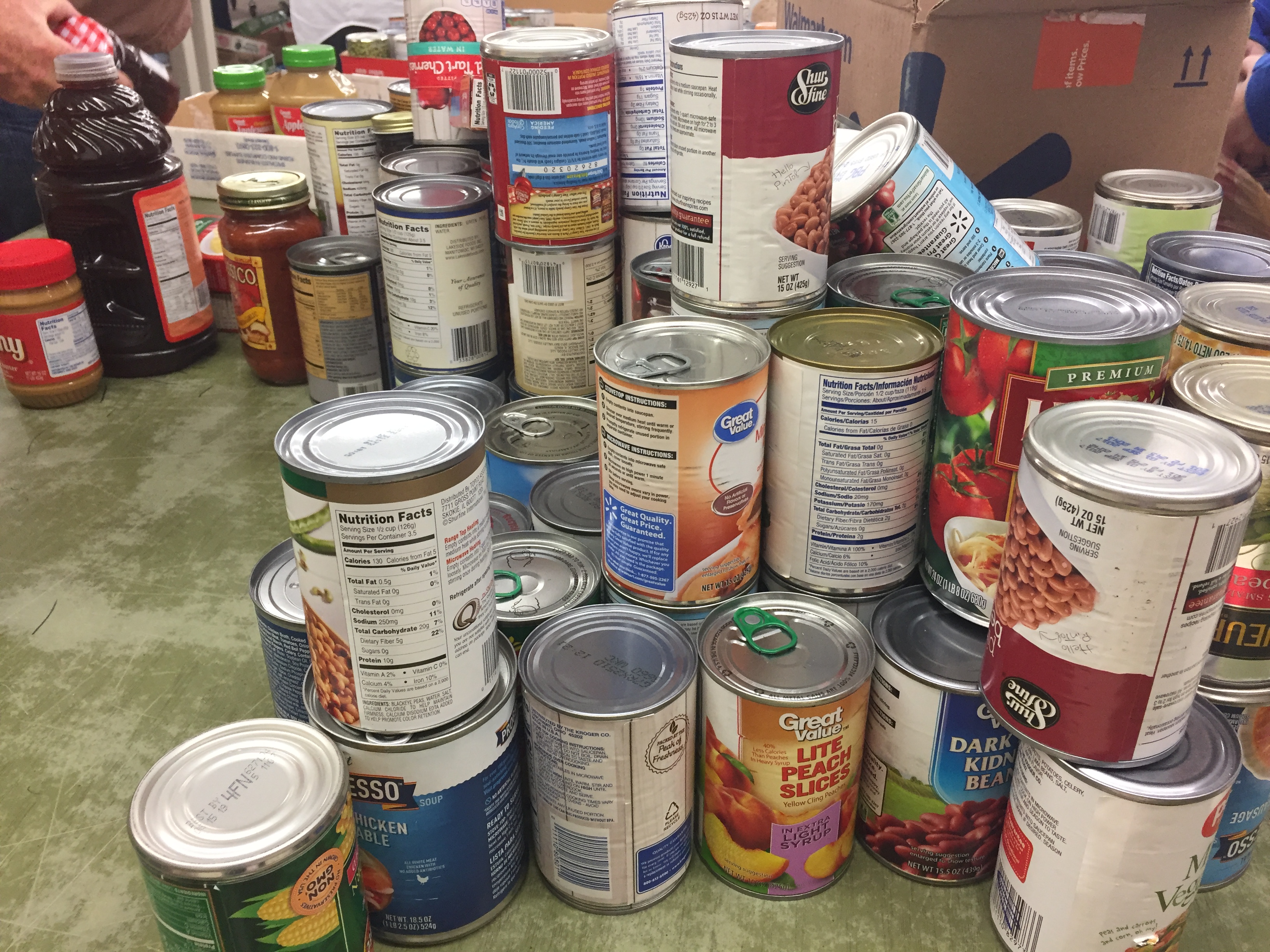
ELLIS — The Ellis Trick or Treat So Others Can Eat will begin at 4 p.m. Sunday at the Ellis Food Pantry. The food pantry is located behind Casey’s.
Community members will be going door to door collecting non-perishable food items for the the food bank.
This is a great way for students to earn community service hours, KAY points, FCCLA points, FFA involvement and others.
The Post Podcast: Good crops start with good soil

Racks sell Northwestern Printers to longtime employee


By CRISTINA JANNEY
Hays Post
After 38 years in the printing business, Marvin Rack and his wife, Jennifer, have sold Northwestern Printers, to a longtime employee.
Josh Zweifel, 40, has been an employee at the company for 22 years. He took ownership of Northwestern Printers on Aug. 1.
Marvin, 61, said he and his wife have been considering selling the business for at least a couple of years. They had discussed a sale with Zweifel and were slowly allowing him to become more involved in the management of the business.
“It’s a good business,” Zweifel said. “A lot of people in town rely on this business. I think if it wasn’t here, it would put many people into a bind, trying to find somewhere to have their printing done because print shops are getting to be less and less.”
Zweifel said he had no immediate plans for major changes within the business. He said he hopes to continue the success the business achieved under the Racks and continue the business’ community involvement.
He said he would like to increase the business’ presence online. He envisions designs for some invitations or business cards could be done online.
Marvin said Zweifel has enthusiasm.
Printing was not Zweifel’s intended career. He received his degree in elementary education from FHSU. He worked at the print shop, starting when he was a freshmen in college. He completed his student teaching, went back to the print shop and never left.
The Racks and Zweifel said the transition thus far has been smooth. No employees nor customers have been lost in the transfer of ownership.
Marvin said although neither he nor his wife are quite to retirement age, now was the right time to transition the business.
“We have been in business since 1981, and we have a very good, needed business here in Hays. The last thing we would have ever wanted to do even in 10, 15, 20 years is close the business,” Marvin said.
The Racks have children in college and one still in high school, and they wanted to be able to spend more time with their family. The couple regularly worked seven days a week at the shop.
The Racks are slowly pulling away from the business. Although they are still coming in regularly, that should start to slow within about a month.
Zweifel said, “Marvin and Jennifer stopping in or being able to call them has been priceless.”
“All we needed to do was provide Josh the opportunity, and he took it,” Marvin said. “He had a lot of confidence and a lot of knowledge. It was easy and it was natural.
“Josh had a very good concept of the working parts of Northwestern Printers. He knew the jobs. He knew how to get them done.”
A history in downtown Hays
Marvin purchased the printing business from Northwestern Business Systems when he was only 23.
He had been working in sales. When the print shop was left without a staff, he found himself spending evenings printing his own jobs as well as those of other salesmen. He said he soon discovered he enjoyed the printing more than sales and, as a certified diesel mechanic, had an interest and knack with the machines used in the process.
“It was just like art class,” he said. “It was fun to build this stuff and make it.”
Rack spent many long hours in the print shop, doing the printing and running the business side of the company.
In 1981, the printing process still involved film.
“It was a long series and a very technical series,” Marvin said. “It took a lot of talent to make sure everything was straight and everything was correct and all the halftones were perfectly shot. We were probably one of the lucky print shops that saw that if we didn’t follow the technology, we’d get so far behind we couldn’t afford to keep up with it.”
Northwestern Printers hasn’t had a dark room in a couple of decades. Today, jobs are designed on a computer and printed to a plate setter that is similar to a copier. Those plates go directly to the press.
Jennifer came on board in 1994 and computerized the shop’s hand-written order process.
“At that time, we were still doing everything manually,” Marvin said. “We were still writing up job tickets by hand. We were still filing by hand. We had a card Rolodex that had every customer in it. Jennifer got us on the computer, and that made us the big jump.”
Jennifer, Marvin and Zweifel all said keeping up with technology in the printing industry has been what has kept the business competitive.
“With us having progressed with technology or advanced with technology, we probably kept our customer base strong,” Marvin said. “We kept our employees challenged because I think one of the biggest things in a job is to learn the technology and get good at it.
“When you buy a piece of equipment that is thousands and thousands of dollars and has an instruction book that is 2 inches thick, you sit there and say, ‘I had the old process down so well and felt so comfortable with it and now look at what I got.’ It kept them thinking, and I think that’s why we kept them as we did because it was always exciting.”
The Racks feel their 12 employees are family. They have monthly potluck lunches at the shop.
“Everybody brings food and everybody sits down over lunch and eats and visits,” Marvin said. “It is that type of camaraderie that I think we have always inspired or talked about and encouraged. I think that has helped us keep some of our employees as long as we have had them.”
Hays once had four or five print shops — today Northwestern Printers is the largest print shop in the region. They also complete jobs for customers as far away as Texas, Colorado and Nebraska, Jennifer said.
In addition to quality service, the Racks said giving to the community has also been important.
“We knew in order to be successful, we had to give back to the community,” Marvin said. “I think both of us have always been very kind hearted, and so we have always shared what we’ve made — not just downtown, but with Hays and northwestern Kansas as well.”
Jennifer said stepping away from the business after so many years has been difficult.
“It is definitely a change,” she said, “but it’s exciting, and we are looking forward to something different.”
“But we know it is in good hands,” Marvin added.
The couple is still planning what they will do in retirement, but they said they hope to continue to stay connected to the community.
USD 489 foundation to raise money for security upgrades through dinner, auction

By CRISTINA JANNEY
Hays Post
Tickets are now available for the second annual Hays USD 489 Dinner Show and Auction.
Proceeds raised through the auction and dinner in part will be used to fund the completion of the district’s secure entrance project. The second phase of this project will include adding audio and video systems. This will allow office staff to speak to and see visitors before they are buzzed into school buildings.
“It’s going to give a better view of who the person actually is as opposed to looking 10 or 15 feet through the door. It is going to give a better visual of who the person is and allow us to communicate with them if we have some questions,” Superintendent Ron Wilson said.
The event will be Saturday, Oct. 26, at the Unrein Building at the Ellis County Fairgrounds. Doors open and the silent auction begins at 4 p.m. Dinner will begin at 6 p.m. The live auction will be at 7 p.m.
Tickets are $75 each or $500 for a table of eight.
The foundation is also conducting three raffles. Information on the cost of the raffle tickets and the prizes can be seen below. You do not need to present at the dinner to win the raffle prizes, and raffle tickets can be purchased in advance or during the event.
Entertainment will include Hondo Drums and the Hays Chamber Singers. The dinner is being catered by Smokin. Co. BBQ.
USD 489 Foundation for Education Excellence President Curtis Brown said he hoped to beat last year’s fundraising total, which was about $38,000.
Call (785) 623-2400 or email [email protected] if you have questions about tickets. You can purchase both raffle and dinner tickets at the Rockwell Administration Center, 323 W. 12th. Event tickets will also be available at the door.
You can also purchase tickets via credit card at https://events.ticketprinting.com/event/Project-489-Dinner-Show-Auction-35757?clear
FHSU’s national champion Meyer inspiring younger athletes at his alma mater


By DIANE GASPER-O’BRIEN
FHSU University Relations and Marketing
He won a national championship the final race of his standout collegiate career. Now, Brett Meyer is inspiring other Fort Hays State University runners to set their bars high while still pursuing some lofty goals of his own.
After claiming the NCAA Division II national championship in the 1,500-meter run at last spring’s track and field season finale, Meyer joined the FHSU cross country and track coaching staff as a graduate assistant this fall.
In between, he ran a sub-4-minute mile for the second straight summer while chasing a dream of qualifying for the 2020 Olympic Trials in the 1,500.
And he is close to meeting that goal. Meyer’s mile times convert to 3 minutes, 39 seconds in the 1,500. The qualifying standard for the Trials is 3:37.
Meanwhile, heading into the Tigers’ annual home cross country meet Saturday, both the men’s and women’s teams are undefeated this fall.
That is no coincidence, says Tessa Durnell, one of the leading runners for the Tiger women’s team.
“Brett has done a really good job of helping every runner set expectations for themselves,” said Durnell, a senior from Harwood, Mo. “It’s pretty cool to have a national champion coaching us. Not every athlete gets to have that resource, that experience.”

After watching Meyer compete as an All-American athlete for three years – he earned that honor six times – Durnell is just as impressed with his coaching style.
“I think he might be a better coach than athlete,” Durnell said. “I know that’s a pretty bold statement, because he’s a national champion. But watching him as a coach for just a few months, he is really inspirational, wants everyone to get the most out of their ability that they can.”
One Tiger runner who has been watching Meyer’s progress from afar for several years is Trever Medina, a freshman from Weskan.
During his high school days at Sharon Springs High School, Medina set his sights on becoming another successful western Kansas runner. Meyer is from Scott City, about an hour from Sharon Springs.
That inspiration, along with a reputable radiology program, drew Medina to Fort Hays State, and ultimately alongside his idol.
“I’ve looked up to him a long time,” Medina said. “I thought, ‘I want that to be me someday.’ He wins a national championship, and now, he’s coaching us and he’s practicing for himself at the same time. We learn a lot just by being around him, seeing his work ethic.”
FHSU head coach Jason McCullough said he thinks it’s good for his athletes to be surrounded by people who have been successful.
“It makes the athletes realize people (like Meyer) are normal people,” McCullough said, “and that they can accomplish big things, too.”
After graduating from FHSU with his bachelor’s in health and human performance last spring, Meyer chose to work on his master’s in sports administration and serve as a graduate assistant for the Tiger runners this year. That allows him to train while working on his degree.
One might think a standout middle distance runner who ran sub-4-minute miles twice this summer and is training for the 2020 Trials might choose a more predictable climate in which to train.

Not Meyer.
For starters, he is a loyal sort. Fort Hays State is one of the few colleges to offer him a scholarship out of high school, even after winning the 800 meters at the state track meet and anchoring two state championship relays.
Plus, if his goal of running professionally doesn’t pan out, Meyer will be halfway through his master’s program. He has aspirations of coaching at the college level someday.
Meyer became a collegiate runner himself when he decided to follow his high school sweetheart to Fort Hays State. Kelly Wycoff was a standout sprinter for the Tigers and went on to earn All-America status, too.
They married this summer, and Kelly also is working on her master’s. She is a graduate assistant for the Tiger track and field team.
The Tiger teams and their head coach are supporting Meyer, who McCullough said he thought early on could be a sub-4-minute miler.
Meyer had mostly run the 400 and 800 in high school and wasn’t so sure about the longer distance.
“I knew he could if he believed in it and trained for it, he could do it,” McCullough said. “I tried to put it in his head early.”
Now, Meyer watches as another freshman has similar interests.
Medina might be willing to increase his mileage, just as a certain national champion did three years ago.
“In Trevor, I see a lot of myself,” Meyer said. “I peaked my senior year of high school, and so did he. As coaches, that’s our job to talk to them and make them see that they can get out of their comfort zone.”
And when Meyer talks, the Tigers listen.
“He tells us what we’ve doing wrong and how we can improve,” Medina said. “He tells us how to run smarter, how to eat, a lot of things. Based on his experience, if anyone knows what should be done, he does.”
The Tigers will get to see some strong competition Saturday. The 36-team team field includes Colorado School of Mines, whose men are ranked first in NCAA D-II, and its women’s team is ranked third. The meet is set for 9 a.m. at Sand Plum Nature Trail just outside Victoria, known as one of the finest cross country courses in the Midwest.
“That type of competition is rare around here, and it always motivates us to work harder and allows us to grow and get better for our conference and regional meets,” Meyer said. “It’s also nice to see that those powerhouse Colorado schools are made up of normal people, just like us.”
Cutline: Fort Hays State University’s Brett Meyer, center back, national champion in the 1,500 meters last spring, is a graduate assistant coach for the Tiger cross country team this fall.
ROSS: Heroic girl’s 1904 dying effort to save her little brother and sisters

One of the saddest stories you will ever read
By KIRBY ROSS
Phillips County Review
Phillips County Review
Note: With the hugely successful celebration of the Kirwin Sesquicentennial last weekend, we are concluding our Kirwin History series but have a few loose ends to wrap up, as well as some rough ideas about a direction for the future.
But first, here we are going into triple overtime on the Kirwin series. I’d like to thank everyone for the overwhelming responses and feedback we’ve been getting from all over Kansas, including from U.S. Sen. Jerry Moran.
This week we’ll spotlight the courage of the amazing teenager, Lily Losey, who died along the Rooks/Phillips county line in 1904 trying to save her family.
Lily deserves a real monument rather than the very modest one-square foot gravestone she shares with five other members of her family. Perhaps the telling of the story of her bravery and sacrifice will have to suffice.
After this story, who knows?–Being an avid and moderately well-published history buff, I’m always looking for a good story to research and write about. It’s my privilege to have an organization like theHays Post to partner with — the Post is not only an outstanding media outlet, it’s the best online news site in Kansas, in my opinion. And I make it a point to read a number of them, every single day.
My personal message to the readers of the Hays Post who like these types of narratives — if you have a historical mystery or story you would like looked into concerning anything and anywhere in western Kansas, drop me a line. I can’t promise I’ll take it on … but I will take a close look at it and give it a go if I can.
If I do take it on, make sure to follow the Hays Post and watch for it. But while you’re at it, don’t forget to check out my other work at the Phillips County Review, named by the Kansas Press Association as being the state’s top newspaper in its circulation class for 2019.
[email protected] — Let me hear from you. — Kirby Ross
The Great Kirwin Fire& other fire stories

By KIRBY ROSS
Phillips County Review
In the course of working on this series of historical articles we have made several visits out to the Bow Creek Cemetery on East Early Eve Road a mile east of Hwy 183 on the Phillips County side of the Rooks County line.
During one visit the Smith headstone which accompanies this story was noticed. With brief, passing curiosity it was thought perhaps there had been a diphtheria outbreak, or some other disease which would sometimes claim the lives of entire households 120 years ago.
Several days after noticing the headstone, in the midst of researching the relationship Kirwin had with destructive fires for the half century period from the 1870s through the 1920s, we ran across our first hint that there was actually a very compelling and very tragic story behind the Smith family buried in the cemetery.
That very first hint involved an understated December 16, 1904, two-dozen-word news blurb, without even a headline, we found in the Fox Lake, Wisconsin Representative newspaper. That blurb simply stated “Four children under 12 years of age were burned to death when the home of Charles Smith, of Kirwin, Kan., was destroyed by fire.” That’s it — no other information.
That caught our attention so we started digging for additional details. After a bit more searching we found a story which appeared in the Concordia Blade-Empire with a bold headline “BURNED TO DEATH Three Children of Charles Smith Cremated Near Kirwin Friday Morning.”
That particular two-paragraph report spoke of “A terrible accident which happened on Bow Creek a few miles southwest of Kirwin. A farmer named Charles Smith, accompanied by his wife, left home at an early hour to go to town with a load of grain, leaving their four little children in the house.
“During their absence the house took fire and three of the children were burned to death, while the house and its contents were totally destroyed.”
With that, we went all in on this story and started doing serious in-depth research — the kind that takes hours and hours — emerging from it with details which would be haunting.
While we will be quoting extensively from the newspapers of the day, we will warn you the reporting is quite graphic, so take that into account if you proceed reading beyond this point.
This is the story of heroism at its utmost, about Lillian May Losey, a girl in her very early teens who made the ultimate sacrifice to save her little brother and two sisters.
If you have looked at the gravestone on this page, you already have surmised that she wasn’t entirely successful, but she did save her little brother’s life.
After saving him, she attempted to save her two younger sisters, and in so doing she ended up losing her own life.
Losing it in the most horrific way imaginable.
But first a little background. The newspaper reports of the era were all over the place in regard to the ages of the children and the specifics involved so we had to delve into genealogical records for the sake of accuracy–
The mother of the children was Lou Minnie Smith, who had been born in 1876 and was age 28 at the time of these events.
Minnie had originally been married to Edward Thomas Losey, who was ten years her senior.
This couple had two children — Lillian May Losey, born 1890, and Charity Susan Losey, born 1892.
In July 1897 Minnie filed for divorce from Edward and shortly afterwards married Charles H. Smith in Kirwin. With Charles, Minnie gave birth to Neva M. Smith in 1898, and Charles Cecil Smith in 1900.
Charles, the new family patriarch, homesteaded an 80 acre claim just below Bow Creek a stones throw south of the Rooks County line, with land records showing he filed his final proof of claim in late 1903.
At the time Aledo, Phillips County, just to the north of the Smith clan, was the local farm community, consisting of a handful of buildings — a blacksmith, a store, a post office. The children attended the Sailor Country School in Aledo, which was a little over a mile northeast of the Bow Creek Cemetery, and two miles southwest of the Delmar Hall.
So on the fateful day, December 9, 1904, the ages of the children were–
Lillian “Lily”–14
Charity–12
Neva–6
Charles “Cecil”–4

As stated, use your discretion in reading further — it gets graphic from here.
From the Kirwin Argus—
Early this morning (Friday), Mr. and Mrs. Smith departed for Stockton, each with a load of corn.
They left the house in care of their four children, ranging in age from about 14 years down to the baby of the family, aged about four years.
Later developments show they had been gone scarcely a half hour, when one of the little girls was requested to repair the fire, which, in the excitement incident to the departure of the parents had been permitted to go out — or nearly so.
The little one took the coal oil can from its resting place and going to the stove opened the door and began pouring the contents of the can on the bed of smouldering coals.
This, of course, created a gas, and immediately the flames shot out of the stove and exploded the can still held by the little girl, throwing burning oil over her and the other children who were hovering about the stove to get warm.
It was at this juncture that a scene hard to adequately describe must have been enacted, for at once the clothing of the little ones were enveloped in flames, the greedy blaze at the same time licking up with avidity everything within the wall of the old sod house, while its roar mingled with the cries of pain and affright of the burning children.
As soon as she could sufficiently recover herself, the elder of the children began the work of rescue by grabbing her baby brother, who was nearest to her and with a courage born of despair, she fought her way to the door and the open air where lay safety.
Carrying him a distance of at least two hundred feet from the burning building, she deposited this little fellow on the ground and again re-entered the burning building to complete the work of rescue; and again she repeated this task.
Three times she fought her way through the flames and intense heat, each time bringing forth a burning, suffering, charred little body to a place of safety.
The fortitude, courage and vitality of this little heroine is something wonderful.
With her own hair burned from her head, her body perfectly nude her own clothing having been burned off, and a mass of stinging, burning, blisters from her shoulders to her feet, she hastily enveloped her body in an old bed quilt and started out for help, desperately trudging over the frozen ground with her bare feet suffering intense pain from her burns and the piteous cries of her little brother and sisters ringing in her ears.
The neighborhood is sparsely settled and this little heroine was forced to trudge over hills and through cornfields a distance of nearly two miles for help, finally coming upon Charles McGee and brother, who were husking corn at the far end of an adjoining ranch.
Her appeal for help was quickly made, and then human endurance could stand no more and she fell into the strong arms of these men, and was quickly placed in a wagon and removed to the home of Jud McGee.
The alarm was given by Mr. McGee and the neighbors were quickly at the scene of the fire administering all possible aid to the three little sufferers stretched out on the ground a safe distance from the burning house. All that could be done to allay the sufferings of the little ones was done, to no avail.
A messenger was dispatched for the parents and for Dr. R.J. Dickinson of Kirwin.
It was noon, however, before the parents or the doctor arrived.
Aside from assuaging the pain, medical skill could do but little, and about two o’clock the little girl who had so thoughtlessly used the oil can, was released by death from the most intense suffering ever witnessed by those who tried to care for her.
Her little body was burned to a crisp and her eyes literally burned from their sockets and the flesh sloughed from her bones.
About two hours later the second daughter breathed her last, suffering intensely, the charred flesh in many places having sloughed off the bones and muscles.
It was a terrible tragedy and the awful scene will remain in the minds of the witnesses all through life.
The oldest, whose heroic rescue of her little brother and sisters seems to have been for nought, is in a very critical condition and her recovery is thought doubtful.
The little boy, who was first rescued, seems to be in much better condition than the others and may recover with proper care.
The fire destroyed the household effects and building and leaves Mr. Smith and his family without a home and in destitute circumstances.

From the Topeka State Journal—
Word has been received in Kirwin of the destruction of fire of the country home of Chas. Smith, situated on Bow Creek about 14 miles southwest of Kirwin.
It appears that Mr. and Mrs. Smith left home early in the morning, for Stockton, to do some shopping, leaving their four children at home.
While the children were kindling the fire with kerosene an explosion occurred, severely burning three of them, it is thought fatally, besides destroying the house and contents.
One of the children, her body being horribly burned, lived only a short time, while two others are so badly burned they cannot recover, one of who had her eyes burned out.
From the Rooks County Record—
The worst calamity in the annals of Rooks County occurred at the home of C.H. Smith on Bow Creek last Friday morning, causing the death of two little girls, and is likely to result in the death of an older girl and a very small boy.
Early in the morning Mr. and Mrs. Smith started on the trip to Stockton with two loads of corn, leaving their children at home.
The two older ones were daughters of Mrs. Smith by a former marriage.
Lily Losey was 14 years old and Charity Susan Losey 11 years.
Neva and Cecil were the Smith’s children.
The oldest girl helped them off and was sitting by the stove when the accident happened.
Charity, the next oldest, was reading at a table near the stove.
Neva got the kerosene oil can and poured oil on the fire. Instantly there was a great explosion from the stove and the can and all the children were enveloped in the cruel flames.
With her own clothes on fire, Charity picked up the little boy and carried him out of doors, and then tried vainly to extinguish the fire in her clothing by rolling in the snow.
The oldest girl, herself afire, carried Neva to the well and plunged her into a tub of water. Then she ran back into the burning house and carried out some articles of furniture.
In the meantime the clothing of the little girls had burned off and they were writhing in agony upon the ground.
Then with a fortitude inspired by the highest heroism, suffering from frightful burns about her body and denuded of clothing, she placed the smaller children in the barn and with a blanket thrown around her, hastened along the road for a mile seeking help.
There she found Dan McGee husking corn in a field.
He put her in his wagon and drove a quarter of a mile to his father’s home.
The flesh was dropping from her limbs when she got to the house.
The men drove back for the other children. They saw a terrible sight. Neva’s eyes were blind, one ear was burned off and lips and nose charred to a crisp.
Charity’s face and entire body were burned the color of chocolate and her hair was gone.
Both were conscious. The older one was conscious to the last and was able to tell how it happened.
Neva Smith died at 2 o’clock on Friday afternoon and Charity Losey at 4 o’clock. Lily Losey is still living, though there is very little hope for her recovery. Her sufferings are intense.
The little boy was quite badly burned about the face and will carry fearful scars to the end of his life. He was taken with a high fever at once, and for several days his life hung in the balance. As we write he is reported better.
The funeral of Charity and Neva was held at Aledo in Phillips County on Saturday at 11 a.m.
Mr. Edward T. Losey, father of the two older children came from Naponee, Nebraska, Saturday morning. He was accompanied by Mrs. Ed Critz of Naponee, sister-in-law of Mrs. Smith.
The Smith house was a small sod structure. The house and all its contents were burned, even the things carried out by Lily.
The catastrophe is the most distressing and harrowing in all its details that we have ever been called upon to chronicle.
The sympathetic neighbors have done all in their power to assuage the suffering and grief of those involved in the affair.
By the loss of their home Mr. and Mrs. Smith are left in destitute circumstances.
From the Plainville Times—
Last Friday morning Chas. Smith and wife started from their place, about 13 miles north of Stockton, on Bow Creek.
The children allowed the fire in the stove to burn rather low, and the little girl poured coal oil on the coals to start the fire, the other children trying to prevent her from so doing.
The oil on the coals at once created gas and caused an explosion setting fire to the children’s cloth and the house.
The oldest girl after trying in vain to extinguish the flames, carried her younger sisters and baby brother from the house and to a place of safety and then started to the nearest neighbors for help, whose house was a mile away.
Her clothing having caught fire from the explosion was almost burned off her, and her limbs and arms being burned to a crisp, ran the distance to their neighbors against a strong north wind and gave the alarm.
The little girls were so badly burned that they only lived a few hours, passing away at 2 o’clock, and the other at 5 o’clock that day.
The baby brother is so badly burned that he is not expected to live.
The oldest child is so badly burned she is unable to speak and there is hardly a possible chance of her recovery.
The house and contents were completely destroyed.
From the Stockton Western News—
Last Friday morning the home of Mr. and Mrs. C.H. Smith of Bow Creek, about 12 miles north of Stockton, was totally destroyed by fire and their four children came near being burned alive. As it was two children were so badly burned that they died the same day.
Mr. and Mrs. Smith started for Stockton early in the morning, each with a load of corn, leaving their four children at home.
It was a pretty cold morning, and the fire having burned so low that it needed kindling, the six-year-old girl poured coal oil into the stove. An explosion took place instantly, and before the children could comprehend anything they were in the midst of flames, and the contents of the house caught fire in a moment.
They were so bewildered they could not leave the burning house.
The oldest girl heroically tried to save her brother and sisters. Three or four times she entered the burning building and finally succeeded in getting them all from the house, but not until her clothing was burned from her body and her flesh in many places burned to a crisp.
She carried the children to a hay stack and after covering them as best she could, wrapped a quilt around herself and started barefooted over the frozen ground to Dan McGee’s about a mile away. She found Mr. McGee and his hired hand shucking corn and told the sad story.
They immediately drove with her to their home where everything was done that human aid could do to relieve her suffering.
Then they went to the scene of the fire and found the prostrate forms of the other children whose lives seemed nearly blotted out.
They were taken in charge and the rural telephone was kept busy sending messages along the line to stop the parents and inform them of the awful calamity.
About three miles out of Stockton Mr. Hopkins, so we are informed, met the parents and told them what he had heard.
In the meantime word had reached this city and Lark Johnston started out with his team and spring wagon to meet Mr. and Mrs. Smith.
He met them just north of the academy and insisted on their driving back at once with his rig, which they did.
But what a terrible ending!
Two of the girls, aged 6 and 11 respectively passed away, one dying soon after dinner and the other about 6 o’clock that evening. The boy was burned least of all, though he was not out of danger for a few days, and the eldest girl was near death’s door for three or four days, but it is believed now both will survive.
The suffering those children endured can never be told or even imagined.
Dr. Dickinson of Kirwin was the attending physician but with all his skill the lives of the two youngest girls could not be saved.
Funeral services were held Saturday morning at the Sailor School House, Rev. Chas. Harvey of Osborne County officiated.
From the Hutchinson News—
Not all the heroes or heroines of this world get their names in big headlines in the papers, and not all the brave people in this world have their deeds heralded to the world, says the Salina Journal.
A few days ago in Rooks County an incident occurred which deserved to be published broadcast through all the world but which was hardly known beyond a small circle in a farm neighborhood for some time after the event happened.
A farm house caught fire and burned to the ground while all the family were away from home except four children.
The house was enveloped in flames before the fire was discovered and the country was so sparsely settled that there was no help for the children, save what the little girl could give.
She carried her baby brother from the building and then rushed back to rescue two little girls who were still there, but it was too late.
The fire was bursting then from the doors and windows and the child made her way through the blaze and smoke. She managed to get out of the house just as it collapsed, but so badly burned was she that she endured the most intense suffering.
From the Kansas City Journal—
Her Medal a Tombstone. When the Carnegie hero medals are ready for distribution there is a 15-year-old girl who will be entitled to one. Farmer Charles Smith and his wife went to town, leaving the four children of the family at home.
One of the little girls put some coal oil on the fire and there was an explosion and a fire which quickly consumed the house.
The older girl carried her brother and sisters, one by one, to places of safety. Two were burned so badly that they quickly died.
The little heroine herself is fluttering between life and death.
From the Kirwin Argus—
The third of the victims of the disastrous Smith fire north of Stockton died last Sunday night and was buried Monday afternoon.
This death took from the family Lillian Losey, step daughter of Mr. Smith, and the oldest daughter of his wife by a former marriage.
This death removes the little heroine who battled so strenuously with the terrible flames to rescue her two sisters and baby brother.
Had she been content to rescue only her little brother and turned a deaf ear to the pleas of her burning sisters, she would no doubt have been alive today; but not so; her heroism arose above self-thought and at what proved to be the sacrifice of her own life, she attempted the rescue of her own little sisters.
For this noble act of self-sacrifice her place in heaven is assured, for has it not been said “Tis better to give than receive,” even though it be your own life?
By her heroism and self-sacrifice this noble little girl has erected a monument to herself as lasting as time.
The funeral services were held Monday afternoon and was largely attended by the neighbors, all of whom desired to pay their last respects to one who had gained their lasting esteem.
The remains were laid to rest in the Bow Creek Cemetery.
The grief stricken father of this noble little girl returned to his home in Naponee, Neb., after the funeral, seared in heart, alone and blighted, with no one to care for him and no one upon who to lavish a father’s love and affection.
Tis indeed a sad case and one that should appeal to all parents.
From the Stockton Western News—
Death of Lily Losey. Last Sunday night, about 10 o’clock, Lily Losey, the 14-year-old stepdaughter of C.H. Smith of Bow Creek, passed away, her death being due to the severe burning she received the week before in trying to save her brother and sisters from the flames which destroyed their home.
Her two sisters died the same day of the fire, while she lived one week longer, though during that time her life hung by a thread, as it were.
She suffered untold agony, and so great was her grief that it would be far beyond the power of any human to describe it.
Funeral services were held Monday morning at 10 o’clock, from the Sailor School House and the remains laid to rest in the Bow Creek Cemetery.
Epilogue
Having lost everything except their critically injured son, Minnie and Charles Smith struggled to recover. Four years later Minnie gave birth to Gladys V. Smith in Webster, Kansas. Gladys would marry Frank Clinton Johnson in 1923.
Passing away in Logan in 1984, the little sister the Smith/Losey girls never knew is buried there in the Pleasant View Cemetery.
Minnie and Charles were still together when he died in Bogue in 1924 at the age of 51. Charles was brought back to the children, Lily, Charity and Neva, in the Bow Creek Cemetery.
Minnie lived a quarter century longer than Charles, dying in Rooks County in 1949 at age 73. Although she had married Janson Albert Nelson during that time, following a 45 year separation from her little girls she rejoined them and Charles along the banks of Bow Creek in the little cemetery that bears that quiet stream’s name.
And while courageous Lily died perhaps knowing her sacrifice in going into the inferno to rescue her little sisters ultimately did not save their lives, one hopes that in her final moments she also knew her little brother was clinging to life, still struggling as hard as a four-year-old could, and was making a brave fight of it.
While she wasn’t there to see it, not only did Cecil battle through his awful experience — too awful for anyone to endure, let alone a toddler — he went on to live a very long, fruitful life.
It’s not known how the scars he carried for the rest of his days affected him or if he had been too young to have any memories of his three older sisters, or of that awful morning in early winter 1904 right before Christmas.
Cecil does show up in the 1910 and 1920 censuses living with his parents, and in the 1930 census still with his mother after his father died and she was aging.
By that 1930 census Cecil had two children of his own. Eventually he would have at least four–Billy, Charles, Randy and Janivee.
Another unnamed son of Cecil would die in infancy, and is buried close by the protective sides of his aunts and grandparents.
From Cecil’s four children who survived to adulthood there were at least 16 grandchildren and untold numbers of great-grandchildren.
All of them given life because a remarkable 14-year-old girl, at an extraordinary, terrible cost to herself, swept her siblings out of a hellish nightmarish inferno before racing blistered and burned and barefoot and naked across the blustery frozen December Kansas prairie to bring help to them. And in so doing, sacrificing her own life so a helpless little four-year-old boy might be given a chance at one of his own.
Cecil would pass away peacefully in Billings, Montana on June 5, 1986, just two months shy of his 86th birthday.
And he was surrounded by his large family. The final gift his big sister had made possible for him 82 years before.
Article reprinted from the Phillips County Review, with permission. The Phillips County Review has been named by the Kansas Press Association as being the state’s top newspaper in its circulation class for 2019, beating out over 180 other publications.
Editor and writer Kirby Ross, a past nominee for the Western Writers of America Spur Award and the National Cowboy Hall of Fame’s Western Heritage Award, has had two books of historical nonfiction published by major university presses. He has also personally won over 20 Kansas Press Association Awards of Excellence for his newspaper work over the past three years, including first place recognition for news reporting, news and writing excellence, feature writing, political and government reporting, editorial writing and news photography. He can be reached at [email protected].
Cottonwood Extension District election information

The upcoming Nov. 5 election day will have candidates listed for four positions on the Cottonwood Extension District Executive Board.
In Ellis County, candidates are Tatum Sprague-Kimzey and Allen Roth. Barton County voters will have Richard Dougherty and Kathie Rondeau on the ballot.
To be a qualified voter, you must register at the county clerk’s office in Hays or Great Bend by Tuesday, Oct. 15. Advanced voting in Ellis County begins Monday, Oct. 21, and runs through noon Nov. 4, during the hours of 8 a.m. and 4 p.m. at 718 Main in Hays. Advanced voting in Barton County will begin after Oct. 16 and run through noon Nov. 4, during the hours of 8 a.m. to 5 p.m. 5 at 1400 Main in Great Bend.
Questions may be directed to the Ellis County Clerk at (785) 628-9430 or the Barton County Clerk at (620) 793-1835.
— Cottonwood Extension District
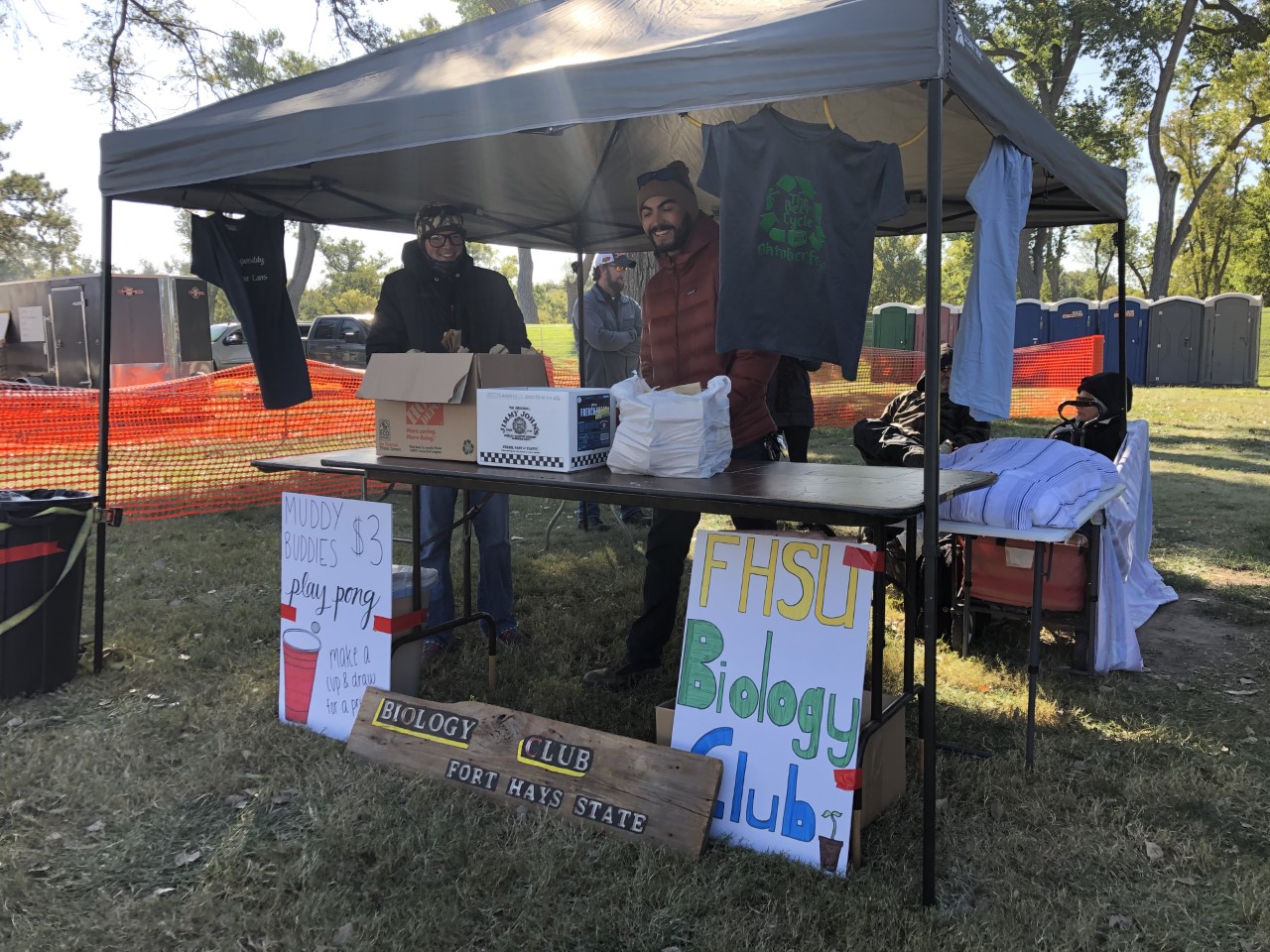
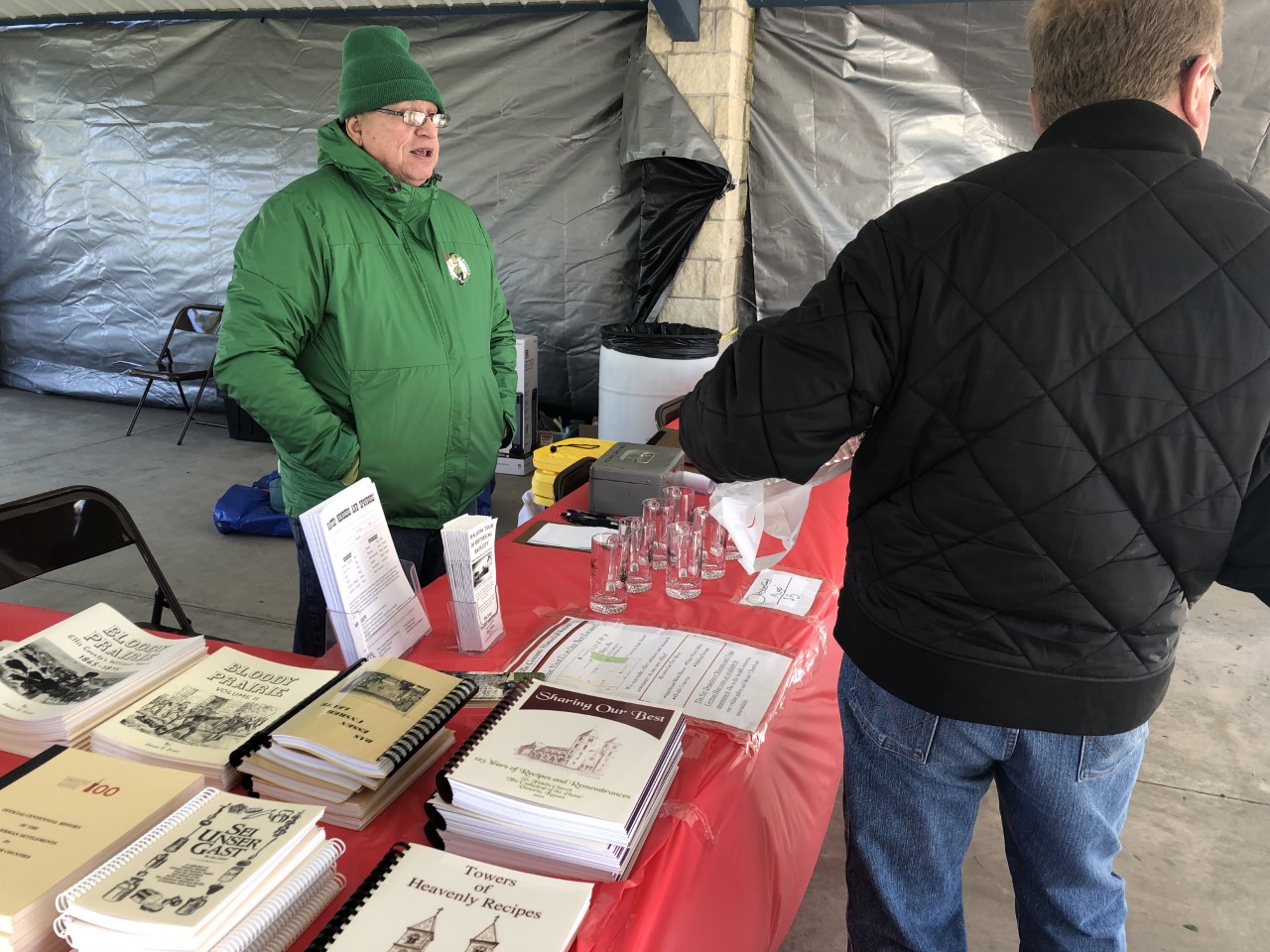
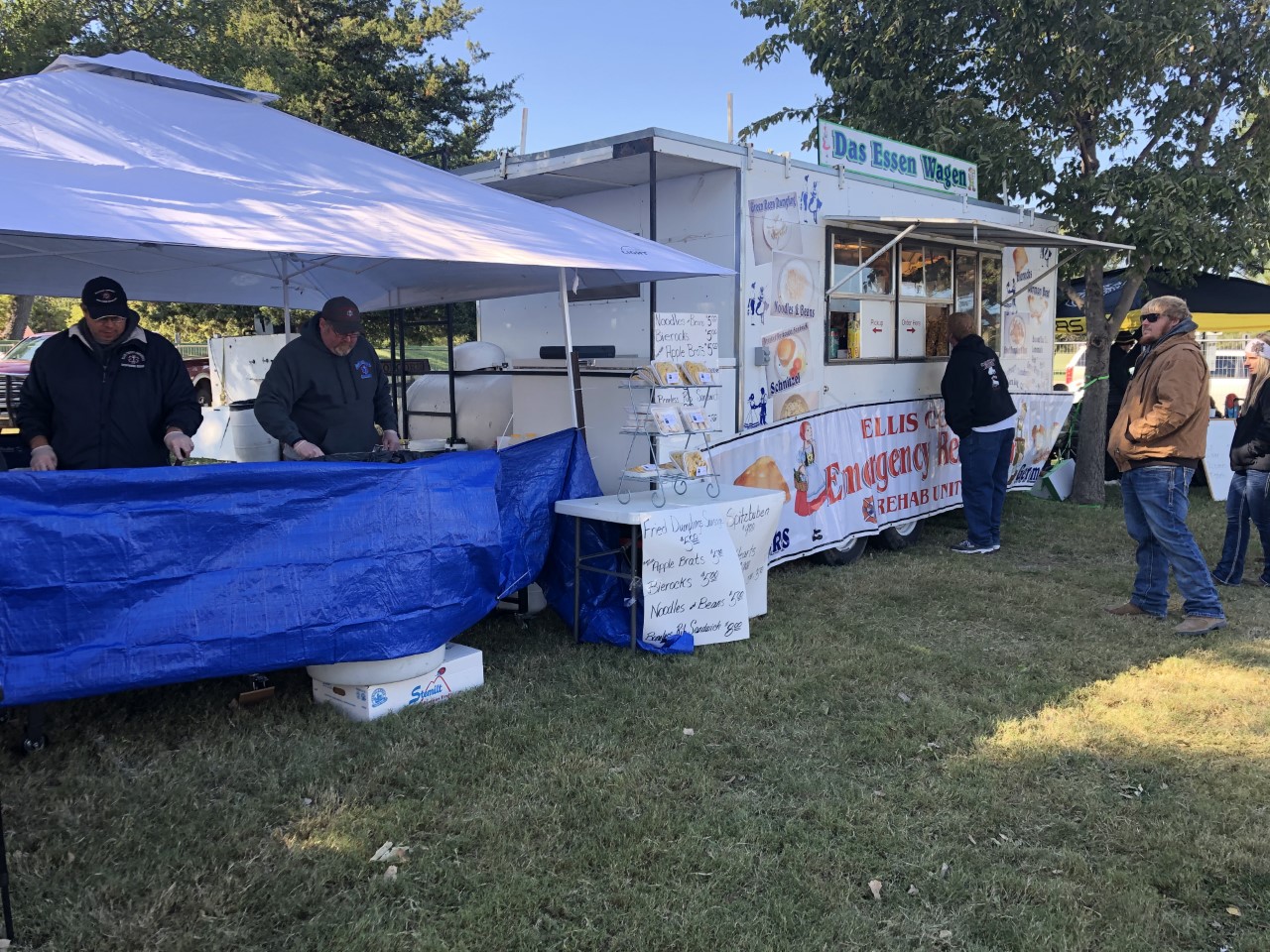
🎥 Cold temp, wind can’t keep away Oktoberfest revelers
By BECKY KISER
Hays Post
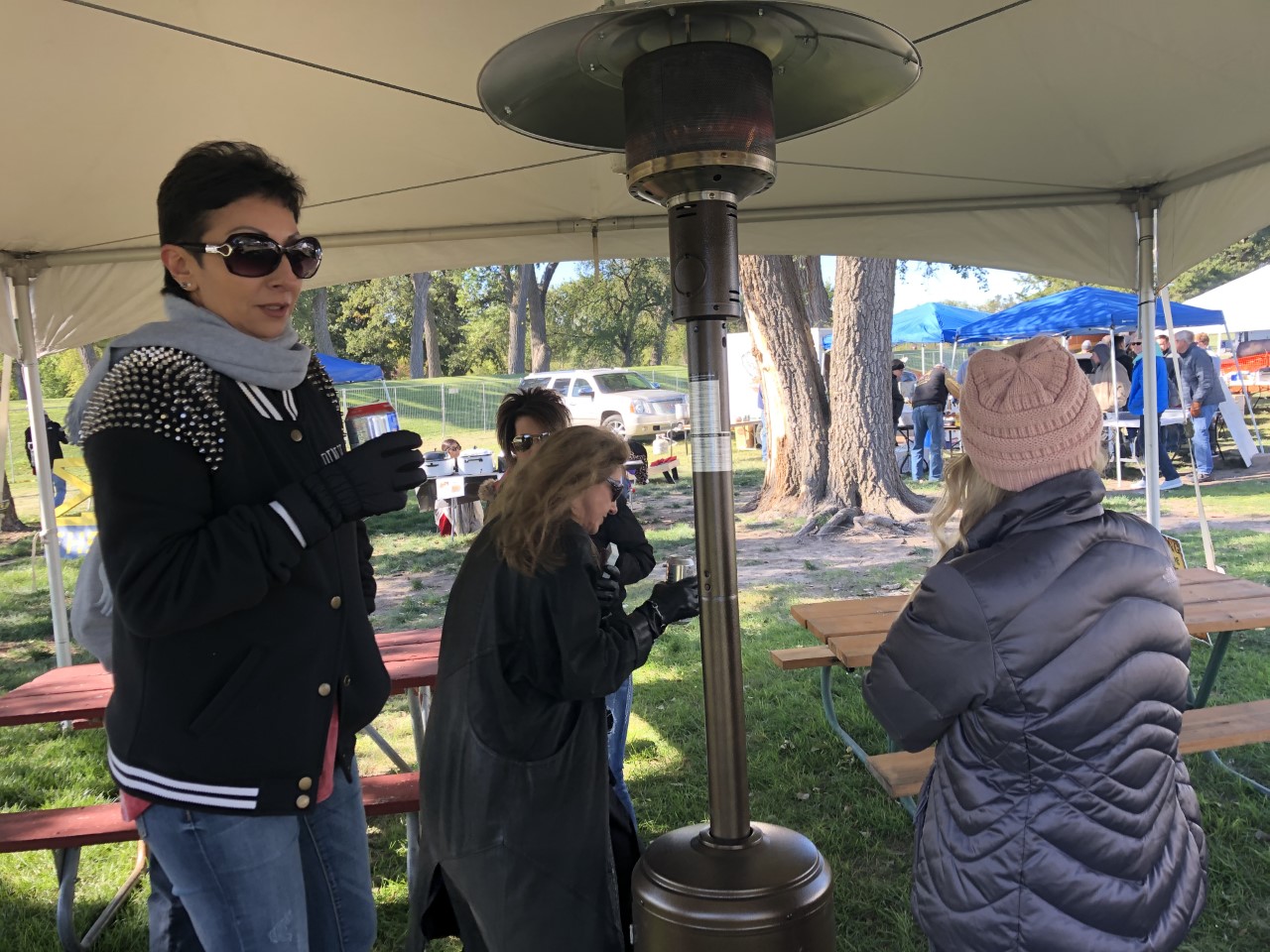
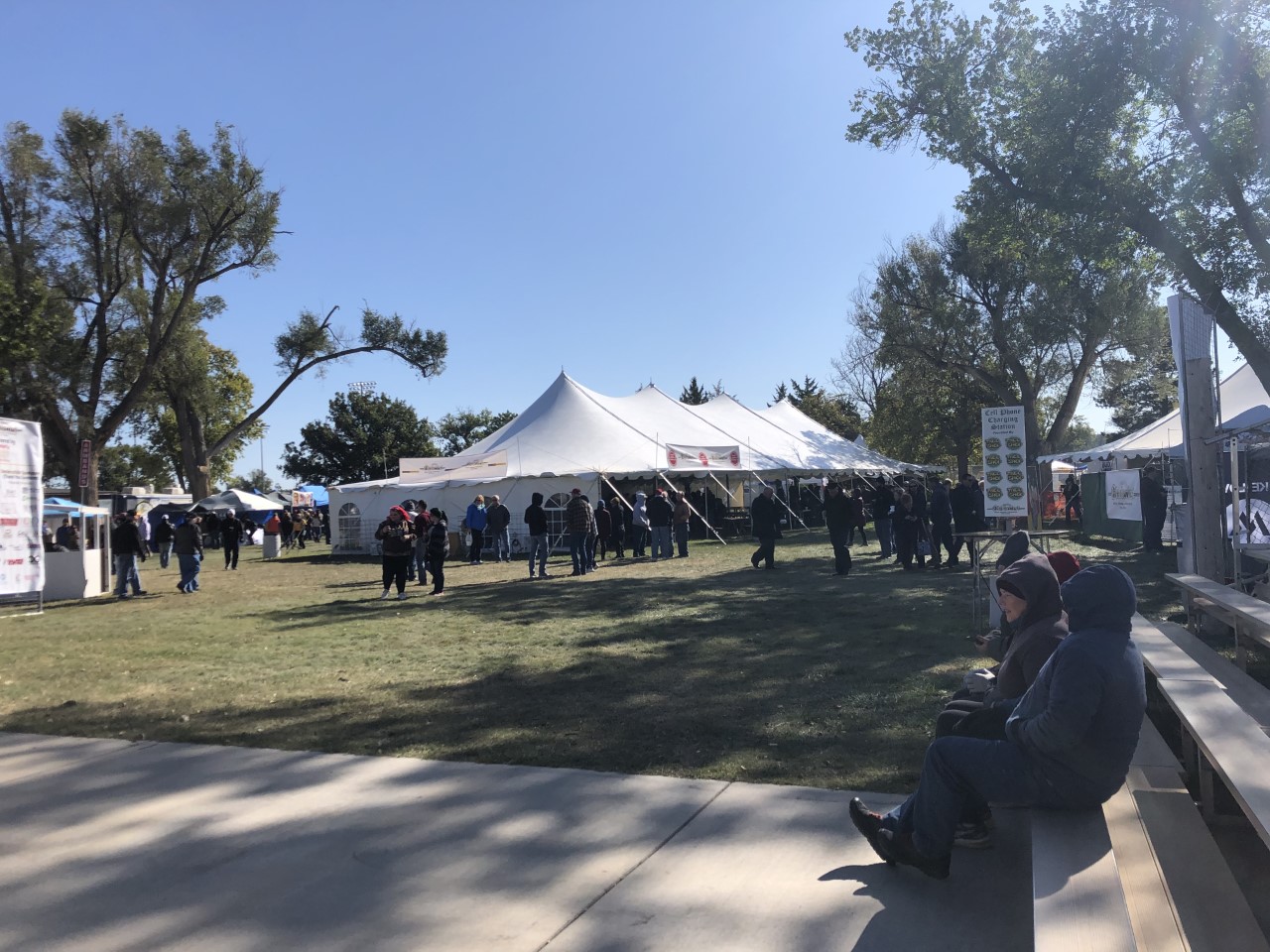
The sun was shining brightly this morning for the opening of the 47th annual Hays Oktoberfest, despite a brisk northwest breeze and a wind chill of 26 degrees.
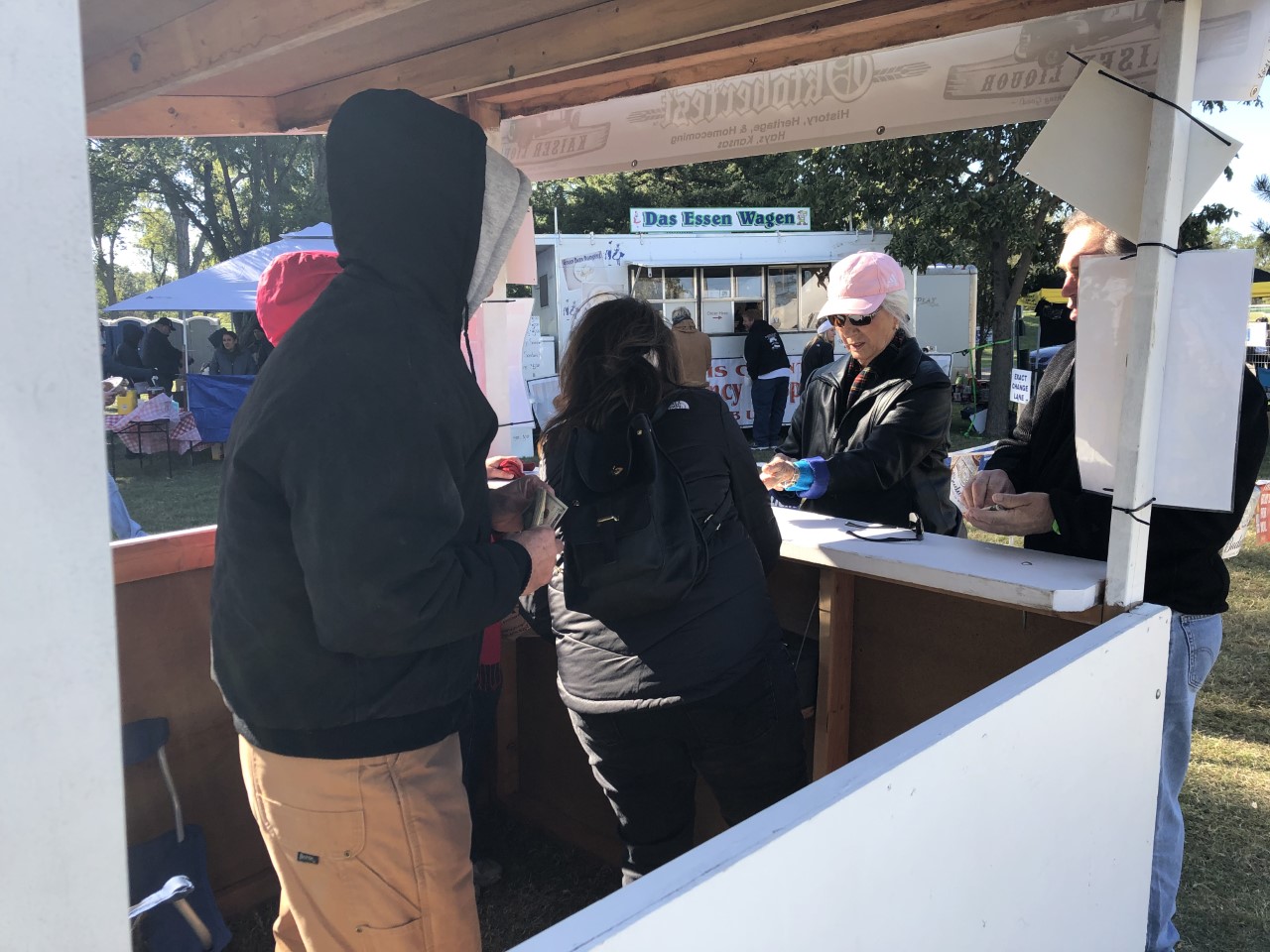
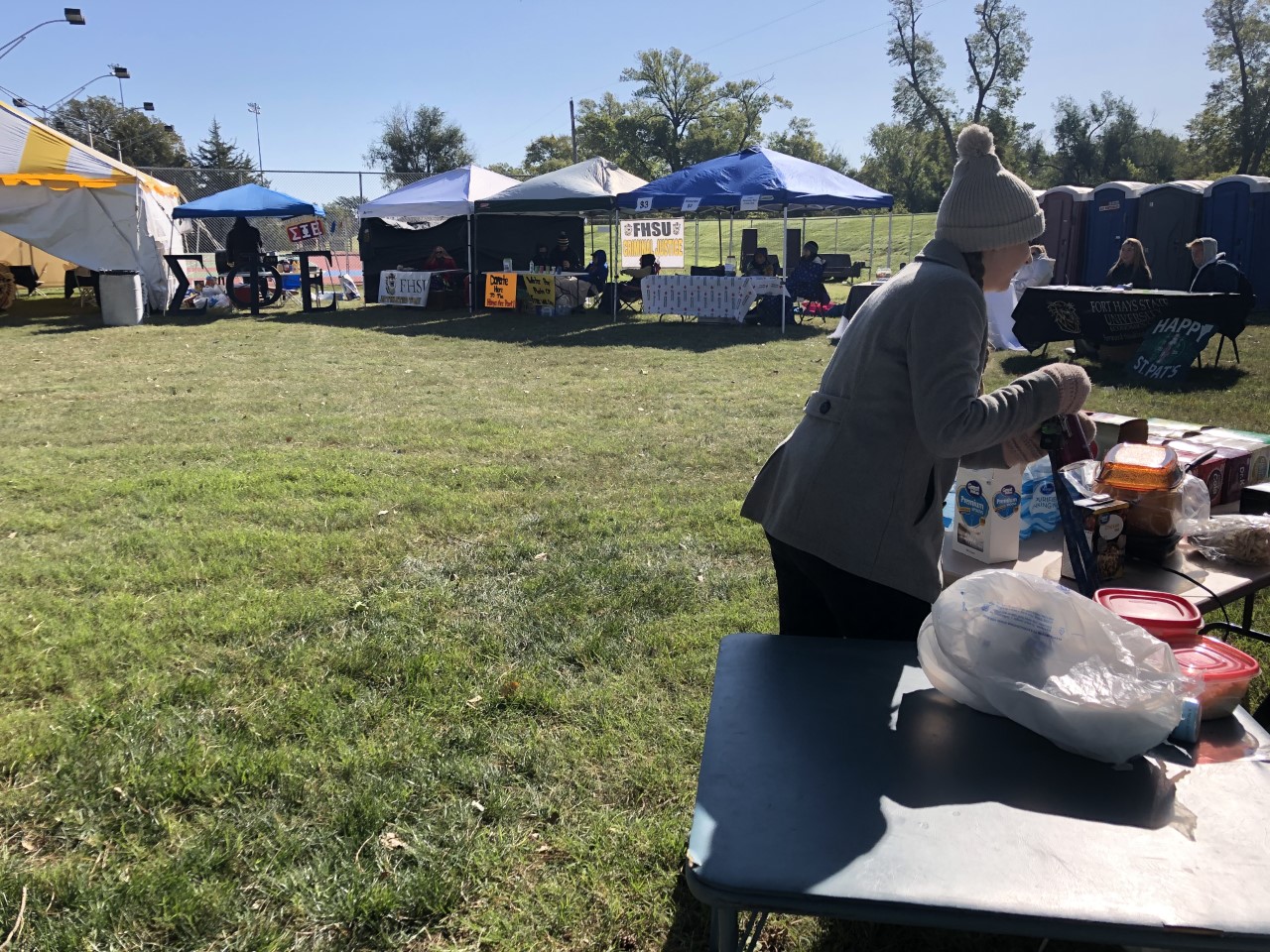
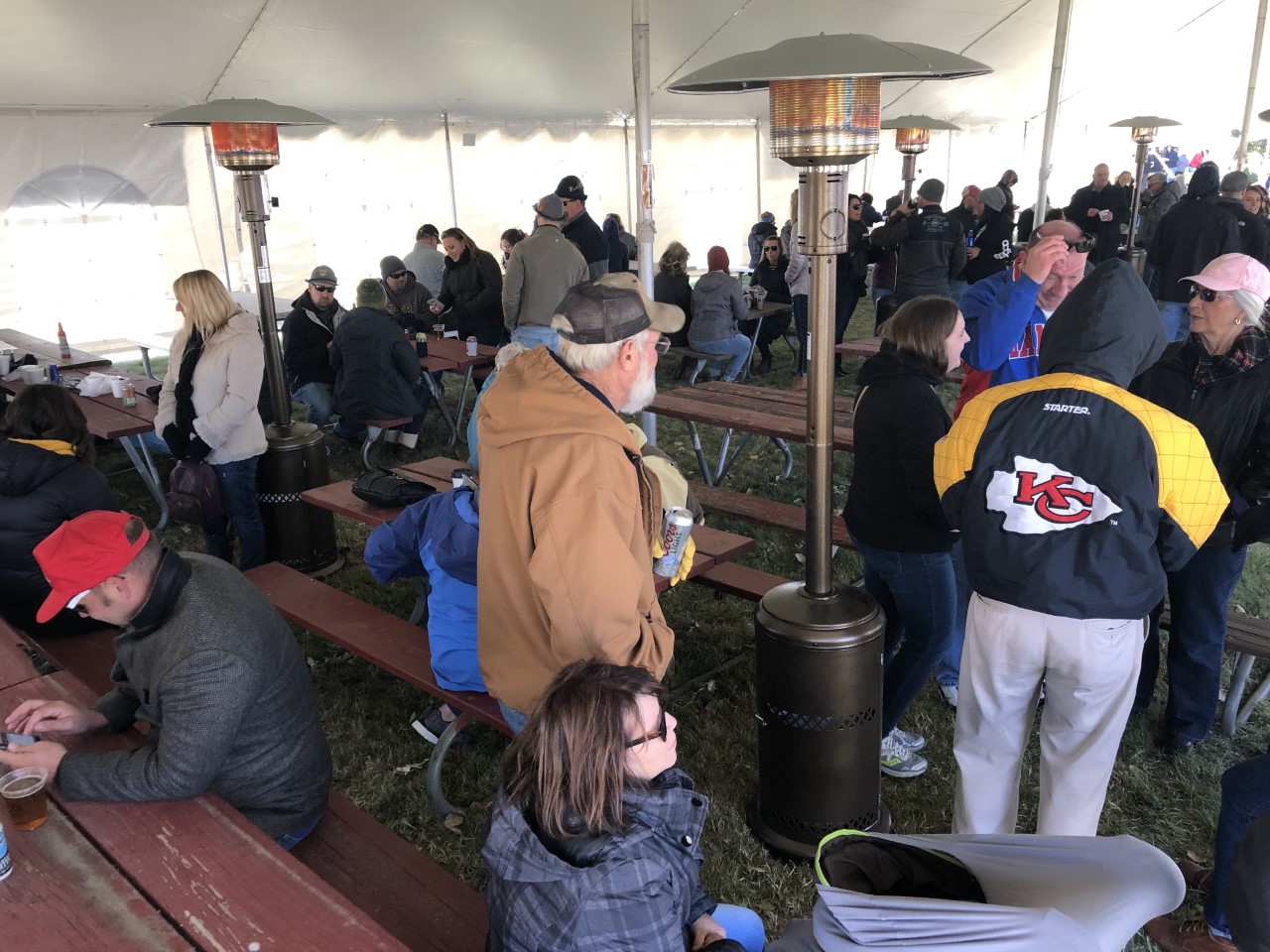
Organizers were prepared for the drastic weather change and had set up propane heaters in nearly every booth and tent dotting the Municipal Park grounds.
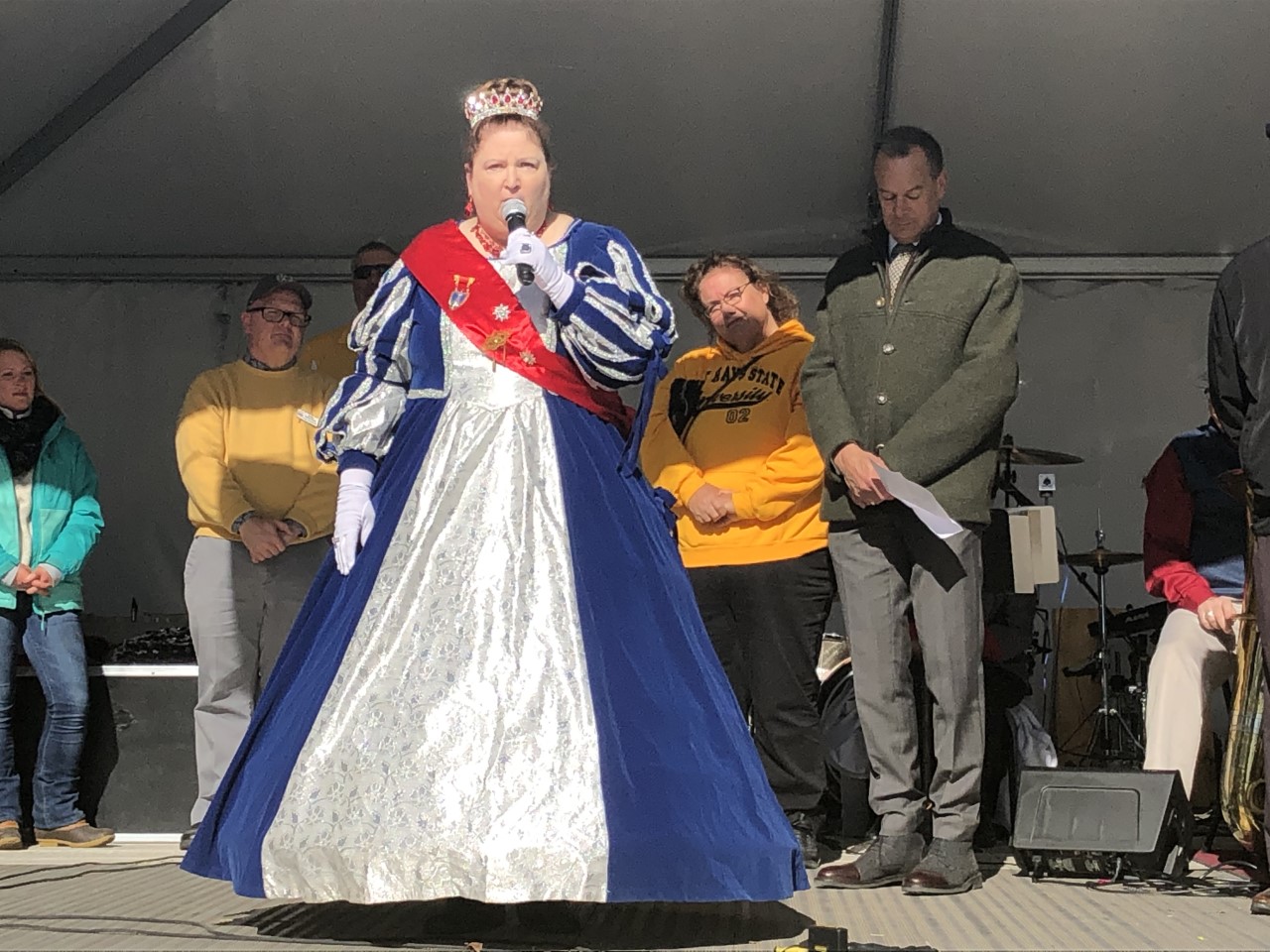
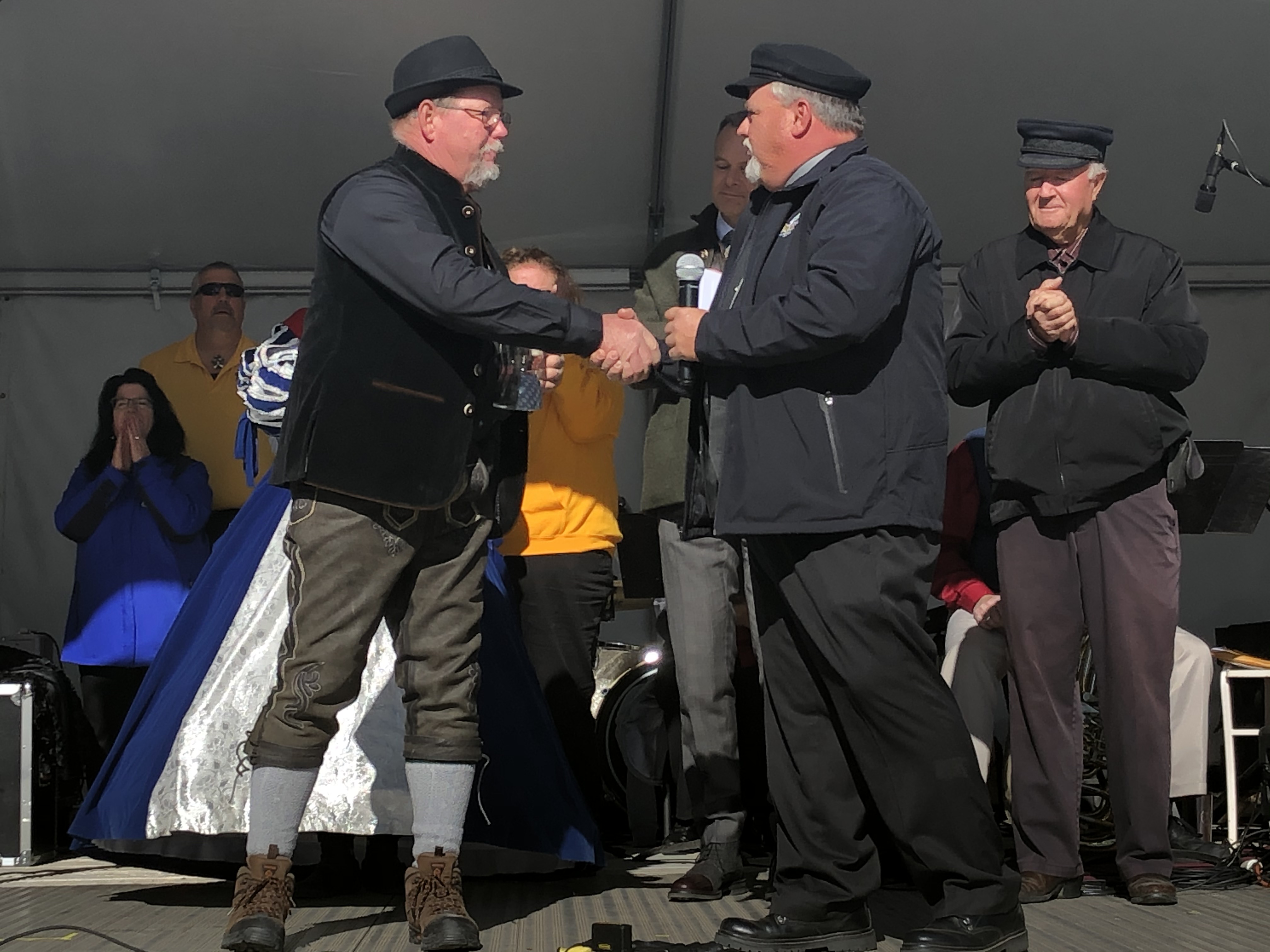
The opening ceremony included a welcome from members of the local Volga German Society, Nick Werth and Tom Haas. Hass noted the Volga German immigrants who settled in Ellis County from Russia approximately 150 years ago kept their town names the same.
“We wouldn’t be here without them,” declared Hays Mayor Henry Schwaller IV, who is of Volga German descent.
Oktoberfest is a shared celebration with Fort Hays State University’s homecoming.
FHSU student Leon Dammert is from southwest Germany, near Frankfort. He talked about how friendly Hays is and “something you should be proud of.”
“It’s the same for FHSU. They really welcome the international students,” Dammer said. “Oktoberfest for me is a fest for family and friends to have fun.”
Werth presented $500 scholarships from the Volga German Society to students Kreighton Meyers, NCK Tech and Alexandra Herman, FHSU.
For the first time, Oktoberfest has been expanded to a two-day celebration. The grounds will close at 7 p.m. tonight.
Saturday morning will feature a German Market during the Downtown Hays Market in the Union Pacific Pavilion 7:30 a.m. to 11 a.m.
Following the FHSU Homecoming Parade, the fun gets underway again in Municipal Park with family-friendly games, more polka music, and of course, homemade German food. Oktoberfest will end at 4 p.m.
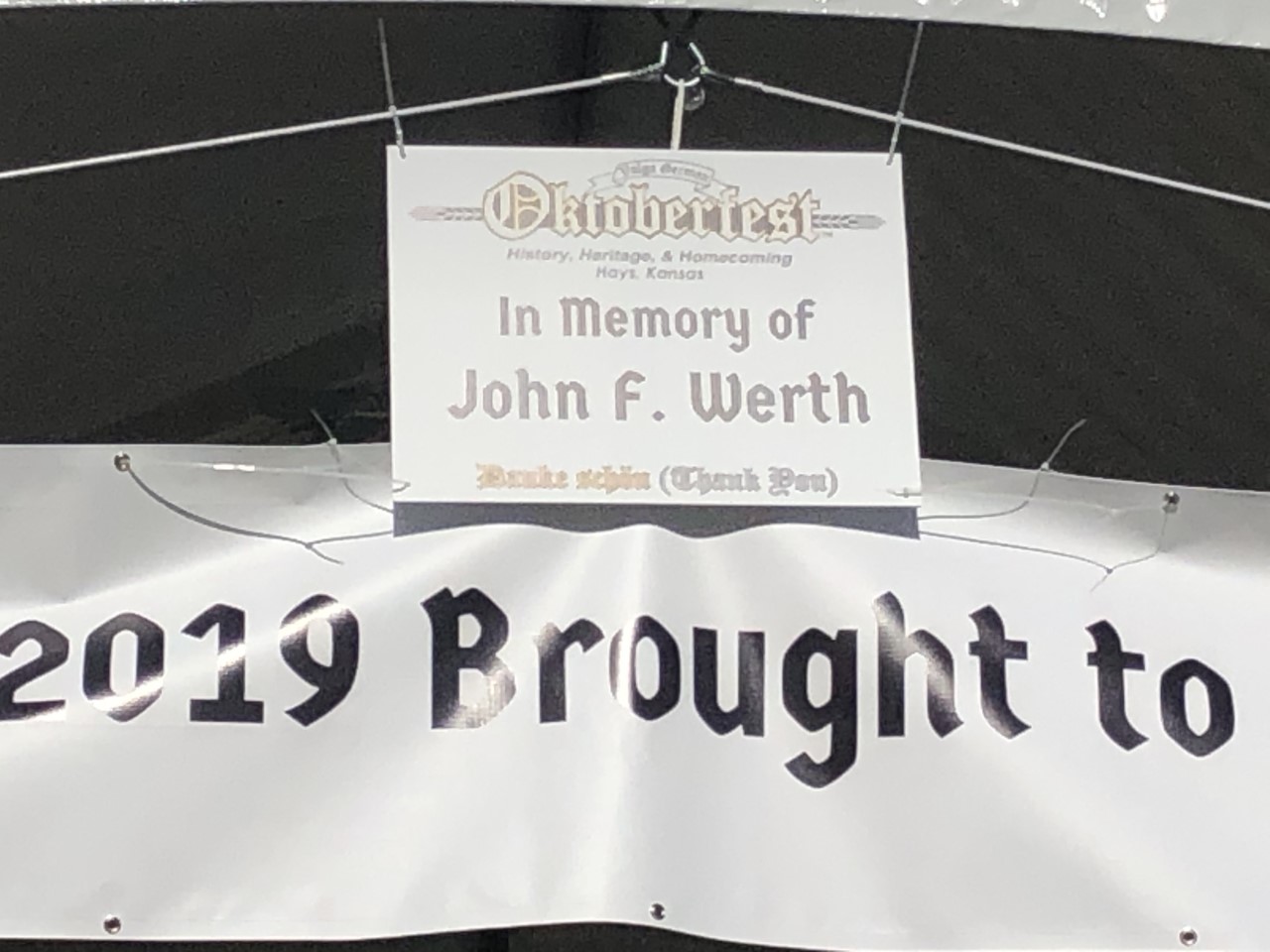
This year’s event was dedicated to the memory of Schoenchen resident John F. Werth, who perished in a cropdusting airplane crash in August. Werth was a leading member of the local Volga-German Society.