FINNEY COUNTY- A Kansas woman and three children were injured in an accident just before 10:30p.m. on Sunday in Finney County.
The Kansas Highway Patrol reported a 2001 Chevy Malibu driven by Rosa Maria Rutiaga, 62, Garden City, was eastbound and failed to yield at the intersection of at Kansas 156 and Mary Street.
The Malibu collided with a 2008 Nissan Rogue driven by Paige Brianne Johnson, 23, Lubbock, Texas.
Rutiaga and three ages 6, 7 and 8 were transported to St. Catherine’s Hospital.
Johnson and a passenger were not injured.
None of the individuals were properly restrained at the time of the accident, according to the KHP.
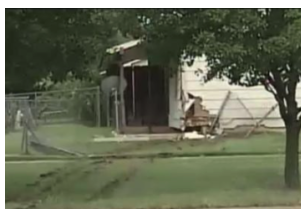
Where the shooting victim crashed into a home early Thursday photo courtesy KWCH
WICHITA, Kan. (AP) — The family of an 18-year-old killed last week by a sheriff’s deputy after pointing a gun at the law enforcer during a traffic stop says the driver’s own actions “ended his life too soon.”
Caleb Douglas’ family said in a statement Saturday that Douglas was “a caring, loving soul,” but that “his troubles were a concern.” The family says Douglas caused “the (Sedgwick County) deputy to fire his own weapon in self-defense.”
Authorities say the deputy spotted a possible impaired driver early Thursday in Wichita and stopped the vehicle. The sheriff says Douglas pointed a handgun at the deputy’s face after being asked to step out of his car.
The sheriff says the deputy retreated before firing at the driver, who drove off before striking a house.
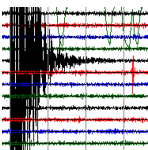
OKLAHOMA CITY (AP) — The 37 wastewater disposal wells to be shut down in north-central Oklahoma, where a 5.6 magnitude earthquake struck this weekend, are just a fraction of the state’s total number.
Oklahoma Corporation Commission spokesman Matt Skinner says the wells are among about 4,200 across the state. They’re also among the about 700 in a 15,000-square-mile “Area of Interest” created by the commission to address earthquakes in the area near Pawnee.
An increase in magnitude 3.0 or greater earthquakes in Oklahoma has been linked to underground disposal of wastewater from oil and natural gas production.
Skinner said it isn’t clear how many wells under the jurisdiction of the Environmental Protection Agency are in an adjacent county.
Saturday’s earthquake tied for the largest in the state. No major damage was reported.
SHAWNEE, Kan. (AP) — Public schools around the country are joining an educational movement that changes how students learn and teachers work.
It’s called the “maker movement,” which encourages students to direct their own education by tapping their creativity and collaborating with others.
The Shawnee Mission, Kansas, and Liberty, Missouri, school districts are among many that have created “makerspaces.” The spaces include a wide range of materials, from 3-D printers to simple building blocks. Students use the materials to solve problems, with teachers watching but not directing the work.
Advocates say the maker movement is a better way for students to learn. But others are worried already-busy teachers will not be able to fit the new makerspace effort into test-based curriculums that need to meet education standards.
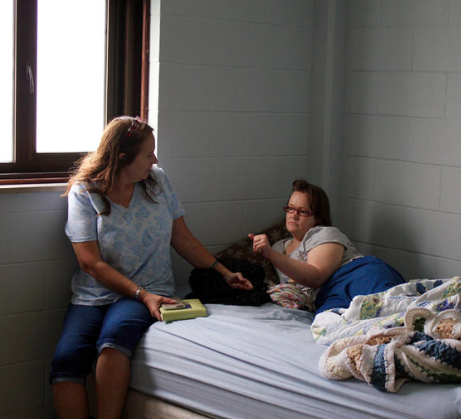
Judy Talbot, left, talks with her daughter, Jill, who is 32 and has autism and post-traumatic stress disorder. ANDY MARSO / HEARTLAND HEALTH MONITOR
By ANDY MARSO
Like most moms, Judy Talbot has photos and videos of her daughter on her smartphone.
But some of the images Talbot keeps on her phone show her daughter smacking herself in the face repeatedly or strapped to a bed, writhing against restraints with bruises up and down both legs.
“From her kicking,” Talbot explained.
Talbot’s daughter, Jill, is 32 and has autism and post-traumatic stress disorder.
Because of that combination, Jill recently spent six days isolated in the emergency department of a Kansas City area hospital while Talbot and Jill’s case manager scrambled to find her a better option.
Jill was taken to the hospital because she was having a psychotic episode. She had become violent, even with her mother. But the hospital, Shawnee Mission Medical Center in Shawnee Mission, Kansas, wouldn’t admit her to its psychiatric floor. Talbot said she was told Jill’s developmental disability would prevent her from participating in group therapy the hospital requires as part of psychiatric treatment.
Hospital staff and Talbot called one psychiatric facility after another, looking for one that would take Jill. All declined.
So Jill stayed for almost a week in a holding unit in the emergency department that Talbot said usually is reserved for criminals. She was strapped to the bed for part of each day.
“It was absolutely the cruelest thing I’ve ever experienced,” Talbot said.
Case managers and other advocates for Kansans with developmental disabilities say it’s not an isolated incident.
Chad VonAhnen, executive director of Johnson County Developmental Supports, said Kansas has for years
failed to provide quality care options for people with intellectual and developmental disabilities (I/DD) in psychiatric crisis.
Judy Talbot leafs through a photo book with pictures of her daughter, Jill, during happier times at the beach or dressed up for Halloween. CREDIT ANDY MARSO / HEARTLAND HEALTH MONITOR
“This isn’t a new issue,” VonAhnen said. “It’s been something our system’s struggled with for a long time.”
Rick Cagan, executive director of the Kansas branch of the National Alliance on Mental Illness, agreed.
“There’s been a longstanding, shall we say, ‘standoff,’ as I have viewed it over the 11 years I have been here, between the intellectual and developmental disability community and the mental health community about who’s responsible for these individuals,” Cagan said. “Psychiatric disorders, they affect everyone. You may be a person who is labeled I/DD for one reason or another, but that does not make you immune to being affected by depression or anxiety or any of the other disorders.”
Efforts at reform
Through the years, several efforts have aimed to bridge the gap between the two communities.
Cagan spoke of an initiative between community mental health centers and Interhab, an umbrella agency for developmental disability service providers.
VonAhnen said his community developmental disability organization, or CDDO, and others like it used to meet regularly to discuss the issue as part of a Kansas Department for Aging and Disability Services work group. But that group hasn’t met for years.
That has left both systems less equipped to handle Kansans with disabilities in crisis.
“This is a significant issue for all of us,” VonAhnen said. “With the erosion of resources, it’s becoming more and more of a concern.”
Amy Campbell, a lobbyist for the Kansas Mental Health Coalition, noted that a reduction in beds at the state’s two psychiatric hospitals has forced Kansans in crisis to often wait days for admittance to one of those facilities, even if they don’t have a developmental disability.
Rennie Shuler-McKinney, director of behavioral health clinical services at Shawnee Mission Medical Center, said the hospital’s psychiatric program provides treatment only to adults who voluntary request it and are able to participate in group therapy.
People unable to consent — including Kansans with intellectual and developmental disabilities — should be assessed for placement at state hospitals or sent to private-sector facilities that take involuntary patients, she said.
Jill Talbot recently was admitted to the Kansas Neurological Institute in Topeka, one of two state residential facilities for Kansans with developmental disabilities. CREDIT ANDY MARSO / HEARTLAND HEALTH MONITOR
experiencing a significant increase in the overall time patients spend in our emergency department as individuals await the availability of an involuntary bed at another facility,” Shuler-McKinney said. “We have implemented numerous initiatives to meet the needs of these individuals.”
But several case managers said it’s hard to get a spot in state facilities that are at or near capacity and nearly impossible to get a private mental health facility to take a patient with developmental disabilities.
Hopes for KanCare
The gap in psychiatric care for people with developmental disabilities predates KanCare, Gov. Sam Brownback’s switch to managed care Medicaid. But KanCare was touted as the sort of system that could help solve such problems by eliminating barriers between health care providers and coordinating patient care on an individual basis.
People in the developmental disability community generally resisted including their support services in KanCare. But VonAhnen said there was hope that the three private insurance companies tapped to administer the program would have some answers for developmentally disabled Kansans looking for acute psychiatric care.
“If there was really any area where we felt there was some potential in long-term support services (under KanCare), this would have been the one,” VonAhnen said. “We’ve had good interactions with the managed care companies, I’d say. But in terms of any new solutions or creating anything new for people, from what I have seen they’re running into the same issues we are, where these types of experts just don’t exist.”
Todd Brennan, a case manager with Jenian Inc. in Johnson County, said he has an I/DD client named Suzette who recently became uncharacteristically violent and destructive. After struggling to find her psychiatric care, he turned to her KanCare company, Sunflower State Health Plan, for help.
The initial response, he said, seemed encouraging.
But they eventually just said Suzette would need a formal mental illness diagnosis and made her an appointment for three months later.
“Meanwhile, every day (her behavior) was getting more extreme and more dangerous for her and the people around her,” Brennan said.
Brennan was able to get Suzette admitted to a Johnson County hospital for treatment of chronic health conditions, and she was sedated.
Most Kansans with I/DD have health coverage through KanCare, but Brennan said the situation for those with private insurance is not much better. He said a client named Mallory, whose parents had “tremendous insurance,” also was shut out of one psychiatric unit after another because of her autism during a time when she was “just really manic.”
“Basically whenever you take an I/DD person to these places, they’ve already got a preconceived notion they can’t help an I/DD person and they’ve definitely got a preconceived notion they can’t help a person with autism,” Brennan said.
After nearly a week of sleepless nights for Mallory’s parents, their insurance finally paid off in the form of an emergency outpatient visit with a local psychiatrist that Brennan said never would have happened under Medicaid reimbursements.
Like the hospital that treated Suzette, the psychiatrist sent them home with prescriptions for enough drugs to sedate Mallory.
“They did get the psychosis to stop, but she’s never really been the same,” Brennan said.
State facilities a last resort
Talbot said the same thing about her daughter, Jill, after her lengthy stay in the emergency department.
Jill’s case manager, Marilyn Kubler, took the pictures and videos of Jill straining against the restraints and sent them to KDADS Secretary Tim Keck.
Keck arranged to first get Jill taken to Parsons State Hospital and Training Center, one of two state residential facilities for Kansans with developmental disabilities, until she could get formally admitted a day later to the other facility, the Kansas Neurological Institute in Topeka.
“I have to say that Secretary Keck was very, very helpful,” Kubler said. “He helped to smooth this, but it wasn’t very fast.”
Kubler said she contacted Keck on a Wednesday and Jill was admitted to Parsons on Sunday.
“Our goal is to ensure every attempt is made at community placement before consumers are admitted to state hospitals,” de Rocha said via email. “As part of our process KDADS verifies community placements are not available before admission. Once that is determined, and the providers cannot find a solution, the agency becomes involved in resolving the situation.
“In this case it became apparent a community placement was not an option, so Secretary Keck took swift and decisive action to ensure this consumer’s needs were met.”
Talbot said Jill is doing better at KNI, where her condition has stabilized while she receives 24-hour care and does not require restraints. Talbot has been told her daughter may be able to come home in a month, maybe two.
But she said Jill regressed developmentally during her six days in the hospital emergency department.
During a visit this week at KNI, Talbot tried to show Jill pictures from a small photo book — snapshots of happier times when Jill posed at the beach or dressed up for Halloween.
Jill looked up briefly from the bed in the corner of the room where she was curled up. Then she laid her head back on the pillow.
“She’s just not herself,” Talbot said.
Andy Marso is a reporter for KHI News Service in Topeka, a partner in the Heartland Health Monitor team. You can reach him on Twitter @andymarso
MCPHERSON COUNTY – A Kansas teen died in an accident just before 9p.m. on Saturday in McPherson County.
The Kansas Highway Patrol reported a 2014 Dodge Ram pickup pulling a horse trailer and driven by Tally A. Klitze, 43, Windom, was westbound on Comanche Road and stopped at the stop sign on Kansas 61.
The Dodge attempted to proceed through the intersection at Kansas 61 after noting the oncoming vehicles were far enough off.
A northbound Chevy S-10 pickup driven by Tyler R. Karraker, 19, Little River, struck the center of the trailer pulled by the Dodge.
The Chevy came to rest across both northbound lanes of Kansas 61.
A northbound 2014 Freightliner semi driven by was Colton L. Dyche, 22, Coats, hit the pickup.
Karraker was transported to the hospital in Hutchinson where he died.
Klitze, Dyche and a passenger in the semi were not injured.
All were properly restrained at the time of the accident A horse in the trailer did not survive the accident, according to the KHP.
PRATT – Kansas Wildlife and Parks magazine staff invite you to enter your favorite outdoor photographs in the 4th Annual Wild About Kansas photo contest ending Nov. 4. Participants can submit up to three photos in select categories including wildlife, other species, hunting and fishing, outdoor recreation, and landscapes. There is no fee to enter or age restrictions, and both residents and nonresidents may participate.
Participants can submit up to three photos total. Photos must be taken within the state of Kansas and must be the entrant’s original work. Images should be in JPEG or TIFF format and file size should be not less than 1mb and not more than 5mb.
Each photo will be judged on creativity, composition, subject matter, lighting, and overall sharpness. Winners will be featured in the 2017 Special Photo Issue of Kansas Wildlife and Parks magazine.
Only electronic images will be accepted and must be e-mailed, with a completed entry form, to Nadia Reimer at nadia.reimer@ksoutdoors no later than 5 p.m. on Nov. 4, 2016.
TOPEKA, Kan. (AP) — A 44-year-old Topeka woman was sentenced to five years in prison for putting prescription drugs in her daughters’ Kool-Aid.
Shakina Dauniel Lawton was sentenced Friday for two counts of attempted second-degree murder in a plea deal. Prosecutors say she gave her daughters, then 14 and 9, the drug-laced Kool-Aid in July 2015.
The Topeka Capital-Journal reports prosecutors say Lawton had a history of mental health problems and was not taking her medication at the time of the crime.
The older daughter called 911 to tell dispatchers her mother was trying to poison her and her sister.
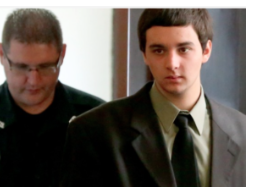
Sam Vanochen in court on Tuesday pool photo Hutch News
HUTCHINSON – The state is not giving up its efforts to have a Kansas teen convicted this week for two counts of murder moved to the county jail from juvenile detention.
The state filed a motion Friday in the case of 17-year-old Samuel Vonachen after the Judge Trish Rose denied their immediate request for the move after the verdict in the murder case was read, according to District Attorney Keith Schroeder.
On Wednesday a jury convicted the teen of two counts of first-degree murder for the killing of his mother and sister, who died after he set fire to the family home on Sept. 26 2013. His father was able to escape.
JEFFERSON COUNTY – A Kansas man died in an accident just after noon on Saturday in Jefferson County.
The Kansas Highway Patrol reported a 2001 Chevy Silverado driven by Reid Allen Bressler, 51, Ozawkie, was southbound on Ferguson Road just south of Kansas 92.
The driver failed to negotiate a left hand curve.
The pickup left the roadway to the right and the driver swerved left and overcorrected.
The pickup left the roadway hit some trees, overturned and the driver was ejected.
Bressler was pronounced dead at the scene.
He was not wearing a seat belt, according to the KHP.
TOPEKA, Kan. (AP) — A new funding plan from a group of Kansas school administrators is reviving longstanding regional tensions and spotlighting questions about whether the state spends enough on public education.
One part of the plan was similar to a complex formula to dole out nearly $4.1 billion yearly that legislators junked last year. Instead, legislators went for predictable “block grants” for districts that allow the state to better control its spending.
But other provisions represent a radical departure from past policy, such as stripping local districts of their power to tax. The state would instead raise property taxes statewide as a way to prevent poorer schools from falling too far behind wealthier ones.
KANSAS CITY, Mo. – A Kansas City man was indicted by a federal grand jury today for assaulting a mail carrier with a firearm, according to Tammy Dickinson, United States Attorney for the Western District of Missouri.
Timothy LaBlance, 52, of Kansas City, was charged in an indictment returned Thursday by a federal grand jury in Kansas City, Mo.
The indictment alleges that LaBlance used a firearm to assault a mail carrier with the U.S. Postal Service on Oct. 10, 2015, while the mail carrier was engaged in the performance of his duties.
Dickinson cautioned that the charge contained in this indictment is simply an accusation, and not evidence of guilt. Evidence supporting the charge must be presented to a federal trial jury, whose duty is to determine guilt or innocence.
This case is being prosecuted by Special Assistant U.S. Attorney Matt Moeder. It was investigated by the U.S. Postal Inspectors Service.
SALINA, Kan. (AP) — One of five men who were involved in the shooting death of a 17-year-old Salina girl was sentenced to more than four years in prison for his part in the crime.
Twenty-year-old Daniel Sims was sentenced Friday for involuntary manslaughter and conspiracy to commit aggravated battery in the May 2015 death of Allie Saum.
Prosecutors say the men were seeking revenge for a confrontation and shot at a truck Saum was riding in because they mistakenly believed the truck’s driver was involved in the confrontation.
Sims received a lighter sentence than others in the case because he cooperated with prosecutors, testified against co-defendants and didn’t have a major role in the shooting.








 KDWPT
KDWPT