PAWNEE, Okla. (AP) — The Latest on the large earthquake in Oklahoma (all times local):
12:25 p.m.
The Oklahoma Corporation Commission has directed dozens of wastewater disposal wells within an approximate 500-square-mile radius of the epicenter the Oklahoma earthquake to shut down.
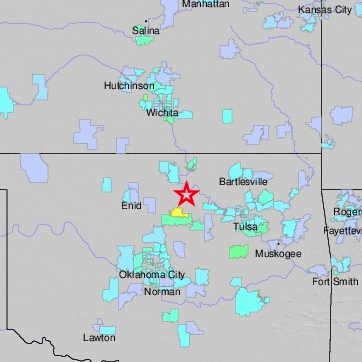
The commission says about 35 wells are included in the directive, which was issued following the 5.6 magnitude earthquake that struck Saturday morning about nine miles northwest of Pawnee in north-central Oklahoma.
The number of magnitude 3.0 or greater earthquakes has skyrocketed in Oklahoma, from a few dozen in 2012 to more than 900 last year.
Commission spokesman Matt Skinner says the wells were directed to shut down due to scientific links that the increase to the underground disposal of wastewater from oil and gas production induces earthquakes. The commission has previously asked producers to reduce wastewater disposal volumes.
The earthquake ties the record for the strongest earthquake in recorded Oklahoma history. No major damage was reported, and there was one minor injury.
___
11:45 a.m.
One minor injury has been reported as the result of a 5.6 magnitude earthquake in north-central Oklahoma.
Pawnee County Emergency Management Director Mark Randell says a man protecting his child suffered a head injury when part of a fireplace fell on him.
Randell says the man was treated at a hospital and released.
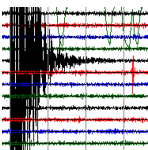
The U.S. Geological Survey reports the quake struck at 7:02 a.m. about nine miles northwest of Pawnee, a town of about 2,200 about 70 miles northwest of Oklahoma City.
The USGS also reports about a half-dozen aftershocks in the same area, including one that was a 3.6 magnitude at 7:58 a.m.
___
11 a.m.
Staffers at the Wolf Creek nuclear power plant in southeast Kansas found no damage to the plant after an earthquake rattled a large swath of the Midwest.
Spokeswoman Jenny Hageman says Saturday’s 5.6 magnitude earthquake centered in north-central Oklahoma did not shake the plant near Burlington, Kansas, enough to set off a seismic alarm but staff checked it as a precaution.
KVOE reports the plant was shut down Friday by a water leak. Hageman says the source of the leak in the reactor cooling system inside the plant’s containment area has been identified and that there was never of threat of a radiation leak.
It’s unclear when Wolf Creek will return to operation.
___
10 a.m.
A Pawnee business owner says the 5.6 magnitude earthquake shook his house “like a rubber band” and knocked items off cabinets and broke glass.
Furniture store owner Lee Wills told The Associated Press he was awake when the quake struck at 7:02 a.m. Saturday and first thought it was a thunderstorm.
But then his home, which is about 2½ miles outside of town, started shaking.
Wills said buildings in the downtown area are cracked and sandstone facing on some buildings fell and described the scene as “a mess.”
TOPEKA, Kan. (AP) — A Kansas psychiatric hospital that’s had a dramatic staff shortage in recent years spent more on overtime pay last year than any other state agency or facility.
The Wichita Eagle reports Larned State Hospital paid its roughly 600 employees $3.8 million in overtime during fiscal 2016, which ended in June. That amounts to nearly a quarter of the state’s total overtime costs for the year.
The next-closest agency was the Kansas Department of Transportation, which has about three times more staff members but spent about $2.1 million on overtime.
Tim Keck, interim director of the Kansas Department of Aging and Disability Services, says overtime hours at Larned have been steadily falling since he took the helm in January.
An earthquake shook much of Kansas, including the Hays area, awake just after 7 a.m. on Saturday. Preliminary reports indicate the quake measured 5.6 on the Richter scale, according to the USGS and was centered near Pawnee Oklahoma, approximately two hours south of Wichita.
5.6 magnitude quake rumbled thru Norton, KS this morning at 7:02 am, was centered 14 km NW of Pawnee, OK. Also felt as far S as Dallas, TX.
People in Kansas City, Missouri, Fayetteville, Arkansas, and Norman, Oklahoma, all reported feeling the earthquake at about 7:05 a.m. Saturday.
A building had collapsed near the epicenter in Oklahoma, according to Pawnee County Emergency Management. Other damage was also reported in portions of Oklahoma. No injuries were reported.
WILSON COUNTY – A Kansas man died and another was injured in an accident just after midnight on Saturday morning in Wilson County.
The Kansas Highway Patrol reported a 1996 Toyota passenger vehicle driven by Lane B. Colby, 21, Fredonia, was westbound on Kansas 47 two miles east of K400.
The vehicle veered left of center, entered the south ditch, became airborne, hit the embankment and ejected both occupants.
A passenger Danny Riddle, 25, Fredonia was pronounced dead at the scene and transported to Frontier Forensics.
Colby was transported to Fredonia Regional Hospital.
Colby and Riddle were not wearing seat belts, according to the KHP.
A Saline County mom has a message for state officials wrestling with a difficult budget: Leave an autism diagnosis program alone.
Click to ENLARGE
Allison, who wanted to be identified only by her first name to protect her family’s privacy, said a telemedicine program — funded in part by the Kansas Children’s Cabinet —made it easier to find out if autism was behind her 9-year-old son’s behavioral symptoms.
“It makes it nice when they can do that instead of my husband having to take off work” to take their son to a specialist in Kansas City, she said. “It was kind of shocking that they were thinking of cutting that.”
The autism diagnosis program is one of three under the Children’s Cabinet flagged for possible cuts next fiscal year.
Cuts aren’t guaranteed, because the Legislature crafts the final budget, but administration officials asked Children’s Cabinet staff to submit a starting budget for fiscal year 2018 with 5 percent cuts to the autism program, a child care quality initiative and the early childhood block grant.
The three programs would lose a combined $833,181 if the Legislature approves that budget. The Legislature already approved $3.3 million in cuts to Children’s Cabinet programs for the current fiscal year.
If another round of budget cuts goes forward, even fewer families will get services, said Lee Stickle, director of the Autism and Tertiary Behavior Supports project under the state’s Technical Assistance Support Network.
The budget cuts this fiscal year mean the project will serve about 20 fewer kids than the 140 it helped to get appointments with autism specialists last year, Stickle said. A projected 5 percent cut for next fiscal year to the project’s roughly $43,000 budget would reduce services even more, she said.
“We anticipate seeing between 15 and 20 percent fewer kids,” she said.
The Children’s Cabinet uses the Children’s Initiatives Fund to make grants to organizations working on youth health, education and development. The Children’s Initiatives Fund money comes from a 1998 settlement with large tobacco companies to compensate states for health costs associated with smoking.
Four other state agencies also oversee funding for children’s programs, but most haven’t released details on potential budget cuts. The Kansas State Department of Education has said that it doesn’t plan to make cuts to Parents as Teachers or the Kansas Preschool Program.
A diagnosis, closer to home
The diagnosis program pays to train local teams in underserved areas of the state to screen children for signs of autism spectrum disorder, Stickle said. If the screening shows the child might have autism, they pay for a specialist at the University of Kansas Medical Center to meet with the family via telemedicine to make a diagnosis, she said.
After a formal autism diagnosis, children are eligible for some support services through Medicaid, and most commercial insurers will pay for speech therapy and other interventions, Stickle said.
Without telemedicine, some families have to wait months to see an autism specialist in Kansas City or Wichita, she said, or they can’t make the trip at all.
“That is such a critical time in the life of a child,” she said. “Any delay (in starting therapies) compounds the issues they’re going to have.”
Photo by KHI News Service Janice Smith, executive director of the Kansas Children’s Cabinet, estimates the programs are serving about 2,000 fewer kids following cuts to this year’s budget and would serve about 125 fewer if the 5 percent cut for fiscal year 2018 moves forward.
Allison said the experts asked questions about her son’s behaviors and decided to have him take a different medication for his attention deficit hyperactivity disorder before making a diagnosis. They will see him again if the symptoms haven’t resolved and his teachers still suspect autism, she said.
“I hope they don’t find anything, but if they do, it’s good” to have the diagnosis, she said.
Reduce services or numbers?
The child care quality initiative also would lose almost $22,000 next fiscal year under the proposed cuts, bringing its budget to about $408,000. The additional cuts would leave its budget 18 percent lower than in fiscal year 2016, when it received $500,000.
Child Care Aware of Kansas administers the grant, which it uses to train child care providers and early childhood educators on how to identify stresses in families that could lead to child abuse or neglect, said Leadell Ediger, the Salina-based nonprofit’s executive director.
Providers receive training and support as they engage more with families and can apply for small grants to fund events with parents, Ediger said.
The idea is to encourage parents to take an active role in their child’s learning and reduce any feelings of isolation, Ediger said. Providers invite families to attend low-cost or free social events where they can play with their children and meet other parents, she said.
“It is showing that they’re not in this alone,” she said. “Together, we’re building a community that can learn to support each other.”
The initiative paid for about 60 providers to participate last year, Ediger said, but could only take 40 providers this year. She isn’t sure how many it could take with an additional 5 percent cut.
“We would just not be able to provide them the level of service we had in the past, or their sheer numbers would have to be reduced,” she said.
‘It goes on and on’
The largest cut, in raw numbers, would be to the early childhood block grant, which would fall by more than $800,000 to about $15 million. The block grant already lost about $2.3 million since fiscal year 2016.
That year, grants were made to Kansas schools and nonprofits to offer pre-kindergarten classes, developmental screenings and home visits to about 10,000 children in 63 counties, according to a report from the Children’s Cabinet.
Janice Smith, executive director of the Children’s Cabinet, estimated the programs were serving about 2,000 fewer kids following the cuts and would serve about 125 fewer if the 5 percent cut for FY 2018 moves forward.
The Children’s Cabinet typically makes the same percentage cut to every organization receiving money from the early childhood block grant, Smith said, but it may not do that because of the risk of losing funds for programs that receive matching federal grants.
The Children’s Cabinet submitted an alternative budget that would undo this year’s cuts, but even its supporters acknowledged it has little chance of getting through, given the state’s persistent revenue shortfalls.
The Legislature likely won’t resume work on the budget until January, unless Gov. Sam Brownback were to convene a special session. Still, Smith said she hopes the early discussion will help organizations to prepare for the possibility of more cuts.
“I wanted to make sure people are aware of it,” she said. “One of the advantages of having advance notice is you can make plans to cope.”
Stickle said programs eventually reach the point where they can’t avoid cutting services and reducing the number of families they serve, however. That can be particularly difficult for families with a child who has autism, because they often use multiple types of services, she said.
Losing diagnosis services “is one of the first ways the cuts hurt some of these families,” she said. “But it goes on and on for them.”
Megan Hart is a reporter for KHI News Service in Topeka, a partner in the Heartland Health Monitor team. You can reach her on Twitter @meganhartMC
Crews search for Brian Bergkamp on July 9 photo courtesy KWCH
WICHITA, Kan. (AP) — As more people canoe and kayak on Kansas waterways, concerns about low-head dams are growing.
The Wichita Eagle reports that Kansas has an estimated 100 such dams, but no state regulations for warning signs. So far this year, 22 deaths have been reported at low-head dams nationwide.
The victims include Brian Bergkamp, a seminarian from Garden Plain. He died this summer after trying to help a fellow kayaker who went over one such dam in the Arkansas River in Wichita.
The hydrology behind low-head dams is why experts call them “drowning machines.” As water flows over the top of the dam, it creates a circular current on the down-river side. That causes people and debris to be pulled down, up and back toward the dam in an unrelenting cycle.
WASHINGTON (AP) — The federal government is banning more than a dozen chemicals long-used in antibacterial soaps and washes, saying manufacturers have failed to show that they are safe and prevent the spread of germs.
The Food and Drug Administration’s Dr. Janet Woodcock says there’s no scientific evidence the products are any better than plain soap and water.
Friday’s decision primarily targets two once-popular ingredients — triclosan and triclocarban — that some research suggests can interfere with hormone levels and spur drug-resistant bacteria. A cleaning industry spokesman said most companies have already reformulated their products.
In late 2013, the FDA told manufacturers they must show their products are safe and effective. Regulators said Friday the data submitted did not meet federal standards to establish safety and effectiveness for the chemicals.
GEARY COUNTY – Law enforcement authorities in Geary County are investigating a suspect for child sex crimes and criminal threat.
On August 22, 2016, Timothy Walter Streit, 37, was located and apprehended by the Kansas Fugitive Apprehension Team at a residence in Carbondale, according to a media release.
Authorities were acting on a warrant for the arrest of Streit issued by Geary County District Court, alleging five counts of Criminal Threat.
Streit is currently being held on a $1.5 million dollar bond in the Geary County Detention Center.
This case is linked to a previous investigation of Aggravated Indecent liberties with a child where Streit is the suspect, according to the sheriff’s department.
The Kansas Apprehension Task Force is a multijurisdictional fugitive task force comprised of the United States Marshals Service, Topeka Police Department, Shawnee County Sheriff’s Office and the Kansas Department of Corrections.
LAWRENCE, Kan. (AP) â The 7-year-old son of a University of Kansas athletic department employee has received an outpouring of support from football players after being diagnosed with cancer.
The Topeka Capital-Journal reports that Shanda Hayden is an academic and career counselor in the athletic department. She said her son, Cole, was diagnosed in August with a pediatric cancer that begins in the body’s connective tissues.
Almost all of the University of Kansas football players and coaches wore wristbands emblazoned with #TeamCole during the team’s August training camp. Co-defensive coordinator Kenny Perry, along with the team’s defensive backs, have pledged a $100 donation to the Team Cole Fund for every interception this season.
Cole continues to receive treatment for his diagnosis.
FORT SCOTT – A Kansas man was sentenced Friday to life in prison without the possibility of parole for at least 25 years for the death of an infant, according to Kansas Attorney General Derek Schmidt.
Anthony Michael Anderson, 22, was found guilty in May by a Bourbon County jury of one count of first-degree murder and one count of abuse of a child. District Court Judge Mark A. Ward today sentenced Anderson to life in the Kansas Department of Corrections without eligibility for parole for 25 years. The convictions stemmed from a crime that occurred in April 2015.
The case was investigated by the Fort Scott Police Department. Assistant Attorney General Adam Zentner of Schmidt’s office prosecuted the case.
BARTON COUNTY – A K&O Railroad locomotive came off the tracks in Ellinwood on Friday in Barton County.
Just after noon, law enforcement authorities briefly closed Main Street and South Fritz to traffic while railroad personnel worked to remove the engine from the street, according to a report from Ellinwood Police.
K& O Railroad officials in Wichita said they had staff on the way to the scene but did not know what caused the locomotive to leave the tracks and would not comment on what the train was carrying at the time of the accident.
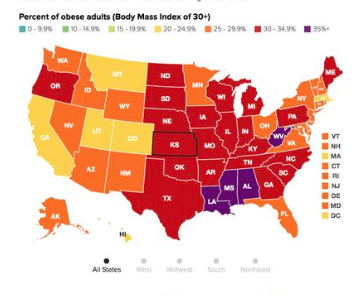
Kansas is one of two states in the country that had an increased rate of obesity in 2015. TRUST FOR AMERICA’S HEALTH / ROBERT WOOD JOHNSON FOUNDATION
By BRYAN THOMPSON
One of every three adult Kansans was obese in 2015, ranking the state seventh in the country in an annual report. Kansas also was one of only two states where obesity rates increased from the previous year.
The State of Obesity: Better Policies for a Healthier America by the nonprofit Trust For America’s Health and the Robert Wood Johnson Foundation reports that Kansas had an adult obesity rate of 34.2 percent in 2015, up from 31.3 percent in 2014, when Kansas ranked 13th. In 1995, just 13.5% of Kansans were obese.
Missouri wasn’t far behind, ranking 10th with an obesity rate of 32.4 percent in 2015, up from 16.9 percent in 1995.
Only Kansas and Kentucky had statistically significant obesity increases among states for 2015. Most remained steady, though rates dropped in four states: Minnesota, Montana, New York and Ohio.
Men and women in Kansas had similar obesity rates, although they varied among racial groups at 42.7 percent for black Kansans, 35.4 percent for Latinos and 31 percent for whites.
Albert Lang, spokesman for Trust for America’s Health, said the growing obesity problem in Kansas is likely to be followed by larger numbers of Kansans with diseases linked to obesity — and larger health care costs.
“With more and more people becoming obese, as we saw in Kansas this year, more and more people are going to end up getting diabetes, hypertension and the other diseases,” he said.
Those other diseases include cancer, heart disease and arthritis. The report projects the number of Kansans with diabetes will increase by half from 2010 levels by 2030. The number of Kansans with hypertension is projected to rise 28 percent over that same time period. Meanwhile, incidence of cancer is projected to more than double, while heart disease cases more than triple.
More than half the country has obesity rates at or above 30 percent, including all of the states that border Kansas except for Colorado at 20.2 percent. Twenty-two of the 25 states with the highest rates of obesity are in the South and Midwest.
“Nebraska, Missouri, Oklahoma, Arkansas — they all have significantly high rates. They’re all above 30 percent,” Lang said. “The troubling thing for Kansas is that those other states did not show increases this year, while Kansas did.”
Not all the news is bad. The number of states where obesity is increasing has dropped over the past decade. Lang said the country also seems to be making progress in the battle against childhood obesity.
“We’re beginning to see across-the-board stabilization or decreases in childhood obesity rates,” he said. “That only is good news for the future adult obesity rate, because we know if we can keep kids at a healthy weight through adolescence and into their teen years, they’re much less likely to be obese when they’re adults.”
Some other findings from the report, now in its 13th year, include:
The number of high school students who drink one or more soda a day has dropped by nearly 40 percent since 2007, to around one in five (20.4 percent).
The number of high school students who report playing video or computer games three or more hours a day has increased more than 88 percent since 2003, from 22.1 percent to 41.7 percent.
More than 29 million children live in “food deserts,” where access to fresh produce and other healthy foods is limited, and more than 15 million children live in “food insecure” households with not enough to eat and limited access to healthy food.
Farm-to-School programs now serve more than 42 percent of schools and 23.6 million children.
Eighteen states and Washington, D.C., require a minimum amount of time that elementary students must participate in physical education; 14 states and Washington, D.C., require a minimum amount for middle schoolers; and six states require a minimum amount for high schoolers.
The report also includes policy recommendations that include investments in obesity prevention and policies and programs at the early childhood, school and community levels.
Richard Hamburg, interim president and CEO of the Trust For America’s Health, called on policymakers nationwide to take steps to build on this progress.
“Across the country, we need to fully adopt the high-impact strategies recommended by numerous experts. Improving nutrition and increasing activity in early childhood, making healthy choices easier in people’s daily lives and targeting the startling inequities are all key approaches we need to ramp up,” he said.
Bryan Thompson is a reporter for KHI News Service in Topeka, a partner in the Heartland Health Monitor team.