KANSAS CITY, Mo. (AP) — Nearly 1,000 people are gathering in Kansas City to celebrate the 10th anniversary of an Animal Health Corridor that stretches from Manhattan, Kansas, to Columbia, Missouri.
The Kansas City Star reports the corridor has become a business site for more than 300 companies devoted to animal health. The companies’ projects include such things as earlier identification of sick cattle and developing drugs and diagnostics for animals.
A 10th anniversary dinner is scheduled for Monday night, with an investor showcase on Tuesday.
A consultant found last year that companies with a business location in the corridor represent 75 percent of the worldwide sales of animal health products and diagnostics. That’s about $19 billion of total global sales of $25.2 billion.
Gene Policinski is senior vice president of the First Amendment Center
Murder. Real. Live.
The shooting of two television journalists. Viewable from two perspectives, including that of the gunman himself.
We saw — or could see if we wished, and apparently millions of us did — the awfulness of it, immediately. And over and over and over again, on TV and online.
The news was that WDBJ7 reporter Alison Parker and photographer Adam Ward were dead, and interviewee Vicki Gardner wounded, during one of those all-too-familiar morning news “live shots.” Shot multiple times by a man identified by police as a former colleague of Parker and Ward, Vester Lee Flanagan II, who later fatally wounded himself as police closed in on his car.
And then there were the videos. First, from Ward’s own camera, airing ”live” in all its stupefying, banal-to-shocking 40 seconds or so as the interview turned into horror. Later, in truncated bits and pieces, as networks and online news operations made individual decisions.
CNN didn’t show it, and then showed it with ample warning to viewers, and later not at all. Other news operations stopped the videos just before the shooting started, or showed still images taken from WDBJ7’s video.
Not so online, where for hours — and very likely, still, as you read this — the entire ghastly episode played on.
And then, two videos posted on social media, apparently by the gunman himself, showing the murders as he must have viewed them. They were taken down quickly by Twitter and Facebook — as soon as eight minutes after posting on Twitter, one news account said. But a copy posted on Facebook was reported to have 3,000 views “a few hours after the shooting.”
Once again, the questions arise: When does responsible journalism mutate into sensationalism and voyeurism? When does a free press need to show — and society need to see — reality in all its awfulness? And when is it just “what we do because we can?” For online sites, when does “a right to do” lose its connection with “the right thing to do?”
Wednesday certainly was not the first time shocking images of violent death, often obtained for the first time through new technology of the era, have dominated the news media — and both stunned and fascinated the nation.
While Wednesday’s drama played out on social media and on the Web, it was a newspaper that provoked criticism the next day. The New York Daily News cover showing Parker being shot from the killer’s perspective drew a description of “death porn” from one media critic.
But Justin Fenton, a crime reporter at The Baltimore Sun, told The Washington Post that “the Daily News cover offered insight into a crime that prose can’t.” On his Twitter account, he wrote, “NY Daily News cover is frightening but not gory. … Reaction at least on my timeline is uniform outrage. … Personally … covering gun violence daily, I don’t think the words convey the horror the way these images do.”
Early Thursday, a new tweet topped his posts: “Reports of 6 shot overnight, from 9 pm-12:30am, including a double (non fatal) in Cherry Hill.”
A 1928 Daily News photo cover is a landmark item in the debate over what should or should not be shown. Surreptitiously taken by a photographer who had hidden an ankle-camera under his pants leg, the photo is said to show convicted murderer Ruth Snyder straining against her bonds in the Sing Sing Prison electric chair as the current took her life. The result: nationwide bans on photographers at executions that continue today.
Magazine photos of racially motivated lynchings brought that terrible practice into subscribers’ homes. And the then-new media of the 1950s and 1960s, by airing film of snarling dogs, burning buses and fire hose streams blasting children, turned the conscience of a nation. Even as the nation in 1963 mourned a president, midday TV showed us “live” the killing of his assassin — 50 years later still an indelible moment for those who watched it.
In this newly interconnected global media hothouse, live images of violent death seem ever more frequent; it was just one year ago that ISIS terrorists used social media to show video of the beheadings of journalists James Foley and Steve Sotloff. Not long after, it was a hostage being burned alive. On April 4, in North Charleston, S.C., a citizen video recorded the shooting by a police officer of a man fleeing in a park after being stopped for a traffic violation.
Wednesday’s on-camera tragedy should bring a new level of concern and discussion over what we can see, and whether we should see it — and how new technology may not only record and distribute, but invite.
A few decades ago, TV journalists once debated whether to show recorded images of violence and death, and then whether to build in several-second delays on “live” reports to allow for such screening.
In 1987, when a Pennsylvania state official shot and killed himself at a news conference, editors and news directors were in charge of deciding what we would see. And to a large degree, we didn’t.
In contrast, within 60 minutes of the first reports of Wednesday’s killings, a network commentator apologized online for not being able to describe in more detail the Roanoke, Va., station’s own video. As he explained, he was watching a blurry cellphone video of a TV image showing a replay. But he, and we, could hear the shots being fired and the victims’ screams.
Online, the immediacy was entangled with the bizarre circumstance that the gunman’s own cellphone video of the killing was posted. Reports are that, using his on-air ID, “Bryce Williams,” Flanagan invited an online audience by tweeting, “I filmed the shooting See Facebook.”
USA Today reported that “at 11:14 a.m., Flanagan tweeted two short videos and posted a 56-second video to Facebook” that showed him approaching Parker, Ward, and the person being interviewed. The gun, in his right hand, comes into view — unnoticed by the trio until the gunman fires. The Twitter text posts are updated six times in 20 minutes, according to The New York Times.
In “frame grabs” that appear to be from one of those videos, published online by the British newspaper the Daily Mail, Parker is shown reacting in shock as the gunman fires.
To be sure, as history demonstrates, there are times we need to see — and remember for generations — what real terror and horrific events are like. Holocaust deniers can never overcome the truth carried by stark images now preserved for the ages.
After the violence earlier this year in Baltimore that followed the death of an unarmed African American man in police custody, a veteran journalism educator was critical of news coverage “live” from the city streets that he felt misrepresented the scope of what some called “riots.” “Live,” he said, “was no longer journalism, but just marketing” — a ploy to attract viewers, but which added nothing to understanding the news.
There’s some theorizing already that each of these deadly real-reality shows prompt copycats who are encouraged by the resulting media exposure, and then are driven to find new and even more dramatic methods to capture the world’s attention. And then there are those in the media who would rather shock than inform, valuing “click-bait” over information.
Once again, the challenge for journalists reporting on our behalf — and now for those re-tweeting and repeating the killer’s cold-blooded social media posts — is to find the balance that lets us both see to understand and to understand what we need to see. And what we do not.
Gene Policinski is chief operating officer of the Washington-based Newseum Institute and senior vice president of the Institute’s First Amendment Center. [email protected]
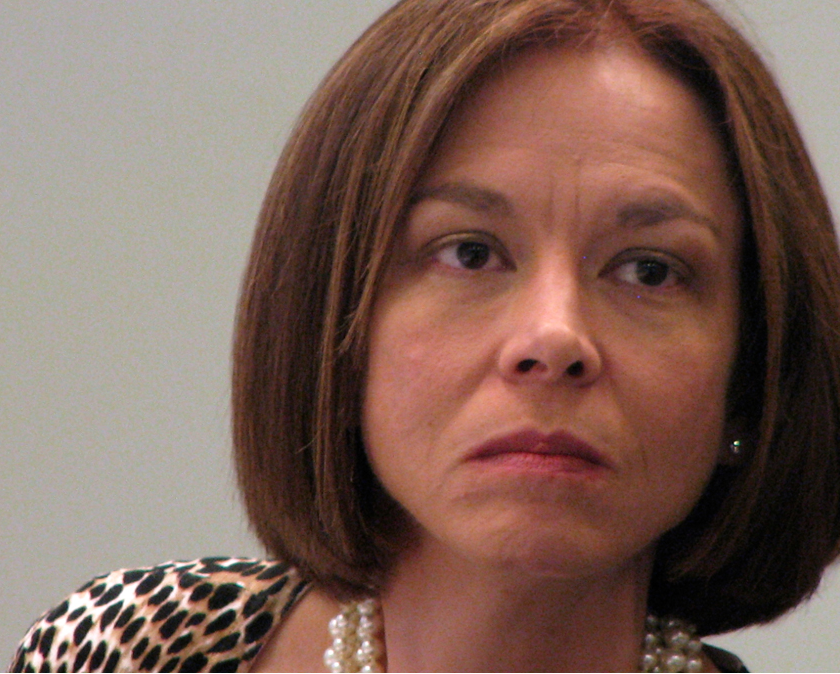
Photo by Dave Ranney Shannon Cotsoradis, president and CEO of Kansas Action for Children, says her agency is hosting a meeting on federal child care grant changes at the request of stakeholders.
People involved in Kansas child care are meeting on Monday to discuss a plan for moving the state in line with new federal regulations — without the state agency that will have to implement the plan.
Shannon Cotsoradis, president and CEO of a Topeka-based nonprofit called Kansas Action for Children, said her organization is hosting the event at the request of child care workers, associations and continuing education specialists.
Cotsoradis said those groups are eager to get started on discussions about the reauthorization of the federal Child Care and Development Block Grants (CCDBG), because a final state compliance plan is due in March.
It’s the first change to the federal program since 1996 and Cotsoradis said it’s a rare and exciting opportunity to decide how to best allocate millions in state and federal funds for day care, after school programs, Early Head Start and other child development and workforce initiatives.
“I don’t think this is coming around again any time soon,” Cotsoradis said Thursday. Monday’s meeting is scheduled for 11 a.m. to 3 p.m. at the Topeka and Shawnee County Public Library. Two national child care experts are slated to attend.
Cotsoradis said officials from the Kansas Department for Children and Families were invited to attend and offered a chance to help shape the agenda. She said she was disappointed they declined and that they have yet to shed any light on what plans the agency may be forming internally.
“We’ve made repeated attempts, as have other stakeholders, to reach out to the agency and get some sense of where they’re headed,” Cotsoradis said.
“Their last response to me was simply that they would be engaging stakeholders when they felt it was appropriate.”
Sandra Kimmons, DCF’s director of economic and employment services, confirmed the agency would not be sending a representative to Monday’s meeting.
“We have a very similar one in a couple weeks, so it seemed a little duplicative,” Kimmons said. Kimmons said DCF officials will be discussing the block grant reauthorization Sept. 8 with members of the Kansas Department of Health and Environment’s Child Care Licensing Systems Improvement Team, an advisory group made up of industry experts. She said she believes the meeting is open to the public.
A representative of Kansas Action for Children said the meeting has not been previously announced. The child care block grants fund almost $79 million in Kansas programs annually — $16 million from state funds, $42.2 million in direct federal funds and $20.4 million in funds transferred from the state’s Temporary Assistance for Needy Families allotment, which also comes from the federal government.
The federal government originally proposed to have states submit new plans for the block grants by June 2015 but pushed that back to March 2016 because federal administrative guidelines were late in coming. In fact, the final guidelines are not yet published, though Cotsoradis said she expects them “any day.”
Her group and the other stakeholders are working off preliminary guidelines released in April. Cotsoradis said that, in fairness to DCF, federal officials have been slow in providing guidance, especially considering the March 2016 deadline and the public comments the states will be required to take in the interim.
“I don’t underestimate the challenge for the agency,” Cotsoradis said. But that’s all the more reason to get started immediately in talking with stakeholders about potential plans, she added.
Cotsoradis said there’s also a possibility that some of the new federal guidelines surrounding child care subsidies for low-income families will conflict with a state law Kansas Republicans passed in June that enacted a raft of new welfare restrictions.
“I feel pretty comfortable in saying that there will have to be some changes (to the state law) as a result of reauthorization,” Cotsoradis said, if the state wants to keep the $42 million in federal money.
Earlier this summer federal scrutiny caused DCF to scrap a $25 ATM withdrawal limit for TANF recipients that lawmakers had originally mandated in the bill, then changed to give the agency discretion. DCF spokeswoman Theresa Freed said the agency is not aware of any conflict between the new state law and the pending federal regulations that would jeopardize the state’s block grant.
“The Kansas Department for Children and Families has received no guidance from its federal partners that the Kansas HOPE Act would need revision related to the Child Care Development Block Grant,” Freed said.
Andy Marso is a reporter for Heartland Health Monitor, a news collaboration focusing on health issues and their impact in Missouri and Kansas.
TOPEKA, Kan. (AP) — Kansans who owe back taxes to the state should consider paying them in the next few weeks.
The state is waiving interest and penalties on back taxes, starting Tuesday through Oct. 15.
The amnesty program is available to Kansans who owe individual and business tax debt that accrued before Dec. 31, 2013. The taxes must be repaid in full.
Officials with the Kansas Department of Revenue estimated the tax amnesty program could bring in up to $30 million.
Applications forms and eligibility information are on the department website. The taxpayer assistance phone number is 785-296-6121.
WICHITA, Kan. (AP) — A 35-year-old man has been arrested after authorities say he tried to assault police officers with a screwdriver at a Wichita hospital.
According to Sgt. Brian Sigman, officers responded to a call about trespassing at Via Christi St. Joseph just before 3 a.m. Saturday. Sigman said when officers made contact with the man near the emergency room, he pulled out a screwdriver from his pocket and wielded it “in an aggressive manner.”
Sigman said officers used a Taser to subdue the suspect and arrested him. No injuries were reported.
The suspect faces charges of aggravated assault on a law enforcement officer and resisting and obstructing an arrest.
RICE COUNTY- A Kansas teen was injured in an accident just before 5 p.m. on Sunday in Rice County.
The Kansas Highway Patrol reported a 1997 Mercury Mountaineer driven by Austin Hoffman, 16, Lyons,
was traveling on 15th Road and Avenue P two miles south of Lyons.
Hoffman exited the vehicle. Ashlyn Troyer, 16, Lyons got into the driver’s seat, drove the vehicle forward and struck Hoffman.
He was transported to Wesley Medical Center. Troyer and three other teens in the vehicle were not injured.
Troyer was not wearing a seat belt at the time of the accident, according to the KHP.
KANSAS CITY, Kan. (AP) — Police are investigating after skeletal remains were found near the Kansas River in Kansas City.
According to police, a fisherman discovered the skeletal remains of a foot inside a shoe Saturday evening. A coroner confirmed the remains were human, which prompted authorities to search the area.
Kansas City, Kansas, police officers and a Missouri Search and Rescue team searched Sunday and say more remains were found.
Authorities say the remains will be sent to a pathologist for analysis.
WICHITA, Kan. (AP) — A Wyatt Earp re-enactor is missing guns and ammunition after a thief broke into his car.
The theft happened Saturday night after the re-enactor spent the day portraying the frontier lawman at a Wichita history museum. The Wichita Eagle reports that while he was inside a restaurant, the back window of his car was smashed.
Sgt. Bob Gulliver, a police spokesman, says the re-enactor reported that someone made off with four handguns, their holsters and several thousand rounds of both blank and live ammunition. The victim’s appearance earlier in the day at the Old Cowtown Museum was part of an event called the “Age of the Gunfighter.”
OZAWKIE, Kan. (AP) — Authorities say a 30-year-old man has drowned at Perry Lake in northeast Kansas.
The Jefferson County Sheriff’s Office has identified the man as Jeremy Welch, of Bonner Springs. The Topeka Capital-Journal ) reports that he jumped into the lake Saturday night and didn’t resurface.
Sheriff Jeff Herrig says the drowning happened at Party Cove, which is a popular spot for boaters to gather on the lake. Four divers searched for 30 to 40 minutes before locating Welch’s body.
Don’t expect widespread sales or cheap flights home for Thanksgiving. But a number of cities are seeing ridiculously low prices at off-peak hours — prices the industry has spent the years trying to eliminate.
Fliers have been able to fly Chicago to Boston for $80 roundtrip, San Francisco to Las Vegas for $67 roundtrip and New York to Los Angeles, with a connection, for $150 roundtrip.
The price of oil is at the lowest level in six and a half years and the industry is saving billions of dollars on fuel, giving airlines leeway to cut fares but still post healthy profits. Airlines have also added larger, more efficient planes to their fleets while packing more seats into existing jets.
SALINA, Kan. (AP) — A $1.2 million federal project to upgrade a concrete installation in the Smoky Hill River will help ensure that a section of the river will flow into Salina’s water supply.
The U.S. Army Corps of Engineers project is paid by federal tax dollars. The Salina Journal reports the installation is essentially a concrete wall in the river that facilitates diverting water from the channel and takes it to the water treatment plant.
About half Salina’s water is supplied by the river. The remainder comes from wells.
High water in the Smoky Hill River in 2013 caused a portion of the project structure to break away, reducing the amount of water diverted to the city.
Officials say the new structure will have a 50-year design life.
TOPEKA–Kansas has received a State Trade and Export Promotion (STEP) Grant of $296,533 from the U.S. Small Business Administration (SBA). The Kansas Departments of Agriculture and Commerce will partner to leverage the grant funding to promote exports.
“Kansas has a proud and rich tradition in agriculture and understands that the international market is the key to growth of the industry. This grant will allow us to explore emerging markets for Kansas agricultural products,” stated Kansas Department of Agriculture Secretary Jackie McClaskey. “Kansas had more than $4.9 billion in agriculture exports in 2014.”
“Trade is critical to the health of the Kansas economy,” Kansas Commerce Interim Secretary Michael Copeland said. “The STEP Grant will allow us to continue to support the efforts of the great businesses in our state to grow and expand in markets across the world.”
The STEP Grant will be used to help businesses begin exporting for the first time or to grow their existing exports. The Kansas STEP team will focus on several areas to accomplish this goal. It will facilitate export training for small and medium-sized enterprises through seminars and courses. The team will also provide exhibition opportunities at international trade shows and support for participation in international trade missions. In addition, the grant will provide market entry support through the U.S. Commercial Service’s expertise and programs.
The STEP program is a pilot export initiative to make matching-fund awards to states to assist small businesses in entering and succeeding in the international marketplace. The program’s objectives are to increase the number of U.S. small businesses that export and to increase the value of exports by small businesses. STEP activities are managed and provided at the local level by state government organizations. The program is managed at the national level by the SBA’s Office of International Trade.
Detailed information about how Kansas businesses may apply for funding through the STEP grant will be available soon.